*Corresponding author: Moon-Ik Chang Phone: +82-43-719-4204; Fax: +82-43-719-4200;
E-mail: [email protected]
Korean J Environ Agric. 2015;34(2):111-119. English Online ISSN: 2233-4173
Published online 2015 June 22. http://dx.doi.org/10.5338/KJEA.2015.34.2.14 Print ISSN: 1225-3537
Establishment of Analytical Method for Residues of Ethychlozate, a Plant Growth Regulator, in Brown Rice, Mandarin, Pepper, Potato, and Soybean Using HPLC/FLD
Jae-Young Kim
1, Jin Hwan Lee
1, Sang-Mok Lee
2, Young-Sik Chae
2, Gyu-Seek Rhee
2and Moon-Ik Chang
2*1Research Development and Education Division, National Institute of Chemical Safety, Ministry of Environment, Daejeon 305-343, Korea, 2Pesticide and Veterinary Drug Residues Division, Department of Food Safety Evaluation, National Institute of Food and Drug Safety Evaluation, Ministry of Food and Drug Safety, Cheongju, 363-700, Korea
Received: 8 April 2015 / Revised: 20 April 2015/ Accepted: 12 June 2015 Copyright ⓒ 2015 The Korean Society of Environmental Agriculture
This is an Open-Access article distributed under the terms of the Creative Commons Attribution Non-Commercial License (http://creativecommons.org/licenses/by-nc/3.0) which permits unrestricted non-commercial use, distribution, and reproduction in any medium, provided the original work is properly cited.
111
Abstract
BACKGROUND: Ethychlozate (ECZ) is a plant growth regulator of synthetic auxin for agricultural commodities (ACs). Accurate and sensitive method to determine ECZ in diverse ACs on global official purpose is required to legal residue regulation. As the current official method is confined to the limited type of crops with poor validation, this study was conducted to improve and extend the ECZ method using high-performance liquid chromatography (HPLC) in all the registered crops with method verification.
METHODS AND RESULTS: ECZ and its acidic metabolite (ECZA) were both extracted from acidified samples with acetone and briefly purified by dichloromethane partition.
ECZ was hydrolyzed to form ECZA and the combined ECZA was finally purified by ion-associated partition including hexane-washing. The instrumental quantitation was performed using HPLC/ FLD under ion-suppression of ECZA with no interference by sample co-extractives. The average recoveries of intra- and inter-day experiment
ranged from 82.0 to 105.2% and 81.7 to 102.8%, respectively. The repeatability and reproducibility for intra- and inter-day measurements expressed as a relative standard deviation was less than 8.7% and 7.4%, respectively.
CONCLUSION: Established analytical method for ECZ residue in ACs was applicable to the nation-wide pesticide residues monitoring program with the acceptable level of sensitivity, repeatability and reproducibility.
Key words: Agricultural commodities (ACs), Analytical method, Ethychlozate (ECZ), HPLC/FLD, Plant growth regulator
Introduction
The pesticides, including plant growth regulators, herbicides, insecticides, and fungicides have contributed much to the quality improvement and the increased production of foods/crops (Park et al ., 2011; Min et al ., 2012). However, the abuse of pesticides can cause adverse effects not only on the environmental pollution but also on the human health (Sharma et al ., 2010). For
Research Article Open Access
this reason, the establishment regarding maximum residue limits (MRLs) of agricultural commodities (ACs) was required, which is strictly regulated in the several countries (Omeroglu et al ., 2012). Furthermore, in order to ensure the safety assurance of circulated ACs, a continuous nation-wide pesticide residue monitoring program have been conducted (Lee et al ., 2013). For examples, “Pesticide program residue monitoring” in USA (U.S. FDA Report, 2013),
“Monitoring of pesticide residues in products of plant origin in the European Union (EU)” in EU (EC Report, 2008), and “Monitoring of pesticide residues in ACs” in Korea (MFDS Report, 2012) are performed. Particularly, in Korea, the pesticide residues monitoring program was got started in 1968, and MRLs regulations about 17 pesticides were first establishment in 1988 (Kim et al ., 2007). At present (in 2013), MRLs is established on the ACs of 432, ginseng of 68, and the livestock products of 83 (Korea Food Code, 2013). In addition, the results of a nation-wide pesticide residue monitoring were reflected in the policy of food safety/hygiene (Do et al ., 2013).
Plant growth regulators were originated from the development of indole acetic acid (IAA) which is a synthetic auxin for ACs (Spaepen et al ., 2007). In addition, 2,4-dichlorophenoxyacetic acid (2,4-D) was introduced as chemical weapons in the second world war, then used as a herbicide and plant growth regulator (Peterson, 1967). The species of the plant growth regulator exist in auxin, gibberellin, cytokinin, and ethylene, among other (Wang et al ., 2011;
Giannakoula et al ., 2012). It was mostly used for stem elongation, germination, flowering, the control of fruit size and quality, sex expression, enzyme induction, and leaf and fruit senescence of plant (Atta et al ., 2012).
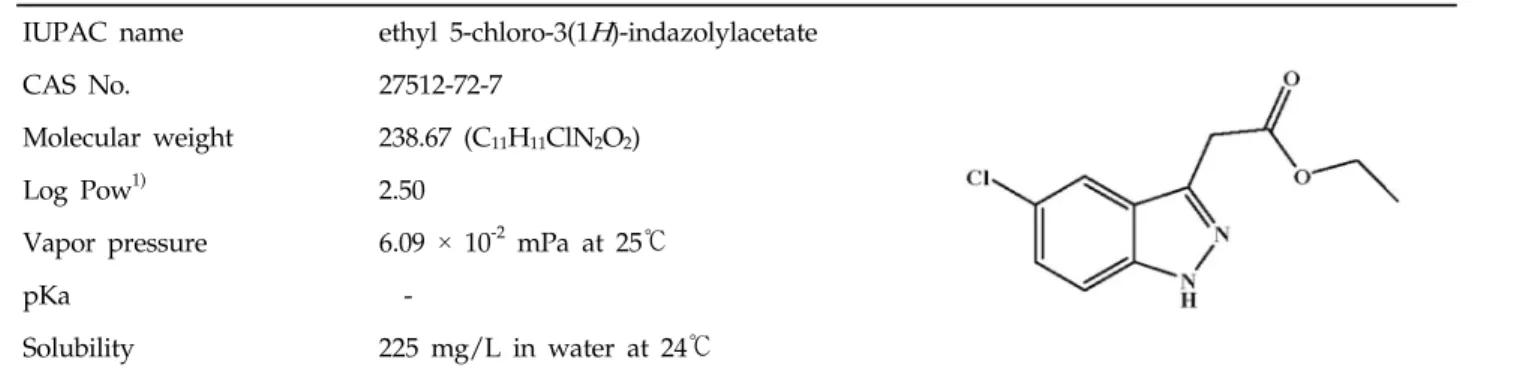
Among these, Ethychlozate (ECZ), ethyl 5-chloro- 3(1 H )-indazolylacetate, is a synthetic auxin, which is used for thin out the fruits (Nissan Chemical Industry Ltd. and Fujisawa Pharmaceutical Ltd., 1986). It was developed by Nissan Chemical Industry Ltd. and Fujisawa Pharmaceutical Ltd. who sell ECZ under the trade name Figaron in Japan (Nissan Chemical Industry Ltd. and Fujisawa Pharmaceutical Ltd., 1986). ECZ is manufactured as the neutral compound of ethyl ester form. However, it was rapidly hydrolyzed as the acidic form, when sprayed in environment or crops. Consequently, the target analytes of ECZ residues should be included with
parent compound and its acidic metabolite. As to the analytical method related to present research, Lee (2013) reported that the analysis of ECZ residues are possible as two methods depending on approach type such as 1) the individual analysis via separation of parent compound and its acidic metabolite and 2) the calculated method by totally acidic amount reference after transformation of target compound (ester form→
acidic form).
Meanwhile, the Ministry of Food and Drug Safety (MFDS, Korea) has established a tolerance for ECZ residue in 1.0 mg/kg for mandarin and 0.05 mg/kg for other foods (Korea Food Code, 2013). In Japan, MRL of 0.05 mg/kg for ECZ residue are set to 9 food items (MHWL Notification, 2007). In addition, FAO/
IAEA has been classified as a normal toxic (FAO/
IAEA Record, 2008).
Accurate and sensitive analytical methodology able to determine ECZ in many samples at low level and world-wide officially recognized method is required (Taylor et al ., 2002). However, the official analytical method for ECZ residue of food/ACs was established only in the partial foods/crops. Particularly, in Korea, because ECZ is applied only to some ACs including a mandarin, the problem was sent to the nation-wide pesticide residue monitoring program requesting the analysis of the other foods. Therefore, the present study was conducted to improve a sensitive method for ECZ residue analysis in all ACs using the HPLC system.
Materials and Methods
Samples
ACs (ECZ residue-free brown rice, mandarin, pepper, potato, and soybean) were purchased from the local markets in Korea. They were selected as the representative ACs considering their matrix characteristics in an analytical procedure. The samples were homogenized by using a blender, and then kept in a polyethylene container in a freezer at temperature below -50℃.
Chemicals and reagents
A pure standard ECZ (certified analytical standard, 98.0%) was purchased from Dr. Ehrenstorfer (Germany).
The physicochemical properties of ECZ are shown in
Table 1. Analytical-grade hydrochloric acid, potassium
hydroxide, potassium phosphate dibasic (K
2HPO
4),
Table 1. Physicochemical properties and structure of ethychlozate IUPAC name ethyl 5-chloro-3(1
H
)-indazolylacetateCAS No. 27512-72-7
Molecular weight 238.67 (C11H11ClN2O2)
Log Pow1) 2.50
Vapor pressure 6.09 × 10⁻² mPa at 25℃
pKa -
Solubility 225 mg/L in water at 24℃
1)
n
-Octanol/water partition coefficientpotassium phosphate monobasic (KH
2PO
4), sodium chloride, and sodium sulfate anhydrous were acquired from Wako chemical (Japan). Acetone, acetonitrile, dichloromethane, n-hexane, and methanol of HPLC grade were supplied by Merck KGaA (Germany).
Formic acid of LC-MS grade was obtained from Sigma-Aldrich (USA). All other chemicals and reagents used throughout the study were of analytical grade, unless stated otherwise.
Standard solution preparation
For stock standard solution, ECZ was prepared in acetonitrile at concentration of a 100 μg/mL. The working solutions were prepared via Hydrolysis and ion-associated partition procedures of the sample preparation. First, 5 mL of stock solution was evaporated to near dryness by nitrogen-evaporator (N-EVAP
TM111, Oranomation Associates, USA) under a nitrogen steam below 40℃. Subsequently, the residues were conducted by Hydrolysis and ion-associated partition procedures of the sample preparation [ECZ →5-chloro- 3(1 H )-indazolylacetic acid (ECZA)]. Finally, the levels of the working standard solutions were prepared via the serial dilution using a mobile phase A, reaching the following concentration: 0.05, 0.1, 0.2, 0.5, and 1 mg/L. All standard solutions were maintained in an amber bottle and stored at -20℃ pending analysis.
Sample preparation
Extraction and partition : Precisely 25 grams (± 0.1 g) of the homogenized sample were placed into a 500 mL capped beaker, to which 1 mL of 6 N HCl solution was added to acidify the sample and 80 mL of acetone was added, and the mixture was shaken for 2 min at 300 rpm for extraction (Brown rice and soybean samples were wetted with a 25 mL of the
distilled water (DW) for 1 hr before extraction). The extract was filtered by vacuum filtration, and then transferred to a 250 mL beaker. After that, 40 mL of 2% KH
2PO
4solution was added and then adjusted as
<pH 2 with conc. HCl. Subsequently, the adjusted solution was transferred to a separatory funnel (250 mL volume), and then added 5-50 mL of saturated sodium chloride solution (According to the matrix properties of sample, adding volumes were controlled), followed by liquid-liquid partitioning with dichloromethane (50 mL × 2). After 2 min of vigorously shaking at 300 rpm, the organic phases were combined in a 250 mL round bottom flask and filtered through anhydrous sodium sulfate. The organic phase (dichloromethane layer) was evaporated to near dryness using a rotary evaporator at 40℃.
Hydrolysis and ion-associated partition : The residues
were reconstituted in 5 mL of methanol and then
hydrolyzed in 4 mL of 4 N KOH solution for 30 min at
30℃ [ECZ→ECZA]. The hydrolysate was added in 40
mL of 2% K
2HPO
4, and then adjusted as pH 8.0 (±0.2)
with 4 N KOH solution. The adjusted solution was
transferred to a 250 mL separatory funnel, followed by
liquid-liquid partitioning with hexane (50 mL). After 2
min of vigorously shaking at 300 rpm, the aqueous
phase was transferred in a 250 mL round bottom flask
and then adjusted as pH 2.0 (±0.2) with 6 N HCl
solution. The adjusted solution was transferred to a 250
mL separatory funnel, followed by liquid-liquid
partitioning with dichloromethane (50 mL × 2). After 2
min of vigorously shaking at 300 rpm, the organic
phases were combined in a 250 mL round bottom flask
and filtered through anhydrous sodium sulfate. The
organic phase (dichloromethane layer) was evaporated
to near dryness by rotary evaporator at 40℃ to a final
volume of 5 mL of mobile phase.
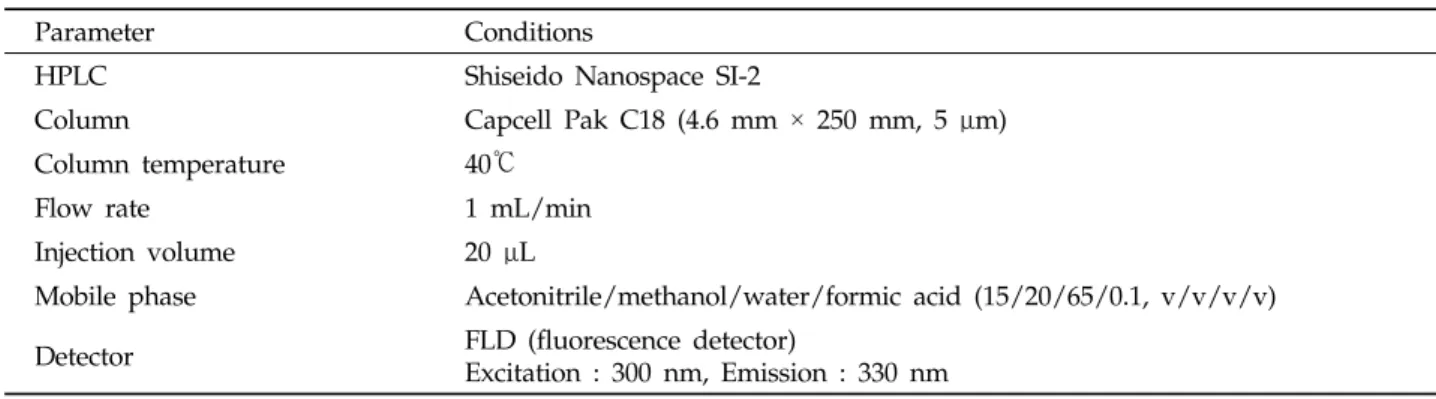
Table 2. HPLC/FLD parameter for the analysis of ethychlozate
Parameter Conditions
HPLC Shiseido Nanospace SI-2
Column Capcell Pak C18 (4.6 mm × 250 mm, 5 μm)
Column temperature 40℃
Flow rate 1 mL/min
Injection volume 20 μL
Mobile phase Acetonitrile/methanol/water/formic acid (15/20/65/0.1, v/v/v/v)
Detector FLD (fluorescence detector)
Excitation : 300 nm, Emission : 330 nm
High-liquid performance chromatography analysis The HPLC system utilized in this study consisted of Shiseido Nanospace SI-2 equipped with fluorescence detector (Japan). Capcell Pak C
18column (4.6 × 250 mm, 5 μm, Shiseido, Japan) was used to separate the ECZA from sample co-extractives flowed under the isocratic condition with acetonitrile/methanol/DW/
formic acid (15/20/65/0.1, v/v/v/v). A 20 μL sample was carried by a mobile phase into a column, which was kept in an oven at 40℃ at flow rate of 1 mL/
min. The ECZA was detected at emission wavelength at 330 nm under the excitation wavelength at 300 nm (Table 2).
Results and Discussion
Establishment of instrument optimization
In order to establish the optimum conditions for the analytical method, the physicochemical properties of ECZ were considered (BCPC, 2012; Table 1). ECZ was possible for HPLC analysis under ion-suppression due to its carboxylic acid existent in the molecule (dissociative property) (Lee, 2013). Furthermore, because the indazole-ring in ECZ compound has fluorescence property, it can be measured by using fluorescence detector (FLD). In addition, according to the former information (Aoki et al ., 2010; Bohne et al ., 2007), the analysis of chemical compound containing the fluorophore mainly used HPLC/FLD which the selectivity and sensitivity is excellent. Therefore, in present study, HPLC/FLD was selected as the most suitable analytical instrument.
Meanwhile, the finally acidified ECZA caused the peak tailing under the reconstitution solution of acetonitrile, reflecting its slightly dissociative and acidic properties. Hence, the reconstitution solution was applied to the mobile phase of the ion-suppression
condition (formic acid addition), resulting in a considerable increase in the peak symmetry and sharpness of ECZA.
Establishment of sample preparation procedure Acetone (Wong et al ., 2010), acetonitrile (Association of Official Analytical Chemists International, 2010), methanol (Tsipi et al ., 1999), and ethyl acetate (Pihlström et al ., 2007) have been commonly used as extraction solvents to optimize and improve the pesticide residue analysis. In the present study, acetone was used as the extraction solvent because it was readily separated from water by liquid-liquid separation with non-polar solvents. However, dry samples (brown rice and soybean) are shown to the low extraction efficiency in water-soluble organic solvent due to strong adsorption (Lee, 2013). In order to combat the problem, sample extraction process was supplemented to moistness process to increase the extraction efficiency. Additionally, in order to extract all of the compounds (ester and acidic form), the sample was extracted after adding 6 N HCl solution.
Sample separation and purification were used for
ion-associated partition method. ECZ was expected
below pKa 3.0 by the existed carboxylic acid in the
compound. Therefore, the extract was adjusted below
pH 2, and then efficiently separated by a non-polar
organic solvent (dichloromethane). According to the
official method of MFDS (2013), ECZ residue pesticide
was applied only to partial ACs (mandarin and other
agricultural commodity). For this reason, the nation-
wide pesticide residue monitoring program requesting
the analysis of the other ACs has difficulty. Actually,
the interfering peak is shown in ECZA retention time
of mandarin, pepper, and potato when applying
representative samples. In order to resolve the
problem, the salts (sodium chloride) were added to
increase the ionic strength. This process is suitable for the ion strength control considering the stability of compound in strong acid or alkali conditions. In addition, sample extraction accelerates in removal of impurities.
The ester form of ECZ was demonstrated with a non-polar form, whereas the acidic form of ECZA was demonstrated with the slightly dissociative form.
Although ECZ was manufactured as the neutral compound of ethyl ester, because it has quickly hydrolyzed in environment or crops, the acidic form was affected as the practically active component (Lee, 2013). For this reason, the analytes of ECZ residues were included together with ECZ and its acidic metabolite altogether. Therefore, this research was measured together based on the calculated method by totally acidic amount reference after transformation of target compound (ester form→acidic form), as suggested by Lee (2013).
An acidic form can be extracted into an organic solvent by suppressing their ionization in an aqueous phase with a buffer of controlled pH or via the addition of acid or base (Park et al ., 2011). In this experiment, in order to suppress the ionization, 2%
K
2HPO
4solution was added, and then controlled as pH 8.0 (±0.1) using 4 N KOH solution. This adjusted aqueous solution added a non-polar organic solvent (n-hexane), which are efficiently separated by a hydrophilic of the analytes. Subsequently, new aqueous phase was controlled as pH 2 (±0.1), and then added a non-polar organic solvent (dichloromethane), which are separated by a hydrophobic of the analytes.
Method validation
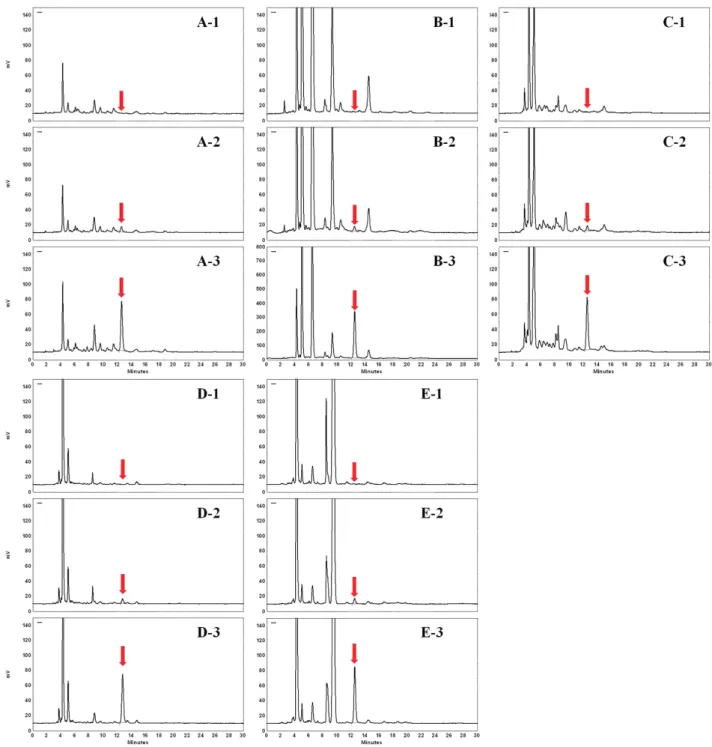
The selectivity of the analytical method was evaluated via the absence of interfering peaks from co-extractives at the retention time of ECZA. As shown in Fig. 1, the typical chromatograms of control and spiked ACs sample were confirmed to the absence of interfering peaks (control samples) as well as good separation of ECZA (spiked samples).
The linearity of ECZA working standard solution by an analytical method was conducted via an external standard procedure. The equation of calibration curve was obtained by plotting peak areas in ‘y’ axis against concentrations of ECZA in ‘x’ axis (Hem et al ., 2011), which was y=115.1 × 10
4x + 0.1935 × 10
4, with a correlation coefficient ( r
2) of 0.9999. These values demonstrate that the method's quantification
issufficient for Codex Guideline ( r
2>0.95) (CAC/GL 40, 1993).
The limit of detection (LOD) and limit of quantification (LOQ) were determined based on the standard deviation of blank sample responses (σ) and the slope of the calibration curve (S), which were calculated by multiplying σ/S by 3.3 and 10, respectively (ICH Guideline, 1996). Instrumental LOD and LOQ were determined to be 0.5 and 2 ng, respectively.
MLOQ (Method Limit of Quantitation) is not an instrumental LOQ, but instead is a practical LOQ for the total analytical method. It is usually calculated by using an instrumental LOQ, injection volume, final extract volume, and sample weight in an analytical method (Lee, 2013; Lee et al ., 2012). MLOQ value for ECZ was 0.02 mg/kg. MRLs for ECZ of ACs in MFDS are set up in mandarin (1.0 mg/kg) and other agricultural commodity (0.05 mg/kg) (Korea Food Code, 2013). According to the guideline on a residue analytical method in SANCO/825/00, MLOQ is recommended below 0.02 mg/kg if MRL is set up as 0.05 mg/kg (EC Guidance, 2010). Consequently, the proposed MLOQ value is adjudged resonable for determination of MRL of ECZ residue in ACs.
Accuracy and precision were conducted via intra- and inter-day analyses (in a single laboratory), and precision was calculated in terms of intra-day repeatability and inter-day reproducibility (Choi et al ., 2011; ICH Guideline, 1996; Thompson et al ., 2002).
Accuracy was expressed as a percentage of recovery and precision as a relative standard deviation (RSD).
Intra- and inter-day analyses were conducted using
the fortified brown rice, pepper, potato, and soybean
(no Korea MRL criteria) at three different concentrations
of MLOQ (0.05 mg/kg), 2 × MLOQ (0.1 mg/kg), and
10 × MLOQ (0.5 mg/kg) and mandarin (Korea MRL
criteria : 0.2 mg/kg) at three different concentrations
of MLOQ (0.05 mg/kg), 0.5 × MRL (0.1 mg/kg), and
MRL (0.2 mg/kg). Intra-day analysis was conducted
in five replicates at each concentration level, whereas
inter-day analysis was performed for three consecutive
days in triplicate at the same concentrations. The
recovery averages of the intra-day experiment ranged
from brown rice 87.2-92.9%, mandarin 100.8-105.2%,
pepper 89.1-95.3%, potato 82.0-85.9%, and soybean
91.2-102.3%, respectively, and the recovery averages
of inter-day experiment ranged from brown rice
86.0-91.7%, mandarin 100.0-102.8%, pepper 88.1-93.2%,
Fig. 1. HPLC chromatograms of extracts from agricultural commodities.
A, brown rice; B, mandarin; C,pepper; D, potato; E, soybean; 1, control; 2, for tified with ethychlozate at LOQ of 0.02 mg/kg; 3, fortified with ethychlozate 0.2 mg/kg (A, C, D, and E) and 1.0 mg/kg (B).
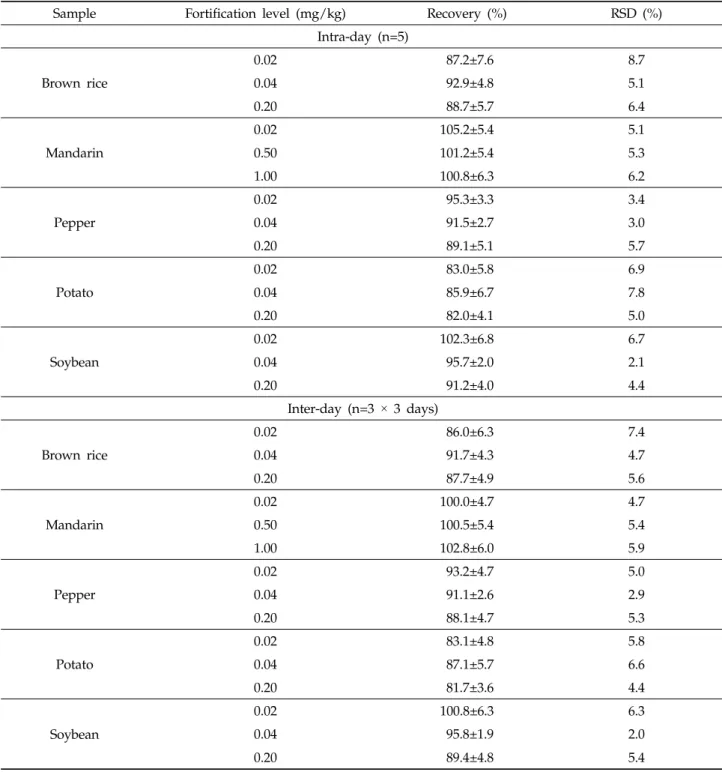
potato 81.7-87.1%, and soybean 89.4-100.8%, respectively (Table 3). The intra-day repeatability expressed as RSD was less than 8.7% in all ACs, whereas inter-day reproducibility expressed as RSD was less than 7.4%
in ACs (Table 3). These recovery and RSD values were consistent with the ranges listed in the Codex and SANCO Guideline (CAC/GL 40, 1993; EC Guidance, 2010), and thus the method described
herein can be considered excellent as a reliable, reproducible, and accurate routine analytical method.
Additionally, it had the tendency to be similar to the
results that the existing researcher reports (Takatsuki
et al ., 2002). Therefore, our newly establishing
analytical method for ECZ residue in ACs can be
confirmed as the suitable method.
Table 3. Intra- and inter-day recoveries and RSD of ethychlozate in agricultural commodities
Sample Fortification level (mg/kg) Recovery (%) RSD (%)
Intra-day (n=5)
Brown rice
0.02 87.2±7.6 8.7
0.04 92.9±4.8 5.1
0.20 88.7±5.7 6.4
Mandarin
0.02 105.2±5.4 5.1
0.50 101.2±5.4 5.3
1.00 100.8±6.3 6.2
Pepper
0.02 95.3±3.3 3.4
0.04 91.5±2.7 3.0
0.20 89.1±5.1 5.7
Potato
0.02 83.0±5.8 6.9
0.04 85.9±6.7 7.8
0.20 82.0±4.1 5.0
Soybean
0.02 102.3±6.8 6.7
0.04 95.7±2.0 2.1
0.20 91.2±4.0 4.4
Inter-day (n=3 × 3 days)
Brown rice
0.02 86.0±6.3 7.4
0.04 91.7±4.3 4.7
0.20 87.7±4.9 5.6
Mandarin
0.02 100.0±4.7 4.7
0.50 100.5±5.4 5.4
1.00 102.8±6.0 5.9
Pepper
0.02 93.2±4.7 5.0
0.04 91.1±2.6 2.9
0.20 88.1±4.7 5.3
Potato
0.02 83.1±4.8 5.8
0.04 87.1±5.7 6.6
0.20 81.7±3.6 4.4
Soybean
0.02 100.8±6.3 6.3
0.04 95.8±1.9 2.0
0.20 89.4±4.8 5.4