†These authors contributed equally to this work.
*Corresponding author: Ju-Sik Cho
Phone: +82-61-750-3297; Fax: +82-61-752-8011;
E-mail: [email protected]
Korean J Environ Agric. 2016;35(2):97-103. Korean Online ISSN: 2233-4173
Published online 2016 June 30. http://dx.doi.org/10.5338/KJEA.2016.35.2.20 Print ISSN: 1225-3537
천매암의 시용이 토양의 이화학적 특성과 작물의 생육 및 무기성분 흡수에 미치는 영향
김현태1†, 강세원2†, 서동철3, 문성동4, 조주식1*
1순천대학교 생물환경학과, 2국립한국농수산대학 특용작물학과,
3경상대학교 응용생명과학부(Bk21 농생명산업 글로벌 인재 육성 사업단), 4강원대학교 산업경영공학과
Effect of Phyllite Application on Physical and Chemical Properties of Soil, Growth and Inorganic Nutrient Uptake of Crops
Hyun-Tae Kim1†, Se-Won Kang2†, Dong-Cheol Seo3, Sung-Dong Moon4 and Ju-Sik Cho1* (1Department of Bio-Environmental Sciences, Sunchon National University, Suncheon 57922, Korea, 2Department of Medicinal &
Industrial Crops, Korea National College of Agriculture and Fisheries, Jeonju 54874, Korea, 3Division of Applied Life Science, Gyeongsang National University, Jinju 52828 Korea, 4Department of Industrial & Management Engineering, Kangwon National University, Samcheok 25913, Korea)
Received: 10 May 2016 / Revised: 7 June 2016 / Accepted: 26 June 2016 Copyright ⓒ 2016 The Korean Society of Environmental Agriculture
This is an Open-Access article distributed under the terms of the Creative Commons Attribution Non-Commercial License (http://creativecommons.org/licenses/by-nc/3.0) which permits unrestricted non-commercial use, distribution, and reproduction in any medium, provided the original work is properly cited.
ORCID Hyun-Tae Kim
http://orcid.org/0000-0002-5451-5427 Se-won Kang
http://orcid.org/0000-0003-2038-5465 Dong-Cheol Seo
http://orcid.org/0000-0001-8515-0670 Sung-Dong Moon
http://orcid.org/0000-0003-4140-2009 Ju-Sik Cho
http://orcid.org/0000-0001-9610-5373
97
Abstract
BACKGROUND: Clay mineral is well known to improve physico-chemical of soil. The objective of this study was to investigate the growth characteristics and inorganic nutrient contents of crops with application levels of phyllite.
METHODS AND RESULTS: Both young radish and lettuce were selected as target crops for this study. The experiment was conducted in a wagner pot(1/5000a) in glass house at Sunchon National University. Treatment conditions were divided P0NPK(No phyllite + NPK), P5NPK(phyllite 5 Mg/ha + NPK), P10NPK(phyllite 10 Mg/ha + NPK) and P15NPK(phyllite 15 Mg/ha + NPK) by crops, respectively. Bulk density and porosity of soil in
control without treatment conditions were ranged from 1.02
∼1.04 g/cm
3and 56.5∼57.0%, respectively, and those for treatments with phyllite were in the ranged from 0.94∼
1.00 g/cm
3and 58.4∼63.5%, respectively. Dry weights of young radish and lettuce were higher in P15NPK treatment than those in other treatments. The amounts of T-N, T-P and K uptake in young radish with phyllite application treatments were increased 36∼115, 18∼67 and 20∼76%
than without phyllite application treatment, respectively. In lettuce treatments, amounts of T-N, T-P and K uptake were intended to all tested treatments similar with result of young radish treatment.
CONCLUSION: Therefore, these results confirm that phyllite application to the soil improves physico-chemical of soil in addition to improving growth of young radish and lettuce.
Key words: Application level, Clay mineral, Lettuce, Phyllite, Young radish
Research Article Open Access
Table 1. Chemical properties of phyllite and soil used in the study
pH EC O.M T-N Avail.
P2O5
Exch. cation
K Ca Mg
1:5H2O dS/m - g/kg - mg/kg -- cmolc/k --
Phyllite 5.74 0.23 10.76 0.34 44.75 0.36 8.45 3.67
Soil 4.83 0.14 6.30 1.10 45.83 0.22 1.42 0.72
서 론
최근 토양에 시용하여 작물의 생장을 증진시킬 수 있는 환경친화형 복합기능으로 무기성 광물이 첨가된 벤토나이 트, 천매암, 제올라이트, 버미큘라이트 및 일라이트 등의 점 토광물이 관심을 받고 있다(Jang, 2002; Lee
et al
., 2010).점토광물의 농업적 이용은 점토광물의 높은 비표면적과 전 하를 가지는 성질을 이용하는 것이며(Kim
et al
., 1999), 토 양교질의 무기성분 주체가 되어 토양의 이화학적 성질을 지 배함은 물론 작물의 생육에 필요한 양분을 공급한다(Zanget al
., 2006). 또한 점토광물은 넓은 표면적, 높은 수분 보유 력 및 유효수분 등 물리적 특성을 가지고 있고, 양이온 교 환능력과 같은 중요한 화학적 성질을 가지고 있으며(Leeet al
., 2012), 벤토나이트, 제올라이트, 펄라이트 및 버미큘라 이트는 주로 토양을 개량하기 위한 용도로 사용된다(Leeet al
., 2010; Leeet al
., 2012)은 일라이트의 시용이 고추의 생 장에 미치는 영향을 조사한 결과, 일라이트의 시용형태에 상관없이 대조구에 비해 유기물, 유효인산 및 양이온 치환 능력 등이 유의성 있게 증가되는 결과를 보고하였으며, Pyonet al
. (1987)은 몰리네이트의 토양 시용이 벼의 생장 에 미치는 영향을 연구한 결과 등 점토광물을 활용한 시용 효과가 보고되고 있다.점토광물 중 하나인 천매암은 다양한 영양 성분을 함유하 고 있으며, 풍화과정을 거치는 동안 식물이 가장 흡수하기 쉬 운 형태로 균형 있게 존재하고 있다. 또한 유기물이 풍부하여 퇴비 제조시 수분조절제로 많이 이용되고 있으며(Park
et al
., 2002), 수도용 상토 개발을 목적으로 사용되고 있다 (Parket al
., 2002). 하지만, 다른 점토광물과 달리 영양성분 이 풍부한 천매암을 이용하여 토성의 개량이나 작물의 생육 을 증진시키기 위한 연구가 부족한 실정이다.따라서 본 연구는 점토광물인 천매암의 토양 시용이 토양 특성 및 근채류와 엽채류 작물의 초기 생육에 미치는 영향을 알아보기 위해 미사질양토에 천매암을 수준별(5, 10 및 15 Mg/ha)로 시용하였으며, 토양의 물리적 특성과 화학적 특성, 열무와 상추의 생육특성, 무기성분 함량 및 흡수량을 조사하 였다.
재료 및 방법
공시재료
본 실험에 사용된 천매암의 화학적 특성은 Table 1에서
보는 바와 같이 pH는 5.74이었고, O.M은 10.76 g/kg이었 으며, T-N의 함량은 0.34 g/kg이었다. 또한 SiO2, Al2O3, Fe2O3, S, Ti, 및 Se의 함량은 각각 65.9, 10.2, 5.25, 0.06, 0.6, 및 1.06%으로 조사되었으며, Mn, B 및 V의 함량은 733, 388, 88.8 mg/kg으로 조사되었다. 공시 토양은 전라남 도 순천시 야흥동에 위치한 밭토양을 채취하였으며, 토양의 pH는 4.83, O.M의 함량은 6.30 g/kg 및 T-N의 함량은 1.10 g/kg이었다(Table 1). 시험작물로는 근채류에 속하는 열무(Young Radish,
Raphanus sativus
L.)와 엽채류에 속 하는 상추(Lettuce,Lactuca sativa
L.)를 사용하였으며, 상 토에 파종 후 7일간 생육시킨 뒤 생육상태가 양호한 것을 선 별하여 사용하였다.실험방법
작물재배는 공시토양을 2 mm체를 통과시켜 균질화된 토 양을 사용하였으며, Wagner pot(1/5000a)에서 수행되었다.
본 실험 처리구는 천매암을 넣지 않은 P0NPK(No phyllite + NPK) 처리구와 천매암을 시용한 P5NPK(phyllite 5 Mg/ha + NPK), P10NPK(phyllite 10 Mg/ha + NPK) 및 P15NPK(phyllite 15 Mg/ha + NPK) 처리구로 각각 나누었다. 천매암 시용수준에 따른 열무 및 상추의 생육과 무 기성분 특성은 작물 이식 후 60일에 수확하여 지상부와 지하 부로 각각 나누어 건물중과 T-N, T-P 및 K 함량을 조사하였 다. 또한 천매암 시용에 따른 토양 특성 변화는 용적밀도, 공 극률, pH, EC, T-N, Avail. P2O5, O.M 및 치환성 양이온 함량을 조사하여 대조구 토양과 비교하였다.
분석방법
토양의 pH 및 EC는 초자전극법을 사용하였으며, T-N 의 분석은 Kjeldahl법을 사용하였고, 유효인산의 분석은 Lancaster법(2120UV, Optizen)을 사용하였다. 유기물의 분 석은 Tyurin법으로 하였고, 치환성 양이온은 1N-NH4OAc 용액으로 침출한 후 ICP(ICPE-9000, Shimadzu, Japan)를 사용하여 각각 분석하였다. 열무와 상추의 T-N, T-P 및 K 는 지상부와 지하부로 나누어 70℃ dry oven에서 3일간 건 조 후 0.1 mm 입자 크기로 분쇄하였으며, 분쇄한 시료를 습식분해법(H2SO4 + H2O2)으로 분해한 후 분해된 여액을 사용하여 T-N의 분석은 Kjeldahl법을 사용하였고, T-P의 분석은 Vanadate법(2120UV, Optizen), K의 분석은 ICP (ICPE- 9000, Shimadzu, Japan)를 사용하여 각각 분석하 였다. 열무와 상추의 무기성분 흡수량은 건물중과 T-N, T-P
Fig. 1. Physical properties of young radish and lettuce cultivated soil under different application levels of phyllite. Means by the same litter within a column are not significantly different at 0.05 probability level according to Duncan’s multiple range test.
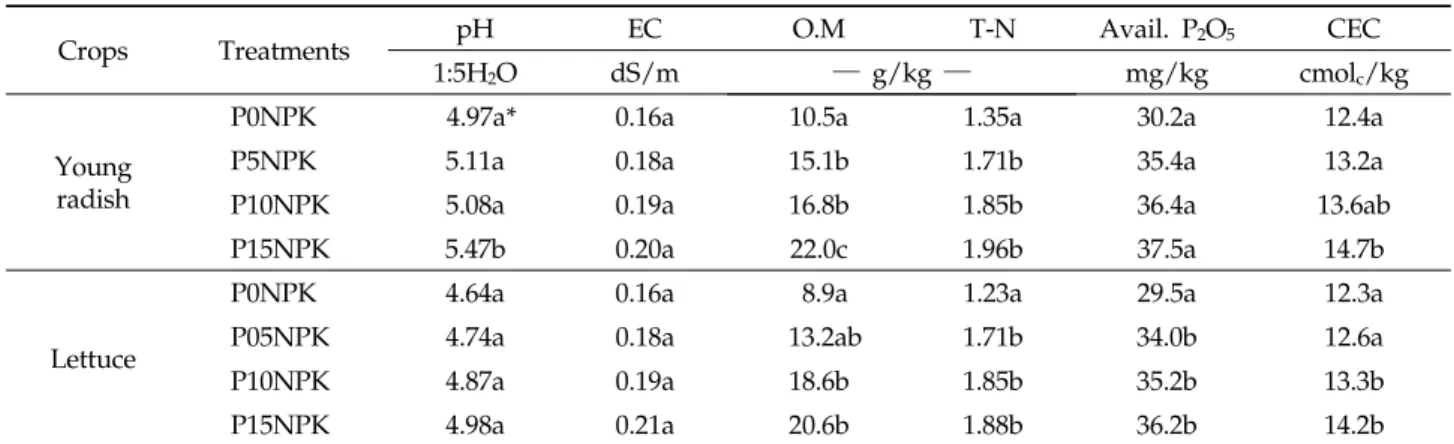
Table 2. Chemical properties of tested soils in pots of young radish and lettuce
Crops Treatments pH EC O.M T-N Avail. P2O5 CEC
1:5H2O dS/m ― g/kg ― mg/kg cmolc/kg
Young radish
P0NPK 4.97a* 0.16a 10.5a 1.35a 30.2a 12.4a
P5NPK 5.11a 0.18a 15.1b 1.71b 35.4a 13.2a
P10NPK 5.08a 0.19a 16.8b 1.85b 36.4a 13.6ab
P15NPK 5.47b 0.20a 22.0c 1.96b 37.5a 14.7b
Lettuce
P0NPK 4.64a 0.16a 8.9a 1.23a 29.5a 12.3a
P05NPK 4.74a 0.18a 13.2ab 1.71b 34.0b 12.6a
P10NPK 4.87a 0.19a 18.6b 1.85b 35.2b 13.3b
P15NPK 4.98a 0.21a 20.6b 1.88b 36.2b 14.2b
*Means by the same litter within a column are not significantly different at 0.05 probability level according to Duncan’s multiple range test.
및 K의 함량을 이용하여 천매암 처리조건별 흡수량을 산정 하였다. 본 시험에서 사용된 모든 분석은 농촌진흥청의 토 양 및 식물체 분석법(NAS, 2000)에 준하여 분석하였다.
통계분석
천매암의 수준별 처리에 따른 모든 연구결과의 통계분석 은 SPSS 19 버전을 사용하여 토양 물리·화학적 특성과 열무 및 상추의 생육 특성 및 무기성분 함량을 5% 유의수준에서 Duncan’s multiple range test를 수행하였다.
결과 및 고찰
천매암 수준별 토양의 특성 변화
천매암 수준별 처리에 따른 토양의 물리적 특성은 Fig. 1 과 같다. 열무 재배 토양의 용적밀도는 P0NPK > P5NPK >
P10NPK > P15NPK 순으로 높았으며, 공극률은 천매암을 시용한 처리구가 P0NPK 처리구에 비해 각각 4, 8 및 11%
증가하였다. 상추 재배 토양의 용적밀도는 열무 재배 토양의 용적밀도와 유사한 경향으로 천매암 시용수준이 증가함에 따 라 감소하는 경향을 보였으며, 공극률 또한 열무 재배 토양과 유사한 경향이였다.
천매암 수준별 처리에 따른 토양의 pH, EC, O.M, T-N, Avail. P2O5 및 CEC의 특성을 조사한 결과는 Table 2와 같 다. 열무 재배 토양 내 pH는 천매암 시용수준이 높아질수록 증가하는 경향을 나타냈다. EC는 모든 처리구에서 0.16∼
0.20 dS/m 범위로 큰 차이 없이 비슷하게 조사되었다. 열무 재배 토양의 O.M 함량은 P5NPK, P10NPK, P15NPK 처리 구에서 P0NPK 처리구에 비해 각각 44, 60 및 110%가 증가 하였다. T-N 및 Avail. P2O5의 함량도 O.M 함량과 비슷한 경향으로 P15NPK 처리구에서 가장 높았으며, 대조구 대비 각각 T-N 함량은 45% 및 Avail. P2O5 함량은 24%의 증가 율을 보였다. 천매암 수준별 처리에 따른 토양의 CEC 특성은 천매암 시용 수준이 증가함에 따라 높아지는 결과를 보였다.
천매암 수준별 처리에 따른 상추 재배 토양의 pH, EC, O.M, T-N, Avail. P2O5 및 CEC의 함량은 각각 4.64∼
4.98, 0.16∼0.21 dS/m, 8.9∼20.6 g/kg, 1.23∼1.88 g/kg, 29.5∼36.2 mg/kg 및 12.3∼14.2 cmolc/kg으로 조 사되었고 열무 재배 토양과 유사한 경향이었다.
본 연구에서 토양의 특성은 전반적으로 천매암 수준별 처 리에 따라 유의성있게 개선되는 경향이였다. 이와 같은 결과 는 천매암이 양이온 및 극성분자와 흡착하고, 양분의 고갈을 방지하여, 토양의 화학적 성분이 대조구에 비해 증가된 것으 로 판단된다(Abbott and Watts, 2010; Lee
et al
., 2012).따라서 NPK를 시비하였을 때 NPK에 포함된 양이온들이 천
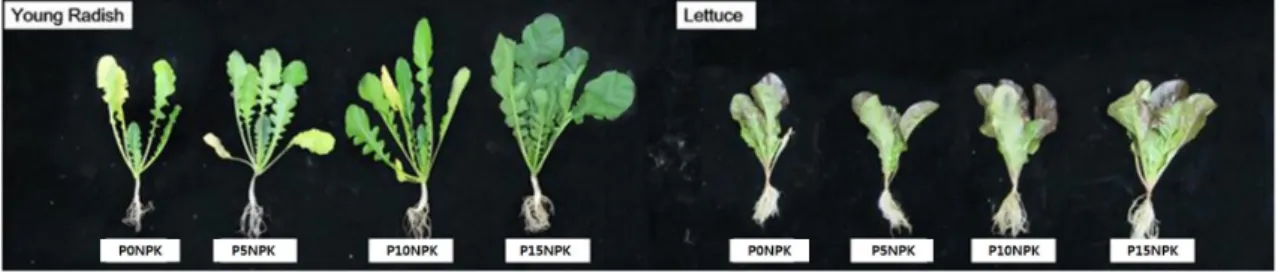
Fig. 2. Growth characteristics of young radish and lettuce under different application levels of phyllite.
Fig. 3. Dry weight of young radish and lettuce under different application levels of phyllite. Means by the same litter within a column are not significantly different at 0.05 probability level according to Duncan’s multiple range test.
매암의 수준별 처리량에 따른 흡착정도의 차이로 인해 처리 구간 양이온 교환이 증가된 결과로 판단된다. 이와 같은 결과 는 Park
et al
. (2002)이 보고한 천매암과 퇴비를 혼합하여 시용하였을 때 T-N 및 CEC가 대조구의 0.4% 및 8.2 cmolc/kg에 비해 돈분퇴비와 phyllite의 혼합비율을 달리한 PSPC20-40 처리구에서 각각 0.12% 및 12.3 cmolc/kg으로 증가된 연구결과와 일치하였다. 천매암을 작물의 생육 및 토 양의 화학성 증진에 이용한 연구가 거의 없어 본 연구와 직접 적인 비교는 어려우나, Kim and Choi(1985)의 연구에서 세 사양토에 NPK, Bentonite 및 Zeolite를 처리하였을 때 O.M 함량은 대조구의 1.66%에 비해 NPK + Bentonite 1.0 M/T 및 NPK + Zeolite 1.0 M/T 처리구에서 각각 1.74 및 1.91%로 높아졌고, CEC 또한 대조구의 9.3 cmolc/kg에 비해 NPK + Bentonite 1.0 M/T 처리구에서 10.6 cmolc/kg 및 NPK + Zeolite 1.0 M/T 처리구에서 11.6 cmolc/kg으로 높아졌으며, 이는 점토광물이 가지고 있는 특 성에 기인한 것으로 판단된다.천매암 수준별 작물의 생육 특성
천매암의 수준별 시용이 작물의 생육에 미치는 영향을 조 사한 결과는 Fig. 2 및 3과 같다. 열무의 지상부 건물중은 P15NPK 처리구에서 5.66 g/pot로 가장 높은 결과를 보였 고, P10NPK(4.76 g/pot), P5NPK(4.45 g/pot) 및 P0NPK (4.01 g/pot) 처리구 순으로 높게 조사되었으며, P15NPK
처리구는 P0NPK 처리구에 비해 약 42% 높은 결과를 보였 다. 열무의 지하부 건물중은 P15NPK(1.43 g/pot) >
P10NPK(1.25 g/pot) > P5NPK(1.12 g/pot) > P0NPK (1.05 g/pot) 처리구 순으로, 천매암 시용수준이 증가될수록 유의성 있게 증가되었다.
상추의 지상부 건물중은 P0NPK, P5NPK, P10NPK 및 P15NPK 처리구에서 각각 1.32, 1.57, 1.73 및 1.88 g/pot 으로 P5NPK, P10NPK 및 P15NPK 처리구가 P0NPK 처 리구에 비해 각각 19, 31 및 42% 증가되었다. 상추의 지하부 건물중은 천매암의 시용수준에 상관없이 0.18∼0.20 g/pot 으로 천매암 시용수준이 증가됨에 따라 약간 증가되는 경향 을 보였으나 큰 차이는 보이지 않았다. Park
et al
. (2002a) 의 연구결과에 의하면, 천매암은 광물 내 많은 기공들로 인하 여 높은 공극률을 가지고 있어 수분 보유력이 높은 것으로 알 려져 있으며, Yanget al
. (2014)은 토성에 따른 수분보유력 등의 물리적 특성이 작물생육에 영향을 미치는 것으로 보고 하였다. 이는 본 연구와 유사한 결과로, 천매암 시용이 토양 내 수분 보유력을 증가시켜 작물의 생육에 영향을 준 것으로 보인다. 따라서 천매암의 토양 시용은 열무 및 상추의 초기 생육 증진에 효과적인 것으로 판단된다.천매암 수준별 작물의 무기성분 특성
천매암 수준별 시용에 따른 열무와 상추의 무기성분의 함 량을 조사한 결과는 Table 3과 같다. 열무의 지상부 T-N 함
Table 3. T-N, T-P and K contents of young radish and lettuce under different application levels of phyllite
Crops Treatments
T-N T-P K
Leaf Root Leaf Root Leaf Root
--- % ---
Young radish
P0NPK 1.21a* 0.76a 0.21a 0.32a 3.09a 2.28a
P5NPK 1.49b 0.93b 0.20a 0.45b 3.24ab 2.90bc
P10NPK 1.71c 1.04c 0.21a 0.41b 3.50bc 2.79b
P15NPK 1.86c 1.18d 0.22a 0.49b 3.82c 3.09c
Lettuce
P0NPK 1.51a 0.47a 0.11a 0.07a 2.42a 0.91a
P5NPK 1.60a 0.55b 0.10a 0.08b 2.62b 0.96a
P10NPK 2.09b 0.60c 0.10a 0.08b 2.78b 0.97a
P15NPK 2.50c 0.76d 0.10a 0.10c 3.25c 1.16b
*Means by the same litter within a column are not significantly different at 0.05 probability level according to Duncan’s multiple range test.
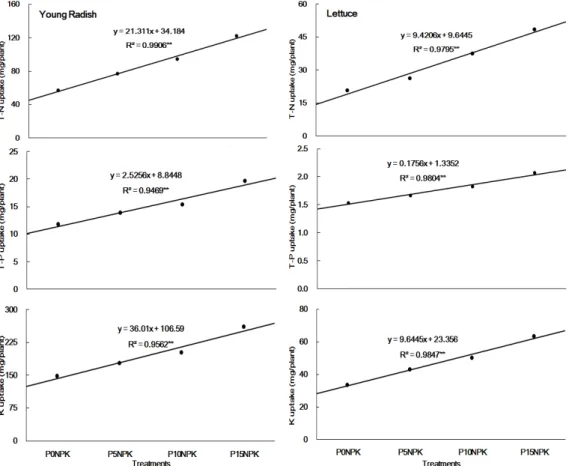
Fig. 4. Amounts of inorganic nutrient uptake of young radish and lettuce under different application levels of phyllite.
량은 P0NPK 처리구에서 1.21%, P5NPK 처리구에서 1.49%, P10NPK 처리구에서 1.71% 및 P15NPK 처리구에 서 1.86%로 조사되었으며, P15NPK 처리구가 P0NPK 처리 구에 비해 약 53%가 증가되었다. 열무의 지하부 T-N 함량은 열무의 지상부 T-N 함량과 유사한 경향으로 P15NPK 처리 구에서 1.18%로 가장 많았으며 P0NPK 처리구에 비해 56%
의 함량 증가를 나타내었다. 열무의 지상부 및 지하부 T-P 함
량은 P15NPK 처리구에서 각각 0.23 및 0.49%로 모든 처리 구중 가장 높게 조사되었으며, P0NPK 처리구 대비 각각 7 및 52%의 증가를 보였다. 열무의 지상부 및 지하부의 K의 함량 또한 T-N 및 T-P의 함량과 비슷한 경향으로 P15NPK 처리구에서 각각 3.82 및 3.09%로 가장 높았으며, P0NPK 처리구에 비해 각각 23 및 35%의 함량이 증가한 것을 볼 수 있었다. 상추의 지상부 T-N의 함량은 P15NPK 처리구에서
2.50%으로 가장 높은 함량을 보였으며, 상추의 지하부 T-N 함량의 경우 천매암 시용수준에 상관없이 0.47∼0.76%로 조 사되었다. 상추의 지상부 및 지하부 T-P 함량은 처리조건에 상관없이 0.10∼0.11 및 0.07∼0.10% 범위로 큰 차이 없었 다. 상추의 지상부 K의 함량은 T-N 결과와 유사한 경향으로 P15NPK에서 3.25%로 가장 높게 조사되었으며, P0NPK 처 리구에 비해 약 34% 증가되었다. 상추의 지하부 K 함량은 천매암 시용수준에 상관없이 0.91∼1.16%로 조사되었다.
천매암의 시용수준에 따른 열무 및 상추의 무기성분 흡수 량을 조사한 결과는 Fig. 4에서 보는 바와 같다. 열무의 T-N, T-P 및 K의 흡수량은 상추의 무기성분 흡수량과 유사한 경 향으로 천매암을 시용한 처리구가 P0NPK 처리구에 비해 36
∼115, 18∼67 및 20∼76% 증가되었고, 상추의 T-N, T-P 및 K의 흡수량은 천매암을 시용한 처리구가 P0NPK 처리구 에 비해 각각 27∼134, 9∼35 및 28∼89% 증가되었다. 본 연구의 천매암의 시용이 작물의 생육에 도움을 주는 것으로 판단된다. 이와 같은 결과는 천매암 시용이 양분보유능을 증 가시켜 작물의 생육에 필요한 양분유효도가 증가된 것으로 판단되며, 이로 인해 열무 및 상추의 N, P 및 K 흡수량이 유 의성 있게 증가된 것으로 판단된다. Lee
et al
. (2012)의 연 구에서 보고된 고추의 무기성분 함량은 점토광물의 종류와 시용량에 상관없이 점토광물 처리구의 고추가 무처리구 고추 에 비해 K, Ca 및 Mg 함량이 각각 2~76, –4~107 및 – 3~126%로 조사되었으며, 전반적인 무기성분 함량이 증가되 었다고 보고한 바 있다. 이는 본 연구와 유사한 경향으로 점 토광물은 수분 보유력이 뛰어나며, 양이온치환능력이 높아 토 양 시용시 작물의 수분 및 양분 흡수에 유리한 환경을 만들어 준 것으로 판단된다.결 론
본 연구는 점토광물인 천매암의 초기 작물의 생육 증진효 과를 알아보기 위하여 천매암을 수준별(5, 10 및 15 Mg/ha) 로 처리하여 토양의 물리 ․ 화학적 특성, 열무 및 상추의 생육 특성, 무기성분 함량 및 흡수량을 조사하였다. 열무 재배 토 양의 용적밀도는 P0NPK > P5NPK > P10NPK >
P15NPK 처리구 순으로 조사되었고, 공극률은 시용수준이 증가함에 따라 증가하는 경향으로 P15NPK 처리구에서 가장 높게 조사되었다. 열무 및 상추 재배 토양의 pH, O.M, T-N, Avail. P2O5 및 CEC는 천매암을 시용한 처리구가 P0NPK 처리구에 비해 화학적 성분이 높게 조사되었다. 열무 및 상추 의 건물중은 P15NPK > P10NPK ≧ P5NPK > P0NPK 처리구 순으로 증가하는 경향이었다. 열무와 상추의 무기성분 함량은 천매암의 시용수준이 증가함에 따라 증가하는 경향으 로, P15NPK 처리구에서 가장 높았다. 열무의 T-N, T-P 및 K의 흡수량은 P15NPK 처리구가 P0NPK 처리구에 비해 각 각 115, 67 및 76% 증가되었으며, 상추의 T-N, T-P 및 K의 흡수량은 P15NPK 처리구가 P0NPK 처리구에 비해 각각 134, 35 및 89% 증가된 결과를 보였다. 이상의 결과로 미루 어 볼 때 천매암의 토양 시용은 토양 내 양분이동이 원활할
수 있는 환경을 조성하여 토양 개량 효과와 작물의 생육을 증 진시키는데 좋은 개량제로 판단된다.
Acknowledgment
This work was carried out with the support of BOONONG Corp., Republic of Korea. & ALNONGBIO Co. Ltd., Republic of Korea. Also, this work was carried out with the support of “Cooperative Research Program for Agriculture Science & Technology Development (Project No. PJ011227042016)”, Rural Development Administration, Republic of Korea.
References
Abbott, D. R., & Watts, J. (2010). Identical rock types with different chemistry: sourcing phyllite-tempered Hohokam pottery from the Phoenix basin, Arizona.
Journal of Archaeological Science, 37(7), 1612-1622.
Kim, J. G., Lee, S. H., Lee, C. H., Lee, N. J., Son, Y. S., &
Lim, S. K. (1999). Field treatment of cow manure originated from the clay mineral feeding and the change of nitrogen in soils. Korean Journal of Environmental Agriculture, 18(4), 366-371.
Kim, H. J., Kim, H. K., Kwon, S. M., Lee, S. E., Woo, S.
H., Park, M., & Chung, K. Y. (2010). Effect of the clay mineral illite on the growth of cherry tomato in the bed soil. Korean Journal of Soil Science and Fertilizer, 43(3), 322-328.
Kim, S. H., & Choi, J. (1985). The Effect of whole layer placement of total amount of N. P. K. application with clay minerals on the growth and the yield of paddy rice in different soil types. Agricultural Research Bulletin of Kyungpook National University, 3, 14-20.
<http://www.earticle.net/article.aspx?sn=220918>
Jang, Y. S. (2002). Pulse rock and soil conditioner. Soil and Fertilizer, 10, 11-16.
Lee, S. E., Kim, H. K., Kwon, S. M., Kim, H. J., Yoo, R.
B., Back, K. T., Lee, M. S., Woo, S. H., Park, M. &
Chung, K. Y. (2010). Effect different levels of applications of illite on the growth of red pepper(
Capsicum annuum
L.) in bed soil. Korean Journal of Soil Science and Fertilizer, 43(6), 852-857.Lee, D. G., Lee, S. E., Kim, S. H., Hong, H. K., Nam, J.
H., Choi, J. S., Lee, M. S., Woo, S. H., & Chung, K. Y.
(2012). Effects of the applications of clay minerals on the early growth of red pepper in growing medium.
Korean Journal of Horticultural Science and Technology, 30(4), 463-470.
Lee, S. E., Kim, D. H., Hong, H. K., Kwon, S. M., Lee, M.
S., Woo, S. H., & Chung, K. Y. (2012). Effect of different levels of applications of illite on the growth of red pepper in soil. Korean Journal of Soil Science and Fertilizer, 45(3), 339-343.
Park, Y. H., Chang, K. W., & Hong, J. G. (2002).
Development of nursery soil rice seedling. Journal of the Korea Organic Resource Recycling Association, 10(2), 71-81.
Park, Y. H., Chang, K. W., & Hong, J. G. (2002b). Study on pig manure composting using phyllite as bulking agent. Journal of the Korea Organic Resource Recycling Association, 10(2), 82-91.
Park, Y. H., Chang, K. W., & Hong, J. G. (2002). Changes of soil properties and evaluation of plant utilization according to the application of compost used with phyllite. Journal of the Korea Organic Resource Recycling Association, 10(2), 92-99.
Pyon, J. Y., Kim, M. H., Oak, H. S., & Park, S. H. (1987).
Effect of Molinate Granular Formulations on Weed Control Efficacy and Growth of Rice Plants. Korean Journal of Weed Science, 7(3), 316-320.
Yang, H. S., Kim, D. J., An, B. K., & Lee, J. H. (2014).
Impact of green manure crop and Charcoal application on ginger growth and soil properties. Korean Journal of Organic Agriculture, 22(22), 503-519.
Zhang, Y. S., Sonn, Y. K., Park, C. W., Jung, S. J., Lee, G.
J., Kim, M. S., Kim, S. K., Lee, J. Y., & Pyun, I. H.
(2006). Clay mineral composition of the soils derived from residuum and colluvium. Korean Journal of Soil Science and Fertilizer, 39(5), 245-252.