© 2018 The Korean Ophthalmological Society
This is an Open Access article distributed under the terms of the Creative Commons Attribution Non-Commercial License (http://creativecommons.org/licenses /by-nc/3.0/) which permits unrestricted non-commercial use, distribution, and reproduction in any medium, provided the original work is properly cited.
Original Article
Ocular disease caused by herpes simplex virus (HSV) in- fection occurs in 4.1 to 20.7 people per 100 thousand people every year, and the prevalence of HSV-induced ocular dis- ease is 149 per 100 thousand people [1,2]. Eye disease caused by HSV infection mainly appears as blepharitis, conjuncti- vitis, and keratitis. Repeated recurrences can result in seri- ous ocular diseases such as endothelial and stromal kerati-
Received: November 27, 2017 Accepted: March 6, 2018
Corresponding Author: Seong-Jae Kim, MD, PhD. Department of Ophthal- mology, Gyeongsang National University School of Medicine, #15 Jinju-dae- ro 816beon-gil, Jinju 52727, Korea. Tel: 82-55-750-8170, Fax: 82-55-758-4158, E-mail: [email protected]
*
These two authors contributed equally to this article and should be regard- ed as co-first authors.
Clinical Features of Herpes Simplex Keratitis in a Korean Tertiary Referral Center: Efficacy of Oral Antiviral and Ascorbic Acid on
Recurrence
Gyu-Nam Kim 1* , Woong-Sun Yoo 1* , Mi-Hwa Park 1 , Jin-Kwon Chung 2 , Yong-Seop Han 1,3 , In-Young Chung 1,3 , Seong-Wook Seo 1,3 , Ji-Myong Yoo 1,3 , Seong-Jae Kim 1,3
1
Department of Ophthalmology, Gyeongsang National University School of Medicine, Jinju, Korea
2
Department of Ophthalmology, Soonchunhyang University Seoul Hospital, Soonchunhyang University College of Medicine, Seoul, Korea
3
Institute of Health Science, Gyeongsang National University, Jinju, Korea
Purpose: To describe the clinical manifestations of herpes simplex keratitis (HSK) in a tertiary referral center in South Korea and to determine whether ascorbic acid treatment prevents recurrence of herpetic epithelial keratitis.
Methods: This retrospective cohort study included all consecutive patients with herpetic keratitis referred to our center from January 2010 to January 2015. Clinical features, ocular complications, and recurrences were recorded.
Results: In total, 149 eyes of the 133 patients (72 male and 61 female) were followed for an average of 24.6 ± 13.2 months. Sixteen (12.0%) patients had bilateral HSK. The most frequent HSK subtype was epithelial keratitis (49.7%), which was followed by stromal keratitis (23.5%). Epithelial keratitis was the most likely subtype to recur.
Complications occurred in 122 (81.9%) eyes. The most common complication was corneal opacity. Recurrenc- es were observed in 48 (32.2%) eyes. The recurrence rates were lower in the prophylactic oral antiviral agent group (16 / 48 eyes, 33.3% vs. 49 / 101 eyes, 48.5%) and the ascorbic acid treatment group (13 / 48 eyes, 27.1% vs. 81 / 101 eyes, 70.3%) compared with the groups without medications. Univariate logistic regression analysis revealed that both factors significantly reduced the risk of recurrence (acyclovir: odds ratio, 0.25; 95%
confidence intervals, 0.12 to 0.51; ascorbic acid: odds ratio, 0.51; 95% confidence intervals, 0.20 to 0.91).
Conclusions: This retrospective study described the clinical findings of HSK in a tertiary referral center in South Korea. Prophylactic oral antiviral agent treatment and oral ascorbic acid administration may lower the risk of recurrence.
Key Words: Acyclovir; Ascorbic acid; Keratitis, herpetic; Recurrence
tis, which can induce permanent visual loss [3]. Although the administration of antiviral agents and corticosteroids is relatively effective in the acute inflammatory phase of kera- titis, it does not prevent recurrence, which can lead to corne- al opacity, corneal thinning, and neovascularization [4-6].
By contrast, the Herpetic Eye Disease Study (HEDS), which is an important prospective series of studies on the thera- peutic and prophylactic effect of oral acyclovir in herpes simplex keratitis (HSK), has shown that prophylactic oral acyclovir administration reduces the frequency of stromal and epithelial keratitis recurrence [7-9]. However, a system- atic review on the HEDS reported that the ability of various treatments to prevent HSK, including oral acyclovir, re- mains debatable [10].
Ascorbic acid is a co-factor for an enzyme that participates in collagen synthesis. It is a water-soluble antioxidant that can interact with reactive oxygen species and reduce the generation of radicals. Previously we reported systemic ascorbic acid administration reduced corneal opacity in in- fectious keratitis with a concomitant decrease of epithelial defect [11]. In addition, oral administration of ascorbic acid has been suggested to prevent HSV-1 reactivation under ex- perimental environments [12,13].
The purpose of this study was to investigate the clinical characteristics and demographics of patients with HSK in South Korea and to determine whether oral acyclovir and oral ascorbic acid treatment can prevent HSK recurrence.
Materials and Methods
All consecutive patients with HSK who were referred to our tertiary eye clinic at Gyeongsang National University Hospital in Jinju, South Korea, between January 2010 and January 2015 were identified by a retrospective review of the medical records. All patients with HSK who were fol- lowed up for at least 6 months were included in the study.
All patients initially presented in a local clinic and had been referred to our center. The hospital cornea specialist diag- nosed patients with HSK based on patient history and the presence of typical clinical signs and symptoms. The com- plete ophthalmic examination included determining the best-corrected visual acuity (BCVA) and performing mea- surements, tonometry, slit-lamp anterior segment biomicros- copy, and fundus ophthalmoscopy. Complete ophthalmic examinations were also performed at each follow-up visit.
Treatment was based on the clinical features and recurrenc- es during follow-up. This study adhered to the Declaration of Helsinki, and approval for retrospective review of clinical re- cords was obtained from the institutional review board of Gyeongsang National University Hospital (GNUH2018-07- 020). According to the institutional review board standard operating procedures on retrospective single center clinical study, ethics committee of Gyeongsang National University Hospital ruled that subject consent was not required for this study. The clinical variables evaluated in the study were HSK subtype, the number and types of recurrences, the BCVA, the ocular complications during follow-up, and the treatment.
Clinical presentation and diagnosis
HSV ocular infections were diagnosed clinically on the basis of pathognomonic signs such as dendritic epithelial keratitis and iris atrophy. HSK was classified as epithelial keratitis, stromal keratitis, endotheliitis, and neurotrophic keratopathy subtypes. Epithelial keratitis was diagnosed when the lesion exhibited dendritic or geographic epithelial irregularity or ulceration. Stromal keratitis was diagnosed when necrotizing or immune stromal keratitis that had stro- mal nummular, patchy, sectorial infiltrate, or opacity was present. Endotheliitis was diagnosed when sectorial or num- mular stromal edema that associated spatially with keratic precipitates was observed. Neurotrophic keratopathy was diagnosed when the patient had indolent interpalpebral ep- ithelial irregularity or ulceration that lacked signs of acute infection. Patients with a history of herptic keratitis without any other cause, such as neurosurgical history or drug tox- icity, were included in the neurotrophic keratopathy group.
There were 7 cases in which two types were observed clin- ically at the same time, 4 cases were classified as endothe- liitis in which mild stromal keratitis were combined with endotheliitis, 3 cases were classified as stromal keratitis in which mild epithelial keratitis was combined with stromal keratitis.
Treatment
All patients were treated according to the degree of intra-
ocular inflammation, as determined by the location of the
infection, the corneal or intraocular involvement, and the
number of cells in the anterior chamber. Epithelial keratitis
was treated with topical acyclovir and prophylactic antibi- otic eye drops. Immune stromal keratitis was treated with topical steroids, and oral steroids were added in the presence of severe inflammation. Endotheliitis was treated with top- ical steroids, oral steroids, and oral acyclovir were added in the presence of severe inflammation or linear endothe- liitis. Neurotrophic keratopathy was treated with nonpre- served artificial tears and prophylactic antibiotic eye drops.
In severe cases of neurotrophic keratopathy in which the above regimen was inadequate, surgical treatment such as amniotic membrane transplantation was performed. After the acute phase, patients who experienced two or more HSK recurrences received prophylactic treatment with oral acyclovir (400 mg twice daily, total 800 mg), and treatment lasted at least one year. Oral ascorbic acid was adminis- tered to all patients except if they were pregnant or lactat- ing; had a chronic systemic disease such as liver disease, re- nal disease, uncontrolled diabetes mellitus, or hypertension;
had a history of renal calculi or gout; or had a history of al- lergic reaction to ascorbic acid. Each patient was given one 1,000 mg ascorbic acid tablet (Korea Eundan, Seoul, Korea) two times per day.
Statistical analysis
All statistical analyses were performed using IBM SPSS ver. 21.0 (IBM Corp., Armonk, NY, USA). Continuous vari- ables were expressed as mean ± standard deviation, and categorical variables were expressed as percentages. The distribution of the continuous variables was assessed using one-sample Kolmogorov-Smirnov tests. Groups were com- pared using the chi-squared test, the independent samples t-test, and the one-way analysis of variance test. Univariate and multivariate logistic regression analyses were used to identify risk factors for HSK recurrence. A p-value below 0.05 was considered as statistically significant.
Results
Demographic and main clinical characteristics
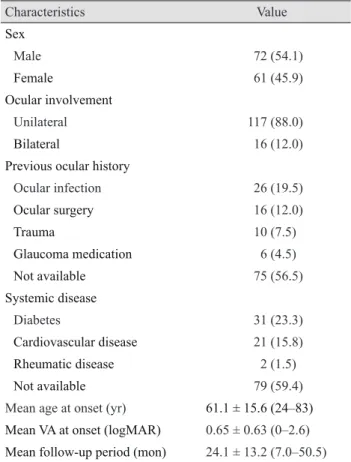
The general characteristics of all patients are summarized in Table 1. In total, 133 patients (72 male and 61 female) with 149 affected eyes were included in the study. The pa- tients were followed for 24.1 ± 13.2 (range, 7 to 50.5) months
on average. The mean age of HSK onset was 61.1 ± 15.6 (range, 24 to 83) years, and the mean BCVA at onset was 0.65 ± 0.63 (range, 0 to 2.6). Ocular involvement was unilat- eral in 117 (88%) cases and bilateral in 16 (12%). Twenty-six (19.5%) patients had a past ocular history of ocular infection such as blepharitis, infectious conjunctivitis, corneal ulcer, and endophthalmitis, while 31 (23.3%) patients had been di- agnosed with diabetes at the time HSK was diagnosed.
Table 1. Demographic and main clinical features of the 133 pa- tients in the study cohort
Characteristics Value
Sex
Male 72 (54.1)
Female 61 (45.9)
Ocular involvement
Unilateral 117 (88.0)
Bilateral 16 (12.0)
Previous ocular history
Ocular infection 26 (19.5)
Ocular surgery 16 (12.0)
Trauma 10 (7.5)
Glaucoma medication 6 (4.5)
Not available 75 (56.5)
Systemic disease
Diabetes 31 (23.3)
Cardiovascular disease 21 (15.8)
Rheumatic disease 2 (1.5)
Not available 79 (59.4)
Mean age at onset (yr) 61.1 ± 15.6 (24–83) Mean VA at onset (logMAR) 0.65 ± 0.63 (0–2.6) Mean follow-up period (mon) 24.1 ± 13.2 (7.0–50.5) Values are presented as number (%) or mean ± standard deviation (range).
VA = visual acuity; logMAR = logarithm of the minimum angle of resolution.
Table 2. Frequency of keratitis subtypes in the 149 affected eyes in the study cohort
Keratitis subtype
*Value
Epithelial keratitis 74 (49.7)
Stromal keratitis 35 (23.5)
Endotheliitis 28 (18.8)
Neurotrophic keratopathy 12 (8.0)
Values are presented as number (%).
*
The subtype refers to the subtype at presentation in our clinic.
Clinical features of patients with HSK subtypes
Table 2 shows the number of patients and eyes with the various HSK subtypes. Of the 149 affected eyes, 74 (49.7%) had epithelial keratitis, 35 (23.5%) had stromal keratitis, 28 (18.8%) had endotheliitis, and 12 (8.0%) had neurotrophic keratopathy.
Analysis of the BCVA at presentation and at the final vis- it for patients in each subtype group showed that stromal keratitis associated with the lowest BCVA at both time points. However, the subtypes did not differ significantly in terms of the BCVAs at either time point (Table 3).
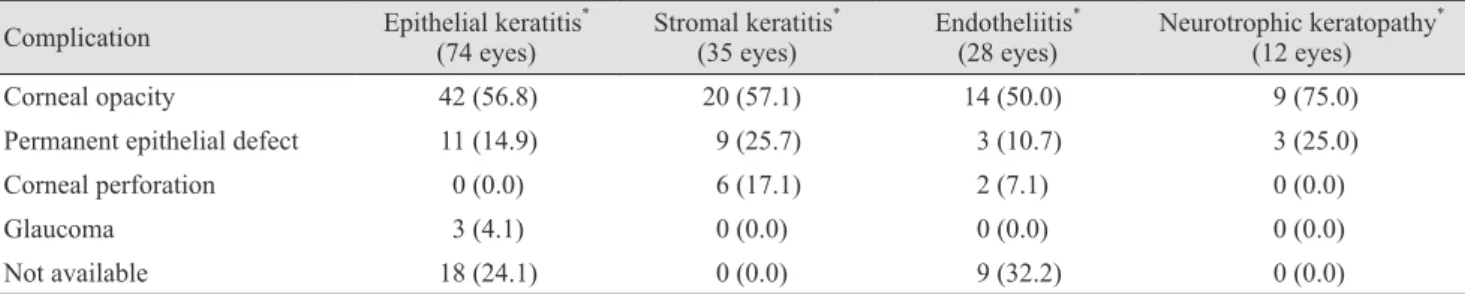
Table 4 shows the ocular complications that were encoun- tered during follow-up in each HSK subtype group. Cor- neal opacity was the most frequently seen ocular complica- tion in all four subtypes. Corneal perforation, which is a severe complication, occurred in six eyes with stromal ker- atitis and in two eyes with endotheliitis.
Recurrences
All patients were classified according to their follow-up duration, and the recurrence rate was higher with the lon- ger follow-up duration: 16.7% (13 / 78) within 1 year, 25.9%
(7 / 27) between 1 and 2 years, 53.8% (14 / 26) between 2 and 3 years, 77.8% (14 / 18) over 3 years. The numbers of
HSK recurrences in the four HSK subtype groups during follow-up are shown in Table 5. The types of ocular disease in the recurrences are also shown. Overall, 48 of 149 eyes (32.2%) exhibited one or more recurrences during fol- low-up. There was no significant difference in the follow-up period between the HSK subtype groups ( p = 0.983). The eyes that presented initially with neurotrophic keratopathy had the highest recurrence rate (6 of 12 eyes, 50.0%), fol- lowed by epithelial keratitis (24 of 74 eyes, 32.4%), endo- theliitis (9 of 28 eyes, 32.1%), and stromal keratitis (9 of 35 eyes, 25.7%). The number of recurrences ranged from one to three; none of the eyes recurred more than three times.
In the epithelial keratitis, stromal keratitis, and endotheliitis groups, the eye disease in the recurrence was mostly the same subtype as the eye disease in the first episode (83.3%, 66.7%, and 66.7%, respectively). However, in the six pa- tients with neurotrophic keratopathy who exhibited recur- rences, only three (50%) recurred as neurotrophic keratopa- thy (50%); the remaining three (50%) recurred as epithelial keratitis.
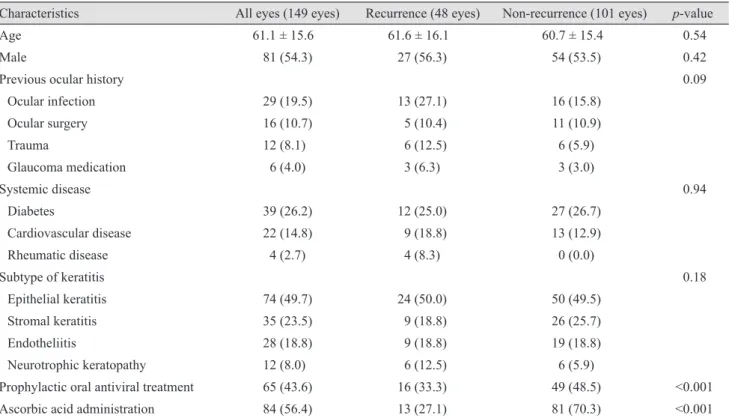
When the eyes with and without recurrence were com- pared, the two groups did not differ significantly in terms of age, sex, previous ocular history, systemic disease, or HSK subtype frequency. However, the recurrence rates were lower in prophylactic oral antiviral agent group (16 / 48 eyes, 33.3% vs. 49 / 101 eyes, 48.5%) and ascorbic acid treatment
Table 4. Frequency of ocular complications in the four keratitis subgroups Complication Epithelial keratitis
*(74 eyes) Stromal keratitis
*(35 eyes) Endotheliitis
*(28 eyes) Neurotrophic keratopathy
*(12 eyes)
Corneal opacity 42 (56.8) 20 (57.1) 14 (50.0) 9 (75.0)
Permanent epithelial defect 11 (14.9) 9 (25.7) 3 (10.7) 3 (25.0)
Corneal perforation 0 (0.0) 6 (17.1) 2 (7.1) 0 (0.0)
Glaucoma 3 (4.1) 0 (0.0) 0 (0.0) 0 (0.0)
Not available 18 (24.1) 0 (0.0) 9 (32.2) 0 (0.0)
Values are presented as number (%).
*
The subtype refers to the subtype at presentation in our clinic.
Table 3. Visual acuity of the keratitis subgroups at presentation and at the last follow-up visit
BCVA (logMAR) Epithelial keratitis
*Stromal keratitis
*Endotheliitis
*Neurotrophic keratopathy
*p-value
At presentation 0.57 ± 0.49 0.92 ± 0.79 0.54 ± 0.69 0.75 ± 0.71 0.06
At last visit 0.63 ± 0.70 1.21 ± 1.12 0.41 ± 0.37 0.43 ± 0.38 0.06
Values are presented as mean ± standard deviation.
BCVA = best-corrected visual acuity; logMAR = logarithm of the minimum angle of resolution.
*
The subtype refers to the subtype at presentation in our clinic.
group (13 / 48 eyes, 27.1% vs. 81 / 1 01 eyes, 70.3%) com- pared to the groups without medications (Table 6). Univar- iate logistic regression analysis revealed that prophylactic oral antiviral agent significantly lowered the risk of recur- rence (odds ratio, 0.51; 95% confidence interval, 0.12 to
0.5 1; p < 0.001). Oral ascorbic acid administration also sig- nificantly reduced the recurrence risk (odds ratio, 0.25; 95%
confidence interval, 0.20 to 0.91; p = 0.04). In addition, mul- tivariate logistic regression analysis showed that prophylac- tic oral antiviral agent and oral ascorbic acid administra-
Table 6. Characteristics of eyes with keratitis that did and did not recur during follow-up
Characteristics All eyes (149 eyes) Recurrence (48 eyes) Non-recurrence (101 eyes) p-value
Age 61.1 ± 15.6 61.6 ± 16.1 60.7 ± 15.4 0.54
Male 81 (54.3) 27 (56.3) 54 (53.5) 0.42
Previous ocular history 0.09
Ocular infection 29 (19.5) 13 (27.1) 16 (15.8)
Ocular surgery 16 (10.7) 5 (10.4) 11 (10.9)
Trauma 12 (8.1) 6 (12.5) 6 (5.9)
Glaucoma medication 6 (4.0) 3 (6.3) 3 (3.0)
Systemic disease 0.94
Diabetes 39 (26.2) 12 (25.0) 27 (26.7)
Cardiovascular disease 22 (14.8) 9 (18.8) 13 (12.9)
Rheumatic disease 4 (2.7) 4 (8.3) 0 (0.0)
Subtype of keratitis 0.18
Epithelial keratitis 74 (49.7) 24 (50.0) 50 (49.5)
Stromal keratitis 35 (23.5) 9 (18.8) 26 (25.7)
Endotheliitis 28 (18.8) 9 (18.8) 19 (18.8)
Neurotrophic keratopathy 12 (8.0) 6 (12.5) 6 (5.9)
Prophylactic oral antiviral treatment 65 (43.6) 16 (33.3) 49 (48.5) <0.001
Ascorbic acid administration 84 (56.4) 13 (27.1) 81 (70.3) <0.001
Values are presented as mean ± standard deviation or number (%).
Table 5. Frequency and type of clinical recurrence in the four keratitis subgroups Epithelial keratitis
*(74 eyes) Stromal keratitis
*(35 eyes) Endotheliitis
*(28 eyes) Neurotrophic keratopathy
*(12 eyes)
Mean follow-up period (mon) 23.4 ± 11.6 23.8 ± 15.3 24.2 ± 13.6 24.8 ± 13.1
Eyes with recurrences 24 (32.4) 9 (25.7) 9 (32.1) 6 (50.0)
No. of recurrences
1 18 (75.0) 3 (33.3) 3 (33.3) 3 (50.0)
2 6 (25.0) 3 (33.3) 3 (33.3) 0 (0.0)
≥3 0 (0.0) 3 (33.3) 3 (33.3) 3 (50.0)
Subtype of recurrences
Epithelial keratitis 20 (83.3) 3 (33.3) 0 (0.0) 3 (50.0)
Stromal keratitis 4 (16.7) 6 (66.7) 3 (33.3) 0 (0.0)
Endotheliitis 0 (0.0) 0 (0.0) 6 (66.7) 0 (0.0)
Neurotrophic keratopathy 0 (0.0) 0 (0.0) 0 (0.0) 3 (50.0)
Values are presented as mean ± standard deviation or number (%).
*