Meaning Relatedness of SPATIAL PROXIMITY with COMPARISON, CONTRAST, and CONCESSIVE: Focusing on Korean Verb tayta
Youngju Choi (Chosun University)
Choi, Youngju. (2019). Meaning relatedness of SPATIAL PROXIMITY with COMPARISON, CONTRAST, and CONCESSIVE: Focusing on Korean verb tayta.The Linguisitic Association of Korea Journal, 27(1), 103-121. Based on cognitive semantics, Izutsu and Izutsu (2011) provide an explanation of how English connectives such as while and whereas extend their meanings to CONTRAST and CONCESSIVE from their original meaning TEMPORAL/SPATIAL OVERLAP. In case of while, the two propositions connected by while are arranged side by side within the viewer’s viewing frame. The arrangement creates spatial proximity between the two propositions, making it easy to compare and contrast them, leading to the meaning CONTRAST for while. The meaning CONCESSIVE is developed when the co-occurrence of the events denoted by the two propositions is not compatible with one of the viewer’s assumptions. These explanations raise the question as to whether this type of meaning development is restricted to connectives or if it can be extended to other categories. In answering the question, the paper examines Korean verb tayta, which literally means SPATIAL CONTACT, and reveals that the meaning development is similarly observed. The cross-categorical finding of the paper strengthens the linguistic motivation towards meaning development from spatial proximity to comparison, contrast, and concessive.
Key Words: cognitive semantics, spatial proximity, contrastive meaning, concessive meaning, linguistic motivation
1. Introduction
Claiming that linguistic units are not arbitrary but motivated, Radden and Panther (2004) show how various linguistic phenomena are predominantly motivated. In doing so, they define the linguistic motivation as in (1), where we can find two different types of contributing causes
relevant to the motivation.
(1) A linguistic unit (target) is motivated if some of its properties are shaped by a linguistic source (form and/or content) and language-independent factors. (Radden and Panther 2004: 4)
The first cause is a linguistic source and the second are language independent factors. The linguistic source is the content or the form of the linguistic unit. For example, when a linguistic unit reflects its content as in the case of onomatopoeic words, then the content is said to motivate its form. The language-independent factors are mainly cognitive factors, such as metaphoric and metonymic mappings, which are not directly related to language itself.
When considering linguistic motivation, it must be remembered that we cannot exhaustively cover every possible motivational factor, as Radden and Panther (2004) indicated. Rather, through abductive reasoning, we identify the most likely motivational cause. They take as an example the grammaticalization phenomenon of the Ewe verb nâ which originally means ‘to give’ and is changed to benefactive marker. Though there is, potentially, a host of reasons for this change, abductive reasoning points to the most compelling causes, a linguistic cause and a language-independent cause, as follows: the original meaning of nâ ‘to give’ serves as a linguistic source for the meaning change. The metonymy NEUTRAL FOR POSITIVE evokes an inference drawing the meaning of benefactive from recipient and the metonymy EVENT FOR SALIENT PARTICIPANT OF EVENT evokes an inference drawing the meaning of benefactive from the entire event of giving. The two metonymies are language-independent contributing causes for the grammaticalization. The procedure of abductive reasoning is summarized in (2).
(2) a. observed fact: Target: Ewe nâ has the grammatical meaning BENEFACTIVE.
b. abductive reasoning:
(i) Source: nâ originally meant ‘give’, i.e. ‘Agent causes Recipient to have Object’ [contributing cause: linguistic source]
(ii) The metonymic principle NEUTRAL FOR POSITIVE invites the inference from RECIPIENT to BENEFACTIVE [contributing cause:
language-independent factor)]
(iii) The metonymic principle EVENT FOR SALIENT PARTICIPANT OF
EVENT invites the inference from event of ‘giving’ to ‘benefiting recipient’ of this event [contributing cause: language-independent factor]
(iv) The grammatical meaning BENEFACTIVE of nâ is caused (= motivated) by the contributing causes (i) - (iii).
(Radden and Panther 2004: 10)
Through this kind of abductive reasoning, Izutsu and Izutsu (2011) explain how the meaning change/extension observed in English connectives while and whereas is motivated. The linguistic source is the original meaning of the connectives: the prototypical sense of while is TEMPORAL OVERLAP and the prototypical sense of whereas is SPATIAL OVERLAP. The language-independent factor is the conversational implicature, which evokes the inference meanings such as comparison, contrast, and concession from the side-by-side arrangement of two events.
Linguistic motivation is strengthened when similar phenomena are repeatedly observed. For example, in the case of the meaning change/extension of the connectives while and whereas, the same meaning change is observed prevalently in conceptually similar connectives across languages, strengthening the linguistic motivation. This paper aims to strengthen the linguistic motivation even further by dealing with the meaning extensions of the Korean verb tayta, whose prototypical meaning is SPATIAL CONTACT. If tayta participates in the same meaning change from SPATIAL CONTACT to COMPARISON, CONTRAST, CONCESSIVE, it would strengthen the linguistic motivation further, since it would show that the meaning change occurs not only in connectives but also in verbs.
In section 2, the motivation causing the meaning extensions/changes of some connectives, such as while and whereas, will be explained based on Izutsu and Izutsu (2011). In section 3, the meaning extensions of the Korean verb tayta will be observed, demonstrating that not only connectives but also verbs can participate in the same meaning extensions. The observation leads us to conclude that the meaning extension is very prevalently observed cross-linguistically and even cross-categorically. These findings are summarized in section 4.
2. TEMPORAL/SPATIAL OVERLAP to CONTRAST and CONCESSIVE
Traugott and König (1991) claim that contrastive and concessive meanings emerged from spatial and temporal overlap through conventionalizing conversational implicatures. Adopting their idea, Izutsu and Izutsu (2011) explain how the meanings CONTRAST and CONCESSIVE arise from TEMPORAL/SPATIAL OVERLAP with the English examples while and whereas. The connective while originally indicates TEMPORAL OVERLAP, as shown in (3a). However, in the Present-Day English (PDE), it can also indicate CONTRAST and CONCESSIVE, as shown in (3b) and (3c). In (3b), Tom’s hardworking is contrasted with Bill’s laziness. In (3c), sympathizing with a person and not accepting his opinion are in conflict and therefore establish a concessive relationship.
(3) From temporal overlap to contrast/concessive: while
a. TEMPORAL OVERLAP: I killed time in a book shop while I was waiting.
b. CONTRAST: Tom is hardworking, while Bill is lazy.
c. CONCESSIVE: While I sympathize with you, I cannot accept your opinion.
In case of while, its original meaning and extended meanings are all observed in PDE while whereas only has the extended meanings in PDE, with its original meaning SPATIAL OVERLAP being obsolete. Whereas, which is used to indicate SPATIAL OVERLAP, as in (4a), now means CONTRAST and CONCESSIVE, as shown in (4b) and (4c).
(4) From spatial overlap to contrast/concessive: whereas a. SPATIAL OVERLAP (obs.):
[..] oure heartes may surely there be fixed, whereas true joyes are to be founde.
‘[...] our hearts may surely there be fixed where true joys are to be found’
(1547–49, The Book of Common Prayer)
b. CONTRAST: Some of the students achieve good results, whereas others do not.
c. CONCESSIVE: Whereas it would be naive to maintain that inflation is no longer of concern, (nevertheless) all the economic indicators suggest that the money supply can now be safely increased. (Quirk et al.
1985: 1099)
The meaning extension/change from TEMPORAL/SPATIAL OVERLAP to CONTRAST and CONCESSIVE in the category of connectives is observed cross-linguistically, as shown in (5).
(5) Connectives of other languages
Japanese: nagara ‘while’, -noni [〈 no (formal noun) + ni (allative /temporal case marker)] ‘even though’, tokoroga [〈 tokoro ‘place’ + ga (nominative case marker)] ‘but’
Ainu: korka [〈 kor ‘while’ + ka ‘also’] ‘though’
Korean: -myeonseo ‘while’, -neun/(eu)nde [〈 neun/(eu)n (adnominal ending) +de ‘place’] ‘(al)though’, ‘but’
Indonesian: sedang ‘while’, ‘(al)though’
German: wahrend ‘while’, indes(sen) ‘meanwhile’
Latin: cum ‘when’, ‘(al)though’
French: tandis que ‘while’, cependant ‘meanwhile’, ‘yet’, ‘however’; alors que
‘when’, ‘(al)though’, lorsque ‘when’, ‘(al)though’, au lieu que ‘in the place that’, ‘whereas’, quand ‘when’, (al)though’
Italian: mentre ‘while’, ‘whereas’
Spanish: cuando ‘when’, ‘(al)though’
Dutch: terwijl ‘while’
Danish: medens ‘while’
Turkish: iken ‘when’, ‘(al)though’, and others.
Izutsu and Izutsu (2011: 109)
Among many, Korean –myeonseo, which originally meant temporal overlap, also means contrast and concessive in Present-Day Korean (PDK) and –neunde, which used to indicate
‘place,’ means ‘although’ in PDK. The ubiquity of the meaning changes in the connectives requires an adequate explanation.
2.2. From TEMPORAL OVERLAP to CONTRAST
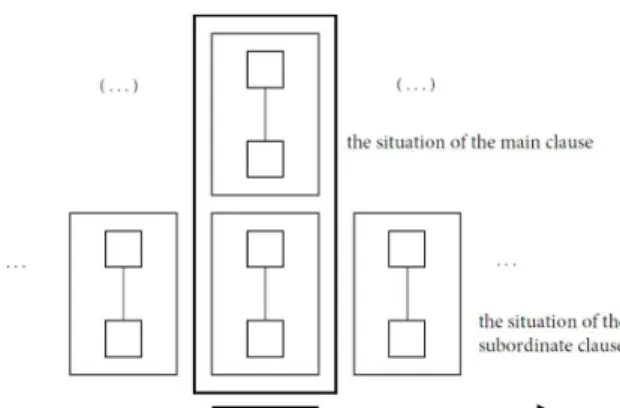
Why does the meaning changes arise cross-linguistically? Izutsu and Izutsu (2011) provide the answer based on cognitive semantics. In case of while, the TEMPORAL OVERLAP meaning can be diagrammed as shown in <Figure 1> where the profiled two events occur on the same temporal plane.
Figure 1. Temporal while(Izutsu and Izutsu 2011: 111)
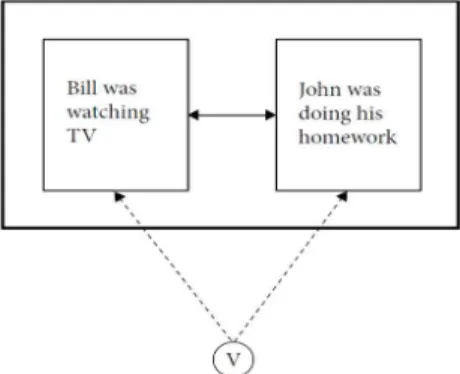
Adopting Langacker’s viewing arrangement, Izutsu and Izutsu (2011) arrange the two concurrent events side by side in the same viewing frame, as in <Figure 2>. When they are placed together as objective scenes within viewer’s viewing frame, they are likely to be compared. When the result of the comparison shows great contrast between the two scenes, the CONTRAST meaning arises, as in While Bill was watching TV, John was doing his homework.
Figure 2. Viewing arrangement of temporally overlapping situations (Izutsu and Izutsu 2011: 112)
According to Izutsu and Izutsu (2011), when the two scenes, Bill watching TV and John doing his homework, are on the same stage as shown in <Figure 3>, the viewer is encouraged to compare the two scenes. As a result of the comparison, the clear difference between the two activities of watching TV and doing one’s homework is noticed, leading to the dominance of contrastive meaning over temporal meaning. The double-headed arrow indicates the clear
contradiction between the two activities.
Figure 3. The perception of contrast (Izutsu and Izutsu 2011: 112)
2.3. From TEMPORAL OVERLAP to CONCESSIVE
In the contrastive meaning, we can find that there is a clear difference between the two scenes on the same stage. In the concessive meaning, on the other hand, the difference is not found between the two scenes, but rather between the co-occurrence of the two scenes and the viewer‘s assumption. By Izutsu (2005, 2008), the concessive meaning is defined as shown in (6). The meaning arises when a proposition of one clause assumes something different from a proposition of the other clause.
(6) Concessive is a conflict relation between an assumption evoked by the propositional content of one clause and the propositional content of the other.
(Izutsu 2005, 2008)
Since (7a) involves the background assumption in (7b), the contradictory proposition asserted in the main clause of (7b) invokes a concessive reading.
(7) a. Concessive sentence: Although it was raining, the game took place.
(Although p, q.)
b. Assumption involved: ‘If it is raining, then normally the game does not take place.’
(more generally: ‘If p, then normally not q.’)
(Izutsu and Izutsu 2011: 113)
The concessive meaning of the following sentence arises because the proposition of the main clause the game took place is in a conflict relation with the viewer’s general assumption that the game does not take place in case of rain.
(8) While it was raining, the game took place.
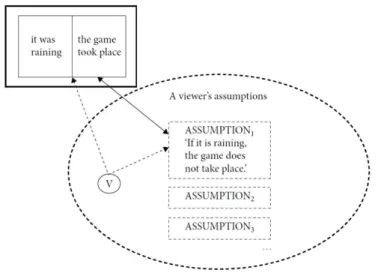
The diagram in <Figure 4> illustrates the development of the concessive meaning. The two propositional contents it was raining and the game took place which are on the same stage in the viewing arrangement model, are not in contrast with each other. However, when the co-occurrence of the two states is compared with one of the viewer’s general assumptions, the co-occurrence of the two states conflicts with the assumption. The conflict relation is represented in the double-headed arrow in <Figure 4>.
Figure 4. Development of concessive meaning (Izutsu and Izutsu 2011: 114)
When we accept the explanation Izutsu and Izutus (2011) provide, one question arises as to whether the semantic change from spatial/temporal overlap to contrast and concessive is observed only in connectives or in other categories as well. To answer the question, this paper will observe the Korean verb tayta ‘to contact,’ whose prototypical meaning is related to spatial overlap/contact, and examine whether the verb also undergoes meaning extensions from spatial contact
to comparison, contrast, and concessive.
3. Korean Verb tayta ‘to contact’
3.1. Prototypical Meaning of tayta: Spatial Contact
The Korean verb tayta prototypically means spatial contact, ‘to bring one thing close to another so that they make contact,’ as shown in (9)1). The two examples include the instances where a body part makes a contact with an object.
The body parts, lips and elbows, move towards some physical entities, pump and table in (9a) and (9b), respectively, and touch them.
(9) a. phemphwuey ipul tayko hekepcikep mwulul tulikyessta pump.to lips contact.and very.hurriedly water gulped
‘With his lips to the pump, (he) gulped water very hurriedly.’
b. phalkkwumchilul tayko ancun namwu sikthakun
elbow touch.and sit.down wood table
koki kilum ttaymwuninci kkuncekkkuncekhayssta
meat grease because.of was.sticky
‘The wood table on which (I) had (my) elbows while sitting at was very sticky, perhaps due to meat grease.’
When an elongated object makes a contact with another entity, the meaning is extended to ‘to put one thing under/beside another.’ In (10), the physical contact made along the elongated object, which is located under the other object.
In (10a), the splint is under the person’s arm and in (10b), the bamboo sticks are under shoes.
(10) a. Mantolinun phaley kakmokul tayko
Mantol arm.to dressing.stick put.under
pwungtaylo kamko issessta
with.a.sterile.pad roll was.being
1) The data used in the paper are all from the Corpus of National Institute of the
‘Mantol had a splint under his arm and he was dressing it with bandages.’
b. wulinala centhong sukheyithulo our.country traditional as.a.skate
cipsinpatakey taynamwuccokul tayn ’
under.the.sole.of.straw.shoes bamboo.part put.under taypal’ilanun key kunseykkaci issessta
bamboo.shoes thing till.modern.days was
‘As traditional skate shoes, we used, until recently, woven shoes with bamboo sticks under them.’
3.2. Meaning Extensions to ARRIVAL, PARKING, PUNCTUALITY, and PROVISION
The prototypical meaning SPATIAL CONTACT is extended to ARRIVAL, as shown in (11). ARRIVAL is interpreted as a person/a vehicle’s being in contact with a place. In (11), the train’s coming in contact with the station refers to the arrival of the train.
(11) kichanun pansikani mot toye pwulkwuksa yekey tayessta
train half.hour not become Pulkuk.Temple station contacted
‘The train arrived at Bulkuk temple station within a half of an hour’
The prototypical meaning SAPTIAL CONTACT also extends to the meaning of PARKING.
When a vehicle is parked, it is often brought up to a certain point or marker which limits its further movement. The contact of the vehicle with the limit makes the vehicle stop. The stop is construed as parking, as shown in (12).
(12) kueykey khilul nemkyecwuko chalul mwun palo
him key pass.over.and car door right
apheytaka taytallako pwuthakhayssta front contact.want asked
'I passed the key over to him and asked him to park my car right in front of the door'
The SPATIAL CONTACT meaning is also extended to PUNCTUALITY. The example
(13) shows that the ARRIVAL meaning has a potential to be extended to PUCTUALITY when time is metaphorically understood as a place. In (13), tayta means PUNCTUALITY as well as ARRIVAL, meaning a vehicle’s arrival at a specified time. The contact is made to hayan ’before sunset,’ which is a temporal expression.
(13) hayaney taykika elyepkwu com etwuwese day.in contact difficult a.little become.dark tahci anhulkka siphkwumeniyo
arrive not seems.like
'It’ll be hard to arrive at sunset, I think we’ll get there after it gets a little dark.’
The verb tayta in (14) indicates PUNCTUALITY alone without accompanying the meaning ARRIVAL. When an event becomes in contact with a fixed time, the meaning PUNCTUALITY arises.
(14) ku ilul cenghaycin sikaney taylyeko setwulessta the job fixed time contact.in.order.to hurried
‘In order to be punctual, (we) hurried up’
When money or resources are in contact with someone, that person can then make use of them. The SPATIAL PROXIMITY established through the SPATIAL CONTACT implicates possession and control. Therefore, bringing resources close to someone is construed as providing it for use, evoking the meaning PROVISION.
(15) a. kyengpika mwunceylamyen ceyka ta taytulikesssupnita
money problem.if I all provide.give.will
'If money is the issue, I can provide all the money you need' b. wuli myenulika pyenhosanun taysseyo
our daughter-in-law laywer provided
'My daughter-in-law provided the laywer'
Other than those that have been introduced, the meaning extension of the verb tayta takes another path that is relevant to the research question of the paper. It extends to the meaning
of comparison, contrast, and concessive, as will be introduced in the next section.
3.3. Meaning Extensions to COMPARISON, CONTRAST and CONCESSIVE 3.3.1 From SPATIAL CONTACT to COMPARISON
In order for two things to be compared, they need to be located close to each other so that the viewer can observe them together with ease. Therefore, ‘to contact’ is construed as ‘to compare,’ through the metonymy ACTION FOR IMPLICATURE. The action of putting two things together (ACTION) implies the comparison between them (IMPLICATURE). When talking about physical entities, there arise two meanings, literal and metonymical. As in (16), tayta can be interpreted in its literal sense ‘to contact’ and then with its metonymical meaning
‘to compare,’ which is implicated as a result of the contact.
(16) hanpen tay polkka? nikkey khunci naykkey khunci?
once contact try yours is.bigger mine is.bigger
‘You want to measure them up against each other? See if yours is bigger or mine is?’
However, when the two entities are not physical but abstract, it is impossible to put them together and put them in contact physically. Therefore, the possibility of the literal sense is eliminated and the meaning ‘to compare’ becomes the only possible option. As in (17), when the proverb ‘long and short can only be determined by measuring them up against each other’
is applied to an abstract situation, it is interpreted, in this case, as ‘we have to put two teams in the competition to see which team is stronger (rather than making assumptions).’ The two teams in competition are put in contact in the viewer‘s perceptual viewing frame, rather than physically.
(17) kilko ccalpun kesun tay pwaya antako yakchey long short thing contact try know weak.team
115
Cenpwuki choykun 2 yensungulo mwusepkey Chonbuk.team recent 2 successive.victory fiercely sangsungseylul thako issten Yukongul capa high.spirit ride exist Yukong.team catch welchekul kilokhayssta
big.fish recorded
‘As the proverb says, long and short can only be determined by measuring them up against each other; the Chonbuk team set a new record, unexpectedly winning over the Yukong team which was on a streak, having had two victories in a row recently.’
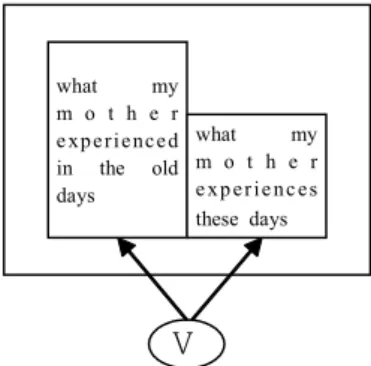
In (18), the two things being put together are experiences that occurred at two different times. Therefore, as with the previous example, the meaning of physical contact is eliminated and the meaning of comparison is the only possible reading.
(18) thukhi emeninun nulkekasilswulok kukey te simhayssta especially mother be.older.and.older that.way more seriously mwuesitunci ku sicelhako taypolye tusyessta
whatever the with.days contact tried
‘My mother, especially, got worse with age; she tried to compare everything to the old days.’
what my
m o t h e r e xp e r i e nc e d in the old days
what my
m o t h e r e x p e r i e n c e s these days
V
kanu close . b u t
retur n
pat h kanu n
Figure 5. Development of the Comparison Meaning intayta
The previous examples all have tay-pota which has the auxiliary verb pota ‘to try.’ So, it may be thought that the COMPARISON meaning is only possible when tayta occurs with
the auxiliary verb pota. However, we have the following example where tayta without having the auxiliary verb indicates the meaning of COMPARISON. In (19), the speaker compares what he used to be with what he is now.
(19) ku ttaymanhayto cikumeyta taymyen
that days.with to.now contact.if
hancham celmessul ttayye
much young days
‘Even then, if you compare it to now, he was still very much in his youth.’
3.3.2 From SPATIAL CONTACT to COMPARISON and further to CONTRAST
When the result of a comparison shows a big difference between the compared entities, then the meaning CONTRAST is made available, as shown in (20). The meaning COMPARISON implicates the meaning CONTRAST when there is a big difference between the entities or events which are in comparison.
(20) Sewuleyse Cencwu onun kiley taymyen Cencwueyse cipulo
from.Seoul Cheonju comepath contact.if from.Cheonju to.home kanun kilun cichekikenman tolaonun kilun sillo melko go path close.but return path really distant atukhayssta
was.far.away
‘When compared with the distance from Seoul to Cheonju, the distance from Cheonju to home was nothing at all, but my actual experience of returning home seemed to take forever.’
d i s t a n c e between S to C
d i s t a n c e between C to H
V
Figure 6. Development of the Contrast Meaning intayta
When the verb tayta occurs with negative expressions such as anita ‘not,’ as in tayl kesto anita, its contrastive meaning becomes more evident. The expressions tayl kesto anita indicates
‘not necessary to make the two things contact and compare,’ which metonymically indicates that the two entities are so contrasting that comparing them is unnecessary or unreasonable.
The two entities are, in other words, incomparable.
(21) a. kyay atul Changhwanihakon tayl kesto aninikkayo his son with.Changhwan contact thing.even not
‘(That one) is not comparable to his boy, Changhwan’
b. sikoleyse sal ttaywanun tayl kesto aninkey rurual.area live with.days contact thing not copun matangiko hwachoka cal calaci anhassta small yard.and flowers well grow not
‘The yard is so small, it‘s incomparable to the yard in the country, and the flowers did not bloom very well there.‘
Similarly, the expression taymyen amwukesto anita literally means ‘if something is in contact and comparison with another, it is nothing.’ Metonymically, it means that the contrast between the two compared entities is so large, it makes one look like nothing in relation to the other.
(22) olhayeyta taymyen amwukesto anin cangmalul kyekkun this.year contact.if anything not rainy.season experience hwu khemphwutheka caktongi antoye eyieysulul patassnuntey after computer operation impossible AS received.but
'After a rainy season that was nothing compared to this year’s, the computer stopped working and we had to get it repaired.'
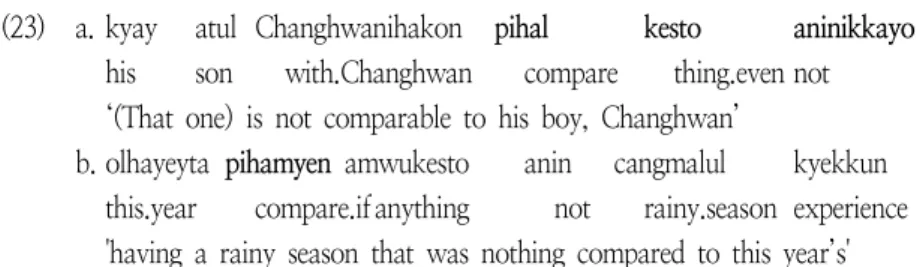
When the verb tayta is replaced by the verb pihata, which literally means 'to compare,' as shown in (23a) and (23b), they have the same meaning as the previous sentences which are (21a) and (22). The meaning of the verb pitahta 'to compare' is extended to 'to contrast' when the verb is accompanied by the negative phrases such as anita 'not', amwukesto anita 'be nothing,' since the comparison result is that nothing is comparable, then it is interpreted as there is a big contrast.
(23) a. kyay atul Changhwanihakon pihal kesto aninikkayo his son with.Changhwan compare thing.even not
‘(That one) is not comparable to his boy, Changhwan’
b. olhayeyta pihamyen amwukesto anin cangmalul kyekkun this.year compare.if anything not rainy.season experience 'having a rainy season that was nothing compared to this year’s'
3.3.3. From SPATIAL CONTACT to COMPARISON and further to CONCESSIVE
The concessive meaning is obtained when a condition and its consequence are not in concord with one of the viewer’s assumptions. As shown in <Figure 7>, the viewer’s assumption is that great suffering leaves marks on those who experienced it. tayta in (24) has a concessive meaning, because even though the person in the sentence experienced great suffering, she did not bear its signs, and the speaker concedes to this fact even though it goes against the speaker’s assumption.
(24) “kosaynghanteyta taymyen
what.she.have.experiencced if.contact hemcipiya acwu epsnun semicyo”
marks very not.exist is.counted
‘Even though (she) has been through a lot, she does not bear the signs of suffering.’
Figure 7. Development of the Concessive Meaning intayta
When the verb tayta is replaced by other verb pihata which literally means ‘to compare,’
as shown in (25), the replacement does not change the meaning at all. The sentence in (25) literally means that if the amount of suffering she experienced is compared with the signs of the suffering, she does not seem to have them.
(25) kosaynghantey(ta) pihamyen what.she.have.experienced if.compared hemcipiya acwu epsnun semicyo remarks very not.exist is.counted
‘(Lit.) When compared with how much shes been through, she does not bear the signs of suffering’’
‘Even though (she) has been through a lot, (she) does not bear the signs of suffering’
The two sentences in (24) and (25) share the meaning of comparison. The meaning COMPARISON implicates the meaning of CONCESSION, through the conversational implicature. Therefore both taymyen and pihamyen indicate the ‘even-though’ meaning in the two sentences. Since the verb tayta can be replaced by pihata, which is literally means comparison, it may be easily interpreted as having the COMPARISON meaning. However, pihata itself extends its meaning to CONCESSION when two events are compared and their co-occurrence is against one of the assumptions of a speaker.
4. Conclusion
We have seen that the meaning extension from SPATIAL PROXIMITY to COMPARISON, CONTRAST, and CONCESSIVE is observed in the verb tayta, similar to the connectives of various languages. The meaning extensions arise through the metonymy ACTION FOR IMPLICATURE. The action, which is used as a metonymic vehicle, is moving one entity to put it in contact with another. When the two entities become closer to each other, it is implicated that they are easily compared. The metonymic vehicle is used to indicate the metonymic target, which is the implicature of the action.
The extended meaning COMPARISON is further extended to CONTRAST. When two entities/events are in comparison and the difference between them is apparent, it is implicated that the two are contrastive. Therefore, the meaning CONTRAST arises due to the same
metonymy ACTION FOR IMPLICATURE.
The meaning COMPARISON is also extended to CONCESSIVE. The meaning CONCESSIVE arises when the co-occurrence of the two events is in conflict with one of the viewer’s assumptions. The contrast here is between the co-occurrence of the two events and an assumption the viewer has.
Through the observation of Korean verb tayta, the motivation of the emergence of COMPARISON, CONTRAST, and CONCESSIVE from SPATIAL PROXIMITY is strengthened further with the cross-categorical evidence.
References
Izutsu, M. N. (2005). Contrast, concessive, and corrective: A unifying analysis of opposition relation in English. Unpublished doctoral dissertation, Hokkaido University, Sapporo, Japan.
Izutsu, M. N. (2008). Contrast, concessive, and corrective: Toward a comprehensive study of opposition relations. Journal of Pragmatics, 40, 646–675.
Izutsu, M. N., & Izutsu, K. (2011). What motivates an inference?: The emergence of CONTRAST/CONCESSIVE from TEMPORAL/SPATIAL OVERLAP. In K-W. Panther
& G. Radden (Eds.), Motivation in grammar and the lexicon (pp. 107-132). John Benjamins Publishing Company.
Lakoff, G. (1993). The contemporary theory of metaphor In Andrew Ortony (Ed.), Metaphor and Thought (pp. 202-251). Cambridge University Press.
Panther, K-U., & Thornburg, L. L. (2003a). Introduction: On the nature of conceptual metonymy. In K.-U. Panther & L. L. Thornburg (Eds.), Metonymy and pragmatic inferencing (pp. 1-22). John Benjamins Publishing Company.
Panther, K-U., & Thornburg, L. L. (2003b). Metonymies as natural inference and activation schemas: The case of dependent clauses as independent speech acts. In K.-U. Panther and L. L. Thornburg (Eds.), Metonymy and pragmatic inferencing (pp. 127-148). John Benjamins Publishing Company.
Radden, G., & Panther, K-U. (2004). Introduction: Reflections on motivation. In G. Radden
& K-U. Panther (Eds.), Studies in linguistic motivation (pp. 1-46). Walter de Gruyter.
Traugott, E. C., & König, E. (1991). The semantics-pragmatics of grammaticalization revisited. In E. C. Traugott & B. Heines (Eds.), Approaches to grammaticalization, 1 (pp. 189-218). John Benjamins Publishing Company.
Youngju Choi Professor
Department of English Language and Literature Chosun University
309, Pilmun-tayro, Dong-gu, Gwangju, 61452 Phone: +82-62-230-6540
Email: [email protected]
Received on January 30, 2019
Revised version received on March 18, 2019 Accepted on March 28, 2019