• 검색 결과가 없습니다.

Laparoscopic repair of a rectal fistula due to a benign ovarian dermoid cyst

N/A
N/A
Protected

Academic year: 2022

Share "Laparoscopic repair of a rectal fistula due to a benign ovarian dermoid cyst"

Copied!
4
0
0

로드 중.... (전체 텍스트 보기)

전체 글

(1)

www.ogscience.org 383

Case Report

Obstet Gynecol Sci 2017;60(4):383-386 https://doi.org/10.5468/ogs.2017.60.4.383 pISSN 2287-8572 · eISSN 2287-8580

Introduction

Dermoid cysts are one of the most common benign neo- plasms, accounting for 10% to 20% of all ovarian tumors [1].

While ovarian dermoid cysts are usually asymptomatic, about 20% of patients with ovarian dermoid cysts can have compli- cations, such as torsion (16%), rupture (1% to 4%), malig- nant transformation (1% to 2%), infection (1%), and invasion into adjacent viscera (<1%) [2]. Although ovarian dermoid rupture and fistula formation involving the bladder, rectum, and intestine are well documented in malignant transforma- tion [3,4], fistula formation due to a benign ovarian dermoid cyst is a rare condition. To the best of our knowledge, laparo- scopic repair of rectal fistula due to benign ovarian dermoid cyst has not been reported. Herein, we present a case of a benign ovarian dermoid cyst with a recto-ovarian fistula and successful laparoscopic repair of the rectal fistula.

Case report

A 17-year-old girl presented with lower abdominal pain, pas- sage of sebaceous materials within the stool, and hemato- chezia for two months. She had no sexual relations and no specific medical or surgical history. The patient’s vital signs on arrival were within normal limits, and she was afebrile. Physi-

cal examination revealed lower abdominal tenderness; how- ever, there was no muscle guarding or rebound tenderness.

Transrectal ultrasonography revealed a 10-cm heterogeneous cystic mass in the right ovary.

Laboratory studies revealed an elevated white blood cell count of 21.9 K/mm

3

and a C-reactive protein level of 20.0 mg/dL. The results of tumor marker analyses performed pre- operatively showed the following values: CA 125 95.3 U/mL (upper limit, 35 U/mL) and CA 19-9 69.9 U/mL (upper limits, 37 U/mL).

Computed tomography scan of the abdomen and pelvis revealed an 11×9×8-cm

3

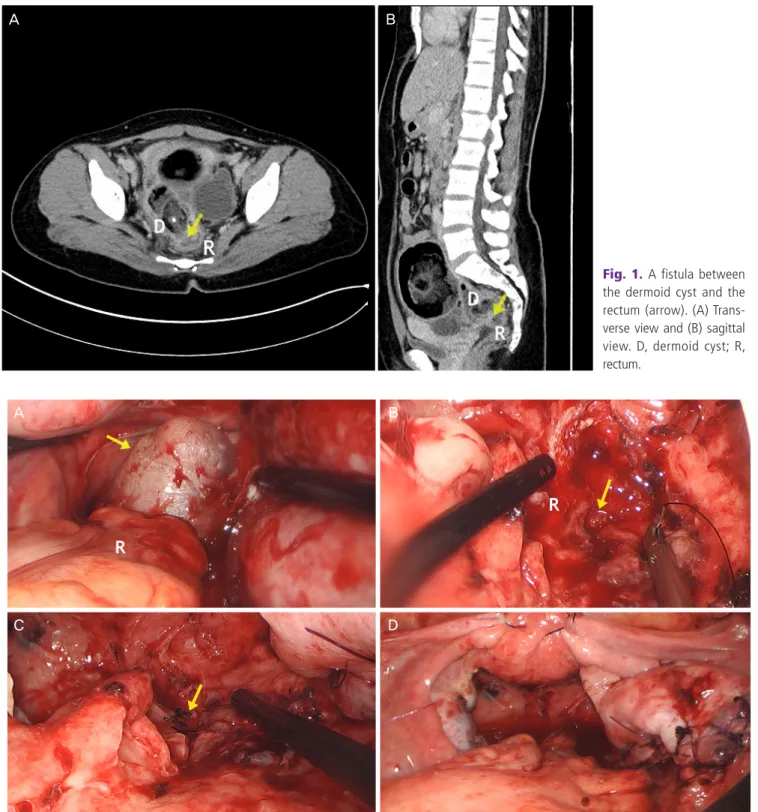
multilocular complex cystic mass thought to be a right dermoid cyst, which was seen to pen- etrate the middle part of the rectum (Fig. 1). A 5×5×4-cm

3

Laparoscopic repair of a rectal fistula due to a benign ovarian dermoid cyst

Ji Hye Kim 1 , Gun Oh Chong 1 , Da Som Chun 1 , Soo Yeun Park 2 , Yoon Hee Lee 1 , Dae Gy Hong 1

1
Gynecologic Cancer Center,

2

Colorectal Cancer Center, Kyungpook National University Medical Center, Kyungpook National University School of Medicine, Daegu, Korea

Ovarian dermoid cysts are one of the most common benign neoplasms in women. Rectal fistula formation due to an ovarian dermoid cyst, particularly a benign dermoid cyst, is extremely rare. A 17-year-old girl with symptoms of lower abdominal pain, passage of sebaceous materials in the stool, and hematochezia was found to have an 11-cm dermoid cyst complicated with a rectal fistula formation. Laparoscopic repair of the rectal fistula was performed successfully with bilateral ovarian cystectomies. This case presents the rare formation of a fistula between a benign dermoid cyst and the rectum and its treatment using laparoscopic repair without laparotomy.

Keywords: Dermoid cyst; Laparoscopy; Rectal fistula

Articles published in Obstet Gynecol Sci are open-access, distributed under the terms of the Creative Commons Attribution Non-Commercial License (http://creativecommons.

org/licenses/by-nc/3.0/) which permits unrestricted non-commercial use, distribution, and reproduction in any medium, provided the original work is properly cited.

Copyright © 2017 Korean Society of Obstetrics and Gynecology

Received: 2016.10.10. Revised: 2016.11.14. Accepted: 2016.11.14.

Corresponding author: Gun Oh Chong

Gynecologic Cancer Center, Kyungpook National University Medical Center, 807 Hogukno, Buk-gu, Daegu 41404, Korea

Tel: +82-53-200-2684 Fax: +82-53-200-2028 E-mail: [email protected]

http://orcid.org/0000-0003-4887-4017

(2)

www.ogscience.org 384

Vol. 60, No. 4, 2017

complex cyst thought to be a dermoid cyst was also identified in the left ovary. The preoperative suspicion was an ovarian dermoid cyst that had ruptured and a recto-ovarian fistula.

Therefore, the decision was made jointly by general surgeon

and gynecologist to take the patient to the operating room for diagnostic laparoscopy and further procedures.

On laparoscopy, a large mass originating from the right ovary was seen, and it was contiguous with the rectum. There Fig. 1. A fistula between the dermoid cyst and the rectum (arrow). (A) Trans- verse view and (B) sagittal view. D, dermoid cyst; R, rectum.

A B

Fig. 2. Laparoscopic view. (A) Previously ruptured contents of the right ovarian dermoid cyst (arrow). (B) Defect of the rectum due to recto-ovarian fistula (arrow). (C) Primary repair of the rectal fistula (arrow). (D) Intrapelvic appearance after operation. R, rectum.

A B

C D

(3)

www.ogscience.org 385 Ji Hye Kim, et al. Rectal fistula due to a dermoid cyst

were extensive adhesions with the omentum and rectum, and preoperatively ruptured cystic contents were identified (Fig. 2A). A 5-cm mass was also identified in the left ovary.

There was no torsion of both ovaries. After careful adhesioly- sis, bilateral ovarian cystectomy was conducted and remnant ovarian tissues were closed using absorbable glyconate monofilament (MonoSyn 2-0, B. Braun, Tuttlingen, Germany).

To identify the site of the rectal fistula, an air leak test was performed. We located the air bubble at the middle rectum.

Perforation of the rectum was identified at the middle rectum (Fig. 2B). Primary repair was performed using 3-0 silk (Fig.

2C). After primary repair of the rectal fistula, we confirmed that there was no leakage during the air leak test. After the operation, massive irrigation was performed using Hartman solution (Fig. 2D). Histopathological examination revealed a benign dermoid cyst with acute suppurative inflammation.

The patient was treated with intravenous piperacillin/tazo- bactam for 10 days and her condition improved clinically.

She was discharged in stable condition on postoperative day 12. The patient has been followed up regularly for the last 6 months.

Discussion

Rupture or perforation of the contents of a dermoid cyst into the adjacent viscera has been reported, with an incidence of less than 1% [1]. The urinary bladder is the most frequent organ involved in fistula formation. In the review of 38 cases of fistula formation of dermoid cysts, 30 fistulas involved the urinary bladder and the others communicated with the colon [5]. Fistula formation between a benign ovarian dermoid cyst and the large bowel and/or the rectum has been reported in a few cases [6-8].

The pathophysiology of fistula formation due to an ovar- ian dermoid cyst is not well understood. It is hypothesized that the mostly sebaceous cyst contents slowly leak into the abdominal cavity through a small rupture site, leading to a chemical granulomatous inflammation response. This causes adhesion between the cyst and the adjacent organs, such as the urinary bladder, small bowel, colon, or rectum. Circulatory disturbance and inflammatory response are probably respon- sible for the fistula formation [7,9].

Depending on the size of the dermoid cyst and the involved adjacent organ, clinical symptoms may include lower abdomi-

nal pain, rectal bleeding, or passage of dermoid cyst contents such as hair and sebaceous material, within the stool or urine.

In this case, rectal bleeding and passage of sebaceous ma- terial within the stool were the main symptoms. Clinicians should be aware of the clinical findings of a rectal fistula due to ovarian dermoid cysts to avoid further life-threatening complications. Because malignant transformation is an im- portant cause of the fistula [4], immediate access to accurate frozen section diagnosis and preparation of a surgical team for adequate cancer surgery is mandatory in suspected cases of fistula formation due to an ovarian dermoid cysts.

To the best of our knowledge, laparoscopic repair of a rectal fistula due to a benign ovarian dermoid cyst has not been reported. Only in one case report, laparoscopic surgery was attempted. However, there was conversion to laparotomy be- cause of a full-thickness transverse colon defect [7]. Although fistula formation is suspected, the laparoscopic approach may be suitable for patients in terms of faster recovery times and better cosmetic outcomes. In addition, collaboration with ex- perienced general surgeons is important to repair the fistula successfully.

In conclusion, a benign ovarian dermoid cyst complicated with rectal fistula formation is an extremely rare condition;

however, awareness of the clinical and radiological findings in a recto-ovarian fistula is important to avoid further compli- cations. In this case, a laparoscopic approach was successful and had the advantage of fast recovery time and a favorable cosmetic outcome; therefore, the laparoscopic approach may be considered for the treatment of a rectal fistula due to a benign ovarian dermoid cyst.

Conflict of interest

No potential conflict of interest relevant to this article was reported.

References

1. Ayhan A, Bukulmez O, Genc C, Karamursel BS, Ayhan A.

Mature cystic teratomas of the ovary: case series from one institution over 34 years. Eur J Obstet Gynecol Re- prod Biol 2000;88:153-7.

2. Park SB, Kim JK, Kim KR, Cho KS. Imaging findings of

(4)

www.ogscience.org 386

Vol. 60, No. 4, 2017

complications and unusual manifestations of ovarian teratomas. Radiographics 2008;28:969-83.

3. Lee YC, Abulafia O, Montalto N, Holcomb K, Matthews R, Golub RW. Malignant transformation of an ovarian mature cystic teratoma presenting as a rectal mass. Gy- necol Oncol 1999;75:499-503.

4. Okada S, Ohaki Y, Inoue K, Nakajo H, Kawamata H, Kumazaki T. A case of dermoid cyst of the ovary with malignant transformation complicated with small intes- tinal fistula formation. Radiat Med 2005;23:443-6.

5. Kim SJ, Kimoto Y, Nakamura H, Taguchi T, Tanji Y, Izu- kura M, et al. Ovarian carcinoma with fistula formation to the sigmoid colon and ileum: report of a case. Surg Today 1999;29:449-52.

6. Cebesoy FB, Baskonus I, Mete A, Kutlar I, Aybasti N.

Benign ovarian dermoid cyst complicated with rectal fistula formation: an unusual case. Arch Gynecol Obstet 2009;279:179-81.

7. von-Walter AR, Nelken RS. Benign cystic ovarian terato- ma with a fistula into the small and large bowel. Obstet Gynecol 2012;119(2 Pt 2):434-6.

8. Singh R, Joshi S, Hatimi H, Somani P, Rath P, Joshi RM.

Rectal fistula due to ovarian teratoma. Endoscopy 2012;44 Suppl 2 UCTN:E260.

9. Shiels WE, Dueno F, Hernandez E. Ovarian dermoid cyst

complicated by an entero-ovarian fistula. Radiology

1986;160:443-4.

수치

Fig. 2. Laparoscopic view. (A) Previously ruptured contents of the right ovarian dermoid cyst (arrow)

참조

관련 문서

1 John Owen, Justification by Faith Alone, in The Works of John Owen, ed. John Bolt, trans. Scott Clark, &#34;Do This and Live: Christ's Active Obedience as the

- distributes indexes across multiple computers and/or multiple sites - essential for fast query processing with large numbers of documents - many variations:

Postoperative adhesion formation and reproductive outcome using interceed ® after ovarian surgery: a randomized trial in the rabbit model.. Adhesion reformation

근래에 연구되는 격자형 모델은 각 경계범위에서 각기 다른 변수의 영향을 정확 하게 산출하지 못하고 있으나 , 수용모델링을 병행하는 경우 높은 정확도를 추정할

 store value (read from the Register File during decode) written to the Data Memory.  load value, read from the Data Memory, written to

 The disk arm starts at the first I/O request on the disk, and moves toward the last I/O request on the other end, servicing requests until it gets to the other extreme

7.2 Turbulent Flow and Eddy Viscosity 7.3 Fluid Flow Past Solid Boundaries 7.4 Characteristics of Boundary Layers 7.5 The Laminar Boundary Layer*.. 7.6 The

- Turbulence is generated primarily by friction effects at solid boundaries or by the interaction of fluid streams that are moving past each other with different velocities