http://dx.doi.org/10.5625/lar.2013.29.3.156
Focal cerebral ischemic injury decreases calbindin expression in brain tissue and HT22 cells
In-Ohk Ouh
#, Young-Min Kim
#, Sang-A Gim, Phil-Ok Koh*
Department of Anatomy, College of Veterinary Medicine, Research Institute of Life Science, Gyeongsang National University, Jinju, Korea
Calbindin is a calcium binding protein that controls intracellular calcium levels and has a neuroprotective function against apoptotic stimuli. We investigated the expression of calbindin in ischemic brain injury.
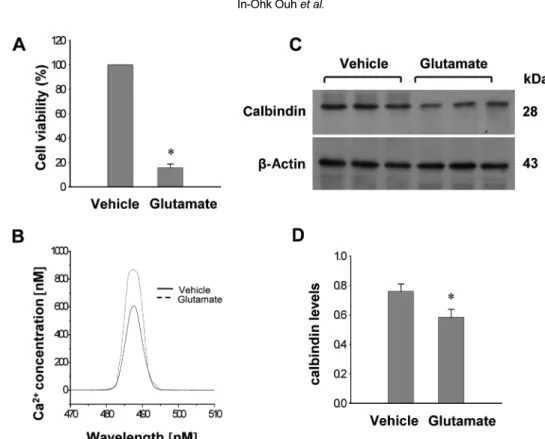
Focal cerebral ischemia was induced in male rats by middle cerebral artery occlusion (MCAO) and cerebral cortices were collected 24 h after MCAO. Cerebral ischemia significantly increased infarct volume. RT-PCR and Western blot analyses showed that MCAO injury induced a decrease of calbindin expression. Moreover, immunohistochemical staining showed that the number of calbindin-positive cells decreased in ischemic regions of MCAO-operated animals. In cultured hippocampal-derived cell lines, glutamate exposure increased intracellular Ca
2+concentrations and decreased calbindin expression. Taken together, both in vivo and in vitro results demonstrated decreases of calbindin after neuronal cell injury.
These results suggest that decreases of calbindin in ischemic brain injury contribute to neuronal cell death.
Key words: Glutamate, middle cerebral artery occlusion, calbindin
Received 14 May 2013; Revised version received 1 July 2013; Accepted 19 July 2013
Stroke is a major cause of death and declines the quality of life, and is characterized by neurological symptoms caused by ischemia after vascular incidents [1]. Cerebral ischemia caused by occlusions of arteries in the brain accounts for more than 80% of all stroke cases [2]. Cerebral ischemia leads to increases of intracellular Ca
2+and mitochondrial bioenergetics dysfunction, which in turn results in neuronal cell death due to the activation of enzymes that generate reactive oxygen species (ROS) [3]. The intracellular Ca
2+overload triggers cell death programs, whereas inhibitors of intracellular Ca
2+influx attenuate mitochondrial damage and preserve neuronal cells from ischemic injury [4-6]. Thus, intracellular Ca
2+overloading is an essential event in ischemic brain injury.
Glutamate is a major neurotransmitter that plays an important role for learning and memory in the central
nervous system [7,8]. However, excessive production of glutamate leads to neurotoxicity and neuronal degeneration.
Glutamate neurotoxicity is involved in the neuro- degenerative disorders, including stroke, Alzheimer’s and Parkinson’s diseases. It has been reported that the levels of glutamate in neurodegenerative diseases patients are significantly higher than those in normal controls [9]. Glutamate exposure induces an increase of neuronal Ca
2+influx and leads to neuronal death. The termination of glutamate exposure decreases extracellular Ca
2+concentration and reduces neuronal degeneration [10].
Calcium binding proteins play critical roles in physiological processes, signal transduction, and muscle contraction [11,12]. Calcium binding proteins protect neurons against damage caused by excessive Ca
2+#