• 검색 결과가 없습니다.

Hypotriglyceridemic effects of brown seaweed consumption via regulation of bile acid excretion and hepatic lipogenesis in high fat diet-induced obese mice

N/A
N/A
Protected

Academic year: 2022

Share "Hypotriglyceridemic effects of brown seaweed consumption via regulation of bile acid excretion and hepatic lipogenesis in high fat diet-induced obese mice"

Copied!
13
0
0

로드 중.... (전체 텍스트 보기)

전체 글

(1)

ABSTRACT

BACKGROUND/OBJECTIVES: The present study aimed to further investigate the potential health beneficial effects of long-term seaweed supplementation on lipid metabolism and hepatic functions in DIO mice.

MATERIALS/METHODS: Four brown seaweeds (Undaria pinnatifida [UP], Laminaria japonica [LJ], Sargassum fulvellum [SF], or Hizikia fusiforme [HF]) were added to a high fat diet (HFD) at a 5% ratio and supplemented to C57BL/6N mice for 16 weeks. Triglycerides (TGs) and total cholesterol (TC) in the liver, feces, and plasma were measured. Fecal bile acid (BA) levels in feces were monitored. Hepatic insulin signaling- and lipogenesis-related proteins were evaluated by Western blot analysis.

RESULTS: Fasting blood glucose levels were significantly reduced in the LJ, SF, and HF groups compared to the HFD group by the end of 16-week feeding period. Plasma TG levels and hepatic lipid accumulation were significantly reduced in all 4 seaweed supplemented groups, whereas plasma TC levels were only suppressed in the UP and HF groups compared to the HFD group. Fecal BA levels were significantly elevated by UP, LJ, and SF supplementation compared to HFD feeding only. Lastly, regarding hepatic insulin signaling-related proteins, phosphorylation of 5′-AMP-activated protein kinase was significantly up-regulated by all 4 types of seaweed, whereas phosphorylation of protein kinase B was up-regulated only in the SF and HF groups. Lipogenesis-related proteins in the liver were effectively down-regulated by HF supplementation in DIO mice.

CONCLUSIONS: Brown seaweed consumption showed hypotriglyceridemic effects in the prolonged DIO mouse model. Specifically, combinatory regulation of BA excretion and lipogenesis-related proteins in the liver by seaweed supplementation contributed to the reduction of plasma and hepatic TG levels, which inhibited hyperglycemia in DIO mice. Thus, the discrepant and species-specific functions of brown seaweeds provide novel insights for the selection of future targets for therapeutic agents.

Keywords: Seaweed; liver; lipogenesis; bile; mice

Original Research

Received: Mar 12, 2020 Revised: Jun 3, 2020 Accepted: Jul 21, 2020

§

Corresponding Author:

Yunkyoung Lee

Department of Food Science and Nutrition, Jeju National University, 9-431, Natural Science Building I, 102 Jejudaehak-ro, Jeju 63243, Korea.

Tel: +82-64-745-3555 Fax: +82-64-725-2539 E-mail. [email protected]

©2020 The Korean Nutrition Society and the Korean Society of Community Nutrition This is an Open Access article distributed under the terms of the Creative Commons Attribution Non-Commercial License (https://

creativecommons.org/licenses/by-nc/4.0/) which permits unrestricted non-commercial use, distribution, and reproduction in any medium, provided the original work is properly cited.

ORCID iDs A-Reum Han

https://orcid.org/0000-0002-5143-797X Jae-Hoon Kim

https://orcid.org/0000-0002-4410-9126 Eunyoung Kim

https://orcid.org/0000-0001-9018-1797 Jiamei Cui

https://orcid.org/0000-0002-9126-9667 In-Suk Chai

https://orcid.org/0000-0002-2673-9829 Guiguo Zhang

https://orcid.org/0000-0002-0515-2172 Yunkyoung Lee

https://orcid.org/0000-0001-6453-769X

A-Reum Han 1,2 , Jae-Hoon Kim 3 , Eunyoung Kim 1 , Jiamei Cui 1 , In-Suk Chai 1 , Guiguo Zhang 4 , and Yunkyoung Lee

1

Department of Food Science and Nutrition, Jeju National University, Jeju 63243, Korea

2

Yerae Elementary School, Jeju 63537, Korea

3

College of Veterinary Medicine, Jeju National University, Jeju 63243, Korea

4

Department of Animal Nutrition, Shandong Provincial Key Laboratory of Animal Biotechnology and Disease Control and Prevention, Shandong Agricultural University, Taian 271018, China

Hypotriglyceridemic effects of brown

seaweed consumption via regulation

of bile acid excretion and hepatic

lipogenesis in high fat diet-induced

obese mice

(2)

Funding

This work was supported by the research grant of Jeju National University in 2018.

Conflict of Interest

The authors declare no potential conflicts of interests.

Author Contributions

Conceptualization: Han AR, Lee Y; Formal analysis: Han AR, Kim E, Cui J, Kim JH, Lee Y;

Funding acquisition: Lee Y; Investigation: Han AR, Kim E, Cui J, Lee Y; Methodology: Kim JH, Han AR, Kim E; Supervision: Lee Y; Writing - original draft: Han AR, Lee Y; Writing - review &

editing: Zhang G, Chai IS, Lee Y.

INTRODUCTION

Seaweeds have been a major constituent of traditional diets as well as alternative medicine in Asian countries such as Korea. Seaweeds have numerous health beneficial effects, such as lipid-lowering [1-3], anti-inflammatory [4,5], and anti-diabetic [1,2,6,7] activities, and have been intensively studied in recent decades. Brown seaweeds are the most commonly consumed, followed by red and green seaweeds consisting of non-digestible dietary fibers, proteins including essential amino acids, minerals, vitamins, and polyphenols [8-10].

Our previous study demonstrated that supplementation with brown seaweeds (5% Undaria pinnatifida [UP], Laminaria japonica [LJ], Sargassum fulvellum [SF], or Hizikia fusiforme [HF]) in a high fat diet (HFD, 60% calories from fat) for 16 weeks in obese C57BL/6N mice decreased systemic inflammation at least in part by reduction of macrophage infiltration in adipose tissue [11]. Especially, supplementation with LJ and HFD resulted in significant amelioration of insulin resistance compared to HFD feeding only. In addition, alterations of muscle physiology and insulin signaling-related proteins by LJ and HF supplementation were confirmed and further compared to the results of treatment with LJ and HF water extracts in mouse-derived skeletal muscle cells (C2C12 myotubes) [12]. Furthermore, others have reported the anti-diabetic effects of brown seaweeds based on their ability to improve liver functionality. For example, Jang and Choung [13] demonstrated that the 6 weeks of Laminaria japonica Areshoung ethanol extract treatment improved insulin resistance induced by HFD in rats. In addition, fucoxanthin, a type of carotenoid from the brown seaweed UP, appeared to reduce obesity by ameliorating fat accumulation as well as improve insulin signaling [14].

Currently, there is a decent body of evidence that consumption of seaweed may attenuate risk factors for metabolic syndrome, which establishes seaweed as a potential therapeutic agent [15]. However, the effects of seaweed supplementation on lipid metabolism in the context of diet-induced obesity remain unclear. Since the liver is the largest organ in the human body and plays a pivotal role in the regulation of numerous functions, abnormal lipid and/or glucose metabolism in the liver has become highly associated with increased risk factors for metabolic syndrome [16]. Indeed, accumulation of triglycerides (TGs) and other active lipid species (i.e., diacylglycerols) has been implicated in the pathogenesis of insulin resistance and could be a common denominator in the improved metabolic profile observed in the liver and muscle [17]. Therefore, the aims of this study were to investigate alterations of blood glucose, plasma, and hepatic total cholesterol (TC) and TG levels as well as fecal TC, TG, and bile acid (BA) levels in HFD-induced obese mice in order to evaluate the effects of seaweed supplementation on glucose and lipid metabolism in the liver. In addition, we further examined insulin signaling- and lipogenesis-related proteins to decipher the mechanism(s) behind the anti-diabetic and hypotriglyceridemic effects of seaweed supplementation in diet- induced obese (DIO) mice.

MATERIAL AND METHODS

Experimental design and animals

C57BL/6N male mice (5-weeks-old) were purchased from Orient Bio Co. (Sungnam, Korea), housed individually, and allowed to rest for 1 week, followed by random assignment into 5 groups (n = 6 per group). The respective diets were provided for 16 weeks: HFD (60% kcal%

fat, D12492) or HFD containing 5% freeze-dried UP (HFD + UP), LJ (HFD + LJ), SF (HFD +

(3)

SF), or HF (HFD + HF). Four types of domestic seaweed were purchased from a traditional market in Jeju from December 2014 to March 2015. The freeze-dried seaweed powder was prepared by Research Diets (New Brunswick, NJ, USA) to produce HFD supplemented with seaweeds (5%). As a negative control, a low fat diet (LFD) group was also included in the original experimental design; however, we only represented the HFD and HFD + seaweed groups herein due to the clear and various differences between LFD and HFD. The composition of the experimental diets was reported in our previous study [11]. Animals were maintained at constant temperature (21 ± 2°C) and humidity (50 ± 20%) with a 12 h dark- light cycle and had free access to their respective food and water throughout the study. The experimental protocol was approved by the Jeju National University Institutional Animal Care and Use Committee (#2014-0004). Weekly body weight and food intake were monitored, and the fasting blood glucose (FBG) concentrations were measured every 4 weeks via tail vein during the feeding experimental period. Mice were sacrificed by cervical dislocation, followed by CO

2

narcosis. Blood was collected by cardiac puncture, and plasma samples were aliquoted for storage at −80°C.

TC, TG, and BA levels in plasma, liver, and feces

Plasma TG and TC contents were measured by using a TG kit and TC kit (Asan

Pharmaceutical, Seoul, Korea), respectively, according to the manufacturer's instructions.

Briefly, 2 μL of plasma and 300 μL of enzyme reagent were mixed and incubated at 37°C for 10 min for TG and 15 min for TC. In addition, TC and TG contents in the liver and feces were measured by using the Folch method with some modifications [11]. A piece of liver (0.5 g) in 6 mL of Folch solution (chloroform/methanol mixture [2:1, v/v]) with 2 mL of distilled water were homogenized for 5 min using a tissue homogenizer, followed by centrifugation at 1,000 × g for 10 min. Weekly collected feces were stored at −80°C until analysis. Frozen feces were freeze-dried and homogenized in Folch solution (1 g of feces/6 mL of Folch solution) and 2 mL of distilled water for 5 min. The chloroform phase containing TC and TG was then collected. To measure TC, 500 μL of the chloroform phase was air-dried and vortexed with 50 μL of Triton X-100/chloroform mixture (1/1, v/v) and then dissolved in 450 μL of chloroform. Then, 10 μL of the mixture was transferred to a new tube and air-dried. Finally, 1.5 mL of enzymatic reagent (Asan Pharmaceutical) was added to the tube and incubated at 37°C for 5 min. To measure TG, 10 μL of the cholesterol phase was air-dried and dissolved in 50 μL of methanol. The mixture was then reacted with 1.5 mL of enzymatic reagent (Asan Pharmaceutical) at 37°C for 10 min. Absorbance was measured at 550 nm for TG or 500 nm for TC using a spectrophotometer (Molecular Devices, San Jose, CA, USA). Concentrations of plasma TG and TC were calculated based on a standard curve. Lastly, total BA levels in feces of mice fed either HFD or HFD supplemented with the 4 types of seaweed were measured using a total BA assay kit (Cell Biolabs, Inc. San Diego, CA, USA) according to the manufacturer's instructions.

Liver histology

Mice were killed by cervical dislocation following CO

2

narcosis. Livers were fixed in 10%

formaldehyde overnight, embedded in paraffin, sectioned, and stained with hematoxylin and eosin (H & E). Digital images were acquired with an Olympus BX51 light microscope (Olympus, Tokyo, Japan).

Western blot analysis

Proteins from frozen liver samples were isolated as described previously [11]. Briefly,

liver tissue (50 mg) was processed in 500 μL of lysis buffer (50 mM Tris-HCL [pH 7.5],

(4)

150 mM NaCl, 1% Nonidet P-40, 2 mM EDTA, 1 mM EGTA, 1 mM NaVO

3

, 10 mM NaF, 1 mM dithiothreitol, 1 mM phenylmethylsulfonyl fluoride, 25 μg/mL of aprotinin, and 25 μg/mL of leupeptin), followed by homogenization and centrifugation. Proteins samples were quantified by a protein assay kit (Bio-rad, CA, USA). Proteins (50 μg/lane) were then separated by SDS-polyacrylamide gel electrophoresis and transferred to polyvinylidene fluoride membranes (Bio-rad, Hercules, CA, USA). Membranes were processed with 5%

blocking buffer for 2 h at room temperature, followed by the indicated primary antibody (acetyl-CoA carboxylase [ACC], phospho-protein kinase B [AKT], AKT, phospho-5′-AMP- activated protein kinase [AMPK], AMPK, fatty acid synthase [FAS], glyceraldehyde-3- phosphate dehydrogenase [GAPDH], sterol regulatory element-binding protein [SREBP]-1c [1:1,000; Cell Signaling Technology, Danvers, MA, USA]) overnight at 4°C. After a series of washing with TBS-T (0.1% Tween-20 in TBS), secondary antibody, horseradish peroxide- coupled anti-species antibody (1:2,000; Cell Signaling Technology), was applied to the membrane. Proteins were visualized by enhanced chemiluminescence and quantified by Fusion Solo (Vilber Lourmat, Baden-Württemberg, Germany).

Statistical analysis

Data are presented as the mean ± standard error of the mean. Statistical differences were determined by t-test or one-way analysis of variance (significance, P ≤ 0.05), followed by Dunnett's multiple comparisons test performed using GraphPad Prism version 8.0.0 for Windows, GraphPad Software (San Diego, CA, USA).

RESULTS

Effects of seaweed supplementation on regulation of blood glucose levels in C57BL/6N mice fed a HFD

In order to evaluate the alteration of FBG levels by seaweed supplementation in DIO mice, FBG levels were measured every 4 weeks during the course of 16 weeks of HFD feeding via tail vein (Fig. 1). Average FBG levels in LFD-fed mice were 146.5 ± 2.4 mg/dL (data not shown). At weeks 4 and 16, the LJ, SF, and HF groups showed significantly lower FBG levels compared to the HFD group. At week 8, all brown seaweed supplemented groups showed significantly lower FBG levels than the HFD group. As shown in the plot of FGB levels by feeding time (Fig. 1B), changes in FBG levels for all 3 LJ, SF, and HF groups showed a gentle slope compared to the HFD and HFD + UP groups. Thus, despite the increase in FBG levels induced by HFD in all experimental groups, seaweed supplementation (LJ, SF, and HF) did ameliorate HFD-induced FBG levels during the 16 weeks of HFD feeding.

Effects of seaweed supplementation on TC and TG levels in the liver and plasma of DIO mice

Next, we evaluated changes in the liver and plasma lipid profiles of DIO mice caused

by seaweed supplementation for 16 weeks. As shown in Fig. 2, plasma TC levels were

significantly reduced in the UP and HF groups compared to the HFD group. Although the

LJ and SF groups tended to have lower plasma TC levels than the HFD group, the difference

was not statistically significant. In the case of plasma TG levels, all 4 types of seaweed

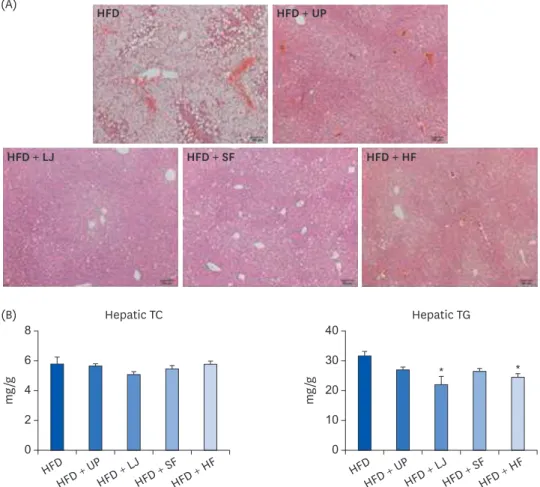
significantly lowered TG levels compared to HFD feeding only. In addition, liver H & E

staining demonstrated that all 4 brown seaweed supplemented groups showed less lipid

accumulation than the HFD group (Fig. 3A). Furthermore, we observed no significant

alteration of TC levels in the livers of mice fed a HFD or seaweed supplemented HFD, whereas

(5)

the LJ and HF groups showed significantly reduced TG levels in the liver compared to the HFD group (P < 0.05, Fig. 3B). Thus, brown seaweeds appeared to have species-specific TG- lowering effects in both the liver and circulation in DIO mice.

Alterations of TC, TG, and BA excretion in feces of DIO mice by seaweed supplementation

We next investigated changes in TC, TG, and BA excretion in feces of DIO mice during the latter half of the 16-week HFD feeding period by performing measurements at weeks 8, 12, and 16 (Fig. 4). The TC and TG levels in feces were not dramatically altered during this period in either the HFD only or seaweed supplemented groups, whereas BA levels

0

FBG (mg /dL )

Week 4

(A) Week 8 (B)

300

100

200 * * *

* *

* * * *

0

FBG (mg /dL )

300 200 100

HFD HFD + UP HFD + LJ HFD + SF HFD + HF HFD

HFD + UP HFD + LJ HFD + SF HFD + HF

0

FBG (mg /dL )

Week 12 Week 16

Weeks of feeding

300

100

200 * * *

0

FBG (mg /dL )

300 200 100

HFD HFD + UP HFD + LJ HFD + SF HFD + HF HFD

HFD + UP HFD + LJ HFD + SF HFD + HF

100 4 8 12 16

FBG (mg /dL )

300

250

200

150

HFD HFD + UP HFD + LJ

HFD + SF HFD + HF

*

** * * * *

* *

*

* *

*

Fig. 1. Alteration of plasma FBG levels during the 16-week period of HFD or HFD supplementation with 4 types of seaweed in C57BL/6N mice. (A) Plasma FBG levels at weeks 4, 8, 12, and 16 of the experimental diet present significant differences between the seaweed supplemented groups compared to the HFD group every 4 weeks. (B) Alteration of plasma FBG levels measured every 4 weeks during the entire 16 weeks of feeding in C57BL/6N mice. Values are the mean ± standard error of the mean (n = 6 mice per group). An asterisk indicates a significant difference compared to either the HFD group (P < 0.05) or week 4 values of each group in (A) and (B), respectively.

FBG, fasting blood glucose; HFD, high fat diet; UP, Undaria pinnatifida; LJ, Laminaria japonica; SF, Sargassum fulvellum; HF, Hizikia fusiforme.

* *

0

HFD HFD + UPHFD + LJHFD + SFHFD + HF

m g/g

Plasma TC Plasma TG

4

2 3

1

HFD HFD + UPHFD + LJHFD + SFHFD + HF

* *

* *

0

m g/g

8 6 4 2

Fig. 2. Effects of seaweed supplementation on plasma TC and TG levels of C57BL/6N mice fed a HFD or seaweed supplemented HFD for 16 weeks. Values are the mean ± standard error of the mean (n = 6 mice per group). An asterisk indicates a significant difference compared to the HFD group (P < 0.05).

TC, total cholesterol; TG, triglyceride; HFD, high fat diet; UP, Undaria pinnatifida; LJ, Laminaria japonica; SF,

Sargassum fulvellum; HF, Hizikia fusiforme.

(6)

in feces were significantly altered especially in the UP, LJ, and SF groups at week 16. As shown in the last graph of Fig. 4 (connecting dot graph for BA concentration at weeks 8, 12, and 16), all 4 brown seaweed supplemented groups showed a continuous increase in fecal BA concentration during this period of feeding. Thus, brown seaweed supplementation increased BA excretion into feces in HFD-fed mice, although the degree of increase was different among the seaweed types (i.e., SF > LJ > UP > HF).

Effects of seaweed supplementation on regulation of insulin signaling and lipogenesis-related proteins in DIO mice

To further elucidate the effects of seaweed supplementation on the insulin signaling pathway, changes in 2 crucial related proteins, including AMPK and PKB/AKT, in the livers of mice fed either a HFD or seaweed supplemented HFD were investigated. As shown in Fig. 5, all 4 brown seaweed supplemented groups showed significantly improved AMPK activation via phosphorylation compared to the HFD group. In addition, the SF and HF groups showed significantly increased phospho-AKT levels compared to the HFD group.

HFD HFD + UP

HFD + LJ HFD + SF HFD + HF

(A)

0

HFD HFD + UPHFD + LJHFD + SFHFD + HF

m g/g

Hepatic TC

(B) Hepatic TG

8

4 6

2

HFD HFD + UPHFD + LJHFD + SFHFD + HF

* *

0

m g/g

40 30 20 10

Fig. 3. Protective effects of seaweed supplementation on hepatic lipid accumulation in diet-induced obese mice.

(A) Representative hematoxylin and eosin staining of livers from mice fed a HFD or seaweed supplemented HFD for 16 weeks, (B) Liver TG and TG contents of mice fed a HFD or seaweed supplemented HFD for 16 weeks (n = 5–6). Values are the mean ± standard error of the mean. An asterisk indicates a significant difference compared to the HFD group (P < 0.05).

HFD, high fat diet; UP, Undaria pinnatifida; LJ, Laminaria japonica; SF, Sargassum fulvellum; HF, Hizikia

fusiforme; TC, total cholesterol; TG, triglyceride.

(7)

0 mg/g Fecal T C

W eek 8 W eek 12 10 2 4

* * * *

* * *

*

0 mg/g

10 6 6 4 2

HFD HFD + UP HFD + LJ HFD + SF HFD + HF HFD HFD + UP HFD + LJ HFD + SF HFD + HF

W eek 16 0

10 8 8 8 6 mg/g 4 2 HFD HFD + UP

HFD + LJ HFD + SF HFD + HF

0 8 10 12 14 16

TC (mg

10 8 /g) 6 4 2 W eek s W eek s

0 mg/g

Fecal T G

8 2 4 * 0

8 6 6 4 mg/g 2

HFD HFD + UP HFD + LJ HFD + SF HFD + HF HFD HFD + UP HFD + LJ HFD + SF HFD + HF

0 mg/g

8 6 4 2 HFD HFD + UP

HFD + LJ HFD + SF HFD + HF

0 8 10 12 14 16

TG (mg

6 4 /g) 2 0

Concentration (µM) Fecal BA

40 10 20 0

Concentration (µM)

40 30 30 20 10

HFD HFD + UP HFD + LJ HFD + SF HFD + HF HFD HFD + UP HFD + LJ HFD + SF HFD + HF

0 Concentration (µM)

40 30 20 10

HFD HFD + UP HFD + LJ HFD + SF HFD + HF

0 8 10 12 14 16

BA concentration (µM)

40 30 20 10 W eek s

HFD HFD + UP HFD + LJ HFD + SF HFD + HF

HFD HFD + UP HFD + LJ HFD + SF HFD + HF HFD HFD + UP HFD + LJ HFD + SF HFD + HF

* *

* * * *

* * *

Fig . 4 . Alt er ations of fecal T C, T G , and BA cont ents b y se aweed suppl ementation d uring the latt er half of the HFD feeding period in C57BL/6N mice. F eces s ampl es fr om individ ual mouse cag es wer e coll ect ed in or der t o me asur e fecal T C, T G , and BA l ev els as described in the Methods. V al ues ar e the me an ± standar d err or of the me an (n = 4–5). An ast erisk in the bar gr aphs indicat es a significant differ ence compar ed t o HFD feeding onl y, wher eas an ast erisk in the connecting line gr aphs indicat es a significant differ ence compar ed t o week 8 ( P < 0 .05). HFD , high fat diet ; UP , Undaria pinnatifida ; LJ, Laminaria japonica ; SF , S ar gassum fulvellum ; HF , Hizikia fusiforme ; T C, t otal chol est er ol; T G , trigl yceride; BA , bil e acid.

(8)

Alterations of lipogenesis-related proteins such as ACC, FAS, and SREBP-1c were observed in the livers of mice fed either a HFD or seaweed supplemented HFD for 16 weeks (Fig. 6).

Specifically, ACC expression was significantly reduced in the UP and HF groups compared to the HFD group. In the case of FAS and SREBP-1c expression, only the HF group showed significant reduction of FAS and SREBP-1c protein expression compared to the HFD group.

DISCUSSION

We previously reported that seaweed consumption ameliorated insulin resistance and systemic inflammation in C57BL/6N mice fed a HFD for 16 weeks [11]. Among the 4 types of brown seaweed (UP, LJ, SF, and HF), LJ resulted in the strongest improvement of insulin sensitivity in DIO mice based on an insulin-tolerance test, followed by HF. Even though seaweed consumption did not prevent the obese phenotype in mice, a metabolically healthy phenotype with reduced local (i.e., adipose tissue and muscle) and systemic inflammation was observed in the 5% seaweed supplemented groups. Therefore, we concluded that such physiological alteration of adipose tissue and muscle in DIO mice contributed to the potential health beneficial effects of seaweed [11,12]. In the present study, we further examined lipid accumulation in the liver and local/systemic lipid profiles along with alterations of fasting glucose levels and hepatic insulin signaling- and lipogenesis-related proteins by seaweed supplementation during 16 weeks of HFD feeding in DIO mice in order to decipher the anti- diabetic and lipid-lowering effects along with potential mechanism(s) of seaweed.

* * * *

0

HFD HFD + UPHFD + LJHFD + SFHFD + HF (B)

phospho- AMPK /t otal AMPK 2.5

0.5 1.5 2.0

1.0

HFD HFD + UPHFD + LJHFD + SFHFD + HF

* *

0 phospho -AKT /t otal AKT

2.0 1.5 1.0 0.5

(A) HFD

phospho-AMPK Total AMPK phospho-AKT Total AKT GAPDH

HFD + HF HFD + SF

HFD + LJ HFD + UP

Fig. 5. Effects of insulin signaling-related proteins via seaweed supplementation in the livers of diet-induced obese mice. (A) Representative immunoblot analysis of phospho-AMPK and total AMPK, phospho-AKT, total AKT, and GAPDH levels in the liver, (B) Intensity of phospho-AMPK was normalized to total AMPK, and intensity of phospho-AKT was normalized to total AKT. Values are the mean ± standard error of the mean. An asterisk indicates a significant difference compared to the HFD group (P < 0.05).

UP, Undaria pinnatifida; LJ, Laminaria japonica; SF, Sargassum fulvellum; HF, Hizikia fusiforme; AMPK, 5′-AMP-activated protein kinase; AKT, protein kinase B;

GAPDH, glyceraldehyde-3-phosphate dehydrogenase; HFD, high fat diet.

(9)

In addition to LJ, other 3 brown seaweeds (UP, SF, and HF) seemed to exhibit protective potential against HFD-induced hyperglycemia in C57BL/6N mice by inhibiting and/or slowing the increase in FBG levels (Fig. 1) during the experimental feeding period. This alteration of FBG levels by seaweed supplementation in DIO mice might be attributable to both improvement of the plasma lipid profile and up-regulation of insulin signaling-related proteins such as AMPK and AKT in the liver (Figs. 2 and 5). Brown seaweeds are a rich source of non-digestible polysaccharides (dietary fiber), minerals, vitamins, polyunsaturated fatty acids, and bioactive polyphenols [8,18,19]. Thus, seaweeds, their extracts, and/or isolated bioactive compounds from seaweeds have been shown to have various health beneficial effects, including anti-diabetic activity in both in vitro and in vivo models. For example, fucoxanthin, a carotenoid in brown seaweeds such as UP and HF, has been shown to reduce blood glucose levels in obese and diabetic KK-A

y

mice [20]. In addition, a recent study by Jia et al. [21] reported the hypoglycemic and hypolipidemic properties of 3 different polysaccharides isolated from Ascophyllum nodosum, Fucus vesiculosus, and UP in diet-induced and streptozotocin-induced type 2 diabetes rats, although a direct comparison to the results of the present study might be difficult due to the different types of seaweed added to animal diets (i.e., purified polysaccharides vs. freeze-dried seaweed powder). Previously, it was demonstrated using C2C12 myotubes that water extracts of LJ and HF have anti-diabetic properties, as the extracts significantly increased phosphorylation of skeletal AMPK and AKT as well as promoted glucose uptake to levels comparable to that of insulin action on AMPK and AKT [12]. In addition, the same phenomenon was observed in muscle tissue of mice fed LJ and HF with a HFD compared to mice fed HFD only. Therefore, the anti-diabetic potential of freeze-dried seaweed supplementation in long-term HFD-induced obese mice in this present study could be attributed to the combinatory and species-specific effects of bioactive compounds contained in brown seaweeds.

* *

0

HFD HFD + UPHFD + LJHFD + SFHFD + HF (B)

ACC /GAPDH r atio

1.5

0.5 1.0

HFD HFD + UPHFD + LJHFD + SFHFD + HF

*

0

FAS /GAPDH r atio

1.5

1.0

0.5

HFD HFD + UPHFD + LJHFD + SFHFD + HF

*

SREBP -1 c/ GAPDH r atio 0 2.0 1.5

0.5 1.0

(A) HFD

ACC FAS SREBP-1c GAPDH

HFD + HF HFD + SF

HFD + LJ HFD + UP

Fig. 6. Effects of lipogenesis-related proteins via seaweed supplementation in the livers of diet-induced obese mice. (A) Representative immunoblot analysis of ACC, FAS, SREBP-1c, and GAPDH in the liver, (B) Intensities of ACC, FAS, and SREBP-1c were normalized to GAPDH. Values are the mean ± standard error of the mean. An asterisk indicates a significant difference compared to the HFD group (P < 0.05).

UP, Undaria pinnatifida; LJ, Laminaria japonica; SF, Sargassum fulvellum; HF, Hizikia fusiforme; ACC, acetyl-CoA carboxylase; FAS, fatty acid synthase; SREBP-

1c, sterol regulatory element-binding protein-1c; GAPDH, glyceraldehyde-3-phosphate dehydrogenase; HFD, high fat diet.

(10)

Our findings also demonstrated the hypotriglyceridemic effects of all 4 brown seaweeds in the HFD feeding-DIO mouse model, whereas only UP and HF supplementation reduced circulating TC levels. Although no solid conclusion has been made yet, several studies have demonstrated the lipid-lowering effects of seaweed consumption in experimental animal models based on their high contents of polysaccharides [8,22]. Bocanegra et al. [22] demonstrated that dietary supplementation with Laminaria digitata (kombu) or Porphyra tenera (nori) (7% freeze-dried seaweed) in a cholesterol-rich diet for 3 weeks had a significant cholesterol-lowering effect in rats. In addition, Zha et al. [23] demonstrated the hypolipidemic effects of an LJ-derived crude polysaccharide in a diet-induced mouse model of atherosclerosis. Fucoidans are soluble fibers found in great abundance in brown seaweeds, and they constitute a potential candidate for lowering lipids. Recently, Yang et al. [24]

reported that administration of fucoidan from the brown seaweed Ascophyllum nodosum for 6 weeks decreased plasma lipids in HFD-fed C57BL/6J mice via regulation of reverse cholesterol transport. Thus, the relative short-term lipid-lowering effects of seaweed consumption have been studied, but the health benefits of long-term dietary seaweed consumption in terms of hypolipidemic effects have not been well established. Future studies are necessary to identify which compound(s) from seaweeds are responsible for the plasma lipid-lowering effects of seaweed supplementation in this study.

To investigate the possible mechanism behind the hypotriglyceridemic effects observed in the present study, hepatic expression levels of proteins involved in lipogenesis, including SREBP-1c, ACC, and FAS, were determined. SREBP-1c is known to play an essential role in TG synthesis by regulating the expression of lipogenic genes, including ACC and FAS [25]. In this study, we observed that UP and HF supplementation dramatically suppressed ACC protein expression compared to the HFD group, whereas FAS and SREBP-1c protein expression levels were significantly attenuated by HF supplementation. Thus, HF supplementation appeared to suppress lipogenesis-related proteins such as ACC, FAS, and SREBP-1c compared to the HFD group, which was supported by the significant reduction of plasma TG and hepatic TG accumulation. On the other hand, inhibition of lipogenesis in the liver may not be a major factor contributing to the TG-lowering effects of LJ and SF supplementation. Evaluation of the expression of lipolysis-related genes in the liver and serum non-esterified fatty acids levels could help to further elucidate the mechanisms driving the TG-lowering effect of seaweed consumption in DIO mice.

Next, fecal TG, TC, and BA levels were measured during the latter half of the 16-week feeding

period. Although seaweed supplementation did not dramatically alter fecal TC or TG levels in

DIO mice, fecal BA contents profoundly increased in the UP, LJ, and SF groups compared to

the HFD group. The increase in BA levels upon UP, LJ, and SF supplementation compared to

that of HFD became even more pronounced as the experiment continued (i.e., fecal BA levels

at weeks 8, 12, and 16). However, such alteration of fecal BA excretion was not in agreement

with the reduced plasma TC levels resulting from UP and HF supplementation. Cholesterol

homeostasis in the body is maintained by endogenous synthesis, hepatic transport, intestinal

absorption, and excretion [26]. In the case of excretion, hepatobiliary cholesterol excretion

is one method by which the body removes cholesterol, whereas active secretion of cholesterol

in the proximal part of the small intestine, called transintestinal cholesterol efflux, is another

way [27]. Therefore, the hepatic expression of genes involved in cholesterol synthesis and

BA biosynthesis should be evaluated in a future study in order to understand the distinctive

effects of the 4 different brown seaweeds.

(11)

It has been well established that dietary fiber plays an important role in regulating BA metabolism via adsorption of bile salts and their metabolites, eventually altering the excretion amounts of BAs [28,29]. For example, Wang et al. [30] reported that the bile salt- binding capacity of dietary fibers derived from seaweeds, including Porphyra yezoensis, UP, LJ, and HF, can prevent the reabsorption of BA in the liver in order to maintain the balance of the bile pool, which may partially explain the increase in BA excretion upon seaweed consumption observed in the present study. In addition, AMPK, a well-known regulator of lipid and energy metabolism, was highly up-regulated by all 4 brown seaweeds in this study. Activation of insulin signaling-related protein AKT was only induced by SF and HF supplementation in DIO mice. This phenomenon was also observed in the skeletal muscle of DIO mice in our previous study; both AMPK and AKT in muscle were highly activated by LJ and HF supplementation in HFD-induced obese C57BL/6N mice [12]. Further study is needed to determine whether or not regulation of lipogenic- and insulin signaling-related proteins in the liver are pivotal elements of the systemic lipid profile.

In summary, 4 brown seaweeds (UP, LJ, SF, and HF) appeared to exhibit health beneficial properties, including reduction of systemic TG (all 4 seaweeds) and systemic cholesterol levels (UP, HF), lowering of blood glucose (LJ, SF, and HF), protection against insulin resistance (LJ, HF), and anti-inflammatory effects (all 4 seaweeds), in a long-term HFD- induced metabolically unhealthy and obese mouse model mediated via complex mechanisms involving: 1) combinatory regulation of BA excretion and hepatic expression of proteins involved in lipogenesis, 2) alteration of insulin signaling-related proteins in the liver and muscle, and 3) metabolically healthy and less inflamed adipose tissue due to a smaller cell size and reduced macrophage infiltration. Thus, the health beneficial potential of brown seaweed consumption in DIO mice could be achieved by local alterations of various organs, including adipose tissue, muscle, and the liver, resulting in improvement of whole-body physiology in a seaweed species-specific manner.

ACKNOWLEDGMENTS

This study contains a part of A-Reum Han's master thesis (2015) at Jeju National University and has been modified with new data to submit to Nutrition Research and Practice.

REFERENCES

1. Lee HS, Choi MS, Lee YK, Park SH, Kim YJ. A study on the development of high-fiber supplements for the diabetic patients - Effect of seaweed supplementation on the lipid and glucose metabolism in streptozotocin-induced diabetic rats -. Korean J Nutr 1996;29:296-306.

2. Cho YJ, Bang MA. Effects of dietary seaweed on blood glucose, lipid and glutathione enzymes in streptozotocin-induced diabetic rats. J Korean Soc Food Sci Nutr 2004;33:987-94.

CROSSREF

3. Jang MA, Lee KS, Seo JS, Choi YS. Effects of dietary supplementation of sea tangle extracts on the excretion of neutral steroids and bile acid in diabetic rats. J Korean Soc Food Sci Nutr 2002;31:819-25.

CROSSREF

4. Khan MN, Choi JS, Lee MC, Kim E, Nam TJ, Fujii H, Hong YK. Anti-inflammatory activities of methanol extracts from various seaweed species. J Environ Biol 2008;29:465-9.

PUBMED

5. Cumashi A, Ushakova NA, Preobrazhenskaya ME, D'Incecco A, Piccoli A, Totani L, Tinari N, Morozevich

GE, Berman AE, Bilan MI, Usov AI, Ustyuzhanina NE, Grachev AA, Sanderson CJ, Kelly M, Rabinovich

(12)

GA, Iacobelli S, Nifantiev NE; Consorzio Interuniversitario Nazionale per la Bio-Oncologia, Italy. A comparative study of the anti-inflammatory, anticoagulant, antiangiogenic, and antiadhesive activities of nine different fucoidans from brown seaweeds. Glycobiology 2007;17:541-52.

PUBMED | CROSSREF

6. Park MJ, Ryu HK, Han JS. Effects of Laminaria japonica extract supplement on blood glucose, serum lipids and antioxidant systems in type II diabetic patients. J Korean Soc Food Sci Nutr 2007;36:1391-8.

CROSSREF

7. Park SH, Lee YK, Lee HS. The effect of dietary fiber feeding on gastrointestinal functions and lipid and glucose metabolism in streptozotocin-induced diabetic rats. Korean J Nutr 1994;27:311-22.

8. Jiménez-Escrig A, Sánchez-Muniz F. Dietary fibre from edible seaweeds: chemical structure, physicochemical properties and effects on cholesterol metabolism. Nutr Res 2000;20:585-98.

CROSSREF

9. Choi JS, Bae HJ, Kim YC, Park NH, Kim TB, Choi YJ, Choi EY, Park SM, Choi IS. Nutritional composition and biological activities of the methanol extracts of sea mustard (Undaria pinnatifida) in market. J Life Sci 2008;18:387-94.

CROSSREF

10. Narayan B, Miyashita K, Hosakawa M. Comparative evaluation of fatty acid composition of different Sargassum (Fucales, Phaeophyta) species harvested from temperate and tropical waters. J Aquat Food Prod Technol 2005;13:53-70.

CROSSREF

11. Oh JH, Kim J, Lee Y. Anti-inflammatory and anti-diabetic effects of brown seaweeds in high-fat diet- induced obese mice. Nutr Res Pract 2016;10:42-8.

PUBMED | CROSSREF

12. Kang SY, Kim E, Kang I, Lee M, Lee Y. Anti-diabetic effects and anti-inflammatory effects of Laminaria japonica and Hizikia fusiforme in skeletal muscle: in vitro and in vivo model. Nutrients 2018;10:491.

PUBMED | CROSSREF

13. Jang WS, Choung SY. Antiobesity effects of the ethanol extract of Laminaria japonica Areshoung in high-fat- diet-induced obese rat. Evid Based Complement Alternat Med 2013;2013:492807.

PUBMED | CROSSREF

14. Grasa-López A, Miliar-García Á, Quevedo-Corona L, Paniagua-Castro N, Escalona-Cardoso G, Reyes- Maldonado E, Jaramillo-Flores ME. Undaria pinnatifida and fucoxanthin ameliorate lipogenesis and markers of both inflammation and cardiovascular dysfunction in an animal model of diet-induced obesity. Mar Drugs 2016;14:148.

PUBMED | CROSSREF

15. Kumar SA, Brown L. Seaweeds as potential therapeutic interventions for the metabolic syndrome. Rev Endocr Metab Disord 2013;14:299-308.

PUBMED | CROSSREF

16. Brunt EM. Pathology of fatty liver disease. Mod Pathol 2007;20 Suppl 1:S40-8.

PUBMED | CROSSREF

17. Samuel VT, Shulman GI. The pathogenesis of insulin resistance: integrating signaling pathways and substrate flux. J Clin Invest 2016;126:12-22.

PUBMED | CROSSREF

18. Gupta S, Abu-Ghannam N. Bioactive potential and possible health effects of edible brown seaweeds.

Trends Food Sci Technol 2011;22:315-26.

CROSSREF

19. MacArtain P, Gill CI, Brooks M, Campbell R, Rowland IR. Nutritional value of edible seaweeds. Nutr Rev 2007;65:535-43.

PUBMED | CROSSREF

20. Maeda H, Hosokawa M, Sashima T, Miyashita K. Dietary combination of fucoxanthin and fish oil attenuates the weight gain of white adipose tissue and decreases blood glucose in obese/diabetic KK-A

y

mice. J Agric Food Chem 2007;55:7701-6.

PUBMED | CROSSREF

21. Jia RB, Wu J, Li ZR, Ou ZR, Zhu Q, Sun B, Lin L, Zhao M. Comparison of physicochemical properties and antidiabetic effects of polysaccharides extracted from three seaweed species. Int J Biol Macromol 2020;149:81-92.

PUBMED | CROSSREF

22. Bocanegra A, Benedí J, Sánchez-Muniz FJ. Differential effects of konbu and nori seaweed dietary supplementation on liver glutathione status in normo- and hypercholesterolaemic growing rats. Br J Nutr 2006;95:696-702.

PUBMED | CROSSREF

(13)

23. Zha XQ, Xiao JJ, Zhang HN, Wang JH, Pan LH, Yang XF, Luo JP. Polysaccharides in Laminaria japonica (LP):

extraction, physicochemical properties and their hypolipidemic activities in diet-induced mouse model of atherosclerosis. Food Chem 2012;134:244-52.

CROSSREF

24. Yang Z, Liu G, Wang Y, Yin J, Wang J, Xia B, Li T, Yang X, Hou P, Hu S, Song W, Guo S. Fucoidan A2 from the brown seaweed Ascophyllum nodosum lowers lipid by improving reverse cholesterol transport in C57BL/6J mice fed a high-fat diet. J Agric Food Chem 2019;67:5782-91.

PUBMED | CROSSREF

25. Horton JD, Goldstein JL, Brown MS. SREBPs: activators of the complete program of cholesterol and fatty acid synthesis in the liver. J Clin Invest 2002;109:1125-31.

PUBMED | CROSSREF

26. Jakulj L, van Dijk TH, de Boer JF, Kootte RS, Schonewille M, Paalvast Y, Boer T, Bloks VW, Boverhof R, Nieuwdorp M, Beuers UH, Stroes ES, Groen AK. Transintestinal cholesterol transport is active in mice and humans and controls ezetimibe-induced fecal neutral sterol excretion. Cell Metab 2016;24:783-94.

PUBMED | CROSSREF

27. van der Velde AE, Brufau G, Groen AK. Transintestinal cholesterol efflux. Curr Opin Lipidol 2010;21:167-71.

PUBMED | CROSSREF

28. Kern F Jr, Birkner HJ, Ostrower VS. Binding of bile acids by dietary fiber. Am J Clin Nutr 1978;31:S175-9.

PUBMED | CROSSREF

29. Story JA, Kritchevsky D. Comparison of the binding of various bile acids and bile salts in vitro by several types of fiber. J Nutr 1976;106:1292-4.

PUBMED | CROSSREF

30. Wang W, Onnagawa M, Yoshie Y, Suzuki T. Binding of bile salts to soluble and insoluble dietary fibers of seaweeds. Fish Sci 2001;67:1169-73.

CROSSREF

수치

Fig. 1. Alteration of plasma FBG levels during the 16-week period of HFD or HFD supplementation with 4 types of seaweed in C57BL/6N mice
Fig. 3. Protective effects of seaweed supplementation on hepatic lipid accumulation in diet-induced obese mice
Fig. 4. Alterations of fecal TC, TG, and BA contents by seaweed supplementation during the latter half of the HFD feeding period in C57BL/6N mice
Fig. 5. Effects of insulin signaling-related proteins via seaweed supplementation in the livers of diet-induced obese mice
+2

참조

관련 문서

Conclusions : No significant corelation of the patency rate was shown in the study on the effects of local irrigation and systemic application of heparin

Results: In this research, in the group with fibromyalgia patients group, systemic lupus erythematosus patients group and without systemic autoimmune

Contents of total lipid in the epididymal adipose of rats fed high fat-high cholesterol diet containing Stachys sieboldii Miq root powder for 6 weeks ···78 Fig.. Contents of

The purpose and necessity of this study was to investigate the effects of lactic acid fatigue and body oxidation through myofascial relaxation exercise using small tools

The purpose of this study was to investigate the effects of 8 weeks trampoline exercise on health promotion (health related fitness, blood lipid) in

In this study, we investigated the effects of a HF+HS diet in DMM-induced OA mice and found that compared with a HF diet, a HF+HS diet promoted OA. Moreover, our results

Effects of high-fat diet and various concentrations of CG200745 on blood pressure and body weight in mice... Effects of various concentrations of CG200745 on expression

Leaves at 4 days after treatment (DAT) in dark- and salt- senescence condition contains 80% and 78% of chlorophyll levels relative to those of DAT 4 leaves in MES buffer