PPC와 Organo-Clay 나노 조성물의 합성과 실리카층의 수분흡수와 열적특성에 대한 영향
Sher Bahadar Khan⋅서 종 철*⋅장 의 성⋅최 준 석⋅최 승 혁⋅한 학 수
† 연세대학교 화공생명공학과, *연세대학교 패캐징학과(2009년 12월 7일 접수, 2009년 12월 23일 수정, 2009년 12월 24일 채택)
Synthesis and Characterization of PPC/Organo-Clay Nanohybrid: Influence of Organically Modified Layered Silicates on Thermal and Water Absorption Properties
Sher Bahadar Khan, Jongchul Seo*, Eui Sung Jang, Joon Suk Choi, Seunghyuk Choi, and Haksoo Han
†Department of Chemical Engineering, Yonsei University, Seoul 139-749, Korea
*Department of Packaging, Yonsei University, Wounju-si, Gangwon-do 220-710, Korea (Received December 7, 2009, Revised December 23, 2009, Accepted December 24, 2009)
요 약: Poly propylene carbonate (PPC)와 cloisite 20B (PPC/C-20B)을 solution method를 통하여 합성하였고, 이를 통해 합성된 나노 조성물의 morphology, 열적 특성, 수분 흡수의 특성을 평가하였다. 나노 조성물의 구조는 X-ray diffraction (XRD) 로 확인하였고, 열적 특성은 thermal gravimetric analysis (TGA)와 differential scanning calorimetric (DSC)를 이용해 분석하였 다. TGA와 DSC의 결과를 통해 나노 조성물은 기존의 PPC에 비해 높은 열적 안정성을 가짐을 확인할 수 있었다. DSC측정에 서 5 wt%의 clay를 포함한 nanohybrid의 유리전이온도는 순수한 PPC의 21°C에서 30°C로 9°C 증가하였고, TGA 측정을 통해 확인한 열분해온도(T
d50%)는 순수 PPC에 비해 23°C가 높아졌음을 확인하였다. 또한 PPC 나노 조성물의 수분 흡수량은 기존의 PPC에 비해 상당히 감소하였다. 이는 clay의 PPC matrix 구조 내에 존재함으로 인해 수분 흡수를 감소시킨 것으로 해석할 수 있다. 수분 흡수는 코팅 막의 분해를 유발하고 물리적, 기계적 성능에 영향을 미친다. 따라서 나노 조성물로 인한 PPC의 열적 안정성, 수분흡수도 향상은 PPC의 사용과 실제 공정에 중요한 변수로 작용할 수 있다.
Abstract: Nanohybrid based on environmentally friendly and biodegradable polymer, poly propylene carbonate (PPC) and cloisite 20B (PPC/C-20B) have been synthesized by solution blending method and their morphology, thermal and water absorption properties have been evaluated. The structure of PPC/C-20B nanohybrid was confirmed by X-ray diffraction (XRD). The thermal property of PPC and PPC/C-20B nanohybrid were investigated by thermal gravimetric analysis (TGA) and differential scanning calorimetric (DSC). The experimental results demonstrated that nanohybrid showed the highest ther- mal stability in TGA and DSC. TGA tests revealed that the thermal decomposition temperature (T
d50%) of the nanohybrid in- creased significantly, being 23°C higher than that of pure PPC while DSC measurements indicated that the introduction of 5 mass% of clay increased the glass transition temperature from 21 to 30°C. Further the water absorption capacity of the PPC was significantly decreased by the incorporation of clay. Water absorption cause degradation of the coating by the moistures and affect the physical and mechanical performance. This result indicates that organic modifiers have effect on thermal and water absorption capacity of PPC and are of importance for the practical process and application of PPC.
Keywords: poly(propylene carbonate) (PPC), cloisite 20B, nanohybrid, Solution intercalation, thermal properties, water absorption
1. Introduction
1)
Water uptake is an important parameter in the charac-
†주저자(e-mail:[email protected])
terization of biodegradable polymers [1,2]. It affects
degradation, swelling and induces changes in mechanical
properties [3,4], the biological response [5] and drug re-
lease behavior [6,7]. Poly(propylene carbonate) (PPC) is
wide range of applications such as PPC has been used in binders, brazing pastes and solutions, propellants and diamond cutting tools. PPC is also a new biodegradable aliphatic polycarbonate which could allow degradation under the natural environment and have gained consid- erable interests due to the urgent need for the develop- ment of green materials [8-11]. Owing to biodegrad- ability and thermoplasticity, PPC has been processed in- to biomedical, packaging materials and binder resins [8-11]. Nevertheless, the flexible carbonate groups in backbone chains have created many blemishes, including non-crystallizability, weaker processing stability, poorer mechanical properties and poor thermal stability. This has prevented more extensive PPC use and limited its applications [8-11]. As it has interesting physical and chemical properties, being an attractive green environ- mental material for many applications [8-11], it is need- ed to improve its thermal and mechanical properties.
Composite material [12,13] especially polymer/clay nanocomposites have been an interesting area in the field of material science in recent years, because of their unusual properties [14]. These two phase materials affects the water absorption capacity [15] and exhibit increased modulus [16], reduced gas permeability [17]
and enhanced thermal stability [18] as compared to the conventional composites. The improvements in mechan- ical, thermal and physicochemical property depend on the amount of clay loading and the degree of dispersion of aluminosilicate layers in the polymer matrix. Poly- mer/clay nanocomposites provide improvements in me- chanical, thermal and physicochemical property at small (0.5∼5 wt%) clay loadings versus the pristine polymer or conventional clay-filled composites (micro- and mac- rocomposites) [10]. However, high loading levels of in- organic fillers may lead to deteriorated properties, such as increase in density and loss of tenacity due to the in- terfacial incompatibility between organic polymer and inorganic filler. Moreover, the processability becomes worse, as the torque level of the mixing equipment in-
properties, decreased thermal expansion coefficient. The degree of improvement of polymeric properties is also dependent on the size of the clay particles dispersed [19].
To improve thermal and antiwater absorption in PPC, PPC/organoclay nanohybrid was prepared with 5 wt%
clay loadings via solution method and studied the effect of organo-clay (Cloisite 20B) on thermal and water ab- sorption properties of PPC-clay nanocomposite material.
2. Experimental
2.1. Materials
Polypropylene carbonate (PPC) and Cloisite 20B were purchased from Sigma-Aldrich Chemicals, USA and other chemicals and solvents were of reagent grade and used without further purification.
2.2. Preparation of Nanohybrid
PPC/C-20B nanocomposite was synthesized by dis- solving PPC (2 g) in 30 mL acetone and a dispersed C-20B (0.1 g) in acetone (10 mL) was prepared sepa- rately by using magnetic stirrer in order to prevent co- agulation and precipitation. Further the dispersed sol- ution of C-20B/acetone was added drop wise into the PPC/acetone solution at room temperature and stirred for 24 h. The solvent from the suspension was evapo- rated and the product was dried at 25°C for 24 h in vacuum oven.
2.3. Characterization
2.3.1. Wide Angle X-ray Diffraction (WXRD)
X-ray diffraction patterns (XRD) were taken with a computer controlled RINT 2000, Rigaku diffractometer using the Ni-filtered Cu-K
αradiation (λ = 1.5405 Å).
X-ray diffractometer was operated at 40 kV/20 mA in
continuous scan mode at a scanning speed of 0.02° 2 s
-1with a slit of 1°.
Fig. 1. Structure of PPC.
2.3.2. Fourier Transforms Infrared (FTIR) Spec- troscopy
FT-IR (Fourier transform infrared spectrometer) spec- tra were recorded in KBr dispersion on Excalibur Series FT-IR (DIGLAB Co.) instrument.
2.3.2. Thermogravimetric Analysis (TGA)
Thermogravimetric (TG) is conducted using thermog- ravimetry analyzer (Q 50, TA instrument), at a heating rate of 10°C/min in the temperature range from 30 to 600°C in nitrogen atmosphere.
2.3.3. Differential Scanning Calorimeter
The glass transition temperature (Tg) of nanocom- posites were analyzed by a thermogravimetry analyzer (Q 50, TA instrument), in a N
2environment. The sam- ples were heated at a rate of 10°C/min from -10 to 70°C, then quenched to -10°C and finally heated again to 70°C at a rate of 10°C/min. The Tg was gotten from the second heating run.
2.3.4. Water Absorption
The water sorption behaviors of the PPC and PPC/C- 20B films were gravimetrically measured with a home- made thin film diffusion analyzer, as described in our previous articles [18].
3. Results and Discussion
3.1. WXRD Analysis
Cloisite 20B clay was carefully selected in order to get the PPC/clay nanocomposite with improved thermal and mechanical properties. Cloisite 20B is an orga- no-clay and thus due to its organophilic character and increased basal spacing, PPC can more easily enter the sheet of the clay. The prepared composite was analyzed
Fig. 2. Powder XRD patterns of PPC, C-20B and PPC-C- 20B nanohybrid.
Table 1. TGA results of PPC and PPC/C-20A nanocom- posites
Sample name PPC PPC/C-20B
Td5% (°C) 230 175
Td10% (°C) 234 239
Td50% (°C) 239 262
by XRD and the basal spacing of the clay and nano- composite was calculated from the d
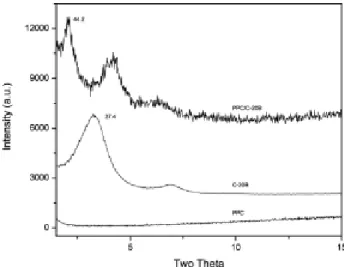
001peak using the Bragg’s equation. Fig. 2 shows the X-ray diffraction patterns (XRD) of PPC, cloisite 20B and PPC/cloisite 20B. XRD shows an intense peak at 27.4 Å for cloisite 20B which are shifted to 44.2 Å after treatment with PPC in acetone at room temprature. These significant increases in the basal space confirm that the PPC has been intercalated into the sheets of the clay and in- creased the basal spacing of the sheets.
3.2. FT-IR Characteristics
Fig. 3 shows the FT-IR spectra for PPC, cloisite 20B
and PPC/cloisite 20B nanohybrid. The characteristic ab-
sorption bands for pure PPC are due to stretching vi-
bration of C=O at 1,750 cm
-1, stretching vibration of
C-O at 1,360, 1,220 and 775 cm
-1and stretching vi-
bration of C-H at 2,800∼2,900 cm
-1. In the spectrum of
the cloisite 20B, the absorption bands at 1,050 cm
-1re-
sult from stretching vibrations of clay Si-O while band
Fig. 3. FT-IR spectra of PPC, C-20B and PPC/C-20B nano- hybrid.
at 914 cm
-1was due to Al-Al-OH stretching mode in octahedral layer [16,21]. The Peaks in 3,400∼3,600 cm
-1region are due to the silanol groups [9]. The absorption bands at 3,000 and 1,500 cm
-1regions can be attributed to C-H stretching and bending, respectively, from the organic portion of the clay. The characteristic peaks of alkylammonium occur at 2,926 cm
-1, ν
as(CH
3); 2,852 cm
-1, ν
as(CH
2); and 1,470 cm
-1, δ
s(CH
2). All these character- istics peaks of clay and PPC were detected in the spec- trum of PPC-organo-clay nanohybrid, suggesting the for- mation of PPC/cloisite 20B nanocomposite. The FT-IR data is in good agreement with the data reported by Longchao et al. [9].
3.3. Thermal Degradation
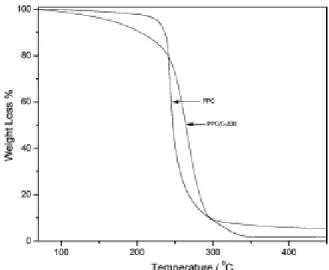
The thermal stability of the PPC/organo-clay nano- hybrid was discussed and compared to that of PPC. The TG data for PPC and PPC/organo-clay nanohybrid is shown in Fig. 4. In the TG curves, there are two steps in the degradation of PPC and nanohybrid. The first step is roughly from 235 to 242°C and the second step is about from 330 to 345°C in PPC. The first step (235
∼242°C) of degradation is attributed to the main chain pyrolysis while the second step (330∼345°C) may be assigned to the degradation of the carbonaceous residue formed during the first step. Thus, the first step is the main step of ABS resin degradation while in nanohybrid
Fig. 4. TG curves of PPC and PPC/C‐20B nanohybrid.
Fig. 5. DTG curves of PPC and PP/C‐20B nanohybrid.
the degradation step occurred between around 50 and 250°C is accounted to around 8% weight loss, corre- sponding to the poor thermal stability of organic ammo- nium compounds within the C-20B of the hybrid membrane. The second stage of decomposition started from around 250 to 307°C, was attributed to major weight loss due to decomposition of polymeric network.
Although the onset of weight loss of PPC nano- composites occurs at a lower temperature than that of pure ABS, the incorporation of inorganic precursors was highly influenced on the thermal stability of the organic matrix.
From the DTG results in Fig. 5, it can be seen that
the fastest thermal decomposition temperatures are im-
Fig. 6. DSC curves of PPC and PPC/C-20B nanohybrid.
proved after the addition of C-20B, which is higher than that of PPC. The curves of nanohybrid become coarser and wider than that of pure PPC. The in- corporation of clay into the polymer matrix would en- hance its thermal stability by acting as a superior insulator. The silicate layers which uniformly disperse in matrix lead to the difficulty in heat conduction and acts as a mass transport barrier to the volatile products which generate during decomposition. Those functions of silicate layers will result in the lag, wide and coarse peaks of nanocomposites during decomposition.
The DSC traces of both PPC and PPC/OMMT nano- hybrid are shown in Fig. 6. The pure PPC exhibits a glass transition temperature (Tg) at 21°C. With the addi- tion of OMMT, the glass transition temperatures of PPC/
OMMT nanohybrid obviously increased and show the Tg at 31°C, which is 10°C higher than that of PPC.
This is because of the strong interaction between the polymer and the nano-dispersed silicate layers, which restricts the segmental motion of PPC molecular chains.
The improvement of both the decomposition temperature and glass transition temperature of composites indicates that nanocomposition is an efficient way to increase the thermal stability of PPC.
3.4. Water Absorption
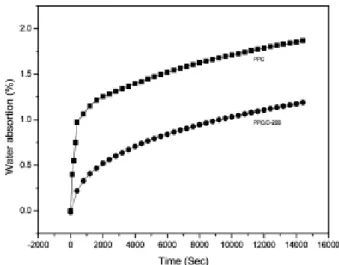
For water uptake studies, the PPC and PPC/C-20B membrane were first dried in vacuum oven at 100°C for
Fig. 7. Water absorption graph of PPC and PPC/C-20B nanohybrid.
Table 2. DSC results of PPC and PPC/C-20B nanocom- posites
Sample name PPC Intercalated
Tg (°C) 21 30
12 h. The weight of the completely dried samples (W
d) was initially measured using microbalance. Then the membrane was kept in a humidified chamber with de- ionized water until no further water uptake took place.
A water uptake study was carried out at room tem- perature. When there was no water uptake, again the weight of the membrane was measured (W
s) with micro balance. Then the water uptake (S) was calculated using the following equation.
×