Analysis of Postoperative Complications Following Laparoscopic Gastrectomy in 1332 Gastric Cancer Patients
Dong Woo Hyun, M.D.
1, Ki Hyun Kim, M.D.
2, Si Hak Lee, M.D., Ph.D.
2, Sun Hwi Hwang, M.D., Ph.D.
2,
Dae Hwan Kim, M.D., Ph.D.
1, Tae Yong Jeon, M.D., Ph.D.
1, Dong Heon Kim, M.D., Ph.D.
1, Do Youn Park, M.D., Ph.D.
3, Chang In Choi, M.D.
11
Department of Surgery, Medical Research Institute, Pusan National University Hospital, Busan,
2Department of Surgery, Medical Research Institute, Pusan National University Yangsan Hospital, Yangsan,
3Department of Pathology, Medical Research Institute, Pusan National University Hospital, Busan, Korea
Purpose:
To analyze postoperative complications for gastric cancer patients undergoing laparoscopic gastrectomy in single institution over long period of time.Methods:
The data of 1332 consecutive patients undergoing laparoscopic gastrectomy for gastric cancer at a single institution from January 2007 to December 2015 were reviewed. The patients were classified into the early or late surgery group; the initial 100 cases were classified as the initial group.We compared between the two groups and analyzed risk factors for postoperative complications.
Results:
A total of 265 postoperative complications occurred in 223 patients (16.7%). Major complications occurred in 38 patients (2.9%) including 1 death (0.1%). Operative time and hospital stay were significantly shorter in the late group. Blood loss was greater in the initial group. Sex, comorbidity, tumor location, D2 LND, operative method, non B-I anastomosis, co-resection, long operative time, and blood loss were significant risk factors for overall postoperative complication. In the multivariate analysis, male sex, comorbidity, D2 lymph node dissection, total or proximal gastrectomy, non B-I anastomosis, co-resection, operative time and blood loss were associated with postoperative overall complications.Conclusion:
Sex, co-morbidity, D2 LND, operative method, co-resection, operative time and blood loss revealed as the risk factor of overall postoperative complication. And there was no significant differences of risk factor related to postoperative complication between initial and maturation surgical period. This suggests that beginners also can safely perform laparoscopic gastrectomy through the appropriate patient selection.Keywords:
Postoperative complication, Gastrectomy, Laparoscopy, Minimal invasive surgery, Gastric cancerReceived August 24, 2017 Revised October 20, 2017 Accepted November 7, 2017
Corresponding author Chang In Choi
Department of Surgery, Medical Research Institute, Pusan National University Hospital, 179 Gudeok-ro, Seo-gu, Busan 49241, Korea Tel: +82-51-240-7238 Fax: +82-51-247-1365 E-mail: [email protected] ORCID:
http://orcid.org/0000-0002-1920-1879
This study was previously presen- tated at the following meeting.
Organisation: The Endoscopic &
Laparoscopic Surgeons of Asia 2016 (ELSA 2016). Place: Suzhou, China Date: 9~12, Nov, 2016.
This is an Open Access article distributed under the terms of the Creative Commons Attribution Non-Commercial License (http://
creativecommons.org/licenses/by-nc/4.0/) which permits unrestricted non-commercial use, distribution, and reproduction in any medium, provided the original work is properly cited.
Copyright © 2018 The Journal of Minimally Invasive Surgery. All rights reserved.
Journal of Minimally Invasive Surgery
J Minim Invasive Surg 2018;21(1):13-24
INTRODUCTION
Since Kitano et al. first described laparoscopic distal gas- trectomy,
1several randomized controlled trials have validated
procedure as the accepted standard treatment for patients with
early gastric cancer.
2-5The laparoscopic approach has been
further refined over the past decade with improvements in
surgical instrumentation and techniques. Numerous studies
are currently assessing the use of laparoscopic gastrectomy in patients with advanced gastric cancer and favorable outcomes have been reported in small-scale prospective and in several retrospective studies.
5-7Through accumulated surgical experience and extensive study, the laparoscopic gastrectomy procedure has become standardized and more familiar. However, this procedure may be technically challenging for inexperienced surgeons. A sur- geon trained in a center with a large surgical volume and se- nior surgical instructors has a lower barrier to competency in laparoscopic surgery. In contrast, surgeons trained in centers with a low surgical volume with fewer and less experienced instructors may face some difficulties in learning proper lapa- roscopic techniques and accumulating the experiences.
8In particular, anastomotic complications. may be a significant obstacle to safely performing laparoscopic gastrectomy or newer procedures because anastomotic complications are po- tentially fatal.
The incidence of postoperative complications can be used as a tool to evaluate “surgical quality”, but many previous studies have used different definitions for complications, making it difficult to compare the results because of a lack of objectiv- ity.
9-11The Clavien-Dindo classification of complications was established in 2004 as a more objective method to evaluate complications, and a significant number of studies have been conducted based on this classification. However, significant deviations in the frequency of complications are still observed in studies because of various factors. In this study, we aimed to analyze the risk factors for postoperative complications af- ter laparoscopic gastrectomy using the Clavien-Dindo classifi- cation and to compare the incidence of postoperative compli- cations in those undergoing surgery early in the study period with those undergoing surgery later in the study period.
MATERIALS AND METHODS
We enrolled 1332 patients who underwent laparoscopic gas- trectomy for gastric cancer from January 2007 to December 2015 at Pusan National University Hospital. In all patients, preoperative endoscopic biopsy was performed to diagnose the cancer histologically and the stage and location of the tu- mor were evaluated by abdominal computed tomography and endoscopic ultrasonography. The indication for laparoscopic gastrectomy was limited to mucosal or submucosal invasion without lymph node metastasis (cT1a/T1bN0). Surgery was performed by three gastric surgeons who had experience in
>100 open gastrectomies. The patients’ medical records were prospectively collected. The 1332 enrolled patients were clas- sified into early or late surgical groups; the initial 100 cases were classified as the initial group. (reached at August 2008)
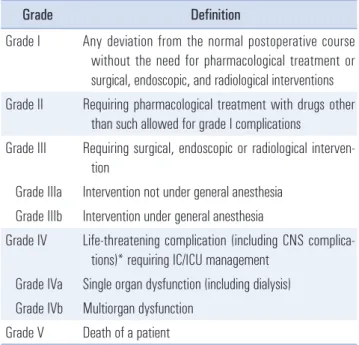
We compared patient demographics, pathological data, and perioperative data between the two groups and analyzed the risk factors for postoperative complications. The Clavien-Din- do classification was used to analyze postoperative complica- tions, and grade III or higher complications were defined as major complications
12(Table 1). Delayed complication, which defines as occurrence after postoperative 30 days or readmis- sion was also included in this study.
Surgical procedure
The operative method followed that used for conventional laparoscopic gastrectomy with lymph node dissection. A cam- era port for a 30-degree rigid scope was inserted through in- fra-umbilical incision. Two acting ports for the operator were inserted on the right side of each patient and 2 assistant ports were placed on the patient ’s left side. A 5 mm port for liver retraction was inserted in the epigastrium. The anastomosis for maintaining intestinal continuity was performed with a Billroth I, Billroth II, Roux-en-Y, or double-tract reconstruc- tion. Roux-en-Y esophagojejunostomy was performed intra- corporeally with a double-stapling method. Others anastomo- ses were performed extracorporeally through the 5 cm mini- laparotomy port in the epigastrium.
Table 1. Clavien-Dindo classification for the postoperative complication
12Grade Definition
Grade I Any deviation from the normal postoperative course without the need for pharmacological treatment or surgical, endoscopic, and radiological interventions Grade II Requiring pharmacological treatment with drugs other
than such allowed for grade I complications
Grade III Requiring surgical, endoscopic or radiological interven- tion
Grade IIIa Intervention not under general anesthesia Grade IIIb Intervention under general anesthesia
Grade IV Life-threatening complication (including CNS complica- tions)* requiring IC/ICU management
Grade IVa Single organ dysfunction (including dialysis) Grade IVb Multiorgan dysfunction
Grade V Death of a patient
*Brain hemorrhage, ischemic stroke, subarrachnoidal bleeding, but ex-
cluding transient ischemic attacks. CNS = central nervous system; IC =
intermediate care; ICU = intensive care unit.
Statistical analysis
All data were expressed as the mean±the standard de- viation. The chi-square test and student’s t-test were used to compare categorical variables and continuous variables between groups, respectively. Multivariate analysis was per- formed using a logistic regression model to identify risk fac- tors for postoperative complications. Two-tailed p values<0.05 were considered statistically significant. Statistical analyses were performed using SPSS version 18.0 (SPSS Inc., Chicago, IL, USA).
RESULTS
Patient demographics
The mean age was 59.0±11.1 years and body mass index was 23.5±2.9 kg/m
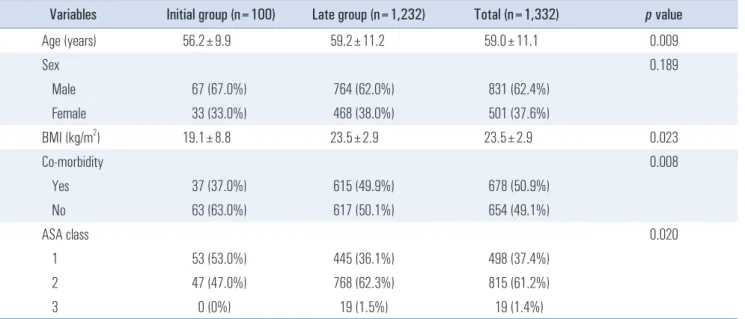
2. A total of 831 (62.4%) patients were male and 501 (37.6%) patients were female. A total of 678 patients (50.9%) had a comorbidity. There were significant differences in age, body mass index, comorbidities, and American Society of Anesthesiologists (ASA) score. The patient demographics of the each study group are summarized in Table 2.
Pathologic data
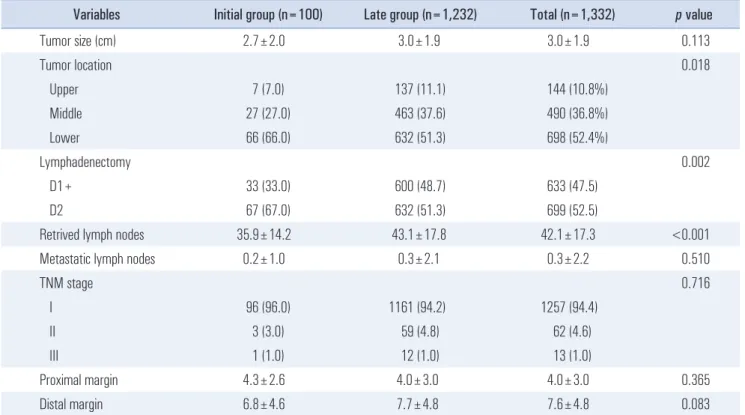
The mean tumor size of all patients was 3.0±1.9 cm and there was no significant difference in tumor size between the two groups (2.7±2.0 cm vs. 3.0±1.9 cm, p=0.113). Tumors were most commonly located in the lower gastric region; however,
there was a tendency towards a higher incidence of upper gastric cancers in the late group A total of 699 patients (52.5%) underwent a D2 lymph node dissection (LND), and a D2 LND was performed significantly less frequently in the late group.
However, the number of harvested lymph nodes was greater in the late group compared with that seen in the initial group (35.9±14.2 vs. 43.1±17.8, p<0.001) Permanent pathological re- sults confirmed early gastric cancer in most patients, and there were no differences in TNM stage between the two groups.
The mean proximal and distal margin of all study patients were not shown the significant differences. All pathologic data are presented in Table 3.
Postoperative data
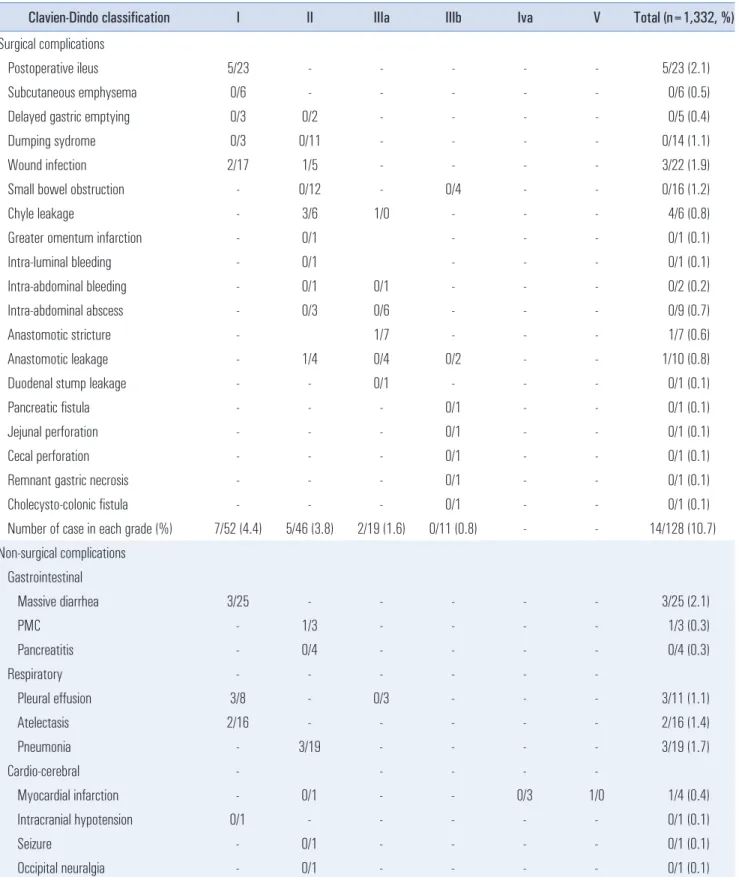
All patients in the early group underwent laparoscopic as- sisted distal gastrectomy. In the late group, laparoscopic distal gastrectomy, total gastrectomy, and proximal gastrectomy was performed in 1,136 patients (92.2%), 90 patients (7.3%), and 6 patients (0.5%), respectively. Operative time and hospital stay were significantly shorter in the late group. Blood loss was greater in the initial group compared to that seen in the late group (369.3±226.7 mL vs. 214.6±66.5 mL, respectively, p<0.001) Postoperative complications occurred in 224 pa- tients (16.8%), and major complications (≥grade IIIa Clavien- Dindo classification) occurred in 37 patients (2.8%). There was no significant difference in the incidence of postoperative complications, including major complications, between the two groups (Table 4). One death (0.1%) occurred in the initial group; a patient with coronary artery occlusive disease died
Table 2. Patient demographics
Variables Initial group (n=100) Late group (n=1,232) Total (n=1,332) p value
Age (years) 56.2±9.9 59.2±11.2 59.0±11.1 0.009
Sex 0.189
Male 67 (67.0%) 764 (62.0%) 831 (62.4%)
Female 33 (33.0%) 468 (38.0%) 501 (37.6%)
BMI (kg/m
2) 19.1±8.8 23.5±2.9 23.5±2.9 0.023
Co-morbidity 0.008
Yes 37 (37.0%) 615 (49.9%) 678 (50.9%)
No 63 (63.0%) 617 (50.1%) 654 (49.1%)
ASA class 0.020
1 53 (53.0%) 445 (36.1%) 498 (37.4%)
2 47 (47.0%) 768 (62.3%) 815 (61.2%)
3 0 (0%) 19 (1.5%) 19 (1.4%)
BMI = body mass index; ASA = American Society of Anesthesiologist.
Table 3. Pathological data
Variables Initial group (n=100) Late group (n=1,232) Total (n=1,332) p value
Tumor size (cm) 2.7±2.0 3.0±1.9 3.0±1.9 0.113
Tumor location 0.018
Upper 7 (7.0) 137 (11.1) 144 (10.8%)
Middle 27 (27.0) 463 (37.6) 490 (36.8%)
Lower 66 (66.0) 632 (51.3) 698 (52.4%)
Lymphadenectomy 0.002
D1+ 33 (33.0) 600 (48.7) 633 (47.5)
D2 67 (67.0) 632 (51.3) 699 (52.5)
Retrived lymph nodes 35.9±14.2 43.1±17.8 42.1±17.3 <0.001
Metastatic lymph nodes 0.2±1.0 0.3±2.1 0.3±2.2 0.510
TNM stage 0.716
I 96 (96.0) 1161 (94.2) 1257 (94.4)
II 3 (3.0) 59 (4.8) 62 (4.6)
III 1 (1.0) 12 (1.0) 13 (1.0)
Proximal margin 4.3±2.6 4.0±3.0 4.0±3.0 0.365
Distal margin 6.8±4.6 7.7±4.8 7.6±4.8 0.083
TNM stage was followed by AJCC 7
thedition.
Table 4. Postoperative data
Variables Initial group (n=100) Late group (n=1,232) Total (n=1,332) p value
Operation method 0.015
LADG 100 (100.0) 1136 (92.2) 1236 (92.8)
LATG 0 (0) 90 (7.3) 90 (6.8)
LAPG 0 (0) 6 (0.5) 6 (0.5)
Reconstruction method 0.065
B-I 76 (76.0) 661 (53.7) 723 (54.3)
Others 24 (24.0) 571 (46.3) 609 (45.7)
Co-resection 0.089
Yes 18 (18.0) 156 (12.7) 174 (13.1)
No 82 (82.0) 1076 (87.3) 1158 (86.9)
Operative time (min) 271.1±75.0 214.6±66.5 218.4±68.5 <0.001
Blood loss (ml) 369.3±226.7 183.3±164.3 195.8±175.5 <0.001
Hospital stay (days) 9.4±3.3 8.6±3.3 9.3±3.9 0.015
Postoperative complication 21 (21.0) 203 (16.5) 224 (16.8) 0.153
Major complication (Grade≥IIIa)* 2 (2.0) 35 (2.8) 37 (2.8) 0.465
LADG = laparoscopic assisted distal gastrectomy; LATG = laparoscopic assisted total gastrectomy; LAPG = laparoscopic assisted proximal gastrectomy;
B-I = Billoth I, Other = Billoth II, Roux-en-Y, esophagogastrostomy and double tract reconstruction. *Grade of Clavien-Dindo classification.
Table 5. Details of postoperative complications (Initial group/Late group)
Clavien-Dindo classification I II IIIa IIIb Iva V Total (n=1,332, %)
Surgical complications
Postoperative ileus 5/23 - - - - - 5/23 (2.1)
Subcutaneous emphysema 0/6 - - - - - 0/6 (0.5)
Delayed gastric emptying 0/3 0/2 - - - - 0/5 (0.4)
Dumping sydrome 0/3 0/11 - - - - 0/14 (1.1)
Wound infection 2/17 1/5 - - - - 3/22 (1.9)
Small bowel obstruction - 0/12 - 0/4 - - 0/16 (1.2)
Chyle leakage - 3/6 1/0 - - - 4/6 (0.8)
Greater omentum infarction - 0/1 - - - 0/1 (0.1)
Intra-luminal bleeding - 0/1 - - - 0/1 (0.1)
Intra-abdominal bleeding - 0/1 0/1 - - - 0/2 (0.2)
Intra-abdominal abscess - 0/3 0/6 - - - 0/9 (0.7)
Anastomotic stricture - 1/7 - - - 1/7 (0.6)
Anastomotic leakage - 1/4 0/4 0/2 - - 1/10 (0.8)
Duodenal stump leakage - - 0/1 - - - 0/1 (0.1)
Pancreatic fistula - - - 0/1 - - 0/1 (0.1)
Jejunal perforation - - - 0/1 - - 0/1 (0.1)
Cecal perforation - - - 0/1 - - 0/1 (0.1)
Remnant gastric necrosis - - - 0/1 - - 0/1 (0.1)
Cholecysto-colonic fistula - - - 0/1 - - 0/1 (0.1)
Number of case in each grade (%) 7/52 (4.4) 5/46 (3.8) 2/19 (1.6) 0/11 (0.8) - - 14/128 (10.7) Non-surgical complications
Gastrointestinal
Massive diarrhea 3/25 - - - - - 3/25 (2.1)
PMC - 1/3 - - - - 1/3 (0.3)
Pancreatitis - 0/4 - - - - 0/4 (0.3)
Respiratory - - - - - -
Pleural effusion 3/8 - 0/3 - - - 3/11 (1.1)
Atelectasis 2/16 - - - - - 2/16 (1.4)
Pneumonia - 3/19 - - - - 3/19 (1.7)
Cardio-cerebral - - - - -
Myocardial infarction - 0/1 - - 0/3 1/0 1/4 (0.4)
Intracranial hypotension 0/1 - - - - - 0/1 (0.1)
Seizure - 0/1 - - - - 0/1 (0.1)
Occipital neuralgia - 0/1 - - - - 0/1 (0.1)
from an acute myocardial infarction on the day of surgery.
Details of postoperative complication for the entire study group and the initial and late groups are presented in Table 5.
Risk factors for postoperative complications after laparoscopic gastrectomy
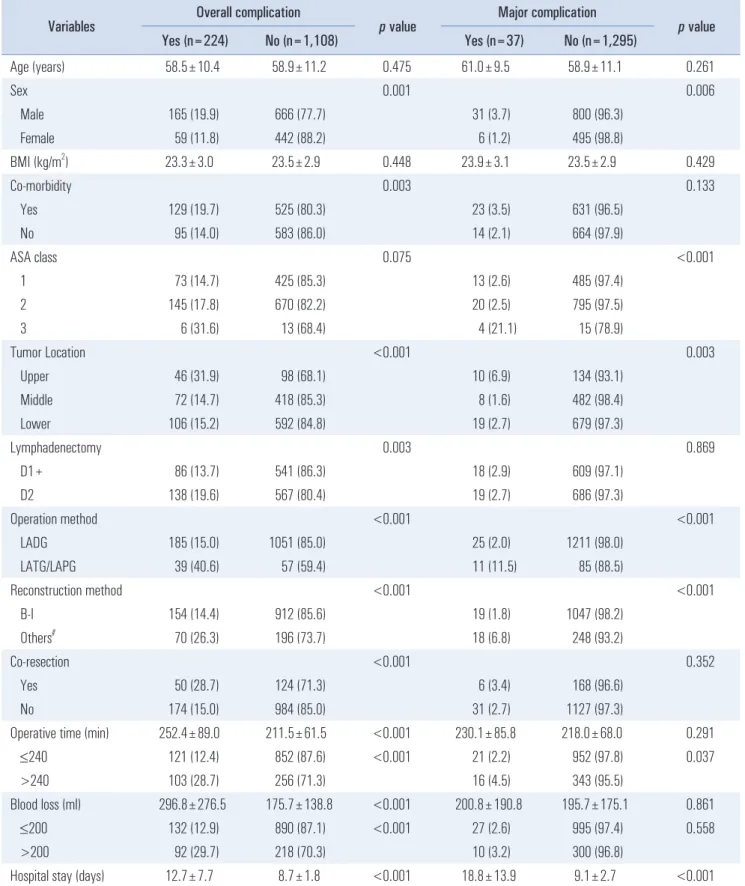
In the univariate analysis, male sex, the presence of a co- morbidity, tumor location, D2 lymph node dissection, lapa- roscopic total gastrectomy (LTG) or laparoscopic proximal gastrectomy (LPG), non B-I anastomosis, co-resection, op- erative time, and blood loss were significantly associated with the overall incidence of postoperative complications. Major complications were associated with male sex, ASA score, tumor location, operation method such as LTG/LPG and non B-I anastomosis (Table 6). In the multivariate analysis, overall postoperative complications were significantly associ- ated with male sex (odds ratio [OR], 1.719; 95% confidence interval [CI], 1.242~2.442; p=0.002), presence of a comorbid- ity (OR, 1.473; 95% CI, 1.084~2.001; p=0.013), D2 LND (OR 1.615; 95% CI, 1.152~2.264; p=0.005), operation method-LTG/
LPG (OR, 4.622; 95% CI, 2.809~7.606; p<0.001), co-resection (OR, 1.806; 95% CI, 1.210~2.696; p=0.004), operation time (OR, 1.426; 95% CI, 1.001~2.032; p=0.049) and blood loss (OR 2.662; 95% CI, 1.816~3.904; p<0.001). Male sex (OR, 3.123;
95% CI, 1.273~7.660; p=0.013), ASA score (OR, 12.203; 95%
CI, 3.582~41.568; p<0.001), operation method-LTG/LPG (OR, 2.819; 95% CI, 1.028~7.731; p=0.044) and non B-I anastomosis (OR, 2.609; 95% CI, 1.061~6.416; p=0.037) were significant risk factors for the major complication, which was similar to the results of the univariate analysis (Table 7).
DISCUSSION
Differences in the postoperative complication rates in previous studies
Laparoscopic gastrectomy has been accepted as the stan- dard surgery for early gastric cancer patients, and advanced gastric cancer is become a more frequent indication for lapa- roscopic gastrectomy. Several studies from the 2000s reported a postoperative complication rate ranging from 4.7% to 23.3%
after laparoscopic gastrectomy.
10,13-16Several reports since 2010 have shown no significant change in the rate of postoperative complications despite improvements in surgical instrument and technique.
17-19In 2004, Dindo et al. developed a clas- sification system for postoperative complications in an effort to standardize the quality assessment of surgery; however, a large variation in the incidence of complications is still seen in recent studies. Dindo et al. defined a complication as “any Table 5. Continued
Clavien-Dindo classification I II IIIa IIIb Iva V Total (n=1,332, %)
Renal - - - - - -
Urinary difficulty - 0/8 - - - - 0/8 (0.6)
APN - 0/1 - - - - 0/1 (0.1)
AKI 0/3 - - - - - 0/3 (0.2)
CKD - - - - 0/1 - 0/1 (0.1)
Hepatobiliary - - - - - -
Massive ascites - 0/1 0/2 - - - 0/3 (0.2)
Hyperbilirubinemia 0/5 - - - - - 0/5 (0.4)
Hepatic encephalopathy - 0/1 - - - - 0/1 (0.1)
Others
DVT - 0/1 - - - - 0/1 (0.1)
Delirium - 0/4 - - - - 0/4 (0.3)
Skin eruption - 0/2 - - - - 0/2 (0.2)
Thrombocytopenia - 0/1 - - - - 0/1 (0.1)
Number of case in each grade (%) 8/58 (5.0) 4/48 (3.9) 0/5 (0.4) - 0/4 (0.3) 1/0 (0.1) 13/115 (2.9)
Total case number (%) 15/110 (9.4) 9/94 (7.7) 2/24 (2.0) 0/11 (0.8) 0/4 (0.3) 1/0 (0.1) 33/243
PMC = pseudomembranous colitis; APN = acute pyelonephritis; AKI = acute kidney injury; CKD = chronic kidney disease; DVT = deep vein thrombosis.
Table 6. Univariate analysis of risk factors of postoperative complication after laparoscopic gastrectomy Variables Overall complication
p value Major complication
p value
Yes (n=224) No (n=1,108) Yes (n=37) No (n=1,295)
Age (years) 58.5±10.4 58.9±11.2 0.475 61.0±9.5 58.9±11.1 0.261
Sex 0.001 0.006
Male 165 (19.9) 666 (77.7) 31 (3.7) 800 (96.3)
Female 59 (11.8) 442 (88.2) 6 (1.2) 495 (98.8)
BMI (kg/m
2) 23.3±3.0 23.5±2.9 0.448 23.9±3.1 23.5±2.9 0.429
Co-morbidity 0.003 0.133
Yes 129 (19.7) 525 (80.3) 23 (3.5) 631 (96.5)
No 95 (14.0) 583 (86.0) 14 (2.1) 664 (97.9)
ASA class 0.075 <0.001
1 73 (14.7) 425 (85.3) 13 (2.6) 485 (97.4)
2 145 (17.8) 670 (82.2) 20 (2.5) 795 (97.5)
3 6 (31.6) 13 (68.4) 4 (21.1) 15 (78.9)
Tumor Location <0.001 0.003
Upper 46 (31.9) 98 (68.1) 10 (6.9) 134 (93.1)
Middle 72 (14.7) 418 (85.3) 8 (1.6) 482 (98.4)
Lower 106 (15.2) 592 (84.8) 19 (2.7) 679 (97.3)
Lymphadenectomy 0.003 0.869
D1+ 86 (13.7) 541 (86.3) 18 (2.9) 609 (97.1)
D2 138 (19.6) 567 (80.4) 19 (2.7) 686 (97.3)
Operation method <0.001 <0.001
LADG 185 (15.0) 1051 (85.0) 25 (2.0) 1211 (98.0)
LATG/LAPG 39 (40.6) 57 (59.4) 11 (11.5) 85 (88.5)
Reconstruction method <0.001 <0.001
B-I 154 (14.4) 912 (85.6) 19 (1.8) 1047 (98.2)
Others
#70 (26.3) 196 (73.7) 18 (6.8) 248 (93.2)
Co-resection <0.001 0.352
Yes 50 (28.7) 124 (71.3) 6 (3.4) 168 (96.6)
No 174 (15.0) 984 (85.0) 31 (2.7) 1127 (97.3)
Operative time (min) 252.4±89.0 211.5±61.5 <0.001 230.1±85.8 218.0±68.0 0.291
≤240 121 (12.4) 852 (87.6) <0.001 21 (2.2) 952 (97.8) 0.037
>240 103 (28.7) 256 (71.3) 16 (4.5) 343 (95.5)
Blood loss (ml) 296.8±276.5 175.7±138.8 <0.001 200.8±190.8 195.7±175.1 0.861
≤200 132 (12.9) 890 (87.1) <0.001 27 (2.6) 995 (97.4) 0.558
>200 92 (29.7) 218 (70.3) 10 (3.2) 300 (96.8)
Hospital stay (days) 12.7±7.7 8.7±1.8 <0.001 18.8±13.9 9.1±2.7 <0.001
BMI = body mass index; ASA = American Society of Anesthesiologist; LADG = laparoscopic assisted distal gastrectomy; LATG = laparoscopic assisted
total gastrectomy; LAPG = laparoscopic assisted proximal gastrectomy; B-I = Billoth I; Other = Billoth II, Roux-en-Y, esophagogastrostomy and double
tract reconstruction.
deviation from the ideal postoperative course ”. Because this definition is vague with terms such as “any” or “ideal”, there is a significant possibility that the researcher ’s subjective judg- ment will influence study results. Variations in the complica- tion rates between studies are due to differences in operative procedures, operator and patient characteristics, as well as the definition of postoperative complications.
16Jung et al. has validated the Accordion Severity Grading System, described by Strasberg et al., to overcome shortcomings of the Clavien- Dindo classification.
18Risk factors for postoperative complications after laparoscopic gastrectomy
Two hundred twenty-four of 826 patients (16.8%) expe- rienced at least one postoperative complication in the pres- ent study. The incidence of major complications (≥grade III Clavien-Dindo classification ) was 37 (2.8%) and there were a total of 276 postoperative complications in the present study.
The incidence of postoperative complications we report is not significantly different from that of previous reports, but the risk factors associated with postoperative complications are.
In a large-scale Korean multicenter study reported by Kim et al., the incidence of systemic complications was signifi- cantly increased in patients over 60 years old.
16Nagasako et al.
reported that the incidence of complications was significantly increased in patients >70 years old.
20Lee et al. reported that the incidence of complications was increased in patients older than 70 years, but not the incidence of major complications (grade III Clavien-Dindo or higher).
21In contrast, Ryu et al.
reported that age was not associated with complications after
laparoscopic distal gastrectomy.
11Jung et al. also reported that there was no significant correlation between age and compli- cations in a multivariate analysis of their study data.
18Age is the patient’s factor that reflects the physical condition along with ASA score and co-morbidity. In the present study, there was no association between age and the incidence of post- operative complications. The age of patients experiencing a major complication was slightly higher than that of the study group, but this difference was not statistically significant. This may be due to relatively young patients - the mean age was
<60 years (58.5 years). However, careful attention should be paid to the preoperative evaluation and postoperative manage- ment of older patients, because numerous reports suggest that advanced age affects the incidence of postoperative complica- tions.
19Overall complications were more common in men, and there was also correlation between major complications and sex.
This may be associated that men more frequently smoke and drink alcohol than do women, but this has not been proven to be the cause of increased complications in previous studies.
The presence of co-morbidity was a risk factor for postopera- tive complications, but was not a risk factor for major compli- cations. However, severe cardiovascular or pulmonary disease is known to increase the occurrence of postoperative compli- cations.
18The only mortality in this study was caused by an acute myocardial infarction in a patient with coronary artery occlusive disease.
LTG, which is performed in patients with upper gastric can- cer, is known to be more difficult and challenging than partial gastric resection. The incidence of overall complications was 31.9% in patients with upper gastric cancer, and there was Table 7. Multivariate analysis of risk factors of postoperative complication after laparoscopic gastrectomy
Variables Overall complication Major complication
OR (95% CI) p value OR (95% CI) p value
Sex (Male vs. Female) 1.719 (1.242~2.442) 0.002 3.123 (1.273~7.660) 0.013
Co-morbidity 1.473 (1.084~2.001) 0.013
ASA (3 vs. 1/2) 12.203 (3.582~41.568) <0.001
Tumor Location (upper vs. mid/lower) 1.475 (0.808~2.694) 0.206 Lymphadenectomy (D2 vs. D1) 1.615 (1.152~2.264) 0.005
Operation method (Others vs. LDG) 4.622 (2.809~7.606) <0.001 2.819 (1.028~7.731) 0.044 Reconstruction (B-I vs. others) 1.173 (0.727~1.894) 0.514 2.609 (1.061~6.416) 0.037
Co-resection 1.806 (1.210~2.696) 0.004
Operative time (>240 vs. ≤240 min) 1.426 (1.001~2.032) 0.049 Blood loss (>200 vs. ≤200 ml) 2.143 (1.523~3.017) <0.001
ASA = American Society of Anesthesiologists; Others = laparoscopic total gastrectomy/proximal gastrectomy; LDG = laparoscopic distal gastrectomy.
significant difference in the incidence of major complications between the tumor locations. In addition, the LTG/LPG group showed a significantly higher overall and major complication incidence than that seen in the LDG group. The multivari- ate analysis showed results similar to the univariate analysis.
This may be due to the result of postoperative strictures in the LTG/LPG group. Kubota et al. has reported that the compli- cation rate in upper gastric cancer patients was higher than that seen in patients with lower gastric cancer, and Jeong et al. also has reported a higher incidence of complications in patients undergoing LTG compared to that seen in patients undergoing LDG.
22,23In order to evaluate the efficacy of extended LND, two western randomized trials were conducted by the Medical Re- search Council in the United Kingdom and the Dutch Gastric Cancer Group in the Netherlands.
24,25In both trials, the mor- bidity and mortality rates were substantially higher in patients who underwent D2 LND. Although these large scale random- ized controlled trials had some limitations, it is generally ac- cepted that the greater the extent of the LND, the higher the complication rate.
26,27Recently, various efforts to reduce com- plications related to radical LND have been made with the function preserving surgrey such as sentinel node navigation
surgery. Improvements in techniques and instruments now allow D2 LND to be performed more safely. In the present study, the overall complication was higher in patients under- going D2 LND; however, there was no difference in the rate of major complications between D1+ and D2 LND patients. Some prior studies have reported that the extent of LND does not affect postoperative complications, but this remains an issue of ongoing debate.
18,19,21Moreover, patients undergoing adjacent organ resection, such as the pancreas, spleen, or colon, were not rarely included in this study. Because most patients en- rolled in this study preoperatively diagnosed as the early stage cancer, adjacent organ invasion was very rare. Actually, 169 (97.1%) of 174 patients performed the co-resection (concurrent resection of another organ during the gastrectomy) underwent a simple cholecystectomy due to cholelithiasis. This may lead the result that co-resection was not risk factor for major com- plications in the present study, unlike the findings of previous European studies conducted in the 1990s.
There are several opinions as to how the rate of postop- erative complications is influenced by operative time and intraoperative bleeding. New anesthesia techniques and im- provements in perioperative management have reduced the complication rates in patients with unfavorable intraoperative
A B
C D
Fig. 1. Anastomotic leakage manage- ment. (A) Tubography revealed the anas- tomotic fistula to the remnant stomach.
(B) It shows the anastomotic fistula near
a staple line (blue arrow). (C) Endoscopic
hemoclips were applied around the
fistula and tightened with detachable
snare (at postoperative day 17). (D) No
remarkable leakage finding was observed
in upper gastrointestinal contrast test af-
ter procedure (at postoperative day 20).
circumstances. In the present study, the overall complication rate was associated with operative time and blood loss; how- ever, major complications were not associated with these fac- tors. In the multivariate analysis, blood loss was the potent risk factor that increased the occurrence of overall postoperative complications. Generally, transfusion and volume over-load occurring during the treatment of excessive blood loss could cause complications such as atelectasis or ileus. However, Wu et al. has reported that blood transfusions decreased mortality in patients with lower hemoglobin levels and in elderly pa- tients.
28And prolonged operative time has also been reported to be associated with wound complications or sepsis, but this has not been found to be a risk factor in recent reports.
19,29Anastomosis-related complications and their management
Anastomosis-related problems are a great concern to sur- geons except for systemic complications. Strictures are often easily treated endoscopically with interventional balloon dila- tation and localized abdominal abscess can be controlled with external drainage and antibiotics. However, because of the risk of sepsis from a fistula or leakage, more careful manage- ment of anastomosis-related problems is required. Although the learning curve for procedural competence in laparoscopic gastrectomy is known to be around 50 cases,
30we could not find any statistical significance between the frequency of postoperative complications and the learning curve in the present study. This may be because the surgeons in this study had extensive experience in gastrectomy and because there was variation in the operative team. Anastomotic leakage occurred in eleven patients and ten patients in the late sur- gery group. Nine patients underwent LDG with a Billroth-I anastomosis, and five of them were treated with conservative management including antibiotics. The other two patients were managed with percutaneous catheter drainage, and two pa- tients were recovered with endoscopic intervention to close an anastomotic fistula. Endoscopic intervention was performed, placing hemoclips around the fistula and tightening them with a detachable snare (Fig. 1) This method may be effective if the fistula is not large and fibrosis has well formed at the periphery of the fistula. Actually two patients underwent the endoscopic intervention for closing the fistula at postoperative 14 day and 17 day, respectively. All anastomotic leakages were well controlled without any mortality. Anastomotic stricture occurred in eight patients and mostly in LTG or LPG (six patients). All patients was performed several endoscopic bal- looning and its result was satisfied. Anastomotic intraluminal bleeding was occurred in 1 patients, who recovered with blood transfusion. Authors check the bleeding into anastomotic site
through the gastrotomy after all reconstruction and control the bleeding with suturing if it is necessary. This may be the reason why incidence of intraluminal bleeding was very low in this study.
Comparison of postoperative complications according to the time of surgery
Patients in the initial surgery group were younger, thin- ner, had fewer comorbidities, and were in better physical condition than those in the late surgery group. This may be because the patient selection was more stringent at the early period of laparoscopic gastrectomy. The prolonged operative time and increased blood loss in initial group suggest that the operative technique had not yet fully evolved, even though all patients in the initial group underwent LADG. Also, the longer hospital stay in the initial group may have been due to concerns regarding perioperative management. Consequen- tially, the overall complication and major complication rates were not significantly different between the initial and late surgery groups. This suggests that an experienced surgeon can perform laparoscopic gastrectomy without great difficulty through appropriate initial patient selection.
Study limitations
This study has some limitations. The Clavien-Dindo clas- sification is a simple assessment tool, but leaves room for the researcher ’s subjective judgment by using terms like “any devi- ation”. This classification was designed for use in retrospective analyses, and many retrospective studies can miss grade I or II low-grade complications. The authors of the present study tried to minimize this bias by collecting the data prospec- tively. Although we enrolled a significant number of patients in our study, a larger study volume would allow a more effec- tive analysis because the incidence of major complications was less than 5% in the present study. However, we believe that ours study’s data and findings are reliable because 1) the cases were collected over a long period of time, 2) the complication patterns were confirmed during the development of improved surgical techniques and instruments, and 3) the participating surgeons were from a single institution and shared a similar surgical technique.
In conclusion, there were no significant differences in the
incidence of postoperative complications in those patients un-
dergoing laparoscopic gastrectomy during the initial operative
period compared with those undergoing surgery after matura-
tion of the surgical procedure. These results suggest that be-
ginners also can safely perform laparoscopic gastrectomy with
LND through appropriate patient selection, even if they are
familiar with the open surgical anatomy. The only risk factor for major postoperative complications in our study’s multivari- ate analysis was the operative method used (total gastrectomy or proximal gastrectomy). However, because studies of com- plication rates are often affected by various biases, further research is needed to provide additional clarification.
ACKNOWLEDGMENTS
This work was supported by a 2-year Research Grant of Pusan National University. And this research was also sup- ported by the Bio & Medical Technology Development Pro- gram of the NRF funded by the Korean government, MSIP (2016M3A9E8942069).
REFERENCES
1) Kitano S, Iso Y, Moriyama M, Sugimachi K. Laparoscopy-assisted Billroth I gastrectomy. Surg Laparosc Endosc 1994;4:146-148.
2) Kitano S, Shiraishi N, Fujii K, Yasuda K, Inomata M, Adachi Y. A randomized controlled trial comparing open vs laparoscopy-as- sisted distal gastrectomy for the treatment of early gastric cancer:
an interim report. Surgery 2002;131:S306-311.
3) Hayashi H, Ochiai T, Shimada H, Gunji Y. Prospective random- ized study of open versus laparoscopy-assisted distal gastrectomy with extraperigastric lymph node dissection for early gastric can- cer. Surg Endosc 2005;19:1172-1176.
4) Lee JH, Han HS, Lee JH. A prospective randomized study com- paring open vs laparoscopy-assisted distal gastrectomy in early gastric cancer: early results. Surg Endosc 2005;19:168-173.
5) Cai J, Wei D, Gao CF, Zhang CS, Zhang H, Zhao T. A prospective randomized study comparing open versus laparoscopy-assisted D2 radical gastrectomy in advanced gastric cancer. Dig Surg 2011;28:331-337.
6) Moisan F, Norero E, Slako M, et al. Completely laparoscopic versus open gastrectomy for early and advanced gastric cancer: a matched cohort study. Surg Endosc 2012;26:661-672.
7) Kim HH, Han SU, Kim MC, et al. Long-term results of lapa- roscopic gastrectomy for gastric cancer: a large-scale case- control and case-matched Korean multicenter study. J Clin Oncol 2014;32:627-633.
8) Kim MG, Kwon SJ. Comparison of the outcomes for laparo- scopic gastrectomy performed by the same surgeon between a low-volume hospital and a high-volume center. Surg Endosc 2014;28:1563-1570.
9) Oh SJ, Choi WB, Song J, Hyung WJ, Choi SH, Noh SH. Com- plications requiring reoperation after gastrectomy for gastric can- cer: 17 years experience in a single institute. J Gastrointest Surg 2009;13:239-245.
10) Lee JH, Yom CK, Han HS. Comparison of long-term outcomes of
laparoscopy-assisted and open distal gastrectomy for early gastric cancer. Surg Endosc 2009;23:1759-1763.
11) Ryu KW, Kim YW, Lee JH, et al. Surgical complications and the risk factors of laparoscopy-assisted distal gastrectomy in early gastric cancer. Ann Surg Oncol 2008;15:1625-1631.
12) Dindo D, Demartines N, Clavien PA. Classification of surgical complications: a new proposal with evaluation in a cohort of 6336 patients and results of a survey. Ann Surg 2004;240:205-213.
13) Adachi Y, Shiraishi N, Shiromizu A, Bandoh T, Aramaki M, Kita- no S. Laparoscopy-assisted Billroth I gastrectomy compared with conventional open gastrectomy. Arch Surg 2000;135:806-810.
14) Huscher CG, Mingoli A, Sgarzini G, et al. Laparoscopic versus open subtotal gastrectomy for distal gastric cancer: five-year re- sults of a randomized prospective trial. Ann Surg 2005;241:232- 237.
15) Kitano S, Shiraishi N, Uyama I, Sugihara K, Tanigawa N. A mul- ticenter study on oncologic outcome of laparoscopic gastrectomy for early cancer in Japan. Ann Surg 2007;245:68-72.
16) Kim MC, Kim W, Kim HH, et al. Risk factors associated with complication following laparoscopy-assisted gastrectomy for gastric cancer: a large-scale korean multicenter study. Ann Surg Oncol 2008;15:2692-2700.
17) Zhao Y, Yu P, Hao Y, et al. Comparison of outcomes for lapa- roscopically assisted and open radical distal gastrectomy with lymphadenectomy for advanced gastric cancer. Surg Endosc 2011;25:2960-2966.
18) Jung MR, Park YK, Seon JW, Kim KY, Cheong O, Ryu SY. Defi- nition and classification of complications of gastrectomy for gastric cancer based on the accordion severity grading system. World J Surg 2012;36:2400-2411.
19) Lee KG, Lee HJ, Yang JY, et al. Risk factors associated with complication following gastrectomy for gastric cancer: retrospec- tive analysis of prospectively collected data based on the Clavien- Dindo system. J Gastrointest Surg 2014;18:1269-1277.
20) Nagasako Y, Satoh S, Isogaki J, Inaba K, Taniguchi K, Uyama I.
Impact of anastomotic complications on outcome after laparo- scopic gastrectomy for early gastric cancer. Br J Surg 2012;99:849- 854.
21) Lee JH, Park DJ, Kim HH, Lee HJ, Yang HK. Comparison of complications after laparoscopy-assisted distal gastrectomy and open distal gastrectomy for gastric cancer using the Clavien-Dindo classification. Surg Endosc 2012;26:1287-1295.
22) Kubota T, Hiki N, Sano T, et al. Prognostic significance of com- plications after curative surgery for gastric cancer. Ann Surg Oncol 2014;21:891-898.
23) Jeong O, Ryu SY, Zhao XF, Jung MR, Kim KY, Park YK. Short- term surgical outcomes and operative risks of laparoscopic total gastrectomy (LTG) for gastric carcinoma: experience at a large- volume center. Surg Endosc 2012;26:3418-3425.
24) Bonenkamp JJ, Songun I, Hermans J, et al. Randomised compari-
son of morbidity after D1 and D2 dissection for gastric cancer in 996 Dutch patients. Lancet 1995;345:745-748.
25) Cuschieri A, Fayers P, Fielding J, et al. Postoperative morbidity and mortality after D1 and D2 resections for gastric cancer: pre- liminary results of the MRC randomised controlled surgical trial.
The Surgical Cooperative Group. Lancet 1996;347:995-999.
26) Memon MA, Subramanya MS, Khan S, Hossain MB, Osland E, Memon B. Meta-analysis of D1 versus D2 gastrectomy for gastric adenocarcinoma. Ann Surg 2011;253:900-911.
27) Seevaratnam R, Bocicariu A, Cardoso R, et al. A meta-analysis of D1 versus D2 lymph node dissection. Gastric Cancer 2012;15
Suppl 1:S60-69.
28) Wu WC, Smith TS, Henderson WG, et al. Operative blood loss, blood transfusion, and 30-day mortality in older patients after major noncardiac surgery. Ann Surg 2010;252:11-17.
29) Fogarty BJ, Khan K, Ashall G, Leonard AG. Complications of long operations: a prospective study of morbidity associated with prolonged operative time (> 6 h). Br J Plast Surg 1999;52:33-36.
30) Kim MC, Jung GJ, Kim HH. Learning curve of laparoscopy-as- sisted distal gastrectomy with systemic lymphadenectomy for early gastric cancer. World J Gastroenterol 2005;11:7508-7511.