• 검색 결과가 없습니다.

Growth Characteristics, Antixoident Capacity and Total Phenolic Content of Lettuce According to Generation Position of Air Anion in a Closed-type Plant Factory

N/A
N/A
Protected

Academic year: 2021

Share "Growth Characteristics, Antixoident Capacity and Total Phenolic Content of Lettuce According to Generation Position of Air Anion in a Closed-type Plant Factory"

Copied!
11
0
0

로드 중.... (전체 텍스트 보기)

전체 글

(1)

Received: March 21, 2018 Revised: July 6, 2018 Accepted:July 19, 2018

OPEN ACCESS

HORTICULTURAL SCIENCE and TECHNOLOGY 36(6):820-830, 2018

URL: http://www.kjhst.org pISSN : 1226-8763 eISSN : 2465-8588

This is an Open Access article distributed under the terms of the Creative Commons Attribution Non-Commercial License which permits unrestricted non-commercial use, distribution, and reproduction in any medium, provided the original work is properly cited.

Copyrightⓒ2018 Korean Society for Horticultural Science.

Growth Characteristics, Antixoident Capacity and Total Phenolic Content of Lettuce According to Generation Position of Air Anion in a Closed-type Plant Factory

Jin-Ho Won 1† , Jung Hyun Lee 3† , Byeong Hyo Cho 3 , Chung-Su Han 1 , and Tae Hwan Kang 2*

1

Department of Biosystems Engineering, Chungbuk National University, 1 Chungdae-ro, Seowon-gu, Cheongju, Chungbuk 28644, Korea

2

Major in Bio-Industry Mechanical Engineering, Kongju National University, 54 Daehak-ro,Yesan-eup, Yesan-gun, Chungnam 32439, Korea

3

Laboratory of Agricultural and Food Process Engineering, Hokkaido University, 8 Kita, 5 Nishi, Kita-ku, Sapporo, Hokkaido 060-0808, Japan

*Corresponding author: [email protected]

The authors contributed equally to this manuscript.

Abstract

This study investigated the growth characteristics of lettuce ( Lactuca sativa L. ‘Jeokchima’) according to the position of air anion treatment in a closed-type plant factory. The experimental conditions in the plant factory were as follows: fluorescent light with photoperiod of 16/8 h (light/dark), temperature of 20 ± 2°C and 50 ± 5% relative humidity. The nutrient solutions had a pH of 6.0 ± 0.5 and 1.8 ± 0.2 dS·m

-1

electrical conductivity (EC). The plants were transplanted into the factory from a plastic bed and exposed to air anion treatment from three different positions (sideward, upward, and downward) for 4 weeks. The growth characteristics of lettuce (leaf length and width, shoot fresh weight and shoot dry weight, leaf area, chlorophyll content, antioxidant capacity, and total phenol content) were measured at 3 weeks and 4 weeks. After 4 weeks in the downward anion treatment, lettuce leaves were 14% longer and 21.5% wider than the leaves of the control plants. Furthermore, the shoot fresh weight of lettuce grown in the downward anion treatment was 37.1% greater than that of the control lettuce. Similar results were observed for shoot dry weight. Out of the 3 positions of anion generation, the downward position produced lettuces with the greatest leaf area. The chlorophyll content of lettuce decreased during all of the anion treatments. The antioxidative activity and total phenol content of lettuce decreased during the downward anion treatment. These results imply that the optimum position of anion treatment for increasing lettuce production in closed-type plant factories is the downward position.

Additional key words: anion generation system, antioxidative activity, shoot fresh weight, SPAD, total phenol content

Introduction

Due to recent climate change, disease and insect damage caused by global warming, the cultivation

area and yield per unit area are decreasing every year (Jang et al., 2011). Vegetable production in

(2)

Korea has been decreasing every year since 2005 (KREI, 2017). For this reason, there is an increasing interest in the plant factory system, which is capable of producing agricultural products throughout the year without being affected by the climate. A plant factory system is a facility that can artificially control the environment such as light, temperature, humidity, carbon dioxide concentration, and nutrient solution (Kozai, 2007; Kim, 2010, Park et al., 2016). Since plant factory systems are disconnected from the outside, it is possible to safely produce a stable supply of agricultural products without being affected by disease, insect damage and climate. However, due to the fact that plant factory systems are expensive to set up and run, it has been difficult to commercialize them. In order to allow agricultural products produced in plant factory systems to compete with similar products produced in the field, new cultivation techniques are needed to increase the productivity of the plants and to reduce the cost of production.

Anions are negatively-charged particles that come from neutral atoms or neutral molecules. Usually anions exist in the form of air anions. When the anions are applied to crop plants, they improve photosynthesis and respiration in the crops, thereby promoting plant growth and increasing production (Wachter and Widmer, 1976; Pohl, 1977). Air anions promote photosynthesis in leafy vegetables such as lettuce and kale, and have positive effects on growth (Song, 2014; Lee et al., 2015), and also enhance growth and sterilization of sprouts (Song et al., 2015). In this way, research on how anion treatment affects the growth of agricultural products has been carried out in Korea, but it is insufficient.

Anion generators can be placed in various positions in plant factory systems, which may affect the anion concentrations reaching the plants. Thus, it is important to verify the anion concentration and the growth characteristics of the plants according to anion generation position. In this study, we investigated the growth of lettuce in a closed-type plant factory to identify the optimum position to generate air anions in relation to the plants.

Materials and Methods

Disclosure Materials and Cultivation Environment

The lettuce is known as an optimum crop for cultivation in the plant factory because of its characteristics such as short growth period and easy cultivation (Cha, 2012). Therefore, lettuce ( Lactuca sativa L. ‘Jeokchima’) was used as disclosure materials. Lettuce seeds were sowed on rock wool and cultivated on a growth chamber for 2 weeks. Then the plants were transplanted to a closed-type plant factory with the anion generation system and cultivated for 4 weeks.

The experimental conditions of growth chamber and plant factory were as follows. The temperature, humidity and carbon dioxide concentration were 20 ± 2°C, 50 ± 5% and 1000 ± 200 ppm, respectively. Fluorescent lamps (200 ± 30 µ mol·m

-2

·s

-1

) were used as light source and the photoperiod was 16/8 h (light/dark).

Nutrient solution for lettuce was supplied using NFT (nutrient film technique). At this time, the pH and electric conductivity (EC) of the Yamazaki nutrient solution (N:P:K = 17.3:4.0:8.0) were adjusted to 6 ± 0.5 and 1.8 ± 0.2 dS·m

-1

, respectively, and supplied for 5-min at 25-min intervals using a timer (Park and Lee, 1999; Cha et al., 2012; Lee et al., 2016).

Additionally, the lettuces were rearranged every day to reduce growth differences caused by the imbalance of light and

air anion distribution.

(3)

Anion Treatment

The anion generators (TFB-YA249, Trumpxp, China) used in this study used an electrospinning method based on the principle that the electrons emitted into the air by the pulsed high voltage are combined with the surrounding oxygen or moisture to generate anions.

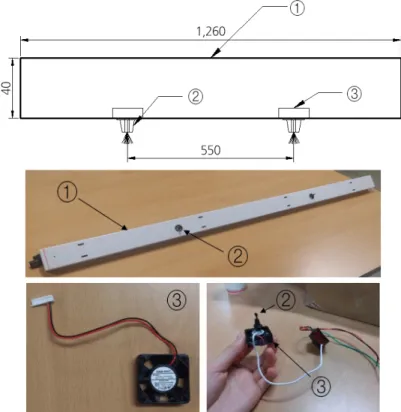
The anion generation system was made with dimensions of 1,260 × 60 × 40 mm (L × W × H) and two anion generators were installed per anion generation system. The distance between the anion generators was set to 550 mm. The fan (1204KL-04W-B40, Minebea Moter, Japan) with a blowing rate of 0.046 m

3

·min

-1

and an air velocity of 0.27 m·s

-1

was installed behind the anion generator (Fig. 1) to smoothly supply the anion to the lettuce.

Fig. 1. Anion generation system. ① Case of anion control system ② Anion generator ③ Air blower.

As shown in Fig. 2 , two anion generation systems were installed in each 1,300 × 450 mm culture bed. The anion generation position was set to three conditions: sideward (A), upward (B), and downward (C). The distance between the bed and the anion generator was set to 200 mm for the sideward and downward anion conditions.

The anion concentrations were measured using an air anion counter (COM-3200 PRO, COM System Inc., Japan)

according to the position of each anion generation system. Since anions are lighter than the air, differences in air flow can

cause very high deviation or measurement errors. Therefore the power to the fan in the closed-type plant factory was cut

off just before the anion concentration was measured to block the flow of air as much as possible. The culture bed was

divided into 9 equally sized sections and the anion concentrations were measured at the center of each section and

expressed as the average value.

(4)

(A) Sideward anion treatment

(B) Upward anion treatment

(C) Downward anion treatment Fig. 2. Generation positions of air anion.

Analysis of Growth Characteristics for Lettuce

Growth characteristics of lettuce were measured at 21 days (3 weeks) and 28 days (4 weeks) after seedlings were

transplanted into the factory system. The leaf length, leaf width, fresh weight, dry weight, leaf area, SPAD, antioxidant

ability and total phenolic content were measured. For the leaf length and width measurements, the longest and widest parts

of the third leaf from the growth point were measured using vernier calipers (CD-15CP, Mitutoyo, Kanagawa, Japan). The

(5)

fresh shoot weight of lettuce leaves was measured with electronic scales (HF-200GD, And, Tokyo, Japan). The shoot dry weight was measured with electronic scales after drying for 72 h at of 70°C in a dry oven (OF-11E, JeioTech, Korea). The leaf area was measured by placing the leaves of decomposed lettuce in a leaf area meter (LI-3100C, LI-Cor, Lincoln, USA) and the average of 3 measurements calculated. To measure the SPAD, the third leaf from the growing point was placed in a chlorophyll meter (SPAD-502, Konica Minolta, Japan) and the average value of 5 measurements calculated.

Measurement of Antioxidant Capacity and Total Phenolic Content

About 0.2 g of the third leaf from the growth point was sampled and stored in a deep freezer (NF-300SF, Nihon Freezer Co. Ltd., Tokyo, Japan) at -70°C. After extraction with Folin & Ciocalteu's phenol reagent and 2,2'-azino-bis (3-ethylbenzothiazoline-6-sulfonic acid) diammonium salt reagent, a spectrophotometer (UV-1800, Shimadzu, Japan) was used to measure absorbance for antioxidant capacity and total phenolic content at 730 nm and 765 nm, respectively.

(Lee et al., 2013).

Statistical Analysis

Statistical analysis was performed using SPSS (Statistical Package for the Social Sciences, IBM, USA) statistical program. Duncan's one-way ANOVA was used to analyze the significance according to the anion generation position at significance level 0.05.

Results

Anion Concentration According to Generation Position

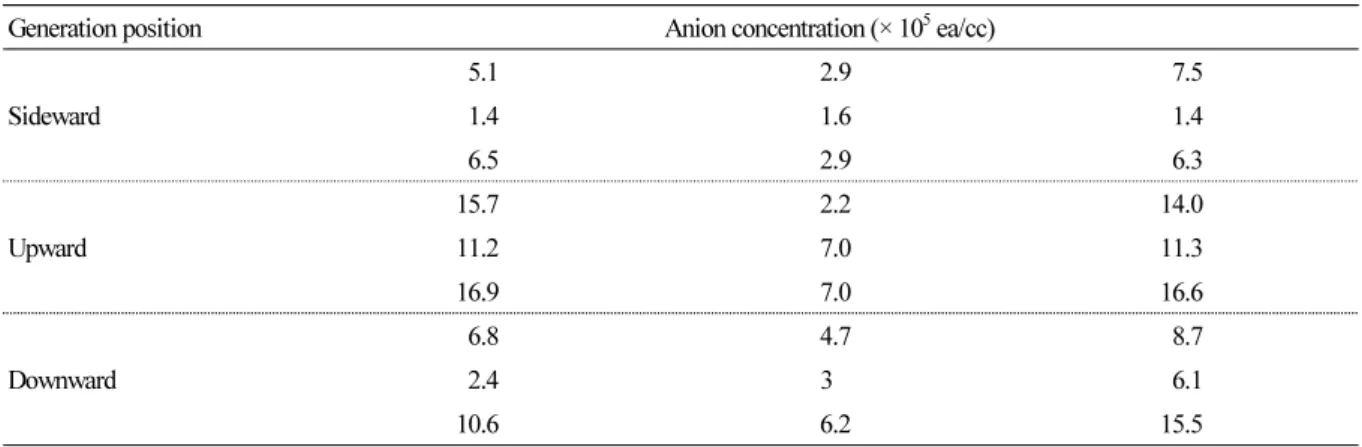
Table 1 shows the anion concentrations measured in the 9 sections of the bed according to the position of anion generation. The anion concentration in the upward position was highest with an average of 11.3 × 10

5

ea/cc, compared to 4.0 × 10

5

ea/cc and 7.1 × 10

5

ea/cc for the sideward and downward conditions, respectively. In the control condition where there was no anion treatment the anion concentration was measured to be about 70 ea/cc.

Table 1. The anion concentration of 9 sections in bed according to anion generation position

Generation position Anion concentration (× 10

5

ea/cc)

Sideward

5.1 2.9 7.5

1.4 1.6 1.4

6.5 2.9 6.3

Upward

15.7 2.2 14.0

11.2 7.0 11.3

16.9 7.0 16.6

Downward

6.8 4.7 8.7

2.4 3 6.1

10.6 6.2 15.5

(6)

Leaf Length and Leaf Width

The lengths of lettuce leaves at 3 and 4 weeks were different under the various experimental conditions (Fig. 3) . The average leaf length after 3 weeks was 111.13 mm for the control, 120.34 mm for the sideward anion condition, and 118.91 and 127.55 mm for the upward and downward anion conditions, respectively (Fig. 3A) . In this way, the anion-treated lettuce had a tendency to grow more than the control, with the plants grown in the downward anion condition having the longest leaves. A similar tendency was observed at 4 weeks, with average leaf lengths of 158.68 mm for the control, and 163.28 mm, 163.22 mm and 184.41 mm for the sideward, upward and downward anion conditions, respectively. Overall, the growth rate of lettuce treated with anions was 2.8-14% higher than that of the control plants.

As shown in Fig. 3B , the average leaf width at 3 weeks was 77.19 mm in the control plants compared with 85.77 mm, 86.99 mm and 97.95 mm in the plants grown in sideward, upward and downward anion conditions, respectively. The average leaf width at 4 weeks was 106.25 mm for the control and 111.38 mm, 109.15 and 135.36 mm for the sideward, upward and downward anion conditions, respectively. As shown above, leaf width was about 4.6-21.5% greater for plants grown in the sideward anion and downward anion conditions than in the control plants.

A B

Fig. 3. (A) Leaf length of lettuce according to generation position of air anion in fluorescent light. The data are the averages and the bars indicate standard errors (n = 3). Significant at * p ≤ 0.05. (B) Leaf width of lettuce according to generation position of air anion in fluorescent light. The data are the averages and the bars indicate standard errors (n = 3).

Significant at *p ≤ 0.05.

Shoot Fresh Weight

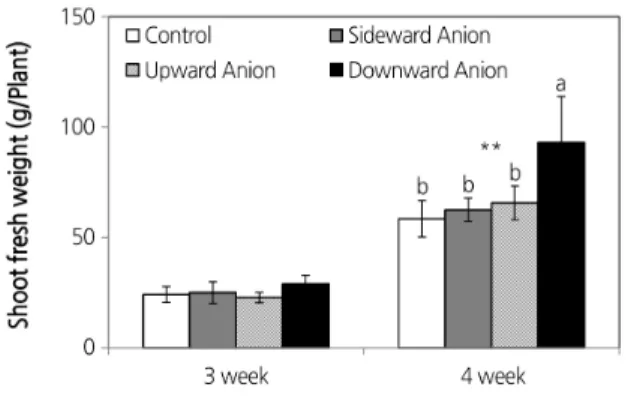
At 3 weeks there was no significant difference in the shoot fresh weight of lettuce grown with anion treatment compared

with the control plants (24.12, 25.04, 22.78, and 29.03 g/plant for the control, and sideward, upward and downward anion

conditions, respectively). At 4 weeks, there were differences in the fresh weight between the experimental conditions, but

these differences were not statistically significant (Fig. 4) . At 4 weeks, the average shoot fresh weights were 58.46 g/plant

in the control and 62.52, 65.70 and 93.00 g/plant in the sideward anion, upward and downward anion conditions,

respectively. Overall, the plants grown in anion generation conditions had fresh weights that were of 6.5-37.1% higher

than the control.

(7)

Fig. 4. Shoot fresh weight of lettuce according to generation position of air anion in fluorescent light. The data are the averages and the bars indicate standard errors (n = 3). Significant at **p ≤ 0.01.

Shoot Dry Weight

At 3 weeks, there was a slight difference in average shoot dry weight under the different experimental conditions (1.27, 1.33, 1.22 and 1.57 g/plant in the control, and sideward, upward and downward anion conditions, respectively). At 4 weeks, there was a difference in plant growth depending on anion generation and generation position (Fig. 5) . The average shoot dry weights were 2.91, 3.18, 3.27 and 4.16 g/plant in the control, and sideward, upward and downward anion conditions, respectively.

Fig. 5. Shoot dry weight of lettuce according to generation position of air anion in fluorescent light. The data are the averages and the bars indicate standard errors (n = 3). Significant at *p ≤ 0.05.

Leaf Area

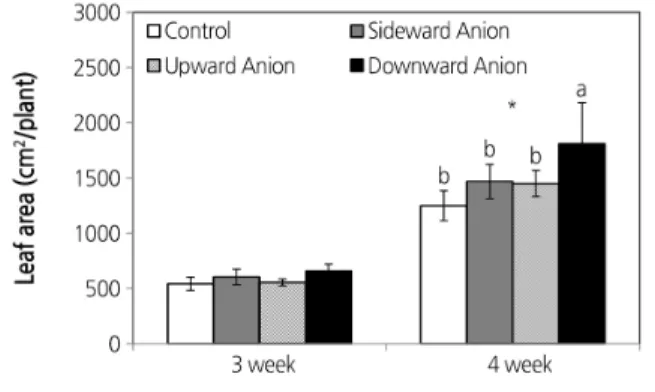
Fig. 6 compares the average leaf area of lettuce grown under the various experimental conditions. At 3 weeks, no

significant differences was observed in average leaf area (541.71 cm

2

/plant for the control, and 602.83, 553.70 and 658.96

cm

2

/plant for the sideward, upward and downward anion conditions, respectively). At 4 weeks, the plants grown with

anion treatment had larger average leaf areas (1467.97, 1449.94, 1809.78 cm

2

/plant for the sideward, upward and

downward conditions) than the control plants (1249.91 cm

2

/plant). The plants grown in the downward anion condition

had the largest average leaf area.

(8)

Fig. 6. Leaf area of lettuce according to generation position of air anion in fluorescent light. The data are the averages and the bars indicate standard errors (n = 3). Significant at *p ≤ 0.05.

Chlorophyll Content

Fig. 7 compares average chlorophyll content of lettuce according to the anion generation position. At 3 weeks, the average SPAD value was measured as 20.7 for the control, and 20.0, 21.6 and 22.3 for the sideward, upward and downward anion conditions, respectively. The plants grown under the downward anion condition tended to have SPAD values that were 0.7-2.3 higher than the other conditions. At 4 weeks, the average SPAD value was 21.2 for the control, which represents a 0.5 increase over the value at 21 day. The average SPAD values were 18.7, 19.3 and 19.5 in the sideward, upward and downward anion conditions, respectively, which represent decreases of 1.3, 2.3, and 2.8, respectively, since 21 days.

Fig. 7. SPAD value of lettuce according to generation position of air anion in fluorescent light. The data are the averages and the bars indicate standard errors (n = 5). Significant at **p ≤ 0.01.

Antioxidant Ability

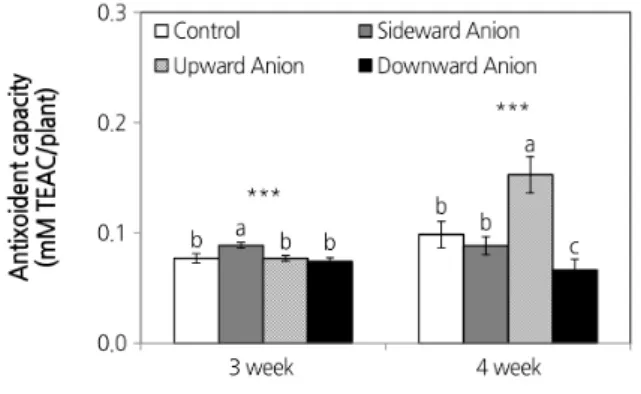
There were no significant differences in antioxidant capacity of lettuces between the various experimental conditions

(Fig. 8) . However, at 4 weeks the antioxidant capacity tended to be higher than at 3 weeks in all the conditions except the

downward anion condition. At 3 weeks the values were 0.077 mM Trolox Equivalent Antioxidant Capacity (TEAC) per

plant in the control condition, and 0.089, 0.077, and 0.074 mM TEAC/plant for the sideward, upward and downward

(9)

anion conditions, respectively. The antioxidant capacity in the control and upward condition at 4 weeks was 0.099 and 0.153 mM TEAC/plant, respectively. This is an increase of 0.022 mM and 0.079 mM TEAC/plant, respectively, compared with the value at 3 weeks. The antioxidant capacity in the sideward anion side condition at 4 weeks was 0.089 mM TEAC/plant, which is no different from the value at 3 weeks. For the downward anion condition, the value was 0.066 mM TEAC/plant at 4 weeks, which showed a tendency to decrease by 0.008 mM TEAC/plant compared with 3 weeks.

Fig. 8. Antioxidant capacity of lettuce according to generation position of air anion in fluorescent light. The data are the averages and the bars indicate standard errors (n = 3). Significant at ***p ≤ 0.001.

Total Phenolic Content

The total phenolic content of lettuce according to the position of generation from the fluorescent light source is shown in Fig. 9 . The total phenolic content at 3 weeks was 0.266, 0.249, and 0.257 mg Gallic Acid Equivalents (GAE) pre plant for the control, and sideward and upward anion conditions, respectively. On the other hand, total phenolic content of the plants grown in the downward anion condition was slightly lower compared with the other conditions (0.234 mg GAE/plant). The total phenolic content at 4 weeks was measured as 0.313, 0.262, 0.383 mg GAE/plant for the control, sideward anion, and upward conditions, respectively, representing increases of 0.047, 0.013, and 0.126 mg GAE/plant compared with the values at 3 weeks.

Fig. 9. Total phenolic content of lettuce according to generation position of air anion in fluorescent light. The data are the

averages and the bars indicate standard errors (n = 3). Significant at **p ≤ 0.01.

(10)

Discussion

In this study, the average anion concentrations measured in the plant factories were different according to the position of the anion generator. The upward anion condition produced the highest anion concentration and the sideward anion condition produced the lowest anion concentration. Anion concentration decreases further away from an anion generator (Song, 2014). The differences in anion concentration observed in this study are thought to be due to differences in the distances from the anion generators. As shown in Table 1 , the anion concentration of sideward anion condition expressed the distribution of low anion concentration such as the low anion concentration in the middle bed of far distance from the anion generator, in this results, average anion concentration was lower than other anion conditions. The upward and the downward anion conditions had similar anion distributions, but the average anion concentration in the upward anion condition was higher because the anion generators were positioned closer to the culture bed than they were in the downward anion condition.

The growth characteristics of lettuce were affected by the position of anion generation. The measured values were higher in the anion generation conditions compared with the control, with the downward anion condition producing the highest values for several growth characteristics such as leaf length, leaf width, shoot fresh weight, shoot dry weight and leaf area.

These results are consistent with previous studies showing that the dry weight of barley and Antirrhinum majus exposed to air anions increased compared to untreated plants (Elkiey et al., 1985) and that air anions have an effect on the shoot fresh weight of lettuce (Song et al., 2015). The growth-enhancing effect of anion generators appears to be due to the fact that photosynthesis and respiration are accelerated by air anions (Song, 2014).

Moreover, the anion concentration observed in the downward anion condition is concluded to be most suitable for promoting the growth of lettuce. The anion concentration was highest in the upward anion condition, but the downward anion condition was the most effective at promoting the growth of lettuce. Song (2014) reported that air anion treatment of a medium concentration (7 × 10

5

-12 × 10

5

ion/cm

3

) promoted lettuce growth better than a lower concentration (1 × 10

5

-5 × 10

5

ion/cm

3

) or a higher concentration (15 × 10

5

-20 × 10

5

ion/cm

3

). Thus, because the anion concentration of downward anion condition was optimum for growth of lettuce, the downward position may have the highest value in lettuce production.

On the other hand, the reason the antioxidant capacity and the total phenolic content of lettuce in the downward anion condition were lower than in the other conditions was that these lettuces had the highest leaf area. The tendency of decreasing functional material according to the degree of growth was similar to the results of Lee et al. (2011).

This study demonstrates that the position of anion generators and the anion concentration in plant factories must be

controlled according to the purpose of growing the plants. For example, the downward generation position may be used

to maximize the size of the plants, and the sideward generation position may be used to increase the antioxidant capacity

and total phenolic content. Moreover, when an anion generator is installed in a plant factory, it is necessary to consider the

anion distribution in the culture bed and the distance between anion generators to optimize the anion concentration for the

plants.

(11)

Literature Cited

Cha MK, Kim JS, Cho YY (2012) Growth response of lettuce to various levels of EC and light intensity in plant factory. J Bio-Environ Control 21:305-311. doi:10.12791/KSBEC.2012.21.4.305

Elkiey TM, Bhartendu S, Barthakur N (1985) Air ion effect on respiration and photosynthesis of barley and Antirrhinum majus. Int J Biometeorol 29:285–292. doi:10.1007/BF02189659

Jang SJ, Lee DU, Hong JH (2011) Basic research of plant factory - Indoor air quality improvement use of plant photosynthesis. J Archit Inst Korea 31:61–62

Kim JW (2010) Trend and direction for plant factory system. J Plant Biotechnol 37:442–455. doi:10.5010/JPB.2010.37.4.442

Kozai T (2007) Propagation, grafting and transplant production in closed systems with artificial lighting for commercialization in Japan.

Propag Ornam Plants 7:145–149

KREI (Korea Rural Economic Institute) (2017) Food balance sheet 2016. KREI, Korea. pp 150-151

Lee MJ, Son JE, Oh MM (2013) Growth and phenolic content of sowthistle grown in a closed-type plant production system with a UV-A or UV-B lamp. Hortic Environ Biotechnol 54:492–500. doi:10.1007/s13580-013-0097-8

Lee MJ, Son JE, Oh MM (2016) Increase in biomass and bioactive compounds in lettuce under various ratios of red to far-red LED light supplemented with blue LED light. Hortic Environ Biotechnol 57:139-147

Lee MJ, Son KH, Kim EY, Song MJ, Kim EK, Oh MM (2011) Inflence of LED wavelength on leaf index, growth and the accumulation of phenolic compounds in red leaf lettuce. Korean J Hortic Sci Technol 29:83-83

Lee SR, Kang TH, Han CS, Oh MM (2015) Air anions improve growth and mineral content of kale in plant factories. Hortic Environ Biotechnol 56:462–471. doi:10.1007/s13580-015-0035-z

Park KS, Bekhzod K, Kwon JK, Son JE (2016) Development of a coupled photosynthetic model of sweet basil hydroponically grown in plant factories. Hortic Environ Biotechnol 57:20-26. doi:10.1007/s13580-016-0019-7

Park MH, Lee YB (1999) Effects of light intensity and nutrient level on growth and quality of leaf lettuce in a plant factory. J Bio-Environ control 8:108–114. doi:10.1007/BF02310088

Pohl HA (1977) Electroculture. J Biol Phys 5:3–23

Song MJ (2014) Air anion enhances growth of several edible sprouts and lettuce in a closed-type plant production system. Master’s Thesis, Chungbuk National University, Cheongju, Korea, pp 34-36, 40-43

Song MJ, Jeon YM, Oh MM (2015) Growth of and bacterial counts on several edible sprouts exposed to spray ionization. Protected Hortic Plant Fact 24:45–50. doi:10.12791/KSBEC.2015.24.1.045

Wachter S, Widmer R (1976) The effects of negative air ions on plant growth. HortScience 11:576-578

수치

Fig. 1. Anion generation system. ① Case of anion control system ② Anion generator ③ Air blower.
Table 1  shows the anion concentrations measured in the 9 sections of the bed according to the position of anion  generation
Fig. 4. Shoot fresh weight of lettuce according to generation position of air anion in fluorescent light
Fig. 6. Leaf area of lettuce according to generation position of air anion in fluorescent light
+2

참조

관련 문서

Differences in the volume fraction calculated from the OD values with the measured Ke of 10.0 are attributed to the optical response characteristics of

Figure 15 Tensile strength and modulus values for the MB-CNTFs after (a) chemical functionalization of the CNT surface with 4-iodoaniline under acidic

Step1) Select your type in Engine Type menu and then start the engine with the preset configuration values maintaining it with no load. Step2) During

The index is calculated with the latest 5-year auction data of 400 selected Classic, Modern, and Contemporary Chinese painting artists from major auction houses..

SigmaNEST 펀칭 파워팩 제품 관리, 자동 다이나믹™ 배 열 및 펀칭 툴 관리를 갖춘 터렛 펀칭 프로그래밍을 위한 가장 완벽하고 최적화된

The “Asset Allocation” portfolio assumes the following weights: 25% in the S&P 500, 10% in the Russell 2000, 15% in the MSCI EAFE, 5% in the MSCI EME, 25% in the

1 John Owen, Justification by Faith Alone, in The Works of John Owen, ed. John Bolt, trans. Scott Clark, "Do This and Live: Christ's Active Obedience as the

In this study, the different codes were compared and analyzed for the research on decontamination and decommissioning waste generation by using the codes