서 언
현재 우리나라의 실내조경에 이용되는 식물들은 외국도입종 이 80% 이상을 차지하고 있으며 자생식물은 극히 일부만 이용 되고 있다(Kang et al., 1990; Lee and Oh, 2002). 자생식물은 한국적인 정서를 표현할 수 있고, 오랫동안 본토의 기후에 적응 하여 환경적응성이 뛰어나며 병해충의 저항성도 높아 유리하게 이용될 수 있다(Ryu, 2004). 따라서 자생식물을 활용하여 기존 의 외국 도입종을 대체하기 위한 관상 및 화훼소재로서 개발이 요구되는 시점이다.
한국특산식물인 산꼬리풀[Veronica rotunda var. subintegra (Nakai) T.Yamaz.]은 현삼과(Scrophulariaceae) 개불알풀속 (Veronica)으로, 초장은 40-80 ㎝이며 8월에 10-20 ㎝의 벽자 색을 띄는 화기가 가지와 원줄기 끝에 총상화서로 달린다 (KPNI, 2019). 전초는 기침, 천식 및 만성 기관지염을 치료하는 데 이용된 바 있으며, 최근에는 산꼬리풀을 이용한 만성폐쇄성 폐질환의 치료제가 개발 중이다(Oh, 2015).
식물을 재배함에 있어서 육묘 시 용기의 크기(Lee et al., 2001)와 파종량(Cho et al., 2000; Park et al., 2015)에 따라 생 육에 미치는 영향이 다르므로, 초기 유묘의 생육 차이에 따른 정 식 후 묘의 생육 변화를 구명할 필요성이 있다. 또한 자생식물은 대부분 종에 따라 생리적 특성이 다르기 때문에 재배 시 기본이
몇 가지 재배조건에 따른 산꼬리풀의 생육특성
이상인
1,3
, 연수호1,3
, 조주성2,4
, 이철희2,4
*1
충북대학교 축산·원예·식품공학부, 대학원생,
2교수,
3충북대학교 생물건강소재 산업화 사업단, 대학원생,
4교수
Growth Characteristics of Veronica rotunda var. subintegra (Nakai) T.Yamaz. according to Several Cultivation Conditions
Sang In Lee
1,3
, Soo Ho Yeon1,3
, Ju Sung Cho2,4
and Cheol Hee Lee2,4
*1
Graduate Student and
2Professor, Division of Animal, Horticultural and Food Sciences, Chungbuk National University, Cheongju 28644, Korea
3
Graduate Student and
4Professor, Brain Korea 21 Center for Bio-Resource’ Development, Chungbuk National University, Cheongju 28644, Korea
Abstract - This study was aimed to establish the most effective approach for the cultivation of Veronica rotunda var.
subintegra (Nakai) T.Yamaz. plants, which was expected as new ornamental plants. We conducted an experiment using plug seedlings, varied the seeding container type and seeding rate. We also varied seedling quality, planting container, soil type, and shading ratio. Seedling quality was used seedlings produced from different seeding containers and seeding rates.
The seedling quality were seeding growth using 162, 200, and 288 trays, and seedings rate was used seedlings produced by sowing 1, 2, 4 and 6 seeds. As a result, 162 trays of seedlings were suitable for use in this study. Plants grown with one seed per cell in individual cells exhibited increased individual growth, but those grown with four seeds per cell exhibited better growth for the whole plant. According to seedling quality, seedlings produced in the 162 trays or with four seeds per cell showed higher growth than other seedlings. In the cultivation of V. rotunda var. subintegra (Nakai) T.Yamaz., seedling growth increased depending on container capacity for both shoot and root parts. Container material had no significant impact on seedling growth. Seedlings grew the best on horticultural substrate, and showed better growth on mixed soils with high decomposed granite content than on peatmoss.
Key words –
Mixed soil, Ornamental plants, Planting container, Produced seedling, Seedling rate, Seedling quality
*교신저자: E-mail [email protected] Tel. +82-43-261-2526
Original Research Article
되는 식재용기 (Seo et al., 2006a; 2006b)와 토양 조건(NAAS, 2008)이 반드시 확립되어야 한다. 현재까지 우산나물 외 8종 (Ryu, 2004), 박주가리 외 15종(Sohn and Kim, 2010), 비비추 외 6종(Kim and Lee, 2009) 등 국내 자생식물을 이용하여 관상 식물 개발을 위한 연구가 수행된 바는 있으나, 방대한 식물자원 에 비해 자생식물의 재배 조건에 관한 연구는 여전히 미비한 실 정이다.
따라서 본 연구는 관상 및 약용 소재로 개발가치가 높은 산꼬 리풀의 재배기술을 확립하기 위하여 몇 가지 재배조건에 따른 생육특성을 분석하기 위해 수행되었다.
재료 및 방법
식물재료
연구에 사용된 산꼬리풀 종자는 2017년 9월에 산림청 산하 유용식물증식센터의 재배온실(위도 37° 28’ 45.2”, 경도 127°
35’ 51.4”)에서 채종되어 불순물이 제거된 종자를 분양 받았으 며, 4℃에서 건조 보관하면서 실험에 사용하였다. 직파 육묘용 파종 용기 및 파종량 실험은 종자를 직파하였으며, 그 외 재배 실험은 2018년 4월 11일에 파종하여 12주간 재배된 균일한 묘를 사용하였다. 이때 식재 용기 및 토양 종류별 실험에서는 200구 트레이에 셀 당 4립을 파종하여 생산된 묘를 사용하였다.
재배조건
플러그 육묘를 위한 파종 용기별 실험은 162, 200 및 288구 트 레이[플러그 트레이, ㈜범농, Korea]의 각 셀에 원예상토[한아름 상토, ㈜신성미네랄, Korea]를 충진한 다음 셀 당 4립씩 파종하였 으며, 용기별 셀 용량은 각 15, 10 및 5 mL였다. 파종량에 따른 실험은 200구 트레이에 셀 당 1, 2, 4 또는 6립을 파종하였다.
묘의 소질별 실험은 육묘용기를 162, 200 및 288구 트레이로 달리한 다음 셀 당 4립씩 파종하여 생산한 묘와 200구 트레이에 셀 당 파종량을 1, 2, 4 및 6립으로 달리하여 생산한 묘를 각 플라 스틱 화분[이색칼라, ㈜영농사, Korea] 10호에 원예상토를 충 진한 다음 정식하였다.
식재 용기별 실험은 플라스틱 화분 8(7×7 ㎝), 10(9×9 ㎝) 및 12호(10.5×10.5 ㎝)와 비닐포트[Vinyl pot, ㈜한국원예자 재, Korea] 3치(7×7 ㎝)와 4치(9×9.85 ㎝)를 사용하였다.
토양 종류별 실험은 원예상토를 단용하거나 중화 피트모스 (BM4, Berger Co. Ltd., Canada)와 펄라이트[New pershine 2 호, (주)GFC, Korea]를 3:1 또는 4:1로, 마사토(2 ㎜ 소립)와 중
화 피트모스를 2:1 또는 3:1로 혼용하였다. 비료는 가축분퇴비 [옛날거름, (주)유나, Korea]를 각 혼용토양 9 L당 1 L의 비율로 첨가하였다.
플러그 육묘 실험은 2018년 4월 3일에 파종하여 8주간 실시 하였으며, 트레이 크기에 관계없이 20셀을 3반복하였다. 묘의 소질, 식재 용기 및 토양 종류 등 재배 실험은 2018년 7월 3일에 정식하여 15주간 실시하였으며 8포트를 3반복으로 하였다.
미스트 자동관수를 위하여 살수 직경 5-6 m인 스프링쿨러 [미니스프링쿨러SS, (주)에이월드, Korea]를 설치하였으며 최 대양수량이 분당 40 L인 펌프[PB-138MA, (주)Wilo, Japan]를 사용하였다. 육묘 실험 중 관수는 09시, 18시에 각 5분, 재배 실 험 중 관수는 09시, 12시, 18시에 각 15분간 3회 실시하였다.
모든 실험은 충북대학교 유리온실(위도 36° 37’ 50.3”, 경도 127° 27’ 06.1”)에서 진행되었다. 실험기간 내 주간 평균온도는 18.1-32.9℃로 기록되었으며, 평균습도는 22.3-48.4%로 조사 되었다(Fig. 1).
생육조사 및 통계분석
묘의 생육은 초장, 근장, 절간장, 경직경, 마디수, 분지수 및 엽수를 플라스틱 자와 버니어 캘리퍼스[NA500-150S, (주)Blue bird, Korea]로 조사하였다. 개화율은 개화된 포트의 수를 비율 로 계산하였으며, 엽록소 함량은 SPAD-502 (Minolta, Japan) 로 측정하였다. 유묘의 생체중은 미세전자저울[DRAGON 204/S, (주)Mettler toledo, Switzerland]로, 재배묘의 생체중과 건물 중은 전자저울[BB120, (주)Mettler toledo, Swizerland]을 이용 Fig. 1. Temperature and humidity during experimental period on April to October, 2018.
하여 측정하였다.
각 처리별 측정 항목에 대한 평균 및 표준오차를 계산하였으 며, SAS 프로그램(Statistical Analysis System, 9.4 Version, SAS Institute, Cary, NC, USA)으로 Duncan's multiple range test를 사용하여 p<0.05 수준에서 유의성을 검정하였다.
결 과
플러그 육묘 조건
산꼬리풀의 플러그 육묘에 따른 묘의 생육은 셀 당 토양 용적 량이 가장 많은 162구 트레이에서 왕성하였다. 초장과 근장은 162구 트레이에서 각 46.3, 50.2 ㎜로 가장 길었으며, 다음으로 200구(36.6, 47.9 ㎜), 288구(29.7, 46.4 ㎝) 순으로 짧아지는 경향이었다(Table 1). 줄기직경도 162구에서 1.55 ㎜로 조사되 어, 200구와 288구 트레이에 비해 유의적으로 굵었다. 엽수는 162구 트레이에서 5.3개로 가장 많았으나, 엽록소 함량은 162구 에 비해 생육이 억제된 200구 및 288구 트레이에서 유의적으로
높았다.
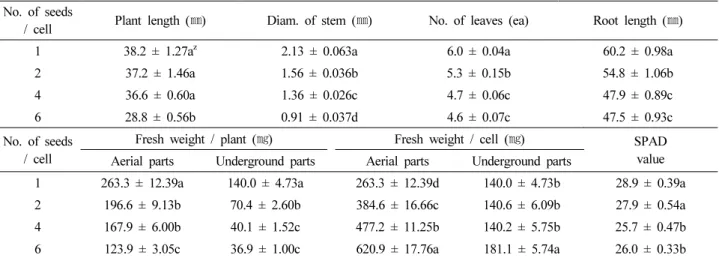
플러그 육묘 시 셀 당 파종량도 유의적인 생육 차이를 보였다.
초장은 1, 2 및 4립 파종 시 36.6-38.2 ㎜ 수준이었으나 6립 파종 시 28.8 ㎜로 짧아졌다. 또한 경직경, 엽수 및 근장은 파종량이 증가할수록 감소하는 경향을 보였다. 개체당 생체중은 2, 4, 6 립 파종 시 1립 파종구에 비해 각 25, 37 및 53%가 감소하였고, 셀 당 생체중은 각 46, 81 및 136%가 증가하였다(Table 2).
묘의 소질
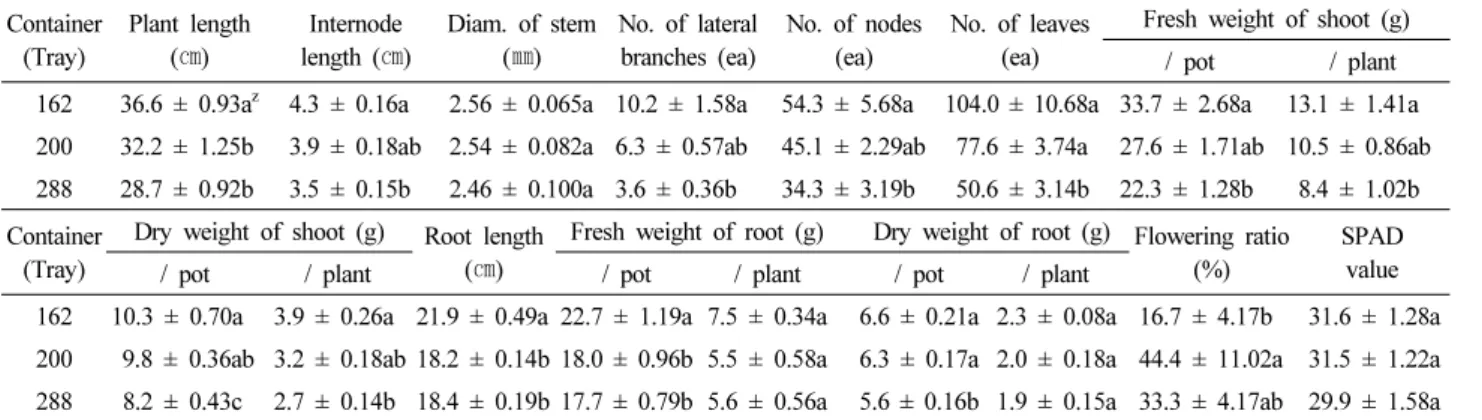
육묘 시 셀 당 토양 용적량이 많을수록 정식한 산꼬리풀의 생육 이 왕성하였으며(Fig. 2A), 초장과 근장은 162구 트레이 육묘분 에서 각 36.6, 21.9 ㎝로 가장 길었다. 반면 절간장, 마디수 및 측 지수는 셀 당 토양 용적량이 적을수록 감소하는 경향을 보였고, 경직경은 육묘 용기에 따른 유의적인 차이가 없었다(Table 3).
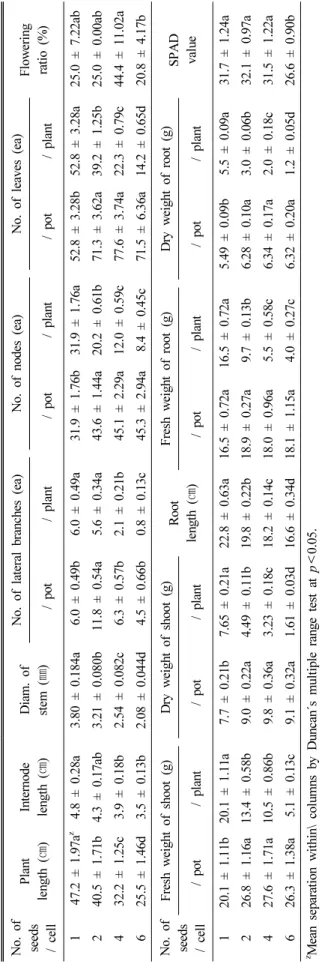
셀 당 파종량을 달리한 묘의 정식 후 생육에서 포트 내 개체의 생육은 파종량이 적을수록 우수한 경향이었다(Fig. 2B). 포트 내 전체 묘의 생육은 셀 당 파종량이 증가할수록 초장, 절간장,
Table 1. Effect of planting container on seedling growth of Veronica rotunda var. subintegra (Nakai) T.Yamaz.
Container
z(Tray)
Plant length ( ㎜)
Diam. of stem ( ㎜)
No. of leaves (ea)
Root length ( ㎜)
Fresh weight / cell ( ㎎) SPAD value Aerial parts Underground parts
162 46.3 ± 1.00a
y1.55 ± 0.026a 5.3 ± 0.08a 50.2 ± 0.75a 256.9 ± 8.53a 52.7 ± 1.59a 20.6 ± 0.34b 200 36.6 ± 0.60b 1.36 ± 0.026b 4.7 ± 0.06b 47.9 ± 0.89ab 167.9 ± 6.00b 40.1 ± 1.52b 25.7 ± 0.47a 288 29.7 ± 0.60c 1.29 ± 0.025b 4.7 ± 0.08b 46.4 ± 0.78b 136.1 ± 4.38c 37.0 ± 1.20b 26.2 ± 0.52a
z
Four seeds were sowed at each cells.
y
Mean separation within columns by Duncan´s multiple range test at p<0.05.
Table 2. Effect of seeding rate per cell at 200 tray on seedling growth of Veronica rotunda var. subintegra (Nakai) T.Yamaz.
No. of seeds
/ cell Plant length ( ㎜) Diam. of stem ( ㎜) No. of leaves (ea) Root length ( ㎜)
1 38.2 ± 1.27a
z2.13 ± 0.063a 6.0 ± 0.04a 60.2 ± 0.98a
2 37.2 ± 1.46a 1.56 ± 0.036b 5.3 ± 0.15b 54.8 ± 1.06b
4 36.6 ± 0.60a 1.36 ± 0.026c 4.7 ± 0.06c 47.9 ± 0.89c
6 28.8 ± 0.56b 0.91 ± 0.037d 4.6 ± 0.07c 47.5 ± 0.93c
No. of seeds / cell
Fresh weight / plant ( ㎎) Fresh weight / cell ( ㎎) SPAD
value Aerial parts Underground parts Aerial parts Underground parts
1 263.3 ± 12.39a 140.0 ± 4.73a 263.3 ± 12.39d 140.0 ± 4.73b 28.9 ± 0.39a
2 196.6 ± 9.13b 70.4 ± 2.60b 384.6 ± 16.66c 140.6 ± 6.09b 27.9 ± 0.54a
4 167.9 ± 6.00b 40.1 ± 1.52c 477.2 ± 11.25b 140.2 ± 5.75b 25.7 ± 0.47b
6 123.9 ± 3.05c 36.9 ± 1.00c 620.9 ± 17.76a 181.1 ± 5.74a 26.0 ± 0.33b
z
Mean separation within columns by Duncan´s multiple range test at p<0.05.
줄기직경 및 근장이 감소하였으며, 마디수, 엽수, 생체중 및 건 물중은 2립 파종 이상인 경우 유의적인 차이가 없었다(Table 4).
개화율은 4립 파종묘에서 가장 우수하였으나 1, 2립 파종묘와 오차범위 내에서 유의적인 차이가 크지 않았다. 한편 1, 2립 파 종묘의 경우 식물체가 도장하여 넘어지는 현상이 나타났으며, 4립 파종묘부터 도장하지 않았다.
식재 용기
산꼬리풀의 정식 용기는 재질에 관계없이 토양 용적량의 차 이에 의해 생육이 달랐다. 식재 용기에 따른 초장, 절간장, 근장
을 비교하였을 때 플라스틱 12호에서 36.8, 4.8, 22.8 ㎝로 가장 길었으며, 다음으로 비닐 4치(32.7, 3.9, 18.4 ㎝)와 플라스틱 10호(32.2, 3.9, 18.2 ㎝), 비닐 3치(26.6, 3.3, 15.2 ㎝)와 플라 스틱 8호(26.5, 3.3, 14.8 ㎝)순으로 나타났다(Table 5). 엽수와 마디수도 용기 재질에 상관없이 토양 용적량이 증가할수록 양 호하였다. 측지수는 토양 용적량이 가장 큰 플라스틱 화분 12호 를 제외하고 유의성이 나타나지 않았다. 개화율도 플라스틱 화 분 12호에서 가장 우수하였으나 플라스틱 화분 8호를 제외하고 는 큰 차이가 없었다.
Fig. 2. Growth of Veronica rotunda var. subintegra (Nakai) T.Yamaz. seedling after cultivation according to seedling quality under different seeding container (A) and seeding rate per cell (B).
Table 3. Effect of seedling quality produced under different container on growth of Veronica rotunda var. subintegra (Nakai) T.Yamaz.
Container (Tray)
Plant length (㎝)
Internode length (㎝)
Diam. of stem (㎜)
No. of lateral branches (ea)
No. of nodes (ea)
No. of leaves (ea)
Fresh weight of shoot (g) / pot / plant 162 36.6 ± 0.93az 4.3 ± 0.16a 2.56 ± 0.065a 10.2 ± 1.58a 54.3 ± 5.68a 104.0 ± 10.68a 33.7 ± 2.68a 13.1 ± 1.41a 200 32.2 ± 1.25b 3.9 ± 0.18ab 2.54 ± 0.082a 6.3 ± 0.57ab 45.1 ± 2.29ab 77.6 ± 3.74a 27.6 ± 1.71ab 10.5 ± 0.86ab 288 28.7 ± 0.92b 3.5 ± 0.15b 2.46 ± 0.100a 3.6 ± 0.36b 34.3 ± 3.19b 50.6 ± 3.14b 22.3 ± 1.28b 8.4 ± 1.02b Container
(Tray)
Dry weight of shoot (g) Root length (㎝)
Fresh weight of root (g) Dry weight of root (g) Flowering ratio (%)
SPAD value
/ pot / plant / pot / plant / pot / plant
162 10.3 ± 0.70a 3.9 ± 0.26a 21.9 ± 0.49a 22.7 ± 1.19a 7.5 ± 0.34a 6.6 ± 0.21a 2.3 ± 0.08a 16.7 ± 4.17b 31.6 ± 1.28a 200 9.8 ± 0.36ab 3.2 ± 0.18ab 18.2 ± 0.14b 18.0 ± 0.96b 5.5 ± 0.58a 6.3 ± 0.17a 2.0 ± 0.18a 44.4 ± 11.02a 31.5 ± 1.22a 288 8.2 ± 0.43c 2.7 ± 0.14b 18.4 ± 0.19b 17.7 ± 0.79b 5.6 ± 0.56a 5.6 ± 0.16b 1.9 ± 0.15a 33.3 ± 4.17ab 29.9 ± 1.58a
zMean separation within columns by Duncan´s multiple range test at p<0.05.
워터마크
T ab le 4 . E ff ec t o f s ee d lin g q u ality p ro d u ce d u n d er d if fe re n t s ee d in g r ate o n g ro w th o f V er oni ca r ot und a va r. s u bi nt egr a ( N ak ai ) T .Y am az. No . o f see ds / c ell Plan t le ngt h ( ㎝ ) In terno d e le ngt h ( ㎝ ) Di am . o f st em ( ㎜ )
N o . o f l ateral b ran ch es (e a) N o. of n ode s ( ea ) N o . o f l eav es (e a) F lo w eri ng rat io (% ) / pot / pl an t / pot / pl ant / po t / pl ant 1 4 7. 2 ± 1. 97a
z4. 8 ± 0. 28a 3. 8 0 ± 0. 1 84a 6 .0 ± 0. 49 b 6. 0 ± 0. 49a 31. 9 ± 1. 76b 3 1 .9 ± 1. 76a 5 2. 8 ± 3. 28 b 52. 8 ± 3 .2 8a 2 5 .0 ± 7. 22a b 2 40. 5 ± 1. 71b 4. 3 ± 0. 17a b 3. 21 ± 0. 08 0b 11. 8 ± 0 .5 4a 5. 6 ± 0. 34a 4 3 .6 ± 1. 44a 20. 2 ± 0. 61b 71. 3 ± 3. 6 2a 3 9 .2 ± 1. 25 b 2 5 .0 ± 0. 00a b 4 3 2. 2 ± 1. 25c 3. 9 ± 0. 1 8b 2. 5 4 ± 0. 0 82c 6 .3 ± 0. 57 b 2. 1 ± 0. 21b 4 5 .1 ± 2. 29a 1 2 .0 ± 0. 59c 77. 6 ± 3. 7 4a 22. 3 ± 0 .7 9c 44. 4 ± 11. 02a 6 25. 5 ± 1. 46d 3. 5 ± 0. 1 3b 2. 08 ± 0. 04 4d 4 .5 ± 0. 66 b 0. 8 ± 0. 13c 4 5 .3 ± 2. 94a 8. 4 ± 0 .4 5c 71. 5 ± 6. 3 6a 1 4 .2 ± 0. 65 d 2 0 .8 ± 4. 17 b No . o f see ds / c ell
Fr es h w ei ght o f s h oot (g) D ry w ei ght o f s h oot (g) R oot le ngt h ( ㎝ )
Fr es h w ei ght o f r oot (g) D ry w ei gh t of r o ot ( g) SPA D va lue / p ot / pl ant / po t / pl ant / po t / pl ant / pot / pl ant 1 20. 1 ± 1. 1 1b 20. 1 ± 1. 11a 7. 7 ± 0. 2 1b 7. 65 ± 0. 21a 2 2. 8 ± 0. 63a 16. 5 ± 0. 7 2a 16. 5 ± 0. 72a 5. 49 ± 0. 09 b 5 .5 ± 0. 09a 31. 7 ± 1 .2 4a 2 26. 8 ± 1. 16a 13. 4 ± 0 .5 8b 9. 0 ± 0. 22a 4 .4 9 ± 0 .1 1b 19. 8 ± 0. 22b 18. 9 ± 0. 2 7a 9. 7 ± 0 .1 3b 6 .2 8 ± 0 .1 0a 3. 0 ± 0. 06b 32. 1 ± 0 .9 7a 4 27. 6 ± 1. 71a 10. 5 ± 0 .8 6b 9. 8 ± 0. 36a 3. 23 ± 0. 18c 1 8. 2 ± 0. 14c 18. 0 ± 0. 9 6a 5. 5 ± 0. 58c 6 .3 4 ± 0 .1 7a 2 .0 ± 0. 18c 31. 5 ± 1 .2 2a 6 26. 3 ± 1. 38a 5. 1 ± 0. 13c 9. 1 ± 0. 32a 1 .6 1 ± 0 .0 3d 16. 6 ± 0. 34d 18. 1 ± 1. 1 5a 4. 0 ± 0. 27c 6 .3 2 ± 0 .2 0a 1. 2 ± 0. 05d 2 6 .6 ± 0. 90 b
zM ea n se p ar atio n w ith in \ co lu m n s b y D u n ca n ´s m u ltip le r an g e te st at p< 0. 05. T abl e 5. E ff ec t of pot t ype and s iz e o n s ee dl ing gr o w th o f Ve ron ic a r o tu nd a var . subi nt egr a (N ak ai ) T .Y am az. Po t P la n t l en g th (㎝ ) In te rn o d e le n g th (㎝ ) D ia m . o f ste m (㎜ ) No . o f l at er al b ra n ch es (e a) N o. of no de s (e a) N o . o f l eav es (ea)
Fr es h w ei ght of s hoot ( g) Ty p e Si ze / p o t / p la n t Vi n y l 3 26. 6 ± 8. 12c
z33. 4 ± 0. 72c 2. 1 8 ± 0. 0 7 1 b 5. 3 ± 0 .6 8b 30. 6 ± 2. 1 7c 4 7. 4 ± 3. 16c 1 9. 9 ± 1. 04 b 6. 2 ± 0. 44 b 4 32. 7 ± 15. 53a b 38. 9 ± 0. 6 5b 2. 61 ± 0. 097a 6. 2 ± 0 .3 1b 4 7. 4 ± 3. 71 b 78. 2 ± 3. 26b 27. 1 ± 2. 4 9a 10. 2 ± 0 .9 9a P la stic 8 26. 5 ± 11. 07c 33. 4 ± 0. 99c 2. 1 4 ± 0. 0 6 4 b 4. 7 ± 0 .5 9b 31. 3 ± 1. 7 7c 5 2. 0 ± 3. 95c 1 9. 4 ± 0. 89 b 6. 5 ± 0 .6 4b 10 32. 2 ± 12. 52b 38. 6 ± 1. 8 2b 2. 54 ± 0. 082a 6. 3 ± 0 .5 7b 4 5. 1 ± 2. 29 b 77. 6 ± 3. 74b 27. 6 ± 1. 7 1a 10. 5 ± 0 .8 6a 12 36. 8 ± 11. 22a 48. 0 ± 2. 14a 2. 70 ± 0. 074a 9. 3 ± 0. 89a 60. 3 ± 3. 6 7a 9 3. 8 ± 6. 20a 32. 3 ± 1. 2 1a 13. 1 ± 1 .2 8a Po t D ry w ei g ht of s ho ot (g) R o ot l eng th (㎝ )
F re sh w ei g ht of r oot ( g) D ry w ei gh t of r o ot ( g) Fl ow er ing r at io (% )
SPA D va lue Ty p e Si ze / p o t / p la n t / pot / p la n t / p o t / p la n t Vi ny l 3 7. 1 ± 0. 30b 2. 6 ± 0. 1 1a 1 5 .2 ± 2. 77c 1 2. 6 ± 0. 79c 3. 6 ± 0. 28c 5. 1 ± 0. 11b 1. 6 ± 0. 1 0c 37. 5 ± 0. 0 0ab 2 6 .3 ± 1. 26 b 4 9 .7 ± 0. 57a 3. 2 ± 0. 1 3a 18. 4 ± 1. 94b 18. 5 ± 0. 86b 5. 4 ± 0. 2 4b 6 .2 ± 0. 14a 1. 9 ± 0. 1 0ab 41. 7 ± 4. 1 7ab 31. 1 ± 1 .1 5ab P la stic 8 7. 3 ± 0. 27b 2. 5 ± 0. 1 4a 1 4 .8 ± 4. 52c 1 1. 0 ± 0. 27c 3. 3 ± 0. 21c 5. 0 ± 0. 12b 1. 5 ± 0. 0 5c 2 9. 2 ± 8. 33 b 26. 7 ± 1 .5 7a 10 9 .8 ± 0. 36a 3. 2 ± 0. 1 8a 18. 2 ± 1. 39b 18. 0 ± 0. 96b 5. 5 ± 0. 58a b 6 .3 ± 0. 17a 2. 0 ± 0. 1 8ab 44. 4 ± 11. 02a b 31. 5 ± 1 .2 2ab 12 11. 1 ± 0. 74a 3. 2 ± 0. 3 8a 2 2 .8 ± 3. 20a 2 2. 4 ± 0. 72a 6. 9 ± 0. 44 a 6 .7 ± 0. 23a 2. 2 ± 0. 0 8a 58. 3 ± 4. 1 7a 31. 5 ± 1 .0 7a
zM ea n se p ar atio n w ith in co lu m n s b y D u n ca n ´s m u ltip le r an g e te st at p< 0. 05.
토양 종류
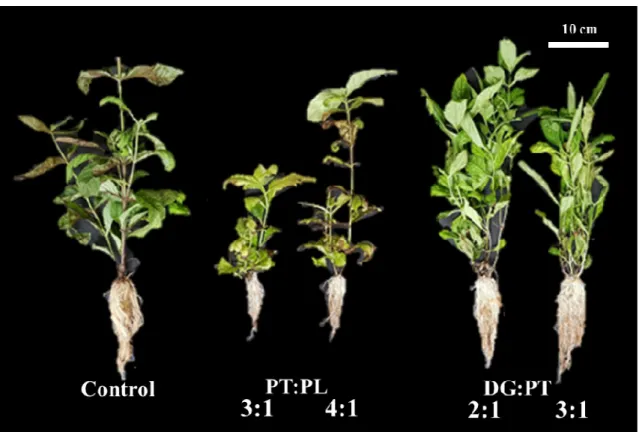
산꼬리풀 재배 시 원예상토를 단용하였을 때 생육이 가장 우 수하였으며, 토양 종류에서 혼용토의 피트모스 비율이 증가할
수록 생육이 향상되었으나, 혼용토의 60% 이상 피트모스가 함 유되었을 경우 30% 비율과 비교하였을 때 생육이 억제되었다 (Fig. 3). 또한 혼용토간 생육을 비교한 결과 마사토 혼용토가 Fig. 3. Growth of Veronica rotunda var. subintegra (Nakai) T.Yamaz. seedling after cultivation according to soil types. Control, Horticultural substrate; PT, Peatmoss, PL, Perlite; DG, Decomposed granite. Mixed soils was mixed with each soils per volume.
Table 6. Effect of soil type on seedling growth of Veronica rotunda var. subintegra (Nakai) T.Yamaz.
Soil Plant length ( ㎝)
Internode length ( ㎝)
Diam. of stem ( ㎜)
No. of lateral branches (ea)
No. of nodes (ea)
No. of leaves (ea)
Fresh weight of shoot (g)
Type Ratio / pot / plant
HS 32.2 ± 1.25a
z3.9 ± 0.18ab 2.54 ± 0.082a 6.3 ± 0.57a 45.1 ± 2.29a 77.6 ± 3.74a 27.6 ± 1.71a 10.5 ± 0.86a PT:PL
y3:1 14.1 ± 1.57d 2.9 ± 0.21c 1.89 ± 0.082c 3.5 ± 0.52b 27.4 ± 0.96b 29.8 ± 2.37c 10.2 ± 1.40d 3.3 ± 0.54c
4:1 20.2 ± 1.13c 3.3 ± 0.21bc 2.28 ± 0.158ab 4.5 ± 0.33ab 30.7 ± 2.27b 32.0 ± 2.37c 13.1 ± 0.57d 5.0 ± 0.49bc DG:PT 2:1 28.0 ± 1.22b 4.3 ± 0.26a 2.04 ± 0.065bc 4.9 ± 1.15ab 34.0 ± 3.66b 58.0 ± 3.28b 22.4 ± 0.57b 6.5 ± 0.33b
3:1 25.9 ± 0.80b 4.0 ± 0.22ab 1.88 ± 0.072c 4.5 ± 0.44ab 35.0 ± 1.61b 66.0 ± 3.04b 17.9 ± 0.85c 5.6 ± 0.50b Soil Dry weight of shoot (g) Root length
( ㎝)
Fresh weight of root (g) Dry weight of root (g) Flowering ratio (%)
SPAD value
Type Ratio / pot / plant / pot / plant / pot / plant
HS 9.8 ± 0.36a 3.2 ± 0.18a 18.2 ± 0.14a 18.0 ± 0.96a 5.5 ± 0.58a 6.3 ± 0.17a 1.96 ± 0.18a 44.4 ± 11.02a 31.5 ± 1.22a PT:PL 3:1 4.5 ± 0.12d 1.8 ± 0.11c 12.4 ± 0.49d 6.0 ± 0.47c 2.7 ± 0.34c 3.8 ± 0.06c 1.36 ± 0.14b 0.0 ± 0.00b 15.9 ± 0.87b 4:1 5.1 ± 0.06d 2.1 ± 0.12bc 14.0 ± 0.56c 7.9 ± 0.60c 3.3 ± 0.10bc 4.0 ± 0.05c 1.57 ± 0.12 4.2 ± 4.17b 16.1 ± 0.58b DG:PT 2:1 7.7 ± 0.22b 2.4 ± 0.10b 16.7 ± 0.35b 15.1 ± 0.58b 5.5 ± 0.46a 5.7 ± 0.17b 1.92 ± 0.11a 0.0 ± 0.00b 31.4 ± 0.81a 3:1 6.4 ± 0.18c 2.2 ± 0.10bc 16.0 ± 0.31b 14.5 ± 0.54b 4.7 ± 0.22ab 5.4 ± 0.08b 1.69 ± 0.05ab 16.7 ± 8.33b 32.2 ± 0.62a
z
Mean separation within columns by Duncan´s multiple range test at p<0.05.
y
HS, Horticultural substrate; PT, Peatmoss; PL, Perlite; DG, Decomposed granite.
중화 피트모스 혼용토에 비해 생육이 양호하였다(Table 6). 특 히 마사토와 피트모스 2:1비율에서 초장, 절간장 및 근장은 각 28.0, 4.3, 16.7 ㎝로 우수하였다.
고 찰
육묘 시 양질의 묘 생산에 적절한 용기 용량을 구명할 필요가 있다(Lee and Kim, 1999). 플러그 셀의 크기가 커질수록 고추와 토마토는 생육이 증가하였고(Charles and Jirak, 1990; Latimer, 1988; Shin et al., 2000; Weston, 1988; Weston and Zandstra, 1986), 양배추의 경우 셀의 크기가 작을수록 생육이 양호하였다 (Mametuka and Yamamoto, 1990). 본 연구에서 산꼬리풀의 생 육은 파종 용기의 용량이 클수록 증가하였는데, 이는 육묘 시 용 기의 용량이 커질수록 지하부의 환경이 개선되어 T/R률의 증가 에 따른 지상부의 생육이 촉진된 것으로 판단된다(Kemble et al., 1994; Weston and Zandstra 1986; Lee et al., 2001).
차풀(Cho et al., 2000)과 콩(Kang et al., 1998)에서 단위면 적당 파종량이 많을수록 생체중이 일정량까지 증가하였지만 식 물별 적정 파종량을 초과하면 생체중은 점차 감소하였다. 본 연 구에서도 파종량이 증가할수록 셀 당 생체중이 증가하였으나, 개체별 초장은 1, 2 및 4립 처리구에서 차이가 없었고 개체별 생 체중은 파종량이 많을수록 감소하였다. 이는 단위면적당 파종 량이 개체의 생육과 밀집도에 영향을 준다는 것을 의미하며 (Urbaniak et al., 2008), 적정 파종량의 결정을 위해서는 개체 별 생육과 단위면적당 생체중이 복합적으로 고려되어야 할 것 으로 생각된다.
육묘 시 용기의 크기에 따라 근권부의 생육이 변화하게 되는 데 이는 초기 생육차이가 정식 후에도 영향을 미치게 된다. 고추 의 경우 육묘 시 근권이 제한될수록 생육을 회복하지 못하는 결 과를 보였다(Aloni, 1991). 또한, 용기의 크기가 클수록 고추를 정식 후 T/R율이 증가하였으며, 경직경과 엽면적도 우수하였다 (Lee et al., 2001). 이와 같은 결과는 산꼬리풀의 생육결과와 일 치하며 근권부 생육 촉진에 따른 적정 육묘용기의 크기는 162구 트레이로 판단된다.
식물을 정식할 경우 셀 당 파종량에 따라 식물의 생육이 변화 할 수 있다. 따라서 식물을 정식 후 관상가치를 높여 적절한 상 품성을 갖는 묘 생산을 위한 적정 파종량이 필요하다. 바위취와 용머리는 재식주수가 증가할수록 초장은 감소하였지만 포트 당 엽수, 마디수, 줄기수 및 화서수가 증가하였다(Seo et al., 2006a).
한편 1, 2립 파종묘의 경우 식물이 도복하였으며, 4립 파종묘 이
상은 다음과 같은 현상이 나타나지 않았다. 본 연구에서는 육묘 시 셀 당 생육 증가율이 높았던 4립 파종구를 정식하였을 때 측 지수 및 엽수가 비교적 우수하였으므로, 관상용 재배를 위해서 는 식물이 도복하지 않는 4립 파종묘를 정식하여 재배하는 것이 효과적일 것으로 생각된다.
식재용기 내 토양 용적량의 증가는 지하부의 환경 개선에 따 른 T/R률과 비례하여 증가하기 때문에 식물의 생육 증진에 효과 가 있다(Lee et al., 2001). 본 연구에서 토양 용적량이 가장 큰 화분 12호를 사용하였을 때 엽수와 측지수 및 개화율이 우수하 였다. 이는 도깨비고비(Seo et al., 2006a), 바위취 및 용머리 (Seo et al., 2006b)의 분화재배시 화분의 크기가 증가할수록 생 육이 증가한 결과와 일치하였다. 한편 용기의 재질에 따른 유의 적인 생육차이가 확인되지 않았으므로, 분화용 또는 대량 지피 식재용 등의 목적에 따른 적절한 선택이 필요할 것으로 생각된 다.
피트모스는 부피의 98% 정도가 수분세포이기 때문에 물과 공기가 이상적인 비율로 함유되어 있어 통기성과 보수력이 매 우 우수하다(Kim, 2003). 프리지아는 피트모스를 혼용하였을 때 초장, 엽수 및 생체중이 증가하는 결과를 보였다(Lee, 2017).
그러나 본 연구에서는 피트모스 혼용토에서 생육이 억제되었는 데, 이는 피트모스의 과용이 지하부를 과습하게 하며 토양친화 력이 낮아 근권 활착에 장해로 작용하였기 때문으로 생각된다 (Kim, 2003). 마사토는 원예상토, 피트모스, 펄라이트에 비해 저렴한 가격을 형성하고 있으며, 배수성과 공극률이 높다. 토양 에서 투수속도가 증가할수록 지하부가 증가하고 깊이도 확장된 다고 보고되었다(Ahn, 1987). 또한, 산소 공급 능력이 낮은 토 양은 식물이 뿌리를 통해 양분이나 수분의 흡수가 정지되어 생 육이 저조해진다(Cho and Kim, 1997). 울릉연화바위솔은 마사 토의 비중이 높은 토양에서 생체중, 런너수 및 초장이 가장 높게 나타났다(Jeong et al., 2012). 이는 산꼬리풀 재배 시 피트모스 혼용토에 비해 마사토 혼용토에서 생육이 우수한 결과를 뒷받 침한다.
적 요
본 연구는 국내 특산식물이며 신 관상식물로 기대되는 산꼬 리풀[Veronica rotunda var. subintegra (Nakai) T.Yamaz.]의 효과적인 재배법을 구명하고자 수행되었다. 플러그 육묘는 파 종용기와 파종량을 달리하였다. 재배는 묘의 소질, 식재용기, 토양종류 및 차광정도를 달리하여 처리하였다. 묘의 소질은
162, 200 및 288구 트레이를 이용하여 육묘한 묘를 사용였으며, 파종량은 1, 2, 4 및 6립을 파종하여 생산된 묘를 사용하였다.
본 연구에서 산꼬리풀의 육묘 시 트레이 종류는 162구가 적절하 였으며, 셀 당 1립씩 파종할 경우 각 개체의 생육이 증가하였으 나 4립 파종 시에는 전체 식물의 생육에 유리하였다. 묘의 소질 에 따른 실험은 162구 트레이에서 생산된 묘와 4립씩 파종하여 생산된 묘에서 각기 우수한 생육을 보였다. 산꼬리풀 재배 시 식 재용기의 용적량이 커질수록 지상부 및 지하부의 생육이 증가 하는 경향이었으며, 용기의 재질에 따른 유의적인 차이는 나타 나지 않았다. 토양조건별 생육은 원예상토에서 가장 왕성하였 으며, 혼용토에서는 피트모스에 비해 마사토의 함량이 높은 조 건에서 양호한 생육을 나타냈다.
사 사
본 연구는 국립수목원 유용식물증식센터 “야생화 산업화를 위한 신 관상식물 (new ornamental crops) 고품질 재배기술 개 발, KNA 18-C-23”의 사업비 지원에 의해 수행되었음.
References