SK-Hep1 인체 간암 세포에서 Luteolin에 의한 TRAIL 저항성 감소 효과
김은영·김안근# 숙명여자대학교 약학대학
(Received January 10, 2012; Revised February 21, 2012; Accepted February 22, 2012)
Sensitization of TRAIL-resistant SK-Hep1 Human Hepatocellular Carcinoma Cells by Luteolin
Eun Young Kim and An Keun Kim#
College of Pharmacy, Sookmyung Women’s University, Seoul 140-742, Korea
Abstract — In this study, we examined the effect of luteolin to enhance TRAIL-induced anticancer effect in SK-Hep1 cells.
We found that combined use of TRAIL with luteolin markedly enhanced the cytotoxicity compared to either agent alone by inducing apoptosis. Furthermore, combined treatment of TRAIL with luteolin significantly induced activation of death recep- tor pathway-related proteins as well as PARP-cleavage and activation of effector caspases. Also, our result indicated that upregulation of DR4 and DR5 by luteolin combination may contribute to enhanced susceptibility of SK-Hep1 cells to TRAIL.
Keywords □ TRAIL, luteolin, apoptosis, death receptors
TNF-related apoptosis-inducing ligand(TRAIL)는 tumor necrosis factor family의 subfamily에 속하는 싸이토카인으로, 정 상세포에는 독성을 나타내지 않으면서 암세포에만 선택적으로 독성을 나타낸다는 것이 여러 in vivo, in vitro 실험들을 통해 보 고되고 있어 유망한 항암 후보물질로 주목 받고 있다.1-3) 그러나 췌장암, 유방암, 결장암4-6) 등을 비롯해 많은 암세포들이 TRAIL 에 내성을 보이는 것으로 나타나 TRAIL 단독만으로 효과를 나 타내기 어려운 경우가 많다. 현재 암세포가 TRAIL에 저항성을 나타내는 기전으로는 NF-κB의 활성화, decoy receptor의 발현, DR4/DR5의 변이 또는 발현 억제, cFLIP(cellular FLICE- inhibitory protein)의 발현 증가, caspase 활성의 억제 등 여러 기전이 제시되어 있다.7-9) 따라서 이러한 저항 기전을 억제할 수 있는 물질을 함께 이용하면 TRAIL의 적용 가능성을 더욱 높일 수 있으므로 최근의 연구는 TRAIL을 다른 항암제나 방사선 요 법과 병용 치료하여 항암 효과를 높이기 위한 방법이 활발히 연 구되고 있다.
현재까지의 다양한 연구에 따르면 암의 발병은 음식과 깊은 관련성을 가지고 있으며 항암 활성을 가진 천연 식품을 섭취하
는 것은 암 예방에 많은 도움이 된다고 알려져 있다.10,11) 특히, 천연 식품에 풍부한 물질 중에서도 플라보노이드류를 비롯한 페 놀성 물질은 항산화, 항염 작용을 나타내며 다양한 암세포에서 항암 활성을 가지고 있다고 보고되고 있어 화학적 암예방 물질 로서 많은 주목을 받고 있다.12-14) 이와 관련하여 기존 연구들을 통해 curcumin, resveratrol, quercetin, silibinin 등 천연물에서 얻어진 성분들이 TRAIL에 대한 암세포의 저항성을 줄여주는 역 할을 한다는 보고가 있었으며, 그와 관련된 기전이 규명된 바 있다.
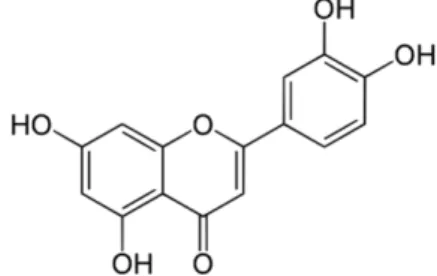
Luteolin은 식물의 잎에 많이 포함되어 있으며 샐러리, 당근, 박하 등 다양한 식물에 함유되어 있는 천연물질로 Fig. 1과 같은 구조를 가진 플라보노이드류이다.15) Luteolin은 항산화, 항염 효 과를 비롯해 다양한 생리활성을 가지고 있는 것으로 보고되었으
며,16-18) 여러 암세포에서 항암활성을 나타낸다고 알려져 왔다.19,20)
#본 논문에 관한 문의는 저자에게로 (전화) 02-710-9566 (팩스) 02-710-9871 (E-mail) [email protected]
종 설
Fig. 1− Chemical structure of luteolin.
또한 Shi et al.은 luteolin이 다양한 암세포에서 protein kinase C 활성 억제를 통한 XIAP 감소에 의해 TRAIL 감수성을 증가 시키는데 기여한다고 보고한 바 있다.21)
본 연구는 luteolin이 SK-Hep1 간암세포의 TRAIL 저항성을 감소시키는 데에도 작용할 것이라 보고, 그와 관련된 기전을 연 구하였다. 이를 위해 TRAIL과 luteolin의 단독 또는 병용 처리 가 SK-Hep1 간암세포의 세포생존율에 미치는 영향을 조사하였 고, flow cytometry analysis를 통한 apoptosis 증가 확인 및 apoptosis와 관련된 단백질들의 발현을 확인하여 그와 관련된 기 전을 밝혔다.
실험방법
시약
본 실험에 사용한 luteolin은 Sigma-Aldrich(St. Louis, MO, USA)사로부터 구입하였으며 dimethyl sulfoxide(DMSO)에 최종 농도 0.1% 이하로 녹여서 사용하였다. Soluble recombinant human TRAIL/Apo2L는 Peprotech(Rocky Hill, NJ, USA)에서, human recombinant DR4(TRAIL-R1)/Fc chimera protein, human recombinant DR5(TRAIL-R2)/Fc chimera protein은 R&D Systems(Minneapolis, MN, USA)에서 구매하였다. 세포배양에 사용한 Dulbecco's modified eagle medium(DMEM), Dulbecco's phosphate buffered saline(DPBS), fetal bovine serum(FBS), trypsin-EDTA, penicillin/streptomycin 항생제는 WelGENE (Daegu, South Korea)에서 구입하였으며 MTT 시약 [3-(4,5- dimethylthiazol-2-yl)-2,5-diphenyl tetrazolium bromide]은 Sigma- Aldrich(St. Louis, MO, USA)사의 제품을 이용하였다. Annexin V-FITC Apoptosis Detection Kit는 BD Biosciences(San Jose, CA, USA)에서 구매하였다. Western blotting에 사용된 cleaved caspase-8, cleaved caspase-7, cleaved caspase-6, cleaved caspase-3, PARP, DR4, DR5, β-actin antibody는 Cell Signaling (Danvers, MA, USA)에서 구입하였으며 protease inhibitor cocktail 은 Roche 제품을, detection kit(ECL solution)는 Amersham Pharmacia Biotech (Piscataway, NJ, USA)사의 제품을 사용하였다.
실험기기
세포의 배양을 위해 Forma Scientific(Marrietta, Ohio, USA) 사의 CO2 incubator를 사용하였으며, MTT assay에는 ELISA reader(BIO-TEK instruments, Winooski, VT, USA)를 사용하였 다. 유세포분석기로는 BD FACS CantoTMII Flow Cytometer (BD Biosciences, San jose, CA, USA)의 제품을 이용하였다.
세포배양
본 연구에 사용한 인간 유래 간암세포주인 SK-Hep1 cell line
은 한국 세포주 은행(Seoul, Korea)에서 구입하였다. SK-Hep1 세포는 10% heat-inactivated fetal bovine serum, 항생제 (10,000 units/ml penicillin G sodium, 10,000µg/ml streptomycin sulfate)를 포함하는 DMEM 배지를 배양액으로 하여 37oC, humidified 5% CO2 incubator에서 배양하였으며 culture flask가 confluent해 졌을 때 trypsin-EDTA를 처리하여 실험에 이용하였다.
Cell viability 측정
세포생존율은 MTT assay를 통해 측정하였다. Cell suspension 을 96-well plate에 분주하여 배양기에서 24시간 안정화시키고, 조건에 따라 cell을 처리하여 24시간 동안 배양하였다. 각 well 에 MTT 용액 50µl를 첨가하여 4시간 동안 배양기에 방치한 후 상층액을 제거하고 DMSO를 well당 100µl 가하여 formazan을 용해시켜서 ELISA plate reader로 540 nm에서 흡광도를 측정하 였다. 각 시료군에 대한 평균 흡광도 값을 구해 대조군의 흡광도 값과 비교하여 증식 억제 정도를 확인하였다.
Flow cytometry analysis
Flow cytometry를 이용해 annexin V-FITC/PI 이중 염색한 세 포를 분석하여 apoptosis 발생을 측정하였으며, 방법은 다음과 같다. 세포를 6-well plate에 seeding하고 안정화시킨 후 조건에 따라 cell을 처리하여 24시간 배양하였다. Trypsin-EDTA를 처리 하여 세포를 떼어내 원심 분리한 후 PBS로 두 번 washing 하고 1× binding buffer에 현탁시켜 annexin V-FITC와 PI 시약으로 염색하였다. 그 후 flow cytometer를 이용하여 apoptosis의 발생 을 확인하였다.
Western blotting
100 mm2 dish에 cell을 배양하여 TRAIL, luteolin을 24시간 동 안 단독 혹은 병용 처리한 후, harvest 하여 conical tube에서 원 심분리 하였다. PBS로 두 번 washing한 뒤, protease inhibitor 를 넣은 lysis buffer로 lysis하여 원심분리 하였다. 단백질 정량 을 통해 동량의 단백질을 loading하여 SDS-PAGE gel에서 전기 영동으로 분리하고 분리된 단백질을 poly-vinylidene difluoride (PVDF) membrane에 transfer 시킨 후, 5% skim milk를 함유한 TBS-T(25 mM Tris, 137 mM NaCl and 0.1% Tween 20)에 넣어 실온에서 2시간 shaking하며 incubation하여 비특이적 결합을 blocking 하였다. Membrane을 4oC 조건에서 특정 단백질에 대한 항체와 하룻밤 동안 처리한 다음 TBS-T 용액으로 씻어내고 이차 항체와 반응시켰다. 결과는 ECL용액을 처리하여 LA-3000 분석 기(Fuji, Tokyo, Japan)로 특정 단백질의 발현을 측정하여 얻었다.
통계처리
실험 결과는 평균±SD로 표시하였으며, 통계처리는 one-way
ANOVA를 이용하여 분석하고 사후검정으로 Turkey test를 이용 하였다. 모든 검정에서 P값이 0.05 미만인 경우를 유의성이 있 는 것으로 판정하였다.
실험결과 및 고찰
세포생존율에 대한 병용 효과
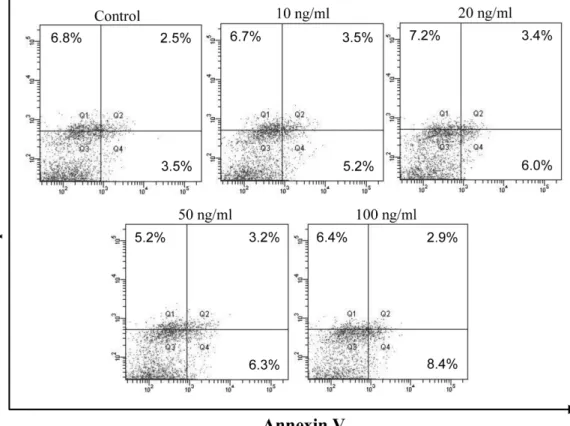
SK-Hep1 세포에서 TRAIL 감수성을 확인하기 위해 TRAIL을 단독으로 처리하여 annexin V-FITC/PI 이중 염색 후 FACS analysis를 통해 apoptosis를 측정하였다. 이는 apoptosis가 일어 나게 되면 세포막 안쪽에 있던 phosphatidyl serin(PS)이 세포표 면으로 뒤집혀 노출되게 되는데,22) 이렇게 노출된 PS가 annexin V와 결합하는 것을 이용한 방법이다.23) 다양한 TRAIL농도(0~
100 ng/ml)를 24시간 동안 처리하여 apoptosis의 발생을 확인한 결과, Fig. 2에서 나타나듯이 가장 높은 TRAIL 농도(100 ng/ml) 에서도 apoptosis 발생의 유의적인 증가가 나타나지 않아 SK- Hep1 세포가 TRAIL에 민감한 세포주가 아닌 것을 확인하였다.
Luteolin이 TRAIL에 대한 SK-Hep1 세포의 감수성을 증가시 키는지 확인하기 위해 세포생존율이 90% 이상 나타나는 농도
(10 ng/ml)의 TRAIL을 다양한 농도의 luteolin과 함께 24시간 처 리하여 MTT assay를 통해 luteolin 단독 처리시의 결과와 비교 하였다. 그 결과 luteolin 또는 TRAIL을 단독으로 처리했을 때 보다 함께 처리했을 때 세포생존율의 감소가 유의적으로 증가하 였으며, luteolin 농도가 높아짐에 따라 병용에 의한 세포증식 억 제 효과가 더 크게 나타났다. 특히, 가장 높은 luteolin 농도(15µg/
ml)에서 luteolin 단독일 때의 결과에 비해 TRAIL과 병용시 세 포생존율의 차이가 약 50.5%로 크게 나타나, TRAIL과 luteolin 의 병용에 의해 SK-Hep1 간암 세포의 생존율 억제 상승효과가 일어난 것을 확인할 수 있었다(Fig. 3). 앞선 MTT assay의 결과 를 토대로 TRAIL과 luteolin의 병용 효과를 좀 더 자세히 알아 보기 위해 TRAIL 10 ng/ml, luteolin 15µg/ml의 농도를 정하여 이후의 실험을 진행하였다.
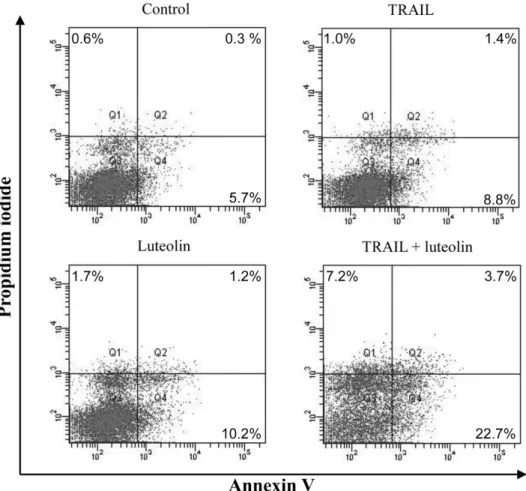
Luteolin 병용에 의한 TRAIL-매개 apoptosis의 상승효과 확인 병용에 의한 apoptosis 유도 증가를 확인하기 위해 annexin V- FITC와 PI 이중 염색 후 유세포분석기를 통해 apoptosis를 측정 하였다. TRAIL과 luteolin을 단독 혹은 병용하여 초기 apoptosis 의 발생을 확인한 결과 대조군(5.7%)이나 단독투여군(TRAIL:
Fig. 2− Effect of TRAIL on SK-Hep1 cell death. Cells were treated with various concentrations of TRAIL (0~100 ng/ml) for 24 h and stained with annexin V-FITC and PI. Quantitative analysis of apoptosis was evaluated by flow cytometric analysis. Bottom left quadrant shows the live cells; bottom right quadrant shows the early apoptotic cells; top right quadrant shows the late apoptotic or necrotic cells.
Representative data are shown.
8.8%, luteolin 10.2%)에 비해 병용시의 apoptosis 발생 비율이 22.7%로 뚜렷한 증가를 보인 것이 확인되었다(Fig. 4).
Apoptosis 하위 단계 단백질들의 발현 확인
앞선 결과에서 TRAIL과 luteolin의 병용시 나타나는 apoptosis 상승효과를 확인하였으므로, apoptosis 유발에서 가장 핵심적인 역할을 하는 caspase와의 관련성을 조사하였다. 많은 선행연구 를 통해 caspase 활성화가 apoptosis의 증거가 된다는 것이 보고 된 바 있다. Caspase는 전구부위의 길이에 따라 두 그룹으로 분 류된다. 주로 짧은 전구 부위를 지니는 effector caspase들은 보 통 상위의 initiator caspase에 의해 절단되어 활성화되며, 하위 의 다양한 기질을 절단하여 apoptosis 단계에서 실행자 역할을 담당한다.24) TRAIL과 luteolin의 병용 효과를 알아보기 위해 effector caspase인 caspase-7, -6, -3의 활성화를 western blotting 으로 확인한 결과, Fig. 5A에서 나타난 바와 같이 대조군이나 단 독 처리군에 비해 병용시 확연히 증가된 caspase 활성화가 관찰 되었다.
한편, PARP는 DNA repair 과정에 중요한 역할을 담당하는 단
Fig. 4− Quantitative analysis of apoptosis was examined by flow cytometry. SK-Hep1 cells were treated with or without luteolin (15 µg/ml) and/or TRAIL (10 ng/ml) for 24 h and stained with annexin V-FITC and PI. Bottom left quadrant shows the live cells; bottom right quadrant shows the early apoptotic cells; top right quadrant shows the late apoptotic or necrotic cells. Representative data are shown.
Fig. 3− Effect of co-treatment of luteolin and TRAIL on SK-Hep1 cell viability. SK-Hep1 cells were treated with or without TRAIL (10 ng/ml) and indicated concentrations of luteolin for 24 h. Cell viability was evaluated by MTT assay. Data is expressed as mean±SD of three independent experiments.
Statistical significance: *p<0.001 versus TRAIL-untreated cells.
백질로, 세포의 핵 내에 존재하며 caspase-3에 의해 분절화되어 불활성화된다. 그 결과 세포의 분해가 촉진되어 apoptosis가 야 기되므로 PARP cleavage는 apoptosis 평가의 주요 지표 중 하 나이다.25) TRAIL과 luteolin의 병용시 caspase-3 활성화가 유의 적으로 증가하였으므로, 병용에 의해 caspase-3의 주요 표적 단 백질인 PARP의 분절화에도 그러한 영향이 나타나는지 확인하기 위해 western blotting을 실시하였다. 그 결과, 다른 그룹에 비해 병용했을 때 PARP의 분절화 형태가 뚜렷하게 증가한 것이 관찰 되었다(Fig. 5B).
이상의 결과들로부터 TRAIL과 luteolin 병용에 의해 apoptosis 상승 효과가 나타난다는 것을 확인할 수 있었다.
Death receptor pathway와의 관련성 확인
TRAIL과 luteolin의 병용이 SK-Hep1 간암 세포에서 apoptosis 를 상승시켰으므로, 이와 관련된 기전이 무엇인지 조사하였다.
Caspase를 활성화시키는 경로에는 크게 두 가지 경로, 즉 미토 콘드리아를 경유하여 유도되는 intrinsic pathway와 세포표면의 death receptor 가 관여하여 일어나는 extrinsic pathway가 존재 한다. Intrinsic pathway에서는 미토콘드리아에 있는 다양한 Bcl-
2 family 단백질들의 조절에 의해 intrinsic pathway의 initiator caspase인 caspase-9이 활성화되어 하위 caspase의 활성이 조절 되는 반면, extrinsic pathway에서는 death receptor에 death ligand가 결합하여 extrinsic pathway의 initiator caspase인 caspase-8이 활성화된다. 활성화된 caspase-8은 하위의 여러 caspase cascade를 활성화하여 apoptosis를 유도한다.26) Death receptor는 세포질 쪽의 death domain을 통해 apoptosis와 관련 된 신호전달을 매개하는 것으로 알려져 있다. 이 중에서 TRAIL- 매개 apoptosis 신호 전달에 관여하는 death receptor는 DR4 (Death receptor 4, TRAIL-receptor 1)와 DR5(Death receptor 5, TRAIL-receptor 2)가 있으며 이들은 TRAIL과 결합하여 death domain을 통해 세포에 apoptosis 신호를 전달한다.27) 지금 까지 암 치료에 사용되어온 chemotherapy나 radiotherapy는 p53 경로를 통해 apoptosis를 유도하여 암세포를 사멸시키는 경우가 많았다. TRAIL을 통한 apoptosis 경로는 death receptor를 통해 p53과는 무관하게 apoptosis를 유도할 수 있기 때문에 p53 돌연 변이에 의한 내성 기전을 피할 수 있다는 장점이 있다.28)
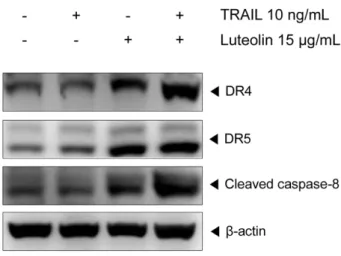
본 실험에서 얻어진 TRAIL과 luteolin의 병용에 의한 apoptosis 상승 효과가 death receptor와 관련하여 일어난 것인 지 확인하기 위해 DR4와 DR5의 단백질 발현을 western blotting 으로 조사하였다. 그 결과 Fig. 6에서 나타난 바와 같이 TRAIL 과 luteolin을 병용했을 때 DR4와 DR5 발현이 유의적으로 증가 한 것이 관찰되었다. 또한 death receptor pathway의 initiator caspase인 caspase-8의 활성화도 유의적으로 증가한 것을 확인 할 수 있었다. 이상의 결과를 고려해 볼 때 TRAIL/luteolin 병용 에 의한 apoptosis 상승 작용은 death receptor pathway의 활성 화와 관련이 있을 것으로 보인다. 따라서 병용에 의한 효과가 DR4, DR5의 활성화를 통해 일어나는 것인지 알아보기 위해 DR4- Fig. 5− Effect of TRAIL and luteolin combined treatment on
effector caspase family and PARP cleavage in SK-Hep1 cells. Cells were treated with or without luteolin (15µg/ml) and/or TRAIL (10 ng/ml) for 24 h and cell lysates were prepared for western blotting. (A) Western blot analysis was performed for analysis of effector caspases (caspase-7, -6, -3). (B) Western blotting was carried out to monitor PARP-cleavage. β-actin was used as loading control.
Fig. 6− Effect of TRAIL/luteolin combination on DR4, DR5 and caspase-8. SK-Hep1 cells were treated with or without luteolin (15µg/ml) and/or TRAIL (10 ng/ml) for 24 h and whole-cell extracts were prepared for western blotting. β- actin was used as loading control.
chimera, DR5-chimera(DR4, DR5-specific blocking chimera antibody)를 각각 TRAIL/luteolin과 함께 처리하여 세포생존율 억제에 대한 영향을 확인하였다. 그 결과 TRAIL/luteolin 병용에 의해 감소한 세포생존율(24.5%)이 DR4-chimera 또는 DR5- chimera protein을 함께 처리했을 때 각각 50%, 83.4%으로 유 의적인 증가를 보였다(Fig. 7). 이를 통해 TRAIL/luteolin에 의해 상승한 세포독성은 DR4 및 DR5 활성화를 통해 유도된다고 생 각되며, DR5 blocking에 의해 세포독성이 더 크게 억제되었으므 로 DR4와 DR5 중에서도 DR5의 활성 증가가 TRAIL/luteolin 병용에 의한 세포독성 상승 기전에 중요한 역할을 한다는 것을 알 수 있었다. 기존 연구 중 Horinaka et al.의 연구에서 luteolin 이 HeLa 자궁경부암 세포의 세포사멸을 유도하는 데에 DR5 활 성화가 관여한다는 것이 보고된 바 있으나 인체 간암 세포주에 서 DR4 및 DR5 death receptor 활성화를 통한 TRAIL/luteolin 병용 효과 상승 작용은 본 연구를 통해 처음으로 확인되었다.29)
결 론
본 연구에서 TRAIL과 luteolin의 병용 처리는 SK-Hep1 간암 세포에서 TRAIL 이나 luteolin 각각의 작용에 비해 유의적인 세 포독성을 나타내었다. 병용에 의한 세포독성 증가는 apoptosis 유도와 관련이 있다는 것을 annexin V(+) 세포 비율의 증가를 통해 확인할 수 있었으며 apoptosis 하위 단계에 속하는 단백질 들의 변화를 통해서도 알 수 있었다. 이와 관련된 기전으로는 death receptor apoptotic pathway가 관여하는 것으로 보이며,
DR4및 DR5의 활성화가 TRAIL과 luteolin의 병용에 의한 항암 효과에 중요한 역할을 담당하는 것으로 확인되었다.
감사의 말씀
본 논문은 2010년도 정부(교육과학기술부)의 재원으로 한국연 구재단의 지원을 받아 수행된 기초연구사업으로, 이에 감사드립 니다(2010-0010538).
참고문헌
1) Ashkenazi, A., Pai, R. C., Fong, S., Leung, S., Lawrence, D. A., Marsters, S. A., Blackie, C., Chang, L., McMurtrey, A. E., Hebert, A., DeForge, L., Koumenis, I. L., Lewis, D., Harris, L., Bussiere, J., Koeppen, H., Shahrokh, Z. and Schwall, R. H. : Safety and antitumor activity of recombinant soluble Apo2 ligand. J. Clin. Invest. 104, 155 (1999).
2) Roth, W., Isenmann, S., Naumann, U., Kugler, S., Bahr, M., Dichgans, J., Ashkenazi, A. and Weller, M. : Locoregional Apo2L/TRAIL eradicates intracranial human malignant glioma xenografts in athymic mice in the absence of neurotoxicity.
Biochem. Bioph. Res. Co. 265, 479 (1999).
3) Walczak, H., Miller, R. E., Ariail, K., Gliniak, B., Griffith, T. S., Kubin, M., Chin, W., Jones, J., Woodward, A., Le, T., Smith, C., Smolak, P., Goodwin, R. G., Rauch, C. T., Schuh, J. C. and Lynch, D. H. : Tumoricidal activity of tumor necrosis factor- related apoptosis-inducing ligand in vivo. Nat. Med. 5, 157 (1999).
4) Hinz, S., Trauzold, A., Boenicke, L., Sandberg, C., Beckmann, S., Bayer, E., Walczak, H., Kalthoff, H. and Ungefroren, H. : Bcl-XL protects pancreatic adenocarcinoma cells against CD95- and TRAIL-receptor-mediated apoptosis. Oncogene 19, 5477 (2000).
5) Zhang, Y. and Zhang, B. : TRAIL resistance of breast cancer cells is associated with constitutive endocytosis of death receptors 4 and 5. Mol. Cancer Res. 6, 1861 (2008).
6) Van Geelen, C. M., Pennarun, B., Le, P. T., de Vries, E. G. and de Jong, S. : Modulation of TRAIL resistance in colon carcinoma cells: different contributions of DR4 and DR5. BMC Cancer 11, 39 (2011).
7) Zhang, L. and Fang, B. : Mechanisms of resistance to TRAIL- induced apoptosis in cancer. Cancer Gene Ther. 12, 228 (2004).
8) Khanbolooki, S., Nawrocki, S. T., Arumugam, T., Andtbacka, R., Pino, M. S., Kurzrock, R., Logsdon, C. D., Abbruzzese, J. L. and McConkey, D. J. : Nuclear factor-κB maintains TRAIL resistance in human pancreatic cancer cells. Mol. Cancer Ther.
5, 2251 (2006).
9) Van Geelen, C. M. M., de Vries, E. G. E. and de Jong, S. : Fig. 7− DR4/Fc chimera and DR5/Fc chimera block cell cytotoxicity
by TRAIL/luteolin combination. SK-Hep1 cells were treated with TRAIL (10 ng/ml) and luteolin (15µg/ml) for 24 h with or without DR4/Fc (1µg/ml) or DR5/Fc (1 µg/ml) chimera protein. Cell cytotoxicity was evaluated by MTT assay. Data is expressed as mean±SD of three independent experiments. Statistical significance: *p<0.01, **p<0.001.
Lessons from TRAIL-resistance mechanisms in colorectal cancer cells: paving the road to patient-tailored therapy. Drug Resist. Updates 7, 345 (2004).
10) Birt, D. F., Hendrich, S. and Wang, W. : Dietary agents in cancer prevention: flavonoids and isoflavonoids. Pharmacol.
Therapeut. 90, 157 (2001).
11) Greenwald, P., Clifford, C. K. and Milner, J. A. : Diet and cancer prevention. Eur. J. Cancer 37, 948 (2001).
12) Kawamori, T., Lubet, R., Steele, V. E., Kelloff, G. J., Kaskey, R. B., Rao, C. V. and Reddy, B. S. : Chemopreventive effect of curcumin, a naturally occurring anti-inflammatory agent, during the promotion/progression stages of colon cancer.
Cancer Res. 59, 597 (1999).
13) De Flora, S. and Ferguson, L. R. : Overview of mechanisms of cancer chemopreventive agents. Mutat. Res. 591, 8 (2005).
14) Malik, A., Afaq, F., Sarfaraz, S., Adhami, V. M., Syed, D. N. and Mukhtar, H. : Pomegranate fruit juice for chemoprevention and chemotherapy of prostate cancer. P. Natl. Acad. Sci. USA 102, 14813 (2005).
15) Lopez-Lazaro, M. : Distribution and biological activities of the flavonoid luteolin. Mini-Rev. Med. Chem. 9, 31 (2009).
16) Jang, S., Kelley, K. W. and Johnson, R. W. : Luteolin reduces IL- 6 production in microglia by inhibiting JNK phosphorylation and activation of AP-1. P. Natl. Acad. Sci. USA 105, 7534 (2008).
17) Wolfle, U., Esser, P. R., Simon-Haarhaus, B., Martin, S. F., Lademann, J. and Schempp, C. M. : UVB-induced DNA damage, generation of reactive oxygen species, and inflammation are effectively attenuated by the flavonoid luteolin in vitro and in vivo. Free Radical Bio. Med. 50, 1081 (2011).
18) Zhu, L.-H., Bi, W., Qi, R.-B., Wang, H.-D., Wang, Z.-G., Zeng, Q., Zhao, Y.-R. and Lu, D.-X. : Luteolin reduces primary hippocampal neurons death induced by neuroinflammation.
Neurol. Res. 33, 927 (2011).
19) Lin, Y., Shi, R., Wang, X. and Shen, H. M. : Luteolin, a flavonoid with potential for cancer prevention and therapy. Curr. Cancer Drug Tar. 8, 634 (2008).
20) Seelinger, G., Merfort, I., Wolfle, U. and Schempp, C. M. : Anti- carcinogenic effects of the flavonoid luteolin. Molecules 13, 2628 (2008).
21) Shi, R. X., Ong, C. N. and Shen, H. M. : Protein kinase C inhibition and x-linked inhibitor of apoptosis protein degradation contribute to the sensitization effect of luteolin on tumor necrosis factor-related apoptosis-inducing ligand-induced apoptosis in cancer cells. Cancer Res. 65, 7815 (2005).
22) Fadok, V. A., Voelker, D. R., Campbell, P. A., Cohen, J. J., Bratton, D. L. and Henson, P. M. : Exposure of phosphatidylserine on the surface of apoptotic lymphocytes triggers specific recognition and removal by macrophages. J. Immunol. 148, 2207 (1992).
23) Vermes, I., Haanen, C., Steffens-Nakken, H. and Reutellingsperger, C. : A novel assay for apoptosis Flow cytometric detection of phosphatidylserine expression on early apoptotic cells using fluorescein labelled Annexin V. J.
Immunol. Methods 184, 39 (1995).
24) Budihardjo, I., Oliver, H., Lutter, M., Luo, X. and Wang, X. : Biochemical pathways of caspase activation during apoptosis.
Annu. Rev. Cell Dev. Bi. 15, 269 (1999).
25) Oliver, F. J., de la Rubia, G., Rolli, V., Ruiz-Ruiz, M. C., de Murcia, G. and Murcia, J. M.-d. : Importance of poly(ADP- ribose) polymerase and its cleavage in apoptosis. J. Biol. Chem.
273, 33533 (1998).
26) Hengartner, M. O. : The biochemistry of apoptosis. Nature 407, 770 (2000).
27) Schneider, P., Thome, M., Burns, K., Bodmer, J.-L., Hofmann, K., Kataoka, T., Holler, N. and Tschopp, J. : TRAIL receptors 1 (DR4) and 2 (DR5) signal FADD-dependent apoptosis and activate NF-κB. Immunity 7, 831 (1997).
28) Wang, S. and El-Deiry, W. S. : TRAIL and apoptosis induction by TNF-family death receptors. Oncogene 22, 8628 (2003).
29) Horinaka, M., Yoshida, T., Shiraishi, T., Nakata, S., Wakada, M., Nakanishi, R., Nishino, H., Matsui, H. and Sakai, T. : Luteolin induces apoptosis via death receptor 5 upregulation in human malignant tumor cells. Oncogene 24, 7180 (2005).