당뇨유발 흰쥐에서 돼지감자 여주 혼합즙 음용에 의한 혈당저하 효과
양 양1․김용훈2․황은희3
1원광대학교 대학원 식품영양학과
2도천 농원
3원광대학교 식품영양학과
Effect of Helianthus tuberosus Juice Mixed with Dried Bitter Melon Juice on Hypoglycemic Function in Streptozotocin-Induced Diabetic Rats
Yang Yang1, Yonghoon Kim2, and Eunhee Hwang3
1Department of Food and Nutrition, Graduate School and
3Department of Food and Nutrition, Wonkwang University
2DoCheon Farm
ABSTRACT This study was conducted to develop Helianthus tuberosus (HT) juice mixed with dried bitter melon juice and assess its hypoglycemic effect in streptozotocin (STZ)-induced diabetic rats. HT juice mixed with 5.0%
dried bitter melon juice was used in this study. Male Sprague-Dawley rats were divided into four groups (eight rats per group) and drunk each sample for 4 weeks: normal water [normal control (NC) group], STZ+normal water (STZ group), STZ+HT juice (HT group), STZ+HT juice mixed with 2.5% bitter melon juice (HT2.5 group), and STZ+HT juice mixed with 5.0% bitter melon juice (HT5.0 group). HT juice was diluted to 25% in distilled water and supplied to rats. Food intake, body weight gain, and food efficiency ratio were lower in the STZ group than in the NC group.
HT, HT2.5, and HT5.0 groups showed higher parameters than the STZ groups. Water intakes were higher in the STZ group than in the NC group. After 3 weeks, HT, HT2.5, and HT5.0 groups showed lower parameters than the STZ group. After 1 week, blood glucose level of the STZ group (476.7±22.8 mg/dL) was significantly higher than those of the HT group (376.3±25.8 mg/dL), HT2.5 group (405.2±35.1 mg/dL), and HT5.0 group (342.8±29.7 mg/dL).
After 4 weeks, blood glucose level of the STZ group were significantly higher than those of the HT, HT2.5, and HT5.0 group. Serum insulin levels of the HT group (3.13±0.32 ng/mL), HT2.5 group (3.40±0.23 ng/mL), and HT5.0 group (3.48±0.43 ng/mL) were higher than that of the STZ group (2.72±0.53 ng/mL). These results indicate that H. tuberosus juice mixed with dried bitter melon juice helps prevent or attenuate progression of diabetes in rats with STZ-induced diabetes.
Key words: Helianthus tuberosus juice, bitter melon juice, hypoglycemic effect, streptozotocin rats
Received 28 March 2017; Accepted 20 July 2017
Corresponding author: Eunhee Hwang, Department of Food and Nutrition, Wonkwang University, Iksan, Jeonbuk 54538, Korea E-mail: [email protected], Phone: +82-63-850-6658
서 론
당뇨병은 불충분한 인슐린 합성, 인슐린 파괴 증가 또는 비효율적인 인슐린 작용 등에 의해 일어나는 심각한 대사질 환으로 세포가 혈액으로부터 포도당을 제대로 흡수할 수 없 게 되어 일어나는데(1), 2014 국민건강영양조사(2)에 의하 면 당뇨병 유병률은 30세 이상 성인에서 10.6%로 성인 10 명 중 1명은 당뇨 환자로 추정된다. 최근에는 질병의 예방과 치료에 천연물 소재의 기능성에 대한 기대가 커서 당뇨병을 개선할 수 있는 여러 천연재료가 발굴되고 있는데 근래에 돼지감자(Helianthus tuberosus L.)와 혈당 개선에 연관된
여러 보고가 있다(3-11).
돼지감자는 국화과 해바라기속 다년생 식물로 뿌리가 이 용되며 척박한 환경에서 잘 생장하고 많은 양을 수확할 수 있는 장점이 있다. 돼지감자의 주성분은 fructose의 중합체 인 이눌린(inulin)이며, 이는 돼지감자 건조중량의 약 70~
80%를 차지하는데, 사람에게는 난용성으로 인체에 거의 흡 수되지 않고 단맛이 커서 체중조절용 대체 감미료로 활용되 고 있다(12-15). 혈당 개선기능 외의 효능에 대해서는 항산 화 및 항암작용(16-18), 혈액지질 개선작용(19), 기능성 성 분(20), 생리활성성분(21), 페놀산(22) 등 여러 연구가 진행 되었다. 또한, 여주(Momordica charantia L., bitter mel- on)도 대표적인 혈당저하 기능성 식물로서 혈당조절 기여 효과를 밝히는 연구 결과들(23-26)이 있어 식물 인슐린으 로 불리기도 한다.
식품을 혼합하였을 경우 혈당 개선기능 효과가 더 증가한
선행 연구들이 있어(27-31) 본 연구에서는 돼지감자와 여 주의 혼합을 시도하였다. 돼지감자는 즙으로 가장 많이 이용 되고 있음에도 불구하고 즙을 음용한 연구는 거의 없는 실정 에서 돼지감자즙과 돼지감자즙에 여주즙을 2.5%, 5.0% 혼 합하여 돼지감자 여주혼합즙을 만들어 혈당 개선기능을 알 아보았다.
돼지감자 여주혼합즙의 혈당저하기능 측정은 strepto- zotocin(STZ)으로 당뇨를 유발한 흰쥐에 음용수로 4주간 공급한 후 혈당지표로서 혈액 포도당 농도 변화, 혈청 인슐 린 농도, 경구 당부하 검사를 실시하여 장기간 마셨을 때 혈당에 어떠한 영향을 주는지 알아보았다.
재료 및 방법
실험재료와 돼지감자 건조 여주 혼합즙 제조
본 실험에 사용된 돼지감자와 건조 여주는 2014~2015년 에 전북지역에서 재배한 것으로 이물질제거 및 수세 후 물기 를 제거하여 냉장, 냉동 보관하면서 시료로 사용하였다.
돼지감자즙은 11월에 수확한 성숙한 생돼지감자 뿌리에 약 300 mL의 물을 가하여 고압으로 110°C에서 약 3시간 처리하여 얻었으며 생돼지감자에 대한 즙액의 수율은 약 78%였다. 주재료인 돼지감자의 수확 시기에 혼합즙을 만들 어야 하므로 여주는 건조한 것을 사용하였다. 건조 여주즙은 7월~9월에 수확한 미성숙한 초록색의 여주를 깨끗이 씻어 2~3 mm로 얇게 썰어 105°C에서 5시간 건조한 후 맛을 좋게 하려고 160°C에서 15분간 볶은 다음 8배량의 물로 105°C에서 6시간 추출하여 만들었다.
2가지 이상의 물질을 혼합할 때 혼합비율은 재료에 따라 다양하였는데(27-31) 본 실험에서는 주재료인 돼지감자즙 의 단맛을 유지하면서 여주의 쓴맛을 완화해 마시기 좋은 최소량의 여주즙을 혼합하는 것이므로 돼지감자즙에 여주 즙을 2.5%, 5.0%, 7.0%, 10.0% 각각 혼합하여 대학생 15명 을 대상으로 한 관능검사에서 유의적으로 좋은 평가를 받은 최소 혼합 비율이 5.0%였던 선행연구(27)에 근거하여 여주 즙 5.0% 혼합한 것(돼지감자 여주즙)을 택하였다. 기초자료 로 일반 영양성분을 알아보았고, 5.0%보다 낮은 혼합비율에 서도 당뇨 개선 효과가 있는지 알아보고자 2.5%, 5.0% 혼합 하여 STZ로 당뇨를 유발한 흰쥐를 이용하여 당뇨 개선 효과 를 평가하였다.
돼지감자 여주즙의 영양성분 분석
돼지감자 여주즙에 함유된 수분, 조단백질, 조지방, 조회 분, 나트륨, 콜레스테롤, 포화지방산 함량분석은 식품공전의 성분분석법(32)에 따라 3회 반복 분석하였다
실험동물 사육
실험동물은 Sprague-Dawley계 수컷 흰쥐 5주령 체중 170 g 내외인 것을 샘타코(Samtako BioKorea, Osan, Ko-
rea)로부터 구입하여 환경에 적응시키기 위해 표준사료 (SAM#3, Samtako BioKorea)로 1주일간 예비 사육하였고 물과 사료는 자유롭게 섭취하도록 하였다.
실험군은 체중에 따라 임의로 실험군당 8마리씩 배치하 여 정상 대조군(normal control, NC)군과 당뇨 실험군 4개, 총 5개 군으로 나누었다. 본 실험의 목적은 돼지감자즙이 혈당 개선에 유의한 효과를 나타내는 최소량의 여주를 혼합 하는 것이므로 5.0%와 2.5% 혼합비를 택하여 실험군으로 하였다. 당뇨를 유발하지 않고 증류수를 공급한 군은 NC군, 당뇨 대조군은 STZ로 당뇨를 유발하고 증류수를 공급한 STZ군, STZ로 당뇨를 유발하고 돼지감자즙을 공급한 군을 HT군, STZ로 당뇨를 유발하고 돼지감자즙에 건조 여주즙 을 2.5% 혼합한 물을 공급한 군을 HT2.5군, STZ로 당뇨를 유발하고 돼지감자즙에 건조 여주즙을 5.0% 혼합한 물을 공급한 군을 HT5.0군으로 분류하였다.
예비실험에서 돼지감자 여주즙 비율이 증류수에 대하여 50% 이상인 경우는 흰쥐가 음수하지 않았으며 25% 비율의 경우 흰쥐가 체중을 유지하고 혈당저하 효과를 보였고, 15%
이하 비율 군에서는 혈당저하 효과가 나타나지 않아 증류수 에 대하여 25% 돼지감자즙, 즉 돼지감자즙에 3배의 증류수 를 가하여 음용수로 공급하였다.
STZ에 의한 당뇨 유발일을 실험 0일로 하여 실험 기간 동안 매일 일정한 시간에 사료섭취량과 체중을 측정하였으 며, 식이 이용효율(feed efficiency ratio: FER)은 사료섭취 량에 대한 체중 증가량으로 계산하였다.
대사 케이지에 한 마리씩 분리하여 온도 22±4°C에서 주 간 사육하였고 본 동물실험은 원광대학교 동물실험 윤리위 원회의 승인을 받은 후(승인번호 WKU15-108) 실험동물 관리 및 이용에 관한 지침에 맞추어 실시하였다.
당뇨유발 및 혈당지표 측정
당뇨유발은 흰쥐를 16시간 절식시킨 후 췌장의 베타세포 에만 특이적으로 작용하여 다른 기관에 영향을 미치지 않는 다고 알려진 STZ(28)를 pH 4.5의 0.01 M citrate buffer에 50 mg/kg bw 농도로 녹여 복강에 주사하였다. 당뇨유발의 확인은 STZ 투여 24시간 후 꼬리 정맥에서 채혈하여 당도 계(ACCU-CHEK, Mannheim, Germany)로 측정하여 혈장 포도당 농도가 200 mg/dL 이상인 흰쥐를 실험에 사용하였 다.
혈당 농도 측정은 1주일 간격으로 꼬리 정맥에서 란셋으 로 혈액을 채취하여 당도계(ACCU-CHEK)로 측정하였고, 혈청 인슐린 분비능 측정은 4주간 사육 후 흰쥐를 희생시켜 얻은 전혈을 3,000 rpm에서 15분간(4°C) 원심분리 한 후 혈청에서 rat insulin ELISA kit(Shibayagi, Gunma, Japan) 을 이용하여 측정하였다.
돼지감자 여주즙의 당 분해 및 당 흡수 기전을 확인하기 위한 당부하 검사는 STZ로 유도된 당뇨쥐를 사육 3주째에 12시간 절식시킨 공복 상태에서 포도당 용액을 1 g/kg body
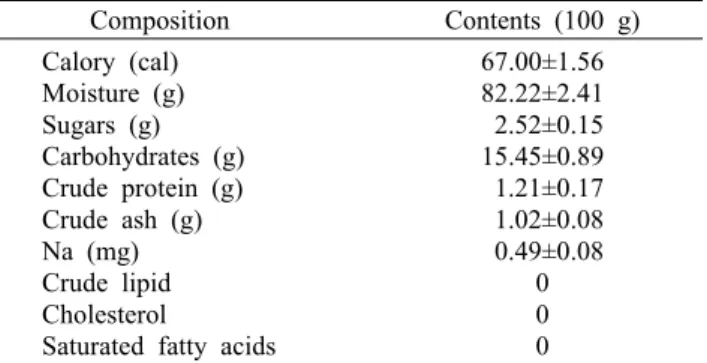
Table 1. Nutritional composition of Helianthus tuberosus juice mixing bitter melon juice
Composition Contents (100 g) Calory (cal)
Moisture (g) Sugars (g) Carbohydrates (g) Crude protein (g) Crude ash (g) Na (mg) Crude lipid Cholesterol
Saturated fatty acids
67.00±1.56 82.22±2.41 2.52±0.15 15.45±0.89 1.21±0.17 1.02±0.08 0.49±0.08
0 0 0
Analysis were performed according to the KFDA method.
Data are presented as mean±SD of three times independent experiment.
Table 2. Body weight (BW), BW gains, food intakes, and food efficiency ratio (FER) of rats during 4 weeks drunk Helianthus tuberosus juice mixing bitter melon juice
Initial BW (g) Final BW (g) BW gains (g/d) Food intakes (g/d) FER NC
STZ HT HT2.5 HT5.0
164.3±5.2 160.3±4.7 162.9±6.3 158.2±7.3 163.5±5.3
318.9±15.6d 122.4±18.3a 134.4±25.4b 141.5±28.0b 145.3±27.2b
5.6±1.2b -1.36±0.7a -1.04±0.6a -0.85±0.5a -0.64±0.4a
40.4±5.4b 25.0±7.2a 26.5±6.3a 25.4±8.2a 25.9±5.4a
0.138±0.003b -0.054±0.002a -0.028±0.004a -0.033±0.002a -0.024±0.030a NC: normal water, STZ: streptozotocin (STZ)+normal water, HT: STZ+H. tuberosus juice, HT2.5: STZ+H. tuberosus juice mixing 2.5% dried bitter melon juice, HT5.0: STZ+H. tuberosus juice mixing 5.0% dried bitter melon juice.
Values are the mean±SD.
Different letters indicate statistically significant differences at P<0.05 by Duncan’s multiple range test.
weight 용량으로 경구 투여한 후 0, 30, 60, 90, 120분에 꼬리 정맥에서 채혈하여 혈장 포도당량을 측정하였다.
통계분석
본 연구의 통계분석은 SPSS program(Ver. 18, SPSS Inc., Chicago, IL, USA)을 이용하여 분석값을 평균과 표준 편차(standard deviation, SD)로 표시하였다. 실험군 간의 차이는 one-way ANOVA로 검증하였고, P<0.05 수준에서 유의성이 관찰된 경우 각 실험군 간의 평균값의 차이에 대한 유의성은 Duncan’s multiple range test를 이용하여 P<
0.05 수준에서 평가하였다.
결과 및 고찰
영양성분 분석
돼지감자즙에 여주즙을 5% 혼합한 본 시료의 영양성분 함량은 Table 1과 같다. 100 g당 수분 82.22 g, 열량 67.00 cal, 당류 2.52 g, 탄수화물 15.45 g, 조단백 1.21 g, 조회분 1.02 g, 나트륨 0.49 mg을 함유하였고 포화지방산, 조지질, 콜레스테롤은 검출되지 않았다. 혈당 개선기능과 일반 영양 성분 함량 간에 직접 관련은 없으나 본 실험재료의 기본정보 를 제공하고자 하였다.
60°C에서 7시간 열풍 건조된 분말의 일반성분 및 총 당의
함량을 측정한 연구(33)에서 돼지감자의 수분함량은 5.06±
0.08%였고 조회분 5.04±0.03%, 조단백질 8.30±0.26%, 조지방 0.70±0.16%, 탄수화물 80.90%로 조사된 바 있다.
사료 이용효율
돼지감자 여주즙을 4주 동안 음용수로 공급받은 흰쥐의 사료 이용효율은 Table 2에 정리하였다. 하루 동안 체중 변 화는 NC군이 5.6±1.2 g 정도 증가하였고 STZ군은 -0.64~
-1.36 g으로 체중이 감소하였다. 하루 동안 사료섭취량은 NC군 40.4±5.4 g에 비하여 STZ군 25.0±7.2 g, HT군 26.5±6.3 g, HT2.5군 25.4±8.2 g, HT5.0군 25.9±5.4 g 으로 유의적으로 적었다. 사료 이용효율은 NC군 0.138에 비하여 STZ군은 -0.024~-0.054로 유의적으로 낮았다.
STZ군의 식이 이용효율의 저하는 당뇨로 인한 체내 대사의 퇴행적인 변화 때문으로 보고되고 있다(34).
사료섭취량, 체중의 변화, 물 섭취량 및 사료 이용효율 돼지감자 여주즙을 4주 동안 음용수로 공급한 후 흰쥐의 식이섭취량, 체중의 변화 및 물 섭취량은 Fig. 1에 나타내었 다.
사료섭취량(Fig. 1A)은 적응 기간에는 하루 32~34 g이 었는데 STZ 투여 1주일 후 NC군 38.6±9.2 g에 비하여 STZ 군은 25.0±5.4~30.3±6.1 g으로 적었다. 4주 후에는 NC군 의 사료섭취량이 43.5±8.1 g으로 STZ군 26.2±7.2 g보다 유의적으로 많았다. STZ를 투여 받은 흰쥐의 사료섭취량은 사료의 종류에 따라 증감의 양상이 크게 다름을 보였다(35- 38).
흰쥐의 시작 체중은(Fig. 1B) 153.5~163.0 g으로 비슷 하였는데 STZ 투여군은 STZ 투여 후 체중이 감소하였다.
NC군은 꾸준히 증가하여 4주 후 315.7±11.0 g으로 157.0 g 증가하였는데 당뇨유발군들 중 STZ군은 평균 44 g, HT5.0군은 평균 8 g 감소하였다. 일반적으로 STZ 투여로 인한 체중감소 원인은 생리작용저하, 낮은 사료섭취량 등에 의한 스트레스, 당뇨에 의한 체내 대사 작용의 이상으로 인 해 섭취한 식이가 에너지대사에 제대로 사용되지 못한 채 체외로 배출되기 때문이라고 알려져 있다(34).
하루 동안 물 섭취량(Fig. 1C)은 적응 기간 동안 1일 평균
b b b
ab
a a a
a
ab ab
ab a
ab ab
a ab
ab ab ab
ab
20 30 40 50
0 1 2 3 4
Week
Food intakes (g/day) .
NC STZ HT
HT2.5 HT5.0
A
c
c c
c
a a a a
b b b
ab
b b
b b
100 150 200 250 300 350
0 1 2 3 4
Week
Body weight (g/day) .
NC STZ HT
HT2.5 HT5.0
B
a a a
a
c c c
b
c
c b
b b b
b
b b b
60 80 100 120 140 160
0 1 2 3 4
Week
Water intakes (mL/day) .
NC STZ HT HT2.5 HT5.0
C
Fig. 1. Food intakes (A), body weight (B), water intakes (C) of normal and diabetic rats per one day during 4 weeks drunk H. tuberosus juice mixing dried bitter melon juice. NC: normal water, STZ: STZ+normal water, HT: STZ+H. tuberosus juice, HT2.5: STZ+H. tuberosus juice mixing 2.5% dried bitter melon juice, HT5.0: STZ+H. tuberosus juice mixing 5.0% dried bitter melon juice. Values are the mean±SD. Values with different letters (a-f) indicate statistically significant differences in the same week at P<0.05 by Duncan’s multiple range test.
a a a a
c c c
b
b b
b b
b b b
b
b b b b
0 100 200 300 400 500 600
0 1 2 3 4
Week
Blood glucose (mg/dL) .
NC STZ HT HT2.5 HT5.0
A
a a
a a
b c
d d
b c c
c
b b b b
50 150 250 350 450 550
0 30 60 90 120
Time (min) Oral glucose tolerance . blood glucose mg/dL .
NC STZ HT HT2.5 HT5.0
B
0 0.5 1 1.5 2 2.5 3 3.5 4 4.5
NC STZ HT HT2.5 HT5.0
Serum insulin (ng/mL) .
C c
b b ab
a
Fig. 2. Blood glucose concentration (A), oral glucose tolerance blood glucose (B), serum insulin levels (C) of normal and dia- betic rats per one day during 4 weeks drunk H. tuberosus juice mixing dried bitter melon juice. NC: normal water, STZ: STZ+
normal water, HT: STZ+H. tuberosus juice, HT2.5: STZ+H. tu- berosus juice mixing 2.5% dried bitter melon juice, HT5.0:
STZ+H. tuberosus juice mixing 5.0% dried bitter melon juice.
Values are the mean±SD. Values with different letters (a-e) in- dicate statistically significant differences in the same time at P<0.05 by Duncan’s multiple range test.
78.2±6.7 mL였는데, STZ 투여 1주일 후 110.5~123.6 mL 로 많았다. 4주 후에는 STZ군이 159.2±6.1 mL로 가장 많 았고 HT군 151.3±3.5 mL, HT5.0군 132.2±8.2 mL로 돼 지감자 여주즙군은 NC군보다 많았고 STZ군보다는 적었다.
당뇨병은 혈중 포도당이 세포 내로 원활하게 유입되지 못하 여 다식이 나타나고 포도당이 체내 수분과 같이 소변으로 배설되어 다뇨에 의한 다음이 뒤따르는데(1) 본 조사에서도 이러한 양상을 확인할 수 있었다.
혈당 변화, 혈장 포도당, 경구 당부하 검사
흰쥐에 돼지감자 여주즙을 음용수로 4주간 공급한 후 측 정한 혈당 변화, 혈장 포도당 및 경구 당부하 검사결과는 Fig. 2에 나타내었다.
혈장 포도당의 수준(Fig. 2A)은 STZ 투여 1주일 후 NC군 의 113±4.5 mg/dL에 비하여 STZ군은 476.7±22.8 mg/
dL로 약 4배 높았고 HT군은 376.3±25.8 mg/dL, HT2.5군 은 405.2±35.1 mg/dL, HT5.0군은 342.8±29.7 mg/dL로
STZ군보다 유의적으로 낮았다. 4주 후에는 NC군이 114.5
±5.2 mg/dL로 처음과 차이가 없었던 것에 비하여 STZ군이 412.7±26.9 mg/dL, HT군 336.2±41.6 mg/dL, HT2.5군 357.2±28.2 mg/dL, HT5.0군 338.4±39.7 mg/dL로 돼지 감자 여주즙군은 NC군보다 많았고 STZ군보다는 적어 돼지 감자즙이나 돼지감자 여주즙 음용이 혈당을 낮춤을 보여주 었다.
어느 함량의 돼지감자가 혈당 개선에 최적인가에 대해서 는 연구들이 돼지감자 생것, 분말, 발효물, 쿠키 등 재료에 따라, 열수, 메탄올 등 추출법에 따라, 세포, 생쥐, 흰쥐, 인체 등 적용 대상에 따라, 사료공급, 경구, 복강투여 등 적용방법 에 따라, 돼지감자 부위별 등에 따라 탁월한 혈당 개선효능 을 나타내는 돼지감자의 농도를 제시하기는 어려우나 공통 으로 혈당 개선 효과가 있음을 보고하였다(3-11).
여주의 혈당 개선기능에 대해서도 각 연구 방법에 따라 혈당 개선 최적 함량이 다른데 당뇨 유발된 마우스에 여주 분말을 사료로 0.2%, 5주간 공급하였을 때(39), 당뇨 유발 된 흰쥐에 여주열매 분말을 5% 사료로 4주간 공급하였을 때(21), 당뇨 유발된 흰쥐에 여주 발효추출물을 0.5 g/mL 농도로 20 μg씩 4주간 공급하였을 때 효과가 크다고(40) 보고하였다.
열풍 건조한 돼지감자 분말 100 g을 증류수 1 L에 넣고 열수로 80°C에서 2시간 동안 추출한 돼지감자추출물의 첨 가가 췌장 β-세포의 생존율을 높이고 세포보호 효과를 가짐 으로써 인슐린분비의 혈당조절 및 당뇨에 긍정적 효과가 있 다고 보고하였는데(3), 돼지감자즙이나 돼지감자 열수 추출 물이 췌장 β-세포 또는 당뇨 유발된 흰쥐에서 혈당 관련 지표에 긍정적 효과가 있음을 알 수 있었다.
STZ로 유도된 당뇨유발 흰쥐의 당 분해 및 당 흡수 기전 을 확인하기 위하여 포도당을 경구 투여한 후 0, 30, 60, 90, 120분에 꼬리 정맥에서 채혈하여 측정한 혈당값은 Fig.
2B에 나타내었다. 포도당투여 후 30분에 NC군의 혈당은 197.9±10.2 mg/dL였고 STZ군은 483.2±33.2 mg/dL, HT 군은 457.8±30.5 mg/dL, HT2.5군은 413.6±28.1 mg/dL, HT5.0군은 403.0±30.5 mg/dL였으며, 120분 후 NC군은 혈당 121.6±22.7 mg/dL, STZ군은 383.2±40.3 mg/dL, HT군은 350.6±27.1 mg/dL, HT2.5군은 328.3±39.4 mg/
dL, HT5.0군은 312.5±29.8 mg/dL로 돼지감자군들의 당 분해가 높음을 보였고, STZ군보다 HT군들의 혈당이 낮은 것은 돼지감자즙과 돼지감자 여주즙의 포도당 분해능이 커 서 혈당을 낮추는 것을 알 수 있었다.
실험 4주 후 흰쥐의 혈청 인슐린(Fig. 2C)은 NC군이 4.06
±0.70 ng/mL였고 STZ군이 2.72±0.53 ng/mL, HT군이 3.13±0.37 ng/mL, HT2.5군이 3.40±0.23 ng/mL, HT5.0 군이 3.48±0.43 ng/mL로 돼지감자즙과 돼지감자 여주즙 이 인슐린분비에 효과가 있음을 보였다.
이상의 결과를 종합하면 돼지감자즙에 건조 여주즙을 5%
혼합하고 3배의 증류수를 가하여 4주간 흰쥐에 식수로 공급
하였을 때 혈당 개선 효과가 있음을 알 수 있었다.
요 약
식품을 혼합하였을 때 생리 기능 상승효과가 있을 것을 기대 하여 돼지감자즙에 건조 여주즙을 5% 혼합하여(돼지감자 여주즙) 일반 영양성분을 알아보았고 streptozotocin(STZ) 으로 당뇨를 유발한 흰쥐에 이를 음용수로 4주간 공급하고 혈당지표로서 혈액 포도당 농도 변화, 최종혈당 농도, 경구 당부하 검사, 혈청 인슐린 농도를 실시하였다. 돼지감자 여 주즙 100 g당 수분 82.22 g, 열량 67.00 cal, 당류 2.52 g, 탄수화물 15.45 g, 조단백 1.21 g, 조회분 1.02 g, 나트륨 0.49 mg을 함유하였고 포화지방산, 조지질, 콜레스테롤은 검출되지 않았다. 돼지감자 여주즙을 3배의 증류수로 희석 하여 4주 동안 음용수로 공급한 흰쥐의 사료 이용효율은 NC 군 0.138에 비하여 STZ군은 -0.024~-0.054로 유의적으 로 낮았다. 사료섭취량은 적응기간에는 하루 32~34 g이었 는데 STZ 투여 1주일 후 NC군의 38.6±9.2 g에 비하여 STZ군은 25.2±5.4 g으로 실험군별 차이가 컸다. 4주 후에 는 NC군의 사료섭취량이 STZ군, HT2.5군, HT5.0군보다 유의적으로 많았다. 흰쥐의 시작 체중은 153.5~163.0 g으 로 비슷하였는데 STZ 투여군은 체중이 감소하였다. NC군 의 체중은 4주 후 평균 157.0 g 증가하였는데 당뇨유발군들 은 4주 동안 체중이 8~44 g 정도 감소하였다. 하루 동안 물 섭취량은 적응 기간에 평균 75.0±6.7 mL였는데, STZ 투여 4주 후에는 STZ군이 159.2±6.1 mL로 가장 많았고 돼지감자 여주즙군은 NC군보다 많았고 STZ군보다는 적었 다. 혈장 포도당의 수준은 NC군의 113±4.5 mg/dL에 비하 여 STZ 투여 1주일 후 STZ군은 476.7±22.8 mg/dL로 약 4배 높았고 HT군은 376.3±25.8 mg/dL, HT2.5군은 405.2
±35.1 mg/dL, HT5.0군은 342.8±29.7 mg/dL로 STZ군보 다 낮았다. 당부하검사에서 포도당투여 후 120분 동안 혈당 을 낮추는 효과가 돼지감자군들에서 컸으며, 돼지감자 여주 즙 음용 4주후 흰쥐의 혈청 인슐린분비가 많아졌음을 알 수 있었다. 이상의 결과는 돼지감자 여주즙 음용이 당뇨 개선에 도움이 될 것으로 평가되며 돼지감자의 고부가가치를 높일 수 있을 것으로 기대된다.
감사의 글
본 논문은 전라북도, 정읍시 농업기술센터, 전북생물산업진 흥원에서 지원하는 2015년도 고부가가치식품 가공기술개 발지원사업의 연구수행으로 인한 결과물임을 밝힙니다.
REFERENCES
1. Trudy M, James RM. 2003. Biochemistry: the molecular ba- sis of life. 3rd ed. McGraw-Hill, Boston, MA, USA. p 420.
2. Ministry of Health and Welfare. 2015. The Third Korea Na-
tional Health and Nutrition Examination Survey (KNHANES
Ⅲ). Seoul, Korea. p 34.
3. Kim JL, Bae CR, Cha YS. 2010. Helianthus tuberosus ex- tract has anti-diabetes effects in HIT-T15 cells. J Korean Soc Food Sci Nutr 39: 31-35.
4. Jeong HJ, Kim JS, Sa YJ, Kim MO, Yang J, Kim MJ. 2011.
Antioxidant activity and α-glucosidase inhibitory effect of Jerusalem artichoke (Helianthus tuberosus) methanol ex- tracts by heat treatment conditions. Korean J Med Crop Sci 19: 257-263.
5. Lee CH, Lee YR. 2016. Antioxidative and antidiabetic ac- tivities of methanol extracts from different parts of Jerusa- lem artichoke (Helianthus tuberosus L.). Korean J Food Nutr 29: 128-133.
6. Chang WC, Jia H, Aw W, Saito K, Hasegawa S, Kato H.
2014. Beneficial effects of soluble dietary Jerusalem ar- tichoke (Helianthus tuberosus) in the prevention of the onset of type 2 diabetes and non-alcoholic fatty liver disease in high-fructose diet-fed rats. Br J Nutr 112: 709-717.
7. Choi BR. 2009. Effect of Helianthus tuberosus supple- mentation on anti-obesity and glycemic control. MS Thesis.
Chonbuk National University, Jeonbuk, Korea.
8. Seo CR. 2015. The effects of Jerusalem artichoke and fer- mented soybean powder mixture supplementation on blood glucose and oxidative stress in subjects with prediabetes or newly diagnosed type 2 diabetes. MS Thesis. Yonsei Univer- sity, Seoul, Korea.
9. Park HY, An NY, Ryu HK. 2013. The quality characteristics and hypoglycemic effect of cookies containing Helianthus tuberosus powder. Korean J Community Living Sci 24: 233- 241.
10. Kim HJ, Kim DI, Yon JM. 2015. Effects of Jerusalem ar- tichoke (Helianthus tuberosus L.) extracts on blood glucose and lipid metabolism in STZ-induced diabetic rats. Korean J Clin Lab Sci 47: 203-208.
11. Zaky EA. 2009. Physiological response to diets fortified with Jerusalem artichoke tubers (Helianthus tuberosus L.) pow- der by diabeteic rats. Am-Eurasian J Agric Environ Sci 5:
682-688.
12. Jhon DY, Kim MH. 1986. Studies on inulase from Jerusalem artichoke. J Korean Soc Food Nutr 17: 205-210.
13. Jang KH, Kang SA, Cho Y, Kim YY, Lee YJ, Hong K, Jang EK, Kim CH, Choue R. 2002. The effects of levan and inulin on the growth of lactic acid-producing bacteria and in- testinal conditions in rats. Korean J Nutr 35: 912-918.
14. Kim CG, Kim SI, Shin HK. 1993. Effect of fructooligo- saccharide-inulin of Jerusalem artichoke on the growth of intestinal microorganisms of pig. Korean J Food Sci Tech- nol 25: 395-399.
15. Shin SH, Kwon SJ, Jo HJ, Go D, Han J. 2012. Extraction and analysis of inulin from Jerusalem artichoke. Food Sci- ence and Industry 45(4): 50-58.
16. Kim YS, Lee SJ, Hwang JW, Kim EH, Park PJ, Jeon BT.
2011. Antioxidant activity and protective effects of extracts from Helianthus tuberosus L. leaves on t-BHP induced oxi- dative stress in Chang cells. J Korean Soc Food Sci Nutr 40: 1525-1531.
17. Kim JW, Kim JK, Song IS, Kwon ES, Youn KS. 2013.
Comparison of antioxidant and physiological properties of Jerusalem artichoke leaves with different extraction pro- cesses. J Korean Soc Food Sci Nutr 42: 68-75.
18. Song RY. 1995. The cytotoxic constituents of Helianthus tuberosus L.. MS Thesis. Sungkyunkwan University, Seoul, Korea.
19. Lee JS, Yeom TR, Shin HK. 1998. Effects of Jerusalem ar- tichoke and chicory on lipid metabolism in rats. Korean J Nutr 31: 13-20.
20. Takeuchi J, Nagashima T. 2011. Preparation of dried chips from Jerusalem artichoke (Helianthus tuberosus) tubers and analysis of their functional properties. Food Chem 126: 922- 926.
21. Pan L, Sinden MR, Kennedy AH, Chai H, Watson LE, Graham TL, Kinghorn AD. 2009. Bioactive constituents of Helianthus tuberosus (Jerusalem artichoke). Phytochem Lett 2: 15-18.
22. Chen F, Long X, Liu Z, Shao H, Liu L. 2014. Analysis of phenolic acids of Jerusalem artichoke (Helianthus tuberosus L.) responding to salt-stress by liquid chromatography/tan- dem mass spectrometry. Sci World J 2014: 568043.
23. Jeong JH, Lee SH, Hue JJ, Lee KN, Nam SY, Yun YW, Jeong SW, Lee YH, Lee BJ. 2008. Effect of bitter melon (Momordica charantia) on anti-diabetic activity in C57BL/
6J db/db mice. Korean J Vet Res 48: 327-336.
24. Welihinda J, Karunanayake EH, Sheriff MHH, Jayasinghe KSA. 1986. Effect of Momordica charantia on the glucose tolerance in maturity onset diabetes. J Ethnopharmacol 17:
277-282.
25. Ali L, Khan AKA, Mamun MIR, Mosihuzzaman M, Nahar N, Nur-e-Alam M, Rokeya B. 1993. Studies on hypoglyce- mic effects of fruit pulp, seed, and whole plant of Momord- ica charantia on normal and diabetic model rats. Planta Med 59: 408-412.
26. Kim MW. 2013. Effect of bitter melon on plasma blood glucose and cholesterol levels in streptozotocin induced dia- betic rats. J East Asian Soc Diet Life 23: 704-712.
27. Kim C, Yang Y, Hwang E. 2016. Development of bitter mel- on juice mixed with condensed oat juice and its hypoglyce- mic effect in streptozotocin-induced diabetic rats. Korean J Hum Ecol 25: 227-238.
28. Son HK, Han JH, Lee JJ. 2014. Anti-diabetic effect of the mixture of mulberry leaf and green tea powder in rats with streptozotocin-induced diabetes. Korean J Food Preserv 21:
549-559.
29. Lee HJ, Moon JH, Lee WM, Lee SG, Kim AK, Woo YH, Park DK. 2012. Charantin contents and fruit characteristics of bitter gourd (Momordica charantia L.) accessions. J Bio-Environ Control 21: 379-384.
30. Lee SJ, Shin JH, Ju JC, Kang SK, Sung NJ. 2013. Hypogly- cemic and hypolipidemic effects of Orostachys japonicus with medicinal herbs in streptozotocin-induced diabetic rats.
J Korean Soc Food Sci Nutr 42: 587-594.
31. Roh SG, Choi WC. 2011. Antidiabetic synergistic effects of medicinal plant extract mixtures on db/db mice. J Life Sci 21: 165-175.
32. KFDA. 2011. Korean Food Standards Codex. Korea Food
& Drug Administration, Cheongwon, Korea.
33. Kim HN, Yu SY, Yoon WB, Jang SM, Jang YJ, Lee OH.
2014. Analysis of nutritional components and physicochem- ical properties of hot-air dried Jerusalem artichoke (Helian- thus tuberosus L.) powder. Korean J Food Sci Technol 46:
73-78.
34. Tian HL, Wei LS, Xu ZX, Zhao RT, Jin DL, Gao JS. 2010.
Correlations between blood glucose level and diabetes signs in streptozotocin induced diabetic mice. Global J Pharma- col 4: 111-116.
35. Kim AR, Lee JJ, Cha SS, Chang HC, Lee MY. 2012. Effect of soybeans, chungkukjang, and doenjang on blood glucose and serum lipid profile in streptozotocin-induced diabetic
rats. J Korean Soc Food Sci Nutr 41: 621-629.
36. Kim SR, Seog HM, Choi HD, Park YK. 2002. Cholesterol- lowering effects in rat liver fed barley and β-glucan-en- riched barley fraction with cholesterol. Korean J Food Sci Technol 34: 319-324.
37. Kim SS, Lim KS, Kim HJ, Chong MS, Cho HE, Choi YH, Lee KN. 2008. Effects of extracts from mixed culture with Tricholoma matsutake mycelium and Cordyceps militaris mycelium on blood glucose in streptozotocin-induced dia- betic rats. Korean J Orient Physiol Pathol 22: 365-370.
38. Lee JS, Son HS, Maeng YS, Chang YK, Ju JS. 1994. Effects
of buckwheat on organ weight, glucose and lipid metabo- lism in streptozotocin-induced diabetic rats. Korean J Nutr 27: 819-827.
39. Park HS, Kim WK, Kim, HP, Yoon YG. 2015. The efficacy of lowering blood glucose levels using the extract of fer- mented bitter melon in diabetic mice. J Appl Biol Chem 58: 259-265.
40. Kim YJ. 2012. Antidiabetic and antioxidative effects of bit- ter melon on streptozotocin-induced diabetic rats. MS Thesis.
Daejeon University, Daejeon, Korea.