Quality Comparison of Activated Carbon Produced From Oil Palm Fronds by Chemical Activation Using Sodium
Carbonate versus Sodium Chloride 1
Seri MAULINA 2,3,4,† ⋅Gewa HANDIKA 2 ⋅Irvan 2,3 ⋅Apri Heri ISWANTO 4
ABSTRACT
1)Using Na
2CO
3versus NaCl as chemical activator, we compared the quality of activated carbon produced from oil palm fronds as raw material. These activators were selected for comparison because both are readily available and are environmentally friendly. In the manufacturing, we used Indonesian National Standard (SNI 06-3730-1995) parameters.
For the quality comparison, we determined activated-carbon yield, moisture, ash, volatiles, and fixed-carbon contents;
and adsorption capacity of iodine. The best characteristics, assessed by morphological surface analysis and Fourier transform infrared (FTIR) spectral analysis, were observed in the carbon activated by Na
2CO
3at an activator concentration of 10% and carbonization temperature of 400 °C. The results were as follows: activated-carbon yield, 84%; water content, 8.80%; ash content, 2.20%; volatiles content, 14.80%; fixed-carbon content, 68.60%; and adsorption capacity of iodine, 888.51 mg/g. Identification using the FTIR spectrophotometer showed the presence of the functional groups O-H, C=O, C=C, C-C, and C-H in the Na
2CO
3-activated carbon.
Keywords: activated carbon, oil palm fronds, sodium carbonate, sodium chloride
1. INTRODUCTION
Oil palm plantation is considered a well-known tropical plantation in Southeast Asia for the past two decades. This vegetative plant plays a major role in various strategic industrial projects as it can increase national income in various important sectors in palm oil-producing countries, such as Indonesia, Malaysia, and Thailand (Irvan et al., 2018). As stated by Prabuningrum et al. (2020) increasing the area and
production of oil palm has an impact on increasing the waste from these plants when they are no longer productive at the age of more than 25 years. Palm oil produces 22-palm fronds per-year with an average weight of 2.20 kg fronds for each palm frond. These figures show the enormous potential of oil palm fronds. Due to large amounts of oil palm frond a pro- duce in palm oil plantation, the selling price of oil palm fronds activated carbon can be reduced to a minimum. Besides, the sustainability of oil palm
1
Date Received April 21, 2020, Date Accepted June 3, 2020
2
Department of Chemical Engineering, Universitas Sumatera Utara, Jalan Almamater Kampus USU, Medan 20155, Indonesia
3
Centre of Excellence in Sustainable Energy and Biomaterials, Universitas Sumatera Utara, Medan
4
Department of Forest Product, Faculty of Forestry, Universitas Sumatera Utara, Padang Bulan, Medan 20155, Indonesia
†
Corresponding author: Seri Maulina (e-mail: [email protected], ORCID: 0000-0002-5856-3768)
Original Article
fronds activated carbon production can be maintained.
However, the utilization of oil palm fronds is still con- strained by low levels of digestibility due to high lev- els of neutral detergent fiber and lignin (Hamchara et al., 2018).
Oil palm fronds fall into the category of wet by-products, approximately contain 70–75% of water content (Pambayun et al., 2013; Ramdja et al., 2008) with production of oil palm frond approximating 5500 kg/ha/years (Hamchara et al., 2018). The availability of palm oil and its waste is abundant. This potential can be utilized by using palm oil waste as an alter- native material in carbon manufacturing. This idea re- sulted in the creation of new economic value, thereby reducing palm oil waste. The above background leads to the importance of conducting research on the manu- facture and characterization of activated carbon from oil palm fronds with Na
2CO
3and NaCl as activators based on activated carbon quality standards according to SNI 06-3730-1995. The reason for choosing these activators because still a few researchers using Na
2CO
3and NaCl as activating agents in the manu- facture of activated carbon especially based on oil palm frond, besides, being easy to obtain, low price and environment friendly.
Activated carbon is an amorphous carbon that pos- sesses a surface area ranging from 1000 to 1500 m
2/g and has been treated with steam and heat (Rahman et al., 2018). This treatment allows activated carbon to exhibit very strong affinity to absorb various mate- rials with large capability, that is, 25–100% of acti- vated carbon weight. This affinity relates to the in- ternal pore structure, causing the activated carbon to act as an adsorbent. Activated carbons show selective adsorption properties that depend on the size or vol- ume of the pores and surface area.
Activated carbon shows a wide range of utilization, in the food and drug industry, petroleum chemical in- dustry, water purifier, shrimp cultivation, sugar in-
dustry, gas purification, catalyst, and fertilizer process- ing (Rahman et al., 2018). Activated carbon possesses a porous surface structure, which is classified by IUPAC as microporous, mesoporous, and macropo- rous. Fig. 1 shows a schematic of the active carbon pore structure.
Activated carbon is manufactured via two processes, namely, carbonization and activation. The activation process consists of two types, namely, physical activa- tion and chemical activation. Physical activation by gas generally uses N
2, CO
2, and water vapor. On the other hand, chemical activation involves an activating agent that is generally a hydroxide (KOH or NaOH), ZnCl
2, and H
3PO
4. Oil palm frond is expected to be a source of a raw material to produce activated carbon, besides coconut shells.Lignocellulosic material in oil palm fronds consist of 34.89% cellulose, 21.54% hem- icellulose, 19.87% lignin (Maulina et al., 2018). Ash content in a charcoal as raw material was around 10-18% (Maulina and Anwari, 2019). Hong et al.
(2012) stated that ash content of oil palm fronds ap- proximately 12.30%.
2. MATERIALS and METHODS 2.1. Materials
The materials used in this study included of oil
palm fronds, Na
2CO
3, NaCl, distilled water, iodine sol-
Fig. 1. Schematic of active carbon pore structure.
ution, sodium thiosulfate, and starch indicator.
2.2. Equipment
The equipment used in this research included of fur- nace, digital balance, 32-mesh screen, porcelain cup, oven, pH meter, stopwatch, stir bar, tube jar, beaker glass, burette, dropper drop, thermometer, hot plate and magnetic stirrer, desiccator, Whatman filter paper, Fourier transform infrared spectrophotometer (FTIR- Shimadzu), and scanning electron microscope (SEM Evo MA 10 ZEISS).
2.3. Methods
Manufacturing of activated carbon is achieved through several processed from oil palm fronds: prepa- ration, impregnation, carbonization, and analysis per- formance of activated carbon as a product.
Oil palm fronds were made into chips, oven-dried at 110 °C for 24 for hours, smoothed with a ball mill, and filtered using a 32-mesh sieve. Impregnation was done at 80
oC for 2 hours, soaking at room temperature for 24 hours, using activator 5%, 7.5%, and 10% of Na
2CO
3and NaCl. After impregnation, carbonization was conducted for 60 min at 400 °C, 500 °C, and 600
°C to produce activated carbon. The activated carbon was washed and filtered until pH 7, and then oven- dried. Analysis of products included of yield, moisture content, ash content, volatile matter content, fixed car- bon content, and absorption capacity of iodine (Iodine number).
∙ Yield of activated carbon (Y
ac) aims to determine the amount of activated carbon produced after carbonisation and the activation process.
Y
ac= (W
ac/ W
opf) × 100%
Remark: W
ac: weight of activated carbon, W
opf: weight of oil palm fronds
∙ Moisture content (MC) is the amount of water
contained in activated carbon.
MC = [(W
0– W
1) / W
0] × 100%
Remark:
W
0= Initial weight;
W
1= After ovendry weight;
∙ Ash content = (ash weight / initial weight) × 100%
∙ Volatile matter content (VM) is volatile content VM = [(W
2– W
3)/ (W
2 –W
1)] × 100%
Remark:
W
1= empty crucible weight + cover;
W
2= empty + sample + cover;
W
3= empty crucible weight + residue + cover
∙ Fixed carbon content is the remaining carbon after carbonisation process and the activation process.
% Fixed carbon = 100% - (%volatile matter con- tent - %ash content)
∙ Absorption capacity of iodine (Iodine number) Iodine number is the mass of iodine in grams that is consumed by grams of chemical substances.
Iodine number (mg/g) = 10 [(V
b-V
t)/W
2)] × W
1× F
pRemark: V
b: volume of blank titration; V
t: vol- ume of sample titration; W
1: 12.693 mg/ml; W
2: sample weight (g); and F
p: dilution factor
Morphological analysis of activated carbon surfaces by using Scanning Electron Microscopy (SEM) with SEM micrographs magnification at 1000x. Fourier Transform Infrared (FTIR) was used to analyze func- tional groups of activated carbon. The spectra recorded in 45 scans per sample with spectrum range 4000 - 400 cm
-1and the resolution of 8.00 cm
-1.
3. RESULTS and DISCUSSION
This study analyzed a yield of activated carbon and
a number of characteristics of activated carbon, includ-
ing the following: water content, ash content, volatile
matter content, fixed carbon content, and iodine
number. Sodium carbonate and sodium chloride acti- vation mechanisms are:
∙ Na
2CO
3+ 2C → 3 CO + 2Na, The presence of sodiumin the char leads to the oxidation of cross linking carbon atoms and form into slightly wrin- kled or folded or puckered form.
∙ NaCl + 2n H
2O → Na
+(H
2O)
n+ Cl
-(H
2O)
n, these molecules will be trapped in cellulose and cellu- lose become swelling.
3.1. Yield of activated carbon
Yield of activated carbon was measured after car- bonization and oven dry step. Fig. 2 reveals the yield of activated carbon obtained by activation at various temperatures and concentrations.
A total of 63.33–74.00% of activated carbon yield was produced using Na
2CO
3activator, whereas 66.67–
88.67% of activated carbon yield was produced using NaCl activator. The yield of activated carbon from oil palm fronds decreased with increasing carbonization temperature of 400-600 °C. This result relates to the high rate of reaction carbon and activator substances to deliver volatile components along with increasing texture characteristics of the activated carbon, which forms pores (Chen et al., 2011) and carbon burning (Saka, 2012).
Activator concentration significantly influences the
yield of the resulting carbon (Tan et al., 2008), where the amount decreases as the activator concentration increases. This phenomenon occurs because the activa- tor will increase the release of volatile components due to dehydration reaction, which can increase carbon burning (Adinata et al., 2005).
3.2. Moisture content
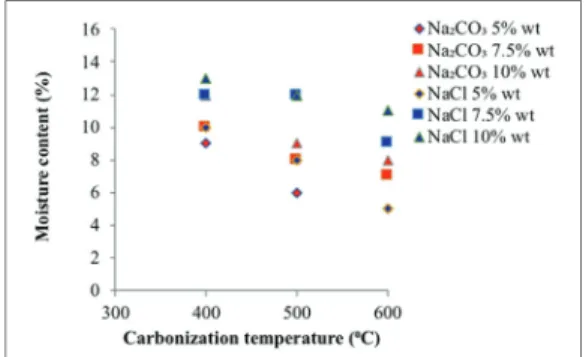
The moisture content shows in Fig. 3 at various carbonization temperatures, activator types, and acti- vator concentrations. The moisture content of acti- vated carbon produced with Na
2CO
3as activator reached 5.00-11.90%. The activator of NaCl produced moisture content of 4.90-13.80%. Moisturecontent de- creased along with carbonization temperature due to the decreasing in the pores of activated carbon. This phenomenon results in reduced hygroscopic capability of activated carbon (Mitome et al., 2013). Moisture content in raw material lower than activated carbon, because of tar and organic materials are still inside the pore (Maulina and Anwari, 2019). Activator con- centration also affects the moisture content produced.
Increased water levels suggest that the activator de- grades additional organic molecules during carbon- ization (Son et al., 2005). Fig. 3 reveals that the mois- ture content of the activated carbon higher with in-
Fig. 2. Yield of activated carbon at various temper- atures and concentrations.
Fig. 3. Moisture content of activated carbon at vari-
ous carbonization temperatures, activated types, and
activator concentrations.
creasing activator concentration, promoting the dis- solution of tar and organic minerals on activated carbon. Thus, the amount and depth of pores of acti- vated carbon produced will higher with increasing ac- tivator concentration. Ultimately, this phenomenon will increase the hydroscopic characteristics to absorb wa- ter from air (Tani et al., 2014). Moisture content ob- tained were in accordance with the activated carbon quality standard based on SNI 06-3730-1995, which required a maximum water content of 15%.
Moisture content analysis showed that sodium car- bonate activators performed better than sodium chlor- ide activators, that is, sodium carbonate activators are better than sodium chloride activators at dissolving tar and organic minerals upon impregnation and carbon- ization and will increase the number of pores, thus in- creasing water absorption from air.
3.3. Ash content
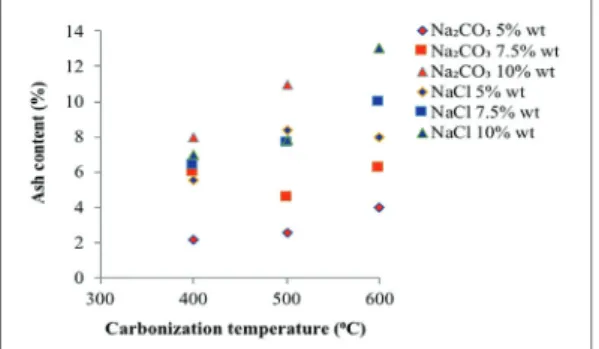
Fig. 4 reveals the ash content at different carbon- ization temperatures, activator types, and activator concentrations in activated carbon.
Fig. 4 shows that the ash content produced using Na
2CO
3as activator reached 2.20–13.00%, whereas the activator NaCl produced an ash content of 5.60–
13.00%. Ash content in charcoal as a raw material
higher than activated carbon, organic materials in raw material will generate metal oxides and will increase the amount of ash content (Maulina and Anwari, 2019). The ash content of activated carbon increased with increasing carbonization temperature. This find- ing indicates that an increase in carbonization temper- ature increases the vaporization of specific volatile compounds, which are within the particles at high car- bonization temperatures (Rodenas et al., 2003). In ad- dition, carbon burning will increase the ash content on activated carbon (Saka, 2012). Ash content in- creased along with the high concentration of acti- vators. The high concentration of the activator will increase the surface area of activated carbon, which will result in formation of additional pores. Increased pores formation results in additional ash production (Tani et al., 2014).
High ash content can cause environmental problems in this case related to air pollution. As a solution to this problem, ash and silica content are used as re- inforcement in rubber vulcanization (Sombatsompop, et al., 2004). Fly ash generated from desalination and power plants is used to capture CO
2emitted from in- dustries (Alhamed et al., 2015).
Ash content is determined by the quantity of silica present in raw material. More silica content results in greater ash content (Kamariya et al., 2016). Silica can cause pore blockage in activated carbon, thus reducing the surface area (Jin et al., 2012). A high activator concentration will cause the silica to dissolve in the activator, thus increasing the surface area of activated carbon. Ultimately, this reaction increases pore for- mation (Tani et al., 2014). The resulted ash content using Na
2CO
3activator was lower than that obtained with NaCl. This finding suggests that compared with NaCl, Na
2CO
3as activator can better maintain heat in carbonization, thus preventing further oxidation against organic substances, which will yield undesir- able substances such as ash (Son et al., 2005).
Fig. 4. Ash content of activated carbon at various car-
bonization temperatures, activator types, and activator
concentrations.
3.4. Volatile matter content
Fig. 5 shows the volatile matter content at various carbonization temperatures, types of activators, and activator concentrations in activated carbon.
Fig. 5 shows that the volatile matter contents ob- tained with Na
2CO
3and NaCl activators reached 11.00 –21.80% and 12.80–24.50%, respectively. Generally, volatile matter of raw material still higher compare to activated carbon, because of tar and material organic (Maulina and Anwari, 2019). The volatile matter con- tent was decreased with rising the temperature of car- bonization, that is, higher carbonization temperature indicates better decomposition of non-carbon com- pounds in activated carbon. This result indicates the production of volatile substances and carbon burning, resulting in low volatile matter content (Chen et al., 2011; Saka, 2012).
Fig. 5 also shows that an increase in activator con- centration will decrease the volatile matter content.
This finding is due to the added activator, which will seep, coat, and protect the material from heat. Thus, the high concentration of activators decreases the amount of ingredients burned (Caroline et al., 2015).
The addition of the activator also caused the degrada- tion of organic material, and this condition can weaken the surface structure of activated carbon and then
cause the release of volatile substances and develop- ment of microporous structure on activated carbon.
Na
2CO
3activators are better than NaCl as Na
2CO
3activators can produce lower volatile matter content.
This finding is attributed to the capability of activator Na
2CO
3to better seep, coat, and protect the material from heat than NaCl activator. Thus, a result of low volatile matter content was observed.
3.5. Fixed carbon content
Fig. 6 reveals the fixed carbon content of activated carbon at various carbonization temperatures, types of activators, and activator concentrations.
Fig. 6 reveals that the fixed carbon contents ob- tained using Na
2CO
3and NaCl activators totaled 65.30 –75.30% and 58.70–74.20%, respectively. The fixed carbon content of activated carbon is inversely pro- portional to water, ash, and volatile matter contents (Caroline et al., 2015). In general, fixed carbon con- tent rise with higher concentration of activator. The addition of activator concentration will increase the activated carbon content as the non-carbon compounds of carbonization will be more easily dissolved with the activator, as indicated by the dense color of the acti- vated carbon (Caroline et al., 2015). Fixed carbon of raw material lower than activated carbon, because of
Fig. 5. Volatile matter content of activated carbon at various carbonization temperatures, types of activators, and activator concentrations.
Fig. 6. Fixed carbon content of activated carbon at
various carbonization temperatures, types of activators,
and activator concentrations.
organic material and tar content in raw material (Maulina and Anwari, 2019)
Fig. 6 also shows that 68.60% of fixed carbon con- tent was obtained from sodium carbonate impre- gnation treatment at 400 °C with different activator concentrations. This level increased at 7.50% activator concentration and decreased to 65.30% at 10% acti- vator concentration. Impregnation treatment of NaCl solution at the same temperature with different activa- tor concentrations resulted in a fixed carbon content of 63.10%. This level increased at 7.50% of activator concentration and decreased to 61.60% at 10% of ac- tivator concentration. At least three factors affect the exchange in bound carbon content namely ash content, volatile matter content, and water content, of activated carbon (Tsoumis, 1991). In addition to the influence of ash and fly contents, the resulting fixed carbon con- tent is also influenced by contents of lignocellulosic material as lignin and cellulose that could be con- verted to carbon atoms (Caroline et al., 2015).
3.6. Absorption capacity of iodine
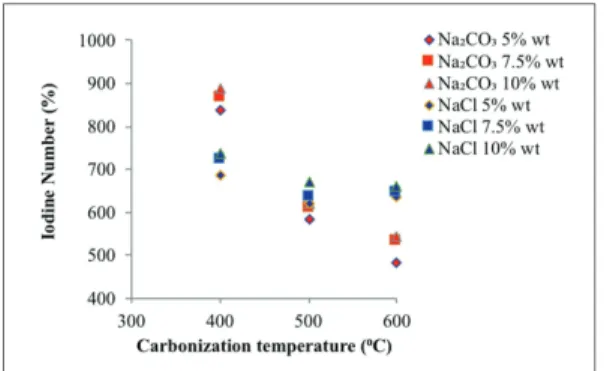
Fig. 7 shows the adsorption capacity of iodine on activated carbon at various carbonization temperatures, types of activators, and activator concentrations. The iodine levels obtained with Na
2CO
3and NaCl activa-
tors ranged between 482.34 and 888.55 mg/g and be- tween 621.96 and 736.19 mg/g, respectively. Higher carbonization temperature indicated lower iodine absorption. This finding was attributed to two fac- tors:breakdown of carbon surface due to the high tem- perature of carbonization and collapse of the wall due to carbon burning (Chen et al., 2011). Alkaline and salt activators can produce activated carbon with max- imum micropores under operating conditions of less than 500 °C (Marsh and Reinoso, 2006).
The volatile compounds present in the interior of activated carbonparticles will further evaporate at high carbonization temperatures (Rodenas et al., 2003).
This reaction triggers carbon burning, which can in- crease ash content on activated carbon (Saka, 2012).
Increasing activator concentration increased the ab- sorption power of iodine. This reaction is due to re- duced tar levels observed along with increased activa- tor concentration at the time of immersion. Thus, the number of pores that were present in the activated car- bon increased, thus increasing absorption (Son et al., 2005). This finding is associated with a wide reaction between the activator substance and the carbon surface (Deng et al., 2010) resulting in an increased release of CO
2and CO gases, which triggered an increase in pore formation (Mitome et al., 2013).
3.7. Morphological analysis surfaces of activated carbon
The SEM analysis of active surface carbon shows on Figs. 8 and 9.
During carbonization, Na
2CO
3decomposes from a metal compound of sodium to form carbon. The so- dium metal atoms formed during activation and car- bonization can enter carbon structures; this condition can expand the pores and create new porosity. Na
2CO
3can be decomposed with carbon at above 400 °C.
Thus, carbon is replace as CO and increases the sur- face area and pore volume. At high temperatures, Fig. 7. Absorption capacity of iodine on activated car-
bon at various carbonization temperatures, type of acti-
vators, and activator concentration.
Fig. 8. SEM analysis of activated carbon with Na
2CO
3activator at 1000x magnifications.
Fig. 9. SEM analysis of activated carbon with NaCl activator at 1000x magnifications.
pores form, and the mesoporous volume increases, but the absorption capacity of iodine decreases (Jin et al., 2012).
As shown in Figs. 8 and 9, more pores formed with greater pore cavity depth after using Na
2CO
3- acti- vated carbons compared with NaCl-activated carbons.
In addition, the Na
2CO
3activator showed better iodine absorption (888.51 mg/g) compared with the NaCl ac- tivator (736.19 mg/g).
3.8. FTIR analysis of activated carbon
This study used the absorption method for spectro- scopic observation; this method is based on differ-
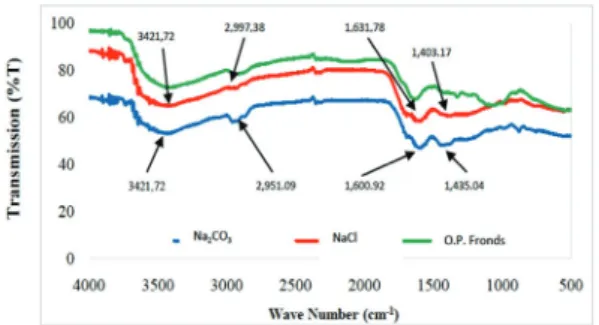
ences in the absorption of infrared radiation. Fig. 10 present the results of FTIR analysis on the resulting activated carbon.
The absorption peak occurred at 3421.72 cm
-1, which corresponds to by oil palm fronds and Na
2CO
3- and NaCl-activated carbons. The absorption peaks at 3500–3200 cm
-1(indicating to O-H spread) indicate the existence of hydroxyl (O-H) functional group. In the FTIR wave spectrum of activated carbon with Na
2CO
3and NaCl activators, an absorption peak ap- peared with wave numbers of 1631.78 and 1600.92 cm
-1, respectively. The absorption peaks occurring in the range of 1820–1600 cm
-1indicate the presence of C=O groups, which are typical groups of activated carbon. The peaks also showed that oil palm fronds originated form carbon-active substances (Kamariya et al., 2016).
Activation of carbon using Na
2CO
3and NaCl also formed a C=C bond. This result was proven by the observation of spectra at wave numbers of 1,435.04 and 1,403.17 cm
-1. The absorption peaks at 1500–1400 cm
-1referring the presence of the C=C group. Absorp- tion peaks with wave numbers of 2951.09 and 299.73 cm
-1indicate the presence of C-H groups (3000–2850 cm
-1) and alkane compounds, respectively (Mitome et al., 2013). Four types of functional groups, namely, C=O, C=C, C-C, and C-H groups, are contained in palm oil activated carbonyl.
Fig. 10. FTIR analysis of oil palm fronds, Na
2CO
3and NaCl activated carbons.
4. CONCLUSION
The depth of the pore cavity is greater by using so- dium carbonate activator than sodium chloride. This is also proved by Iodine number using sodium carbo- nate activator higher than sodium chloride activator in the activated carbon produced at temperature of 400
o