Wood Species Classification Utilizing Ensembles of Convolutional Neural Networks Established by Near-Infrared Spectra and Images Acquired from Korean Softwood Lumber 1
Sang-Yun Yang 2,3 ⋅Hyung Gu Lee 4 ⋅Yonggun Park 2,3 ⋅Hyunwoo Chung 2 ⋅Hyunbin Kim 2 ⋅ Se-Yeong Park 5 ⋅In-Gyu Choi 2,3,6 ⋅Ohkyung Kwon 4,† ⋅Hwanmyeong Yeo 2,3,†
ABSTRACT
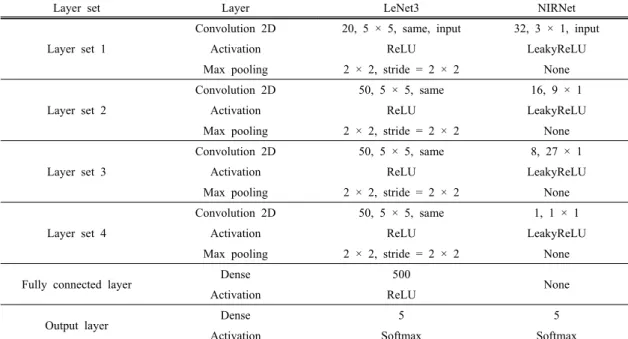
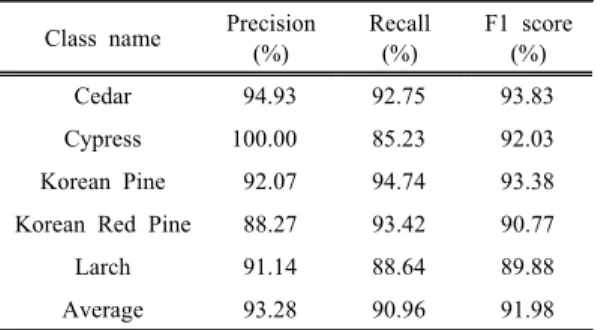
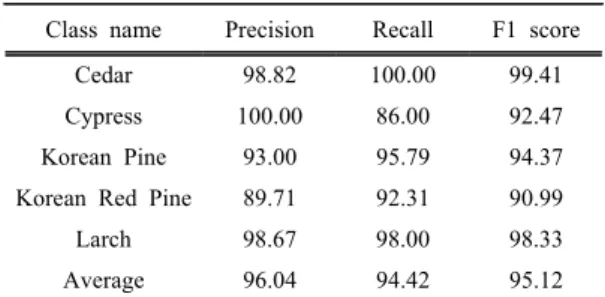
1)In our previous study, we investigated the use of ensemble models based on LeNet and MiniVGGNet to classify the images of transverse and longitudinal surfaces of five Korean softwoods (cedar, cypress, Korean pine, Korean red pine, and larch). It had accomplished an average F1 score of more than 98%; the classification performance of the longitudinal surface image was still less than that of the transverse surface image. In this study, ensemble methods of two different convolutional neural network models (LeNet3 for smartphone camera images and NIRNet for NIR spectra) were applied to lumber species classification. Experimentally, the best classification performance was obtained by the averaging ensemble method of LeNet3 and NIRNet. The average F1 scores of the individual LeNet3 model and the individual NIRNet model were 91.98% and 85.94%, respectively. By the averaging ensemble method of LeNet3 and NIRNet, an average F1 score was increased to 95.31%.
Keywords: lumber species classification, convolutional neural networks, ensemble methods, LeNet, NIRNet, NIR spectroscopy
1. INTRODUCTION
Species identification of lumber is important for various purpose (Kim and Choi, 2016; Eom and Park,
2018; Lee et al., 2018; Park et al., 2018). In our previous study (Kwon et al., 2019), we showed that an ensemble model combining the LeNet2, LeNet3, and MiniVGGNet4 models improved the classification
1
Date Received May 1, 2019, Date Accepted July 2, 2019
2
Department of Forest Sciences, Seoul National University, 1 Gwanak-ro, Gwanak-gu, Seoul 08826, Republic of Korea
3
Research Institute of Agriculture and Life Sciences, Seoul National University, 1 Gwanak-ro, Gwanak-gu, Seoul 08826, Republic of Korea
4
National Instrumentation Center for Environmental Management (NICEM), Seoul National University, 1 Gwanak-ro, Gwanak-gu, Seoul 08826, Republic of Korea
5
Department of Forest Biomaterials Engineering, Kangwon National University, 1 Gangwondaehakgil, Chuncheon 24341, Republic of Korea
6
Institutes of Green Bio Science and Technology, Seoul National University, 1447 Pyeongchang-daero, Daehwa-myeon, Pyeongchang 25354, Republic of Korea
†
Corresponding author: Hwanmyeong Yeo (e-mail: [email protected], ORCID: 0000-0002-1779-069X),
†