41(5), 577~583(2012) http://dx.doi.org/10.3746/jkfn.2012.41.5.577
황 함유 채소 에탄올 추출물의 항산화 및 항균활성
김경희1․김혜정1․변명우2․육홍선1†
1충남대학교 식품영양학과
2우송대학교 외식조리영양학부
Antioxidant and Antimicrobial Activities of Ethanol Extract from Six Vegetables Containing Different Sulfur Compounds
Kyoung-Hee Kim1, Hye-Joung Kim1, Myung-Woo Byun2, and Hong-Sun Yook1†
1Dept. of Food and Nutrition, Chungnam National University, Daejeon 305-764, Korea
2Dept. of Culinary Nutrition, Woosong University, Daejeon 300-718, Korea
Abstract
This study investigated the antioxidant activities, and antimicrobial activity in vitro of an 80% ethanol extract from garlic, daikon, leek, ginger, onion, and green onion, which are widely-used ingredients in Korean food that contain sulfur. The total polyphenol content in ginger and leek extracts showed a high value (233.63±4.59 and 220.98±10.56 mg/g GAE) and onions, leeks, garlic, and daikon followed by with 69.07±1.42, 68.83±2.11, 19.41±0.40, 19.05±03.32 mg/g GAE, respectively. DPPH radical scavenging activity was highest with ginger extracts (1.57±0.15 mg/mL as IC50) followed in order of decreasing activity by leeks, onions, daikon, green onions, and garlic. The results of ABTS radical scavenging activity and FRAP value showed higher antioxidant activity in extracts from ginger and leek. The order of vegetables with most to least prevalent ABTS radical scavenging activity was green onions, onions, garlic, and finally daikon. From greatest to least FRAP value, the relevant vegetables were green onions, onions, daikon, and garlic (p<0.05). Ginger extracts showed promise against seven strains of microbes: Bacillus cereus, Bacillus subtillis, Staphylococcus aureus, Lactobacillus plan- tarum, Escherichia coli, Salmonella enterica, and Pseudomonas aeruginosa. Garlic extracts (5 mg/disc) showed strong antimicrobial activity against B. cereus (22.3 mm) and E. coli (24.3 mm). Extracts of both onion and green onion showed antimicrobial activity against onlyE. coli (12.7 and 10.3 mm) and B. cereus (12.0 and 12.5 mm) at 10 mg/disc, and the inhibition zone diameter from extracts of garlic and leeks were 18.0 mm and 10.4 mm vs. L. plantarum at 10 mg/disc. This study showed positive antioxidant activities for ginger and leeks, and positive antimicrobial activities for leeks and garlic. These sulfur-containing vegetables are widely used in Korean food. Leeks especially could serve as a functional food preservative.
Key words: antioxidant, free radical, antimicrobial activities, sulfur compound vegetables
†Corresponding author. E-mail: [email protected]
†Phone: 82-42-821-6840, Fax: 82-42-821-8887
서 론
최근 우리사회는 활성산소가 각종 성인병과 노화의 원인 이 되고 있기 때문에 이를 주목하고 있다. 특히 노화와 관련 되어 생체 대사과정 중 생성되는 superoxide anion radical의 경우 전자 환원으로 반응성과 파괴성이 매우 크며 세포와 조직에 해로운 독성을 일으켜 질병을 유발시키는 것으로 알 려져 있다(1). 활성산소는 세포가 세포소기관에 손상을 초래 하기도 하며 생채 내 여러 단백질의 아미노산을 산화시켜 단백질의 기능 저하를 초래한다(2,3). 또한 DNA에도 손상을 주는데 핵산 염기의 변형, 핵산 염기의 유리, 결합의 절단, 당의 산화분해 등을 초래하여 돌연변이나 암의 원인이 되기 도 한다. 우리 몸에서 발생하는 질환 중에 90%가 활성산소
와 관련이 있다고 알려져 있는데 그중에 대표적인 것으로 암, 동맥경화, 당뇨병, 뇌졸중, 심근경색, 간염, 신장염, 아토 피성 피부염, 파킨스병 등이 있다(4-7). 따라서 항산화 물질 을 함유한 천연 자원에 대한 관심이 증가되고 있고, 항산화 효과가 높으면서 안전하고 경제적인 식물기원의 천연 항산 화제의 개발이 절실히 요구되고 있다(8). 한편 최근의 식습 관 및 조리행위의 변화, 그리고 식품 공급의 세계화와 인구 의 고령화 등이 식중독 발생 증가의 원인이 되고 있으며 그 독성 또한 강해지고, 치유할 수 있는 백신도 없는 경우가 생기고 있다(9). Kwun과 Lee(10)는 우리나라 식중독 발생 현황 고찰에서 식중독 환자 신고접수는 계속 늘어나고 있으 며 발생 장소에 있어서도 집단 급식소에서 증가 추세를 보이 고 있는 양상이라고 보고하였다. 학교 단체급식에는 한식(寒
食) 메뉴가 주로 제공되고 있는데, 이때 황 함유 채소는 우리 나라 전통 음식인 김치의 양념채소로 쓰이고 있을 뿐 아니라 다양한 종류의 한국음식에 국, 찌개, 반찬류 등의 재료로 광 범위하게 이용되고 있다. 이렇게 한국 음식에서 부재료와 향신료로 많이 사용하고 있는 양파, 마늘, 파, 생강, 양배추, 겨자, 무, 부추, 계피, 박하, 고추냉이, 후추 등은 매운맛을 내는 함황화합물 식품이다. 황은 cysteine, methionine과 같 은 함황 아미노산의 구성성분으로 단백질에 함유되어 있으 며 생체의 여러 가지 유기화합물의 구성성분이다. 알려진 항 산화제 중 많은 효소가 황과 같은 6족의 원소를 가지고 있으 며 황함유 화합물은 그 원소의 화학적 특성상 원자가가 -2가 임으로 주로 화합물내에서 SH(thiol) 형태로, 때로는 S 형태 (oxidation form)로 생체분자내에서 존재하여 생체의 대사 과정중에 산화, 환원에 깊이 관여하여 radical에 의한 세포 손상을 막을 수 있다(11). 실제로 N-acetyl-L-cysteine(NAC) 은 cysteine으로 쉽게 탈아세틸화 되어 glutathione의 전구 체로 쓰이며, glutathionedms SH 그룹이 존재하여 활성 산 소인 H2O2, ․OH, HOCl 등을 환원시키므로 radical에 의한 손상을 억제한다(12). 황화합물은 생체 활력향상과 살균작 용 물질, -2가 화학적 특이성에 의한 중금속 독성을 해독시 키는데 이용되어져 왔으며, 또한 황화합물인 sulfoxide, di- sulfides, trisulfides 및 thiophenes는 지질의 양적인 저하 (13), 항응혈작용 유발(14), 미생물 활동 억제(15) 등의 많은 대사작용에 관여하는 것으로 알려져 있다. Sulindac su- lifed(SS)는 대장암세포 증식 억제 효과를 나타내며(16), 마 늘, 양파에서의 지용성 유기황 화합물과 수용성 유기황 화합 물은 화학적 발암 현상에 대한 억제력을 가지고 있다고 보고 되었다(17).
따라서 본 연구에서는 황 함유 채소류 중 사용범위가 넓은 마늘, 무, 부추, 생강, 양파, 파의 항산화활성과 식중독의 원 인균으로 밝혀진 균주를 바탕으로 선정된 균주들에 대한 항 균활성을 평가 및 분석하여 6가지 황 함유 채소들이 식중독 원인균과 항산화에 미치는 영향을 알아보고자 한다.
재료 및 방법 실험재료
본 실험에 사용된 재료 중 생강과 무는 충남 서천군 판교 면 농가에서 11월에 제공받아 사용하였고 나머지는 대전에 위치한 중앙시장에서 11월 25일 구입하였으며(원산지: 마늘 -경북 의성군, 양파-경남 창녕군, 파-전남 보성군, 부추-경 남 의령군), 모든 재료는 구입 및 제공받은 후 10일 이내에 사용하였다. 모든 재료는 박피 후 수돗물로 2~3회 수세하여 거즈로 물기를 제거한 뒤 각각의 재료 1.5 kg을 분쇄기 (Hanil electric, Seoul, Korea)로 분쇄하여 실험에 사용하였 다. 분쇄한 6종류의 재료중량 대비, 2배량(w/v)의 80%
ethanol을 가하여 실온에서 자동 교반기를 이용하여 24시간
교반하여 1차 추출하였고 같은 방법으로 3회 추출한 다음, 추출액은 여과지(Whatman No.4, Maidstone, England)로 여과하였다. 여액을 39oC 수욕상에서 rotary vacuum evapo- rator (EYELA A-1000S, Tokyo Rikakikai Co., Tokyo, Japan)로 용매를 제거하고 감압․농축한 후 동결 건조하여 4oC 이하로 냉장보관하면서 실험에 사용하였다.
총 폴리페놀 함량
폴리페놀 화합물 함량은 페놀성 물질인 phosphomolybdic acid와 반응하여 청색을 나타내는 원리를 이용한 Folin- Denis 방법(18)을 이용하여 측정하였다. 10 mg/mL 농도로 methanol에 용해시킨 시료액 0.2 mL와 Folin-Ciocalteu's phenol reagent (Sigma, St. Louis, MO, USA) 0.2 mL를 첨 가하여 혼합한 후 3분간 실온에서 반응시킨 뒤, 10% sodium carbonate(Na2CO3) 용액 3 mL를 가하여 암실에서 1시간 동 안 방치하여 상등액을 765 nm에서 흡광도를 측정하였다.
Gallic acid(Sigma)를 이용하여 표준곡선을 작성한 후 이 검 량곡선으로부터 시료중의 총 폴리페놀 함량을 구하였다.
DPPH radical 소거능 측정
항산화활성은 1,1-diphenyl-2-picrylhydrazyl(DPPH, Sig- ma)를 이용하여 시료의 라디칼 소거효과(radical scaveng- ing effect)를 측정하는 Blois법(19)을 활용하였다. 각 분획물 을 농도별 0.3~100 mg/mL로 제조한 시료 0.2 mL에 0.2 mM DPPH 0.6 mL를 가하고 vortex mixer를 사용하여 실온에서 15분간 반응시킨 후 분광광도계를 이용하여 517 nm에서 흡 광도를 측정하여 DPPH의 환원에 의한 흡광도 감소를 조사 하였다. 무처리구와 처리구의 값을 비교하여 free radical 소 거활성을 결정하였다. 이때 IC50(mg/mL)은 추출물을 첨가 하지 않은 대조군의 값을 50% 감소시키는 추출물의 농도를 나타냈으며, 기존의 항산화제인 ascorbic acid를 대조구로 사용하여 비교하였다.
ABTS radical scavenging activity 측정
ABTS radical scavenging activity의 측정은 Pellegrin 등 (20)의 방법에 의해 측정하였다. 즉, 7 mM ABTS와 140 mM K2S2O8을 5 mL : 88 μL로 섞어 어두운 곳에 14∼16시간 방치 시킨 후, 이를 absolute ethanol과 1:88비율로 섞어 734 nm에 서 대조구의 흡광도 값이 0.7±0.002가 되도록 조절한 ABTS solution을 사용하였다. 500 μg/mL 농도의 시료용액 50 μL 와 ABTS solution 1 mL를 30초 동안 섞은 후 2.5분간 in- cubation하여 734 nm에서 흡광도를 측정하여 아래의 식에 의해 저해율을 계산하였다.
Radical scavenging
activity (%) =
(
1- 반응구의 흡광도대조구의 흡광도)
×100FRAP(Ferric-reducing antioxidant potential) 측정
FRAP 측정 방법은 Benzie와 Strain(21)의 방법을 참고하 여 측정하였다. FRAP reagent는 25 mL acetate buffer(300
Table 1. List of strains used for antimicrobial experiments
Strains Media Temp. (oC)
Gram positive bacteria
Bacillus cereus Bacillus subtillis Staphylococcus aureus Lactobacillus plantarum
NA1)/NB2) NA/NB NA/NB LA3)/LB4)
3030 30 37 Gram negative bacteria Escherichia coli
Salmonella Enterica Pseudomonas aeruginosa
NA/NB NA/NB NA/NB
3037 37
1)NA: Nutrient agar. 2)NB: Nutrient broth.
3)LA=Lactobacilli MRS Agar (Difco, Franklin Lakes, NJ, USA). 4)LB=Lactobacilli MRS Broth (Difco).
Table 2. Extraction yield of 80% ethanol extract from six vegetables containing sulfur compounds
Sample Yield
Weight of 80%
ethanol extract (g) Yield (%)1) Allium scorodorpasum var.
viviparum Regel (leek) Allium cepa L. (onion) Allium fistulosum L.
(green onion)
Zingiber officinale Roscoe (ginger)
Raphanus sativusL.
(daikon, white radish) Allium tuberosumRottler
(garlic)
151.84 111.02 83.99 68.85 64.85 34.92
10.12 7.405.60
4.59 4.32 2.33
1)Yield (%)=[weight of 80% ethanol extract/ weight of sample (1,500 g)]×100
mM, pH 3.6)를 37oC에서 가온한 후, 40 mM HCl에 용해한 10 mM 2,4,6-tris(2-pyridyl)-s-triazine(TPTZ, Sigma) 5 mL과 20 mM ferric sulfate(FeSO4) 2.5 mL을 가하여 제조하 였다. 제조된 0.9 mL FRAP reagent에 1 mg/mL의 농도로 용해시킨 시료 각각의 분획물 0.03 mL와 증류수 0.09 mL를 넣은 다음 37oC에서 10분간 반응시킨 후, 593 nm에서 spec- trophotometer를 이용하여 흡광도를 측정하였다. Blank는 시료 대신 메탄올을 넣어 측정하였다. Ascorbic acid를 1 mg/mL 농도로 제조하여 대조군으로 사용하였고, 0.025, 0.05, 0.1, 0.2 및 0.5 mM의 농도로 반복하여 작성한 FeSO4의 검량식에 대입하여 환산하였다.
Disc diffusion assay에 의한 항균활성 측정
각 추출물의 항균활성은 각 균주를 대상으로 disc dif- fusion assay로 측정하였으며, 측정에 사용된 균주는Bacillus cereus(B. cereus) KCTC 1012, Bacillus subtilis(B. sub- tilis) KCTC1022, Staphylococus aureus(S. aureus) KCTC 3881, Lactobacillus plantarum(L. plantarum) KCTC 3014 과 같은 Gram 양성 세균과 Escherichia coli(E. coli) KCTC 2441,Salmonella enterica(S. enterica) KCTC 1925,Pseu- domonas aeruginosa(P. aeruginosa) KCTC 1636과 같은 Gram 음성 세균으로 총 7종을 한국생명공학연구원에서 분 양받아 사용하였고 사용된 배지 조건은 Table 1과 같다. 항 균시험용 평판배지는 계대 배양된 각 균주를 멸균 면봉을 이용하여 100 μL씩 도말하여 준비하였고, 시료를 disc당 5 및 10 mg이 되도록 paper disc(8 mm)에 천천히 흡수시킨 뒤 건조과정을 거쳐 용매를 휘발시킨 후 평판배지 위에 밀착 시킨 상태로 30~37oC에서 24시간 배양한 후 disc 주변에 생성된 저해환(clear zone, mm)을 측정하여 항균활성을 비 교하였다.
통계처리
모든 실험은 3회 이상 반복 실시하였으며, 얻어진 결과들 은 SPSS 14.0(Statistical Package for Social, SPSS Inc., Chicago IL, USA) software를 이용하여 유의적 차이가 있는 항목에 대해서 Duncan's multiple range test로 p<0.05 수준 에서 유의차 검정을 실시하였다.
결과 및 고찰 황 함유 채소 80% 에탄올 추출물의 수율
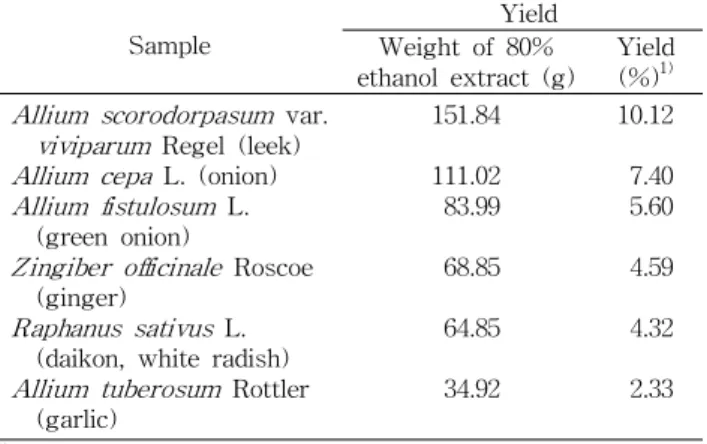
황 함유 채소의 항산화 효과 및 항균효과를 알아보기 위해 시료를 수세하여 분쇄하고, 80% ethanol에서 추출하여 감압 농축한 후 고형분 함량을 추출수율(%)로 계산한 결과는 Table 2와 같다. 6종류의 황 함유 채소의 추출 수율은 마늘 (10.12%)>양파(7.40%)>파(5.60%)>생강(4.59%)>무(4.32%)
>부추(2.33%) 순으로 마늘이 가장 높은 추출수율을 나타내 었고 부추가 가장 낮은 추출수율을 나타내었다. 실험에 사용 된 황 함유 채소류들은 대부분 수분함량이 80~90% 이상이 기 때문에 추출 수율이 10% 이하의 낮은 수율을 보인 것으 로 여겨지며, 다른 채소 추출물의 추출수율은 메탄올 용매에 허브를 추출하여 얻은 추출물의 수율은 10.14~41.23%로 황 함유 채소보다 높은 수율을 나타내었고(22), 12가지 쌈채소 를 에탄올 용매에 추출하여 얻은 추출물의 수율은 Orna- mental kale을 제외하고 모두 5% 이하의 낮은 수율을 나타 내었다고 보고하고 있다(23).
총 폴리페놀 함량
황 함유 채소류의 총 폴리페놀 함량을 gallic acid를 표준 용액으로 하여 작성한 표준곡선으로부터 조사하여 Table 3 에 나타내었다. 황 함유 채소류의 총 폴리페놀 함량은 19.05
Table 3. Total polyphenol contents and DPPH radical scav- enging activity of 80% ethanol extract from six vegetables containing sulfur compounds
Sample Polyphenol
contents (mg/g GAE1))
DPPH radical scavenging activity
(mg/mL)4) Allium scorodorpasum
var. viviparum Regel Allium cepa L.
Allium fistulosum L.
Zingiber officinaleRoscoe Raphanus sativusL.
Allium tuberosumRottler
19.41±0.402)d3) 69.07±1.42c 68.83±2.11c 233.63±4.59a 19.05±3.32d 220.98±10.56b
75.38±3.81a 28.04±0.33c 32.08±0.36b 1.57±0.15e 31.59±0.28b 7.82±0.14d
1)GAE: gallic acid equivalents.
2)Values are mean±SD (n=6).
3)Values with different letters within a column differ signifi- cantly (p<0.05).
4)Amount required for 50% reduction of hydrogen donating activity.
Table 4. ABTS radical scavenging activity and FRAP (ferric reducing antioxidant potential) of 80% ethanol extract from six vegetables containing sulfur compounds
Sample ABTS radical
scavenging activity (%)
value (mM)FRAP Ascorbic acid
Allium scorodorpasum var.
viviparum Regel Allium cepa L.
Allium fistulosum L.
Zingiber officinale Roscoe Raphanus sativusL.
Allium tuberosumRottler
99.46±0.311)a2) 21.06±0.08f 31.03±0.33e 34.17±0.08d 85.94±0.08b 19.30±0.35g 74.36±0.59c
6.63±0.01a 0.06±0.01g 0.25±0.03e 0.30±0.02d 2.84±0.05b 0.14±0.00f 1.65±0.03c
1)Values are mean±SD (n=6).
2)Values with different letters within a column differ signifi- cantly (p<0.05).
~233.63 mg/g 범위로 무의 총 폴리페놀 함량이 19.05±3.32 mg/g으로 가장 낮게 나타났고, 가장 높은 폴리페놀 함량을 나타낸 것은 생강 233.63±4.59 mg/g으로 무보다 약 12배 높게 나타났다. 생강에 이어 부추 220.98±10.56, 양파 69.07
±1.42, 파 68.83±2.11, 마늘 19.41±0.40, 무 19.05±3.32 mg/
g 순으로 페놀함량을 나타냈으며 양파와 파, 마늘과 무의 유의적 수준이 같게 나타났다. Lee 등(24)은 무 에탄올 추출 물의 총 폴리페놀 함량을 27.90 mg/100 g으로 보고하였고, Yang 등(25)은 양파과의 Shallots의 총 phenolic 함량이 10.0±114.7 mg/100 g이라고 보고하였으며 Bae와 Kim(26) 은 생강 80% 에탄올 추출물의 총 페놀 화합물 함량이 66.4
±0.5 mg/g이라고 보고하고 있어, 본 실험의 결과와 차이가 있으나 폴리페놀 함량은 시료의 품종, 숙성시기, 껍질색깔 등의 요인에 따라 함량에 큰 차이를 나타내며 이는 Folin- Denis 시약을 이용할 때 실험절차, 표준물질, 추출방법, 사용 된 시료 등이 다르기 때문에 각 결과 간의 차이가 크다고 보고되고 있다(27).
DPPH radical 소거활성
Free radical은 생물학적 손상의 주요 요인으로 잘 알려져 있는데, DPPH는 천연 항산화제의 free radical 소거활성을 평가하는데 일반적으로 사용된다(28). DPPH radical 소거활 성은 검체 농도에 따른 항산화 활성 변화 곡선으로부터 산화 를 50% 억제시키는 농도인 IC50으로 나타내었으며, 마늘, 양 파, 파, 생강, 무, 부추의 80% ethanol 추출물의 DPPH radi- cal 소거능을 측정한 결과는 Table 3과 같다. 생강의 IC50
값은 1.57±0.15 mg/mL로 가장 높은 항산화 활성을 나타내 었고 그 뒤로 부추가 7.82±0.14 mg/mL로 높은 항산화 활성 을 나타내었다. 무와 파는 각각 31.59±0.28 및 32.08±0.36 mg/mL를 나타내었고 두 시료간에 유의적 차이를 나타내지 않았다. 마늘은 75.38±3.81 mg/mL로 가장 낮은 항산화 활 성을 나타내었다. Lim(29)은 채소류 추출물의 항산화 효과 를 평가하기 위해 DMSO 10 μL와 DMSO에 녹여 농도별로
희석한 시료 10 μL에 DPPH/ethanol 190 μL를 가하여 13종 류의 채소류에 대해 DPPH 라디칼 소거활성을 측정한 결과 저해율이 생강(87.2%), 쑥(85.5%), 쑥갓(78.8%), 돌미나리 (73.6%), 우엉(70.5%), 취나물(51.5%), 돈나물(51.1%)의 순 으로 나타나 본 연구와 유사하게 생강의 항산화 활성이 좋은 것으로 나타났으며, Lee 등(27)은 무 에탄올 추출물의 DPPH 라디칼 소거능의 IC50이 34.93 mg/mL로 보고하고 있어 역시 본 연구와 유사한 결과를 나타내었다. Kang 등(30)은 전자 공여능이 phenolic acid와 flavonoid 및 기타 페놀성 물질에 대한 항산화 작용의 지표로서, 이 물질들은 환원력이 큰 것 일수록 전자공여능이 높다고 하였다. 따라서 황 함유 채소들 중 생강, 부추의 높은 DPPH 라디컬 소거능은 페놀성 화합물 과 서로 밀접한 관계가 있는 것으로 여겨지며 생강의 경우, 항산화 활성은 6-gingerol 등의 gingerol류 화합물, shogaol 류 및 phebolic ketone류와 같은 페놀성 화합물이 관여할 가 능성을 시사하고 있다(26).
ABTS radical scavenging activity
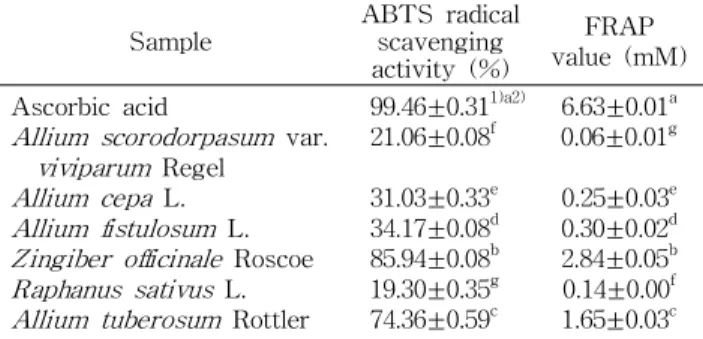
ABTS 라디칼 소거능은 항산화제의 유무를 확인하는 것 으로 radical을 생성하는 ABTS 존재시 hydorgen peroxide 와 metmyoglobin의 활성을 토대로 보다 빠른 항산화 반응 을 일으켜 myoglobin radical을 감소시키는 기전이라고 할 수 있다(31). 황 함유 채소들을 10 mg/mL 농도에서의 ABTS 라디칼 소거능을 측정한 결과는 Table 4에 나타내었다. 앞선 총 폴리페놀 함량과 DPPH 라디칼 소거능에서 나온 결과와 마찬가지로 생강이 85.94±0.08%로 가장 높은 항산화능을 나타내었고 무는 19.30±0.35% 로 가장 낮은 항산화능을 나 타내었다. 전체적으로 생강(85.94±0.08%)>부추(74.36±
0.59%)>파(33.17±0.08%)>양파(31.03±0.33%)>마늘(21.06
±0.08%)>무(19.30±0.35%) 순으로 ABTS 라디칼 소거능 이 높은 것으로 나타났다. Bae와 Kim(26)은 생강 80% 에탄 올 추출물의 ABTS 라디칼 소거활성은 62.5 μg/mL의 시험 농도에서 59.8±1.8%의 소거활성을 나타내었다고 보고하여 본 실험의 결과보다 높은 항산화 활성을 나타내었는데 이러
Table 5. Antibacterial activities of 80% ethanol extract from six vegetables containing sulfur compounds Microorganisms
Size of clear zone (mm)
Six different sulfur compound vegetables Concentration (mg/disc)
5 10
B. cereus
Allium scorodorpasum var. viviparum Regel Allium cepa L.
Allium fistulosum L.
Zingiber officinale Roscoe Raphanus sativus L.
Allium tuberosumRottler
22.31.7 11.0-1) 10.8-
31.312.0 12.5- 17.7
B. subtilis
Allium scorodorpasum var. viviparum Regel Allium cepa L.
Allium fistulosum L.
Zingiber officinale Roscoe Raphanus sativus L.
Allium tuberosumRottler
--
-- 10.7-
--
-- 17.7-
S. aureus
Allium scorodorpasum var. viviparum Regel Allium cepa L.
Allium fistulosum L.
Zingiber officinale Roscoe Raphanus sativus L.
Allium tuberosumRottler
--
-- 10.5-
--
-- 19.3-
E. coli
Allium scorodorpasum var. viviparum Regel Allium cepa L.
Allium fistulosum L.
Zingiber officinale Roscoe Raphanus sativus L.
Allium tuberosumRottler
24.3-
-- 14.3-
30.012.7 10.3- 19.3-
L. plantarum
Allium scorodorpasum var. viviparum Regel Allium cepa L.
Allium fistulosum L.
Zingiber officinale Roscoe Raphanus sativus L.
Allium tuberosumRottler
-9.5
--
--
18.0-
-- 10.4-
S.Enterica
Allium scorodorpasum var. viviparum Regel Allium cepa L.
Allium fistulosum L.
Zingiber officinale Roscoe Raphanus sativus L.
Allium tuberosumRottler
--
-- 15.0-
10.0-
-- 23.0-
P. aerugionsa
Allium scorodorpasum var. viviparum Regel Allium cepa L.
Allium fistulosum L.
Zingiber officinale Roscoe Raphanus sativus L.
Allium tuberosumRottler
9.0
--
-- 12.2
10.0
--
-- 21.0
1)Not detected.
한 차이는 사용된 시료의 품종 및 전처리 방법의 차이 때문 일 것으로 여겨진다.
FRAP(Ferric-reducing antioxidant potential) 측정
FRAP value의 측정은 비교적 최근에 개발된 총 항산화능 을 측정하는 방법(21)으로 낮은 pH에서 환원제에 의해 fer- ric tripyridyltriazine(Fe3+-TPTZ) 복합체가 파란색의 fer- rous tripyridyltriazine(Fe2+-TPTZ)으로 환원되는 원리를 이용한 것으로 대부분의 항산화제가 환원력을 가지고 있다 는 점에 착안하여 고안되어진 방법으로 생체 주요 항산화제 인 글루타치온에 반응하지 않는 치명적인 약점을 가지고 있
지만, 식이의 페놀 함량과 FRAP 값으로 측정한 항산화효과 의 사이에서 높은 상관관계(r=0.956, p<0.001)를 나타내어 FRAP법도 식품의 항산화효과를 측정하는 유용한 방법이 될 수 있다(32). 실험 결과 생강의 FRAP value가 2.84±0.05 mM로 가장 높았으며, 부추(1.65±0.03 mM)>파(0.30±0.02 mM)>양파(0.25±0.03 mM)>무(0.14±0.00 mM)>마늘(0.06
±0.01 mM) 순으로 나타났고, 대조군인 ascorbic acid는 6.63±0.01 mM의 FRAP value를 나타내었다(Table 4). 6종 류의 황 함유 채소들의 FRAP value는 총 폴리페놀 함량 및 DPPH 라디칼 소거활성은 비슷한 경향을 나타내었는데,
이는 총 페놀함량과 FRAP values는 높은 상관관계가 있다 는 Sachez-Gonzaez 등(33)의 보고와 유사한 결과이며, 부추 의 FRAP values와 DPPH 라디컬 소거능이 상관계수 0.992 (p<0.001)로 높은 상관관계에 있다는 Moon 등(32)의 보고와 도 유사한 결과이다.
Disc diffusion assay에 의한 항균활성
황 함유 채소의 추출물에 대한 항균활성을 B. cereus, B.
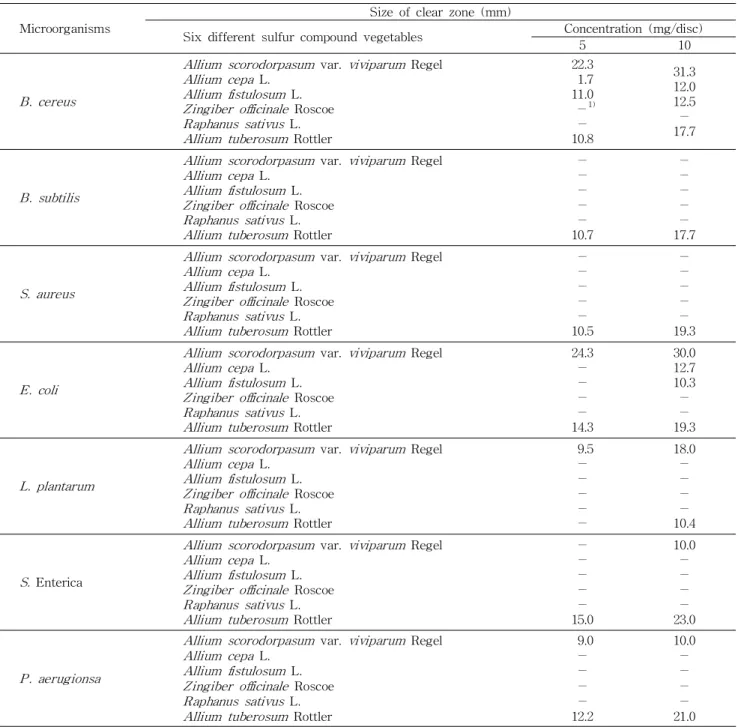
subtilus, S. aureus, L. plantarum과 같은 4종의 Gram 양성 세균과 E. coli,S.Typhimurium,P. aeruginosa와 같은 3종 의 Gram 음성 세균으로 구성된 총 6종의 세균에 대하여 disc 확산법으로 실시한 결과는 Table 5와 같다. 부추 추출물은 모든 균에 대해 clear zone을 형성하였으며 L. plantarum균 종을 제외한 모든 균종에 대해 농도가 높아짐에 따라 clear zone이 넓게 측정되었다. Ahn 등(34)은 품종별 부추 0.1%
에탄올 추출물의 항균활성 측정결과 Staphylococcus aur- eus,B. cereus, Listeria monocytogenes,E. coli, S.Typhi- murium,P. aeruginosa에 대해 항균력을 나타내었고 특히 P. aeruginosa에 대해 높은 항균효과를 보여주었다고 보고 하고 있다. 마늘의 경우 B. subtilus 및 S. aureus에 대해 항균활성을 보이지 않았으나E.coli와 B. cereus균주에 대 해서는 특히 우수한 항균활성을 나타내었다.
김치발효에 관여하는 젖산균인 L. plantarum에 대해 부추 에 비해 마늘에서 높은 항균력을 나타내었으며 이러한 결과 는 Kim과 Park(35)이 김치재료에 주로 관여하는 젖산균인 Lactobacillus mesenteroides에 대해 마늘이 부추에 비해 높 은 항균력을 나타낸다는 결과와 유사한 결과이다. Lee 등 (36)은 부추와 마늘의 생즙과 가루의 항균활성은 농도의존 적으로 증가되어지며 Gram 음성균인 E. coli및 S. enter- itidis보다 Gram 양성균인Sta. aureus에 대한 항균력이 높 았으며, 부추와 마늘생즙, 부추와 마늘가루의 혼합비율에 따 른 항균성의 변화는 마늘비율의 증가에 따른 효과가 나타날 뿐, 시료간 혼합에 따른 상승효과는 나타나지 않았다고 보고 하였다. Hong 등(37)은 부추에서 항균활성을 나타내는 물질 은 cis-propenyl methyl disulfide, S-methyl methyl- thiosulphonate, dimethyl disulfide 등의 황화합물로 구성된 복합물질로 보고하고 있다.
파와 양파는B. cereus및 E. coli균주에 대해 항균활성을 나타내었으나 E. coli 균에서는 5 mg/disc 농도에서 항균활 성을 보이지 않았다. 한편 생강과 무의 경우 실험에 사용한 균주에 대해 항균활성을 나타내지 않았다. 반면 Son(38)은 생강 추출물이 5000 μg/disc 농도에서 Gram 양성균인 B.
cereus에 대해 강한 항균력을 나타내었으며, 양파 메탄올 추출물은 B. cereus,S. aureus,E. coli와 S. enteritidis균주 에 대해 항균효과를 보이지 않았다고 보고하고 있어 본 연구 의 결과와 차이를 나타내었으며 이러한 차이는 사용된 시료 의 품종 및 시료 전처리 방법의 차이나 항균실험에 사용된 균주의 변이 등에 의한 것으로 여겨진다.
Sohn 등(39)은 대파로부터 fistulosides의 분리와 분리물 질의 항진균 활성에 관한 연구에서 대파 식용부위에서 항균 물질인 steroidal saponins(fistuloside A, B, C)을 분리하여, fistuloside A, C의 경우 항진균성이 강하게 있다고 밝힌바 있다. Jung 등(40)은 무의 줄기와 뿌리부위에 E. coli와 B.
subtilis에 대한 항균력이 없다는 보고를 하였고, Park과 Kyung(41)은 무의 젖산균 증식촉진 물질과 촉진작용에 관 한 연구에서 무의 성분 중에는 젖산균 증식을 촉진시키는 것이 있는데 이 활성물질의 본질이 규명되지는 않았으나 황 의 함유량이 특히 높게 분석된다고 보고한 바 있어 무의 경 우 젖산균을 증식시키는 성분이 있으며, 항균력은 가지지 않은 것으로 여겨진다.
요 약
본 연구는 황 함유 채소류 중 사용범위가 넓은 마늘, 무, 부추, 생강, 양파, 파를 80% 에탄올에 추출하여 항산화 및 항균효과에 대해 평가하였다. 추출 수율은 2.33~10.12%를 나타내었으며, 총 폴리페놀 함량은 생강이 233.63±4.59, 부 추가 220.98±10.56 mg/g GAE로 높은 함량을 나타내었고, 양파, 파, 마늘, 무 순으로 69.07±1.42, 68.83±2.11, 19.41±0.40, 19.05±03.32 mg/g GAE의 함량을 나타내었다. DPPH radi- cal 소거활성을 측정한 결과, 생강의 IC50 값이 1.57±0.15 mg/mL로 가장 높았으며, 이어 부추>양파>무>파>마늘의 순이었다. ABTS 라디칼 소거활성 및 FRAP value의 측정 결과 역시 생강 및 부추 추출물에서 높은 항산화활성을 나타 내었으며 ABTS 라디칼 소거활성의 경우 파>양파>마늘>
무, FRAP value의 경우 파>양파>무>마늘의 순으로 항산화 활성을 나타내었다. 항산화 활성 측정결과 전체적으로 생강 에서 가장 높은 항산화활성을 나타내었다. 항균활성 측정결 과, 부추의 경우 실험에 사용된 7가지 균주에 대해 모두 항균 활성을 가지고 있는 것으로 나타났으며, 마늘의 경우(5 mg/disc), B. cereus(22.3 mm) 및E. coli(24.3 mm)에 대해 높은 항균활성을 나타내었다. 양파와 파는 10 mg/disc 농도 에서E. coli(12.7 및 10.3 mm)와B. cereus(12.0 및 12.5 mm) 균주에 대해서만 항균력을 나타내었고, L. plantarum 균주 (10 mg/disc)에 대해서는 마늘(18.0 mm)과 부추(10.4 mm) 가 항균활성을 나타내었다. 본 연구결과, 다양한 한국음식에 광범위하게 이용되는 황 함유채소류 중 생강 및 부추는 항산 화 활성이, 부추 및 마늘은 항균력이 높아 특히 부추의 경우 식품 첨가물 및 식품 보존제로서도 활용될 수 있을 것으로 사료된다.
문 헌
1. Halliwell B, Gutteridge JMC. 1989.Free Radicals in Biology and Medicine. Oxford University, NY, USA. p 398-401.
2. Farinati F, Cardin R, Degan P, Rugge M, Mario FD,
Bonvicini P, Naccarato R. 1998. Oxidative DNA damage ac- cumulation in gastric carcinogenesis. Gut 42: 351-356.
3. Cooked MS, Mistry N, Wood C, Hebert KE, Lunce J. 1997.
Immunogenicity of DNA damaged by ROS-implications for anti-DNA antibodies in lupus. Free Radic Biol Med 22: 151-159.
4. Darely-Usmer V, Halliwell B. 1996. Blood radicals; reactive nitrogen species, reactive oxygen species, transition metal ions and the vascular system. Pharm Res 13: 649-662.
5. Parthasarathy S, Steinberg D, Witztum JL. 1992. The role of oxidezed LDL in the pathogenesis of antherosclerosis.
Ann Rev Med 43: 219-225.
6. Laurindo FR, Da Luz PL, Uint L, Rocha TF, Jaeger RG, Lopes EA. 1991. Evidence for superoxide radical dependent coronary artery vasospasm after antigioplasry in intact dogs. Circulation 83: 1705-1715.
7. Nakazono K, Watanabe N, Matsuno K, Sasaki J, Sato T, Inoue M. 1991. Does superoxide underlie the pathogenesis of hypertension?Proc Natl Acad Sci USA88: 10045-10048.
8. Jeong SJ, Lee H, Song NH, Lee SE, Baeg I. 2004. Natural products chemistry: screening for antioxidative activity of plant medicinal extracts.J Korean Soc Food Sci Nutr33:
28-33.
9. Yasmine M. 1997. Global estimation of foodborne disease.
World Health Statistics Quarterly 50: 5-11.
10. Kwun JW, Lee CH. 2007. Trends of recent food-borne dis- ease outbreaks in Korea. J Korean Med Assoc 50: 573- 581.
11. Lee KS, Lee JC, Na SL, Jung HY, Lim KT. 1999. Effects on mammalian tissues and cells by sulfur containing compounds. J Toxicol Pub Health 15: 79-87.
12. Gillissen S, Nowak D. 1998. Characterization of N-ace- tylcysteine and ambroxol anti-oxidant therapy. Respir Med 92: 609-614.
13. Sainani G, Desai D, Katrodia K, Valame V, Sainani P. 1979.
Onion, garlic and experimental atherosclerosis. Jpn Heart J 20: 351-357.
14. Bordia A. 1978. Effect of garlic on human platelet ag- gregation in vitro. Atherosclerosis 30: 355-360.
15. Subrahmanyan V, Sreenivasamurthy V, Krishnamurthy K, Swaminathan M. 1958. The effect of garlic on certain in- testinal bacteria. Food Sci 7: 223-230.
16. Qiao L, Shiff SJ, Rigas B. 1997. Sulindac sulfide inhibits the proliferation of colon cancer cell: diminished expression of the proliferation markers PCVA and KI-67.Cancer Lett 115: 229-234.
17. Fukushima S, Takada N, Hori T, Wamibuchi H. 1997.
Cancer preventation by organosulfur compounds from gar- lic and onion. J Cell Biochem Suppl 27: 100-106.
18. Folin O, Denis W. 1912. On phosphotungstic-phosphomo- lybdic compounds as color reagents.J Biol Chem 12: 239- 19. Blois MS. 1958. Antioxidant determinations by the use of249.
a stable free radical. Nature 181: 1198-1200.
20. Pellegrin N, Roberta R, Min Y, Catherine RE. 1998. Screen- ing of dietary carotenoids and carotenoid-rich fruit extract for antioxidant activities applying 2,2'-azinobis(3-ethyl- enbenzothiazoline-6-sulfonic acid) radical cation decolori- zation assay. Method Enzymol 299: 379-389.
21. Benzie IFF, Strain JJ. 1996. The ferric reducing ability of plasma (FRAP) as a measure of "antioxidant power": the FRAP assay. Anal Biochem 239: 70-76.
22. Chang JH. 2006. Antioxidant activities and antiproliferative effects of various natural herb extracts.MS Thesis. Seoul National University, Seoul, Korea. p 17.
23. Bang CS. 2007. Antioxidant and antiproliferative activities of the ethanol extracts from leafy vegetables.MS Thesis. Chungbuk National University, Chungbuk, Korea. p 24.
24. Lee SH, Hwang IG, Lee YR, Joung EM, Jeong HS, Lee HB.
2009. Physicochemical characteristics and antioxidant ac- tivity of heated radish (Raphanus sativusL.) extracts. J Korean Soc Food Sci Nutr 38: 490-495.
25. Yang J, Meyers JK, Heide JV, Liu RH. 2004. Varietal differ- ences in phenolic content and antioxidant and antiprolife- rative activities of onions.J Agric Food Chem 52: 6787- 6793.
26. Bae JS, Kim TH. 2011. Pancreatic lipase inhibitory and an- tioxidant activities ofZingiber officinaleextracts.Korean J Food Preserv18: 390-396.
27. Lee JH. 1993. Studies on the content of phenolic substances on plant foods and their physiological effectsin vitro.PhD Dissertation. Ewha Womans University, Seoul, Korea. p 51-53.
28. Kang DY, Shin MO, Shon JH, Bae SJ. 2009. The antioxida- tive and antimicrobial effects of Celastrus orbiculatus. J Life Sci 19: 52-57.
29. Lim SJ. 2002. Screening for antioxidant activity and anti- mutagenic effect of 15 vegetables. MS Thesis. Hannam University, Daejeon, Korea. p 48.
30. Kang YH, Park YK, Lee GD. 1996. The nitrite scavenging and electron donating ability of phenolic compounds.
Korean J Food Sci Technol 33: 626-632.
31. Meller NJ, Rice-Evans C, Davies MJ, Gopinathan V, Milner A. 1993. A novel method for measuring antioxidant capacity and its application to monitoring the antioxidant status in premature neonates. Clin Sci 84: 407-412.
32. Moon GS, Ryu BM, Lee MJ. 2003. Components and anti- oxidant activities of Buchu (Chinese chives) harvested at different times.Korean J Food Sci Technol 35: 493-498.
33. Sachez-Gonazaez I, Jimenez-Escrig A, Saura-Calixto F.
2005.In vitroantioxidant activity of coffees brewed using different procedures (Italian, espresso and filter). Food Chem 90: 133-139.
34. Ahn MS, Kim HJ, Seo MS. 2005. The antioxidant and anti- microbial activities of the three species of leeks (Allium tu- berosub R.) ethanol extracts. Korean J Food Culture 20:
186-193.
35. Kim SJ, Park KH. 1995. Antimicrobial activities of the ex- tracts of vegetable kimchi stuff. Korean J Food Sci Technol 27: 216-220.
36. Lee EH, Jang KI, Bae IY, Lee H. 2011. Antibacterial effects of leek and garlic juice and powder in a mixed strains sys- tem Korean. J Food Sci Technol 43: 518-523.
37. Hong JH, Lee MH, Kang MC, Hur SH. 2000. Separation and identification of antimicrobial compounds from Korean leek (Allium tuberosum). J Fd Hyg Safety15: 235-240.
38. Son JY. 2010. Antioxidant and antimicrobial activities of methanol extracts from spices. J Korean Soc Food Sci Nutr 39: 648-654.
39. Sohn HY, Kum EJ, Ryu HY, Jeon SJ, Kim NS, Son KH.
2006. Antifungal activity of fistulosides, steroidal saponins from Allium fistulosum L. J Life Sci 16: 310-314.
40. Jung MS, Lee GS, Chae HJ. 2004.In vitrobiological activity assay of ethanol extract of radish.J Korean Soc Appl Biol Chem 47: 67-71.
41. Park KS, Kyung KH. 1992. Growth stimulation of lactic acid bacteria by a radish component.Korean J Food Sci Technol 24: 528-534.
(2012년 1월 31일 접수; 2012년 2월 28일 채택)