Print ISSN: 2288-4637 / Online ISSN 2288-4645 doi:10.13106/jafeb.2021.vol8.no2.0001
Measuring COVID-19 Effects on World and National Stock Market Returns*
Anya KHANTHAVIT 1
Received: November 05, 2020 Revised: December 30, 2020 Accepted: January 08, 2021
Abstract
Previous studies have found the significant adverse effects of coronavirus disease 2019 (COVID-19) on stock returns and volatility. The effects varied with the confirmed cases and deaths. However, the extent of the effects have never been measured exactly. This study proposes a measurement model for the COVID-19 effects. In the proposed model, stock returns in the COVID-19 period are weighted averages of pre- COVID-19 normal returns and COVID-19-induced returns. The effects are measured by the contributing weights of the COVID-19-induced returns. Kalman filtering is used to estimate the model for the world and Chinese markets, in combination with 10 markets – five most affected countries (United States, India, Brazil, Russia, and France) and five best recovering countries (Hong Kong, Australia, Singapore, Thailand, and South Korea). The sample returns are daily, obtained from the closing Morgan Stanley global investable market indexes. The full period is from September 24, 2018, to October 30, 2020, whereas the COVID-19 period is from November 18, 2019, to October 30, 2020. The contributing weights are significant and close to 100% for all markets. The COVID-19-induced returns replace the pre-COVID-19 normal returns; they are negatively auto-correlated and highly volatile. The COVID-19-induced returns are new normal returns in the COVID-19 period.
Keywords: Kalman Filtering, New Normal, Pandemic, Return Behavior JEL Classification Code: G12, G14, G15
In addition to health disasters, COVID-19 has led to global economic and financial crises. The pandemic causes simultaneous worldwide disruptions to both supply–due to reduced labor supply and productivity, as well as lockdowns, business closures, and social distancing–and demand due to layoffs, loss of income, reduced household consumption, and declining firms’ investment (Chudik, Mohaddes, Pesaran, Raissi, & Rebucci, 2020). In January 2020, the World Bank (2020a) forecast the world’s real gross domestic product growth of 2.5% for 2020. In June 2020, after COVID-19 had spread, the organization revised the forecast downward to -5.2% (World Bank, 2020b). The spread of the disease continues, and the number of infected and death cases continues to increase. Economic problems persist and their future remains uncertain, leading to firms’ low expected cash flows and rising real and perceived risks. Consequently, stock prices drop (Harvey, 1989).
Despite extensive studies conducted on COVID-19 effects on stock market returns, none have addressed the extent of these effects and how stock returns changed from the pre-COVID-19 to COVID-19 periods. They showed either statistically significant abnormal returns due to the COVID-19 events or significant relationships of confirmed cases and deaths with returns and volatility.
*Acknowledgements:
*
The author thanks the Faculty of Commerce and Accountancy, Thammasat University, for the research grant, the Stock Exchange of Thailand for stock-index data, and Chanya Siriarayaphan for research assistance.
1
First Author and Corresponding Author. Distinguished Professor of Finance and Banking, Faculty of Commerce and Accountancy, Thammasat University, Thailand [Postal Address: No. 2 Phra Chan Road, Phra Nakhon, Bangkok, 10200, Thailand]
Email: [email protected]
© Copyright: The Author(s)
This is an Open Access article distributed under the terms of the Creative Commons Attribution Non-Commercial License (https://creativecommons.org/licenses/by-nc/4.0/) which permits unrestricted non-commercial use, distribution, and reproduction in any medium, provided the original work is properly cited.
1. Introduction
Coronavirus disease 2019 (COVID-19) is an infectious
respiratory disease caused by severe acute respiratory
syndrome coronavirus 2 (Lai, Shih, Ko, Tang, & Hsueh,
2020). The virus was first detected in Wuhan, China, on
November 17, 2019. Since October 30, 2020, COVID-19
has spread to 216 countries and territories, with a total
of 45,382,161 confirmed cases and 1,187,029 deaths
(Worldometers, 2020).
It is important to measure the extent of the effects because statistical significance does not necessarily imply financial significance. The resulting stock return behavior in the COVID-19 period has practical implications for asset allocation (Song, Siu, Ching, Tong, & Yang, 2012), risk measurement (Duffie & Pan, 1997), stock trading (Diether, Lee, & Werner, 2009), and derivative pricing (Bates, 2003).
This study proposes a model to measure the COVID-19 effects on stock returns. The stock return during the COVID-19 sample is a weighted average of the pre- COVID-19 normal returns and COVID-19-induced returns.
The study estimates the two returns and their contributing weights using Kalman filtering. The normal return is the return during the pre-COVID-19 sample. The COVID-19 effects are measured by the contributing weight of the COVID-19-induced return.
2. Literature Review
In international studies, Bash (2020), Khanthavit (2020a), and Liu, Manzoor, Wang, Zhang, and Manzoor (2020) reported negative and significant effects of COVID-19 on stock market returns. These effects were stronger with rising confirmed cases and deaths (Cao, Li, Liu, & Woo, 2020;
Khan et al., 2020). Significant positive abnormal returns were detected for some national markets during certain sub- periods. For example, for the Indian market, Alam, Alam, and Chavali (2020) reported significant, positive abnormal returns during the lockdown period, whereas significant, negative abnormal returns were observed during the pre- and post-lockdown periods. The market believed that the lockdown would stop the virus from spreading.
Within a certain market, COVID-19 affects stocks in different sectors or both in positive and negative ways.
For example, for the US market, Ramelli and Wagner (2020) found that stocks in the utility, healthcare, and telecommunication sectors were positively affected, whereas those in the transportation, automobile, and energy sectors were negatively affected. For the Chinese market, He, Sun, Zhang, and Li (2020) reported the positive effects of COVID-19 for stocks in the public management, information technology, and sports and entertainment sectors. Further, the effects for the stocks in the transportation, construction, environment, electric and heating, real estate, health, education, agriculture, and mining sectors were negative, whereas those for the stocks in the scientific research and lodging and catering sectors were marginal. It is interesting to learn that, in the US market, the negative effects on stocks with high environmental and social ratings were less severe (Albuquerque, Koskinen, Yang, & Zhang, 2020). Al-Awadhi, AlSaifi, Al-Awadhi, and Alhammadi (2020) found that, for the Chinese market, class-B stocks experienced significantly more negative effects than class-A stocks. Moreover, stocks
with larger market capitalization were affected more severely than those with smaller market capitalization.
COVID-19 also affects stock volatility. Baker, Bloom, Davis, Kost, Sammon, and Viratyosin (2020) linked increasing stock volatility with COVID-19 due to government limitations on commercial activities and restrictions on consumers. Zaremba, Kizys, Aharon, and Demir (2020) added that governments’ rigorous actions, such as information campaigns and cancellation of public events, to mitigate the spread of the disease heightened the volatility. The fact that COVID-19 can affect stock volatility is supported by Albulescu (2020) and Onali (2020). They found that stock volatility increased with the number of confirmed cases and deaths. In addition to its short-term effects, COVID-19 affects permanent stock volatility (Bai, Wei, Wei, Li, & Zhang, 2020).
3. Research Method and Data 3.1. The Model
Let rt be the random stock return on day t. The study assumes that the stock return rt moves normally during the pre-COVID-19 period. During the COVID-19 period, the disease causes the stock return to behave differently. The return is a weighted average of the pre-COVID-19 normal returns and COVID-19-induced returns. Equation (1) summarizes the return behavior in the pre-COVID-19 and COVID-19 periods.
, ..., 1 (1 )
0, ...,
tN
N C
t t
for t T
rt γ r r r for t
τ γ
= − −
= − + =
, (1)
where r
tNand r
tCare the pre-COVID-19 normal and COVID-19-induced returns, respectively, and γ is the contributing weight of r
tCto rt . Moreover, Day t = 0 is the event day on which the market acknowledged the COVID-19 virus for the first time; hence, the periods from days t = − T to t = − 1 and t = 0 to t = τ are the pre-COVID-19 and COVID-19 periods, respectively.
The study decomposes the stock return r
tiinto the expected return µ
tiand error term e
ti, where i = N, C indicates the pre-COVID-19 and COVID-19 variables.
i i i
t t t
r = µ + e (2)
The error term e
tihas a zero mean and σ
eistandard deviation. The expected return µ
tifollows an autoregressive process of order 1 (AR(1)) in equation (3).
0 1 1
i i i i i
t t t
µ = α + α µ
−+ ε (3)
The parameter α
0iis the intercept, whereas the parameter
1i
α is the slope, AR(1) coefficient. The error term ε
tihas a zero mean and σ
εistandard deviation, and the AR(1) specification is general. This is consistent with the return autocorrelation observed for stocks in various national markets (Khanthavit, 2020a). The model implies the mean- adjusted specification widely used in event study analyses (Brown & Warner, 1985), when α
1i= σ ε
i= 0.
The model in equations (1), (2), and (3) is the modified model from Khanthavit (2020b). In that study, rt is foreign investors’ trading volume, r
tN+ µ
tCis the return behavior in the COVID-19 period, and the µ
tCcomponent is the abnormal return.
In this study, the different return behaviors during the COVID-19 period from the pre-COVID-19 period are not considered abnormal behaviors; thus, the COVID-19-induced return is not an abnormal return. The study recognizes Goodell (2020) in that COVID-19 presents a new normal to investors.
Therefore, stock returns during the COVID-19 period behave in a new normal way. The specification (1 − γ ) r
tN+ γ r
tCdescribes the new normal return.
3.2. Model Estimation
Combining equations (1) and (2) results in ,..., 1 {(1 ) } 0,..., .
{(1 ) }
tN tC
N C
t t
for t T
N for t
r t
e e
µ
γ µ γµ τ
γ γ
+ = − −
− + + =
= − +
(4)
Equations (3) and (4) constitute a state-space model for the stock returns during the pre-COVID-19 and COVID-19 periods. Equation (4) is the measurement equation in which the observed return is related to the unobserved expected returns µ
tNand µ
tC. Equation (3) is the transition equation that describes the stochastic behaviors of the unobserved state variables. Here, the state variables are the expected returns µ
tNand µ
tC. The transition equation (3) can be rewritten as a system of equations as in equation (5).
0 1
0 1 1
0 ,
0
N N N N N
t t t t
C C C C C
t t t
µ α α µ ε
µ α α µ
−−ε
= + +
(5)
where the covariance matrix of
tNCt
ε ε
is ( )
20
2. 0 ( )
N C
ε
ε
σ σ
This study assumes the uncorrelated error terms ε
tNand ε
tC. because, under the null hypothesis of no COVID-19 effects,
C
µ
tis zero. For the same reason, the error terms e
tNand e
tCare uncorrelated between each other and with ε
tNand ε
tC. This study uses Kalman filtering to estimate the state-space model in equations (4) and (5) (Harvey, 1990).
3.3. Hypothesis Tests
3.3.1. Measuring the COVID-19 Effects
From equation (1), the contributing weight γ enables the study to precisely measure the COVID-19 effects. If the COVID-19 effects are temporary or non-existent,
γ is small because it is averaged out over time or zero initially. The hypothesis is γ = 0 . A significant γ indicates permanent COVID-10 effects and a new normal market.
However, if γ = 1, the new normal returns r r
t=
tC. The COVID-19-induced return replaces the pre-COVID-19 normal return.
3.3.2. Difference Between Pre-COVID-19 Normal Return and COVID-19-Induced Return
Although is non-zero, a new normal market requires different processes for the pre-COVID-19 normal return and COVID-19-induced return. Under a non-difference hypothesis, at least one of the following hypotheses is rejected: α
0N= α α
0C,
1N= α σ
1C, ε
N= σ ε
C, and σ
eN= σ
eC. Each hypothesis is tested in this study. The joint hypothesis is also tested using a Wald test. Under the joint hypothesis, the Wald statistic is distributed as a chi-square variable with four degrees of freedom.
3.4. The Data
This study estimates the state-space model in equations (4) and (5) for stocks in the five most affected countries and five best recovering countries. On October 30, 2020, the most affected countries are the United States, India, Brazil, Russia, and France (Worldometers, 2020), whereas the best recovering countries are Hong Kong, Australia, Singapore, Thailand, and South Korea (PEMANDU Associates, 2020). The study also considers the world and Chinese stock markets. The world market serves as a representative of the national markets worldwide. Meanwhile, the Chinese market is important and interesting because the COVID-19 virus was first detected in China.
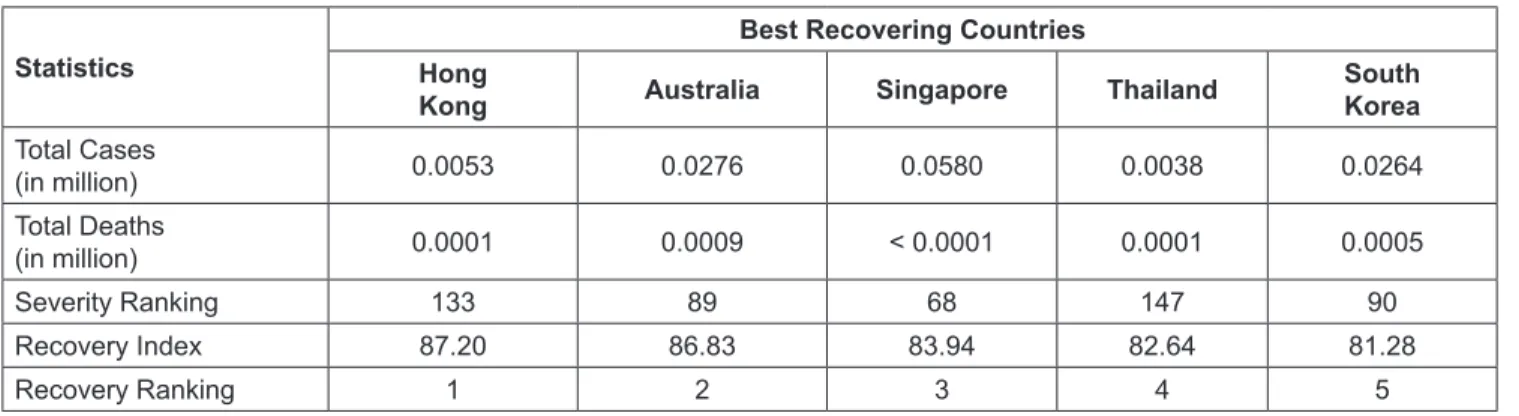
Table 1 reports the COVID-19 statistics for severity and recovery. Severity is measured by confirmed cases and deaths, whereas recovery is measured by the recovery indices of PEMANDU Associates. The United States contributed about a fifth to the world’s confirmed cases and deaths.
Although it is the first country that experienced the disease, China has managed the situation well. Its rankings in terms of severity and recovery are 56th and 10th, respectively.
In particular, the best market in terms of recovery is Hong
Kong, and it contributes only approximately 0.01% to the
world’s confirmed cases and deaths.
The sample returns are the daily logged returns scaled by 100. They are derived from closing Morgan Stanley global investable market indexes. The market indexes are in local currencies, and the world index is in US dollars. The indexes include large, medium, and small capitalization stocks, resulting in the inclusion of approximately 99% of the free float-adjusted market capitalization. They were retrieved from the Morgan Stanley database (www.msci.com/end-of-day-data-country).
To choose the sample period, day t = 0 must be identified. This study follows Khanthavit (2020a; 2020b) to fix day t = 0 for November 17, 2019. The day, November 17, 2020, is the first day that COVID-19 was detected in China (Mimouni et al., 2020). Because November 17, 2019, fell on a Sunday, day t = 0 is adjusted to Monday, November 18, 2019—the first trading day after November 17, 2019.
At the time of this study, COVID-19 continues to spread.
The last available sample return is for October 30, 2020;
thus, the COVID-19 sample covers a period from November 18, 2019, to October 30, 2020 (250 daily observations).
Next, the pre-COVID-19 sample was selected in this study, during which time the return behaved normally and was unaffected by COVID-19. In statistics, a long sample
period is preferred. However, Nazir, Younus, Kaleem, and Anwar (2014) cautioned that a long pre-COVID-19 sample absorbed the economic and noneconomic events irrelevant to the study. The typical lengths of the pre-event period range from 100 to 300 days (Peterson, 1989). With respect to Nazir et al. (2014) and Salinger (1992), the study chooses the longest period of 300 days for accurate parameter estimation.
The pre-COVID-19 sample begins on September 24, 2018, and ends November 15, 2019, resulting in the full sample ranging from September 24, 2018, to October 30, 2020 (550 daily observations).
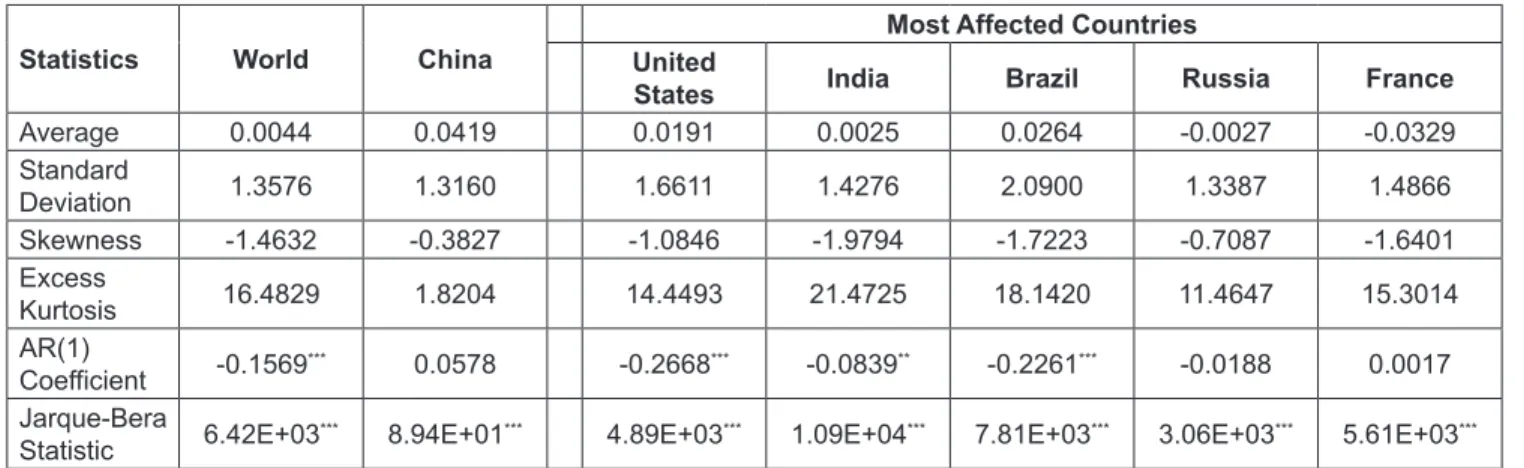
Table 2 reports the descriptive statistics of the sample returns. In Panel 2.1, the full-sample returns for all the markets are negatively skewed and fat-tailed. The AR(1) coefficients are negative and significant for most markets.
The Jarque–Bera statistics reject the normality hypothesis for all the markets. The AR(1) specification for returns in equation (3) is supported by significant autocorrelation.
Although the Jarque–Bera statistics reject the normality hypothesis for the returns in all markets, Kalman filtering can still be used. The filter is optimal and produces the minimum mean square linear estimates (Kellerhals, 2001).
Table 1: COVID-19 Severity and Recovery Statistics
Statistics World China Most Affected Countries
United
States India Brazil Russia France
Total Cases
(in million) 45.3821 0.0859 9.2128 8.0889 5.4964 1.6000 1.2828
Total Deaths
(in million) 1.1870 0.0046 0.2342 0.1211 0.1590 0.0277 0.0360
Severity Ranking N.A. 56 1 2 3 4 5
Recovery Index N.A. 75.40 42.67 65.00 62.31 57.14 28.58
Recovery Ranking N.A. 10 138 27 41 65 166
N.A. denotes non-applicable.
Table 1: COVID-19 Severity and Recovery Statistics (Continued)
Statistics Best Recovering Countries
Hong Kong Australia Singapore Thailand South
Korea Total Cases
(in million) 0.0053 0.0276 0.0580 0.0038 0.0264
Total Deaths
(in million) 0.0001 0.0009 < 0.0001 0.0001 0.0005
Severity Ranking 133 89 68 147 90
Recovery Index 87.20 86.83 83.94 82.64 81.28
Recovery Ranking 1 2 3 4 5
Table 2 reports the descriptive statistics of the sample returns. In Panel 2.1, the full-sample returns for all the markets are negatively skewed and fat-tailed. The AR(1) coefficients are negative and significant for most markets. The Jarque–Bera statistics reject the normality hypothesis for all the markets. The AR(1) specification for returns in equation (3) is supported by significant autocorrelation. Although the Jarque–Bera statistics reject the normality hypothesis for the returns in all markets, Kalman filtering can still be used. The filter is optimal and produces the minimum mean square linear estimates (Kellerhals, 2001).
Panels 2.2 and 2.3 report the statistics for the pre- COVID-19 and COVID-19 samples, respectively. With respect to the AR(1) coefficients, the negative, significant AR(1) coefficients for the full sample result from the AR(1) coefficients in the COVID-19 sample. The normality hypothesis is rejected by the Jarque–Bera statistics for all the
markets for the two samples, except for the Russian market for the pre-COVID-19 sample.
Lyócsa, Baumöhl, Výrost, and Molnár (2020) observed that COVID-19 brought unprecedented declines and high uncertainty in the global stock markets. This study tests for the equal means and standard deviations for the returns in the pre-COVID-19 and COVID-19 samples. As shown in Panel 2.4, the mean returns are larger for the pre-COVID-19 samples than for the COVID-19 samples for the world, Brazilian, Russian, French, Hong Kong, Australian, Singaporean, and Thai markets, whereas those for the remaining markets are smaller. Thus, the equal mean return hypothesis cannot be rejected for any market. The test for equal standard deviations rejects the null hypothesis for all markets. This finding supports high uncertainty, but not falling markets.
It also suggests that the falling markets observed by Lyócsa et al. (2020) are for short term. In particular, the markets recovered in the later period of the COVID-19 sample.
Table 2: Descriptive Statistics
Panel 2.1: Full Sample from September 24, 2018, to October 30, 2020 (550 observations)
Statistics World China Most Affected Countries
United
States India Brazil Russia France
Average 0.0044 0.0419 0.0191 0.0025 0.0264 -0.0027 -0.0329
Standard
Deviation 1.3576 1.3160 1.6611 1.4276 2.0900 1.3387 1.4866
Skewness -1.4632 -0.3827 -1.0846 -1.9794 -1.7223 -0.7087 -1.6401
Excess
Kurtosis 16.4829 1.8204 14.4493 21.4725 18.1420 11.4647 15.3014
AR(1)
Coefficient -0.1569
***0.0578 -0.2668
***-0.0839
**-0.2261
***-0.0188 0.0017 Jarque-Bera
Statistic 6.42E+03
***8.94E+01
***4.89E+03
***1.09E+04
***7.81E+03
***3.06E+03
***5.61E+03
*****
and
***denote significance at the 95% and 99% confidence levels, respectively.
Panel 2.1: Full Sample from September 24, 2018, to October 30, 2020 (550 observations) (Continued)
Statistics Best Recovering Countries
Hong Kong Australia Singapore Thailand South
Korea
Average -0.0232 -0.0095 -0.0433 -0.0854 0.0013
Standard Deviation 1.2764 1.4119 1.1190 1.3829 1.3793
Skewness -0.5272 -1.4016 -0.6139 -2.0712 -0.1274
Excess Kurtosis 3.8560 12.2001 12.0013 21.9750 8.2501
AR(1) Coefficient -0.0031 -0.2357
***-0.0303 -0.1429
***-0.0450
Jarque-Bera Statistic 3.66E+02
***3.59E+03
***3.34E+03
***1.15E+04
***1.56E+03
******
denote significance at the 99% confidence level.
Panel 2.2: Pre-COVID-19 Sample from September 24, 2018, to November 15, 2019 (300 observations)
Statistics World China Most Affected Countries
United
States India Brazil Russia France
Average 0.0123 -0.0107 0.0171 -0.0021 0.0904 0.0639 0.0207
Standard
Deviation 0.7809 1.1668 1.0014 0.9089 1.2045 0.8789 0.8983
Skewness -0.4493 -0.1168 -0.3052 0.3981 -0.0089 0.0565 -0.5430
Excess
Kurtosis 1.8199 0.5884 3.1322 2.7001 0.9986 0.2818 1.5561
AR(1)
Coefficient 0.1615
***0.1526
***0.0327 0.0745 -0.0199 -0.0294 0.0552
Jarque-Bera
Statistic 51.4945
***5.0106
*1.27E+02
***99.0553
***12.4700
***1.1517 45.0139
****
and
***denote significance at the 90% and 99% confidence levels, respectively.
Panel 2.2: Pre-COVID-19 Sample from September 24, 2018, to November 15, 2019 (300 observations) (Continued)
Statistics Best Recovering Countries
Hong Kong Australia Singapore Thailand South
Korea
Average -0.0159 0.0292 0.0107 -0.0441 -0.0203
Standard Deviation 1.0821 0.7451 0.6561 0.7255 0.9323
Skewness 0.1164 -0.8766 -0.4173 -0.1149 -0.4677
Excess Kurtosis 2.3282 2.3541 2.2311 1.3124 2.6650
AR(1) Coefficient 0.0458 0.0396 0.0388 -0.0555 -0.0106
Jarque-Bera Statistic 68.4340
***1.08E+02
***70.9288
***22.1912
***99.7154
******
denote significance at the 99% confidence level.
Panel 2.3: COVID-19 Sample from November 18, 2019, to October 30, 2020 (250 observations)
Statistics World China Most Affected Countries
United
States India Brazil Russia France
Average -0.0052 0.1050 0.0214 0.0079 -0.0504 -0.0827 0.0214
Standard
Deviation 1.8252 1.4752 2.2089 1.8712 2.8067 1.7355 2.2089
Skewness -1.2783 -0.5806 -0.9897 -2.0082 -1.5064 -0.6255 -0.9897
Excess
Kurtosis 10.0754 2.1733 9.1317 15.1390 11.1587 8.0200 9.1317
AR(1)
Coefficient -0.2269
***-0.0166 -0.3408
***-0.1285
**-0.2732
***-0.0187 -0.3408
***Jarque-Bera
Statistic 1.13E+03
***63.2437
***9.09E+02
***2.56E+03
***1.39E+03
***6.86E+02
***9.09E+02
*****
and
***denote significance at the 95% and 99% confidence levels, respectively.
Panel 2.3: COVID-19 Sample from November 18, 2019, to October 30, 2020 (250 observations) (Continued)
Statistics Best Recovering Countries
Hong Kong Australia Singapore Thailand South
Korea
Average -0.0972 -0.0321 -0.0560 -0.1081 -0.1349
Standard Deviation 1.9738 1.4785 1.9299 1.4954 1.8921
Skewness -1.4120 -0.7976 -1.0926 -0.4214 -1.7156
Excess Kurtosis 9.7059 3.6176 6.4510 7.1665 12.5968
AR(1) Coefficient -0.0135 -0.0351 -0.2858
***-0.0500 -0.1597
**Jarque-Bera Statistic 1.06E+03
***1.63E+02
***4.83E+02
***5.42E+02
***1.78E+03
*****
and
***denote significance at the 95% and 99% confidence levels, respectively.
Panel 2.4: Tests for Equal Means and Standard Deviations in the Pre-COVID-19 and COVID-19 Samples
Statistics World China Most Affected Countries
United
States India Brazil Russia France
Mean
Difference 0.0175 -0.1158 -0.0043 -0.0100 0.1409 0.1466 0.1179
Standard- Deviation
Difference -1.0443
***-0.3083
***-1.2074
***-0.9622
***-1.6022
***-0.8566
***-1.0755
******
denotes significance at the 99% confidence level.
Panel 2.4: Tests for Equal Means and Standard Deviations in the Pre-COVID-19 and COVID-19 Samples (Continued)
Statistics Best Recovering Countries
Hong Kong Australia Singapore Thailand South
Korea
Mean Difference 0.0162 0.0853 0.1188 0.0908 -0.0475
Standard-Deviation
Difference -0.3964
***-1.1848
***-0.8394
***-1.1666
***-0.8424
******
denotes significance at the 99% confidence level.
4. Empirical Results 4.1. Parameter Estimates
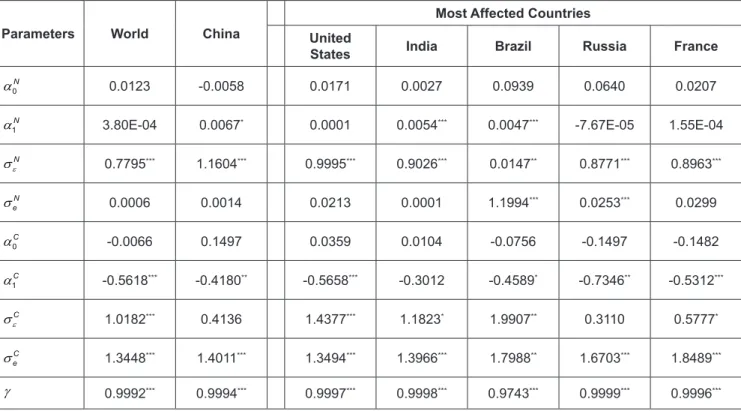
The parameter estimates are reported in Panel 3.1 of Table 3. The intercepts α
0Nand α
0Cfor the pre-COVID-19 normal and COVID-19-induced returns, respectively, are non-significant. This result supports the small mean returns and non-significant mean difference reported in Table 2. The results for the slope coefficients α
1Nfor the normal returns are mixed. They are significant and positive for China, India, Brazil, and Hong Kong. The remaining variables are non-significant. Hence, the negative AR(1) coefficients
in Panel 2.3, Table 2, are explained by the negative slope coefficients α
1Cfor the COVID-19-induced returns. The large standard deviations found for the sample stocks in the COVID-19 sample are explained further by the error terms
tC
e of random returns r
tCthan by the error terms ε
tCof
random expected returns µ
tC. The exceptions are the United
States, Brazilian, Australian, and Thai markets, with reverse
case. Finally, the contributing weights γ are significant
at the 99% confidence level for all markets. The largest
effects are for the Russian market (i.e., 99.99%), whereas
the smallest effects are for the Brazilian market (i.e.,
97.43%). The study concludes that the COVID-19 effects
are significant and very large.
4.2. Hypothesis Tests
4.2.1. COVID-19-Induced Returns Replace Normal Returns
The hypothesis whether COVID-19-induced returns replace the pre-COVID-19 normal returns is tested in this study. Under the null hypothesis, γ = 1 and r r
t=
tCduring the COVID-19 period. In row 2 of Panel 3.2, Table 3, the hypothesis cannot be rejected for any market, except for the Brazilian market. For the Brazilian market, the significant difference of γ from is 2.57%; the contribution of the normal return r
tNduring the COVID-19 period is small. The finding that γ = 1 is consistent with that of Onali (2020), who found from a Markov-switching test for Dow-Jones returns that the probability of returns being in the COVID-19 state was greater than 0.99.
4.2.2. Different Processes for Pre-COVID-19 Normal and COVID-19-Induced Returns
Although the contributing weights γ of COVID-19- induced returns are large and significant for all the sample
markets, the new normal returns are essentially the same as the normal returns if the parameters ( , α α σ σ
0N 1N, ε
N,
eN) and
0 1
( , α α σ σ
C C, ε
C,
eC) are not significantly different. This study conducted a joint hypothesis test for equal parameters. The results are reported in the last row of Panel 3.2, Table 3.
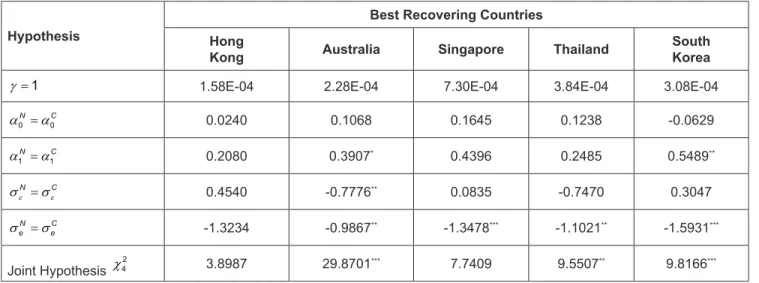
The Wald test rejects the hypothesis for all countries, except for India, Hong Kong, and Singapore. However, when the study conducts separate tests for parameter pairs—
0N 0C
,
1N 1C, ε
Cε
N,
α = α α = α σ = σ and σ
eC= σ
eN, the results show that the hypothesis σ
eC= σ
eNis rejected for the Indian and Singaporean markets. Conversely, none of the four hypotheses is rejected for the Hong Kong market.
The study examines why the results for Hong Kong are non-significant. From Panel 2.4, Table 2, the standard deviations of returns in the COVID-19 sample are significantly larger than those in the pre-COVID-19 sample. Based on this finding, the study examines the sizes of σ σ ε
N( )
eCvis-à-vis σ σ ε
N( )
eCfrom Panel 3.1, Table 3. The sizes are σ ε
N= 1.7086 ( σ
eC= 0.6243) and
0.0073 ( 1.3307).
N C
e
σ ε = σ = The parameters σ ε
Nand σ
eCare significant, and the sizes of the parameters in each pair are financially different. It is likely that non-significance for Hong Kong results from imprecise estimates σ
eNand σ ε
C.
Table 3: Parameter Estimates and Hypothesis Tests Panel 3.1: Parameter Estimates
Parameters World China
Most Affected Countries United
States India Brazil Russia France
α
0N0.0123 -0.0058 0.0171 0.0027 0.0939 0.0640 0.0207
α
1N3.80E-04 0.0067
*0.0001 0.0054
***0.0047
***-7.67E-05 1.55E-04
σ
εN0.7795
***1.1604
***0.9995
***0.9026
***0.0147
**0.8771
***0.8963
***σ
eN0.0006 0.0014 0.0213 0.0001 1.1994
***0.0253
***0.0299
α
0C-0.0066 0.1497 0.0359 0.0104 -0.0756 -0.1497 -0.1482
α
1C-0.5618
***-0.4180
**-0.5658
***-0.3012 -0.4589
*-0.7346
**-0.5312
***σ
εC1.0182
***0.4136 1.4377
***1.1823
*1.9907
**0.3110 0.5777
*σ
Ce1.3448
***1.4011
***1.3494
***1.3966
***1.7988
**1.6703
***1.8489
***γ 0.9992
***0.9994
***0.9997
***0.9998
***0.9743
***0.9999
***0.9996
****
,
**, and
***denote the significance at the 90%, 95%, and 99% confidence levels, respectively.
Panel 3.2: Hypothesis Tests
Hypothesis World China
Most Affected Countries United
States India Brazil Russia France
γ = 1 8.22E-04 6.50E-04 2.79E-04 1.66E-04 0.0257
***5.16E-05 3.68E-04
α
0N= α
0C0.0189 -0.1555 -0.0188 -0.0077 0.1695 0.2136 0.1689
α
1N= α
1C0.5622
***0.4246
**0.5660
***0.3066 0.4636
*0.7345
**0.5313
***ε ε
σ
N= σ
C-0.2387 0.7468
**-0.4381 -0.2797 -1.9760
**0.5661
**0.3186
σ
eN= σ
Ce-1.3442
***-1.3997
***-1.3281
***-1.3965
***-0.5994 -1.6449
**-1.8190 Joint
Hypothesis
χ
4218.7597
***
42.6904
***27.1743
***3.0281 67.0403
***44.0934
***13.1395
****
,
**, and
***denote the significance at the 90%, 95%, and 99% confidence levels, respectively.
Panel 3.1: Parameter Estimates (Continued) Parameters
Best Recovering Countries
Hong Kong Australia Singapore Thailand South
Korea
α
0N-0.0135 0.0292 0.0107 -0.0441 -0.0203
α
1N0.0033
***6.72E-05 5.00E-05 -1.25E-04 -2.75E-05
σ
εN1.0786
***0.7438
***0.6550
***0.7240
***0.9307
***σ
eN0.0073 0.0020
***0.0035 0.0209 0.0127
α
0C-0.0375 -0.0776 -0.1537 -0.1680 0.0427
α
1C-0.2046 -0.3907
*-0.4396 -0.2486 -0.5489
**σ
εC0.6246 1.5214
***0.5714 1.4710
*0.6259
σ
Ce1.3307
***0.9888
**1.3513
***1.1230 1.6058
***γ 0.9998
***0.9998
***0.9993
***0.9996
***0.9997
****
,
**, and
***denote the significance at the 90%, 95%, and 99% confidence levels, respectively.
Table 4: Checks for Robustness and Early Effects
Parameters World China Most Affected Countries
United
States India Brazil Russia France
γ
10.9930
***0.9997
***0.9936
***0.9975
***0.9920
***0.9999
***0.9999
***γ
20.9996
***0.9996
***0.9999
***0.9999
***0.9999
***0.9999
***0.9998
***γ
2− γ 4.71E-04 1.87E-04 1.36E-04 8.09E-05 0.0257
***2.74E-05 1.67E-04
* and *** denote the significance at the 90% and 99% confidence levels, respectively. The estimates γ and γ
1are for the cases in which days t = 0 are November 18, 2019, and January 20, 2020, respectively, whereas the estimate γ
2is for a shorter COVID-19 sample from November 18, 2019, to March 31, 2020. The full parameter estimates can be obtained from the author upon request.
Table 4: Checks for Robustness and Early Effects (Continued)
Parameters Best Recovering Countries
Hong Kong Australia Singapore Thailand South
Korea
γ
10.9461
***0.9946
***0.9973
***0.9999
***0.9980
***γ
20.9996
***0.9999
***0.9998
***0.9999
***0.9999
***γ
2− γ -2.47E-04 1.90E-04
*5.01E-04 2.02E-04 2.21E-04
* and *** denote the significance at the 90% and 99% confidence levels, respectively. The estimates γ and γ
1are for the cases in which days t = 0 are November 18, 2019, and January 20, 2020, respectively, whereas the estimate γ
2is for a shorter COVID-19 sample from November 18, 2019, to March 31, 2020. The full parameter estimates can be obtained from the author upon request.
Panel 3.2: Hypothesis Tests (Continued) Hypothesis
Best Recovering Countries
Hong Kong Australia Singapore Thailand South
Korea
γ = 1 1.58E-04 2.28E-04 7.30E-04 3.84E-04 3.08E-04
α
0N= α
0C0.0240 0.1068 0.1645 0.1238 -0.0629
α
1N= α
1C0.2080 0.3907
*0.4396 0.2485 0.5489
**ε ε
σ
N= σ
C0.4540 -0.7776
**0.0835 -0.7470 0.3047
σ
eN= σ
Ce-1.3234 -0.9867
**-1.3478
***-1.1021
**-1.5931
***Joint Hypothesis χ
423.8987 29.8701
***7.7409 9.5507
**9.8166
****