Print ISSN: 2288-4637 / Online ISSN 2288-4645 doi:10.13106/jafeb.2020.vol7.no9.095
Asian Stock Markets Analysis: The New Evidence from Time-Varying Coefficient Autoregressive Model
Napon HONGSAKULVASU 1 , Asama LIAMMUKDA 2
Received: July 03, 2020 Revised: July 19, 2020 Accepted: August 10, 2020
Abstract
In financial economics studies, the autoregressive model has been a workhorse for a long time. However, the model has a fixed value on every parameter and requires the stationarity assumptions. Time-varying coefficient autoregressive model that we use in this paper offers some desirable benefits over the traditional model such as the parameters are allowed to be varied over-time and can be applies to non- stationary financial data. This paper provides the Monte Carlo simulation studies which show that the model can capture the dynamic movement of parameters very well, even though, there are some sudden changes or jumps. For the daily data from January 1, 2015 to February 12, 2020, our paper provides the empirical studies that Thailand, Taiwan and Tokyo Stock market Index can be explained very well by the time-varying coefficient autoregressive model with lag order one while South Korea’s stock index can be explained by the model with lag order three. We show that the model can unveil the non-linear shape of the estimated mean. We employ GJR-GARCH in the condition variance equation and found the evidences that the negative shocks have more impact on market’s volatility than the positive shock in the case of South Korea and Tokyo.
Keywords: Non-Stationary, Time-Varying Coefficient, Autoregressive Model, Asian Stock Markets, GJR-GARCH JEL Classification Code: C14, C22, G15, G17
market, we use the return of the market instead of the stock market index to avoid time-trend and non-stationary problem (Tsay, 2002). Since the stock market index or price is non- stationary in nature, the studies that involve the stock market index in their model need to use the non-stationary model such as cointegration and VECM (Lee & Zhao, 2014; Lee
& Brahmasrene, 2018) or convert the stock price into stock return and use the stationary model such as autoregressive or vector autoregressive model (Goudarzi & Ramanarayanan, 2010; Parsva & Lean, 2017).
For alternative approach, this paper applies the time- varying coefficient autoregressive model using generalized additive modeling which can be applied to time-trend data (Bringmann et al., 2017). The time-varying model can be applied to both stationary and non-stationary data (Chow, Zu, Shifren, & Zhang, 2011). In additional, the time-varying model offers some great benefit over the traditional one by allowing the parameters in the model to be changing over time. There are some studies try to unveil the changing in stock market by using Markov switching autoregressive model (Ismail & Isa, 2008; Wasim & Bandi, 2011).
However, Markov switching technique is normally applied for 2 regime shifts situation while our model can reveal the
1. Introduction
The traditional autoregressive model has been a popular model in the field of financial economics for many decades.
The nice feature of the autoregressive model is that the model can capture the time-lagged relationship of the interesting variable. However, the parameters in the model are time- invariant and the model can apply only to stationary data (Chatfield, 2003). Since many data in the field of financial economics, such as the stock index, contain time-trend in which researcher needs to detrend the data before estimating the model. So, normally, if we want to study the stock
1
First Author and Corresponding Author. Lecturer, Faculty of Economics, Chiang Mai University, Thailand [Postal Address: 239 Huay Kaew Road, Tambon Su Thep, Mueang Chiang Mai District, Chiang Mai 50200, Thailand] Email: [email protected]
2
Ph.D. Student, Department of Statistics, Faculty of Science, Chiang Mai University, Thailand. Email: [email protected].
© Copyright: The Author(s)
This is an Open Access article distributed under the terms of the Creative Commons Attribution
Non-Commercial License (https://creativecommons.org/licenses/by-nc/4.0/) which permits
unrestricted non-commercial use, distribution, and reproduction in any medium, provided the
original work is properly cited.
dynamic movement on every coefficient and mean over the period of time.
The traditional autoregressive model requires many assumptions on stationarity, however, some assumptions can be relaxed in the time-varying coefficient autoregressive model. For traditional model, the parameters are time- invariant in which mean and variance of the model are also time-invariant. Since the stock market index always has a time-trends in the data, consequently, mean of the stock index is changing all the time. Having the model that can captures the dynamic changing in parameters and mean is a desirable benefit.
The research goals of this paper are to fill the gap in the literature and provide the new evidence of applying the time- varying autoregressive model on Asian stock market indices.
This paper provides the Monte Carlo simulation studies that when the parameters of the autoregressive model changing over time, the time-varying coefficient model can capture the dynamic movement of the parameters very well, even though, there is a sudden change or jump. Our simulation study extends Bringmann et al. (2017)’s paper by covering the model with lag order one, two and three.
This paper provides the empirical study results of applying the time-varying coefficient autoregressive model and time- varying volatility model on four Asian stock market indices, Stock Exchange of Thailand (SET), Korea Composite Stock Price Index (KOSPI), Taiwan Stock Exchange (TWSE) and Tokyo Stock Exchange (TSE). The time-varying autoregressive model provides the evidences that Asian stock market indices have a non-linear dynamic relationship between current index and lagged periods indices. We also provide the evidence that the model can provide non- linear estimated mean which follow closely to the dynamic movement of the stock index. The GJR-GARCH which we employ in the conditional variance equation provide the evidence of the leverage effects in some markets.
This paper is organized as follows: Section II describes methodology while section III presents the Monte Carlo simulation results. Section IV presents the empirical results on Asian Stock markets. Finally, the summary is presented in the last section.
2. Research Methodology
For the traditional autoregressive model with lag order one or AR(1):
y
t= β
0+ β
1y
t−1+ ε
t(1) This AR(1) model has 2 parameters to be estimated β
0and β
1which can be easily estimated by linear least square method. The parameter β
1shows how previous period of the
focused variable affect current period of the same variable.
However, these parameters are constant over-time. Under the stationary assumption, the parameter β
1is required to have value in between -1 and 1 ( − < 1 β
1< 1 ) . The ε
tof the model is assumed to be a white noise series with zero mean and variance σ
2ε (Tsay, 2002). Then, the mean µ and the variance σ
2of the model in equation 1 are
( ) ( )
1 01
1t t
E y E y µ β
β
=
−= =
− (2)
( )
2 221
1Var y
tσ σ ε
= = β
− (3)
From equation 2 and 3, the parameter β
1can’t be equal to +1 or -1, otherwise mean and variance of the AR(1) model will be explode to infinity. For the autoregressive with lag order greater than one, it is required that the characteristic roots of the parameter equation must be less than one in modulus (Chatfield, 2003; Hamilton, 1994; Tsay, 2002). For the time- varying autoregressive model with lag order one (TV-AR(1)):
y
t= β
0,t+ β
1,t ty
−1+ ε
t(4) The parameters β
0,tand β
1,tnow can be changing over time (Giraitis, Kapetanios & Yates, 2014). The ε
tof the model is still assumed to be a white noise series with zero mean and variance σ
2ε . Even though, the parameter β
1,tcan be changing over time, but the model still requires the value of parameter β
1,tto be in between -1 and 1 (–1 < β
1,t<1) (Dahlhaus, 1997). For the model with lag order greater than one, it is also required that the characteristic roots of the parameter equation must be less than one in modulus. Since the parameters of the new model now are time-variant, then mean and variance of the model can be changing over time (Giraitis, Kapetanios, & Yates, 2014).
0,
1
1, tt t
µ β
≈ β
− (5)
2 2
1,2 t
1
t
σ ε
σ ≈ β
− (6)
Bringmann et al. (2017) mentioned that, even though, the
model allows parameters to be changing over time, but it still
requires that the changing in parameters should be gradual
change and shouldn’t have a jump or sudden change in their
values. However, our Monte Carlo simulations show that,
even though, there is a sudden change or jump in parameter
value, the model still works very well. The time-varying
autoregressive model used the generalized additive model
(GAM) to estimate the time-varying parameters (Hastie
& Tibshirani, 1990; Sullivan, Shadish, & Steiner, 2015;
Wood, 2006). GAM applies the non-parametric smooth function that based on regression splines. For the simplified explanation, we follow Bringmann et al. (2017) to consider on time-varying coefficient autoregressive model with one a time-varying intercept and no autoregressive parameter.
y
t= β
0,t+ ε
t(7)
By using regression splines method, the time-varying parameter can be estimate by
( ) ( ) ( ) ( )
0, 1 1 2 2 3 3
ˆ
tˆ R t ˆ R t ˆ R t ˆ
K KR t
β = α + α + α + + α (8)
By choosing the type basis function R(K) and the number of basis function, k, then ˆ
0,β
tcan be estimated by using a simple linear regression.Each basis function can be calculated by the data we have, this method is actually a data driven approach. For a very simple example, we can choose a basis function as a polynomial with order 4, then R t =
1( ) 1 ,
2
( )
R t = t , R t
3( ) = t
2, R t
4( ) = t
3, R t
5( ) = t
4(Wood, 2006).
The parameter ˆ
0,β
tcan be any shape from linear to any non-linear shapes. In practice, we have many choices on the type of basis function such as a cubic regression splines and thin-plate regression splines. In this paper, we use the package “mgcv” on R program to estimate the time-varying coefficient autoregressive model (Wood, 2006). We use a thin-plate regression splines which is the default setting on package because there are no need to choose the knot locations and it performs very well when we have many independent variables which, in our case, means it’s good for autoregressive with order greater than 1 (Wood, 2003).
The optimal value of estimated time-varying parameter ˆ
0,β
tcan be found when we perform the minimization of this penalized least squares loss function.
2 '' 2
0, 0,
1
+∞
= −∞
− +
∑
Tty
tβ
tλ ∫ β
tdt (9)
The first term equation 9 is a simple linear least square minimization. The second term is the roughness penalty or wiggliness. The smoothing parameter λ controls how the shape of time-varying parameter will look like. If λ is small, the wiggliness penalty will be small, then we will have a non- linear and wiggle shape of the parameter. On the other hand, if If λ is large, the shape of the parameter will be a straight line.
( )
( )
2 1 0,
2
ˆ
T
t t
T
ty GCV tr I A
=
− β
= −
∑ (10)
The optimal value of λ can be achieved by choosing λ that give the lowest value of the generalized cross validation score (Wahba, 1980; Wood, 2006). After we perform the time-varying coefficient autoregressive model, we apply the Ljung-Box test on the estimated residuals and estimated squared residuals. If the model is adequate, there won’t have an auto correlation in the estimated residuals. If there is no heteroskedasticity problem, there won’t have an auto correlation in the estimated squared residuals (Tsay, 2002).
In the case that there is a heteroskedasticity problem, we will perform the time-varying volatility model. Glosten, Jagannathan and Runkle (1993)’s GJR-GARCH model will be used for the variance equation.
0, 1, 1
t t t t t
y = β + β y
−+ ε (11)
( )
1/2
; ~ . . . 0,1
t
h z z
t t ti i d
ε = (12)
2 2
1 1 1 1
t t t t t
h = + ω αε
−+ γ I
−ε
−+ β h
−(13) where I
t−1= 0 , if ε
t−1> 0 and I
t−1= 1 , if ε
t−1< 0 . Equation (11) is the conditional mean equation which follows the time-varying coefficient autoregressive model with lag order one. The mean equation can be easily extended to higher lag order. Equation (13) is the conditional variance equation which allow the variance, h
t, to be changing over time under heteroskedasticity condition. We decide the use GJR-GARCH model for the variance equation because it extends Engle (1982)’s ARCH model and Bollerslev (1986)’s GARCH model to capture the different effect between positive and negative shocks on volatility. For the GJR-GARCH estimation, we use “rugarch” package on “R”
program which we decide to choose the generalized error distribution (GED) for the distribution option. GED offers some desirable benefits which can work with the data that has excess skewness and kurtosis.
3. The Monte Carlo Simulation Study
In this section, we provide the simulation study on the time-varying coefficient autoregressive model in order to show that the model can capture the dynamic movement of each parameter very well. The number of data in the simulation is 1,000 which follows the nature of financial data that has abundance of data available. The simulation will repeat 100 times and then calculates for 2.5%, 50%, 97.5% quantiles of each parameter and mean of the model.
We extend the simulation studied of (Bringmann et al., 2017)
to cover the model with lag order one, two and three. The
parameters of the model will follow fours cases: invariant
case, linear increasing case, sine function case and random
walk case.
For the invariant case, we set the parameters to be a fixed value. For the linear increasing case, we set the parameters to be increasing over-time in a linear form. For the sine function case, we set the parameters to be changing over-time in a non- linear form as a sine function; MAX sine . 2. . t
T π
,which
MAX is the maximum value of the parameter. The random walk case, we set the parameters to be changing over-time in a non- linear form with a sudden change or jump which follows the random walk process as β
t= β
t−1+ a
twhich α
thas a normal distribution with zero mean and one standard deviation.
Time-varying coefficient autoregressive model with lag order one will follow equation 4. For the invariant case, the value of β
0,twill be fixed at 3 while the value of β
1,twill be equal to 0.7. For the linear increasing case, the value of β
0,twill be linearly increasing from 0.5 to 3 while the value of β
1,twill be linearly increasing from 0.3 to 0.7. For the sine function case, the value of β
0,tand β
1,twill follow sine function as MAX sine . 2. . t
T
π
which MAX equal to 3 for β
0,tand 0.7 for β
1,t. For the random walk case, the value of β
0,tand β
1,twill follow random walk process with the maximum value equal to 3 and 0.7 respectively.
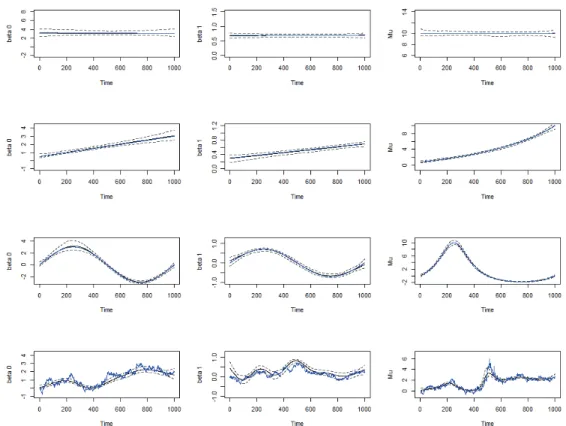
For Figure 1, the blue line is the real value while the black line is the 50% quantile from 100 times simulation and the dot lines are the 2.5% and 97.5% quantile from 100 times simulation. The first row of figure 1 shows the simulation results for the invariant case. Since β
0,tand β
1,thave a fixed value over time, then the mean of the model, µ, also has a fixed value over time. The second row shows the case that the parameter β
0,tand β
1,tare linearly increasing over time and the mean of the model, µ, is non-linear increasing over time with a positive time trend.
The third row shows that the model can reveal the sine shape of the parameters and the mean of the model very well. Even though, Bringmann et al. (2017) mentioned that the model is good if there is no jump or sudden change in the parameter, however, the last row shows that, for the case of random walk process in parameters, the model can capture the sudden change or jump in parameters and mean of the model very well.
Note: First row shows the parameters in theinvariant case. Second row shows the parameters in the linear increasing case. Third row shows the parameters in the sine function case. The fourth row shows the parameters in the random walk case. The first column shows the simulation results of β
0,twhile the second shows the results of β
1,t. The third column shows the simulation results of the mean of the model, µ. Blue line is the real value while the black line is the 50% quantile from 100 times simulation and the dot lines are the 2.5% and 97.5%
quantile from 100 times simulation.
Figure 1: Simulation results of Time-varying coefficient autoregressive model with lag order one.
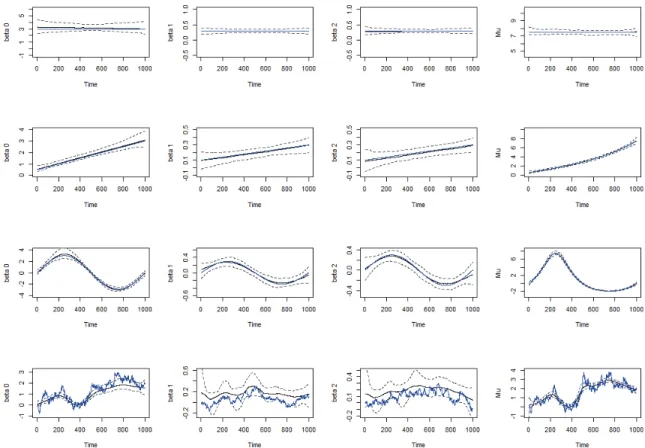
Time-varying autoregressive model with lag order two is shown in the following equation.
0, 1, 1 2, 2
t t t t t t t
y = β + β y
−+ β y
−+ ε (14)
For this model, we have 3 time-varying parameters to be estimated β
0,t, β
1,tand β
2,tFor the invariant case, the value of β
0,t, β
1,tand β
2,twill be fixed at 3, 0.3 and 0.3 respectively.
For the linear increasing case, the value of β
0,twill be linearly increasing from 0.5 to 3 while the value of β
1,tand β
2,twill be linearly increasing from 0.1 to 0.3. For the sine function case, the value of β
0,t, β
1,tand β
2,twill follow sine function as MAX sine . 2. . t
T
π
which MAX equal to 3, 0.3 and 0.3 respectively. For the random walk case, the value of β
0,t, β
1,tand β
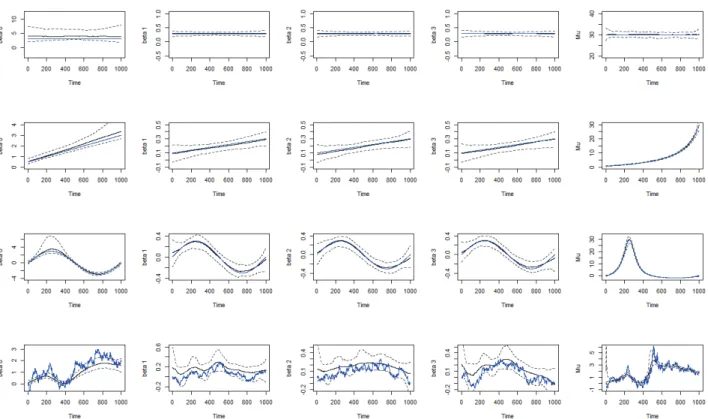
2,twill follow random walk process with the maximum value equal to 3, 0.3 and 0.3 respectively. Time-varying autoregressive model with lag order three.
0, 1, 1 2, 2 3, 3
t t t t t t t t t