대기 중 PCBs의 PAS에 이용되는 여러 매체의 PCBs 침착 특성
천만영† 한경대학교 환경공학과
Depositional Characteristics of Atmospheric PCBs in Several Media Used Passive Air Samplers
Man-Young Chun†
Department of Environmental Engineering, Hankyung National University, Anseong, Korea
ABSTRACT
Objective: This study was carried out to determine the depositional characteristics of pine needles, pine tree bark, moss, and soil, which are used as a passive air sampler (PAS) of atmospheric polychlorinated biphenyls (PCBs).
Methods: All four media were sampled from the same site. PCB concentrations were analyzed by GC/MSD, and the lipid contents were measured using the gravimetric method.
Results: The total PCB concentration (IUPAC No. 28, 52, 101, 138, 153, 180) was the highest in soil (227.97 pg/g dry), followed by pine needles (71.36 pg/g dry), pine tree bark (44.58 pg/g dry), then moss (21.91 pg/g dry).
Pine needles contained the highest lipid contents (21.31 mg/g dry), whereas soil (10.01 mg/g dry), pine tree bark (4.85 mg/g dry), and moss (1.92 mg/g dry) contained less. The concentration of lower-chlorinated PCBs was relatively high in pine needles, pine tree bark and moss, but not in soil. The PCB concentrations were proportional to their lipid contents in pine needles, pine tree bark and moss, but a different trend was revealed in soil.
Conclusions: The PCBs concentrations in the media were affected by various factors including atmospheric PCB concentrations, lipid contents, and depositional pathways. However, each of these factors had a varying influence depending on the type of medium.
Keywords: atmospheric PCBs, passive air sampler, media, lipid contents, depositional pathways
I. 서 론
폴리염화비페닐(Polychlorinated biphenyls, PCBs) 와 다이옥신/퓨란 (polychlorinaned dibenzo-p-dioxins/
furans, PCDD/Fs) 같은 잔류성 유기오염물질(persistent organic pollutants, POPs)은 반휘발성 유기화합물 (semivolatile organic compounds, SOCs)이므로 대기 를 통하여 장거리 이동되며 강우 시나 기온이 낮아
지면 대기로부터 식물, 토양, 수계에 건식 및 습식 침착되고 반대로 기온이 높아지면 이들 환경매체로 부터 대기 중으로 휘발되어 장거리 이동되므로 대기 중 POPs 농도를 아는 것은 POPs의 환경 중에서의 순환을 이해하는데 매우 중요하다.1-3)
대기 중 POPs를 측정하기 위해서는 일반적으로 polyurethane foam (PUF) 시료채취기로 시료를 채 취하는데, PUF 시료채취기는 전원이 필요한 고가 장
†Corresponding author: Department of Environmental Engineering, Hankyung National University, Tel : +82-31-670- 5172, Fax : +82-31-673-2704, E-mail : [email protected]
Received: 26 February 2013, Revised: 15 April 2013, Accepted: 19 April 2013
비이므로 여러 장소에서 동시에 시료를 채취하거나 전원을 이용할 수 없는 지역에서는 사용이 어렵다.
이럴 때 유용하게 이용되는 것이 passive air sampler (PAS)이다.4-21)
지금까지 대기 중 PCBs 등 POPs의 PAS로는 나 뭇잎, 나무껍질, 이끼와 토양 등이 많이 이용되어 왔
다.4-21) 그러나 상술한 PAS에 침착된 POPs 농도는
자외선, OH radical에 의한 분해, 풍속, PAS의 대기 중 노출시간 등에 영향을 받지만 노출 시간 산정이 어려워 PAS에 침착된 POPs 농도로 대기 중 POPs 농도를 추정하는 데에는 어려움이 많았다.22-25,33) 이 러한 이유로 최근에는 보호용기(shelter) 안에 XAD- 2 resin, PUF와 semipermeable membrane devices (SPMDs)를 장착하여 바람과 광분해로 생기는 영향 을 줄인 PAS를 개발하여 대기 중 POPs 농도를 추 정하는데 이용하고 있다.4,5) 그러나 이러한 PAS 역 시 제작단가가 비교적 높고 시료채취 전에 흡착제를 세척하고 밀봉하여 보관하여야 하며 시료채취를 위 하여 시료채취기의 설치와 수거를 해야 하는 등 번 거로운 점이 많다. 나뭇잎, 나무껍질, 이끼와 토양 등은 보호용기의 제작이나 흡착제의 세척 같은 예비 단계가 필요 없고, 언제 어디서나 쉽게 시료의 채취 가 가능하므로 매우 편리하고 경제적인 PAS이다. 그 러므로 PAS로 대기 중 POPs 농도를 계산하는 경우 가 아니고 단순하게 각 지역별 POPs 농도를 비교할 경우 상기의 매체들이 아직도 많이 이용되고 있다.6-20) 그러나 지금까지 몇 가지 매체에 침착되는 대기 중 POPs의 단편적인 연구 결과는 있었지만 여러 가 지 매체에 침착되는 대기 중 POPs의 침착 특성을 총체적으로 비교한 연구는 부족하다.16) 대기 중 POPs 가 각 매체에 침착되는 특성을 파악하지 못한 상태 에서 사용할 경우 PAS에 의한 해석은 오류를 범할 가능성이 크다.
본 연구는 대기 중 POPs의 PAS로 가장 많이 이 용되고 있는 소나무잎, 나무껍질, 이끼와 토양에 침 착된 PCBs의 특성을 파악하여 각 매체를 PAS로 사 용할 때 잘못된 해석으로 인한 오류를 방지하기 위 하여 수행되었다.
II. 재료 및 방법 1. 시약
정제용 내부표준물질(13C12 PCBs mixture, IUPAC No. 28, 52, 101, 138, 153, 180, catalog No. EC-4058) 은 Cambridge Isotope Laboratories, Inc., (Andover, MA, U.S.A.), 첨가용 내부표준물질(recovery surrogate standard; 4,4'-dibromooctafluorobiphenyl)은 Supelco (Bellefonte, PA, U.S.A.)에서 구매하여 사용하였고 용매인 dichloromethane (DCM) 및 n-hexane은 HPLC grade (J.T.Baker, Philipsburg, NJ, USA)를 사 용하였으며 n-hexane은 증류하여 사용하였다.
Na2SO4 (anhydrous granular, Shinyo Pure Chemical, Osaska, Japan), silica(SiO2, 70-230 mesh ASTM, Merck, Darmstadt, Germany)는 130oC의 오븐에 24 시간 이상 넣어 활성화시킨 후 사용하였다. GPC (gel permeation chromatography) 칼럼에 사용된 Bio-bead 는 Bio Rad사의 S-X3, 40-80 µm (Hercules, CA, USA)를 사용하였으며, 분석에 사용된 PCBs 검량선 작성용 표준용액(calibration standard)는 Cambridge Isotope Laboratories, Inc.,의 PCBs mixture (IUPAC No. 28, 52, 101, 138, 153, 180, catalog No. EC- 5179)를 사용하였다. 황산(H2SO4)은 유해금속측정용 (Matsuneon Chemicals, Osaka, Japan)을 사용하였다.
Table 1은 PCBs의 물리ㆍ화학적 특성을 나타낸 것이다.
2. 시료채취
시료로 사용된 소나무잎, 소나무껍질, 이끼와 토 양은 경기도 안성시에 소재하는 한경대학교 내에서 채취하였다. 소나무잎, 소나무껍질은 같은 소나무 (Pinus densiflora)에서 채취하였으며 토양은 소나 무 바로 아래 반경 3 m 이내의 20여 곳에서 표토 5 cm 이내의 토양만을 채취하였다. 이끼는 시료로 사용된 소나무에서 약 5 m 떨어진 다른 종류의 나 무에서 자라는 것을 채취하였다. 소나무잎은 2년생 을 채취하였고, 소나무껍질은 외피에서 약 5 mm를 끌(chisel)로 벗겨내어 시료로 사용하였다. 소나무잎, 소나무껍질 및 이끼는 토양의 영향을 배제하고 자 외선과 통풍에 의한 침착오차를 줄이기 위하여 지 상 1-1.5 m 높이의 모든 방향에서 골고루 채취하여 혼합하였다.
소나무잎은 n-hexane으로 세척한 알루미늄 호일에 싸서 PE 지퍼 백에 넣어 밀봉하였고, 소나무껍질, 이 끼와 토양은 n-hexane으로 세척한 유리병에 넣고 n- hexane으로 세척한 알루미늄 호일을 덮고 두껑으로
밀봉한 다음 아이스박스에 담아 실험실로 운반한 후 분석 때까지 −20oC 냉동고에 보관하였다.
3. 추출 및 시료 건조
추출에 사용된 시료는 각 매체 별로 시료를 골고 루 혼합한 후 소나무잎 약 40 g, 소나무껍질 약 15 g, 이끼 약 6 g, 토양 약 50 g을 사용하였으며 한 매체 에서 2개의 시료(duplicate)을 만들어 정제용 내부표 준물질을 주입한 후 Cellulose thimble (Sigma- Aldrich, size 43 mm×123 mm)에 넣고 속슬렛에서 n-hexane:acetone(4:1) 혼합용액으로 20-24 시간동안 추출하였다. 습/건시료 무게비는 습시료 약 5-10 g을 95oC에서 24시간 이상 건조시킨 후 전후 무게차이 를 이용하여 계산하였다. 지질농도는 오븐에서 건조 시킨 시료를 속슬렛에서 n-hexane으로 20-24시간 추 출하고 추출 용매를 회전증발 농축기에서 농축한 후 시료를 알루미늄 접시에 정량적으로 옮겨 70oC 진 공오븐에서 완전히 용매를 휘발시킨 다음 중량법으 로 측정하였다.
소나무껍질은 스테인레스 파쇄기에서 파쇄시킨 후 체눈크기 2 mm (10 mesh) 스테인레스 체로 쳐서 통 과한 것만 시료로 사용하였다. 토양시료는 체눈크기 1 mm (18 mesh) 스테인레스 체로 쳐서 통과한 토양 에 수분을 제거하기 위하여 같은 양의 무수황산나트 륨을 잘 혼합하여 사용하였다.
4. 전처리
PCBs에 대한 전처리 및 분석법은 기존문헌에 기 술되어 있으나 간략하게 정리하면 아래와 같다.32)
1) Acidic Silica 칼럼
속슬렛에서 추출한 추출액을 회전증발 농축기에서 약 2-3 mL까지 농축하였다. 시료는 내경 200 mm,
길이 300 mm인 유리 칼럼에 하층부터 acidic silica 20 g (H2SO4 30 w/w%), 중성 silica 10 g, 무수 Na2SO4 약 10 g을 차례로 넣고 n-hexane 500 mL로 세척한 후 농축한 시료를 넣고 n-hexane 500 mL로 용출시 켜 방해물질을 제거하였다. 용출한 시료는 회전증발 농축기에서 약 1 mL까지 농축하였다.
2) GPC 칼럼
Acidic silica 칼럼만으로는 시료에 포함되어 있는 방해물질을 충분히 제거할 수 없으므로 내경 20 mm, 길이 220 mm 유리관에 bio-beads 12 g을 충전시킨 GPC 칼럼으로 다시 시료를 정제하였다. Acidic silica 칼럼으로 용출한 용매를 n-hexane:DCM (1:1) 혼합 용매 100 mL로 세척한 GPC 칼럼에 넣고 n-hexane:
DCM (1:1) 혼합용매 90 mL로 용출시켰다. 용출액 의 처음 34 mL에는 방해물질이 포함되어 있으므로 버리고 나머지 56 mL는 PCBs 분율(fraction)이므로 분석에 이용하였다.
5. 분석
GPC 칼럼의 PCBs 분율을 회전증발 농축기에서 약 1-2 mL까지 농축한 다음 10 mL vial에 정량적으 로 옮기고 첨가용 내부표준물질과 최종농축용매로 n-nonane 50 µL를 가한 후 전열판(hot plate) 위에서 질소로 천천히 약 50 µL까지 농축하여 GC-MSD로 분석하였으며, Table 2는 GC-MSD의 PCBs 분석조 건을 나타낸 것이다.
6. QA/QC
PCBs의 정량 시 크로마토그램의 높이가 노이즈의 3배 이상인 것만 정량에 포함시켰다. 정제용 내부표 준물질로 사용된 6종의 13C12 PCBs를 이용하여 모 든 전처리 과정에 대한 회수율을 총 5회 평가한 결 Table 1. Physico-chemical properties of Selected PCB Congeners.
Congeners
(IUPAC No.) Compound Average molecular
weight30)
Vapor pressure (mmHg at 25oC)30)
LogKoa (at 25oC)27,30) 28
52 101 138 153 180
2,4,4’-Trichlorobiphenyl 2,2‘,5,5’-Tetrachlorobiphenyl 2,2‘,4,5,5’-Pentachlorobiphenyl 2,2‘,3,4,4',5’-Hexachlorobiphenyl 2,2‘,4,4’,5,5’-Hexachlorobiphenyl 2,2‘,3,4,4',5,5’-Heptachlorobiphenyl
257.6 292.0 326.4 360.9 360.9 429.8
7.7×10⁻⁵ 8.6×10⁻⁵ 2.1×10⁻⁵ 4.0×10⁻⁵ 5.2×10⁻⁶ 9.7×10⁻⁷
8.08 8.39 9.03 9.81 9.69 10.37
과 회수율은 81.2-110.5%였으며, 분자량이 작을수록 회수율이 낮았다. 시료마다 두 개(duplicate)의 부시 료를 만들어 분석하였는데, 두 부시료 간 변이계수 (coefficient of variation, CV)는 평균 18.43%(3.93- 53.03%)였다.
III. 결 과
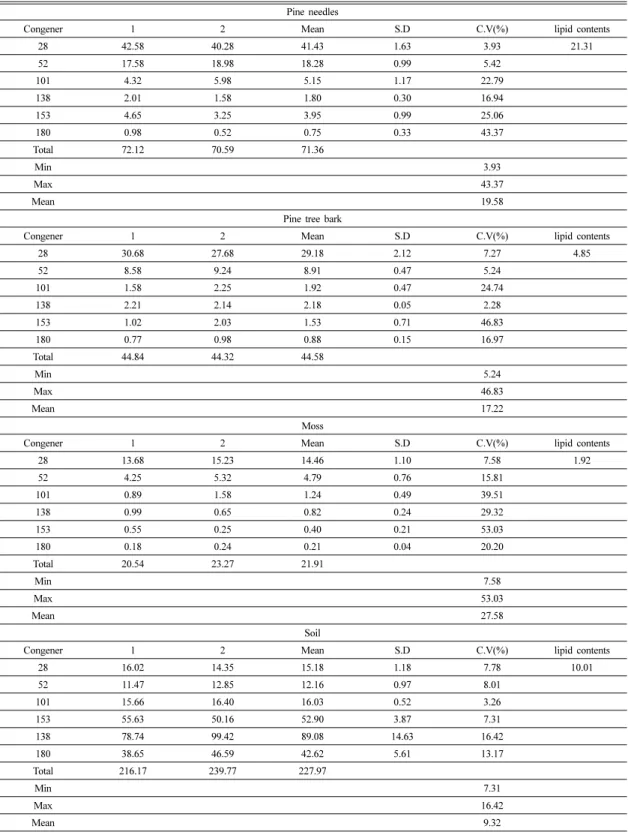
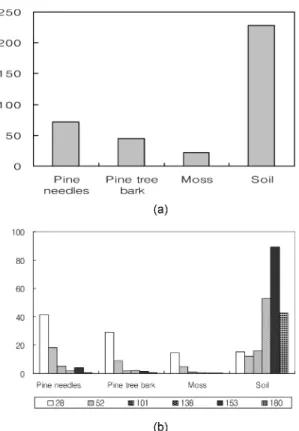
Table 3과 Fig. 1은 소나무잎, 소나무껍질, 이끼 및 토양에 침착된 PCBs의 총 농도, congener 농도(pg/g dry) 및 지질농도(mg/g dry)을 나타낸 것이다. 각 매 체에 침착된 PCBs 총 농도는 토양(227.97 pg/g dry)>
소나무잎(71.36 pg/g dry)>소나무껍질(44.58 pg/g dry)>이끼(21.91 pg/g dry) 순으로 높았다. 그러나 각 congener 농도는 소나무잎, 소나무껍질과 이끼는 저 염소(분자량이 적은) PCBs의 농도는 높았고 고염소 (분자량이 큰) PCBs 농도는 낮았으나 토양은 그 반 대였다. 지질농도는 소나무잎(21.31 mg/g dry)>토양 (10.01 mg/g dry)>소나무껍질(4.85 mg/g dry)>이끼 (1.92 mg/g dry)순으로 높았다.
IV. 고 찰 1. 각 매체에 침착된 PCBs 특성
대기 중에서 나뭇잎이나 식물잎으로 침착되는 PCBs 를 비롯한 POPs의 주경로는 건식 가스상 침착이므 로 대기 중 PCBs의 가스상 농도가 높으면 소나무 잎에 침착된 PCBs 농도도 높아진다.7,28,29,31) Table 1 에서 제시한 바와 같이 저염소 PCBs는 고염소 PCBs 에 비하여 분자량은 작고 증기압은 높아 대기 중에 서 고염소 PCBs에 비하여 가스상 분율이 높고 입 자상 분율은 낮다.7,27,29-31) 이것이 소나무잎 중 고염 소 PCBs 농도에 비하여 저염소 PCBs 농도가 높은 원인으로 생각된다.
소나무껍질과 이끼에 침착된 PCBs 농도는 소나무 잎에 침착된 PCBs 농도보다 더 낮았지만 각 PCBs congener 농도 분포는 소나무잎에 침착된 PCBs congener 농도분포와 거의 같았다. 이것은 대기 중 PCBs가 소나무껍질과 이끼에 침착될 때 소나무잎과 동일한 침착경로(건식 가스상 침착)에 의하여 침착 되기 때문으로 생각된다.28)
그러나 토양은 총 PCBs 농도가 다른 매체보다도 훨씬 더 높고 각 PCBs congener 농도분포도 고염 소 PCBs 농도가 저염소 PCBs 농도보다 훨씬 더 높 은 분포를 보였다. PCBs를 비롯한 SOCs는 강우 시 나 기온이 낮아지면 대기로부터 토양과 수계에 건 식 및 습식 침착되고 반대로 기온이 높아지면 이들 환경매체로부터 대기 중으로 휘발된다.1-3) 대기 중 입자상 PCBs는 소나무잎, 소나무껍질, 이끼에 부착 되었다가 강우 시 빗물에 씻기므로 일정한 양 이상 은 부착되기 어렵지만 토양에는 건식 및 습식침착 이 지속적으로 일어난다.3,16) 또 토양에 침착된 저염 소 PCBs는 휘발성이 강하여 대기로 다시 휘발되지 만 고염소 PCBs는 휘발성이 적어 지속적으로 토양 에 누적침착된다. 이것이 토양 중 고염소 PCBs 농 도가 저염소 PCBs 농도보다 더 높은 원인으로 생
각된다.16,29)
2. 각 매체의 PCBs 농도와 유기물 농도 사이의 상관성 Fig. 2는 각 매체에 침착된 PCBs 총 농도와 지질 농도 사이의 상관성을 나타낸 것으로 (a)는 소나무 잎, 소나무껍질, 이끼 세 가지 매체에 대한 것이다.
Fig. 2(a)는 매체가 세 가지 밖에 되지 않아서 유의 Table 2. GC/MSD operating parameters for PCBs
analysis
GC HP 6890
Detector HP mass selective detector 5973
Electron energy 70 eV
Injector splitless
Sample injection
volume 1µL
Carrier Gas He 1 mL/min
Column HP-5MS capillary column
Temperature Program
(5% diphenyl & 95%
dimethylpolysiloxane) 30 m×0.25 mm×0.25 µm Film thikness
150oC for 2 min 30oC/min. to 170oC 4oC/min. to 200oC for 13 min.
4oC/min. to 268oC 70oC/min. to 320oC for 4.09 min.
Ionization mode EI
Detection mode selected ion monitoring (SIM)
Total Run Time 45 min
Injector
Temperature 300oC
Table 3. PCBs concentrations (pg/g dry) and lipid contents (mg/g dry) in pine needles, pine tree bark, moss and soil
Pine needles
Congener 1 2 Mean S.D C.V(%) lipid contents
28 42.58 40.28 41.43 1.63 3.93 21.31
52 17.58 18.98 18.28 0.99 5.42
101 4.32 5.98 5.15 1.17 22.79
138 2.01 1.58 1.80 0.30 16.94
153 4.65 3.25 3.95 0.99 25.06
180 0.98 0.52 0.75 0.33 43.37
Total 72.12 70.59 71.36
Min 3.93
Max 43.37
Mean 19.58
Pine tree bark
Congener 1 2 Mean S.D C.V(%) lipid contents
28 30.68 27.68 29.18 2.12 7.27 4.85
52 8.58 9.24 8.91 0.47 5.24
101 1.58 2.25 1.92 0.47 24.74
138 2.21 2.14 2.18 0.05 2.28
153 1.02 2.03 1.53 0.71 46.83
180 0.77 0.98 0.88 0.15 16.97
Total 44.84 44.32 44.58
Min 5.24
Max 46.83
Mean 17.22
Moss
Congener 1 2 Mean S.D C.V(%) lipid contents
28 13.68 15.23 14.46 1.10 7.58 1.92
52 4.25 5.32 4.79 0.76 15.81
101 0.89 1.58 1.24 0.49 39.51
138 0.99 0.65 0.82 0.24 29.32
153 0.55 0.25 0.40 0.21 53.03
180 0.18 0.24 0.21 0.04 20.20
Total 20.54 23.27 21.91
Min 7.58
Max 53.03
Mean 27.58
Soil
Congener 1 2 Mean S.D C.V(%) lipid contents
28 16.02 14.35 15.18 1.18 7.78 10.01
52 11.47 12.85 12.16 0.97 8.01
101 15.66 16.40 16.03 0.52 3.26
153 55.63 50.16 52.90 3.87 7.31
138 78.74 99.42 89.08 14.63 16.42
180 38.65 46.59 42.62 5.61 13.17
Total 216.17 239.77 227.97
Min 7.31
Max 16.42
Mean 9.32
S.D : Standard Deviation C.V : Coefficient of Variation
성은 약간 높게 나타났지만(p=0.2133) 결정계수(R2) 는 0.8919로 높았다. 회귀직선을 이용한 유의성 검 증에서 시료 수가 적을 때는 결정계수가 높아도 p
값은 약간 높게 나타나는 경우가 있는데 이것은 시 료 수와 관련된 것으로 결정계수와 p 값을 종합적 으로 판단해 볼 때 PCBs 총 농도와 지질농도 사이 에는 상관성이 있는 것으로 판단된다. 대기 중 PCBs 가 소나무잎, 소나무껍질과 이끼에 침착될 때 주된 침착경로는 건식 가스상 침착이며28) PCBs는 친지질 성이다. 그러므로 이 결과는 대기 중 PCBs가 매체 에 침착되는 주경로가 건식 가스상 침착일 경우에는 매체에 침착된 PCBs 농도는 지질농도에 비례한다는 것을 의미한다.
Fig. 2(b)는 소나무잎, 소나무껍질, 이끼와 토양에 침착된 PCBs 농도와 지질농도 사이의 상관성을 나 타낸 것으로 상관성이 전혀 보이지 않았다. Fig.
2(a)에서 소나무잎, 소나무껍질, 이끼 세 가지 매체 에서는 상관성이 있는 것으로 나타났지만 상기의 세 가지 매체에 토양을 더하면 상관성이 전혀 없 다는 것은 토양 때문에 상관성이 없어진다는 것을 의미한다. 대기 중 PCBs가 토양에 침착될 때 주경 로는 건식 및 습식침착이다.3,16) 또 여34) 등은 토양 중 PCBs 농도는 대기 중 PCBs 농도와는 큰 상관 성이 있지만 토양 중 지질농도와는 약한 상관성만 을 보인다고 하였다. 이것은 각 매체에 침착된 PCBs 농도는 대기 중 PCBs 농도, 매체의 지질농도 및 침착경로가 복합적으로 작용하며, 매체에 따라 각 인자가 미치는 영향은 서로 다르게 나타난다는 것 을 의미한다. 그러므로 소나무잎, 소나무껍질, 이끼 와 토양을 대기 중 PCBs의 PAS로 사용할 때 이 러한 침착 특성들을 종합적으로 고려하지 않으면 Fig. 1. PCBs concentrations distribution in pine needles,
pine tree bark, moss, and soil (a) total concen- trations distribution (b) congener concentrations distribution.
Fig. 2. Correlation between total PCBs concentrations and lipid contents (a) pine needles, pine tree bark, and moss (b) pine needles, pine tree bark, moss, and soil.
해석상 오류를 범할 가능성이 크므로 상당한 주의 가 요구된다.
V. 결 론
이 연구는 대기 중 PCBs의 passive air sampler (PAS)로 자주 사용되고 있는 소나무잎, 소나무껍질, 이끼, 토양에 대한 PCBs의 침착특성을 규명한 것이다.
각 매체에 침착된 PCBs의 총 농도는 토양(227.97 pg/g dry)>소나무잎(71.36 pg/g dry)>소나무껍질 (44.58 pg/g dry)>이끼(21.91 pg/g dry) 순으로 높았 다. 그러나 각 congener 농도는 소나무잎, 소나무껍 질과 이끼는 저염소(분자량이 작은) PCBs의 농도는 높고 고염소(분자량이 큰) PCBs 농도는 낮았으나 토 양은 그 반대였다. 지질농도는 소나무잎(21.31 mg/g dry)>토양(10.01 mg/g dry)>소나무껍질(4.85 mg/g dry)>이끼(1.92 mg/g dry)순으로 높았다. 소나무잎, 소나무껍질과 이끼에 침착된 PCBs 농도와 지질농도 는 상관성을 보였으나 토양은 상반된 결과를 보였다.
대기 중 PCBs가 각종 매체에 침착될 때 대기 중 PCBs 농도, 매체의 지질농도 및 침착경로가 복합적 으로 영향을 미치며 영향 정도는 매체에 따라 서로 다르게 나타났다. 그러므로 상기의 매체들을 대기 중 PCBs의 PAS로 사용할 경우 각 매체의 침착특성을 감안한 신중한 해석이 필요하며 각 매체에 나타난 PCBs의 농도만을 가지고 해석할 경우 해석상 오류 를 범할 수 가능성이 크다.
참고문헌
1. Eitzer BD, Hites RA. Atmospheric Transport and Deposition of Polychlorinated Dibenzo-p-dioxins and Dibenzofurans. Environ Sci Technol. 1989;
23(11): 1396-1401.
2. Gareth T, Sweetman AJ, Ockenden WA, Mackay D, Jones KC. Air-pasture transfer of PCBs. Environ Sci Technol.. 1998; 32(7): 936-942.
3. Bacci E, Cerejeira MJ, Gaggi C, Chemello G, Calamari D, Vighi M. Chlorinated Dioxins : Vola- tillization from Soils and Bioconcentration in Leaves. Bull Environ Contam Toxicol. 1992; 48(3):
401-408.
4. Choi SD, Chang YS. Air Monitoring of Persistent Organic Pollutants Using Passive Air Samplers.
Journal of Korean Society for Atmospheric Environ- ment. 2005; 21(5): 481-494.
5. Shoeib M, Harner T. Characterization and Compar- ison of Three Passive Samplers for Persistent Organic Pollutants. Environ Sci Technol. 2002;
36(19): 4142-4151.
6. Chun MY. Estimation of PCBs Concentrations in Ambient Air Using Pine Needles as a Passive Air Sampler (PAS) J. Environ Health Sci. 2012; 38(4):
360-368.
7. Shim IY, Yeo HG, Choi MK, Kim TW, Chun MY.
Spartial Distribution of PCBs Pine Needles. J. of Korean Society of Environmental Engineering.
2002; 24(12): 2227-2237.
8. Aboal JR, Fernandez JA, Carballeira A. Sampling optimization, at site scale, in contamination moni- toring with moss, pine and oak. Environmental Pol- lution. 2001; 115(2), 313-316.
9. Leed WA, Steinnes ES, Jones KC. Atmospheric Deposition of PCBs to Moss (Hylocomium splen- dens) in Norway between 1977 and 1990. Environ Sci Technol. 1996; 30(2): 524-530.
10. Meredith M, Hites RA. Polychlorinated Biphenyl Accumulation in Tree Bark and Wood Growth Rings. Environ Sci Technol. 1987; 21(7): 709-712.
11. Yeo HG, Cho KC, Choi MK, Chun MY, Kim TW.
Deposition Characteristics of Atmospheric PCBs Depending on Exposure Periods Using Pine nee- dles. Journal of Korean Society of Environmental Engineering. 2006; 28(8): 836-842.
12. Guardo AD, Zaccara S, Cerabolini B, Acciarri M, Terzaghi G, Calamari D. Conifer needles as passive biomonitors of the spartial and temporal distribu- tion of DDT from a point source. Chemosphere.
2003; 52(5): 789-797.
13. Bacci E, Calamari D, Gaggi C, Vighi M. Biocon- centration of Organic Chemical Vapors in Plant Leaves: Experimental Measurements and Correla- tion. Environ Sci Technol. 1990; 24(6): 885-889.
14. Hauk H, Umlauf G, McLachlan MS. Uptake of Gaseous DDE in Spruce Needles. Environ Sci Tech- nol. 1994; 28(13): 2372-2379.
15. Sinkkonen S, Paasivirta J. Degradation half-life times of PCDDs, PCDFs and PCBs for environ- mental fate modeling. Chemosphere, 2000; 40: 943- 949.
16. Chun MY, TW Kim. Comparison of Regional Dif- ferences of PCBs Concentration Using Pine nee- dles and Soil. J. Environ Toxicol. 2009; 24(3), 251- 259.
17. Lim. TB, Xu R, Tan B, Obbard JP. Persistent
organic pollutants in moss as bioindicators of atmo- spheric pollution in Singapore. Chemosphere, 2006;
64: 596-602.
18. Wen S, Yang F, Li JG, Gong Y, Zhang XL, Hui Y, Wu YN, Zhao YF, Xu Y. Polychlorinated dibenzo- p-dioxin and dibenzofurans (PCDD/Fs) polychlori- nated diphenyl ethers (PBDEs), and polychlori- nated biphenyls (PCBs) monitored by tree bark in an E-waste recycling area. Chemosphere, 2009; 74:
981-987.
19. Guegen F, Stille P, Millet M. Air quality assess- ment by tree bark biomonitoring in urban, indus- trial and rural environments of Rhine Valley : PCDD/Fs, PCBs and trace metal evidence. Chemo- sphere, 2011; 85: 195-202.
20. Hermanson MH, Johnson GW. Polychlorinated biphenyls in tree bark near a former manufacturing plant in Anniston Alabama. Chemosphere, 2011;
68: 191-198.
21. Tremolada P, Burnett V, Calamari D, Jones KC. A Study of the Spatial Distribution of PCBs in the UK Atmosphere Using Pine Needles. Chemosphere.
1996; 32: 2189-2203.
22. Xue LI, Lei F, Jun H, Gang YU. Photolysis of mono- through deca-chlorinated biphenyls by ultra- violet irradiation in n-hexane and quantitative struc- ture-property relationship analysis. Journal of Environmental Sciences. 2008; 20: 753-759.
23. Chang FC, Chiu TC, Yen JH, Wang YS. Dechlori- nation pathways of ortho-substituted PCBs by UV irradiation in n-hexane and their correlation to the charge distribution on carbon atom. Chemosphere, 2003; 51: 775-784.
24. Miao XS, Chu SG, Xu XB. Degradation Pathways of PCBs upon UV Irration in Hexane. Chemo- sphere. 1999; 39(10), 1639-1650.
25. Totten LA, Eisenreich SJ, Brunciak PA. Evidence for destruction of PCBs by the OH radical in urban atmospheres. Chemosphere. 2002; 47: 735-746.
26. Bacci E, Cerejerira MJ, Gaggi C, Chemello G,
Calamari D, Vighi M. Bioconcentration of organic chemical vapors in plant leaves : the azalea model.
Chemosphere. 1990; 21: 525-535.
27. Mackay M, Shiu WY, Ma KC. Illustrated Hand- book of Physical-Chemical Properies and Environ- mental Fate for Organic Chemicals, Vol. I. Chelsea:
Lewis Publishers, Inc.; 1992. p.324-644.
28. Pausch KW, McLachlan MS, Umlauf G. Determina- tion of the Principal Pathways of Polychlorinated Dibenzo-p-dioxins and Dibenzofurans to Lolium multiflorum(Rye Grass). Environ Sci Technol. 1995;
29(4): 1090-1098.
29. Yeo HG, Choi MK, Chun MY, Kim TW, Sunwoo Y.
Temperature Dependence of PCBs in Urban area of Seoul city. Journal of Korean Society for Atmo- spheric Environment. 2002; 18(3): 193-204.
30. Erickson MD. Analytical Chemistry of PCBs. Bos- ton: Lewis Publishers; 1992. p.1-7.
31. Falconer RL, Bidleman TF. Vapor pressures and predicted particle/gas distributions of polychlori- nated biphenyl congeners as functions of tempera- ture and ortho-chlorine substitution. Atmosph Environ. 1994; 28(3), 547-554.
32. Yeo HG, Choi MK, Chun MY, Kim TW, Sunwoo Y.
Estimation of Bio-Monitering for PCBs Concentra- tion in Air Using Plant. Journal of Korean Society for Atmospheric Environment. 2002; 18(4): 265- 274.
33. Chun MY. A Sturdy on the Deposition of PCBs in Air on Coniferous Needles. J. of Korean Society of Environmental Engineering. 1998; 20(10): 1377-1383 34. Gouin T, Mackay D, Jones KC, Harner T, Meijer SN. Evidence for “grasshoper” effect and fraction- ation during long-range atmospheric transport of organic contaminants. Environmental pollution 2004; 128: 139-148.
35. Yeo HG, Choi MK, Chun MY, Sunwoo Y. Air-Soil Partitioning of PCBs in Rural Area. Journal of Korean Society for Atmospheric Environment. 2003;
19(E1): 1-9.