Abstract
BACKGROUND: Liquid pig manure (LPM) has been used as an alternative for conventional fertilizers on some gramineous crops. However, its chemical properties varied widely depending on the degree of the digestion. A pot experiment was conducted to determine the responses of persimmon trees to immature (not well‐digested) LPM application.
METHODS AND RESULTS: Ten application levels of immature LPM, consisted of a total of 3 to 30 L in 3‐L increment, were applied during summer to 5‐year‐old
‘Fuyu’ trees grown in 50‐L pots. Increasing the LPM application rate caused defoliation, wilting, and chlorosis in leaves. When applied with the rate of 3 L during summer, the tree produced small fruits with low soluble solids and bore few flower buds the following season, indicating insufficient nutritional status. In trees applied with the LPM rates of 6∼12 L, both fruit characteristics and above‐
ground growth of the trees appeared normal but some roots were injured. However, application of higher LPM rates than 27 L resulted in small size, poor coloration, or flesh softening of the fruits the current season. Furthermore, the
high LPM rates caused severe cold injury in shoots during winter and weak shoot growth the following season. It was noted that the application of higher LPM rate than 9 L damaged the root, even though above‐ground parts of the tree appeared to grow normally.
CONCLUSION: The results indicated that an excessive immature LPM application could cause various injuries on leaves, fruits, and the roots in both the current and the following season.
Key words: Chlorosis, Cold injury, Defoliation, Pig slurry, Root growth
Introduction
Until a few years ago, liquid slurry produced from pig farms has often been discharged into rivers or sea, polluting the water environment. In recent years, the government has strongly prohibited its disposal legally, and has financially supported regional livestock manure collection center to supply the liquid pig slurry, digested as a form of liquid manure, to farmland. The liquid pig manure (LPM) contains a wide range of inorganic ingredients valuable as a nutrient source for crops (Bernal and Kirchman, 1992;
Lee et al., 2012). Therefore, the active use of the LPM for crop cultivation can not only prevent illegal
*Corresponding author: Seong‐Tae Choi Phone: +82‐55‐254‐1562; Fax: +82‐55‐254‐1559;
E‐mail: [email protected]
Korean J Environ Agric. 2019;38(2):89-95. English Online ISSN: 2233-4173
Published online 2019 June 30. https://doi.org/10.5338/KJEA.2019.38.2.13 Print ISSN: 1225-3537
Damages of Young Persimmon Tree as Affected by Application of Immature Liquid Pig Manure
Seong‐Tae Choi
1*, Yeo‐Ok Park
1, Gwang‐Hwan Ahn
1, Eun‐Gyeong Kim
1, Ji‐Young Son
1, Wan‐Kyu Joung
1and Kwang‐Pyo Hong
21Sweet Persimmon Research Institute, Gyeongsangnam‐do Agricultural Research and Extension Services, Gimhae 50871, Korea
2Research and Development Bureau, Gyeongsangnam‐do Agricultural Research and Extension Services, Jinju 52733, Korea
Received: 14 May 2019/ Revised: 18 June 2019/ Accepted: 24 June 2019 Copyright ⓒ 2019 The Korean Society of Environmental Agriculture
This is an Open-Access article distributed under the terms of the Creative Commons Attribution Non-Commercial License (http://creativecommons.org/licenses/by-nc/3.0) which permits unrestricted non-commercial use, distribution, and reproduction in any medium, provided the original work is properly cited.
ORCID
Seong‐Tae Choi
https://orcid.org/0000‐0003‐2558‐0868
89
Research Article Open Access
disposal of pig slurry but also reduce cost for chemical fertilizers in farms. The LPM has widely been applied in rice paddy as a basal fertilizer (Hong et al., 2010; Jeon et al., 2003) in Korea. Also in horticultural crops including fruit trees, previous studies have confirmed there was no difference in growth and quality of the crops between chemical fertilizer and LPM when they were properly applied (Lim et al., 2008; Lim et al., 2009; Park et al., 2012;
Lee and Seong, 2015; Choi et al., 2017). Some persimmon growers have tried the LPM but it has not yet been widely used in the orchards due to several difficulties including little information about effects of the LPM.
In the previous studies, most of the researchers tested effects of well‐digested LPM containing stable nutrient contents. However, it has been revealed that the nutrient concentrations of LPM actually applied to the farmland are very variable, ranging 5.6∼9.5 in pH and 0.02∼0.97% in total nitrogen (N) and some LPMs are supplied without a proper digestion procedure (Lee et al., 2011; Jeon et al., 2012). When the LPM is not sufficiently digested, the ratio of ammonia N is much higher than that of nitrate N and its smell stinks (Jeon et al., 2012). Some persimmon growers have often appealed that applying high rate of immature LPM resulted in poor growth of trees during several years. Nonetheless, adverse effects of the immature LPM application have not been demonstrated in persimmon trees. This study was conducted to determine the responses of the persimmon tree to different rates of immature LPM application.
Materials and Methods
Tree Managements
Five‐year‐old ‘Fuyu’ persimmon ( Diospyros kaki ) trees, grown in 50‐L plastic pots, were used for this experiment at Sweet Persimmon Research Institute in Gimhae, Gyeongsangnam‐do. Pots were placed on the surface of the soil at a distance of 1.5 × 1 m and the soil within pots was sandy in which the response to fertilization could be sensitive. In mid‐March, compost
was spread on the topsoil by about 500 g, and no compost or chemical fertilizer was supplied until mid‐
May of the following year when the experiment was finished. In mid‐May, flower buds were thinned to leave one or two per bearing shoot according to the conventional manual. After the physiological fruit drop, leaf to fruit ratio was adjusted to 15 by fruit thinning in early July. The water was supplied to each pot with mini sprinkler, by maximum of 4 L per day in the summer, and 2 L in spring and autumn.
LPM Treatments
Immature (not well‐digested) LPM was collected from an aerobically‐digesting facility at the livestock manure collection center. The chemical properties of the samples were as shown in Table 1. Compared with the samples used in previous studies (Lim et al., 2009; Park et al., 2012; Lee et al., 2012; Lee and Seong, 2015), N concentration was higher than 2 fold. The sample was blackish and smelled of ammonia gas, indicating the characteristics of immature LPM (Jeon et al., 2012). Ten trees with similar size were chosen for LPM treatments of 10 levels during summer and one tree was assigned for each treatment level. LPM was supplied to soil surface of each pot with 1 to 10 L per tree in 1‐L interval on June 4 (10 after bloom), July 6, and August 26, respectively, during conventional time for supplemental fertilizer. Therefore, the three supplies on the different dates made 10 level treatments ranging the cumulative LPM application rates of 3∼30 L per tree in 3‐L interval.
Measurements
During a week after the LPM applications, fallen leaves were counted and abnormal leaves or fruit drop were investigated. On September 21, SPAD values were read from 15 leaves per tree with chlorophyll meter (SPAD‐502, Minolta Camera Co., Tokyo, Japan). On November 12, whole fruits were harvested and 15 of them were randomly selected to measure fruit characteristics. Skin color was measured as Hunter a value, which indicates the degree of redness, using a portable colorimeter (CM‐2500d, Konica
pH (1:5)
O.M. Total N P2O5 K2O CaO MgO Na2O
‐‐‐‐‐‐‐‐‐‐‐‐‐‐‐‐‐‐‐‐‐‐‐‐‐‐‐‐‐‐‐‐‐‐‐‐‐‐‐‐ g/kg ‐‐‐‐‐‐‐‐‐‐‐‐‐‐‐‐‐‐‐‐‐‐‐‐‐‐‐‐‐‐‐‐‐‐‐‐‐‐‐‐‐‐
8.4 13.3 4.12 0.46 5.57 1.46 0.45 2.14
Table 1. Chemical properties of liquid pig manure used in this experiment
Minolta Sensing Inc., Osaka, Japan). The flesh firmness was measured by a texture analyzer (53205, Turoni srl., Forlì, Italy) equipped with a 5 mm diameter plunger and total soluble solids were determined using a digital refractometer (PAL‐1, Atago Co., Tokyo, Japan).
The effects of immature LPM application rates on tree growth the following year were investigated. On March 21, 4 days before pruning, the one‐year‐old shoots died during winter were counted to calculate the death ratio. On May 13, the number of shoots per tree and the length of terminal shoot were measured from 10 one‐year‐old branches with 10- to 30-cm length, and the number of flower buds on these terminal shoots was also counted. On the same day, the fresh root was weighed for the soil unit volume to assess effect of the LPM applications on the root growth. The living roots of the trees were collected at a distance of 15 cm from the trunk in which the fine roots of the tree were mainly distributed, digging cylindrical pit (volume: 785 cm
3) with a diameter of 10 cm and a depth of 10 cm.
Statistical Analysis
Ten pot‐grown trees for the LPM treatments of 10 levels were randomly deposited. Relationships between different LPM rates and responses of tree were analyzed with coefficients of determination (R
2) using quadratic equations by the SigmaPlot program (Version 8.0, SPSS Inc., USA).
Results
Damage of Leaves and Fruits
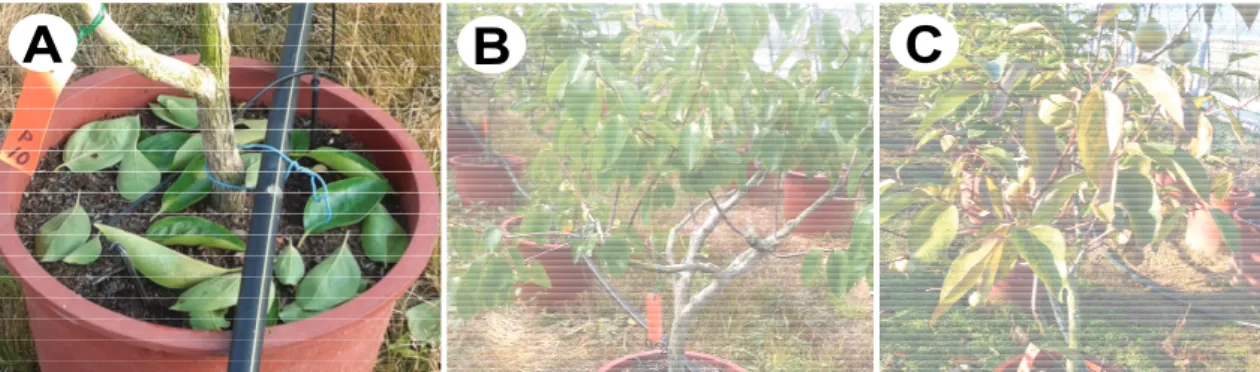
During 2 days after the first LPM application on June 4, leaves fell by 1.3% for the rate of 5 L, but the
ratio increased to higher than 11% as the application rate became over 8 L (Figs. 1A, 2). At the application on July 6, the defoliation was not observed but some leaves remained withered for several days in trees applied with more than 8 L (Fig. 1B). In higher rates than 27 L in cumulative application until August 26, leaf chlorosis occurred (Fig. 1C) and some fruits abscised during the several days after the applications (data not presented). The SPAD value on September 21 was 34.4 at the cumulative LPM rate of 3 L, and it increased to 43.1∼48.4 at the rates of 6∼27 L. In contrast, when the LPM application increased to higher rate than 27 L, the value decreased rather to less than 30 (Fig. 3).
Fruit Characteristic
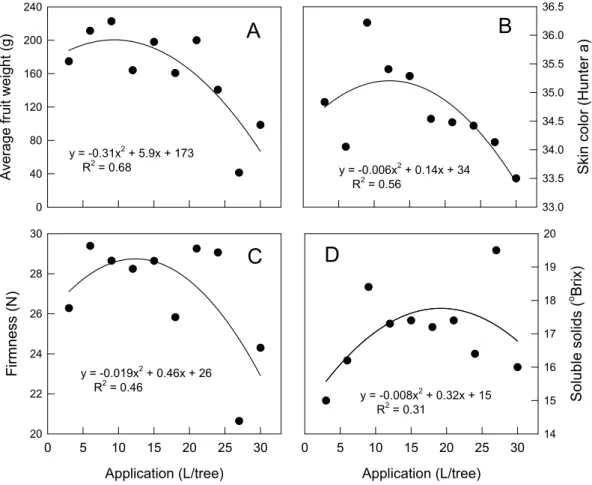
As the cumulative LPM rate increased from 3 to 9 L, average fruit weight increased from 175 g to 223 g (Fig. 4A). Fruit skin color as Hunter a value was not changed consistently within an application range of 3
∼9 L, but it decreased markedly by increasing the application rate to over 18 L (Fig. 4B). Flesh firmness became rapidly softened when the LPM was applied with higher rates than 27 L (Fig. 4C). The soluble solids were 15 °Brix at the rate of 3 L, but it increased to 18.4 °Brix at the rate of 9 L. However, with increasing the application rate, it tended to decrease except for the rate of 27 L (Fig. 4D).
Tree Growth in the Following Season
A significant impact of the excessive LPM application was found in the high percentage of dead shoot. The death of one‐year‐old shoots on March 21 was 20% at the rate of 3 L, and it remained under 10% at the rates of 9∼24 L (Fig. 5). However, the
A B C
Fig. 1. Leaf damages of persimmon trees by the high application rate of liquid pig manure: A, defoliation after the first application on June 4; B, wilting after the second application on July 6; C, leaf chlorosis and abscission on September 8 after the third application on August 26.
Application (L/tree)
0 2 4 6 8 10
Defoliation (%)
0 3 6 9 12 15 18
y = 0.034x2 - 0.60x + 2.0 R2 = 0.84
Fig. 2. Relationship between the application rates of liquid pig manure on June 4 and the defoliation ratio of persimmon trees measured on June 11.
Application (L/tree)
0 5 10 15 20 25 30
SPAD value
20 25 30 35 40 45 50
y = -0.088x2 + 2.5x + 29 R2 = 0.62
Fig. 3. Relationship between the application rates of liquid pig manure during summer and leaf SPAD value of persimmon trees on September 21.
Average fruit weight (g)
0 40 80 120 160 200 240
Application (L/tree)
0 5 10 15 20 25 30
Soluble solids (o Brix)
14 15 16 17 18 19 20
Skin color (Hunter a)
33.0 33.5 34.0 34.5 35.0 35.5 36.0 36.5
Application (L/tree)
0 5 10 15 20 25 30
Firmness (N)
20 22 24 26 28 30
y = -0.31x2 + 5.9x + 173
R2 = 0.68 y = -0.006x2 + 0.14x + 34
R2 = 0.56
y = -0.019x2 + 0.46x + 26
R2 = 0.46 y = -0.008x2 + 0.32x + 15
R2 = 0.31
A B
C D
Fig. 4. Relationships between the application rates of liquid pig manure during summer and fruit characteristics of persimmon trees on November 12.
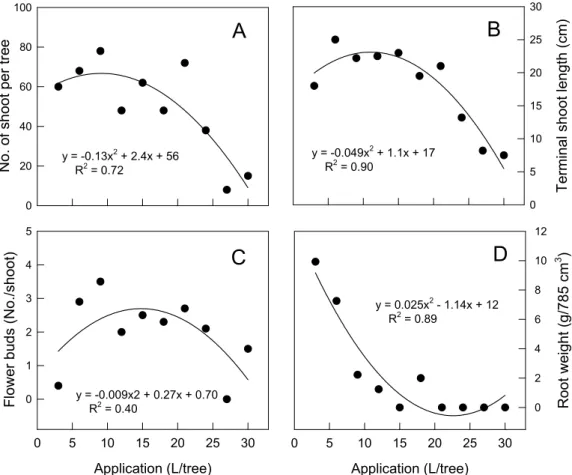
dead shoot increased up to 90% at the higher rates than 27 L, indicating normal tree growth would be difficult for the following season. The number of shoots per tree on May 13 was not significantly affected
at the rates of 3∼21 L, but it sharply decreased when the LPM rate increased to more than 24 L (Fig. 6A).
Terminal shoot of a one‐year‐old branch grew to 18 cm
at the rate of 3 L, and it became to 20∼25 cm at
Application (L/tree)
0 5 10 15 20 25 30
Dead shoot (%)
0 20 40 60 80 100
y = 0.33x2 - 8.3x + 47 R2 = 0.81
Fig. 5. Relationship between the application rates of liquid pig manure during summer the previous season and the dead shoot ratio of persimmon trees during winter.
the rates of 6∼21 L exhibiting normal shoot growth (Fig. 6B). However, it grew only to 13 cm at higher rate than 24 L. Trees applied with the LPM rates of
6∼24 L the previous season bore more than 2 flower buds per terminal shoot the following season, but trees with the rates of 3 L or 27∼30 L had less than 1.5 flower buds (Fig. 6C). It was notable that increasing the LPM application damaged roots of trees (Fig. 6D). When the rate increased from 3 to 9 L, the fresh root weight per the unit soil volume sharply decreased from 9.9 g to 2.2 g, and no survival roots was found at higher rate than 21 L.
Discussion
Defoliation and fruit drop after application of the high LPM rate might be due to the toxicity of NH
4+excessively absorbed into the tree (Britto and Kronzucker, 2002). The leaf wilt after the LPM application in July could be related to water stress resulted from root damage by high concentrations of NH
4+and salinity with high pH (Britto and Kronzucker, 2002; Chun, 2008). Therefore, the high LPM rate might reduce fruit growth by inhibiting the activity of leaves (Figs. 1, 2, 3)
시 시 시 vs 과과
No. of shoot per tree
0 20 40 60 80 100
Terminal shoot length (cm)
0 5 10 15 20 25 30
Application (L/tree)
0 5 10 15 20 25 30
Flower buds (No./shoot)
0 1 2 3 4 5
Application (L/tree)
0 5 10 15 20 25 30
Root weight (g/785 cm3 )
0 2 4 6 8 10 12 y = -0.13x2 + 2.4x + 56
R2 = 0.72
y = -0.049x2 + 1.1x + 17 R2 = 0.90
y = -0.009x2 + 0.27x + 0.70 R2 = 0.40
y = 0.025x2 - 1.14x + 12 R2 = 0.89
A B
C D
Fig. 6. Relationships between the application rates of liquid pig manure during summer the previous season and shoot growth, number of flower buds, and root weight of persimmon trees on May 13 the following season.