Shu-gyo-ryoku : An Academic and Career Skills' Enhancement Program for Engineering Students at Gunma University
Hiroyuki Matsumoto
*,†․ Kenji Amagai
**․ Yasushi Yuminaka
**․ Barry Keith
******Support center of Shu-gyo-ryoku, Gunma University
***Support center of Shu-gyo-ryoku, Kiryu Branch, School of Engineering, Gunma University
***University Education Center, Gunma University
ABSTRACT
Shu-gyo-ryoku, a program to enhance students’ academic and career skills, was begun in the academic year 2011. Under the new program, “Career Planning” and “Career Design” were introduced as part of the liberal arts education for incoming freshmen.
Approximately 500 students majoring in engineering enrolled in “Career Planning”, in which they study a “curriculum map” and how it relates to their future fields of employment. The curriculum map illustrates the connections between classes and increases students’understanding of the curriculum structure. In small groups, students discussed the curriculum in order to develop sketches of their career paths. In addition, students answered a career anchor test and though several communicative activities, improved their communication skills. A portfolio system was built into the university network to record the learning history of each student.
Students are able to check their learning histories and reflect on the change in themselves during their academic careers.
Keywords: Engineering education, Enhancement of Students’ Academic and Career Skills, Career Planning, Career Design
I. Introduction
1)Due to the unstable economy in Japan during recent years, many university graduates have struggled in finding a job. In 2010, the average of students’ employment rate was 60.8% [1] This situation has become a serious social problem and a rapid improvement is needed. In addition to a more competitive hiring environment, employers are demanding higher quality in their potential employees.
Under these circumstances, the enhancement of students’
academic and career skills is essential. Consequently, an education system which supports students acquiring these skills must also be developed.
Shu-gyo-ryoku
, the Japanese term, generally refers to the enhancement of students’ academic and career skills.Shu-gyo-ryoku
may be more clearly defined as follows:1. Students are able design their future lives and work
Received 4 October, 2011; Revised 12 June, 2012 Accepted 10 September, 2012
† Corresponding Author: [email protected]
and maintain a work-life balance
2. Students are able to make a plan of study through the understanding of their own personality and potential, which in turn assists them in choosing their future career
3. Students are able to apply specialized knowledge to praxis
The government Ministry of Education, Culture, Sports, Science & Technology (MEXT) founded a funding program for the enhancement of
Shu-gyo-ryoku
in 2010 as one scheme to improve Japanese universities [2]. In all, 441 universities applied for this program. Of them, 180 uni- versities received funding under the scheme [1]. Gunma University was one of them and its new curriculum began from the academic year 2011. TheShu-gyo-ryoku
program was implemented in two colleges, the Faculty of Engineering and the Faculty of Social & Information Studies. This paper will discuss aspects of the program at the Faculty of Engineering.Fig. 1 Curriculum structure of Shu-gyo-ryoku program
II. Outline of the Faculty of Engineering
The number of students in the Faculty of Engineering at Gunma University is approximately 2,500 undergraduate and 900 postgraduate schools. The faculty consists of seven departments: Chemistry and Chemical Biology, Mechanical Systems Engineering, Production Science and Technology, Chemical and Environmental Engineering, Civil and Environmental Engineering, Electronic Engineering, and Computer Science. Of these, three departments were recognized by the Japan Accreditation Board for Engineering Education (JABEE). Roughly 600 students graduate each year from the undergraduate school. About 60% of them go on to the master course and 40% seek employment.
Of the job-seekers, 70% of them, obtain work in the industrial sector. Another 15% become public servants.
The employment rate has been held to more than 95%.
However, the enhancement of students’ academic and career skills is an important part of the curriculum.
III. Outline of the Program
In order to enhance the students’ academic and career skills, the following elements make up the program:
1. Establishment of a support center for
Shu-gyo-ryoku
2. Holding of “Career Planning” and “Career Design” classesas part of liberal arts education for incoming freshmen 3. Increasing the number of English classes for incoming
freshmen
4. Holding symposiums and seminars on
Shu-gyo-ryoku
5. Earlier commencement of internship programs (fromthe sophomore year)
6. Development of a career design portfolio system
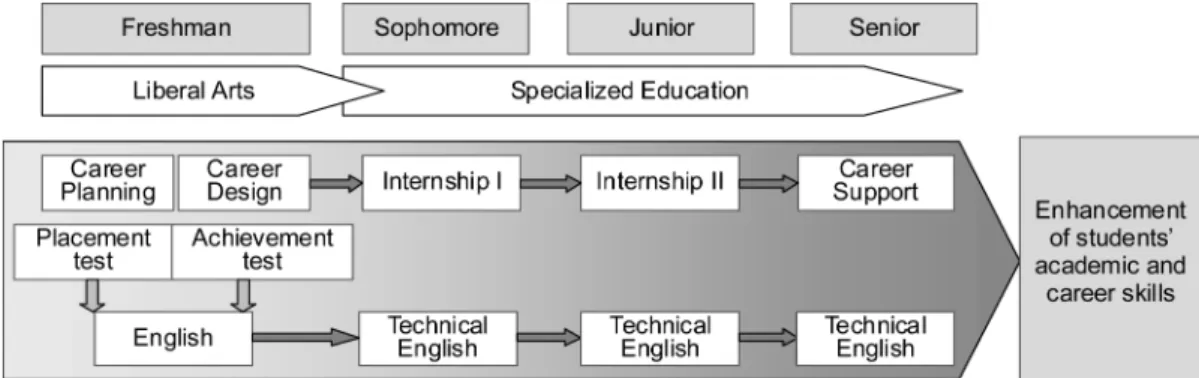
The structure of the curriculum is shown in Fig. 1. Details of “Career Planning” and “Career Design” are explained in the following section.
To strengthen students’ English skills, a “placement test” was administered before the start of the school year. Based on the results of the test, students were assigned to English classes at different proficiency levels.
An “achievement test” will also be carried out to evaluate student progress. During the sophomore year, technical English classes are offered, using an e-learning system.
The course design for these technical English classes was developed under the Good Practice (GP) program supported by MEXT from 2005 to 2008.
“Internship I” will be introduced during the sophomore year in 2012. In addition, a “Manner Up” component, i.e.
training in working-environment etiquette, will be featured in “Internship II”, in which students will have two- or three-week internships during their junior year. In fact, this internship was already begun under the old curriculum.
During their senior year, students are offered support in research potential employers and finally securing a position.
IV. “Career Planning” and “Career Design”
“Career Planning” and “Career Design” are two new courses in the liberal arts education in the freshman year (as shown in Fig. 1). Approximately 500 students majoring in engineering enrolled in “Career Planning”, outlined below in Table 1. Students learn a “curriculum map”, which
Table 1 Contents of “Career Planning”
Weeks Contents
1 Introduction to the program of Shu-gyo-ryoku 2 Explanation of “curriculum map” and first questionnaires 3 Review of “curriculum map” and group discussion of future plans 4 Continuation of group discussion of future plans and second questionnaires
5-9 Lectures international relations, contemporary Japanese history, learning at university, health and diet, career anchor test 10-15 Field work (visiting companies and/or university laboratories, training camp)
16 Summary of the class and final questionnaires
Table 2 Contents of “Career Design”
Weeks Contents
1 Introduction of “Career Design” with group work
2 Introduction of “Career Design” with group work (continued) 3 Lecture by a recent graduate
4 Group work (group discussion related to the lecture) 5 Lecture by a key alumni
6 Group work (group discussion related to the lecture) 7 Lecture by a company Chief Executive Officer (CEO) 8 Group work (group discussion related to the lecture)
9-11 Lectures by instructors from the support center for Shu-gyo-ryoku 12-15 Group presentations on career design
16 Summary of “Career Design” class and final questionnaires
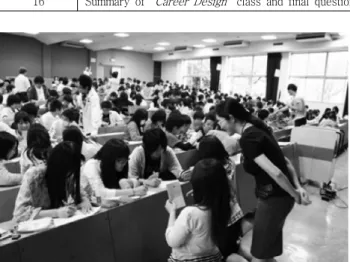
Fig. 2 Students work on their communication skills in groups
illustrates the connections between their classes so that students become aware of the curriculum structure. From this activity, they can discover how their coursework relates to their future fields of employment.
Several lectures related to
Shu-gyo-ryoku
were given.One noteworthy example was the lecture on a healthy diet while at university, in which students answered questions
related to their diet and then reflected on their eating habits and the importance of a healthy diet while at uni- versity and beyond. In small groups, students discussed the curriculum in order to develop sketches of their career paths. In addition, students answered a career anchor test, in which students discover their career priorities. Through a number of communicative activities, students improved their communication skills. Fig. 2 is a snapshot of the lecture on group communication.
The contents of “Career Design” are shown in Table 2.
This class will be held during the second semester of students’ freshman year. Alumni will be invited to speak on their university and work experience. Group discussions will be held after each lecture so that students can consider their career paths. Finally, the students will make pre- sentations on their own career designs.
V. The Career Design Portfolio
Through the newly developed course on “Career Planning”, we are hopeful that students’ perception of
Shu-gyo-
Fig. 3 System image of GUWSS
Fig. 4 Sample of questionnaire in the portfolio system
ryoku
has evolved. At the very least, they now have abetter appreciation for the importance in developing career/life skills. To see how the students’ perceptions change over time, students answer questionnaires at regular intervals.
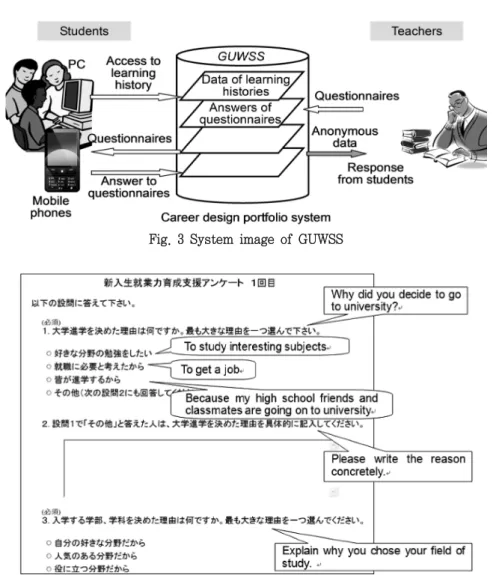
In order to store and manage such a large amount of data we have incorporated a career design portfolio system into our university computer network to record the learning history of each student. The system, called Gunma Uni- versity Working Skill System (
GUWSS
) is an interactive tool that will allow students to record, review, and reflect on their experiences and accomplishments as university students. Students are even able to use their mobile phones to check their learning. Fig. 3 illustrates theGUWSS
system.Several surveys were conducted using the portfolio
system. The results are stored in a database accessible to administrative staff, with guaranteed anonymity and privacy. The portfolio provides “evidence” of student work.
In other words, it becomes a record of what students accomplished in the past, and therefore it can assist them in making good decisions about their future. Fig. 4 shows a questionnaire example stored in the portfolio system.
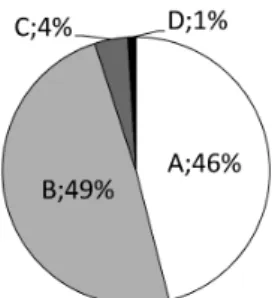
The first question is “Why did you decide to go to uni- versity?” Selectable answers are,
A: To study interesting subjects B: To get a job
C: Because my high school friends and classmates are going to university
D: Other
Fig. 5 Example of questionnaire results
Fig. 5 shows the students’ responses. Answer “B” was the most popular response at 49%. This seems to suggest that students feel the importance of going to university is to get a job. Slightly fewer (46%) of the respondents held expectations regarding their university education.
VI. Conclusion
We have described a new program to enhance students’
academic and career skills. This program was just begun in academic 2011, and it is a key component of the efforts to improve university education. Under the program, new courses of “Career Planning” and “Career Design” were introduced into the liberal arts education for incoming freshmen. In these courses, students take lectures on a series of topics related to
Shu-gyo-ryoku
. For students, the “curriculum map” was an effective tool to understand the relationship between the university education and their futures. For the university, the link between these courses and the curriculum can serve as a catalyst for further curricular reform and integration. A series of trial and error is under way and more detailed results of this new endeavor are forthcoming.This program was supported by The Ministry of Education, Culture, Sports, Science & Technology (MEXT) at 2011.
Reference
1. http://www.mext.go.jp/a_menu/koutou/kaikaku/shugyou/
1296632.htm.
2. Materials of the Meeting of East Japan Area Shu-gyo-ryoku
Program, Aoyama Gakuin University, Aoyama campus, 28 July 2011.
3. Matsumoto, H (2011). Course Design for Academicand Career Skills -Course for Engineering Majors-, 2011 JSEE Annual Conference Proceedings: 146-147.
Hiroyuki Matsumoto
Completed the Graduate School of Science at Kobe University in 1981, worked in a private enterprise. In 1999, began research and education at Gunma University.
Research fields are history of science and science education. Currently is a Professor of Gunma University and the Director of Support Center of Shu-gyo-ryoku.
Phone: +81-(0)27-220-7502 Fax: +81-(0)27-220-7502 E-mail: [email protected]
Kenji Amagai
Graduated Tohoku University in 1992 with a Ph. D. degree in Engineering. After graduation, began work at Gunma University. Specializes in thermo-fluid mechanics and laser diagnostics. Currently is Professor of the Mechanical Engineering department at Gunma University and a member of the Support Center of Shu-gyo-ryoku.
Phone: +81-277-30-1513 Fax: +81-277-30-1508 E-mail: [email protected]
Yasushi Yuminaka
Completed his Ph.D at Tohoku University in 1995. Is currently Associate Professor in Electronic Engineering at Gunma University and a member of the Support Center of Shu-gyo-ryoku. Specializes in design of multiple-valued integrated circuits, communication systems, new-paradigm of computing systems and their applications. Received the IEE Ambrose Fleming Premium Award in 1994, and the Outstanding Contributed Paper Award at the 2000 and 2009 IEEE International Symposium on Multiple-Valued Logic.
Phone: +81-277-30-1790 Fax: +81-277-30-1707
E-mail: [email protected]
Barry Keith
Completed Master's course in International Relations at Ritsumeikan University. Began teaching English at Gunma University in 2000. Is currently Associate Professor at the University Education Center of Gunma University. Specializes in English Education, specifically Extensive Reading and Second Language Acquisition.
Phone: +81-27-220-7571 Fax: +81-27-220-7571 E-mail: [email protected]