R E S E A R C H Open Access
The rate and stability of mandibular block bone graft in recent 5 years
Jong-Cheol Park
1,2, Yun-Ho Kim
1,2, Hong-Seok Choi
1,2, Jong-Shik Oh
1,2, Sang-Hun Shin
1,2and Yong-Deok Kim
1,2*Abstract
Background: The purposes of the present study were to compare implant stabilities of mandibular block bone graft and bovine bone graft and to evaluate influencing factors for implant stability in mandibular block bone (MBB) graft.
Methods: This retrospective study investigated 1224 cases and 389 patients treated by one surgeon in the
Department of Oral and Maxillofacial Surgery of Pusan National University Dental Hospital (Yangsan, Korea) between January 2010 and December 2014. Proportions that MBB graft cases constitute in all implant restoration cases and in all bone graft cases were measured. Implant stability quotient (ISQ) values were achieved by the same surgeon before loading. The average ISQ values of the experimental groups were compared. In addition, ISQ values of influencing factors, such as age, sex, implant size, and implant placement site, were compared within the MBB group using Osstell
TMMentor (Osstell®, Göteborg, Sweden). Paired t test and ANOVA were conducted for statistical analysis with a significance level of 0.05.
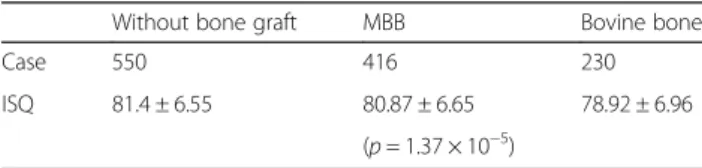
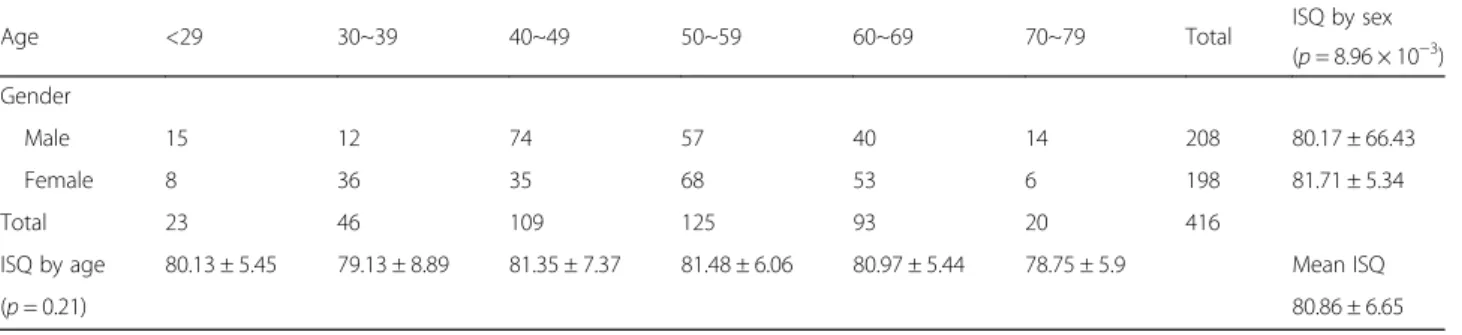
Results: Fifty-five percent of all implant restoration cases performed bone graft while MBB cases constituted 34% of all implant restoration cases and 61% of all bone graft cases. Comparing ISQ values according to bone graft materials, the MBB group manifested sufficient implant stability by presenting comparable ISQ value to that of the experimental group without bone graft. Among the reviewed factors, females, mandibular molar regions, and implants in larger diameter displayed greater implant stabilities.
Conclusions: Satisfactory implant stability was accomplished upon administration of MBB graft. Within the limitation of this study, gender, implant site, and implant diameter were speculated to influence on implant stability in MBB graft.
Keywords: Implant stability, Mandibular block bone, Bone graft, ISQ, Impact factor
Background
Tooth loss leads to change in bone resorption pattern and serious alveolar bone atrophy, ultimately risking successful implant restoration by reducing bone quantity and density. In order to resolve such problems, various surgical techniques have been suggested to reconstruct a severely atrophied jawbone. The traditional surgical methods with alveolar bone augmentation pose limita- tions on improving volumetric stability and implant sta- bility. For patients with jawbone atrophy, an additional surgical procedure is inevitable to ensure sufficient amount of bone for implant installation. Herein, implant
installation in autogenously grafted area has been sug- gested to reduce bone resorption and restore function.
Autogenous bone grafts can be commonly harvested from various donor sites including the calvarium bone and iliac bone [1 –4]. Among the available sites, the mandibular bone has been widely adopted since it allows better accessibility, less scarring, and adequate harvest for implant installation [5]. Bone graft harvestings from the mandibular ramus and body bone have been more popular than symphysis bone harvesting which manifests higher morbidity including nerve injury and cosmetic concern [6, 7]. Nevertheless, few studies have studied the initial stability of implants installed after performing mandibular body bone graft, and a few studies have con- ducted statistical evaluation on a number of cases.
* Correspondence: [email protected]
1
Department of Oral and Maxillofacial Surgery, School of Dentistry, Pusan National University, Yangsan, Republic of Korea
2
Dental Research Institute and Institute of Translational Dental Research, Pusan National University, Yangsan, Republic of Korea
© The Author(s). 2017 Open Access This article is distributed under the terms of the Creative Commons Attribution 4.0 International License (http://creativecommons.org/licenses/by/4.0/), which permits unrestricted use, distribution, and reproduction in any medium, provided you give appropriate credit to the original author(s) and the source, provide a link to the Creative Commons license, and indicate if changes were made.