DOI http://dx.doi.org/10.9725/kstle.2015.31.2.56
초음파나노표면개질 기술을 적용한 초경의 기계적특성 및 마모 연구
이승철1·김준형1·최갑수1·장영도2·아마노프 아웨즈한3·편영식3†
1선문대학교 대학원 기계공학과, 2한국폴리텍II대학 기계시스템과
3선문대학교 기계공학과
Improvement in Mechanical and Wear Properties of WC-Co by Ultrasonic Nanocrystal Surface Modification Technique
Seung-Chul Lee1, Jun-Hyong Kim1, Gab-Su Choi1, Young-Do Jang2, Auezhan Amanov3 and Young-Sik Pyun3†
1Graduate School, Dept. of Mechanical Engineering, Sun Moon University, Asan 336-708, Korea
2Dept. of Machine System, Korea Polytechnic II, Incheon 403-719, Korea
3Mechanical Engineering, Sun Moon University, Asan 336-708, Korea (Received January 30, 2015; Revised March 15, 2015; Accepted March 17, 2015)
Abstract − In this study, we investigated the effectiveness of an ultrasonic nanocrystal surface modification (UNSM) technique on the mechanical and wear properties of tungsten carbide (WC). The UNSM technique is a newly developed surface modification technique that increases the mechanical properties of materials by severe plastic deformation. The objective of this study was to improve the wear resistance of press die made of WC by applying the UNSM technique. We observed the microstructures of the untreated and UNSM-treated spec- imens using a scanning electron microscope (SEM), and energy-dispersive X-ray spectroscopy (EDX) was used to investigate the chemical composition. The SEM observations showed the pore size and the number of pores decreased after the UNSM treatment. We assessed the wear behavior of both the untreated and UNSM-treated specimens using a scratch test. The test results showed that the wear resistance of the UNSM-treated specimens increased by about 46%
compared with the untreated specimens. This may be attributed to increased hardness, reduced surface roughness, induced compressive residual stress, and refined grain size following the application of the UNSM technique. In addition, we found that the UNSM treatment increased the carbon concentration to 63% from 33%. We expect that implementing the findings of this study will lead to an increase in the life of press dies.
Keywords − dimple(딤플), press die(프레스 금형), sintered tungsten carbide(초경), surface hardness(표면경도), ultrasonic nanocrystal surface modification(초음파나노표면개질)
1. 서 론
주로 금속판을 반복적으로 소성변형시켜 제품을 만 드는 프레스금형은 제품 정밀도를 유지하기 위해 부품 의 내구성이 중요하며, 이와 관련하여 내마모성과 고온
강도가 확보되어야 한다[1]. 이에 산업계에서는 고가의 초경부품을 주로 사용하므로 효율적인 사용을 위해 인 서트 타입의 공구개발[2] 및 부품설계 최적화를 통해 원가절감을 위해 노력하고 있다. 초경 수명을 연장하는 기술은 소결시 성분 밀도를 높게하는 방법[3]과 physical vapor deposition (PVD)[4] 및 chemical vapor deposition (CVD)[5] 등이 개발되어 공구 등 다양한 부품의 적용되고 있지만, 제품 정밀도와 생산성 향상을
†Corresponding author : [email protected] Tel: +82-41-530-2333, Fax: +82-41-530-8018
위한 내마모성과 피로한계는 점점 높아지고 있는 산업 계의 요구에는 한계가 있을 것으로 보고 있으며, 원재 료의 표면개질 처리를 통한 수명연장은 아직 적용되고 있지 않다. 주로 판금을 가공하는 프레스금형은 가공 시 높은 면압부하가 발생하므로PVD와 CVD는 표면 박리현상에 의해 적용하는데 한계가 있었다. 이와 관 련하여 본 논문에서는 국내에서 개발된 UNSM(초음파 나노표면개질) 기술을 적용하여 내구성 확보를 통한 프 레스금형 수명연장 가능성을 확인하였다. 시험 전 예 비 시험을 진행하여 적정한 UNSM 처리 조건을 선정 하였으며, UNSM 처리 후 표면성분 및 기공크기 변화 를 통해 초경부품의 내구성 향상 여부를 확인하였고, 표면거칠기, 표면경도등 기계적 특성 변화를 확인하여 UNSM 기술이 마찰·마모에 미치는 영향을 분석하였 다. 정확한 분석을 위해서는 현장시험이 중요하나 우 선적으로 초경 시험편을 이용한 UNSM 처리 전/후 표 면성분 변화와 scratch test를 통한 프레스 금형 수명 연장 가능성을 확인하기 위해 본 시험을 진행하였다.
UNSM 기술은 초음파 진동에너지를 응용하여 아주 큰 정적 및 동적 하중이 부가된 볼로써 1초에 20,000 번 이상의 타격(1,000~100,000회/mm2 정도)을 금속 표면에 주어, SPD(severe plastic deformation) 및 탄 성변형을 발생시켜 이로 인해 표층부의조직을 나노결 정 조직으로 개질함과 동시에 아주크고 깊은 압축잔류
응력 등을 부가하는 한국의 특허기술이다[6]. Fig. 1은 UNSM 기술의 기본 원리를 나타낸다. Fig. 2(a)는 UNSM 처리모습을 나타냈으며, UNSM 장치의 구성은 Fig. 2(b)와 같이 진동자(20 kHz 또는 40 kHz), 부스 터(booster), 혼(horn)으로 되어있고, 추가로 혼의 선단 에는 볼(ball)과 볼을 고정시켜주는 볼팁(tip)이 위치해 있다.
UNSM처리 전과 후의 베어링강 표면상태는 Fig. 3 과 같다. 연마(polishing)한 금속에 UNSM 처리를 하 면 예로 들은Fig. 4(a)와 같이 외관상 구분이 되며, Fig. 4(b)와 같이 마이크로 딤플(dimple)이 생성되면서
Fig. 1. Basic mechanism of UNSM treatment.
Fig. 2. UNSM treatment process (a) and its anatomy (b).
Fig. 3. Comparison of some properties of material before and after UNSM treatment [7].
Fig. 4. UNSM-treated specimen (a) and optical micrograph of UNSM-treated specimen showing the produced dimples on the surface (b).
딤플 패턴을 형성하게 되고, 이 표면은 연마한 표면보 다 거칠기(surface roughness)가 낮아진다. 또한 금속 표면에 1초당 20,000번 이상의 타격을 통해 나노 구조 화(nano structure), 표면경도(surface hardness) 향상, 압축잔류응력(compressive residual stress)이 부가된다.
Table 1은 UNSM 처리 후 얻게 되는 기계적 특성 및 기대 효과를 보여주며, Fig. 5와 Fig. 6은 예로들 은STD61에 UNSM 처리 전, 후 경도변화와 압축잔류 응력 변화를 나타내었다.
2. 시험절차
2-1. 시험편
본 시험에서 기계적 특성을 확인하기 위해 사용한 시 험편은 Fig. 7(a)와 같이 원형형태의 초경을 사용했으며, 시험편의 물성값은 Table 2와 같다. 타격볼의 형상은 Fig. 7(b)와 같이 둥근 형태의 초경 볼을 사용하였다.
2-2. 시험 방법
2-2-1. 기계적 특성 시험편 및 Scratch test 시험편 UNSM 처리조건
기계적 특성 변화를 확인하기 위해 Table 3과 같은 조건으로 시험편에 UNSM 처리 하였으며, Scratch Table 1. The effects and benefits of UNSM treatment [8]
UNSM Features Anticipated benefits
Increased hardness
(Into depths of more than 1,500ìm)
1) Reduced wear rate
2) Improved LCF and HCF endurance limit Deep compressive residual stresses
(Greater than 1,000 MPa into depths of more than 2,000 µm)
1) Improved LCF and HCF endurance limit 2) Improved rolling contact fatigue (RCF) strength 3) Improved stress corrosion cracking (SCC) resistance Micro dimples surface
(Diameter of area : 1-2 µm, Depth : sub micron, Pattern pitch : few µm)
1) Reduced surface roughness 2) Decreased friction coefficient 3) Reduced wear rate
Nanocrystalline structure
(Grain size of 50-200 nm into depths of 100 µm)
1) Increased tensile strength and hardness 2) Increased fatigue strength
3) Increased wear resistance
Fig. 5. Comparison of micro-hardness of the untreated and UNSM-treated STD61 specimens [9].
Fig. 6. Comparison of compressive residual stress of the untreated and UNSM-treated STD61 specimens [9].
Fig. 7. Dimensions of the plate and ball specimens.
Table 2. Chemical composition of untreated disk specimen (in at %)
Element W C Co
% 77.6 18.7 3.7
Table 3. UNSM treatment parameters UNSM unit
speed (mm/min) Pitch (mm)
Load (N)
Amplitude (µm)
Frequency (kHz)
4000 0.01 140 10 20
test를 진행하기 위한 시험조건은 Table 4와 같고, Fig.
8은 Scratch test 개략도이다.
2-2-2. 시험 측정장비
표면기공 및 입자 크기를 확인하기 위해 사용된 측정 장비는 atomic force microscopy AFM: SPA400, Japan 을 사용하였으며, 표면거칠기를 확인하기 위한 측정 장 비는 Mitutoyo SJ-200, Japan 표면경도를 확인하기 위한 측정 장비 Akashi, Corp. AAV-4M, Japan을 사용하였다.
또한 표면 탄소 및 코발트 함유량 변화는 energy dispersive X-ray spectroscopy EDS: Rontec, Germany 측정장비를 사용했으며, scratch test처리면을 확인하기 위 해 Rhesca TB-01, Japan 장비를 사용하였다. 그리고 scratch test 마모량을 확인하기 위해 scanning electron microscopy SEM SUPRA 40, ZEISS, Germany 측정장 비를 사용하였다.
3. 시험 결과
3-1. UNSM 처리 후 표면 변화
Fig. 9의 (a) 및 (b)는 UNSM 처리 전/후의 기공크 기를 나타내었고, Table 5는 UNSM 처리 전/후의 기 공크기와 입자크기 변화를 나타낸 표이다. UNSM 처
리 전/후의 기공 및 입자크기를 확인했을 때 UNSM- 140N 시험편의 기공크기는 Untreated 시험편 보다 50%, 입자크기는 39%로 작아졌다. 이러한 결과는 UNSM처 리시 표면이 다져지면서 표면조직이 미세하게 변화된 것으로 사료된다.
3-2. UNSM 처리 후 기계적 특성 및 표면성분 변화 UNSM 처리 후 Fig. 10과 같이 표면거칠기는 처리 전 대비 UNSM-140N에서 81% 향상되었으며, 표면경 도는 처리 전 보다 42% 향상되었다. 이러한 결과는 UNSM 처리에 의해 기공 및 WC 입자의 미세화에 따른 영향으로 사료된다.
UNSM 처리 후 Fig. 11과 Fig. 12와 같이 표면 코 발트와 탄소 변화량을 확인한 결과 Fig. 13과 같이 화 Table 4. Scratch test parameters
Load (N) Load speed (N/min) Scratch length (mm)
10 40 2
Fig. 8. Schematic view of a scratch testing method.
Fig. 9. Microstructure of the untreated (a) and UNSM- treated (b) specimen of WC-Co.
Table 5. Pore size and grain size before and after UNSM Pore Size [mm] Grain Size [nm]
Untreated 1.0 5.80
UNSM-140N 0.5 3.53
Fig. 10. Surface roughness and hardness before and after UNSM.
Fig. 11. EDS mapping showing Co on the untreated (a) and UNSM-treated (b).
Fig. 12. EDS mapping showing C on the untreated (a) and UNSM-treated (b).
학적 변화없이 성분 함량의 변화가 있었다. UNSM- 140N으로 처리된 시험편은 처리 전 대비 탄소는 91%
증가하였고, 코발트는 63% 감소하였다. 이러한 결과는 UNSM처리시 타격에 의해 조직이 미세화되는 과정에 서 탄소가 침투된 것으로 사료된다.
3-3. UNSM 처리 후 마모량 변화
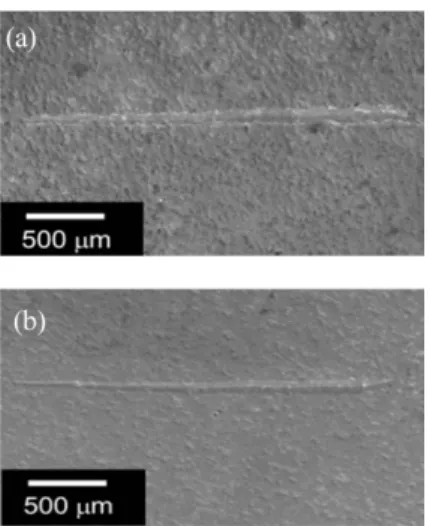
UNSM 기술 적용 후 초경 부품의 성능향상 여부를 확인하기 위해 Fig. 14와 같이 진행한 scratch test 결 과 140N으로 처리 했을 때 Fig. 15와 같이 scratch test처리면의 표면거칠기는 UNSM처리전 대비 40%가
낮아졌고, 마모량은 Fig. 16과 같이 UNSM처리전 보 다 46% 감소되었다. 마모량 감소 원인으로 UNSM 처리시 표면이 나노결정조직으로 개질되면서 표면거칠 기, 표면경도 등 기계적 특성이 향상되었기 때문으로 판단된다. 또한 표면의 코발트 함유량 감소와 탄소 함 유량 증가가 초경 내구성 향상에 좋은 영향을 주었기 때문으로 사료된다.
4. 결 론
초경 시험편을 이용하여 UNSM 처리 후 표면거칠 기는 81% 낮아졌고, 표면경도는 42% 높아졌다. 또한 표면입자 크기는 처리 전 대비 39% 작아져 UNSM처 리 후 표면 조직이 미세화 되는 것을 확인할 수 있었 다. 또한 프레스금형의 수명연장 가능성을 확인하기 위 해 진행한 scratch test결과 UNSM 처리 후 시험편 마모량이 46% 향상되어 초경부품 수명연장에 UNSM 기술이 도움이 되는 것을 확인하였다. 차후 피로특성 확인을 위하여 RCF 시험과 프레스금형 적용시 어떠한 영향이 있는지 현장시험도 진행할 계획이다.
References
[1] Jeon, Y. J., Kim, S. H., Yoon, K. T., Heo, Y. M., Lee, T.
G., “Indirect Prediction of Surface Damage for a Press Die with Wear Characteristics and Finite Element Stamping Analysis”, Transactions of Materials Pro- cessing, Vol. 23, No. 1, pp. 29-34, 2014.
[2] Kang, J. H., “The technology trends of new concept of cutting tools of eco convergence”, Journal of the KSME, Vol. 52, No. 2, pp. 48-52, 2012.
[3] Kim, J. H., Park, Y. H., Haa, G. H., “Synthesis of Nano- sized Tungsten Carbide - Cobalt Powder by Liquid Phase Method of Tungstate”, Journal of Korean Pow- der Metallurgy Institute, Vol. 18, No. 4, pp. 332- 339, 2011.
[4] Gim, J. S., Jeong, Y. T., “Introduction to PVD/PACVD Coating”, Journal of the Korean Society for Preci- sion Engineering, Vol. 24, No. 5, pp 7-13, 2007.
Fig. 13. Surface C-Co contents before and after UNSM.
Fig. 14. Scratch test before (a) and after (b) UNSM.
Fig. 15. Scratch test surface roughness before and after UNSM.
Fig. 16. Scratch test wear loss of WC-Co.
[5] Oh, S. M., “A Study on the Tribological Character- istics of Surface Modification by TiC,N of the Ther- mal CVD Method use to the Automotive Poppet Valve”, J. Korean Soc. of Mechanical Technology, Vol. 15(2), pp. 273-278, 2011.
[6] Suh, C. M., Pyun, Y. S., Suh, M. S., “Variation of Rotating Bending Fatigue Characteristics by UNSM on Ti-6Al-4V”, Journal of Ocean Engineering and Technology, Vol. 25, No. 6, pp. 49-55, 2011.
[7] Park, B. G., Pyun, Y. S., Kim, J. H., Kim, K. Y., Kim, K. S., Jung, C. M., Kim, C. K., “Study on the Drag Reduction of 2-D Dimpled-Plates”, Journal of the Society of Naval Architects of Korea, Vol. 49, No. 4,
pp. 333-339, 2012.
[8] Suh, C. M., Pyun, Y. S., Cho, I. H., Baek, U. B.,
“UNSM Surface Technology for Manufacturing and Remanufacturing Torsion Bars for Crawler Vehicles”, Journal of Ocean Engineering and Technology, Vol.
25,No. 6, pp. 80-85, 2011.
[9] Pyoun, Y. S., Cho, I. S., Hong, J. H., Lee, C. S., Park, I.
G., Suh, C. M., Cho, I. H., Kim, C. S., “Application of Ultrasonic Nano Crystal Surface Modification Technology for Increasing the Fatigue Strength, Weight Reduction and Decreasing the Friction Loss”, The korean society of automotive engineers Symposium, pp. 44-53, 2007.
![Fig. 3. Comparison of some properties of material before and after UNSM treatment [7]](https://thumb-ap.123doks.com/thumbv2/123dokinfo/5123437.334529/2.892.526.696.768.1027/fig-comparison-properties-material-unsm-treatment.webp)