A New species of Elsholtzia (Lamiaceae): E. byeonsanensis M. Kim Changhak Choi, Kyeongsuk Han, Jungsim Lee, Soonku So, Yong Hwang and Muyeol Kim*
Department of Biological Sciences, Chonbuk National University, Jeonju 561-756, Korea (Received 27 August 2012; Revised 12 September 2012; Accepted 17 September 2012)
향유속(꿀풀과)의 신종:
변산향유(Elsholtzia byeonsanensis M. Kim)
최창학·한경숙·이정심·소순구·황 용·김무열*
전북대학교 자연과학대학 생명과학과
ABSTRACT: A new species, Elsholtzia byeonsanensis M. Kim is named and described from Byeonsan, Jeolla- bukdo Province, Korea. Molecular data confirmed that this new taxon was distinguished from other congeneric species. Elsholtzia byeonsanensis shares several characteristics (secund spikes, ovate leaves, long corolla length, etc.) with its related species E. splendens, but it is distinct from E. splendens which has a large plant, green stem color, chartaceous leaf textures, non-shiny leaf surfaces, pubescent petioles, pubescent leaf blade surfaces, pubescent bract surface, and open woodland habitats by having a small plant, purple stem color, coriaceous leaf textures, shiny leaf surfaces, glabrous petioles, glabrous leaf blade surfaces, glabrous bract surface, and marine habitats.
Keywords: Elsholtzia byeonsanensis, E. splendens, Lamiaceae
적 요:
전북 변산에서 향유속의 신종인 변산향유(Elsholtzia byeonsanensis M. Kim)를 새로이 발견하여 기재하였다. 분자생물학적인 결과는 변산향유가 근연종들과 구별되는 신종임을 지지해 주었다. 변산향유는 꽃이 한쪽 방향으로 밀생하는 수상화서이며 난형인 잎과 화관길이가 길어 꽃향유와 유사하다. 그러나 변산향유는 식물체는 작고 줄기는 자주색이며 잎은 혁질이고 윤기가 나며 엽병과 엽신 표면 및 화서의 포 표면에 털이 없고 바닷가 바위틈에 자라는 반면에, 꽃향유는 식물체는 크고 줄기는 녹색이며 잎은 초질이고 윤기가 없으 며 엽병과 엽신 표면 및 화서의 포 표면에 털이 있고 숲 가장자리에서 자라는 점에서 두 종이 뚜렷하게 차이 가 난다.
주요어: 변산향유, 꽃향유, 꿀풀과
The genus Elsholtzia Willd. (Lamiaceae) consists of approximately 40 species and is distributed primarily in temperate regions of the Northern Hemisphere including China, Russia, Europe, and North America (Li and Hedge, 1994; Jeon and Hong, 2006). The genus Elsholtzia are characterized by opposite leaves, compact spikes, ovate bracts, cylindrical calyx, and nutlet fruit (Hong, 2007). Six taxa of Elsholtzia are distributed in Korea (Lee, 2000; Lee et al., 2011). Of 6 taxa, E. splendens occur widely in Korea, while E. minima and E.
angustifolia are rather rare and sporadically distributed.
During field work in 2011, a new species from Byeonsan in Jeollabukdo Province, Korea was discovered. In this paper, we named this new taxon as Elsholtzia byeonsanensis M. Kim and described several morphological features relative to its related species E. splendens. The new species shares several characteristis with its related species, but it can be distinguished based on habit (i.e. small plants), leaf textures (i.e., coriaceous), bract abaxial surface (i.e., glabrous), habitat (i.e., on the steep cliff near sea), etc. Also molecular data confirmed that Elsholtzia byeonsanensis is a new species and distinguished from its
*Author for correspondence: [email protected]
related species (M. Kim et al., unpubl. data).
Elsholtzia byeonsanensis M. Kim, sp. nov. Figs. 1, 2, 3 Korean name: Byeonsan-Hyangyu 변산향유
Herba annulae, erectus, ramosa, 20 −35 cm alta. Caulis purpurea. Folia opposita, corium; lamina ovatus, 3.5−4.5 cm longa, 1.5−2.2 cm lata. supra glabra, subtus glandula; petioli glabra, 2.0 −3.2 cm longi; margo serratus. Spicae 3.5−4.5 cm longa; bracteae ovatus, glabra, 5 × 6−7 mm; pedicelli 1 mm longi. Calyx cylindrus, 2−3 mm longa, 5 lobis. Corolla purpurea, 6−7 mm longi, pilosus et glandula externus. Stamina 4, exserta;
filamenta purpurea, glabra; antherae ruber. Ovaria 4 lobis; styli linearis, rubellus, exserta; stigmata 2 lobi. Fructus nuculae;
semina brunneolus. Flores Novembris anthesis, purpurea.
Herb annual, erect, branched, 20 −35 cm high. Stem purple.
Leaves opposite, coriaceous; leaf blade ovate, 3.5 −4.5 × 1.5−
2.2 cm, glabrous adaxially, densely impressed glandular abaxially; petiole 2.0−3.2 cm; margin serrate. Spikes secund, 3.5-4.5 cm; bracts broadly ovate, 5 × 6−7 mm. Pedicel 1 mm.
Calyx cylindrical, 2 −3 mm, villous, 5 lobes. Corolla purple, 6−
7 mm, hairy and glandular outside, upper lip emarginate, lower lip 3 lobes. Stamens 4, exserted, 2 anterior ones longer; filaments purplish, glabrous; anther red. Ovary 4 lobed, style redish, exserted; stigma 2 cleft. Fruit nutlets; seeds brown. Flowering November, purple.
Type Locality: Byeonsan, Jeollabukdo Province, Korea.
Holotype: Byeonsan, Jeollabukdo Province, Korea. Nov. 26, 2011. M. Kim 110101. Herbarium of Chonbuk National University (JNU).
Isotype: Byeonsan, Jeollabukdo Province, Korea. Nov. 26, 2011. M. Kim 110102-110109 (JNU).
Fig. 1. Photographs of Elsholtzia byeonsanensis M. Kim at type locality. A. adult plant; B. flower; C. bract; D. habitat; E. inflorescence. Scale
bars 1 cm in A and E ; 2 mm in B and 1 mm in C.
Flowering: November
Distribution: Byeonsan, Jeollabukdo Province, Korea.
Etymology: The specific epithet is derived from Byeonsan where this new species is located.
Habitats: The natural habitats of Elsholtzia byeonsanensis M. Kim were discovered at coastal regions in the Byeonsan, Jeollabukdo Province, Korea. Hundreds of new individuals occur on steep cliffs along the 1−2 km seaside dominated by Carpinus turczaninowwii, Elaeagnus macrophylla, and Ulmus parvifolia. The new species also occurs with other herbaceous species dominated by Dendranthema indicum, Aster spathulifolius, and Cyrtomium falcatum.
Key to Elsholtzia byeonsanensis M. Kim and its related taxa
1. Spikes cylindrical
2. Stem quadrilateral, 10−20 cm high
··· E. saxatilis 애기향유 2. Stem rounded, 2 −5 cm high ···E. minima 좀향유 1. Spikes secund
3. Corolla 4−5 mm ··· E. ciliata 향유 3. Corolla more than 5 mm
4. Petioles absent, leaf blade linear
··· E. angustifolia 가는잎향유 4. Petioles present, leaf blade ovate
Fig. 2. Elsholtzia byeonsanensis M. Kim. A. habit; B. calyx; C. flower; D. bract; E. pistil.
5. Coriaceous leaf textures, petioles and adaxial surface of leaf blade glabrous; bract surface glabrous; marine habitats ··· E. byeonsanensis 변산향유 5. Chartaceoust leaf textures, petioles and adaxial surface of leaf blade pubescent; bract surface pubescent; woodland habitats
6. Plants 40−70 cm ··· E. splendens 꽃향유 6. Plants 7−15 cm
···E. splendens var. hallasanenssis 한라꽃향유
Large populations of the new species, Elsholtzia byeonsanensis M. Kim were first discovered at Byeonsan, Jeollabukdo
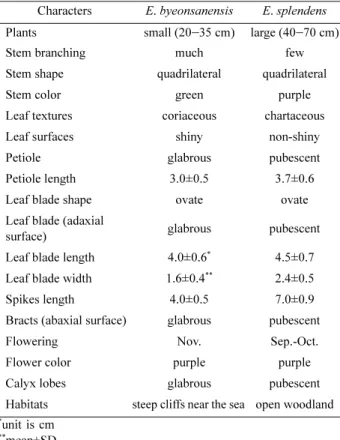
Province, Korea. Elsholtzia byeonsanensis shares several characteristics (secund spikes, ovate leaves, long corolla length, etc.) with its related species E. splendens, but it is distinct from E. splendens which has a large plant, green stem color, chartaceous leaf textures, non-shiny leaf surfaces, pubescent petioles, pubescent leaf blade surface, pubescent bract surface, and open woodland habitats by having a small plant, purple stem color, coriaceous leaf textures, shiny leaf surfaces, glabrous petioles, glabrous leaf blade surface, glabrous bract surface, and marine habitats. Thus, the authors described this taxon as a new species of the genus Elsholtzia.
Molecular data provided some insights into the taxonomical
Fig. 3. Holotype of Elsholtzia byeonsanensis M. Kim
position of Elsholtzia byeonsanensis M. Kim. For example, nrDNA ITS and cpDNA (rpl16 and trnH-psbA) sequences
suggested that Elsholtzia byeonsanensis is an independent species and is distinguished from other Korean species (M.
Kim et al., unpubl. data).
Acknowledgement
We are deeply indebted to Dr. Chang-Shook Lee of Ewha Womans University for her taxonomical review.
Literature Cited
Hong, S. P. 2007. Elsholtzia Willd. In The Genera of Vascular Plants of Korea. Park, C.-W. (ed.), Academy Publishing Co., Seoul. Pp. 838-840.
Jeon, Y. C. and S. P. Hong. 2006. A systematic study of Elsholtzia Willd. (Lamiaceae) in Korea. Korean Journal of Plant Taxon- omy 36: 309-333. (in Korean)
Lee, C. S., K. A. Hwang, J. O. Kim, H. M. Suh, and N. S. Lee.
2011. Taxonomical status of three taxa of Elsholtzia (E. hal- lasanensis, E. springia, and E. splendens var. fasciflora) (Lamiaceae) based on molecular data. Korean Journal of Plant Taxonomy 41: 259-266.
Lee, Y. N. 2000. The genus Elsholtzia in Korea. Bulletin of Korean Plant Research 1: 48-54. (in Korean)
Li, X. and I. C. Hedge. 1994. Elsholtzia Willd. In Flora of China.
Vol. 17. Wu, Z.-Y. and P. H. Raven (eds.), Science Press, Beijing and Missouri Botanical Garden Press, St. Louis, USA.
Pp. 246-255.
Table 1. Comparison of morphological characters between Elsholtzia byeonsanensis M. Kim and its related species E.
splendens.
Characters E. byeonsanensis E. splendens Plants small (20 − 35 cm) large (40 − 70 cm)
Stem branching much few
Stem shape quadrilateral quadrilateral
Stem color green purple
Leaf textures coriaceous chartaceous
Leaf surfaces shiny non-shiny
Petiole glabrous pubescent
Petiole length 3.0 ± 0.5 3.7 ± 0.6
Leaf blade shape ovate ovate
Leaf blade (adaxial
surface) glabrous pubescent
Leaf blade length 4.0 ± 0.6
*4.5 ± 0.7 Leaf blade width 1.6 ± 0.4
**2.4 ± 0.5
Spikes length 4.0 ± 0.5 7.0 ± 0.9
Bracts (abaxial surface) glabrous pubescent
Flowering Nov. Sep.-Oct.
Flower color purple purple
Calyx lobes glabrous pubescent
Habitats steep cliffs near the sea open woodland
*
unit is cm
**