Received: November 8, 2018 Revised: November 27, 2018 Accepted: November 30, 2018
depression on the correlation between the frequency of community volunteer activities and job consciousness in dental hygiene
students
Marcia H. Lorentzen*・Young-Soo Lee1*・Jong-Hwa Jang2 Department of Dental Hygiene, Bridgeport University
1Department of Dental Hygiene, Sunmoon University
2Department of Dental Hygiene, Health Science, Dankook University
*This authors contributed equally to this study and should be considered co-first authors.
Corresponding Author: Jong-Hwa Jang, Department of Dental Hygiene, College of Health Science, Dankook University, Cheonan-si, Chungnam, Republic of Korea, Tel: +82-41-550-1495, E-mail:
Abstract
Objectives: This study examined dental hygiene students' frequency of participation in community volunteer activities, job consciousness, depression, and self-esteem, and then identified the correlation among them. We also analyzed the moderating effect of depression and self-esteem on the correlation between participation in community volunteer activities and job consciousness. Methods: We surveyed 312 dental hygiene students attending four universities in South Chungcheong Province, Korea, from May 2 to June 15, 2016, through direct visits. They were given structured questionnaires containing four items on community volunteer activities, three on job consciousness, ten on self-esteem, and 13 on depression.
To examine the moderating effect of depression and self-esteem, we performed analysis of variance, correlation analysis, and structural equation modeling analysis (based on the path analysis model and by inserting interaction terms) using SPSS and AMOS. Results: We observed a negative correlation between self-esteem and depression (r=-0.062) but a positive correlation between self-esteem and job consciousness (r=0.125). Depression and job consciousness had a negative correlation (r=-0.176). Depression had a statistically significant impact on job consciousness (r=-0.519, p<0.01). The interaction term between depression and frequency of community volunteer activities also had a statistically significant influence on job consciousness (r=0.090, p<0.05). These findings indicate that depression moderates the correlation between frequency of community volunteer activities and job consciousness at a statistically significant level. Conclusions: More frequent participation in volunteer activities enhances dental hygiene students' self-esteem, reduces depression, and raises job consciousness. The positive impact of volunteering on self-esteem, depression, and job consciousness warrants encouraging students' J Korean Soc Dent Hyg 2018;18(6):1025-35 https://doi.org/10.13065/jksdh.20180088 pISSN : 2287-1705 eISSN : 2288-2294
participation in community volunteer activities, creating supportive structures, and developing various volunteer programs relevant to the students' area of study.
Key Words: Community volunteer activity, Depression, Dental hygiene students, Job consciousness, Self-esteem
Introduction
Universities contribute to a nation's economic and industrial development with the knowledge produced and accumulated through educational and research activities [1]. They also train future talents through joint programs with businesses in various sectors while facilitating technological advances and supporting the economic growth of a community [2]. Academic achievements in university, when combined with community volunteer activities, can create great value for universities, students, and communities. Volunteering in the context of university education goes beyond the distribution of resources or philanthropyit enhances the quality of education in university and offers students an opportunity to pursue self-development [3]. Volunteering also enables students to gain an accurate, informed insight into social phenomena, analyze them critically, envision solutions to social issues, and put them into practice [4].
Korea's economic development and ensuing technological advances have enhanced the quality of health care services and allowed people to turn their attention from struggling to meet their basic needs to taking care of their health and beauty. These trends have brought an increasing number of patients to dental clinics. However, an equally increasing number of people in local communities throughout the country are simultaneously excluded from health care services owing to physical, financial, and time constraints.
The volunteering programs for residents in local communities who do not have access to oral care services are attracting increasing participation from dental hygiene students. Korea's statute law defines volunteer activities as activities performed by individuals or organizations devoting their time and effort without compensation at their free will, for the benefit of the local community, nation, and human society [5]. Dental hygiene students involved in these volunteer activities contribute to ongoing efforts to improve oral health conditions in communities by educating residents excluded from oral care services on dental management and prevention of dental diseases. Educators are called upon to incorporate volunteering into their school's formal or informal curricula to maintain students' mental health, as an experience with volunteering can enhance students' self-esteem and reduce depression [6]. A previous study reported that students' experience with volunteer activities enhances their confidence at work [7].
Dental hygiene students' participation in volunteer activities can be credited with creating synergies
for both residents in local communities and the students themselves. The frequency of participation in
such activities is associated with various socio-psychological factors and can potentially influence the
students' job consciousness as they prepare themselves for a professional career.
Previous research on dental hygiene students' job consciousness examined its correlation with the students' sex-role identity [8], job values [9], satisfaction with their major [10], and career awareness [11].
However, the correlation between job consciousness and community volunteer activities remains unclear.
As such, this study examined dental hygiene students' frequency of participation in community volunteer activities, self-esteem, depression, and job consciousness, and analyzed the moderating effect of self-esteem and depression on the correlation between the frequency of community volunteer activities and job consciousness. We anticipate that our findings will contribute to ongoing endeavors in promoting community volunteering programs among dental hygiene students and raising their consciousness about their future career.
Methods
1. Research design
This study adopted a cross-sectional, correlational design to examine dental hygiene students' participation in community volunteer activities and job consciousness, and to analyze the moderating effect of self-esteem and depression on the correlation between them.
2. Subjects
The study population consisted of students attending universities across Korea that operate a dental hygiene course. A total of 312 dental hygiene students at four universities in South Chungcheong Province, Korea, were selected for this study. The sample size was determined on the basis of Kline's methodology [12], which recommends a minimum of 20 times the size of measured variables as the ideal sample size for a structural equation model, among various methods of sample size estimation.
Regarding ethical considerations, this study obtained approval from the Institutional Review Board of S University (IRB No: SM-201509-036-1).
3. Data collection
The participants were surveyed from May 2 to June 15, 2016, using structured questionnaires. We paid a direct visit to the universities selected for the survey, explained the purpose of our research to the students, distributed the questionnaire copies to the students who consented to participation, and then collected the copies immediately upon completion. Of the collected questionnaires, 12 were excluded on account of incomplete answers, and the remaining 300 were used for the analysis.
4. Measuring tools
The questionnaire contained 4 items on the participants' general characteristics (year of study, total
duration of course, and frequency of participation in community volunteer activities), 3 on their job
consciousness, 10 on self-esteem, and 13 on depression. Self-esteem was measured using Rosenberg's [13] self-esteem measurement tool, where the positively worded question items 1, 2, 4, 6, 7 were chosen for our survey and anchored between 1 = strongly disagree and 5 = strongly agree, with higher scores indicating higher self-esteem. The Cronbach's internal consistency coefficient of this tool was 0.777.
Depression was measured with the Center for Epidemiologic Studies Depression(CES-D) scale restructured by Kang [14]. The participants' mean scores were calculated based on the question items anchored between 1 = strongly disagree and 5 = strongly agree, with higher scores indicating a higher degree of depression. The Cronbach's coefficient of this tool was 0.817.
Job consciousness was measured with Hwang and Cho's [11] tool. The items were anchored between 1 = strongly disagree and 4 = strongly agree, with higher scores indicating higher job consciousness. The Cronbach's coefficient of this tool was 0.818.
5. Data analysis
The collected data were analyzed using statistical processing software SPSS WIN 22.0. Descriptive statistics were calculated to examine the participants' socio-demographic characteristics and frequency of participation in community volunteer activities. Pearson's correlation analysis was performed to examine the correlation between job consciousness, self-esteem, and depression. The moderating effect of self-esteem and depression was analyzed by inserting interaction terms into the path analysis model under the structural equation modeling analysis, for which AMOS 21.0 software was used. The significance level used to determine statistical significance of the outcome, was set at 0.05.
Results
1. Participants' general characteristics
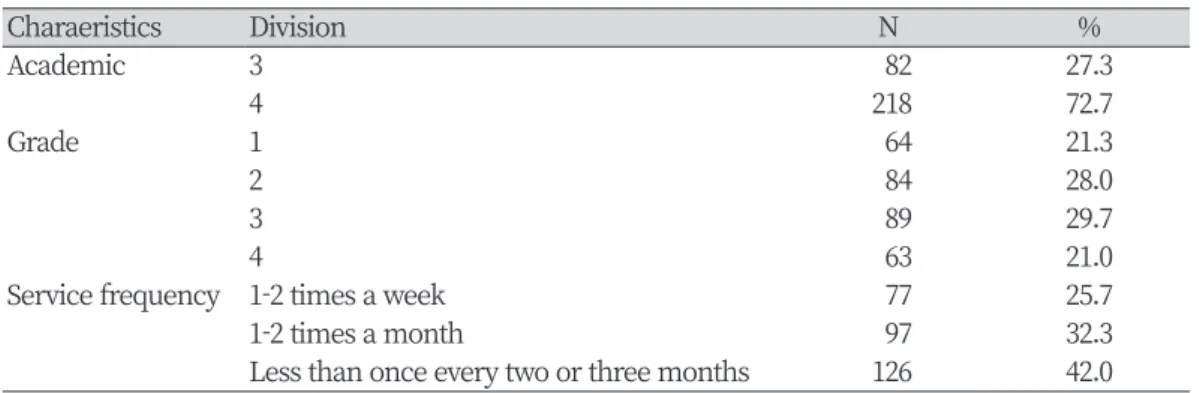
<Table 1> gives the participants' general characteristics. In terms of the total duration of the course, 218 students (72.7%) were enrolled in a four-year course, and 82 (27.3%) in a three-year course. A total of 89 students (29.7%) were in their third year in university, followed by 84 (28.0%) in the second year, 64 (21.3%) in the first year, and 63 (21.0%) in the fourth year. Regarding the frequency of participation in community volunteer activities, the most common response was less than once in two or three months (126 participants, 42.0%), followed by once or twice a month (97 participants, 32.3%) and once or twice a week (77 participants, 25.7%).
2. Descriptive statistics on depression, self-esteem, and job consciousness
<Table 2> shows the descriptive statistics on the participants' self-esteem, depression, and job
consciousness. Self-esteem and depression scores, rated on a five-point scale, stood at a moderate level,
with mean scores of 3.19 and 3.00, respectively. The job consciousness score was also moderate, with a
mean score of 2.62 out of the total 4.
3. Variations in self-esteem, depression, and job consciousness vis-à-vis frequency of participation in community volunteer activities
We analyzed the variations in the subjects' self-esteem, depression, and job consciousness vis-à- vis their frequency of participation in community volunteer activities <Table 3>. More frequent participation in community volunteer activities led tl.o higher self-esteem and lower depression.
The respondents who said that they volunteer either once or twice a week or once or twice a month demonstrated higher self-esteem and lower depression at a statistically significant level compared with those who reported participating less than once in two or three months (p<0.001). Variations in job consciousness scores vis-à-vis frequency of participation in community volunteer activities were not statistically significant (p=0.615).
4. Correlations between self-esteem, depression, and job consciousness
We analyzed the correlation between the participants' self-esteem, depression, and job consciousness Table 1. Participants' general characteristics
Charaeristics Division N %
Academic 3 82 27.3
4 218 72.7
Grade 1 64 21.3
2 84 28.0
3 89 29.7
4 63 21.0
Service frequency 1-2 times a week 77 25.7
1-2 times a month 97 32.3
Less than once every two or three months 126 42.0
Table 2. Descriptive statistics on self-esteem, depression and job consciousness
Characteristics N Min Max Mean±SD Cronbach’s α
Self-esteem 300 1.00 5.00 3.19±0.91 0.777
Depression 300 1.23 5.00 3.00±0.73 0.817
Job consciousness 300 1.00 4.00 2.62±0.76 0.818
Table 3. Variations in self-esteem , depression, and job consciousne ss vis-à-vis frequency of participation
Characteris tics N Self-esteem Depression Job consciousness
Characteris tics N Mean±SD Mean±SD Mean±SD
1-2 per weekends 77 3.62±0.69a 2.63±0.70a 2.66±0.49
1-2 per months 97 3.43±0.67a 2.80±0.56a 2.60±0.44
>1 per two or three months 126 2.75±0.99b 3.37±0.70b 2.66±0.53
p* <0.001 <0.001 0.615
* by one way ANOVA test at a=0.05
a,b Means followed by different letters (Duncan) are significant ly different at a=0.05
<Table 4>. We observed a negative correlation between self-esteem and depression (r=-0.062) and a positive correlation between self-esteem and job consciousness (r=0.125). Depression and job consciousness had a negative correlation with each other (r=-0.176). In other words, a higher self-esteem meant lower depression and higher job consciousness, whereas higher depression translated into lower job consciousness.
5. Moderating effect of self-esteem and depression on the correlation between frequency of participation in community volunteer activities and job consciousness
The model fit, described in <Table 5>, was 327,428 in terms of the chi-squared statistic (CMIN), which was statistically significant at 3 degrees of freedom. This finding warrants further analysis based on a larger number of explanatory variables to explain the variables in our data. Comparative Fit Index (CFI) and Goodness-of-fit Index (GFI) were close to 0.9, indicating an overwhelmingly better fit of the above model over the basic model. However, the Root Mean Square error of approximation (RMSEA) value, which exceeded 0.10, suggested a certain level of gap between the observed and actual covariance models. A more complex model would increase the model fit, but our primary aim in this study was to analyze the presence of moderating variables and their impact through the structural equation model. We thus focused on examining the moderating variables than estimating the parameters, the latter of which was unnecessary for the purpose of this research.
<Table 6> describes the outcomes from analyzing the moderating effect of self-esteem and depression on the correlation between frequency of volunteer activities and job consciousness. A more frequent participation in community volunteer activities led to higher job consciousness (r=0.459, p<0.05). In addition, we inserted two interaction terms (i.e., frequency of volunteer activities and self-esteem;
frequency of volunteer activities and depression) into the model to determine whether self-esteem and depression moderate the impact of the frequency of volunteer activities on job consciousness.
The analysis showed that depression has a statistically significant impact on job consciousness (r=- 0.519, p<0.01). Moreover, the interaction term composed of frequency of volunteer activities and self- esteem had a statistically significant impact on job consciousness (r=0.091, p<0.05) and depression had a statistically significant impact on job consciousness (r=0.090, p<0.05). These outcomes suggest that
Table 4. Correlations between self-esteem, depression, and job consciousness
Characteristics Self-esteem Depression Job consciousness
Self-esteem 1.000
Depression -0.602** 1.000
Job consciousness 0.125* -0.176** 1.000
*p<0.05, **p<0.01 by the pearson’s correlation analysis
Table 5. Model fit for the path model
CMIN df p CMIN/df CFI RMSEA GFI
327.428 3 <0.001 109.143 0.857 0.601 0.818
depression has a statistically significant moderating effect on the correlation between frequency of volunteer activities and job consciousness.
In contrast, self-esteem did not explain the impact of the frequency of volunteer activities on job consciousness with statistical significance, when the influence of depression was controlled for ( p
>0.05).
Discussion
Regular participation in volunteering as part of the learning process enhances students' soft skills, including critical thinking, conflict resolution, leadership, interpersonal skills, and collaborative capacity [15]. Given the increasing number of residents in local communities excluded from the benefits of health care services owing to various reasons including physical, financial, and time constraints, dental hygiene students' volunteer activities for these people are all the more meaningful. These students' engagement with their local communities through volunteering creates synergies that benefit not only local residents but also the students themselves, especially in terms of the positive impact of volunteer activities on their self-esteem, depression, and job consciousness.
This study sought to examine the correlation between the frequency of dental hygiene students' participation in community volunteer activities and their job consciousness, and to identify the moderating effect of self-esteem and depression. Our findings are anticipated to inform ongoing efforts to promote community volunteer programs.
We found that more frequent participation in volunteer activities translated into higher self-esteem, which is consistent with Park's [6] findings. The volunteering, satisfies people's innate desire to take part in something valuable, make themselves necessary to others, and win social recognition [16]. In this sense, we suggest that volunteer activities may open dental hygiene students' eyes to their self-worth as future dental hygienists and give them a sense of fulfillment, both of which contribute to higher self- esteem.
The present study also found that a more frequent participation in volunteer activities led to lower depression, which is consistent with Kang's findings [14]. Student volunteers donate their talents and, in return, receive due recognition and respect from the beneficiaries of their assistance. This experience shows them how valuable they are, offers them the pleasure of feeling fulfilled through the beneficiaries' Table 6. Moderating effect of self-esteem and depression on the correlation between frequency of participati on in community volunteer activities and job consciousness
r S.E C.R p
Community volunteer activity frequency -> Job consciousness 0.459 0.218 2.106 0.035
Self-esteem -> Job consciousness -0.151 0.184 -0.819 0.413
Depression -> Job consciousness -0.519 0.161 -3.223 0.001
Community volunteer activity frequency × Self-esteem
-> Job consciousness 0.091 0.044 2.064 0.039
Community volunteer activity frequency × Depression
-> Job consciousness 0.090 0.036 2.536 0.011