자녀 동반 가족여행에서의 Push-pull 동기, 경험이 행동의도에 미치는 영향
Influence of Parent-child Travel Push-pull Motivation, Experience on Behavioral Intention
위옥천, 박근수, 유항유, 조혁족 배재대학교
Yuqian Wei([email protected]), KeunSoo Park([email protected]) Liu Hengyu([email protected]), Yizu Zhao([email protected]) 요약
중국의 사회 발전에 따른 가족 구조의 변화와 가족 소득의 증가로 자녀 동반 가족여행은 점차 관광소비 분야 의 각광받는 새로운 트렌드가 되고 있다. 관광마케터들에게 자녀를 동반한 가족여행자들의 요구와 동기를 이 해하는 것이 중요한 과제로 떠오르고 있다. 본 연구는 농장으로 여행하는 자녀 동반 가족관광객 290명을 대상 으로 설문조사를 실시하였으며, 자녀 동반 가족 여행자의 Push-pull 동기를 분석하고 Push-pull 동기와 경 험, 행동의도 사이의 영향 관계를 검증하였다. 이 연구의 분석결과는 다음과 같이 나타났다. 13개의 push 동 기 항목에 대한 요인 분석에서 '어린이 & 가족', '도피 & 휴식', '사회화'의 3개 push 동기 요인을 도출하였으 며, 11개의 pull 동기 요인을 분석하여 '시설 & 안전', '테마추구 활동', '환경'의 3개의 pull 동기 요인을 도출 하였다. 하위 가설 검증을 통해, 자녀 동반 가족여행자의 Push-pull 동기가 참석 경험(4E)에 긍정적인 영향을 미친다는 것을 결과를 도출하였다. '에스테틱스 체험'은 자녀 동반 가족자의 행동 의도에 가장 큰 영향을 미치 고, '교육 경험'과 '엔터테인먼트 경험'도 영향을 미치는 것으로 나타났다.
■ 중심어 :∣Push-pull 동기∣경험 행동의도∣자녀 동반 가족여행∣
Abstract
With the development of society, changes in the family structure of China's residents and the increase in family income, parent-child travel has gradually become a new hotspot for tourism consumption. It is important for tourism marketers to understand the needs and motivations of parent-child travelers. This study explored the push and pull motivations of parent-child travelers by conducting a questionnaire survey of 290 travelers to parent-child farms and validated the path relationships between push and pull motivations, experiences and behavioral intentions. The result indicated that: 3 push factors were derived from the factor analysis of 13 push items and were named as 'For children & Family’ , 'Escape & Relax’, and 'Socialization’; 3 pull factors were derived from the factor analysis of 11 pull items and were labeled: 'Facilities & Safety’, 'Theme activities’, and 'Environment’. Through sub hypotheses testing, the results show that push-pull motivation of parent-child travelers has a positive effect on their experience(4Es) for attending. 'Esthetics Experience' has the highest effect on the parent-child travelers’ behavioral intentions, followed by 'Education Experience' and 'Entertainment Experience'.
■ keyword :∣Push-pull Motivation∣Experience∣Behavioral Intention∣Parent-child Travel∣
접수일자 : 2020년 09월 23일
수정일자 : 2020년 10월 10일 심사완료일 : 2020년 10월 10일
교신저자 : 박근수, e-mail : [email protected]
I. Introduction
Since 2013, the "Where's Dad Going" reality show has exploded the Parent-child travel market in China. Parent-child travel is one of the types of market segmentation based on the subject of tourism by the Chinese researchers.
Parent-child travel is a kind of tourism activity which takes the child as the main body, the parents as the leaders and the family as a unit, with the purpose of strengthening the emotional relationship between parents and children, social cultivation, knowledge education and ability and quality[1]. A substantial amount of statistics and articles in travel magazines indicated that family vacation travel is one of the major worldwide trends[2].
In 2018, Document No. 544 issued by the Ministry of culture and tourism of China pointed out that the development of high-quality weekend parent-child tourism products should be encouraged. The tourism subjects of parent-child travel is the core family consisting of a pair of parents and their children. With the rapid development of Chinese society and the increase in family income, the total demand for the parent-child travel market is growing rapidly, and the differences in demand are becoming apparent.
Different family backgrounds, different spending power, different age groups of children and parents' different ideas about child development all lead to different demands for parent-child travel products. At present, the market potential of China's parent-child tourism is huge, but the types of products are simple[3], the service facilities are imperfect, and safety and security are insufficient[4].
It is important to everyone in tourism related
industries to understanding the family vacation decision-making process and the family travel market segment has great economic impact[5].
Children have the greatest influence when deciding on the type of family vacation activity[5], although they have often been overlooked in past research on the subject[6][7].
The purpose of this study was to explore the push and pull motivations of parent-child travelers and to exam the theoretical model representing the relationships among push-pull motivation, experience and behavioral intention.
II. Literature review 1. Push-pull motivation
Tourist motivation can be considered the primary driver when analyzing the tourist behavior[8][9]. According to Maslow’s hierarchy of needs, Crompton proposed a push-pull model of tourism motivation that determines the push-pull effects of tourist destination selection and experience[10]. This theory provides an effective way to examine the tourism motivation[11].
Most of previous studies have tried a number of approaches to empirically examine push-pull motivation in different dimensions. Similar to the findings of Uysal[12], Mohr et al. proposed the same five motivation factors: ‘escape’,
‘excitement’, ‘event novelty’, ‘socialization’, and
‘family togetherness’[13]. Cha et al.(1995) stated that motivation can be measured by six distinct factors: ‘Relax’, ‘Knowledge’, ‘Adventure’, ‘Travel Bragging’, ‘Family’, and ‘Sports’[14]. In addition, scholars have explored the motivations of travelers in different market segments such as
‘adolescents’[15], ‘seniors’[16], ‘students’[17],
‘rock climbing tourists’[18], ‘dental tourism’[19],
‘retirement tourism’[20],and so on.
The push and pull factors of tourist behavior are two sides of the same motivational coin[21].
It essentially contributes to our overall understanding of why holiday makers take travel decisions to opt for destinations, and can therefore help destination marketers develop better marketing programmers to meet the specific needs of their customers [22]. Besides, a successful matching of push and pull motives is essential for a marketing strategy in destination areas[23], and the examination of the motives are useful in segmenting markets, designing promotional programs, and decision-making about destination development[24].
2. Experience
Experience is a constant flow of thoughts and feelings during moments of perception which occur through highly complex interaction processes of sociological, psychological, and cognitive[25], and involves cognition[26].
As the world economy shifts from service-based to experience-based, the era of the experience economy has arrived[27].
Experience has become the latest consumer hot spot in the market[28], especially the travel industry[29]. Cohen’s (1979) delimited five modes of experience: recreational, diversionary, experiential, experimental, and existential in his typology[30]. Combined the hierarchy of demand theory and function theory, Pine &
Gilmore(1999) identified 4 realms of experience: entertainment (passive-absorption), education (active-absorption), esthetics (passive-immersion), and escapism
(active-immersion), which were extensively applied in tourism researches as a cornerstone of consumer experience[31]. The development of the experience economy has promoted a plethora of studies dedicated to the consumer experiences,and also been applied to tourism research[32-34].
Seen as a driving force behind experience, motivation can help understand the origin of experience[35-37]. In the existing tourism research literature, the research on the influence of motivation on experience is limited, and it is mainly used for the study of dark tourism[1][38-40]. Kang et al.(2012) developed this model (motivation-experience-benifits) to provide an effective framework for comprehending visitor experiences in dark tourism contexts, and indicated that two motivations (learning and obligation, social reasons and curiosity) were significantly related to the six dimensions of experiences[38]. In addition, other scholars have verified the effect of motivation on experience from the perspectives of "study tourism"[41], "wildlife tourism"[42]and others.
Hypothesis 1: Parent-child travelers’ push motivations has a positive effect on their experience.
Hypothesis 2: Parent-child travelers’ pull motivations has a positive effect on their experience.
3. Behavioral intention
Behavioral intentions frequently represent an individual's anticipated or planned future behavior[43]. Although there are difference in the definition of behavioral intentions and loyalty, most studies agree that loyalty in future behavior reflects in repeated purchases and
recommendations[44], which are basically consistent with behavioral intentions. The intention to repurchase and the intention to provide positive recommendations in measuring the future behavioral intention construct were been seen as two popular indicators[45].
Therefore, in tourism research, behavioral intentions refers to revisiting the destination and their willingness to recommend it to other[46][47].
Experience is the perception of the destination or event after the tourists participate, while, behavioral intention can be seen as the results of the tourists' evaluation of the travel experience [48]. Tourists would have plans to revisit the destination in the future if they have more satisfaction experience than expected[49]. Therefore, some scholars considered the experience as an antecedent of behavioral intention[50][51]. The relationship between experience and behavioral intentions has also been validated for ‘theme parks’[52],
‘ecotourism’[53] and others[54].
Hypothesis 3: Parent-child travelers’
experience has a positive effect on their behavioral intention.
III. Methodology
1. Questionnaire Design
In order to measure parent-child tourist motivation, this study utilizes pull and push motivation variables. The questionnaire design was informed by previous research[55-58]. Push factors which were associated with internal motivations consisted of 13 items and grouped into 4 dimensions. Similarly, 15 pull motive items, which were the external forces of
destination attributes, were divided into 4 groups. Those items of experience based on existing literature[31][59][61]. Behavioral intention was investigated by 4 items adopted from previous researches on a 5-point Likert scale. The respondents’ demographic variables include gender, age, education level, occupation, marriage, and income.
2. Data Collection and analysis
The survey was conducted on May 15 to May 25, 2018. To effectively measure the push-pull motives and experience of parent-child travelers, the study used the Children Country as a case study site. The Children Country is located in Zhengzhou City, Henan Province, which is the first brand of family theme farm in China and included in the '2017 National Tourism Optimization Project' which is selected by the National Tourism Administration.
As a professional parent-child farm, a large number of parents and child travelers has been visiting the farm, of which the environment helped the researcher the investigation, and the questionnaire collection process. In this survey, researcher contacted several educational institutions which had organized parents and children to visit Children Country, sent questionnaires to 338 parents by the staff. A total of 309 questionnaires were recovered, some of which were excluded due to incomplete and less authentic. 290 valid samples were used, and the effective questionnaire rate was 85.8%.
This study discusses the relationship between push-pull motivation, experience and behavioral intentions of parent-child travelers, and uses IBM SPSS 23 software to analyze the final effective data from the questionnaire
survey.
First of all, descriptive analysis and Frequency Analysis were used to describe and analyze the demographic characteristics of the sample and the tourists' evaluation level of each index.
Secondly, in order to identify push-pull motives for parent-child travelers, factor analysis was used to extract common factors. Besides this, regression analysis, variance analysis (analysis of independent samples t-Test test and ANOVA variance) were used to test the correlation dimension properties and relationships. Finally, according to the data to test and judge the hypothesis.
IV. Results
1. Demographic information
In this part, descriptive analysis was utilized to show the characteristics profiles of respondents such as gender, age, education level, income, number of children and children's age.
The percentage of female respondents(59.7%) was higher than that of males(40.3%), and most of the respondents were 20-40 years old(90.4%) and had a college degree or above(86.3%).
These respondents had only one child in greater proportion(73.1%) and most of the children were under 6 years of age(83.5%). In terms of income, personal monthly income was higher at 4000-5999 RMB (36.2%) and 2000-3999¥ (25.2%).
2. Results of Exploratory Factor Analysis (EFA)
A principal components analysis using a varimax rotation identified three factors with
eigenvalues greater than one, which explained 73.27% of variance of factors of push motivation. The results of this analysis are displayed in [Table 2]. The three factors were labeled ‘For children & Family’; ‘Escape &
Relax’;and ‘Socialization’. The questions were evaluated for reliability and validity. All loadings were greater than 0.60, and the reliabilities (alpha) were 0.922, 0.826, and 0.880, KMO value was 0.859, which meant was good for factor analysis.
A principal components analysis using a varimax rotation identified three factors with eigenvalues greater than one, which explained 83.14% of variance of factors of pull motivation.
The three factors were labeled ‘Facilities &
Safety’; ‘Environment’;and ‘Theme activities’.
The questions were evaluated for reliability and validity. All loadings were greater than 0.60, and the reliabilities (alpha) were 0.928, 0.911, and 0.921, KMO value was 0.892, which meant was good for factor analysis.
A principal components analysis using a varimax rotation identified four factors with eigenvalues greater than one, which explained 79.76% of variance of factors of experience.
The factors were 'Education’ ; ‘Entertainment’;
‘Esthetics’; and ‘Escape’. The questions were evaluated for reliability and validity. All loadings were greater than 0.60, and the reliabilities (alpha) were 0.907, 0.9886, 0.911, and 0.922, KMO value was 0.875, which meant was good for factor analysis.
The factor of behavior intention included 4 items with an eigenvalue of 3.268 and explained 81.71% of the variance. Factor loading ranged from 0.94 to 0.81, and Cronbach's alpha coefficient was 0.925, it supports that these four factors to measure
behavioral intentions were reliable and had internal consistency of items on each indicators or domain. KMO value was 0.844 which indicates that the factor analysis was considered a useful validation of the factor model.
3. Results Regression Analysis
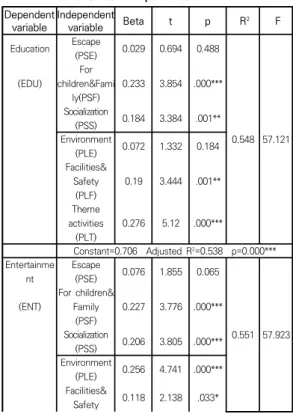
In the regression analysis for education and push-pull motivation, the results show that 'For children & Family’(Beta=0.233,t=3.854),
‘Socialization’(Beta=0.184, t=3.384), ‘Facilities &
Safety’(Beta=0.190, t=3.444), and ‘Theme activities’(Beta=0.276, t=5.120) have a significant positive relationship with education in Chilren Country. The results suggest that the overall model is significant (R²=0.548; F=57.121;
p=0.000).
In the regression analysis for entertainment and push-pull motivation, all the factors have a significant impact on entertainment, except
‘Escape’. The results from regression analyses suggest that the overall model is significant (R²=0.551; F=57.923; p=0.000). Among those independent variables, 'Socialization’(Beta=0.206, t=3.805, p=0.000) is the most important push factor in explaining the variance entertainment experience, followed by ‘For children &
Family’(Beta=0.277, t=3.776, p=0.000). ‘Environment’
(Beta=0.256,t=4.741, p=0.000) is the most important pull factor in explaining the variance entertainment experience, followed by 'Theme activities’(Beta=0.161, t=2.995, p=0.003) and 'Facilities & Safety’(Beta=0.118, t=2.138, p=0.033).
In the regression analysis for esthetics and push-pull motivation, ‘Socialization’(Beta=0.223, t=4.258, p=0.000) is the most important push factor in explaining the variance esthetics experience, followed by and 'Escape’(Beta=0.084,
t=2.114,p=0.035). ‘Environment’ (Beta=0.376, t=7.190, p=0.000) is the most important pull factor in explaining the variance of esthetics experience, followed by ‘Facilities & Safety’
(Beta=0.204, t=3.823, p=0.000) and ‘Theme activities' (Beta=0.129, t=2.494, p=0.013). The results from regression analyses suggest that the overall model is significant (R²=0.572, F=65.433, p=0.000).
In the regression analysis for escape and push-pull motivation, the results show that 'Escape' (Beta=0.410, t=8.535, p=0.000) is the most important push factor in explaining the variance escape experience, followed by and 'Socialization' (Beta=0.186, t=2.929, p=0.004).
The results from regression analyses suggest that the overall model is significant (R²=0.388, F=29.903, p=0.000).
Table 1. Forward Regression Model for Push-pull otivation and Experience
Dependent
variable Independent
variable Beta t p R² F
Education Escape
(PSE) 0.029 0.694 0.488
0.548 57.121
(EDU)
For children&Fami
ly(PSF) 0.233 3.854 .000***
Socialization
(PSS) 0.184 3.384 .001**
Environment
(PLE) 0.072 1.332 0.184 Facilities&
Safety (PLF)
0.19 3.444 .001**
Theme
activities (PLT)
0.276 5.12 .000***
Constant=0.706 Adjusted R²=0.538 p=0.000***
Entertainme
nt Escape
(PSE) 0.076 1.855 0.065
0.551 57.923 (ENT) For children&
Family
(PSF) 0.227 3.776 .000***
Socialization
(PSS) 0.206 3.805 .000***
Environment
(PLE) 0.256 4.741 .000***
Facilities&
Safety 0.118 2.138 .033*
* p< 0.05, ** p< 0.01, ***p<0.001
In the regression analysis for experiencea(4 E) and push-pull motivation, the results show that 'Esthetics' (Beta=0.369,t=7.535) has the highest effect on parent-child travelers’
behavioral intentions. 'Education' (Beta=0.290, t=5.954) is the second-ranked variable, followed by 'Entertainment' (Beta=0.221,t=4.410). In other word, parent-child travelers' esthetics experience and education experience can positively influence their behavioral intention in the future. In addition, entertainment experience also impact on parent-child travelers' behavioral intentions. The results from regression analyses suggest that the
overall model is significant.
Table 2. Forward Regression Model for Experience and Behavior Intention
* p< 0.05, ** p< 0.01, ***p<0.001
According to the regression analysis, the results showed that some hypotheses were established. The model relationship between the three concepts in this study is shown in [Figure 1]:
V. Conclusion and implications
From the above data results, we can analyze and draw the following conclusions. Most respondents have a higher education degree, means they pay more attention to children's education and health, and have the ability to pay for the cost of parent-child travel.
Motivation reflects the intrinsic needs of tourists, and the research on the target motivation of different market segments can provide help for organization managers in product development and publicity. First, for children & Family’ and ‘Socialization’ are the main push motivation factors for parent-child travelers in decision making[1][58], and ‘Escape
& Relax’ factor is presented the lowest, which is different from some foreign scholars' viewpoints[15]. Second, ‘Theme activities’ and
‘Environment’ are the main pull motivation factors for parent-child travelers in making
(PLF)
Theme
activities
(PLT) 0.161 2.995 .003**
Constant=0.702 Adjusted R²=0.542 p=0.000***
Esthetics Escape
(PSE) 0.084 2.114 .035*
0.581 65.433 (EST) For children&
Family(PSF) 0.008 0.146 0.884 Socialization
(PSS) 0.223 4.258 .000***
Environment
(PLE) 0.376 7.19 .000***
Facilities&
Safety
(PLF) 0.204 3.823 .000***
Theme
activities
(PLT) 0.129 2.494 .013*
Constant=0.072 Adjusted R²=0.572 p=0.000***
Escape Escape
(PSE) 0.41 8.535 .000***
0.388 29.903 (ESC)
For children&
Family
(PSF) 0.08 1.147 0.252 Socialization
(PSS) 0.186 2.929 .004**
Environment
(PLE) 0.158 2.508 .013*
Facilities&
Safety
(PLF) 0.093 1.447 0.149
Theme activities
(PLT) 0.129 2.063 .040*
Constant=0.560 Adjusted R²=0.375 p=0.000***
Dependent
variable Independent
variable Beta t p R² F
Behavioral
Intentions Education
(EDU) 0.29 5.954 .000***
0.627 119.718 (BH) Entertainment
(ENT) 0.221 4.41 .000***
Escape(ESC) 0.082 1.94 0.053 Esthetics(EST) 0.369 7.535 .000***
Constant=0.644 Adjusted R²=0.622 p=0.000***
decisions, and ‘Facilities & Safety’ factor is presented the lowest[1][16][56]. Parent-child interactive activities with educational functions may be the content that Chinese parents pay more attention to when choosing parent-child travel products. At the same time, they are also very concerned about the environment and facility safety of the destination. Therefore, in order to attract the attention of target groups, 'educational activities', 'strengthening family interaction' and 'cultivating children's social ability' can be the focus of destination marketing.
In addition, parent-child travelers’ push-pull motivation has a positive effect on their experience[1][42]. The data results indicate that
‘For children & Family’ and ‘Theme activities’
are significantly influence parent-child travelers’ education experience in Children Country. Specifically, the strong recognition of 'to make the family feel closer’ by visitors indicates that the parents really hope to have a time to accompany their child, and to enhance the relationship of their family members.
Parent-child travelers believe that their children
learned more about nature, and parents learned more about their children through the travel.
Therefore the marketers of parent-child travel products could develop the programmes which offer education experience and make parents and their children gained a lot, like kites making, farming activities, flowers cake making and so on.
Furthermore, all factors of pull motivation (‘Environment’, ‘Facilities & Safety’, and
‘Esthetics’)are significantly influence the entertainment and esthetics experience of parent-child travelers in Children Country.
While improving the environment and facilities, the theme activities of the farm should be regularly updated and reflect the characteristics of parent-child travel to enhance the experience of tourists. Besides this, even if the children are accompanied by their parents, the managers should consider further enhancement of both security and safety measures, and must pay great attention to the children's safety issues, such as regular equipment maintenance, restaurant food hygiene, professional medical staff, and so on.
Finally, assuming the test results, the parent-child travel destination should continue to maintain its proper characteristics of the project and theme activities, forming a distinct theme style, which is conducive to distinguishing from other scenic spots. In addition, managers can work with professional children's educational institutions or hire professional children's education experts to improve the overall quality of staffs, and ensure the quality of service.
This study has several limitations which are addressed below. First, the main subjects of this study are parent-child tourists, and may be somewhat different from those of other countries. Afterwards, the study may select parent-child tourists from other countries to examine the research results. Second, the respondents in this survey were all parents, however, another character in the parent-child travel was ignored. Subsequent studies may use interviews to focus on children's motivations and experiences to verify the reliability of this model.
참 고 문 헌
[1] 刘妍, 赵川与陈嘉睿, 基于“推拉阻”模型的国内亲子旅游 决策研究, 地域研究与开发, Vol.35, No.5, pp.115-119, 2016.
[2] S. So and X. Y. Lehto, “The situational influence of travel group composition:
Contrasting Japanese family travelers with other travel parties,” Journal of Travel &
Tourism Marketing, Vol.20, No.3-4, pp.79-91, 2007.
[3] 李菊霞与林翔, “亲子游市场若干问题探讨,” 企业活力, Vol.2008, No.2, pp.32-33, 2008.
[4] 张红, “有关亲子游产品及其开发的几点思考,” 旅游研
究, Vol.2, No.4, pp.51-55, 2010.
[5] R. L. Jenkins, “Family vacation decision-making,” Journal of Travel Research, Vol.16, No.4, pp.2-7, 1978.
[6] L. A. Flurry and A. C. Burns, “Children's influence in purchase decisions: a social power theory approach,” Journal of Business Research, Vol.58, No.5, pp.593-601, 2005.
[7] Kuo-Ching Wang, An-Tien Hsieh, Yi-Chun Yeh, and Chien-Wen Tsai, “Who is the decision-maker: the parents or the child in group package tours?,” Tourism management, Vol.25, No.2, pp.183-194, 2004.
[8] P. F. Eagles, “The travel motivations of Canadian ecotourists,” Journal of Travel Research, Vol.31, No.2, pp.3-7, 1992.
[9] D. Fodness, “Measuring tourist motivation,”
Annals of tourism research, Vol.21, No.3, pp.555-581, 1994.
[10] J. L. Crompton, “Motivations for pleasure vacation,” Annals of tourism research, Vol.6, No.4, pp.408-424, 1979.
[11] G. M. Dann, “Tourist motivation an appraisal,” Annals of turism research, Vol.8, No.2, pp.187-219, 1981.
[12] Uysal, Muzaffer and L. A. R. Hagan,
“Motivation of pleasure travel and tourism,”
Encyclopedia of hospitality and tourism, Vol.21, No.1, pp.798-810, 1993.
[13] Mohr, and G. L. W. Karen “An investigation of festival motivations and event satisfaction by visitor type,” Festival Management and Event Tourism, Vol.1, No.3, pp.89-97, 1993.
[14] Sukbin Cha, Ken W. Mccleary, and Muzaffer Uysal, “Travel motivations of Japanese overseas travelers: A factor-cluster segmentation approach,” Journal of travel research, Vol.34, No.1, pp.33-39, 1995.
[15] Carr and Neil, “A comparison of adolescents' and parents' holiday motivations and desires,”
Tourism and Hospitality Research, Vol.6, No.2, pp.129-142, 2006.
[16] S. Jang, Shawn and C. E. Wu, “Seniors’ travel
motivation and the influential factors: An examination of Taiwanese seniors,” Tourism management, Vol.27, No.2, pp.306-316, 2006.
[17] K. K. Kim, Giri Jogaratnam, and J. H. Noh,
“Travel decisions of students at a US university: Segmenting the international market,” Journal of vacation marketing, Vol.12, No.4 pp.345-357, 2006.
[18] Caber, Meltem and T. Albayrak, “Push or pull? Identifying rock climbing tourists' motivations,” Tourism Management, Vol.55, pp.74-84, 2016.
[19] Jaapar, Mustaffa and E. Al, “Dental tourism:
Examining tourist profiles, motivation and satisfaction,” Tourism Management, Vol.61, pp.538-552, 2017.
[20] Brian K. M. Wong, Ghazali Musa, and Azni Zarina Taha, “Malaysia my second home: The influence of push and pull motivations on satisfaction,” Tourism Management, Vol.61, pp.394-410, 2017.
[21] Muzaffer Uysal, Lawrence Gahan, and Bonnie Martin “An examination of event motivations:
A case study,” Festival management and event tourism, Vol.1, No.1, pp.5-10, 1993.
[22] Kassean, Hemant and R. Gassita, “Exploring tourists push and pull motivations to visit Mauritius as a tourist destination,” African Journal of Hospitality, Tourism and Leisure, Vol.2, No.3, pp.1-13, 2013.
[23] D. B. Klenosky, “The “pull” of tourism destinations: A means-end investigation,”
Journal of travel research, Vol.40, No.4, pp.396-403, 2002.
[24] Mohammad, B. A. M. Al-Haj, and A. P. M.
Som, “An analysis of push and pull travel motivations of foreign tourists to Jordan,”
International Journal of Business and Management, Vol.5, No.12, pp.41, 2010.
[25] M. H. Kang and U. Gretzel, “Effects of podcast tours on tourist experiences in a national park,” Tourism Management, Vol.33, No.2, pp.440-455, 2012.
[26] Altunel, M. Cevdet and B. Erkurt, “Cultural tourism in Istanbul: The mediation effect of tourist experience and satisfaction on the relationship between involvement and recommendation intention,” Journal of Destination Marketing & Management, Vol.4, No.4, pp.213-221, 2015.
[27] Pine, B. Joseph and J. H. Gilmore, “Welcome to the experience economy,” Harvard business review, Vol.76, pp.97-105, 1998.
[28] O'Dell and Thomas, Experiencescapes:
Blurring borders and testing connections, 2005.
[29] Volo and Serena, “Conceptualizing experience: A tourist based approach,” Journal of Hospitality Marketing & Management, Vol.18, No.2-3, pp.111-126, 2009.
[30] Cohen and Erik, “A phenomenology of tourist experiences,” Sociology, Vol.13, No.2, pp.179-201, 1979.
[31] Pine, et al., The experience economy: work is theatre & every business a stage, Harvard Business Press. 1999.
[32] Quan, Shuai and N. Wang, “Towards a structural model of the tourist experience: An illustration from food experiences in tourism,”
Tourism management, Vol.25, No.3, pp.297-305, 2004.
[33] H. M. Oh, Ann Marie Fiore, and M. Y. Jeoung,
“Measuring experience economy concepts:
Tourism applications,” Journal of travel research, Vol.46, No.2, pp.119-132, 2007.
[34] T. D. Andersson, “The tourist in the experience economy,” Scandinavian journal of hospitality and tourism, Vol.7, No.1, pp.46-58, 2007.
[35] J. L. Crompton “Motivations for pleasure vacation,” Annals of tourism research, Vol.6, No.4 pp.408-424, 1979.
[36] Michael J. Manfredo, B. L. Driver, Michael A.
Tarrant, “Measuring leisure motivation: A meta-analysis of the recreation experience preference scales,” Journal of leisure Research,
Vol.28, No.3, pp.188-213, 1996.
[37] S. E. Iso-Ahola, “Toward a social psychological theory of tourism motivation: A rejoinder,” Annals of tourism research, Vol.9, No.2, pp.256-262, 1982.
[38] E. J. Kang, Noel Scott, Timothy J. L. Lee, and Roy Ballantyne, “Benefits Of Visiting A Dark Tourism Site The Case Of The Jeju April Rd Peace Park, Korea,” Tourism Management, Vol.33, No.2, pp.257-265, 2012.
[39] S. Y. Shen, J. Y. Guo, and Y. Y. Wu,
“Investigating the structural relationships among authenticity, loyalty, involvement, and attitude toward world cultural heritage sites:
An empirical study of Nanjing Xiaoling Tomb, China,” Asia Pacific Journal of Tourism Research, Vol.19, No.1, pp.103-121, 2014.
[40] Y. L. Fang. Z. F Huang, and K. Wang, “Impact of tourism motivation on experience at war memorials: A case study of Nanjing Massacre Memorial Hall,” Tourism Science, Vol.27, No.5, pp.64-75, 2013.
[41] 杜裕民, “研学旅游动机对体验影响研究——以北京游 为例,” 德州学院学报, Vol.33, No.2, pp.77-83, 2017.
[42] C. N. Mutanga, et al., “Travel motivation and tourist satisfaction with wildlife tourism experiences in Gonarezhou and Matusadona National Parks, Zimbabwe,” Journal of outdoor recreation and tourism, Vol.20, pp.1-18, 2017.
[43] J. E. Swan and I. F. Trawick, “Disconfirmation of expectations and satisfaction with a retail service,” Journal of retailing, Vol.57, No.3, pp.49–67, 1981.
[44] W. Boulding, Ajay Kalra, Richard Staelin, and Valarie A. Zeithaml, “A dynamic process model of service quality: from expectations to behavioral intentions,” Journal of marketing research, Vol.30, No.1, pp.7-27, 1993.
[45] P. A. Dabholkar and D. I. Thorpe, “Does customer satisfaction predict shopper intentions,” Journal of Consumer Satisfaction, Dissatisfaction and Complaining Behavior,
Vol.7, No.1, pp.161-171, 1994.
[46] C. Chen and D. Tsai, “How destination image and evaluative factors affect behavioral intentions?,” Tourism management, Vol.28, No.4, pp.1115-1122, 2007.
[47] Mohd Noor Ismawi Ismail, Mohd Hafiz Hanafiah, Norliza Aminuddin, and Norazah Mustafa “Community-Based Homestay Service Quality, Visitor Satisfaction, and Behavioral Intention,” Procedia-Social and Behavioral Sciences, Vol.222, pp.398-405, 2016.
[48] B. Suzan, S. Sheather, and J. Roberts, “Reality or perception? The effect of actual and perceived performance on satisfaction and behavioral intention,” Journal of Service Research, Vol.5, No.4, pp.292-302, 2003.
[49] T. K. Hui, D. Wan, and A. Ho, “Tourists’
satisfaction, recommendation and revisiting Singapore,” Tourism management, Vol.28, No.4, pp.965-975, 2007.
[50] C. Chen and F. Chen, “Experience quality, perceived value, satisfaction and behavioral intentions for heritage tourists,” Tourism management, Vol.31, No.1, pp.29-35, 2010.
[51] H. Han and C. Jeong, “Multi-dimensions of patrons’ emotional experiences in upscale restaurants and their role in loyalty formation:
Emotion scale improvement,” International Journal of Hospitality Management, Vol.32, pp.59-70, 2013.
[52] Y. Kao, L. Huang, and C. Wu, “Effects of theatrical elements on experiential quality and loyalty intentions for theme parks,” Asia Pacific Journal of Tourism Research, Vol.13, No.2, pp.163-174, 2008.
[53] C. J. Shieh, S. L. Hsueh, and I. Y. Chang,
“Correlation research on ecotourism involvement, tourist experience, and behaviour intention,” Journal of Environmental Protection and Ecology, Vol.15, No.3A, pp.1264-1272. 2014.
[54] J. J. Jr. Cronin, M. K. Brady, and G. T. MHulta,
“Assessing the effects of quality, value, and
customer satisfaction on consumer behavioral intentions in service environments” Journal of retailing, Vol.76, No.2, pp.193-218, 2000.
[55] G. Lee, J. T. O'Leary, S. H. Lee, A. Morrison,
“Comparison and contrast of push and pull motivational effects on trip behavior: An application of a multinomial logistic regression model,” Tourism Analysis, Vol.7, No.2, pp.89-104, 2002.
[56] Y. S. Yoon and M. Uysal, “An examination of the effects of motivation and satisfaction on destination loyalty: a structural model,”
Tourism management, Vol.26, No.1, pp.45-56, 2005.
[57] C. Kim and S. Lee, “Understanding the cultural differences in tourist motivation between Anglo-American and Japanese tourists,” Journal of Travel & Tourism Marketing, Vol.9, No.1, pp.153-170, 2000.
[58] S. Kim and X. Y. Lehto, “Travel by families with children possessing disabilities: Motives and activities,” Tourism Management, Vol.37, pp.13-24, 2013.
[59] J. G. Park, G. S. Jung, K. S. Oh, and S. J. Park
“Double-layered PTFE-covered nitinol stents:
experience in 32 patients with malignant esophageal strictures,” Cardiovascular and interventional radiology, Vol.33, No.4, pp.772-779, 2010.
[60] S. Hosany and D. Gilbert, “Dimensions of tourists’ emotional experiences towards hedonic holiday destinations,” Available at SSRN 1871768, 2009.
[61] Aikaterini Manthiou, Seonjeong (Ally) Lee, Liang (Rebecca) Tang, and Lanlung Chiang,
“The experience economy approach to festival marketing: Vivid memory and attendee loyalty,” Journal of Services Marketing, Vol.28, Issue 1, 2014.
저 자 소 개
위 옥 천(Yuqian Wei) 정회원
▪2016년 6월 : 중국 하남대학교 관 광경영학과(경영학사)
▪2018년 6월 : 배재대학교 여가서비 스스포츠학과(경영학석사)
▪2018년 9월 ~ 현재 : 배재대학교 박사과정재학
<관심분야> : 레저 관광, 자녀 동반 가족여행
박 근 수(Keun-Soo Park) 종신회원
▪2002년 3월 ~ 현재 : 배재대학교 호텔레저경영학과 교수
▪1997년 12월 : 미국 The Pennsylvania State University The Graduate School College of Health and Human Development (관광레저학 박사)
▪1992년 2월 : 한양대대학원 관광학과(문학석사)
▪1990년 2월 : 한양대 사회과학대 관광학과(문학사) <관심분야> : 공정관광, 관광개발, 노인학
유 항 유(Liu Hengyu) 정회원
▪2020년 6월 : 중국 하남대학교 관 광경영학과(경영학사)
▪2020년 8월 ~ 현재 : 배재대학교 여가서비스스포츠학과(석사과정재학)
<관심분야> : 관광 마케팅
조 혁 족(YiZu Zhao) 정회원
▪2012년 6월 : 배재대학교 무역학과 (경영학사)
▪2014년 6월 : 배재대하교 동북아시 아 경제통상학과(경제학박사)
▪2017년 6월 : 배재대학교 여가서비 스스포츠학과(박사)
▪2020년 9월 ~ 현재 : 하남성 금융 대학교 관광학과 강사
<관심분야> : 레저 관광, 레저 스포츠, 농촌 여행,리조트