Erlotinib Monotherapy for Stage IIIB/IV Non-small Cell Lung Cancer
A Multicenter Trial by the Korean Cancer Study Group
Ji Eun Uhm, MD, MSc,* Byeong-Bae Park, MD, MSc,† Myung-Ju Ahn, MD, PhD,*
Jeeyun Lee, MD, PhD,* Jin Seok Ahn, MD, PhD,* Sang We Kim, MD, PhD,‡
Heung-Tae Kim, MD, PhD,§ Jong Seog Lee, MD, PhD,储 Jin Hyung Kang, MD, PhD,¶
Jae Yong Cho, MD, PhD,# Hong Suk Song, MD, PhD,** Se Hoon Park, MD, MSc,††
Chang Hak Sohn, MD, PhD,‡‡ Sang Won Shin, MD, PhD,§§ Jin Hyuck Choi, MD, PhD,储储 and Keunchil Park, MD, PhD*
Background: Erlotinib (Tarceva, OSI Pharmaceuticals, Melville, NY) is an oral, epidermal growth factor receptor tyrosine kinase inhibitor that has antitumor activity and good tolerability in non- small cell lung cancer (NSCLC). In particular, higher response rates have been reported in Asian patients than in Western patients. The aim of this study conducted by the Korean Cancer Study Group was to evaluate the efficacy and tolerability of erlotinib monotherapy as a palliative treatment for advanced NSCLC patients in Korea.
Patients and Methods: Patients with histologically or cytologically confirmed stage IIIB or IV NSCLC including recurrent or metastatic disease, with performance status from 0 to 3, were eligible either if they had received any anticancer treatment except epidermal growth factor receptor inhibitors or if they were unsuitable for chemother- apy because of poor performance status. Enrolled patients were
treated with oral erlotinib at a dose of 150 mg daily until disease progression or development of intolerable toxicity.
Results: A total of 120 patients were enrolled between January 2005 and May 2006. Forty-four patients (36.7%) were female and 72 patients were current or former smoker. Fifty percent of patients had received one prior palliative chemotherapy regimens and 34.2% had two or more prior palliative regimens. The overall tumor response rate was 24.2% (95% confidence interval [CI], 16.8 –32.8%) with 4 complete responses and 25 partial responses, and the disease control rate was 56.7%. The favorable clinical variables for tumor response were female (P⫽ 0.001), never smokers (P ⫽ 0.041), and adeno- carcinoma (P⫽ 0.001). The most common adverse event was skin rash (78% of which grade 3 or 4 skin rash occurred in 13.3% of the patients). With a median follow-up of 23.6 months, the median time to progression was 2.7 months (95% CI, 2.2–3.2), and the median overall survival was 12.9 months (95% CI, 6.9 –18.8). By multivar- iate analysis, female and development of skin rash were significantly associated with longer time to progression and overall survival.
Conclusion: Erlotinib monotherapy showed significant antitumor activity and an acceptable tolerability profile as a palliative treat- ment in advanced NSCLC patients in Korea, especially in females, never smokers, and patients with adenocarcinoma histology.
Key Words: Erlotinib, Non-small cell lung cancer, Korean.
(J Thorac Oncol. 2009;4: 1136–1143)
Non-small cell lung cancer (NSCLC) is the leading cause of cancer-related mortality in Korea and in Western countries. Recent advances in understanding of the molecular mechanism of the disease have translated into the launch of molecularly targeted therapy.
Platinum-based combination regimens as a first-line palliative chemotherapy for advanced NSCLC offer a modest survival advantage over best supportive care, but these agents are commonly associated with nephrotoxicity, neurotoxicity, and myelosuppression.1Such toxicities may preclude the use of these regimens in elderly patients or those with poor
*Division of Hematology/Oncology, Department of Medicine, Samsung Medical Center, Sungkyunkwan University School of Medicine, Seoul;
†Division of Hematology/Oncology, Department of Internal Medicine, Hanyang University College of Medicine; ‡Division of Oncology, De- partment of Internal Medicine, Asan Medical Center, University of Ulsan College of Medicine, Seoul; §Research Institute and Hospital, National Cancer Center, Goyang;储Department of Internal Medicine, Seoul Na- tional University Bundang Hospital, Seongnam; ¶Department of Internal Medicine, Kang Nam St. Mary’s Hospital, The Catholic University of Korea; #Department of Internal Medicine, Yonsei University College of Medicine, Gangnam Severance Hospital, Seoul; **Department of Inter- nal Medicine, Keimyung University School of Medicine, Daegu; ††De- partment of Hematology/Oncology, Gachun Medical School Gil Medical Center, Incheon; ‡‡Department of Internal Medicine, Inje University College of Medicine, Pusan; §§Division of Hematology/Oncology, De- partment of Internal Medicine, Korea University Medical Center, Anam Hospital, Seoul; and储储Department of Hematology/Oncology, Ajou Uni- versity School of Medicine, Suwon, Korea.
Disclosure: The authors declare no conflicts of interest.
Address for correspondence: Keunchil Park, MD, PhD, Division of Hema- tology-Oncology, Department of Medicine, Samsung Medical Center, Sungkyunkwan University School of Medicine, 50 Ilwon-dong, Kang- nam-gu, Seoul 135-710, Korea. E-mail: [email protected]
Ji Eun Uhm and Byeong-Bae Park contributed equally to this work.
Copyright © 2009 by the International Association for the Study of Lung Cancer
ISSN: 1556-0864/09/0409-1136
performance status (PS), although some data suggest that elderly patients can benefit from platinum-based chemother- apy doublets.2On the other hand, response to first-line ther- apy is generally short lived, and disease progression fre- quently occurs 4 to 6 months after the treatment is discontinued.3 Because a great majority of these patients continue to have a good PS, they are candidates for second- line therapy. Although docetaxel, pemetrexed, and epidermal growth factor receptor (EGFR) tyrosine kinase inhibitors (TKIs) such as erlotinib are recommended as salvage chemo- therapy for patients with good PS, the effort has been re- quired to determine the effective and well-tolerated antitumor agents for patients who failed to first-line platinum-based chemotherapy.4 –7
Erlotinib (Tarceva, OSI Pharmaceuticals, Melville, NY), an oral human EGFR TKI, was approved by the U.S.
Food and Drug Administration in November 2004 and by the European Commission in September 2005 for patients with advanced or metastatic NSCLC who have failed at least one prior chemotherapy regimen. The previous phase III trial (BR.21) of erlotinib monotherapy showed survival benefit for previously treated advanced NSCLC. Of particular interest, exploratory analysis demonstrated favorable response and prolonged survival in Asian patients.7 Gefitinib, which is another EGFR TKI used for NSCLC, also showed survival benefit in Asian patients.8 –10 In support of this, a recent analysis of 1974 patients indicated that the EGFR TKI re- sponse was significantly dependent on ethnicity (Caucasian 10% versus East Asians 33%).11
Given the favorable treatment outcome from EGFR TKIs in Asian NSCLC patients, the Korean Cancer Study Group conducted a multicenter prospective study to evaluate the efficacy and tolerability of erlotinib monotherapy as a palliative treatment for advanced NSCLC patients in Korea.
PATIENTS AND METHODS Eligibility Criteria
Eligibility for the present clinical trial required histo- logically or cytologically proven stage IIIB (only the cases with malignant pleural effusion or pleural seeding)/IV, ad- vanced or metastatic NSCLC patients who have failed stan- dard treatment, patients who cannot receive other cytotoxic anticancer therapy, or patients who are not medically suitable for systemic chemotherapy. Other inclusion criteria included age 18 years or older with a life expectancy of 3 months or longer; measurable disease according to the Response Eval- uation Criteria in Solid Tumors (RECIST); Eastern Cooper- ative Oncology Group PS 3 or lower; adequate function of the bone marrow (absolute neutrophil count ⱖ1.5 ⫻ 109/liter, platelet count ⱖ100 ⫻ 109/liter), kidney (serum creatinine ⱕ1.5 ⫻ upper normal limit (UNL) or creatinine clearance ⱖ60 ml/min), and liver (total bilirubin ⱕ1.5 ⫻ UNL, aspar- tate transaminase and alanine aminotransferase ⬍2 ⫻ UNL (or ⬍5 ⫻ UNL, in case of liver metastasis). Females of childbearing potential had to have a negative pregnancy test.
Patients were excluded if they had unstable systemic disease (active infection, uncontrolled hypertension, unstable angina, congestive heart failure, myocardial infarction within 1 year,
and serious cardiac arrhythmia requiring medication), any other malignancies within 5 years except for adequately treated carcinoma in situ of the cervix, or basal or squamous cell skin cancer. Patients with brain metastases were allowed in the study if there was no evidence of progression in the brain after local treatment and in the absence of corticosteroid treatment. Patients with significant eye disorders were ex- cluded (severe dry eye syndrome, Sjogren syndrome, severe exposure keratinitis, and any other eye disorder likely to increase the risk of corneal epithelial lesions). Signed in- formed consent was required for all patients. The study was conducted according to the latest version of the Declaration of Helsinki, and the protocol was approved by the indepen- dent Ethics Committee and the Review Board from each participating institution.
Treatment and Assessments
Erlotinib 150 mg tablets were given orally daily, in the morning with 200 ml of water, and at least 1 hour before or 2 hours after ingestion of food or medication. Treatment was continued until disease progression, patient refusal, or intol- erable toxicity. Dose adjustment, in 50-mg decrements, was done if grade 3 or 4 toxicity was encountered.
Before treatment, all patients underwent a complete medical history and physical examination, chest radiography, chest and upper abdominal computed tomography (CT) scan, and electrocardiogram. A brain CT or magnetic resonance imaging scan and radionuclide bone scan were optionally performed to document the extent of the disease. Laboratory tests included complete blood cell counts with differential counts of white blood cell, liver function tests, serum elec- trolytes, serum creatinine, blood urea nitrogen, and urinalysis.
The physical examination, laboratory tests, and chest radiography were performed every 4 weeks. Tumor measure- ments were assessed at first 4th week after treatment and then every 8 weeks using chest and upper abdominal CT scans.
Additional assessments with CT scans were performed at next 4th week in cases of response to treatment to confirm tumor response. Response assessment was according to the Response Evaluation Criteria in Solid Tumors (RECIST).12A minimum duration of 4 weeks was required to document a response and the best response was recorded for each patient.
Drug-induced toxicity was assessed every 4 weeks and was classified in accordance with National Cancer Institute Com- mon Toxicity Criteria, version 2.0. The worst data for each patient across all course of treatment were used in the toxicity analysis.
Statistical Methods
The primary end point of the study was the response rate, and secondary objectives were disease control rate (DCR), time to disease progression, survival, and safety.
Efficacy and safety was evaluated from the basis of intent- to-treatment. The association between tumor responses and each of the interest variables was measured using Pearson’s
2 or Fisher’s exact tests. Baseline factors found to be significant by univariate analysis were included in logistic regression multivariate models to identify baseline factors that might independently predict response and disease con-
trol. Statistical significance was defined as p⬍ 0.05. Survival and time to progression (TTP) were calculated from day 1 of treatment. Survival curves were constructed using the Kaplan- Meier method, and survival was compared using the log-rank test. The Cox proportional hazards model was used to estimate the hazard ratio.
RESULTS Patient Characteristics
Between January 2005 and May 2006, 120 patients were enrolled from 12 medical centers in Korea. Table 1 summarizes the baseline characteristics of the patients. The median age was 61 years (range, from 33 to 83). Forty-four patients (36.7%) were female. Most patients had a good PS of 0 or 1, but 13 (10.8%) had PS of 2 or 3. Sixteen patients (13.3%) had stage IIIB disease, and 104 (86.7%) had stage IV disease at study entry. Histologically, 74 patients (61.7%) had adenocarcinoma (including 4 bronchioloalveolar carcino- mas), 31 (25.8%) squamous cell carcinoma, and 15 other histologic types. Sixty patients (50.0%) had failed one prior chemotherapy regimen, 41 (34.1%) failed to respond to at least two prior regimens, and 19 (15.8%) were treated with erlotinib as first-line therapy. Seventy-two (60.0%) of them were current smokers or ever smokers.
Efficacy Response
All enrolled patients received erlotinib monotherapy, but 109 patients were assessable for efficacy and safety. Five patients died before first evaluation because of disease pro- gression, another five patients were not assessable because of patients’ refusal for further treatment, and one patient was lost to follow-up. The objective best response rate was 24.2%
(29 of 120, 95% confidence interval [CI], 16.5–31.9) with 4 complete responses and 25 partial responses. In addition, 39 patients had stable disease, producing an overall DCR of 56.7% (95% CI, 47.7– 65.7). Female, never smokers, and patients with adenocarcinoma were significantly more re- sponsive to erolotinib than male, smokers, and patients with nonadenocarcinoma histology, respectively; and superior DCR was achieved in female and never smokers (Table 2).
The type of prior chemotherapeutic regimen did not affect response rate or DCR. The occurrence of skin rash was signif- icantly associated with treatment response to erlotinib (p ⫽ 0.047). Of note, only 7 patients of 27 patients (25.9%) with no skin rash achieved a response better than stable disease. In contrast, 54.3% (25 of 46) with grade 1 skin rash, 67.7% (21 of 31) with grade 3, and 93.8% (15 of 16) with grade 4 skin rash had response better than stable disease (p⬍ 0.001).
In multivariate analyses, female (hazard ratio [HR] ⫽ 0.25; 95% CI, 0.07– 0.88; p⫽ 0.031) was independently asso- ciated with a better response rate, whereas female (HR⫽ 0.15;
95% CI, 0.06 – 0.38; p⬍ 0.001) and the presence of skin rash (HR ⫽ 0.22; 95% CI, 0.08–0.63; p ⫽ 0.004) were indepen- dently associated with a better DCR. Among the responders, the median duration of response was 11.6 months (range, 2.6 –18.2), and the median duration of disease control was 5.8 months in patients with disease controlled (range, 1.6 –18.7).
Survival
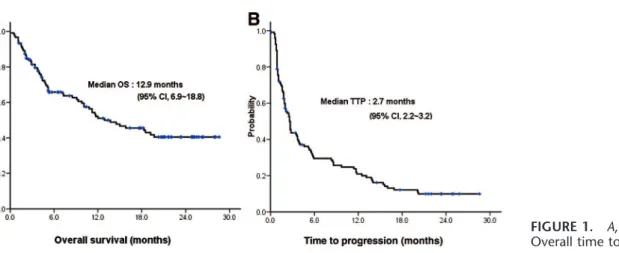
With a median follow-up duration of 23.6 months (range, 1.2–29.0), the median TTP was 2.7 months (95% CI, 2.2–3.2) and the median overall survival (OS) was 12.9 months (95% CI, 6.9 –18.8) (Figure 1). The 1-year TTP and OS rates were 21.7% and 54.3%, respectively.
Univariate analysis showed that female, histology of adenocarcinoma, never smoker, good performance (Eastern Cooperative Oncology Group PS 0 to 1), and the occurrence of skin rash were significant favorable factors for prolonged TTP and OS (Table 4). In multivariate analysis, female and development of skin rash were significantly associated with longer TTP and OS (Table 4). PS 0 –1 was one of the good prognostic factors for OS but not correlated with longer TTP. In contrast, age, stage, and the number of prior chemotherapy regimens did not retain statistical signifi- cance in multivariate level.
Safety
At least one drug-related adverse event was observed in 106 (86.6%) of patients, but most of them were mild (grade 1 or 2) and reversible with no grade 4 toxicity (Table 3).
Ninety-three patients (77.5%) experienced drug-related skin rash including 16 patients (13%) of grade 3, often in association with other skin-related symptoms, such as popu- lar or pustular rash and pruritus. In patients with grade 3 skin TABLE 1. Patients Characteristics
Characteristics
nⴝ 120 No. of
Patients %
Age (yr)
Median 61
Range 33–83
Sex
Male 76 63.3
Female 44 36.7
ECOG PS
0 7 5.8
1 100 83.3
2 10 8.3
3 3 2.5
Stage
IIIB 16 13.3
IV 104 86.7
Histology
Adenocarcinoma 74 61.7
Squamous cell carcinoma 31 25.8
Others 15 12.5
Prior chemotherapy
None 19 15.8
One regimen 60 50.0
Two or more regimens 41 34.2
Smoking status
Current or former smoker 72 60.0
Never smoker 48 40.0
ECOG PS, Eastern Cooperative Oncology Group performance status.
toxicity, skin rash was improved after temporary interruption of drug or treatment with topical antibiotics and antihista- mines. Another commonly reported adverse event was diar- rhea (39.2%), which could be controlled if necessary with antidiarrheal agents such as loperamide. No clinically signif- icant deterioration in renal or hepatic function was observed during the trial, even in patients who entered the trial with mild or moderate functional impairment. There were no grade 3 or 4 hematologic toxicities. There was one case of suspi- cious drug-induced interstitial lung disease that completely resolved upon conservative treatment.
Dose reduction to 100 mg/d of erlotinib was necessary in 22 patients (18.3%) because of grade 3 toxicities. Two patients required short treatment interruptions, because of prolonged grade 3 skin reaction despite dose reduction. There were no drug-related deaths.
DISCUSSION
Erlotinib is the first and the only EGFR TKI to show survival benefit in patients with previously treated advanced NSCLC in a randomized, placebo-controlled trial (BR.21),7
FIGURE 1. A, Overall survival. B, Overall time to progression.
TABLE 2. Best Response Rate and Disease Control Rate for Erlotinib Monotherapy
Response Rate Disease Control Rate
n % P n % P
Overall rate 29/120 24.2 68/120 56.7
Age
⬍60 18/53 34.0 0.026 33/53 62.3 0.271
ⱖ60 11/67 16.4 35/67 52.2
Sex
Female 19/44 43.2 ⬍0.001 37/44 84.1 ⬍0.001
Male 10/76 13.2 31/76 40.8
ECOG PS
0–1 27/107 25.2 0.732 61/107 57.0 0.828
2–3 2/13 15.4 7/13 53.8
Stage
IIIB 5/11 31.3 0.477 10/16 62.5 0.613
IV 24/104 23.1 58/104 55.8
Histology
Adenocarcinoma 25/74 33.8 0.002 47/74 63.5 0.055
Nonadenocarcinoma 4/46 8.7 21/46 45.7
Smoking status
Never smoker 16/47 34.0 0.043 35/48 74.5 0.002
Smoker 13/73 17.8 33/72 45.2
Erlotinib treatment
1st line 6/19 31.6 0.411 13/19 68.4 0.260
ⱖ2nd line 23/101 22.8 55/101 54.5
Skin rash
Yes 26/93 28.0 0.080 61/93 65.6 0.001
No 3/27 11.1 7/27 25.9
ECOG PS, Eastern Cooperative Oncology Group performance status.
particularly in Asian patients. In salvage setting, erlotinib has similar response rate to pemetrexed or docetaxel mono- therapy as second-line treatment,6 but spares from premedi- cation or inconvenience from intravenous administration. In this study, 24.2% response rate was observed with erlotinib monotherapy in NSCLC patients, most of who had failed to previous chemotherapy. The response rate achieved in this study (24.2%) is considerably higher than the response rate of 8.9% observed in the BR.21 study.
One of the plausible explanations for the high response rate observed in the study may be the ethnic difference in prevalence of EGFR gene mutations. We have recently con- ducted EGFR gene mutational analyses in the same cohort of patients and observed a superior response rate (58.3%) in the group with EGFR gene mutations as compared with the group without EGFR mutations (16.2%) (p⬍ 0.001).13Consistent with previous reports, the incidence of EGFR mutations was higher (26.1%) in Korean patients when compared with the Western countries (⬍10%). Importantly, we recently showed that patients with EGFR gene mutations or gene amplification showed both better response rate (58.3% versus 16.2%, p⬍ 0.001; 41.7% versus 17.3%, p⫽ 0.012) and TTP (8.6 versus 2.5 months, p⫽ 0.003; 5.8 versus 1.8 months, p ⬍ 0.001) and overall survival (not reached versus 10.8 months, p⫽ 0.023;
not reached versus 10.1 months, p ⫽ 0.033).13 However, multivariate analysis revealed that EGFR gene mutation was an independent factor associated with prolonged TTP, but not OS, suggesting other clinical parameters such as female, adenocarcinoma histology, or never smokers may be in- volved in prolongation of OS.
Despite similar progression-free survival (PFS) with BR.21 trial (2.6 months of current data versus 2.2 months of
BR.21), the current trial demonstrated longer overall survival (12.9 months versus 6.7 months, respectively).7 The study population of current study might have had more indolent disease than previous studies, which includes the ethnic differences. Many clinical trials suggested the Asian ethnicity as good prognostic factor of survival as well as the clinico- pathologic characteristics such as histology, PS, EGFR mu- tations, and smoking history.7,8,14 The subgroup analysis of BR.21 suggested Asian ethnicity as good prognostic factors of erlotinib therapy.7 Furthermore, better survival outcomes of Asians with EGFR TKIs also demonstrated in gefitinib trials.8,14However, it is unclear that Asian origins has benefits from EGFR TKIs but not cytotoxic chemotherapy or benefits from both modalities. Although recent two randomized trials of gefitinib versus docetaxel could not demonstrate superior survivals of gefitinib compared with docetaxel,15,16the Japa- nese trial reported longer overall survival than INTEREST trial, which included about 20% of Asian patients (11.5–14.0 months and 7.6 – 8.0 months, respectively). A small phase II trial of erlotinib monotherapy for Japanese patients as salvage treatment also demonstrated 14.7 months of median OS.17 Although the molecular biomarkers and study designs have to be considered, the ethnic diversity as a prognostic factor remains to be solved.
Recently, Lilenbaum et al.18 reported the result of randomized phase II trial of erlotinib or paclitaxel/carboplatin chemotherapy in patients with PS 2. As the first-line treat- ment for advanced NSCLC patients with PS 2, erlotinib demonstrated inferior survival outcome than standard chemo- therapy of paclitaxel and carboplatin (median OS 6.5 months versus 9.7 months, respectively, p⫽ 0.018). PS ⱖ2 as poor prognostic factor was also suggested in BR.21.7As compared with BR.21, current trial included only 10% of patients with PS 2 or 3, whereas BR.21 did over 30%. In addition, the subgroup of PS 2 or 3 in current study achieved only 4.7 months of median OS. Therefore, the good survival outcomes of current study have to be considered with the majority of good PS patients.
Erlotinib was generally well tolerated with the most common ⱖgrade 3 toxicities being skin rash and diarrhea.
The correlation between clinical efficacy of EGFR TKI ther- apy and the occurrence of skin rash have been reported in other TKI trials.19 –22Although skin rash may be a potentially predictive factor for clinical efficacy and may be used as a surrogate marker, its predictive capacity needs to be further validated. Patients who developed skin rash were likely to respond to erlotinib with statistical significance (p⫽ 0.047).
Particularly, more than 90% of the patients (15 of 16) with grade 3 skin rash achieved stable disease or better to erlotinib treatment. Its statistical significance was retained at the mul- tivariate level (HR⫽ 0.22; 95% CI, 0.08–0.63; p ⫽ 0.004) along with female (HR ⫽ 0.25; 95% CI, 0.07–0.88; p ⫽ 0.031) to predict favorable response. In patients with grade 3 skin toxicity, skin rash was improved after temporary drug interruption. Another commonly encountered adverse event was diarrhea, which was easily controllable with loperamide.
The adverse events of current data were overly similar with previous results of BR.21 with differences in details.7 TABLE 3. Nonhematological Treatment-Related Adverse
Effects
Toxicity Grade
No. of Patients (%), Total
1 2 3
Skin rash 46 (38.3) 31 (25.8) 16 (13.3) 93 (77.5)
Dry skin 37 (30.8) 12 (10.0) — 49 (40.8)
Diarrhea 33 (27.5) 9 (7.5) 5 (4.2) 47 (39.2) Myalgia 22 (18.3) 14 (11.7) 3 (2.5) 39 (32.5) Anorexia 25 (20.8) 10 (8.3) 1 (0.8) 36 (30.0)
Emesis 23 (19.2) 7 (5.8) — 30 (25.0)
Fatigue 14 (11.7) 8 (6.7) 4 (3.3) 26 (21.7)
Mucositis 15 (12.5) 8 (6.7) — 23 (19.2)
Paronychia 11 (9.2) 5 (4.2) — 16 (13.3)
Neuropathy 13 (10.8) 2 (1.7) — 15 (12.5)
Dyspepsia 7 (5.8) 4 (3.3) — 11 (9.1)
Alopecia 9 (7.5) 1 (0.8) — 10 (7.5)
Edema 5 (4.2) 1 (0.8) 1 (0.8) 7 (5.8)
Coneal injury 4 (3.3) — 1 (0.8) 5 (4.1)
Insomnia 2 (1.7) 2 (1.7) — 4 (3.3)
Pneumonia — — 2 (1.7) 2 (1.7)
ILD — 1 (0.8) — 1 (0.8)
There was no grade 4 toxicity.
ILD, Interstitial lung disease.
The skin rashⱖgrade 3 was 13.3% of this study and 9% of BR.21, whereas the grade 3 anorexia was 0.8% and 6%, respectively. Fatigueⱖgrade 3 also reported less in current study than BR.21 (6.7% and 19%). Recent report of erlotinib monotherapy in Japanese patients demonstrated that all study population suffered from any adverse events. However, the adverse events ⱖgrade 3 seemed to be lower than current study and BR.21 in terms of 3% of skin rash, 5% of diarrhea, and 0% of fatigue.7,17In current study, dose reduction needed in 18.3% of patients and dose interruptions occurred in 2% of patients, which were similar dose reduction rate and lower treatment interruption rate of BR.21 (19% and 27%, respec- tively).7 Although a phase II study of erlotinib in Japanese population seemed to show lower rates of serious adverse events, they needed more dose modifications including 23%
of dose reduction, 48.4% of dose interruptions, and 18% of discontinuation.17 In comparison with gefitinib, which is another EGFR TKI, previous reports of two phase II trials of gefitinib in Korean patients demonstrated less than 3% of ⱖgrade 3 skin rashes, anorexia, and diarrhea.23,24 These findings of Korean population showed consistency with pre- vious gefitinib trials such as IDEAL-1, IDEAL-2, and ISEL.8,9,14However, there was no randomized controlled trial of gefitinib and erlotinib. In addition, the heterogeneity of EGFR mutation status of each trial should also be considered.
Therefore, it is inconclusive whether gefitinib has more tolerable toxicity profiles than erlotinib.
Three agents are currently approved by the U.S. Food and Drug Administration in the second-line setting: do- cetaxel, pemetrexed, and erlotinib. Phase III trial comparing standard dose docetaxel every 3 weeks with pemetrexed (500 mg/m2 every 3 weeks) demonstrated that the two regimens were similar in clinical efficacy with lower rate of hemato- logic toxicities in pemetrexed alone arm.6 Although the clinical superiority of erlotinib over docetaxel or pemetrexed has not been proven in phase III trials, erlotinib may be preferred by patient because of no premedication, no alope- cia, less physician’s office visits, and convenience of oral administration. Given a high response rate in Asian patients, a randomized clinical trial should be conducted to compare pemetrexed or docetaxel to erlotinib as second-line treatment even though two recent trials of docetaxel and gefitinib failed to show survival differences.15,16Indeed gefitinib was asso- ciated with lower rates of treatment related adverse events including serious adverse events, treatment discontinuation than docetaxel, whereas noninferiority of gefitinib was veri- fied for overall survival (HR⫽ 1.020; 95% CI, 0.905–1.150) in INTEREST trial.15 Furthermore, the clinical benefit of erlotinib in terms of PFS was recently reported in first-line setting in a phase III randomized study comparing erlotinib to TABLE 4. Prognostic Factors for Survival
TTP OS
Univariate Multivariate Univariate Multivariate
Median (mo) P HR (95% CI) P Median (mo) P HR (95% CI) P
Age
⬍60 2.6 0.656 0.816 0.335 18.3 0.293 1.07 0.809
ⱖ60 2.7 (0.54–1.23) 11.7 (0.63–1.82)
Sex
Female 8.6 ⬍0.001 0.33 ⬍0.001 NR ⬍0.001 0.18 ⬍0.001
Male 1.8 (0.21–0.51) 5.3 (0.09–0.36)
ECOG PS
0–1 2.6 0.352 0.52 0.052 15.0 0.005 0.21 ⬍0.001
2–3 2.7 (0.27–1.01) 4.7 (0.11–0.43)
Stage
IIIB 3.8 0.301 0.58 0.072 11.7 0.604 1.32 0.489
IV 2.5 (0.32–1.05) 13.7 (0.60–2.93)
Histology
Adenocarcinoma 3.9 0.001 0.72 0.177 NR 0.001 0.76 0.329
Others 2.0 (0.45–1.16) 7.2 (0.43–1.33)
Smoking
No 5.6 0.002 0.64 0.218 NR ⬍0.001 0.91 0.833
Yes 1.9 (0.32–1.30) 5.3 (0.36–2.30)
Erlotinib treatment
1st line 4.0 0.352 0.68 0.209 19.2 0.465 0.56 0.149
ⱖ2nd line 2.5 (0.37–1.24) 12.0 (0.25–1.23)
Skin rash
Yes 2.7 0.003 0.54 0.019 19.2 ⬍0.001 0.35 ⬍0.001
No 1.7 (0.32–0.90) 4.3 (0.20–0.63)
TTP, time to progression; OS, overall survival; ECOG PS, Eastern Cooperative Oncology Group performance status; HR, hazard ratio; CI, confidence interval; NR, not reached.
standard chemotherapy (paclitaxel and carboplatin) in never smokers and Asian population (IPASS trial).25Although final results are pending with further survival update, PFS that was primary end points of IPASS trial was superior in erlotinib group, especially positive EGFR mutation status (HR ⫽ 0.741 of all patients, p ⬍ 0.0001 and 0.48 of patients with EGFR mutations, p⬍ 0.0001). This study probably provides support for the role EGFR TKI as the first-line treatment in subpopulation of NSCLC patients in selected patients such as never smoker or positive EGFR mutation status.
Although gefitinib was not recommended as second- line treatment, the questions about the efficacy of gefitinib for selected patients such as female, adenocarcinoma, EGFR mutation, and Asian population still remain with debate. Even though gefitinib failed to confirm survival benefit compare with placebo in a large phase III trial (5.6 months for gefitinib and 5.1 months for placebo, p⫽ 0.087), East Asian patients achieved longer survivals than other ethnical populations in subgroup analysis (HR ⫽ 0.66; p ⫽ 0.010).14The survival benefits of East Asian patients from gefitinib also observed in subset analysis of IDEAL-1.8,26The original results of IDE- AL-1 demonstrated about 8 months of median OS, which was similar to 6 –7months of IDEAL-2, whereas Japanese subset (n ⫽ 102) achieved 12.0 months of median OS with higher response rates (27.5% versus 10.4%, respectively, p ⫽ 0.0023).8,9,26 Even though a Japanese phase III study of gefitinib and docetaxel as second-line treatments (V-15-32 trial) showed no difference of overall survival between two groups, recent presentation of Korean trial (ISTATA trial) suggested the benefit of PFS for gefitinib group than do- cetaxel group.16,27 Therefore, gefitinib as second-line treat- ments for East Asian origin compared with single-agent chemotherapy warrants to further investigation.
In conclusion, this study indicates that erlotinib mono- therapy is an effective and well-tolerated regimen for Korean patients with advanced NSCLC in salvage setting. Tumor responses and survival outcomes for erlotinib were compa- rable or superior to the reported results from previously tried first- or second-line chemotherapy regimens. Therefore, er- lotinib monotherapy was verified as the one of salvage treatments for patients with advanced NSCLC in Korea or Asia. This study provides the supplementary evidence for randomized trial compared erlotinib with systemic chemo- therapy.
ACKNOWLEDGMENTS
All authors disclose any financial or personal relation- ship with other people or organizations that could inappro- priately influence their work.
REFERENCES
1. Schiller JH, Harrington D, Belani CP, et al. Comparison of four che- motherapy regimens for advanced non-small-cell lung cancer. N Engl J Med 2002;346:92–98.
2. Ramsey SD, Howlader N, Etzioni RD, Donato B. Chemotherapy use, outcomes, and costs for older persons with advanced non-small-cell lung cancer: evidence from surveillance, epidemiology and end results-Medi- care. J Clin Oncol 2004;22:4971– 4978.
3. Shepherd FA. Second-line chemotherapy for non-small cell lung cancer.
Expert Rev Anticancer Ther 2003;3:435– 442.
4. Fossella FV, DeVore R, Kerr RN, et al. Randomized phase III trial of docetaxel versus vinorelbine or ifosfamide in patients with advanced non-small-cell lung cancer previously treated with platinum-containing chemotherapy regimens. The TAX 320 Non-small Cell Lung Cancer Study Group. J Clin Oncol 2000;18:2354 –2362.
5. Shepherd FA, Dancey J, Ramlau R, et al. Prospective randomized trial of docetaxel versus best supportive care in patients with non-small-cell lung cancer previously treated with platinum-based chemotherapy.
J Clin Oncol 2000;18:2095–2103.
6. Hanna N, Shepherd FA, Fossella FV, et al. Randomized phase III trial of pemetrexed versus docetaxel in patients with non-small-cell lung cancer previously treated with chemotherapy. J Clin Oncol 2004;22:1589 – 1597.
7. Shepherd FA, Rodrigues Pereira J, Ciuleanu T, et al. Erlotinib in previously treated non-small-cell lung cancer. N Engl J Med 2005;353:
123–132.
8. Fukuoka M, Yano S, Giaccone G, et al. Multi-institutional randomized phase II trial of gefitinib for previously treated patients with advanced non-small-cell lung cancer (The IDEAL 1 Trial) [corrected]. J Clin Oncol 2003;21:2237–2246.
9. Kris MG, Natale RB, Herbst RS, et al. Efficacy of gefitinib, an inhibitor of the epidermal growth factor receptor tyrosine kinase, in symptomatic patients with non-small cell lung cancer: a randomized trial. JAMA 2003;290:2149 –2158.
10. Miller VA, Kris MG, Shah N, et al. Bronchioloalveolar pathologic subtype and smoking history predict sensitivity to gefitinib in advanced non-small-cell lung cancer. J Clin Oncol 2004;22:1103–1109.
11. Mitsudomi T, Kosaka T, Yatabe Y. Biological and clinical implica- tions of EGFR mutations in lung cancer. Int J Clin Oncol 2006;11:
190 –198.
12. Therasse P, Arbuck SG, Eisenhauer EA, et al. New guidelines to evaluate the response to treatment in solid tumors. European Organiza- tion for Research and Treatment of Cancer, National Cancer Institute of the United States, National Cancer Institute of Canada. J Natl Cancer Inst 2000;92:205–216.
13. Ahn MJ, Park BB, Ahn JS, et al. Are there any ethnic differences in molecular predictors of erlotinib efficacy in advanced non-small cell lung cancer? Clin Cancer Res 2008;14:3860 –3866.
14. Thatcher N, Chang A, Parikh P, et al. Gefitinib plus best supportive care in previously treated patients with refractory advanced non-small-cell lung cancer: results from a randomized, placebo-controlled, multicentre study (Iressa Survival Evaluation in Lung Cancer). Lancet 2005;366:
1527–1537.
15. Kim ES, Hirsh V, Mok T, et al. Gefitinib versus docetaxel in previously treated non-small-cell lung cancer (INTEREST): a randomised phase III trial. Lancet 2008;372:1809 –1818.
16. Maruyama R, Nishiwaki Y, Tamura T, et al. Phase III study, V-15–32, of gefitinib versus docetaxel in previously treated Japanese patients with non-small-cell lung cancer. J Clin Oncol 2008;26:4244 – 4252.
17. Kubota K, Nishiwaki Y, Tamura T, et al. Efficacy and safety of erlotinib monotherapy for Japanese patients with advanced non-small cell lung cancer: a phase II study. J Thorac Oncol 2008;3:1439 –1445.
18. Lilenbaum R, Axelrod R, Thomas S, et al. Randomized phase II trial of erlotinib or standard chemotherapy in patients with advanced non-small- cell lung cancer and a performance status of 2. J Clin Oncol 2008;26:
863– 869.
19. Cohen EE, Rosen F, Stadler WM, et al. Phase II trial of ZD1839 in recurrent or metastatic squamous cell carcinoma of the head and neck.
J Clin Oncol 2003;21:1980 –1987.
20. Dudek AZ, Kmak KL, Koopmeiners J, Keshtgarpour M. Skin rash and bronchoalveolar histology correlates with clinical benefit in patients treated with gefitinib as a therapy for previously treated advanced or metastatic non-small cell lung cancer. Lung Cancer 2006;51:89 –96.
21. Soulieres D. Identifying predictive and surrogate markers of erlotinib antitumor activity other than rash. Oncology (Williston Park) 2003;17:
29 –33.
22. Susman E. Rash correlates with tumour response after cetuximab.
Lancet Oncol 2004;5:647.
23. Park J, Park BB, Kim JY, et al. Gefitinib (ZD1839) monotherapy as a salvage regimen for previously treated advanced non-small cell lung cancer. Clin Cancer Res 2004;10:4383– 4388.
24. Kim KS, Jeong JY, Kim YC, et al. Predictors of the response to gefitinib in refractory non-small cell lung cancer. Clin Cancer Res 2005;11:
2244 –2251.
25. Mok T, Wu YL, Thongprasert S, et al. Phase III, randomized, open- label, first-line study of gefitinib (G) vs carboplatin/paclitaxel (C/P) in clinically selected patients with advanced non-small cell lung cancer (IPASS). Ann Oncol 2008;19(Suppl 9):iii1.
26. Nishiwaki Y, Yano S, Tamura T, et al. [Subset analysis of data in the Japanese patients with NSCLC from IDEAL 1 study on gefitinib]. Gan To Kagaku Ryoho 2004;31:567–573.
27. Lee DH, Kim SW, Park K, et al. A randomized open-label study of gefitinib versus docetaxel in patients with advanced/metastatic non- small cell lung cancer (NSCLC) who have previously received platinum- based chemotherapy. J Clin Oncol 2008;26(Suppl):8025.