• 검색 결과가 없습니다.

Renal Squamous Cell Carcinoma with Severe Hydronephrosis

N/A
N/A
Protected

Academic year: 2021

Share "Renal Squamous Cell Carcinoma with Severe Hydronephrosis"

Copied!
6
0
0

로드 중.... (전체 텍스트 보기)

전체 글

(1)

Corresponding Author: Yu Na Kang, M.D., Department of Pathology, Keimyung University School of Medicine 56 Dalseong-ro, Jung-gu, Daegu 700-712, Korea

Tel: +82-53-250-7290, +82-53-580-3814

E-mail: [email protected], [email protected]

Introduction

Renal squamous cell carcinoma (RSCC) is an uncommon case. There have been some case reports until now. We report a clinical case of multiple renal stones with severe hydronephrosis, which developed to RSCC.

The etiology of renal malignancy is associated with the irritation of renal stones and infection. In addition, the renal calculi stimulate the aggravation of squamous metaplasia, which will be a squamous cell carcinoma after all [1].

Case Report

A 57-year-old female admitted with right flank pain for the last two months. She had been diagnosed with stone of urinary tract twenty years earlier. She had previously complaint with fever, chilling and dysuria for two months. Fever and chilling were relieved by medication. But, flank pain was consistent. Her voiding symptoms were frequency (#2/hr) and residual urine sensation. The patient had a history of hypertension and diabetes mellitus. Physical examination demonstrated a

Abstract

Renal squamous cell carcinoma (RSCC) is a rare tumor. We present a case of incidentally diagnosed RSCC with severe hydronephrosis. A 57-year-old female admitted with right frank pain for 2 months. She had staghorn calculi in right renal pelvis and major calyx for 20 years. Long-standing nephrolithiasis with chronic inflammation causes squamous metaplasia, which may develop to squamous cell carcinoma. Here we present the typical renal squamous cell carcinoma case with severe hydronephrosis, arising in long- standing nephrolithiasis.

Key Words : Hydronephrosis, Nephrolithiasis, Renal, Squamous cell carcinoma

Undergraduate Student, Department of Pathology

1

, Keimyung University School of Medicine, Daegu, Korea

Moon Young Seo, Yu Na Kang

1

, M.D.

Renal Squamous Cell Carcinoma with Severe Hydronephrosis

(2)

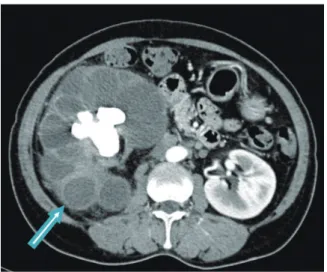
out. Multiple stones were also observed in a calyx of the lower portion. Size, contour, and parenchymal enhancement of left kidney were normal (Fig. 2).

Therefore, the right nephrectomy was done due to the symptoms by staghorn stone and severe hydronephrosis.

On operation, perinephric adhesion was found.

About 800 cc pus-like fluid was seen in a calyx and pelvis of the right kidney. The gross specimen consisted of a resected right kidney with attached ureter, measuring 17.0 × 8.5 × 7.5 cm and weighing 280.0 gm. The capsular surface of the right kidney was markedly distended and multinodular. The cut surface showed multiple parenchymal cystic change in the renal pelvis. There were multiple, conglomerated, brown to black, sandy stones, m e a s u r i n g a b o u t 6.0 × 5.0 × 5.0 c m i n aggregates(Fig. 3). The renal parenchyma was thinned and showed fibrotic appearance. There was no mass-like lesion. The attached right ureter was grossly normal shaped and measured to be 5.5 cm in length and 0.4 cm in diameter.

Histologically, the renal parenchyma revealed overlying anaplastic squamous lining epithelial cells of multicystic lesion, infiltrating into the interstitial tissue. Keratin pearls and keratinization of tumor cells were often seen.

The renal pelvis and ureter showed transmural involvement of tumor cells. Numerous infiltrates of inflammatory cells, as well as interstitial fibrosis and tubular atrophy were seen in the non-neoplastic Fig. 1. Abdominal KUB The arrow indicates the

right staghorn calculi with severe dilatation of calyces.

Fig. 2. Abdominal CT The arrow indicates a

markedly hydronephrotic right kidney with

caliceal stones.

(3)

kidney. In the immunohistochemical stain, the tumor showed positivity for p63 [2].

About two months after operation, she complaint back pain and on the contrary, left flank pain. At this time, no recurrent mass was found on abdominal CT. Whole body bone scan using Tc99m- MDP revealed no definite metastatic bone lesion.

Well functioning left kidney and right nephrectomy state were also showed. So, she was consulted to the department of anesthesia and pain medicine. To relief pain, she had medication continuously.

Therefore, the left lower back pain was relieved quietly. However, unspecific right inguinal pain was occurred.

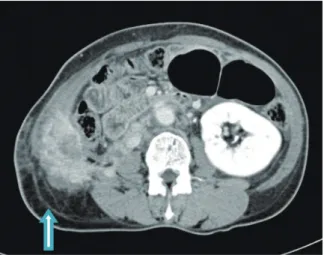
About seven months after nephrectomy, continuous follow up study reported 31 × 27 mm recurred mass lesion at previously operated site on abdominal CT. In addition, direct liver and abdominal wall invasion was showed (Fig. 4).

PET-CT using F-18 FDG demonstrated an ill- d e f i n e d, i r r e g u l a r s h a p e d a n d m a r k e d l y hypermetabolic mass at previous right nephrectomy bed (Fig. 5).

Also, direct invasion to right lobe of liver and lateral aspect of right abdominal wall with bony

destruction of posterolateral arc of right 10th and 11th ribs was showed. Whole body bone scan using Tc99m-MDP revealed mild increased radioactivity at posterolateral aspect of right 10th and 11th ribs, compatible with bone metastases on prior F-18 FDG PET. Consequently, she was hospitalized for pain control, palliative radiotherapy and CCRT with cisplatin. After hospital treatment, stationary state of recurred mass was confirmed and pain was improved.

Fig. 3. Gross specimen Right kidney shows severe hydronephrosis with multiple brown sandy stones. The wall of multicystic lesions is

thinned and shows fibrotic change. Fig. 4. Abdominal CT The arrow indicates recurred mass and abdominal wall invasion.

Fig. 5. PET-CT The arrow indicates a markedly

hypermetabolic mass at previous right

nephrectomy bed.

(4)

squamous metaplasia.

And then, the regions of metaplasia undergo differentiation and finally aggravate to squamous cell carcinoma [1]. Besides, the most common risk factor of RSCC is kidney stone in mostly older adults aged 50-70 years [5,6]. Because of the above mentioned reasons, patients with chronic preexisting renal calculi (most commonly of the staghorn type) need to be monitored [6]. Other possible predisposing factors leading to induce RSCC are prior surgery for renal calculi, radiotherapy, vitamin A deficiency, hormonal imbalance, schistosomiasis, smoking and analgesics abuse [6].

Symptoms of RSCC are flank pain, fever, hematuria, and palpable abdominal mass. Hematuria may have been due to nephrolithiasis [6]. These symptoms are obtained by other diseases such as xanthogranulomatous pyelonephritis and secondary neoplasm.

In our case, hydronephrosis was showed. The cause of hydronephrosis was difficult to explain. It has been suggested that some necrotic tumor tissue might obstruct the ureter and consequently cause hydronephrosis. Because hydronephrotic sac is filled with sloughed materials and the tumor is mostly exophytic nature. Another hypothesis has been reported that the tumor has arisen in a persistently inflamed hydronephrotic sac [3]. This hydronephrosis is strongly related to the advanced stage of RSCC commonly showing metastasis

observations certainly suggested that pathological diagnosis of our case was squamous cell carcinoma.

Remarkable dutcher bodies were also found. N/C ratio was increased. The tumor cells had large pleomorphous and hyperchromatic nuclei with distinctive nucleoli. Their nuclear margin was irregular. Many mitotic figures were found. So, the microscopic finding of the tumor cells suggested that this tumor cells were malignancy. Squamous metaplasia and infiltrative appearance were seen in some regions (Fig. 6).

Immunohistochemistry revealed p63 (+), CD31 (-). p63 is an effective marker for identifying squamous cell carcinoma [8]. CD31 is an endothelial cell marker such as von willebrand factor (vWF), CD34 [9]. Single immounostaining for factors including CD31, podoplanin, and factor Ⅷ have all caused to an increase of detecting rate of lymphovascular space invasion, but have failed to reach significance [10].

Treatment of RSCC involves surgery with nephrectomy or nephroureterectomy. The treatment of choice in patients without metastasis is radical nephrouterectomy with excision of bladder cuff.

But, in aspect of the unifocal nature of this tumor, parenchyma sparing surgery has also been preferred [6,11]. Cisplatinum-based adjuvant chemotherapy and radiotherapy are usually used for advanced stage and poor prognosis in most patients but, have revealed no survival benefit [6].

RSCC has a poor prognosis. Because when it is

(5)

diagnosed, RSCC is already in highly advanced stage. The outcome of RSCC patients is poor with average future lifetime of only 5-7 months after nephrectomy and less than 10% alive after 5 years [12,13]. On the other hand, histopathological type of tumor has no significant difference in prognosis in advanced stage RSCC and urothelial carcinoma [12].

References

1. Paonessa J, Beck H, Cook S. Squamous cell carcinoma of the renal pelvis associated with kidney stones: a case report. Med Oncol 2011;28 Suppl 1:S392-4.

2. Uke M, Rekhi B, Ajit D, Jambhekar NA. The use of p63 as an effective immunomarker in the diagnosis of

pulmonary squamous cell carcinomas on de-stained bronchial lavage cytological smears. Cytopathology 2010;21:56-63.

3. Bandyopadhyay R, Biswas S, Nag D, Ghosh AK.

Squamous cell carcinoma of the renal pelvis presenting as hydronephrosis. J Cancer Res Ther 2010;6:537-9.

4. Mizusawa H, Komiyama I, Ueno Y, Maejima T, Kato H.

Squamous cell carcinoma in the renal pelvis of a horseshoe kidney. Int J Urol 2004;11:782-4.

5. Bhaijee F. Squamous cell carcinoma of the renal pelvis.

Ann Diagn Pathol 2012;16:124-7.

6. Jain A, Mittal D, Jindal A, Solanki R, Khatri S, Parikh A, et al. Incidentally detected squamous cell carcinoma of renal pelvis in patients with staghorn calculi: case series with review of the literature. ISRN Oncol 2011;2011:620574.

Fig. 6. Histopathologic findings (A) Renal parenchyma shows diffuse infiltration of inflammatory cells, interstitial fibrosis and tubular atrophy like thyroid follicle (H&E, ×200). (B) Squamous metaplasia with chronic inflammation (right) develop into overlying anaplastic squamous tumor cells (left), infiltrating into the interstitial tissue (H&E, ×100). (C) Keratin pearl, keratinization and intercellular bridge are found (H&E,

×400). (D) Immunohistochemistry reveals positive for p63 staining in the overlying squamous tumor cells

and infiltrating tumor cell nests (H&E, ×100).

(6)

squamous cell carcinoma of the lung. PLoS One 2010;5:e12209.

9. Gluhovschi C, Gluhovschi G, Potencz E, Herman D, Trandafirescu V, Petrica L, et al. The endothelial cell markers von Willebrand Factor (vWF), CD31 and CD34 are lost in glomerulonephritis and no longer correlate with the morphological indices of glomerular sclerosis, interstitial fibrosis, activity and chronicity. Folia Histochem Cytobiol 2010;48:230-6.

12. Holmang S, Lele SM, Johansson SL. Squamous cell carcinoma of the renal pelvis and ureter: incidence, symptoms, treatment and outcome. J Urol 2007;178:51-6.

13. Busby JE, Brown GA, Tamboli P, Kamat AM, Dinney

CP, Grossman HB, et al. Upper urinary tract tumors

with nontransitional histology: a single-center

experience. Urology 2006;67:518-23.

수치

Fig. 2.  Abdominal CT  The arrow indicates a  markedly hydronephrotic right kidney with  caliceal stones
Fig. 3.  Gross specimen  Right kidney shows severe  hydronephrosis with multiple brown sandy  stones
Fig. 6.   Histopathologic findings (A) Renal parenchyma shows diffuse infiltration of inflammatory cells, interstitial  fibrosis and tubular atrophy like thyroid follicle (H&E, ×200)

참조

관련 문서

Patients with breast cancer; ovarian cancer; renal cell carcinoma; pancreatic neuroendocrine cancer; colorectal cancer; head and neck cancer; non-small cell lung

Method We obtained blood samples from 49 patients who underwent surgical treatment for esophageal squamous cell cancer (ESCC) We performed ctDNA analysis with

The expression levels of apoptotic related proteins and caspase dependent proteins by the ostreolysin purified from P.ostreatus on cell viability in FaDu human

Concentration-Dependent inhibition of cell viability by adenosine in human oral fibroblast and FaDu human head and neck squamous cell carcinoma · · ·

It also suggest that cell proliferation inhibits by a novel signal transduction for adenosine effect in human FaDu hypopharynx squamous cell carcinoma cells....

Differential Expression of Desmoglein1, Desmoglein3, Epithelial Membrane Antigen, Ber-EP4 and CD10 in Basal Cell Carcinoma and Squamous Cell Carcinoma

– Embryonic stem cell : Pluripotent cells that can give rise to all tissue types. – Adult stem cell : Multipotent cells

Objective: The purpose of this study was to analyze recent trend in incidence of basal cell carcinoma and squamous cell carcinoma in patients from the Gwangju City