• 검색 결과가 없습니다.

GALAXIES ON DIET: FEEDBACK SIGNATURES IN RADIO-AGN HOST GALAXIES

N/A
N/A
Protected

Academic year: 2021

Share "GALAXIES ON DIET: FEEDBACK SIGNATURES IN RADIO-AGN HOST GALAXIES"

Copied!
3
0
0

로드 중.... (전체 텍스트 보기)

전체 글

(1)

Publications of the Korean Astronomical Society pISSN 1225-1534

32: 201 ∼ 203, 2017 March eISSN 2287-6936

2017. The Korean Astronomical Society. All rights reserved. c https://doi.org/10.5303/PKAS.2017.32.1.201

GALAXIES ON DIET: FEEDBACK SIGNATURES IN RADIO-AGN HOST GALAXIES

Marios Karouzos 1 , Myungshin Im 1 , Markos Trichas 2 , Tomogotsu Goto 3 , Matthew Malkan 4 , Angel Ruiz 5 , Yiseul Jeon 1 , Ji Hoon Kim 6 , Hyung Mok Lee 1 , Seong Jin Kim 1 , Nagisa Oi 7 , Hideo Matsuhara 7 , Toshinobu

Takagi 7 , Kazumi Murata 7 , Takehiko Wada 7 , Kensuke Wada 7 , Hyunjin Shim 8 , Hitoshi Hanami 9 , Stephen Serjeant 10,11 , Glenn White 10,11 , Chris Pearson 10,11 , and Youichi Ohyama 12

1 Department of Physics and Astronomy, Seoul National University, Gwanak-gu, Seoul 151-742, Korea

2 Airbus Defence and Space, Gunnels Wood Road, Stevenage SG1 2AS, UK

3 Department of Physics, National Tsing Hua University, Hsinchu, Taiwan 30013

4 Division of Astronomy and Astrophysics, 3-714 UCLA, LA CA 90095-1547, USA

5 Inter-University Centre for Astronomy and Astrophysics (IUCAA), Post Bag 4, Ganeshkhind, 411 007 Pune, India

6 Subaru Telescope, National Astronomical Observatory of Japan, 650 North A’ohoku Place, Hilo, HI 96720, USA

7 Institute of Space and Astronautical Science, JAXA, Yoshino-dai 3-1-1, Sagamihara, Kanagawa 229-8510, Japan

8 Department of Earth Science Education, Kyungpook National University, Daegu 702-701, Korea

9 Physics Section, Faculty of Humanities, Iwate University, Ueda 3 chome, 18-34 Moriokam Iwate 020-8550, Japan

10 Department of Physics & Astronomy, The Open University, Walton Hall, Milton Keynes, UK

11 RALSpace, Science and Technology Facilities Council, Rutherford Appleton Laboratory, Chilton, Didcot, OX11 0NL, UK

12 Academia Sinica, Institute of Astronomy and Astrophysics, No. 1, Sec. 4, Roosevelt Rd., Taipei 10617, Taiwan, R.O.C.

E-mail: [email protected]

(Received July 22, 2015; Revised October 20, 2016; Accepted October 20, 2016)

ABSTRACT

There exists strong evidence supporting the co-evolution of central supermassive black holes and their host galaxies; however it is still under debate how such a relation comes about and whether it is relevant for all or only a subset of galaxies. An important mechanism connecting AGN to their host galaxies is AGN feedback, potentially heating up or even expelling gas from galaxies. AGN feedback may hence be responsible for the eventual quenching of star formation and halting of galaxy growth. A rich multi- wavelength dataset ranging from the X-ray regime (Chandra), to far-IR (Herschel ), and radio (WSRT ) is available for the North Ecliptic Pole field, most notably surveyed by the AKARI infrared space telescope, covering a total area on the sky of 5.4 sq. degrees. We investigate the star formation properties and possible signatures of radio feedback mechanisms in the host galaxies of 237 radio sources below redshift z

= 2 and at a radio 1.4 GHz flux density limit of 0.1 mJy. Using broadband SED modelling, the nuclear and host galaxy components of these sources are studied simultaneously as a function of their radio luminosity.

Here we present results concerning the AGN content of the radio sources in this field, while also offering evidence showcasing a link between AGN activity and host galaxy star formation. In particular, we show results supporting a maintenance type of feedback from powerful radio-jets.

Key words: galaxies: active - galaxies: jets - galaxies: star formation - galaxies: statistics - galaxies:

evolution

1. AGN AS REGULATORS OF COSMIC GROWTH It has long been believed that active galactic nuclei (AGN) play a key role in regulating the growth of their

http://pkas.kas.org

host galaxies, especially at the massive end of the galaxy mass function (e.g., Croton et al. 2006, Sijacki et al.

2007). In particular, it has been argued that this growth regulation is manifested in two distinct flavours, also

201

(2)

202 M. KAROUZOS ET AL.

0.0 0.5 1.0 1.5 2.0

10 −3 10 −2 10 −1 10 0 10 1 10 2 10 3

0.0 0.5 1.0 1.5 2.0

Redshift 10 −3

10 −2 10 −1 10 0 10 1 10 2 10 3

sSFR [Gyr

−1

]

36.0 38.0 39.0 39.5 40.0 40.5 42.5 logL 1.4GHz [erg s

−1

]

Elbaz et al. (2011) Rodighiero et al. (2010) with AGN (L

AGN

> 0)

L

X−ray

~10

42

−10

44

erg s

−1

(undetected; Mullaney+12) L

X−ray

~10

42

−10

43

erg s

−1

L

X−ray

~10

43

−10

44

erg s

−1

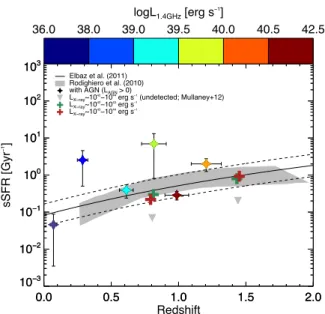
Figure 1. Average sSFR versus redshift in bins of radio lu- minosity at 1.4 GHz of the AKARI radio-AGN. The solid and dashed lines show the main sequence of star-forming galaxies and its 3σ margin, as defined by Elbaz et al. (2011).

The shaded gray locus shows the same relation as defined by Rodighiero et al. (2010a). For comparison we also plot the average values of sSFR for the X-ray selected AGN sample of Mullaney et al. (2012) in different X-ray luminosity bins.

Figure adapted from Karouzos et al. (2014).

called feedback modes: quasar- and radio-mode (e.g., Kormendy & Ho 2013). Radio-mode feedback is associ- ated with the collimated, relativistic outflows observed in radio-AGN, which can deposit mechanical energy in the ISM of their host galaxies and as a result ionize it, incite outflows in other phases of the ISM, and po- tentially suppress or even quench ongoing star forma- tion (e.g., McNamara et al. 2005, Nesvadba et al. 2011).

Here we present results concerning the effect of radio- jets on star formation (SF) within their host galaxies, using data in the North Ecliptic Pole (NEP) field and a rich multi-wavelength dataset.

2. NEP field and the spectral energy distributions of radio- AGN

The AKARI telescope has performed a Deep and a Wide survey of the NEP field (covering a total of 5.4 deg 2 ). These two surveys are complemented by an array of multi-wavelength ancillary data (see NEP overviews in this proceedings). Here we use the radio data at 1.4 GHz from White et al. (2010) to select a sample of ra- dio sources at a flux limit of 0.1 mJy, which are also detected at 2.4 or 3.1 µm from AKARI.

38.5 39.0 39.5 40.0 40.5 41.0 41.5 10 −1

10 0 10 1

38.5 39.0 39.5 40.0 40.5 41.0 41.5 L 1.4GHz [erg s

−1

]

10 −1 10 0 10 1

sSFR [Gyr

−1

]

38.5 39.0 39.5 40.0 40.5 41.0 41.5 L 1.4GHz [erg s

−1

]

10 −1 10 0 10 1

sSFR [Gyr

−1

]

10

11

M

sol

< M

*

< 10

12

M

sol

43.7±0.2

44.2±0.2

44.1±0.3

Elbaz et al. (2011) with AGN (L

AGN

> 0)

Figure 2. Average sSFRs versus radio luminosity for a nar- row range of M ∗ and redshift, for sources classified as AGN.

Lines as in Fig. 1, at the mean redshift of these sources (∼ 0.6). Next to each star, the average value of the AGN- component luminosity within that radio-luminosity bin is given. Adapted from Karouzos et al. (2014).

For these sources, we build their broadband spectral en- ergy distributions (SED), which we then model using a range of galaxy and AGN templates. In particular, the superior coverage of the infrared (IR) wavelength regime from the AKARI-IRC and the Herschel-SPIRE observations allows us to decompose the IR SEDs into AGN and SF components 1 . We compare these two SED components and also study them in relation to the jet radio luminosity, to see whether powerful jets have any effect on their host galaxy star formation.

3. RADIO-AGN AND THE “MAIN SEQUENCE” OF STAR FORMATION

From the modelling of the radio-AGN SEDs, we derive the infrared luminosity due to SF and we can hence con- strain their SF rates (SFRs). Together with the stellar mass derived from the rest-frame near-IR SED, we cal- culate the SFR per unit mass, or specific SFR (sSFR), for each of the radio-AGN. The sSFR reflects the SF efficiency of a galaxy. In Fig. 1, we put radio-detected AGN on the “Main Sequence” of SF (e.g., Elbaz et al.

2011), by dividing them into bins of radio luminosity.

For radio-luminosities above ∼ 10 40 erg s −1 (green to red colours), the sSFR of radio-AGN appears to decrease with increasing radio luminosity (from 10 Gyr −1 at L 1.4GHz ∼ 10 40 erg s −1 to 0.1 Gyr −1 at L 1.4GHz ∼ 10 42 erg s −1 ). Nevertheless, even for the highest radio lu- minosities probed by our sample, these powerful radio-

1 For details about the SED construction, modelling, and the

templates used, see Karouzos et al., 2014.

(3)

RADIO-AGN HOST GALAXIES AND FEEDBACK 203

AGN still lie on the “Main Sequence” of SF, implying that their SF is not totally quenched by the radio jet.

An implicit factor influencing Fig. 1 is the known cor- relation between stellar mass and radio luminosity (e.g., Best et al. 2005). To explore this further, we select a sub-sample of radio-AGN covering a narrow range of stellar masses and redshifts. In Fig. 2, we plot the sSFR of this sub-sample as a function of their radio luminos- ity. We observe the same behaviour as before: AGN with radio-luminosities above ∼ 10 40 erg s −1 show a de- crease in their sSFRs (from 2 Gyr −1 at L 1.4GHz ∼ 10 40 erg s −1 to 0.2 Gyr −1 at L 1.4GHz ∼ 10 41 erg s −1 ). The most radio-luminous AGN, however, still remain on the

“Main Sequence”.

4. RADIO-JETS AS REGULATORS OF SF

We have shown that increasing jet power leads to a de- crease of sSFR for our sample of optical/infrared identi- fied AGN. However, while in relative terms we observe a decrease of sSFR, in absolute terms these powerful radio-AGN at a redshift of ∼ 1 are forming stars at a similar rate/efficiency as their non-active counterparts.

We thus conclude that radio-jets regulate rather than quench star formation in their host galaxies.

ACKNOWLEDGMENTS

This work was supported by the National Research Foundation of Korea (NRF) grant, No. 2008-0060544, funded by the Korea government (MSIP).

REFERENCES

Best, P. N., Kauffmann, G., et al., 2005, The host galaxies of radio-loud active galactic nuclei: mass dependences, gas cooling and active galactic nuclei feedback, MNRAS, 362, 25

Croton, D. J., Springel, V., et al., 2006, The many lives of active galactic nuclei: cooling flows, black holes and the luminosities and colours of galaxies, MNRAS, 365, 11 Elbaz, D., Dickinson, M., et al., 2011, GOODS-Herschel: an

infrared main sequence for star-forming galaxies, A&A, 533, A119

Karouzos, M., Im, M., et al., 2014, A Tale of Two Feedbacks:

Star Formation in the Host Galaxies of Radio AGNs , ApJ, 784, 137

Kormendy, J. & Ho, L. C., 2013, Coevolution (Or Not) of Supermassive Black Holes and Host Galaxies, ARAA, 51, 511

McNamara, B. R., Nulsen, P., et al., 2005, The heating of gas in a galaxy cluster by X-ray cavities and large-scale shock fronts, Nature, 433, 45

Mullaney, J. R., Pannella, M., et al., 2012, GOODS- Herschel: the far-infrared view of star formation in active galactic nucleus host galaxies since z ≈ 3, MNRAS, 419, 95

Nesvadba, N., Polletta, M., et al., 2011, The dynamics of the ionized and molecular interstellar medium in powerful obscured quasars at z ≥ 3.5, MNRAS, 415, 2359

Rodighiero, G., Cimatti, A., et al., 2010a, The first Herschel view of the mass-SFR link in high-z galaxies, A&A, 518, L25

Sijacki, D., Springel, V., et al., 2007, A unified model for AGN feedback in cosmological simulations of structure formation, MNRAS, 380, 877S

White, G. J., Pearson, C., et al., 2010, A deep survey of

the AKARI north ecliptic pole field. I. WSRT 20 cm ra-

dio survey description, observations and data reduction,

A&A, 517, A54

수치

Figure adapted from Karouzos et al. (2014).

참조

관련 문서