ISSN 1225-1534 (Print) http://dx.doi.org/10.5303/PKAS.2012.27.4.287 Publications of the Korean Astronomical Society
27: 287 ∼ 288, 2012 September
° 2012. The Korean Astronomical Society. All Rights Reserved. c
RADIO-AGN IN THE AKARI-NEP FIELD AND THEIR ROLE IN THE EVOLUTION OF GALAXIES
M. Karouzos, M. Im, and the Akari-Nep Team
Department of Physics and Astrnomy, Seoul National University, Seoul 151-747, Korea Center for the Exploration of the Origin of the Universe
E-mail: [email protected] (Received June 28, 2012; Accepted July 27, 2012)
ABSTRACT
Radio-loud active galaxies have been found to exhibit a close connection to galactic mergers and host galaxy star-formation quenching. We present preliminary results of an optical spectroscopic investigation of the AKARI NEP field. We focus on the population of radio-loud AGN and use photometric and spectroscopic information to study both their star-formation and nuclear activity components. Preliminary results show that radio-AGN are associated with early type, massive galaxies with relatively old stellar populations.
Key words: infrared: telescope; conferences: proceedings
1. INTRODUCTION
In the context of galaxy evolution in the Universe, the role of nuclear activity, in particular radio-loud active galactic nuclei (AGN), is still under debate. Are radio- AGN a phase of a galaxy’s evolution? How are they triggered and what is their effect on their host galaxy?
We identify radio-AGN within the AKARI-NEP field and study their host galaxy properties in terms of an hierarchical evolutionary scheme.
2. CROSS-IDENTIFICATION
We cross-identify all AKARI-NEP (wide and deep) sources detected in the N2 band of AKARI with the sources from the WSRT catalog at 1.5 GHz ([WH10]), following [DO86] (also see [WH12]). In total 401 and 168 radio sources are matched for NEP-wide and -deep, respectively. Photo-z for NEP-deep cross matched sources range between 0.37 and 2.2, with most sources having z between 0.37 and 1.
We also cross-identify 1.5 GHz WSRT sources with the optical spectroscopy catalogs available (Shim et al., Takagi et al., private communication). For a matching radius of 3 arcsec, 48 radio sources are matched (spec-z between 0.03 and 4, with a few above 1). Radio-samples are defined in Table 1.
Table 1.
Radio Samples Selection Criteria
Sample Description Selection
(1) All -
(2) Luminosity L
1.5GHz> 10
23W/Hz*
(3) Flat-spectrum α
radio< 0.5**
*limit definition following [CO92][MA07]
**α
radiocalculated using 2 or 3 bands
3. OPTICAL SPECTROSCOPY
We are in the process of analyzing all the available op- tical spectra using IDL routines (emission line fluxes, equivalent widths, 4,000 ˚ A break, etc.). Using the BPT emission line classification diagram (Fig. 1 ) we find 10 AGN/LINERs and 21 transitional objects in a total of 84 sources. 3 radio-sources are classified as AGN/LINERs and 3 as transitional.
4. OPTICAL COLORS AND STELLAR AGES We find that luminosity-selected AGN are pre- dominantly associated with elliptical galaxies (u- r > 2.22;[ST01]), with a similar trend for our flat- spectrum sample. A two-sample KS test gives a 99.8%
http://pkas.kas.org 287
288 KAROUZOS & IM
-2 -1.5 -1 -0.5 0
log([NII]/Hα)
-1 0 1 2
log([OIII]/Hβ)
HECTOSPEC; all HECTOSPEC; radio DEIMOS; all DEIMOS; radio
SF
Seyfert
LINER
Fig. 1. Baldwin-Phillips-Terlevich (BPT) emission line ratios diagnostic diagram to separate star-forming galaxies from active AGN and LINERs. The dashed line is from [n], the dotted line from [l], and the continuous lines are from [m] (horizontal) and [n] (diagonal). They separate star-forming galaxies, LINERs, and Seyferts, respectively.
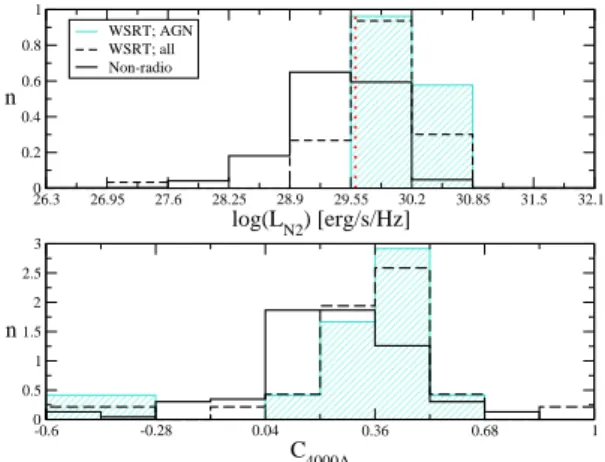
probability that sample (2) is drawn from a different population than its parent sample. For the comparison with sample (3) the KS test does not provide a sig- nificant result. Both samples (1) and (2) show C
4000˚
Acharacteristic of old stellar populations and early-type galaxies (e.g.,[GA05]). A small fraction of sample (2) shows low values of C4000 indicative of a strong power- law non-thermal continuum (Fig. 2). Assuming that rest-frame N2 luminosity is a good proxy for the stellar mass of a galaxy, both samples (1) and (2) inhabit more massive galaxies compared to the non-radio sample.
ACKNOWLEDGEMENTS
MK acknowledges the support from the Creative Research Initiative program, No. 2010-0000712, of the National Research Foundation of Korea (NRFK) funded by the Korea government(MEST).
REFERENCES
Condon, J. J., 1992, Radio Emission from Normal Galaxies, ARA&A, 30, 575
Downes, A. J., Peacock, J. A., Savage, A., et al., 1986, The Parkes Selected Regions - Powerful Radio Galaxies and Quasars at High Redshifts, MN- RAS, 218, 31
Gallazzi, A., Charlot, S., Brinchmann, J., et al., 2005,
26.3 26.95 27.6 28.25 28.9 29.55 30.2 30.85 31.5 32.15
log(LN2) [erg/s/Hz]
0 0.2 0.4 0.6 0.8 1
n
WSRT; AGN WSRT; all Non-radio
-0.6 -0.28 0.04 0.36 0.68 1
C4000A
0 0.5 1 1.5 2 2.5 3
n