2018. The Korean Astronomical Society. All rights reserved. c https://doi.org/10.5303/PKAS.2018.33.2.021
RECENT PROGRESS IN HIGH-MASS STAR-FORMATION STUDIES WITH ALMA Tomoya Hirota 1,2
1 Mizusawa VLBI Observatory, National Astronomical Observatory of Japan, Osawa 2-21-1, Mitaka-shi, Tokyo 181-8588, Japan
2 Department of Astronomical Sciences, SOKENDAI (The Graduate University for Advanced Studies), Osawa 2-21-1, Mitaka-shi, Tokyo 181-8588, Japan
E-mail: [email protected]
(Received May 01, 2018; Revised June 19, 2018; Accepted June 27, 2018)
ABSTRACT
Formation processes of high-mass stars have been long-standing issues in astronomy and astrophysics.
This is mainly because of major difficulties in observational studies such as a smaller number of high-mass young stellar objects (YSOs), larger distances, and more complex structures in young high-mass clusters compared with nearby low-mass isolated star-forming regions (SFRs), and extremely large opacity of in- terstellar dust except for centimeter to submillimeter wavelengths. High resolution and high sensitivity observations with Atacama Large Millimeter/Submillimeter Array (ALMA) at millimeter/submillimeter wavelengths will overcome these observational difficulties even for statistical studies with increasing num- ber of high-mass YSO samples. This review will summarize recent progresses in high-mass star-formation studies with ALMA such as clumps and filaments in giant molecular cloud complexes and infrared dark clouds (IRDCs), protostellar disks and outflows in dense cores, chemistry, masers, and accretion bursts in high-mass SFRs.
Key words: stars: formation — stars: massive — submillimeter: ISM — instrumentation: interferometers
1. INTRODUCTION
High-mass stars defined by the mass of 8M or larger have extremely strong radiation field and stellar wind with high luminosity of > 10 3 L , and significantly af- fect their surrounding environments dynamically and chemically. High-mass stars are progenitors of super- nova which enrich heavy elements in interstellar matters by nucleosynthesis during stellar evolution and super- nova explosion. Thus, they have been contributing to cosmic evolution, galaxy formation and evolution, and star-formation in galaxies. Despite a large impact on as- trophysics and astrochemistry, formation of high-mass stars remains poorly understood due to short evolution- ary timescales, clustering, large distances, and heavy obscuration (Zinnecker & Yorke, 2007; Tan et al., 2014;
Motte et al., 2018).
According to the stellar initial mass function (IMF), which itself is still under debate, higher mass stars are rarely formed compared with lower-mass objects. Fur- thermore, higher mass stars have shorter lifetime of an order of <1 Myr in comparison with the Sun with its expected lifetime of 10 Gyr. Thus, high-mass stars, in particular for those in early evolutionary phase are extremely rare, and hence, there are little newly born high-mass young stellar objects (YSOs) or high-mass star-forming regions (SFRs) in the Solar neighborhood.
http://pkas.kas.org
Although the nearest low-mass SFRs are located at 120- 140 pc from the Sun, even the nearest site of high-mass star-formation, i.e. Orion Molecular Cloud, is located three times larger distance of 420 pc. Except for a few examples like Orion, typical distances of high-mass SFRs are larger than 1 kpc and they are distributed in entire regions of our Galaxy. The large distances of target sources make it difficult to achieve enough high resolution and sensitivity for detailed studies on their properties. The problem of spatial resolution is very serious as high-mass stars are usually formed in dense clusters. It prevents us from statistical studies on high- mass star-formation observationally unless each cluster member can be resolved at sufficiently high resolution.
The large scale surveys with infrared and submillime- ter space instruments starting from IRAS, ISO to Her- schel, Planck, Spitzer, AKARI, etc., have contributed to enhance numbers of possible candidates for high- mass SFRs and YSOs deeply embedded in infrared dark clouds (IRDCs). They can be observed only in centime- ter to far-infrared wavelengths because of large dust opacities of IRDCs even in mid-infrared wavelengths.
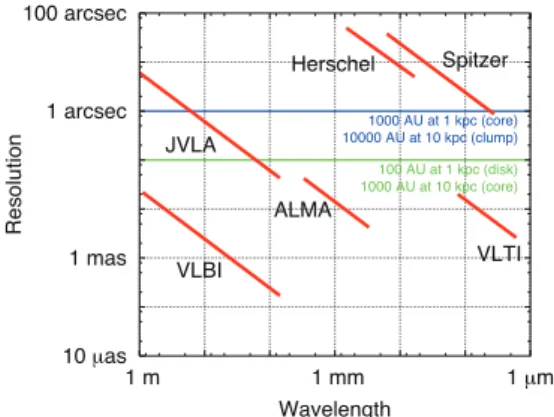
Unfortunately, such large surveys can be done only by satellite telescopes which have less than 1-10” resolution due to limited aperture sizes (Figure 1).
As a result, there still remain fundamental questions
for high-mass star-formation processes: How can high-
mass YSOs accrete their mass within short lifetime
21
1 mas 1 arcsec 100 arcsec
1 μm 1 mm
1 m
R e so lu ti o n
Wavelength 10 μas
VLBI JVLA
ALMA
Herschel Spitzer
VLTI
1000 AU at 1 kpc (core) 10000 AU at 10 kpc (clump) 100 AU at 1 kpc (disk) 1000 AU at 10 kpc (core)
Figure 1. Examples for achievable angular resolutions. For interferometers (VLBI, JVLA, ALMA and VLTI), the red solid lines indicate the highest resolutions corresponding to the longest baselines. Representative angular scales which can be resolved with 0.1 and 1 arcseconds beam sizes are indicated by green and blue horizontal lines, respectively.
For example, a circumstellar disk with a diameter of 100 au at the source distance of 1 kpc corresponds to the angular size of 0.1 arcsecond (green line). Such a structure can be resolved by VLBI, ALMA, and VLTI, but not by JVLA at longer wavelengths than ∼1 cm.
against strong feedback? What are initial conditions for high-mass star-formation? Why high-mass stars are rarely formed in relation to the stellar initial mass func- tion? How high-mass binaries and clusters are formed in terms of high-mass star formation processes? To solve these problems, detailed studies on dynamical and phys- ical properties are necessary for various targets in dif- ferent environments and evolutionary phases from host clouds to high-mass YSOs.
In the last decades, newly constructed and reno- vated observational facilities in various wavelengths have provided high sensitivity and high resolution observa- tions to solve the above fundamental questions. Ra- dio interferometer observations from centimeter, mil- limeter, to submillimeter, such as Jansky Very Large Array (JVLA), Northern Extended Millimeter Array (NOEMA), Submillimeter Array (SMA), Australia Tele- scope Compact Array (ATCA), and very long base- line interferometers (VLBI) such as Very Long Base- line Array (VLBA), European VLBI Network (EVN), VLBI Exploration of Radio Astrometry (VERA), Ko- rean VLBI Network (KVN) and VERA Array (KaVA), and Australian Long Baseline Array (LBA), have been playing crucial roles to reveal innermost parts of high- mass star-formation sites deeply embedded in IRDCs.
In particular, recent progress in Atacama Large Mil- limeter/Submillimeter Array (ALMA) has improved sensitivities and resolutions by one order of magni- tude or larger than previously available connected ar- rays. Furthermore, new capabilities with ALMA have opened millimeter and newly equipped submillimeter windows such as a large instantaneous bandwidth cover- ing numerous molecular lines, wide field mosaic mapping achieving both the higher resolution and larger field of view, high fidelity imaging with multiple 12 m array con- figurations and Atacama Compact Array (ACA) named
as Morita Array, and full polarization observations. Fig- ure 1 shows angular resolutions achieved with the re- cent major astronomical facilities from radio to infrared wavelengths. Except for VLBI, the highest resolution achievable from centimeter to submillimeter and near infrared wavelengths are an order of 0.01-0.1” which en- ables us to resolve the 10-100 AU scales at 1-10 kpc dis- tances. Such high resolutions shed light on circumstellar disks and launching regions of outflows close vicinity to newly born high-mass YSOs as demonstrated in low- mass YSOs.
2. SUMMARY OF ALMA OUTCOMES
This review summarizes the scientific highlights for high-mass star-formation studies with ALMA obtained from the beginning of the ALMA regular operation in 2011 to the time of the East Asian ALMA science work- shop 2017, November. It should be noted that only rep- resentative observational results from ALMA are pre- sented in this review. The readers should refer to origi- nal papers for other studies with ALMA as listed in the references and for those other than from ALMA results which are cited in these ALMA papers.
Since the start of early science operation in 2011, ALMA has completed 5 observing cycles 0-4 until 2017 November, and new cycle 5 session has just started. At the time of East Asian ALMA science workshop 2017, more than 800 refereed journal papers have been pub- lished using the ALMA data (ESO Telescope Bibliog- raphy 1 ), and about 100 of them are related to high- mass star-formation studies. Quarter of them (∼23) are produced from the ALMA Science Verification (SV) data on Orion KL (2011.0.00009.SV), the nearest high- mass SFR (e.g. Zapata et al., 2012; Hirota et al., 2012;
Galv´ an-Madrid et al., 2012; Niederhofer et al., 2012).
In addition to other individual works (e.g. Hirota et al., 2014a,b, 2015, 2016a,b, 2017), 40 papers are published for Orion KL. The other well studied sources are in the Galactic Center region, Sgr B2 (e.g. Belloche et al., 2014;
Higuchi et al., 2015b) and G000.253+0.016 (e.g. Bally et al., 2014; Rathborne et al., 2014; Higuchi et al., 2014), for which 18 papers are published. These Galactic Cen- ter sources are located in different environments com- pared with other typical high-mass star-formation sites in the Galaxy, and hence, they are out of the scope of this review. Rest of about 40 papers are for studies on other Galactic high-mass SFRs. High-mass SFRs in the Large Magellanic Cloud (LMC) have been studied by ALMA with high sensitivities and resolutions of <sub- pc scales (e.g. Fukui et al., 2015; Nayak et al., 2016;
Saigo et al., 2017). Physical and dynamical properties of individual SFRs in the LMC can be directly compared with those in the Galactic SFRs, although the star for- mation in external galaxies in different environments is beyond the scope of the later part of the review. The number of high-mass SFR and YSO samples is still lim- ited and further detailed studies, in particular at higher resolutions as discussed later, are strongly desired.
1 http://telbib.eso.org.
Table 1
Typical properties of high-mass SFRs
Size Mass Density Temperature
Cloud >1 pc >100M 10 2 -10 4 cm −3 10-20 K Clump/filament 0.1-1 pc ∼100M 10 4 -10 6 cm −3 10-20 K Core (prestellar) 10 3 -10 4 AU ∼10M >10 6 cm −3 10-20 K Core (HMC) 10 3 -10 4 AU ∼10M >10 6 cm −3 ∼100 K Disk 10 2 -10 3 AU ∼1M >10 7 cm −3 100-1000 K Note — The above quantities are different from source to source by a factor of 10.
3. BASIC CONCEPTS OF HIGH-MASS STAR- FORMATION
Here the basic concepts of high-mass star-formation are briefly introduced. More details, in particular for theo- retical aspects, are referred to other comprehensive re- view papers (Zinnecker & Yorke, 2007; Tan et al., 2014;
Motte et al., 2018). Table 1 summarizes typical proper- ties in different scales of high-mass star-formation sites.
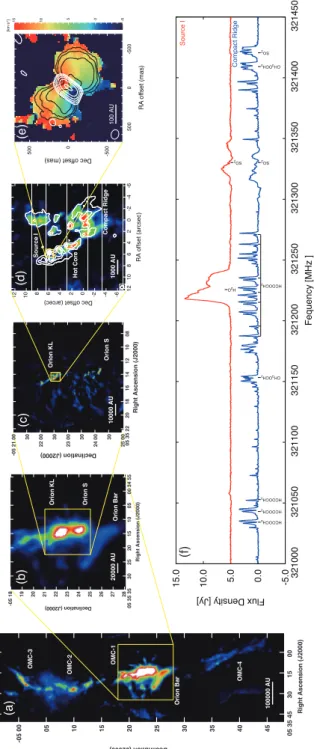
Figure 2(a)-(e) depict relevant structures observed in the nearest high-mass SFR in Orion, although observed properties in Orion cannot always be generalized to typ- ical high-mass SFRs.
High-mass stars are formed in giant molecular clouds (GMCs) with the hydrogen (H 2 ) density and temper- ature of ∼10 2 -10 4 cm −3 and ∼10-20 K, respectively.
Typical sizes range from sub-pc to pc, corresponding to arcseconds or larger angular sizes at distances of the Galactic scale (∼kpc). The host clouds are required to have much larger masses than an order of 100M
to form multiple high-mass stars and star clusters with
> 8M for each member. Inside the host GMCs, there are smaller scale clumps of higher density molecular gas. They are sometimes seen in IRDCs which can be recognized as absorption in near- and mid-infrared wavelengths. Many IRDCs show characteristic filamen- tary elongated structures with smaller fragmentations.
Inside these clumps, high-mass young stellar objects (YSOs) are thought to be formed in the central part of compact dense cores. In general, high-mass stars are formed in binaries or a small number of multiple sys- tems inside the cores. After the onset of high-mass star- formation, dense cores are heated internally via stel- lar radiation and/or outflow shocks. As a result, they can be identified as hot cores at a higher temperature of ∼100 K. These cores have compact structures with 10 4 AU or smaller and hence, high resolutions of 1” or better are required to spatially resolve their structures.
Around the newly born YSOs, there are circumstellar disks and outflows as seen in low-mass YSOs. Outflows are extended from 100 to 10 4 AU scales depending on their evolutionary phases, but disks are always compact with 100-1000 AU scales or 0.1”-1” even at the distance of 1 kpc. Because high-mass YSOs are usually formed in dense star clusters, they have significant feedback to their surrounding media due to their strong radiation field, stellar winds, and outflows, as seen in extended optical/infrared nebular and Hii regions.
4. FILAMENTS, CLUMPS, AND CORES
High-mass YSOs are formed in massive reservoirs of ac- creting materials. Currently, there are two controversial major scenarios for high-mass star-formation. One is turbulent core accretion (McKee & Tan, 2002) and an- other is competitive accretion (Bonnell et al., 2001), and there are several modified/advanced theories. The tur- bulent core accretion model is a so-called scaled-up ver- sion of low-mass star-formation theories and is also re- ferred to as a monolithic collapse model in which a YSO (or binary or a small number of multiples) is formed by collapse of a single dense core. Because the thermal Jeans mass is too small to form high-mass stars, the thermal support is insufficient for dense cores poten- tially forming high-mass stars. For this, it is predicted that high-mass starless cores are supported via turbu- lence or alternatively magnetic fields to form a single high-mass star (or a binary or a small number of mul- tiples) in each core. The initial condition in the cores is thought to be close to the virial equillibrium in the turbulent core accretion model. On the other hand, the competitive accretion model predicts a mass assembly through global gravitational forces in the central part of the clumps surrounded by smaller scale multiple cores.
In contrast to the turbulent core accretion model, it is predicted that there are only low-mass fragments or cores with the thermal Jeans mass close to the possible site of high-mass star-formation. Each high-mass star increases its mass via Bondi-Hoyle accretion at the cen- ter of cluster formation sites. The competitive accretion model predicts that the cores are in sub-virial state and show rapid global collapse.
To investigate initial conditions prior to high-mass star-formation, IRDCs are recognized as ideal laborato- ries because they are in a deeply embedded prestellar phase under gravitational collapse or mass accretion.
One promising approach to distinguish two high-mass
star-formation theories is to search for high-mass star-
less cores which are predicted only for the turbulent core
accretion model. Prototypical examples are IRDC cores
G11.92-0.61-MM2 identified by observations with SMA
and JVLA (Cyganowski et al., 2014), C1-N, C1-S, and
C9A in G028.37+00.07 detected with ALMA (Tan et
al., 2013, 2016; Kong et al., 2016, 2017). In case of in
G028.37+00.07, two dense cores, C1-N and C1-S, were
first identified as possible candidates of very young evo-
lutionary phase of high-mass star-formation because of
no sign of star-formation activity and high deuterium
fractionation in the N 2 D + J =3-2 line, which is a possi- ble indicator of chemically evolved phase and slow grav- itational collapse timescale (Tan et al., 2013). They have masses of ∼60M and are though to be magneti- cally virialized which can form a high-mass YSO in each core as predicted via the turbulent core accretion model.
Subsequent follow-up observations detected molecular outflows from one of the cores, C1-S, (Tan et al., 2016;
Kong et al., 2016; Feng et al., 2016), suggesting that it is a deeply embedded high-mass YSO. Although another one, C1-N, could be a starless prestellar core candidate, there are little other convincing evidences for such high- mass starless cores, and hence, further searches are re- quired.
At pc-scale structures, IRDCs are known to have filamentary structures showing possible signatures of global accretion motions. Many observational stud- ies have been done with ALMA targeting at filaments, clumps, and cores in IRDCs (Sakai et al., 2013, 2015;
Liu et al., 2015; Ohashi et al., 2016; Minh et al., 2016;
Fontani et al., 2016; Maud et al., 2017; Henshaw et al., 2017). ALMA can provide detailed spatial and veloc- ity structures in individual filaments. For instance, an IRDC clump SDC335.579-0.272 (SDC335) shows a hub- filaments structure in the N 2 H + J =1-0 line (Peretto et al., 2013; Avison et al., 2015). SDC335 is thought to be the most massive core in the Galaxy with a mass of 545M (MM1) at a mass flow rate of 2.5×10 −3 M yr −1 along the filaments (Peretto et al., 2013; Avison et al., 2015). The high mass accretion and large mass reservoir suggest that SDC335 is a potential site of OB cluster formation in the central core around the hub-filaments structure via the global collapse.
The sequence of star-formation in each high-mass SFR is also a matter of debate for understanding of high-mass star-formation processes. Two high-mass star-formation theories result in different mass accre- tion processes and consequently different history of star- formation. In the turbulent core accretion model, a high-mass YSO (or multiple system) can be formed in a single massive core. On the other hand, the competitive accretion model expects high-mass star-formation in central parts of the cluster formation surrounded by low- mass cores and YSOs. High sensitivity ALMA imaging can detect substellar-mass cores even in distant high- mass star/cluster-forming regions. These observations are useful to test above differences by identifying poten- tial sites of low-mass star-formation therein. To date, there have been two different observational results favor- ing (or being consistent with) the two controversial mod- els. Extreme cases are high-mass IRDCs G28.34+0.06 P1 (Zhang et al., 2015) and G11.92-0.61 (Cyganowski et al., 2017). In the former case for G28.34+0.06 P1, a high-mass filament with 10 3 M has fragments of 5 cores with a mass of 20-43M for each, while there is no low-mass population distributed around a high- mass filament with the upper limit of 0.2M , which is 30 times lower than the thermal Jeans mass (Zhang et al., 2015). Thus, it is thought that low-mass stars will be formed later than higher mass cluster members in
G28.34+0.06 P1. On the other hand, high-mass cores in G11.92-0.61 (>30M ) are surrounded by several low- mass cores and YSOs with ∼1M (Cyganowski et al., 2017). The low-mass cores in G11.92-0.61 show clear signatures of molecular outflows, suggesting that both high- and low-mass YSOs are forming simultaneously, as predicted by the competitive accretion model. Com- bined with other observational studies on protoclusters (Brogan et al., 2016; Foster et al., 2014; Liu et al., 2017), more statistical datasets would be necessary to judge which the more dominant processes in high-mass star- formation is.
5. DISKS AND OUTFLOWS
One of the well known problems in high-mass star- formation theory is a radiation feedback from newly born YSOs. Because of the shorter Kelvin-Helmholtz timescale than that of accretion, high-mass stars with mass of ∼10M become zero-age main-sequence still un- der accretion phase to grow up higher-mass stars. How- ever, the strong radiation pressure working on the dusty envelope around newly formed YSOs would halt mass accretion against their gravity in the case of a spherically symmetric accretion structure (Wolfire & Cassinelli, 1987). The solution for this problem is to introduce a high-mass accretion rate of the order >10 −3 M yr −1 and/or a non-isotropic accretion geometry. If the sur- rounding envelopes form rotating disks around newly born YSOs due to their angular momentum, the strong radiation can preferentially escape from the polar direc- tion through the outflow cavity and consequently, the mass accretion can be continued through disks, which is known as a flashlight effect (Yorke & Bodenheimer, 1999).
Even before the ALMA era, clear signatures of ro- tating and/or accretion disks around high-mass B-type YSOs have been reported from observational results of millimeter interferometers, near-infrared interferometry and VLBIs (Cesaroni et al., 2007; Beltran & de Wit, 2016). Thus, it has been accepted that high-mass B- type stars can be formed through disk accretion simi- lar to low-mass YSOs, while the number of well studied samples with high resolution is still limited. In contrast, it is unclear whether more massive O-type stars can be formed in a similar way because such objects usually show more massive (> 100M ) and larger (> 10 4 AU) rotating structures called toroids (Cesaroni et al., 2007;
Beltran & de Wit, 2016).
The higher resolution and higher sensitivity ALMA data provide more samples with detailed velocity struc- tures showing rotation motions (S´ anchez-Monge et al., 2013, 2014; Beltran et al., 2014; Guzm´ an et al., 2014;
Hirota et al., 2014a; Zapata et al., 2015) even in O-type stars suggesting the same formation processes (Beltran
& de Wit, 2016). One of the best examples for the
Keplerian-like rotation in which the rotation velocity
is inversely proportional to the square root of the ra-
dius, v rot ∝ r −0.5 , is an O7-type (25M ) high-mass
YSO AFGL4176 (Johnston et al., 2015). They utilize
multi-transitions of the CH 3 CN lines in ALMA Band 6
at different excitation energy levels, which trace the dif- ferent temperature regions and hence, different radius, to construct a model of the Keplerian rotation disk with the 2000 AU radius. Another study of an O-type YSO, G351.77-0.54, also shows a 1000 AU scale rotating disk in the CH 3 CN lines at a resolution of 130 AU (Beuther et al., 2017). The absorption lines at higher-frequency in ALMA Band 9 reveal the infalling motion onto the disk at a high mass accretion rate of 10 −4 -10 −3 M yr −1 . The highest resolution data shows the temperature distribu- tion in the disk suggesting that it is gravitationally sta- ble against fragmentation based on the discussion on the Toomre Q-parameter. Although a pilot survey of disks around O-type stars shows more disturbed and compli- cated structures (Cesaroni et al., 2017), further survey data at high resolutions will provide more detailed dy- namical properties for understanding high-mass YSOs and binaries formation.
Outflows are one of the most outstanding phenom- ena in star-formation activities as they are more ex- tended than those of the disks. Outflows are closely re- lated to mass accretion processes and hence, physically connected to the disks. ALMA provides outflow sam- ples in high-mass SFRs (Merello et al., 2013; Higuchi et al., 2015a; Feng et al., 2016; Beuther et al., 2017) with their size scales ranging from an order of 100-10000 AU.
These studies would give their driving sources and mech- anisms, (indirectly) mass accretion and feedback process which can regulate star-formation activities.
Very recently, ALMA has demonstrated definite evi- dences of rotation motions of outflows and jets for low- mass YSOs (Bjerkeli et al., 2016; Lee et al., 2017). This can also be achieved for the nearest high-mass YSO, a radio source I (Source I) in Orion KL (Hirota et al., 2017). Figure 2(e) shows the distribution of the Si 18 O emission at 484 GHz in ALMA Band 8. The Si 18 O line shows a consistent velocity gradient with those of more compact high excitation H 2 O lines and SiO masers emitted from the disk (Hirota et al., 2014a, 2017). The position-velocity diagram suggests an en- closed mass of 8.7±0.6M and centrifugal radii of 21- 47 AU. Along with the expansion velocity estimated to be 10 km s −1 without high-velocity collimated op- tical or radio jets, the driving mechanism of this low- velocity outflow is most likely explained by a magneto- centrifugal disk wind model (Blandford & Payne, 1982;
Matsushita et al., 2017). It is likely that disk/outflow system around Orion Source I could have a similar for- mation scenario analogous to low-mass YSOs.
In addition to the above bipolar outflow sam- ples, more energetic explosive outflows are identified.
Again, the nearest high-mass SFR Orion KL is one of such rare cases (Bally et al., 2017). The ex- plosive outflow can be traced by near-infrared and millimeter/submillimeter molecular lines ejecting jet- like streamers almost isotropically at the velocity of
>100 km s −1 . The dynamical timescale of ∼500 yrs and kinetic energy of 10 48 erg are consistent with the idea that high-mass YSOs in Orion KL, Source I and BN, experienced a dynamical interaction about 500 yrs
ago to form massive (∼20M ) close binary system in Source I (Rodr´ıguez et al., 2017). However, this scenario is still controversial because of apparent inconsistency with the lower-mass estimated from the other ALMA observations of the rotating disk in Source I (Hirota et al., 2014a, 2017; Plambeck & Wright, 2016). 2
Although both of the two possible accretion scenar- ios of high-mass star-formation (i.e. the turbulent core accretion and competitive accretion models) expect the circumstellar disk/outflow systems, they predict differ- ent dynamical properties (Tan et al., 2014; Beltran & de Wit, 2016). Because the competitive accretion occurs in the central part of dense clusters, disks around newly born high-mass YSOs would be perturbed dynamically, which results in truncation of the smaller disk size and more chaotic directions of outflows. Thus, the statis- tical studies of disk/outflow systems with higher reso- lutions are also the key to understanding of high-mass star-formation scenarios.
6. CHEMISTRY
Once high-mass YSOs are formed in dense cores, they heat surrounding media via radiation and/or outflow shocks up to the sublimation temperature of molecules freezed-out onto grain surface. As a result, high-mass cores hosting YSOs just after formation show rich molec- ular lines in particular from complex organic molecules formed via grain-surface reactions. These objects are known as Hot Molecular Core (HMC) or Hot Core (HC).
Sample spectra for such sources in Orion KL are shown in Figure 2(f). The prototypical HMCs are the Hot Core and Compact Ridge in Orion KL as observed in the ALMA SV (Fortman et al., 2012) and some other studies (e.g. Plambeck & Wright, 2016; Wright & Plam- beck, 2017), although recent observations suggest that Orion Hot Core could be externally heated by outflow shocks rather than by the central YSO (Wright & Plam- beck, 2017; Orozco-Aguilera et al., 2017).
ALMA has opened new windows for high-resolution molecular line maps other than in Orion KL. New ALMA data have revealed chemical differentiation among high-mass SFRs and even within each region (S´ anchez-Monge et al., 2014; Beltran et al., 2014; Zhang et al., 2015; Watanabe et al., 2017). These results show completely different spectral features such that one core shows a rich chemistry while another nearby source with similar physical properties are poor or absent of any molecular lines. Such a striking diversity would be due to intrinsic chemical differentiation affected by a mass and luminosity of the heating source, or due to a high opacity of the dust continuum which results in absorp- tion of molecular lines. Although the interpretation is still not convincing, chemistry could play key diagnos- tics of physical properties and their evolution in high- mass star-formation processes.
2 After the East Asian ALMA science workshop 2017, the higher resolution ALMA observations is reported by Ginsburg et al.
(2018), in which the mass of Source I becomes more consistent
estimated to be 15±2M .
Thanks to the high sensitivity, large instantaneous bandwidth, and wide ranges of submillimeter bands, searches for new molecular/atomic lines have been done with ALMA for various kind of sources including low- and high-mass YSOs, late-type stars, and distant galax- ies. As for high-mass SFRs, ALMA has discovered three new interstellar molecules; isopropyl cyanide (C 3 H 7 CN) in Sgr B2(N) (Belloche et al., 2014), trans ethyl methyl ether (t-C 2 H 5 OCH 3 ) in Orion KL (Tercero et al., 2015), and N-methylformamide (CH 3 NHCHO) in Sgr B2(N) (Belloche et al., 2017). Search for more complex organic molecules will provide a complete picture of chemistry in high-mass SFRs and possible link to astrobiology (i.e.
the origin of terrestrial life).
7. MASERS AND ACCRETION BURSTS
Molecular maser emissions such as H 2 O and CH 3 OH are known to be associated with a large number of high-mass YSOs. They are predominantly distributed in hot (>100-1000 K) molecular gas heated via shocks and/or strong radiation field, and hence, useful trac- ers for disks and outflows in close vicinity to high-mass YSOs at 100 AU scales. Almost all previous observa- tions before the ALMA era were limited to centime- ter to millimeter wavelengths such as methanol masers at 6.7 GHz (class II) and 44 GHz (class I), water masers at 22 GHz, and SiO masers at 43 GHz. With ALMA, various kind of millimeter and submillimeter masers are predicted (Humphreys, 2007; Voronkov et al., 2012; P´ erez-S´ anchez & Vlemmings, 2013). The sub- millimeter H 2 O maser lines at 321 GHz (see Figure 2(f)) and 658 GHz are detected toward Orion Source I (Hirota et al., 2014a, 2016a). Millimeter and submil- limeter CH 3 OH masers are also mapped at 278 GHz in IRDC G34.43+00.24 MM3 (Yanagida et al., 2014) and at 349 GHz in S255IR NIRS3 (Zinchenko et al., 2017). High-sensitivity observations with ALMA have confirmed new SiO maser sources and lines associated with high-mass YSOs (Niederhofer et al., 2012; Higuchi et al., 2015b; Cho et al., 2016), which are quite rare cases with merely three detection until ALMA. These masers are compact and unresolved even with the highest res- olution ALMA observations. They will be good probes for disks and outflows to achieve the highest resolution observations at 100 AU scales comparable with currently available VLBI technique at the maximum resolution of 1 mas (Table 1).
Masers are known to be variable at short (∼days to year) timescales. Regarding such variability, flare- like events nearly synchronized to the infrared and ra- dio continuum emissions are reported for high-mass YSOs in NGC6334I-MM1 (Hunter et al., 2017) and S255IR NIRS3 (Caratti o Garatti et al., 2017). In the case of NGC6334I-MM1, the luminosity is estimated to increase by a factor of 70 (up to 4.2×10 4 L ) than that in pre-flare phase (Brogan et al., 2016; Hunter et al., 2017). This can be explained by a sudden increase in a mass accretion rate as proposed for an accretion burst in low-mass FU-Ori and EX-Lup objects. Thus, such maser flares are recognized as one of key processes to
understand the disk-mediated episodic accretion or ac- cretion burst in star-formation processes.
Burst- or flare-like activities in maser emission have also been recognized for more than 30 years since the discovery of ”Super-maser” in Orion KL and W49N. The H 2 O maser burst occurred in 2011, just before the start of ALMA Early Science cycle 0 (Hirota et al., 2014b).
Although no submilliemter H 2 O line shows such a flare activity unlike that of the 22 GHz H 2 O maser, the data could constrain the emission mechanisms and physical properties of the supermaser region. Further monitoring observations in the ToO mode with ALMA are crucial for coordinated observations of time-domain studies on mass accretion in both high- and low-mass YSOs.
8. FUTURE PROSPECTS
For future high-mass star-formation studies with ALMA, there are several directions; higher resolution, higher sensitivity, larger field of view, wider frequency coverage, and other new capabilities such as polarization and astrometry. ALMA has not yet achieved the highest resolution at the most extended configuration except for lower-frequency than Band 6. Thus, there still remains a room to improve resolution better than 10 mas. It is almost comparable to those achieved by VLBI arrays at lower frequencies (∼a few GHz) (Figure 1). Thus, the ALMA data can be combined with the VLBI map- ping and proper motion measurements of maser lines to reveal three-dimensional velocity fields (e.g. Beltran et al., 2016). It should be noted that the brightness sensitivity is inversely proportional to the square of the beam size. Although the continuum emission will be detectable at sufficiently high sensitivity thanks to the large bandwidths of ALMA, the decrease in brightness sensitivity will be serious for thermal molecular line ob- servations at high resolution configurations. Some of the bright millimeter/submillimeter maser lines will be potential probes for the highest resolution observations as mentioned in the previous section.
Another more important issue is a capability of polar- ization measurements. Polarized emissions provide in- formation on magnetic fields toward the target sources.
The magnetic field is thought to play a crucial role in star-formation processes because it regulates forma- tion of filamentary structures in IRDCs, contraction of dense cores, mass accretion onto YSOs, and forma- tion of disks and outflows (Crutcher, 2012). For this purpose, the linear polarization of the dust continuum emission and maser lines (P´ erez-S´ anchez & Vlemmings, 2013) will provide the magnetic field direction from disks and dense cores to larger scale filamentary structures through high dynamic range polarization images with ALMA. The circular polarization of molecular lines, especially radicals with unpaired electrons (SO, CCS, CN) and strong maser species (H 2 O, CH 3 OH, SiO) can be used for estimating the line-of-sight magnetic field strength through the Zeeman splitting measurements.
With ALMA, there have been only a few examples for
such magnetic field measurements (e.g. Cortes et al.,
2016), and more samples are required.
Because of limited available time and capabilities, high-mass star-formation studies with ALMA have been carried out as compilation of detailed case studies and a small number of pilot surveys such as targeted for 6 O-type YSOs with disks (Cesaroni et al., 2017), 32 high-mass starless core candidates (Kong et al., 2017), 35 massive protoclusters (Csengeri et al., 2017), and 46 ATLASGAL clumps (Chibueze et al., 2017). Further statistics with uniform datasets are desired (e.g. ALMA large program; 2017.1.01355.L).
9. SUMMARY
ALMA has opened a new window for high-mass star- formation studies with the unprecedented high sensitiv- ity and resolution. A number of high quality images of filaments, clumps, and cores in high-mass SFRs pro- vide hints for understanding initial conditions and for- mation scenarios of high-mass YSOs, either the turbu- lent core accretion or the competitive accretion. The high resolution achieved with ALMA can resolve the 100-1000 AU scales of disks and outflows associated with newly born high-mass YSOs. These results show strong evidences of the accretion through disks and magneti- cally driven outflows which are analogous to low-mass star-formation. Molecular chemistry reveals diversity of high-mass SFRs other than a classical hot core in Orion KL, and demonstrats a potential for discoveries of new molecular species.
Nevertheless, observations are still limited for case studies of well know sources, and spatial resolutions are insufficient to resolve the innermost regions close to the newly born YSOs at 100 AU or smaller. Line-survey observations will unveil a complete picture of molecular composition of newly born HMCs, in particular for com- plex organic molecules related to astrobiology. Coordi- nated time domain observations with the continuum and maser emissions will provide episodic accretion in high- mass stars. More importantly, polarization observations are also limited, but the full polarization capability will be available with ALMA for the magnetic field measure- ments by the dust continuum emissions and masers in linear polarization and Zeeman splitting measurements of molecular lines in circular polarization. Further sta- tistical surveys of a large number of high-mass SFRs and wide-field mappings are crucial for understanding of high-mass star-formation.
ACKNOWLEDGMENTS
I would like to thank the anonymous refer- ees for critical reading of the manuscript. I am also grateful to Masahiro N. Machida and Kazuhito Motogi for valuable discussion on this pa- per. This paper makes use of the following ALMA archive data: ADS/JAO.ALMA#2011.0.00009.SV, 2011.0.00199.S, 2013.1.00048.S, and 2015.1.00669.S.
ALMA is a partnership of ESO (representing its mem- ber states), NSF (USA) and NINS (Japan), together with NRC (Canada), NSC and ASIAA (Taiwan), and KASI (Republic of Korea), in cooperation with the
Republic of Chile. The Joint ALMA Observatory is operated by ESO, AUI/NRAO and NAOJ. The au- thor is financially supported by the MEXT/JSPS KAK- ENHI Grant Numbers 21224002, 24684011, 25108005, 15H03646, 16K05293, and 17K05398.
REFERENCES
Avison, A., et al., 2015, Tightening the belt: Constraining the mass and evolution in SDC335, A&A, 577, A30 Bally, J., et al., 2014, Absorption Filaments toward the Mas-
sive Clump G0.253+0.016, ApJ, 795, 28
Bally, J., et al., 2017, The ALMA View of the OMC1 Explo- sion in Orion, ApJ, 837, 60
Belloche, A., et al., 2014, Detection of a Branched Alkyl Molecule in the Interstellar Medium: Iso-Propyl Cyanide, Sci, 345, 1584
Belloche, A., et al., 2017, Rotational Spectroscopy, Tenta- tive Interstellar Detection, and Chemical Modeling of N- Methylformamide, A&A, 601, A49
Beltr´ an, M. T., et al., 2014, Filamentary Structure and Ke- plerian Rotation in the High-Mass Star-Forming Region G35.03+0.35 Imaged with ALMA, A&A, 571, A52 Beltr´ an, M. T. & de Wit, W. J., 2016, Accretion Disks in
Luminous Young Stellar Objects , A&ARv, 24, 6
Beltr´ an, M. T., et al., 2016, Binary System and Jet Preces- sion and Expansion in G35.20-0.74N, A&A, 593, A49 Beuther, H., et al., 2017, Fragmentation and Disk Forma-
tion in High-Mass Star Formation: The ALMA View of G351.77-0.54 at 0.06 00 Resolution , A&A, 603, A10 Bjerkeli, P., et al., 2016, Resolved Images of a Protostellar
Outflow Driven by an Extended Disk Wind, Natur, 540, 406
Blandford, R. D. & Payne, D. G., 1982, Hydromagnetic Flows from Accretion Discs and the Production of Radio Jets, MNRAS, 199, 883
Bonnell, I. A., 2001, Accretion in Stellar Clusters and the Initial Mass Function, MNRAS, 324, 573
Brogan, C. L., et al., 2016, The Massive Protostellar Cluster NGC 6334I at 220 au Resolution: Discovery of Further Multiplicity, Diversity, and a Hot Multi-core, ApJ, 832, 187
Caratti o Garatti, A., et al., 2017, Disk-Mediated Accretion Burst in a High-mass Young Stellar Object, NatPh, 13, 276
Cesaroni, R., et al., 2007, Protostars and Planets V, 197 Cesaroni, R., et al., 2017, Chasing discs around O-type
(proto)stars: Evidence from ALMA observations, A&A, 602, A59
Chibueze, J. O., et al., 2017, Class II 6.7 GHz Methanol Maser Association with Young Massive Cores Revealed by ALMA, ApJ, 836, 59
Cho, S. -H., et al., 2016, Two New SiO Maser Sources in High-Mass Star-forming Regions, ApJ, 826, 157
Cortes, P. C., et al., 2016, Interferometric Mapping of Mag-
netic Fields: The ALMA View of the Massive Star-forming
Clump W43-MM1, ApJL, 825, L15
Crutcher, R. M., 2012, Magnetic Fields in Molecular Clouds, ARA&A, 50, 29
Csengeri, T., et al., 2017, ALMA survey of massive cluster progenitors from ATLASGAL. Limited fragmentation at the early evolutionary stage of massive clumps, A&A, 600, L10
Cyganowski, C. J., et al., 2014, G11.92-0.61-MM2: A Bonafide Massive Prestellar Core?, ApJL, 796, L2 Cyganowski, C. J., et al., 2017, Simultaneous low- and high-
mass star formation in a massive protocluster: ALMA observations of G11.92-0.61, MNRAS, 468, 3694
Di Francesco, J. et al., 2008, The SCUBA Legacy Cat- alogues: Submillimeter-Continuum Objects Detected by SCUBA , ApJS, 175, 277
Feng, S., et al., 2016, Outflow Detection in a 70 mum Dark High-Mass Core, ApJ, 828, 100
Fontani, F., et al., 2016, Magnetically regulated fragmenta- tion of a massive, dense, and turbulent clump, A&A, 593, L14
Fortman, S. M., et al., 2012, An analysis of a preliminary ALMA Orion KL spectrum via the use of complete exper- imental spectra from the laboratory, JMoSp, 280, 11 Foster, J. B., et al., 2014, Distributed Low-mass Star For-
mation in the IRDC G34.43+00.24, ApJ, 791, 108 Fukui, Y., et al., 2015, High-mass Star Formation Triggered
by Collision between CO Filaments in N159 West in the Large Magellanic Cloud, ApJL, 807, L4
Galv´ an-Madrid, R., et al., 2012, ALMA and VLA observa- tions of recombination lines and continuum toward the Becklin-Neugebauer object in Orion, A&A, 547, L3 Ginsburg, A. et al., 2018, A Keplerian Disk around Orion
SrCI, a ∼ 15 M YSO, ApJ, 860, 119
Guzm´ an, A. E., et al., 2014, The Slow Ionized Wind and Ro- tating Disklike System that are Associated with the High- mass Young Stellar Object G345.4938+01.4677, ApJ, 796, 117
Hacar, A. et al., 2018, An ALMA study of the Orion Integral Filament. I. Evidence for narrow fibers in a massive cloud, A&A, 610, A77
Henshaw, J. D., et al., 2017, Unveiling the early-stage anatomy of a protocluster hub with ALMA, MNRAS, 464, L31
Higuchi, A. E., et al., 2014, ALMA View of G0.253+0.016:
Can Cloud-Cloud Collision form the Cloud?, AJ, 147, 141 Higuchi, A. E., et al., 2015a, IRAS 16547-4247: A New Can- didate of a Protocluster Unveiled with ALMA, ApJL, 798, L33
Higuchi, A. E., et al., 2015b, Sgr B2(N): A Bipolar Outflow and Rotating Hot Core Revealed by ALMA, ApJ, 815, 106 Hirota, T., et al., 2012, The First Detection of the 232 GHz Vibrationally Excited H2O Maser in Orion KL with ALMA, ApJL, 757, L1
Hirota, T., et al., 2014a, A Hot Molecular Circumstellar Disk around the Massive Protostar Orion Source I, ApJL, 782, L28
Hirota, T., et al., 2014b, VERA and ALMA observations of the H2O supermaser burst in Orion KL, PASJ, 66, 106 Hirota, T., et al., 2015, ALMA Imaging of Millime-
ter/Submillimeter Continuum Emission in Orion KL, ApJ, 801, 82
Hirota, T., et al., 2016a, ALMA Observation of the 658 GHz Vibrationally Excited H2O Maser in Orion KL Source I, ApJ, 817, 168
Hirota, T., et al., 2016b, ALMA Band 8 Continuum Emission from Orion Source I, ApJ, 833, 238
Hirota, T., et al., 2017, Disk-driven rotating bipolar outflow in Orion Source I, NatAs, 1, 146
Humphreys, E. M. L., 2007, Submillimeter and millimeter masers, in Proc. of IAUS, 242, 471
Hunter, T. R., et al., 2017, An Extraordinary Outburst in the Massive Protostellar System NGC6334I-MM1: Qua- drupling of the Millimeter Continuum, ApJL, 837, L29 Johnston, K. G., et al., 2015, A Keplerian-like Disk around
the Forming O-type Star AFGL 4176, ApJL, 813, 19 Kong, S., et al., 2016, The Deuterium Fraction in Massive
Starless Cores and Dynamical Implications, ApJ, 821, 94 Kong, S., et al., 2017, A Hunt for Massive Starless Cores,
ApJ, 834, 193
Lee, C. F., et al., 2017, A rotating protostellar jet launched from the innermost disk of HH 212, NatAs, 1, 152 Liu, H. B., et al., 2015, ALMA Resolves the Spiraling Ac-
cretion Flow in the Luminous OB Cluster-forming Region G33.92+0.11, ApJ, 804, 37
Liu, T., et al., 2017, ALMA Reveals Sequential High-mass Star Formation in the G9.62+0.19 Complex, ApJ, 849, 25 Matsushita, Y., et al., 2017, Massive outflows driven by mag- netic effects in star-forming clouds with high mass accre- tion rates, MNRAS, 470, 1026
Maud, L. T., et al., 2017, Massive outflows driven by mag- netic effects in star-forming clouds with high mass accre- tion rates, MNRAS, 467, L120
McKee, C. F. & Tan, J. C., 2002, Massive star formation in 100,000 years from turbulent and pressurized molecular clouds, Nature, 416, 59
Merello, M., et al., 2013, ALMA Observations of the Massive Molecular Outflow G331.512-0.103, ApJL, 774, L7 Minh, Y. C., et al., 2016, Chemical Diagnostics of the Mas-
sive Star Cluster-forming Cloud G33.92+0.11 I. 13 CS, CH 3 OH, CH 3 CN, OCS, H 2 S, SO 2 , and SiO, ApJ, 824, 99
Motte, F., et al,. 2018, ARA&A, 56, 1
Nayak, O., et al., 2016, A Study of the Relation between Star Formation and Molecular Clumps on Subparsec Scales in 30 Doradus, ApJ, 831, 32
Niederhofer, F., et al., 2012, Outflow structure and velocity field of Orion source. I. ALMA imaging of SiO isotopo- logue maser and thermal emission, A&A, 548, A69 Ohashi, S., et al. 2016, Dense Core Properties in the Infrared
Dark Cloud G14.225-0.506 Revealed by ALMA, ApJ, 833, 209
Orozco-Aguilera, M. T., et al., 2017,ALMA Observations of the Archetypal “Hot Core” That Is Not: Orion-KL, ApJ, 847, 66
P´ erez-S´ anchez, A. F. & Vlemmings, W. H. T., 2013, Linear
polarization of submillimetre masers. Tracing magnetic
fields with ALMA, A&A, 551, A15
Peretto, N., et al., 2013, Global collapse of molecular clouds as a formation mechanism for the most massive stars, A&A, 555, A112
Plambeck, R. L. & Wright, M. C. H., 2016, ALMA Obser- vations of Orion Source I at 350 and 660 GHz, ApJ, 833, 219
Rathborne, J. M., et al., 2014, Turbulence Sets the Initial Conditions for Star Formation in High-pressure Environ- ments, ApJL, 795, L25
Rodr´ıguez, L. F., et al., 2017,The Proper Motions of the Double Radio Source n in the Orion BN/KL Region, ApJ, 834, 140
S´ anchez-Monge, ´ A., et al., 2013, A candidate circumbinary Keplerian disk in G35.20-0.74 N: A study with ALMA, A&A, 552, L10
S´ anchez-Monge, ´ A., et al., 2014, A necklace of dense cores in the high-mass star forming region G35.20-0.74 N: ALMA observations, A&A, 569, A11
Saigo, K., et al., 2017, Kinematic Structure of Molecular Gas around High-mass YSO, Papillon Nebula, in N159 East in the Large Magellanic Cloud: A New Perspective with ALMA, ApJ, 835, 108
Sakai, T., et al., 2013, ALMA Observations of the IRDC Clump G34.43+00.24 MM3: Hot Core and Molecular Outflows, ApJL, 775, L31
Sakai, T., et al., 2015,ALMA Observations of the IRDC Clump G34.43+00.24 MM3: DNC/HNC Ratio, ApJ, 803, 70
Tan, J. C., et al., 2014, Massive Star Formation , Protostars and Planets VI, 149
Tan, J. C., et al., 2013, The Dynamics of Massive Starless Cores with ALMA, ApJ, 779, 96
Tan, J. C., et al., 2016, An Ordered Bipolar Outflow from a Massive Early-stage Core, ApJL, 821, L3
Tercero, B., et al., 2015, Searching for trans ethyl methyl ether in Orion KL, A&A, 582, L1
Voronkov, M. A., et al., 2012, New class I methanol masers, in Proc. of IAUS 287, 433
Watanabe, Y., et al., 2017, Discovery of Striking Differ- ence of Molecular-emission-line Richness in the Potential Proto-binary System NGC 2264 CMM3, ApJ, 847, 108 Wolfire, M. G. & Cassinelli, J., 1987, Conditions for the
formation of massive stars, ApJ, 319, 850
Wright, M. C. H. & Plambeck, R. L., 2017, ALMA Images of the Orion Hot Core at 349 GHz, ApJ, 843, 83
Yanagida, T., et al., 2014, ALMA Observations of the IRDC Clump G34.43+00.24 MM3: 278 GHz Class I Methanol Masers, ApJL, 794, L10
Yorke, H. W. & Bodenheimer, P., 1999, The Formation of Protostellar Disks. III. The Influence of Gravitationally Induced Angular Momentum Transport on Disk Structure and Appearance, ApJ, 525, 330
Zapata, L. A., et al., 2012, ALMA Observations of the Out- flow from Source I in the Orion-KL Region, ApJL, 754, L17
Zapata, L. A., et al., 2015, ALMA reveals a candidate hot and compact disc around the O-type protostar IRAS
16547-4247, MNRAS, 447, 1826
Zhang, Q., et al., 2015, Fragmentation of Molecular Clumps and Formation of a Protocluster, ApJ, 804, 141
Zinchenko, I., et al., 2017, Detection of a new methanol maser line with ALMA, A&A, 606, L6
Zinnecker, H. & Yorke, H. W., 2007, Toward Understanding
Massive Star Formation, ARA&A, 45, 481
De cli na tio n ( J2 00 0)
Rig h t A s c e n s io n (J 2 0 0 0 )
05 35 45 3 0 1 5 0 0
-05 00 0 5 1 0 1 5 2 0 2 5 3 0 3 5 4 0 4 5
De cli na tio n (J 20 00 )
Right Ascension (J2000)
05 35 35 3 0 2 5 2 0 1 5 1 0 0 5 0 0 34 55
-05 18 1 9 2 0 2 1 2 2 2 3 2 4 2 5 2 6 2 7 2 8 100000 AU
20000 AU RA offset (arcsec)
1 2 1 0 8 6 4 2 0 -2 -4 -6
De c o ffse t (a rcec)
1 0 8 6 4 2 0 -2 -4 -6
1 2 1000 AU 100 AU R A of fse t (ma s)
5 0 0 0 -5 0 0
5 0 0 0 -5 0 0
-501015 5
[km s-1]
De c o ffse t (ma s)
(a) (b) (d) (e)
De cli na tio n (J 20 00 )
Right Ascension (J2000)
05 35 22 2 0 1 8 1 6 1 4 1 2 1 0 0 8
-05 21 00 3 0 22 00 3 0 23 00 3 0 24 00 3 0 25 00
(c) Source I Hot Core Compact Ridge 10000 AU -5.0 0 .0 5 .0
10.0
15.0 321000 32105 0 32110 0 32115 0 321 2 0 0 3 2 1 2 5 0 3 2 1 3 0 0 3 2 1 3 5 0 3 2 1 4 0 0 3 2 1 4 5 0
Flu x D en sity [Jy]
F e q u e n cy [MH z ]
HC OO 3 CH
HC OO 3 CH
HC OO CH 3
3 CH OC 3H 2H O
HC OO 3 CH
SO 2 3 CH OC 3H
SO 2
Source I Compact Ridge
(f)
SO 2