韓蠶學誌 50(2), 109~111 (2012) J Seric Entomol Sci
http://dx.doi.org/10.7852/jses.2012.50.2.109
<論 文 >
109
총채가시응애(Hypoaspis aculeifer)와 긴털가루응애(Tyrophagus putrescentiae)의 저온저장 조건 구명
함은혜1,3·최영철2·이준석3·박종균1*
1경북대학교 생태과학과, 2국립농업과학원 곤충산업과, 3(주)오상킨섹트 생물자원연구소
Study on the Cold Storage Condition of Hypoaspis aculeifer(Canestrini)(Acari:
Gamasida) and Tyrophagus putrescentiae(Schrank)(Acari: Acaridae)
Eun Hye Ham1,3, Young Cheol Choi2, Jun Seok Lee3, Jong Kyun Park1
*
1Department of Ecology Science, Kyungpook National University
2Applied Entomology Division, National Academy of Agricultural Science
3Institute for Bioresources research, Osangkinsect Co., Ltd.
(Received September 27, 2012, Accepted October 12, 2012)
ABSTRACT
The success of biological control depends upon the standard setting and effective mass rearing of natural enemies. In this work, we have investigated cold storage condition of Hypoaspis aculeifer(Canestrini) and Tyrophagus putres- centiae(Schrank). which has been stored at 8, 12oC, RH 70 ± 5%, in dark condition. An appropriate temperature of cold storage was 12oC with wheat bran(50%) and rice bran(50%) for T. putrescentiae. 7o% of T. putrescentiae and H. acule- ifer could survive for 28 days and 70 days at 12oC. After storing at 12oC with prey mite for 28 days, 56 days and 84 days, their reproduction rate showed similar resultes.
Key words : Hypoaspis aculeifer, Tyrophagus putrescentiae, Cold storage, Natural enemy
서 론
총채가시응애(Hypoaspis aculeifer)는 1995년부터 유럽에 서 사용하기 시작하였고, 뿌리이리응애(Hypoaspis miles) 와 더불어 총채벌레류 번데기(Berndt et al. 2004), 뿌리응 애류(BCPC, 2004), 톡토기류(Axelsen et al. 1997), 작은뿌 리파리(Chambers et al. 1993) 등을 방제하기 위한 목적으 로 활용되고 있다. 뿌리이리응애가 외래 도입종인 반면에 총채가시응애는 국내 토착 천적으로 해충의 포식범위가 넓으며 지표에서 서식한다.
천적들은 천적 생산 회사가 상품화하여 농가에 판매하 여 친환경재배농법으로 이용되고 있으나, 종종 해충 방제 에 실패하는 사례가 발생되고 있다. 환경적인 요인과 농 가재배포장의 물리적인 요건, 균일하지 않는 천적의 품질 등이 원인이 된다. 특히 균일하지 않는 천적 품질의 문제
는 사육기술의 미흡, 근친교배에 의한 누대사육, 생산 천 적의 장기저온저장, 품질관리 기준의 부재 및 자율화 등 이 있다. 특히 천적은 살아있는 생물이기 때문에 제품 포장 후 일정시간이 지나면 활력이 떨어진다. 따라서 고품질의 천적을 공급하기 위해서는 저온 환경에서 최적의 저장 온 도, 저장기간등을 구명해야 한다(Gillespie and Ramey 1988, Morewood 1992, Rudolf 1993, De clercq and Degheele 1993). 특히 생물적방제 국제기구(International Organization for Biological Control, IOBC)에서는 상품화된 천적에 대하 여 품질에 관한 기준을 만들어 제시하고 있으며, 각국의 천 적생산 회사들이 IOBC 품질관리 가이드라인을 이용하고 있다.
본 연구는 총채가시응애의 대량사육기준을 설정하기 위 하여, 총채가시응애와 그 먹이 응애인 긴털가루응애의 최 적 저온저장 조건 및 저온 저장 후의 증식률을 구명하기 위하여 수행하였다.
*Corresponding author. E-mail: [email protected]
함은혜·최영철·이준석·박종균
110
재료 및 방법
1. 실험곤충; 긴털가루응애와 총채가시응애
실험에 이용한 긴털가루응애는 2010년 10월, 국립농업 과학원 천적연구실에서 분양받아 온도 28oC, 습도 80 ± 10%, 광주기 16L : 8D로 설정된 사육실에서 소맥피와 쌀겨를 먹이로 제공하면서 실내 누대 사육한 개체를 이용하였다.
총채가시응애는 (주)오상킨섹트에서 한 병(1,000 mL)에 10,000마리가 들어있는 제품을 구입하여 건전한 약충과 성충을 구분하여 실험에 사용하였다.
2. 긴털가루응애의 온도별, 저장기간별 생존율 조사 긴털가루응애의 저온저장 조건과 저장기간별 생존율을 조사하기 위하여 누대 사육중인 긴털가루응애를 J. van Schelt 와 F. Stepper의 Mite extractor(van Lenteren 2003) 를 이용하여 밀도조사 후 실험에 사용하였다. 300 mesh 철망이 부착된 10 cm의 환기구가 측면에 있는 10리터 투 명 사각용기에 부재료의 밀도를 달리해서 실험에 사용하 였다. 소맥피와 쌀겨를 1 : 1, 1 : 9로 접종하여 각 용기별 로 8, 12oC에 저온저장(습도 70 ± 5%, 24시간 암조건)하면 서 주마다 밀도조사를 하여 실험곤충의 생존수를 조사하 였다. 실험은 생존율이 0이 될 때까지 진행하였다. 천적 회사에서 활용가능한 대량사육 매뉴얼 제작이 목표인 만 큼 실험 단위를 대량사육 최소단위로 설정하였다. 실험은
임의로 정한 10개의 사육용기를 1반복으로 4반복 수행하 였다. SAS Institue(1996) 통계프로그램을 이용한 Duncan 다중검정(DMRT)으로 각 처리별 평균값을 비교하였다.
3. 총채가시응애의 저장기간별 생존율 조사
긴털가루응애의 적정 저장 온도가 구명이 되면, 같은 조 건에서 긴털가루응애와 총채가시응애의 비율을 100 : 1로 접종하여 저온저장(습도 70 ± 5%, 24시간 암조건) 후 주 마다 상온으로 옮겨 밀도조사 후, 실험곤충의 생존수를 산출하였다. 또한, 28, 56, 84일 저온저장후 상온(온도 21oC, 습도 80 ± 10%, 광주기 16L : 8D)에서 증식시켜 저온저장 기간별 증식율을 확인하였다. 실험은 임의로 정한 8개의 제품을 1반복으로 6반복 수행하였다. SAS Institue(1996) 통계프로그램을 이용한 Duncan 다중검정(DMRT)으로 각 처리별 평균값을 비교하였다.
결과 및 고찰
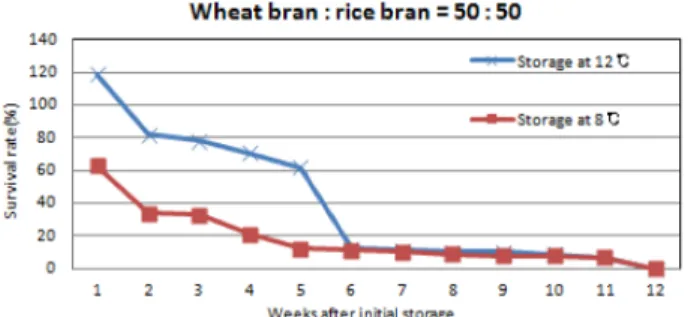
1. 긴털가루응애의 온도별, 저장기간별 생존율 조사 긴털가루응애 먹이사료의 배합비율 및 저온 저장 온도 에 따라 생존율은 큰 차이가 있었다(Fig. 1). 먹이 사료의 배합비율이 소맥피 : 쌀겨가 50 : 50일때는 온도별 70% 생 존율을 보인 기간을 보면, 8, 12oC에서 각 1주, 4주이고, Fig. 2. Survival rate of T. putrescentiae with wheat bran : rice
bran(10 : 90)
Fig. 1. Survival rate of T. putrescentiae with wheat bran : rice
bran(50 : 50) Fig. 3. Survival rate of H. aculeifer with different density at 12
Fig. 4. Reproductionl rate of H. aculeifer with different stored weeks at 12
총채가시응애(Hypoaspis aculeifer)와 긴털가루응애(Tyrophagus putrescentiae)의 저온저장 조건 구명
111 10 : 90일때는 모든 온도에서 저장 1주부터 생존율이 낮게 나타났다(Fig. 2). 먹이배합비율에 따른 뚜렷한 생존율의 차이는 소맥피보다 입자가 고은 쌀겨의 함량이 높아짐에 따라 맑은 공기의 유입과 소맥피와 쌀겨로부터 발생하는 가스의 배출이 어려워졌기 때문으로 사료된다. 이상의 결 과를 종합하면, 12oC에서 소맥피와 쌀겨의 배합비율이 50 : 50일때 5주까지 저장이 가능한 것을 알 수 있다. 천 적의 효율적인 생산을 위하여 대체먹이의 장기 저온 저 장 기술개발은 지속적으로 검토되어야 할 것으로 생각된다.
2. 총채가시응애의 저장기간별 생존율 조사
Morewood(1992)는 칠레이리응애 저온저장시 먹이응애 를 공급했을때가 가장 생존율이 높았다고 했으며(Kim et al. 2009), 실제 천적의 대량생산시에도 먹이를 공급했을 때와 그렇지 않았을 때에는 뚜렷한 생존율의 차이가 있 었다. 위와같이, 천적의 효율적인 저온저장을 위해서는 먹 이 공급이 우선시 되어야 하기 때문에 긴털가루응애의 적 정 저장 가능 온도인 12oC에서 총채가시응애의 저장기간 별 생존율을 조사하였다. 총채가시응애의 12oC 저장기간 별, 초기 밀도별 생존율은 Fig. 3과 같다. 천적 초기 밀도 별 생존율은 초기 밀도가 100,000일때와 125,000일때는 차이가 거의 없었으나, 150,000일때는 생존율이 떨어지는 현상을 보였다. 천적의 초기 밀도에 따라 먹이응애양도 증가되어, 결국 소맥피와 쌀겨의 함유량이 높아짐에 따른 가스 발생으로 천적의 증식량이 저조한 것으로 생각된다.
저온저장 28, 56, 84일 후 상온(온도 21oC, 습도 80 ± 10%, 광주기 16L : 8D)에서 증식시켜 저온저장기간별 증식률을 확인한 결과는 Fig. 4와 같다. 저온저장 하지 않은 개체와 28, 56, 84일 저온저장한 개체는 상온에 옮기고 1주일째 는 약 40% 감소를 보였으나, 2주째부터는 모든 실험구에 서 비슷한 증식률을 보였다.
이상의 결과를 종합해보면, 지표면에 서식하는 총채가 시응애는 긴털가루응애에 비해 저온저장이 용이하며, 84 일까지 저온저장 하여도 재증식에 문제가 없을 것으로 판 단된다. 그러나, 천적 저장에 따른 품질의 저하 현상은 저 장방법, 충의 활력, 저장먹이 등에 따라 달라질 수 있으 므로 지속적인 저장기술 개발이 필요할 것으로 사료된다.
적 요
성공적인 생물학적 방제를 위해서는 적용천적의 사육기 준과 규격이 설정되어 있어야 한다. 8, 12oC, 습도 70 ± 5%, 24시간 암조건에서 총채가시응애와 그 먹이응애인 긴털가 루응애의 저온 저장 실험을 수행하였다. 긴털가루응애는 소맥피(50%)와 쌀겨(50%)로 조성된 먹이사료에 접종하여
12oC에서 저온저장이 가능하였다. 긴털가루응애와 총채가 시응애의 생존율이 70%되는 조건은 12oC에서 28일, 70일 저장후이다. 총채가시응애를 12oC에서 28, 56, 84일 저온 저장후 증식율을 확인한 결과 저온기간에 상관없이 유사 한 결과를 나타내었다.
감사의 글
본 연구는 2012년도 농촌진흥청 산업곤충 및 녹색경관 이용기술 개발 사업 ‘곤충의 사육기준 및 규격 설정 연구 (과제번호: PJ008977)’를 수행한 결과로 작성되었다.
인용문헌
Axelsen JA, Holst N, Hamers T, Krogh PH(1997) Simulations of the predator-prey interactions in a two species ecotoxico- logical test system. Ecol Model 101, 15~25.
Berndt O, Meyhöfer R, Poehling HM(2004) The edaphic phase in the ontogenesis of Frankliniella occidentalis and comparison of Hypoaspis miles and Hypoaspis aculeifer as predators of soil-dwelling thrips stages. Biol Control 30, 17~24.
British Crop Protection Council(BCPC)(2004) The manual of bio- control agents. BCPC, 7 Omni Business Centre, Omega Park, Alton, Hampshire, GU34 2QD, UK. pp.702.
Chambers RJ, Wright EM, Lind RJ(1993) Biological control of glasshouse sciarid larvae(Bradysia spp.) with the predatory mite, Hypoaspis miles on Cyclamen and Poinsettia. Biocontrol Sci Technol 3, 285~293.
De Clercq P, Degheele D(1993) Cold storage of the predatory bugs Podisus maculiventris(Say) and Podisus sagitta(Fabricius)(Het- eroptera: Pentatomidae). Parasitica 49(1-2), 27~41.
Gillespie DR, Ramey CA(1988) Life history and cold storage of Amblyseius cucumeris(Acarina: Phytoseiidae). Entomol Soc Brit Columbia 85, 71~76.
IOBC. Quality control guidelines for natural enemies. www.ento- mology.wisc.edu/iobc/nrs.htm
Kim JH, Kim HY, Han MJ, Choi MY, Hwang SJ, Lee MS(2009) Cold Storage Effect on the Biological Characteristics of Orius laevigatus(Fieber)(Hemiptera: Anthocoridae) and Phytoseiu- lus persimilis Athias-Henriot(Acari: Phytoseiidae). Korean J Appl Entomol 48(3), 361~368.
Morewood WD(1992) Cold storage of Phytoseiulus persimi- lis(Phytoseiidae). Exper Appl Acarol 13, 231~236.
Rudolf E, Malausa JC, Millot P, Pralavorio R(1993) Influence of cold temperature on biological characteristics of Orius lae- vigatus and Orius majusculus(Het.: Anthocoridae). Ento- mothaga 38(3), 317~325.
SAS Institue. 1996. “SAS 6.11 for Window” SAS Institue, Cary, NC, USA.
Van Lenteren JC(2003) Quality Control and Production of Bio- logical Control Agents(Theory and Testing Procedures). CABI Publishing. pp.327.