서 론
Didymella bryoniae에 의한 덩굴마름병은 수박을 포함한 여
러 박과 작물에 큰 피해를 일으키는 병으로 과습하고 따뜻 한 기후 조건에서 많이 발생하며, 재배지뿐만 아니라 수확 후에도 발생하여 심각한 손실을 일으킨다(Sherf와 MacNab, 1986). 덩굴마름병이 박과 작물 줄기에 발생하면 초기 회갈 색의 불규칙한 병반이 형성되고 심하면 식물체 전체가 고 사된다. 잎에서는 황갈색의 작은 반점을 초기에 생성하다가
©The Korean Society of Plant Pathology
cc
This is an open access article distributed under the terms of the Creative Commons Attribution Non-Commercial License (http://creativecommons.org/
licenses/by-nc/4.0/), which permits unrestricted non-commercial use, distribution, and reproduction in any medium, provided the original work is properly cited.
Research Article Open Access
수박 덩굴마름병에 대한 효율적인 저항성 검정 방법 개발
Development of an Efficient Screening System for Resistance of Watermelon Plants to Didymella bryoniae
*Corresponding author Tel: +82-42-860-7434 Fax: +82-42-861-4913 E-mail: [email protected]
이지현1ㆍ장경수1ㆍ최용호1ㆍ김진철2ㆍ최경자1*
1한국화학연구원 친환경신물질연구센터, 2전남대학교 응용생물공학부
Ji Hyun Lee
1, Kyoung Soo Jang
1, Yong Ho Choi
1, Jin-Cheol Kim
2, and Gyung Ja Choi
1*
1Center for EcoFriendly New Materials, Korea Research Institute of Chemical Technology, Daejeon 34114, Korea
2Division of Applied Bioscience and Biotechnology, Institute of EnvironmentallyFriendly Agriculture, Chonnam National University, Gwangju 61186, Korea
Received May 17, 2016 Revised May 24, 2016 Accepted June 3, 2016
Gummy stem blight, caused by the fungus Didymella bryoniae, is major disease of watermelons worldwide. The objective of the present study was to establish an efficient screening system to iden- tify watermelon resistant to D. bryoniae. An GSB3 isolate was prepared from a watermelon plant showing typical symptoms of gummy stem blight in Haman-gun and identified as D. bryoniae based on molecular analysis of internal transcribed spacer sequence. A simple mass-production technique of inoculum was developed based on spore production of D. bryoniae GSB3 under several incubation conditions and their virulence on watermelon plants. Resistance degrees of 22 commercial watermelon cultivars to the GSB3 isolate were evaluated. Among them, four watermelon cultivars showing different degree of resistance response were selected for further study. Development of disease on the cultivars according to various conditions including inoculum concentrations, incubation periods in dew chamber, and incubation temperatures was investigated. From the results, we suggest an efficient screening method for resistant watermelon cultivars to gummy stem blight. Seeds of watermelon cultivar are sown and grown in a greenhouse until plant stage of 2-fully expanded leaves. Seedlings are inoculated with D. bryoniae by spraying spore suspension of the fungus at a concentration of 5.0×10
5spores/ml. The infected plants are incubated in humidity chamber at 25
oC for 48 hours and then transferred to a growth chamber at 25
oC and 80% relative humidity with 12-hour light a day. Three to four days after inoculation, disease severity of the plant are measured using percentage of infected leaf area.
Keywords: Breeding, Disease resistance, Gummy stem blight, Screening
Research in Plant Disease pISSN 1598-2262, eISSN 2233-9191 www.online-rpd.org
72
점차 진전되면 큰 원형의 부정형 병반으로 확대되며, 그 후 병반에 흑색 소립의 병자각을 형성하고, 열매와 열매자루에 서는 배꼽 부분이 갈색으로 변색되어 결국 열매 전체가 마 르고 썩어버린다(Skarshaug, 1981). 특히, 수박의 경우 발생하 면 떡잎, 배축, 잎, 과실 등에서 수관이 마르고, 줄기에 궤양이 생기며 잎이 일찍 떨어지는 증상이 나타나는데(Maynard와 Hopkins, 1999), 착과 이후에 이 병이 급격히 발생하기 때문에 과실이 성숙되기 이전에 잎과 덩굴이 말라 죽는 경우가 많 다(Kwon 등, 1997).
덩굴마름병을 방제하기 위하여 화학적 방제 방법이 효과 적으로 사용되어 왔지만 반복된 농약의 사용으로 인해 환경 에 부정적인 영향을 주고 있으며, 약제 저항성을 보이는 병 원균 출현도 보고되고 있다(Keinath와 Zitter, 1998; Wolukau 등, 2007). 따라서 합성 작물보호제 만으로는 실질적인 방제 가 어려운 상황에서 저항성 품종의 재배는 가장 전략적, 환 경 친화적이며 일반적으로 인정되는 경제적인 방제 방법이 다(Vakalounakis, 1993, 1995; Wehner와 St. Amand, 1993).
덩굴마름병 저항성 육종 소재 발굴에 관한 연구는 지속적 으로 이루어져 왔다. 미국 농무부(United States Department of Agriculture)의 Germplasm Collection에서 보유하고 있는 수박 유전자원 439개 중 ‘PI 189225’가 가장 높은 저항성을 보였으며(Sowell과 Pointer, 1962), ‘PI 271778’도 추가적으로 저항성 소재로 보고되었다(Sowell, 1975). 그리고 감수성인
‘Charleston Gray’와의 교잡에서 ‘PI 189225’의 저항성은 단일 열성 유전자에 의한 것으로 나타났다(Norton, 1979). 이후에 Boylan 등(1994)은 138개의 수박 수집종의 덩굴마름병 저항 성 스크리닝을 수행하여 ‘PI 500335’, ‘PI 505590’, ‘PI 512373’,
‘PI 164247’, ‘PI 500334’ 등의 저항성 소재를 선발하였다. 덩굴 마름병 저항성 유전자원인 ‘PI 189225’와 ‘PI 271778’를 이용 하여 저항성 품종 ‘AU-Producer’, ‘AU-Golden Producer’, ‘AU- Jubilant’, ‘AU-Sweet Scarlet’을 개발하였으나(Norton, 1979;
Norton 등, 1986, 1993, 1995), 이들의 덩굴마름병 저항성이 부 모 세대보다 낮아서 덩굴마름병 저항성 육종의 어려움만 확 인하였다. 따라서 질적으로 우수한 새로운 덩굴마름병 저항 성 육종 소재 발굴과 이를 이용한 저항성 품종 개발 연구가 수행되어야 한다. 이를 위해서는 대량 시료의 덩굴마름병 저항성을 효과적으로 검정하는 것이 필요하다. 하지만 효율 적인 수박 덩굴마름병 저항성 검정 체계 확립에 대한 보고 는 거의 없다.
저항성 육종 소재 발굴과 덩굴마름병 저항성 계통 육성을 위해서는 한 번에 저항성을 검정하는 식물의 수가 많기 때 문에 검정에 사용할 포자를 쉽고 용이하게 대량 생산할 수
있어야 한다. 하지만 덩굴마름병균은 인공배지 상에서 특 별한 처리 없이는 거의 포자를 형성하지 않거나, 계통에 따 라 전혀 형성하지 않는 경우도 있어 실험에 어려움이 있다 고 보고되어 있다(Chiu와 Walker, 1949a; Wiant, 1945). Kwon 등 (1997)은 덩굴마름병균의 병포자를 대량생산하는 방법을 보고하였으나, 방법이 복잡하여 좀 더 이용하기 쉬운 방법 으로의 개선이 필요하다.
본 연구에서는 효율적인 수박 덩굴마름병 저항성 검정 방 법을 확립하고자, D. bryoniae GSB3 균주를 사용하여 배양 조 건에 따른 포자 생산량과 형성된 포자의 수박에 대한 병원 력 차이를 조사하였다. 그리고 시판 중인 수박 22품종의 덩 굴마름병균에 대한 저항성 정도를 확인하여 저항성 정도가 다른 수박 4개 품종을 선발하고, 습실 처리 시간, 접종 농도, 접종 후 재배 온도 등의 몇 가지 발병 조건에 따른 이들 품종 의 덩굴마름병 발생을 조사하였다.
재료 및 방법
병원균 분리 및 동정. 함안 지역에서 전형적인 덩굴 마름병 병징을 보이는 수박으로부터 분리한 GSB3 균주 를 NongwooBio (Suwon, Korea)로부터 분양 받아 실험에 사 용하였다. 병든 줄기 조직을 잘라 1% sodium hypochlorite (Samchun Chemical, Pyeongtaek, Korea)로 30초 동안 표 면을 살균한 후에 멸균수로 씻고 표면을 말려주었다.
Streptomycin sulfate (Sigma-Aldrich, St. Louis, MO, USA) 200 µg/
ml가 포함된 potato dextrose agar (PDA; Becton, Dickinson and Co., Sparks, MD, USA)에 올려 놓고 25oC에서 배양하여 균주를 분리하였다. 이들 중 포자 형성이 가장 좋은 균주(GSB3)의 포 자를 백금이로 긁어내어 1.5% water agar (Junsei Chemical Co., Tokyo, Japan) 배지에 획선도말한 후에 광학현미경 하에서 배지 위에 있는 단일 포자를 떼어내어 PDA 배지에 올려 놓고 25oC에서 배양하였다.
염기서열분석을 통해 병원균 동정을 수행하고자 GSB3 균주를 PDA 배지에 접종하고 25oC에서 7일 동안 배양한 후 에 균사체를 수확하였다. 수확된 균사체를 InstaGene Matrix
#732-6020 solution (Bio-Rad, Hercules, CA, USA) 20 µl에 현탁 하여 12,000 rpm으로 5분간 원심분리한 후에 상등액 1 µl 를 polymerase chain reaction (PCR)에 사용하였다. 염기서열 분석을 위하여 ITS1 (5’-TCCGTAGGTGAACCTGCGG-3’)과 ITS4 (5’-TCCTCCGCTTATTGATATGC-3’) 프라이머(White 등, 1990) 를 사용하여 PCR을 수행하였다. InstaGene Matrix 산물 1 µl, 10 mM dNTP 1 µl, 10× PCR buffer 3 µl, 10 pmol의 프라이머 각
각 1 µl, 2.5 unit/µl의 EF-Taq DNA polymerase (SolGent Co., Ltd., Daejeon, Korea) 0.2 µl를 넣고 멸균수를 첨가하여 최종 30 µl 의 반응액을 만들었다. Internal transcribed spacer (ITS) 영역 유전자 증폭은 95oC에서 2분간 initial denaturation을 실시한 후에 denaturation 95oC/30초, annealing 54oC/30초, extension 72oC/1분으로 35 cycle을 수행하고 final extension 72oC에서 10분간 실시하였다. 그리고 PCR 산물은 Big Dye® terminator ver. 3.1 cycle sequencing kits (Applied Biosystems, Foster City, CA, USA)로 반응 후 각각의 프라이머로 DNA Engine Tetrad 2 peltier thermal cycler (Bio-Rad)를 이용하여 PCR반응을 수 행하고 ABI Prism 3730xl Analyzer 96 capillary type (Applied Biosystems)으로 염기서열 분석결과를 얻었다. 분석된 염기 서열은 BLAST search에 의해 GenBank (www.ncbi.nlm.nih.gov) 에 등록된 ITS 영역의 염기서열과 비교하였다. GSB3 균주와 GenBank로부터 얻은 염기서열은 CLUSTAL X (Thompson 등, 1994)와 PHYDIT program (Chun, 1995)을 이용하여 분석하였 다. Neighbor-joining tree는 PHYLIP 3.57c package (Felsenstein, 1985)의 Kimura’s 2-parameter distance model (Kimura, 1980)을 이용하여 작성하였다.
배지 종류와 광처리에 따른 포자 생산량. 덩굴마 름병균 포자를 대량 생산하기 위한 최적의 배지와 포자 유 도 방법을 결정하기 위하여 PDA, V8-juice agar (V8A; V8 Juice [Campbell Soup Co., Camden, NJ, USA] 200 ml, CaCO3 [Samchun Chemical] 3 g, agar 9 g, distilled water 1 l), oatmeal agar (OMA;
Becton, Dickinson and Co.)를 멸균하여 직경 8.5 cm의 Petri dish에 부어 배지를 준비하였다. D. bryoniae GSB3 균주의 균 사조각을 각 배지의 중앙에 1조각씩 접종하여 25oC에서 7일 동안 암상태에서 배양하였다. 포자를 유도하기 위하여 이를 25oC의 항온항습실(상대습도 80%, 광:암=12시간:12시간)로 이동하고 1일 혹은 2일간 더 배양하거나, 1일 혹은 2일 동안 하루에 12시간씩 광처리(53–58 µmolㆍm–2ㆍs–1)한 후에 25oC 배양기로 이동하여 암상태로 2일간 더 배양하여 포자를 형 성시켰다. 그리고 여기에 멸균수를 넣고 붓으로 긁어 포자 를 수확하고 이를 3겹의 가제에 걸러 균사를 제거한 후, 광학 현미경 하에서 hemocytometer (Paul Marienfeld GmbH & Co.
KG, Lauda-Konighofen, Germany)를 사용하여 포자 농도를 조 사하였다. 이로부터 plate당 형성된 포자의 수를 계산하였 다. 포자 형성 실험은 3반복으로 2회 실시하였다.
식물 재배. 여러 조건에서 생산한 D. bryoniae 포자의 수 박 유묘에 대한 병원력 차이 실험은 ‘꼬꼬마’(Asia Seed Co.,
Ltd., Seoul, Korea)와 ‘서태자’(Asia Seed Co., Ltd.) 품종을 플라 스틱 포트(직경 5 cm, 토양 90 ml)에 원예용 상토 5호(Punong, Gyeongju, Korea)를 넣고 각 품종의 종자를 1립씩 파종한 후 에 온실(25oC±5oC)에서 재배한 5가지 생육 시기의 수박 유묘 (떡잎과 본엽 1엽, 2엽, 3엽 및 4엽이 충분히 전개된 유묘)를 실험에 사용하였다. 떡잎 시기는 플라스틱 포트(직경 5 cm, 토양 90 ml)에서 재배한 유묘를 사용하였으며, 본엽 1엽 또 는 2엽이 충분히 전개된 수박 유묘를 위해서는 플라스틱 포 트(직경 6.5 cm, 토양 200 ml)로 한 번 이식하여 재배하였다.
그리고 3엽 또는 4엽이 충분히 전개된 수박 유묘는 한 번 더 새로운 포트(직경 9 cm, 토양 400 ml)로 이식하여 재배한 유 묘를 실험에 사용하였다.
수박 품종들의 덩굴마름병균에 대한 저항성 정도 실험을 위해서 시판 중인 수박 품종 22개(원더풀꿀, 지존꿀[KP2], 장 춘꿀, 슈퍼그랑프리, 노란부시복, 칠복꿀, 웰빙, 설강102, 부 라보꿀, 낙동꿀, 황금꿀, 슈퍼골드, 흑호, 꼬꼬마, 베스트꿀, 누네띠네꿀, 신설강102, 속노란꿀, 노란복, 서태자, 서태자 꿀, 감천꿀)를 시중에서 구입하여 실험에 사용하였다. 플라 스틱 포트(직경 5 cm, 토양 90 ml)에 원예용 상토 5호(Punong) 를 넣고 각 품종의 종자를 1립씩 파종하여 온실(25oC±5oC)에 서 재배한 후 새 플라스틱 포트(직경 6.5 cm, 토양 200 ml)로 이식하여 2엽이 완전히 전개된 수박 유묘를 실험에 사용하 였다.
발병 조건에 따른 수박 4개 품종들의 덩굴마름병 발생 정 도 조사는 중도저항성 2개 품종 ‘원더풀꿀’(NongwooBio)과
‘지존꿀’(Dongbu Farm Hannong, Seoul, Korea), 그리고 감수성 2개 품종 ‘꼬꼬마’(Asia Seed Co., Ltd.)와 ‘서태자’(Asia Seed Co., Ltd.)를 앞에서와 동일한 방법으로 실험하였다.
접종원 준비. 포자 형성 방법에 따른 D. bryoniae 포자의 병원력 차이 실험을 위해 PDA 배지에 GSB3 균주의 균사조각 을 배지 중앙에 접종하고 25oC 암상태에서 7일 동안 배양한 후에 25oC, 상대습도 80%의 항온항습실로 이동시켰다. 하루 에 12시간씩 2일간 광처리한 배지와 동일한 방법으로 광처 리한 후에, 암상태에서 2일 동안 배양(후숙처리)한 배지에서 형성된 포자를 앞에서와 같은 방법으로 수확하고, 최종 포 자 농도를 5.0×10⁵ spores/ml로 조정하였다.
접종원 농도에 따른 덩굴마름병 발생 실험을 제외한 나머 지 모든 실험을 위해서는 D. bryoniae GSB3 균주의 균사조각 을 직경 8.5 cm의 PDA 배지에 plate당 3조각씩 접종하고 25oC 암상태에서 7일 동안 배양하였다. 그리고 이를 25oC, 상대습 도 80%의 항온항습실로 이동시켜 하루에 12시간씩 2일 동
안 광(53–58 µmolㆍm–2ㆍs–1)을 처리하면서 배양하고, 형성된 포자를 앞에서와 동일한 방법으로 수확하였다. 이를 3겹의 가제로 걸러 균사를 제거하고 광학현미경 하에서 포자 농 도를 조사하고, 멸균수로 희석하여 5.0×10⁵ spores/ml 농도의 포자현탁액을 준비하였다. 그리고 접종원 농도에 따른 수박 품종들의 덩굴마름병 발생 실험을 위해서는 포자 농도가 각 각 2.0×10⁴, 1.0×10⁵, 5.0×10⁵, 2.5×10⁶ spores/ml가 되도록 준비 한 접종원을 실험에 사용하였다.
접종 및 병조사. 수박 유묘에 준비한 D. bryoniae GSB3 균주의 포자현탁액을 흘러내리기 직전까지 분무하여 접종 하고 25oC 습실에서 2일 동안 배양하였다. 습실 처리한 유묘 는 항온항습실(25oC, 상대습도 80%)로 이동하여 하루에 12 시간씩 광을 처리하며 재배하였다.
습실 처리기간에 따른 수박 덩굴마름병 발생 실험은 앞에 서와 같은 방법으로 접종하고, 25oC 습실에서 1일 또는 2일 동안 처리한 수박 유묘를 항온항습실(25oC, 상대습도 80%) 로 이동하여 하루에 12시간씩 광을 처리하며 재배하였다.
그리고 접종 후 재배 온도에 따른 덩굴마름병 발생 실험은 접종한 수박 유묘를 각각 20oC, 25oC, 30oC 습실에서 2일 동안 배양한 후에 항온항습실(25oC, 상대습도 80%)로 이동하고,
앞에서와 동일한 방법으로 재배하여 덩굴마름병 발생을 유 도하였다.
병조사는 접종하고 3–4일 동안 재배하여 덩굴마름병이 충분히 발생한 후에 접종한 잎을 대상으로 달관조사하여 병반면적률(%)을 조사하였으며, 모든 실험은 5반복으로 2 회 수행하였다. 그리고 SAS 프로그램(SAS Institute, Cary, NC, USA)을 이용하여 ANOVA 분석을 하였으며, 처리 평균간 비교 를 위하여 Duncan’s multiple range test (P=0.05)를 실시하였다.
결과 및 고찰
균주 동정 및 최적 포자 생산 조건. 덩굴마름병이 발 생한 수박으로부터 분리된 GSB3 균주를 동정하고자 rDNA- ITS 영역의 ITS1/4 염기서열을 GenBank의 표준 균주들과 비 교 분석한 결과, D. bryoniae 균주들과 99.75%–100% 동일한 염기서열을 가졌으며 하나의 그룹을 형성하였다(Fig. 1). 따 라서 전 세계적으로 수박, 멜론 등 박과 작물에서 나타나는 전형적인 덩굴마름병 병징을 보이는 병반으로부터 분리된 GSB3 균주는 D. bryoniae로 동정되었다.
D. bryoniae GSB3 균주의 포자 형성 최적 조건을 결정하고 자 3종 배지를 사용하여 광처리 기간 그리고 광처리 후 암처 리 여부에 따른 포자 생산량을 조사한 결과, PDA 배지, OMA 배지 그리고 V8 배지 순으로 포자가 많이 형성되었다(Table 1). PDA 배지에서 7일간 배양하고 이를 하루에 12시간씩의 광처리를 1일 동안 한 후 암상태에서 2일 배양하였을 때 가 장 많은 수의 포자가 형성되었으며, 2일 동안 광처리하거나 2일 광처리 후 암상태에서 2일 배양한 처리구는 포자 생산
Fig. 1. Neighbor-joining tree based on internal transcribed spacer sequences showing relationships among Didymella bryoniae GSB3 and closely related species. The values above each branch indicate the percentage levels of bootstrap support (>50%) for the branch point based on 1,000 resamplings. The bar represents 0.01 substitutions per nucleotide position. GenBank accession number are parentheses.
Table 1. Spore production of Didymella bryoniae in three media under some irradiation conditions
Irradiation condition* Total incubation
period
No. of spores (×10
7spores/plate)
PDA V8A OMA
A: One-day (12-h light/day) 8 48 bz 8 ay 36 bzy A and then two-day darkness 10 182 az 6 ay 88 abzy B: Two-day (12-h light/day) 9 152 az 5 ay 104 abz B and then two-day darkness 11 153 az 27 ay 185 az Values in the labeled with the same letter in each column are not significantly different in Duncan’s multiple range test at P=0.05.
PDA, potato dextrose agar; V8A, V8-juice agar; OMA, oatmeal agar.
*D. bryoniae inoculated on three media was incubated at 25
oC in
dark ness for 7 days and then further incubated under several ir-
radiation conditions. Experiment was carried out two runs with
three replicates each.
량이 다소 낮았다(Table 1). 그러나 1일 광처리만 하였을 때에 는 포자가 가장 적게 형성되었다.
덩굴마름병 저항성 검정을 위해서는 포자를 효율적으 로 대량 생산하는 것이 중요하다. 그런데 덩굴마름병균 D.
bryoniae는 암상태 하에서 인공배양하였을 때에는 포자가 거의 형성되지 않는다고 보고되었다(Chiu와 Walker, 1949a;
Wiant, 1945). Kwon 등(1997)은 덩굴마름병균 포자 대량 생산 방법으로 먼저 암상태 하에서 26oC에서 2일간 배양하고 동 일 온도에서 하루 12시간씩 2–3일 자외선을 조사하면서 배 양한 후 자외선 조사를 중지하고 암상태 하에서 다시 2일간 두어 병자각 형성을 유도하고, 이후 4–5일간 암상태 하에서 포자를 성숙시킨 후에 포자를 실험에 사용하는 방법을 제안 하였다. 하지만 본 연구에서는 D. bryoniae를 PDA 배지에 접 종하고 7일 동안 배양한 후에 하루에 12시간씩 2일 동안 광 을 처리하는 것만으로도 효과적으로 덩굴마름병균 포자를 짧은 시간에 많이 얻을 수 있었다.
생산 방법에 따른 포자의 병원력 차이. 포자 생산 방법에 따른 덩굴마름병균 포자의 수박에 대한 병원력 (virulence) 차이를 조사하고자 7일간 암상태에서 배양한 것 을 2일간 광처리하여 형성된 포자와 광처리 후에 추가로 암 상태에서 2일간 배양하여 형성된 포자를 수박 유묘에 접종 하여 덩굴마름병 발생을 비교한 결과, 광처리만 하였을 때 에는 평균 98%의 병반면적률을, 그리고 광처리 후 암처리 하였을 때에는 평균 94%의 병반면적률을 보여 덩굴마름병 균 포자의 병원력은 추가적인 암처리 여부와 관계없음을 알
수 있었다(Table 2).
Kwon 등(1997)은 덩굴마름병균 포자 대량 생산 방법으로 먼저 병자각 형성을 유도하고 이후에 4–5일간 암상태 하에 서 포자를 성숙시킨 후에 포자를 실험에 사용하는 방법을 제안하였다. 하지만, 본 실험에서는 PDA 배지에 덩굴마름병 균을 접종하고 병원균이 충분히 자란 후에 이를 하루 12시 간씩 2일 동안 광처리하는 것만으로, 즉 별도의 후숙처리 없 이도 강한 병원력을 나타내는 다량의 포자를 얻을 수 있었 다(Table 2). 따라서 이 방법을 사용하면 기존의 덩굴마름병 균 포자 형성 방법에 비하여 간단하게 다량의 포자를 얻을 수 있을 것으로 생각되었다.
한편, 암처리를 하지 않은 조건에서 형성된 포자들은 떡 잎, 본엽 1엽, 2엽, 3엽, 4엽이 전개된 수박 유묘에서 각각 100%, 99%, 100%, 98%, 97%의 평균 병반면적률을 보였으며, 암처리를 한 포자의 경우에는 각각 100%, 100%, 94%, 96%, 83%의 평균 병반면적률을 나타내었다(Table 2). 접종하는 수 박 유묘의 생육 시기에 따른 덩굴마름병 발생은 생장 단계 가 높아질수록 덩굴마름병의 발생이 약간 감소하나 큰 차 이가 없었다. 떡잎 단계에서도 병이 순조롭게 진행되었으나 덩굴마름병 저항성 검정에서 떡잎의 접종한 결과는 믿을 수 없다는 보고가 있으므로(Chiu와 Walker, 1949b; van Deer Meer 등, 1978; Wyszogrodzka 등, 1986), 2엽이 충분히 전개된 수박 유묘 시기에 덩굴마름병균을 접종하는 것으로 결정하였다.
수박 22개 품종의 저항성. 시판 중인 수박 22 품종의 D.
bryoniae에 의해 발생하는 덩굴마름병에 대한 저항성 검정
Table 2. Disease development of watermelon plants inoculated with spores of Didymella bryoniae produced under two irradiation condi- tions*
Irradiation
condition Cultivar Plant growth stage (No. of fully expanded leaves)
0 1 2 3 4
A: Two-day
(12-h light/day) Kokoma 100±0.0 az 100±0.0 az 100±0.0 az 100±0.0 az 93±5.8 bz
Seotaja 100±0.0 az 97±13 abz 100±0.0 az 97±5.8 az 100±0.0 az
Mean 100 99 100 98 97
A and then two-day
darkness Kokoma 100±0.0 az 100±0.0 az 100±0.0 az 98±3.5 az 85±18 bcz
Seotaja 100±0.0 az 100±0.0 az 87±15 bz 95±5.0 az 82±24 bcz
Mean 100 100 94 96 83
Each value represents the mean disease severity±standard deviation of two runs with five replicates each.
Values in the labeled with the same letter in each column are not significantly different in Duncan’s multiple range test at P=0.05.
*Seeds of watermelon cultivar were sown and grown in a greenhouse at 25
oC±5
oC to be growth stage of cotyledone and 1-, 2-, 3-, and
4-fully expanded leaves. Seedlings were inoculated with D. bryoniae by spraying spore suspension of the fungus at a concentration of
5.0×10
5spores/ml. The infected plants were incubated in humidity chamber at 25
oC for 48 hours and then transferred to a growth cham-
ber at 25
oC and 80% relative humidity with 12-hour light a day. Four days after inoculation, disease severity of the plant was measured us-
ing percentage of infected leaf area.
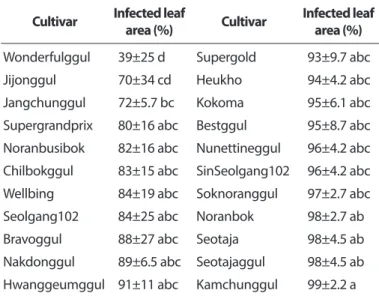
을 수행한 결과, 실험한 모든 품종은 39% 이상의 높은 병반 면적률을 보였다(Fig. 2, Table 3). 따라서 실험한 품종 중 덩굴 마름병에 대하여 높은 저항성을 보이는 품종은 없는 것으로 생각되었다. 하지만 ‘원더풀꿀’과 ‘지존꿀’은 다른 품종들에 비하여 상대적으로 낮은 병반면적률을 보였다.
수박 덩굴마름병에 대한 효율적인 저항성 검정 체계 확립 을 위한 발병조건에 따른 수박 품종들의 덩굴마름병 발생을 실험하기 위하여, 실험한 품종 중 가장 높은 저항성을 보인 두 품종(원더풀꿀, 지존꿀)을 중도저항성 품종으로, 그리고 덩굴마름병이 심하게 발생한 두 품종(꼬꼬마, 서태자)을 감 수성 품종으로 선발하였다.
습실 처리 기간에 따른 덩굴마름병 발생. 접종 후 습 실 처리 기간에 따라 선발한 수박 4개 품종의 덩굴마름병의 발생을 실험한 결과, 48시간 동안 습실 처리한 경우에는 중 도저항성 품종인 ‘원더풀꿀’과 ‘지존꿀’에서 각각 19%와 8%
의 병반면적률을, 그리고 감수성 품종인 ‘꼬꼬마’와 ‘서태 자’는 각각 77%와 84%의 병반면적률을 나타내었다(Table 4).
그러나 24시간 동안 습실 처리하였을 때에는 실험한 모든 품종은 11% 이하의 낮은 병반면적률을 보였다(Table 4).
덩굴마름병의 발생에 습도는 매우 중요한 요소로서 비가 온 후에 야간에 이슬이 낀 기간이 포자 확산의 절정이며, 잎 에 최소 1시간의 자유수분(free moisture)이 있어야 감염이 일어나고 지속적으로 잎이 젖어있어야 병반이 진전된다고 하였다(Sitterly와 Keinath, 1996). 본 연구에서도 접종 후 24시 간 동안의 습실 처리만으로는 병이 충분히 진전될 수 없었 고, 48시간 동안 습실 처리하고 항온항습실(25oC, 상대습도 80%)로 이동하여 하루에 12시간씩 광을 처리하며 덩굴마름
Fig. 2. Typic symptomatic images of two watermelon cultivars to gummy stem blight. (A) ‘Wonderfulggul’ (moderately resistant). (B)
‘Seotaja’ (susceptible).
A B
Table 3. Resistance degree of 22 commercial watermelon cultivars to Didymella bryoniae*
Cultivar Infected leaf
area (%) Cultivar Infected leaf area (%) Wonderfulggul 39±25 d Supergold 93±9.7 abc
Jijonggul 70±34 cd Heukho 94±4.2 abc
Jangchunggul 72±5.7 bc Kokoma 95±6.1 abc
Supergrandprix 80±16 abc Bestggul 95±8.7 abc Noranbusibok 82±16 abc Nunettineggul 96±4.2 abc Chilbokggul 83±15 abc SinSeolgang102 96±4.2 abc Wellbing 84±19 abc Soknoranggul 97±2.7 abc Seolgang102 84±25 abc Noranbok 98±2.7 ab
Bravoggul 88±27 abc Seotaja 98±4.5 ab
Nakdonggul 89±6.5 abc Seotajaggul 98±4.5 ab Hwanggeumggul 91±11 abc Kamchunggul 99±2.2 a Each value represents the mean disease severity±standard deviation.
Values in the labeled with the same letter are not significantly dif- ferent in Duncan’s multiple range test at P=0.05.
*Seedlings with 2-fully expanded leaves were inoculated with D.
bryoniae by spraying spore suspension of the fungus at a concen- tration of 5.0×10
5spores/ml. The infected plants were incubated in humidity chamber at 25
oC for 48 hours and then transferred to a growth chamber at 25
oC and 80% relative humidity with 12-hour light a day. Three days after inoculation, disease severity of the plant was measured using percentage of infected leaf area. Experi- ment was carried out two runs with five replicates each.
Table 4. Development of gummy stem blight on four watermelon cultivars according to incubation period in dew chamber after in- oculation*
Cultivar Trait Incubation period in dew chamber
24 h 48 h
Wonderfulggul MR 8±2.7 az 19±11 cz
Jijonggul MR 6±2.2 az 8±2.7 cz
Kokoma S 5±0.0 ay 77±34 abz
Seotaja S 11±6.5 ay 84±26 az
Each value represents the mean disease severity±standard devia- tion of two runs with five replicates each.
Values in the labeled with the same letter in each column are not significantly different in Duncan’s multiple range test at P=0.05.
MR, moderately resistant; S, susceptible.
*Seedlings with 2-fully expanded leaves were inoculated with
Didymella bryoniae by spraying spore suspension of the fungus at
a concentration of 5.0×10
5spores/ml. The inoculated plants were
incubated in humidity chamber at 25
oC for 24 or 48 hours and
then transferred to a growth chamber at 25
oC and 80% relative
humidity with 12-hour light a day. Three days after inoculation,
disease severity of the plant was measured using percentage of
infected leaf area.
병 발생을 유도하는 것이 수박 덩굴마름병 발생에 효과적인 동시에 품종 간의 저항성 반응 차이도 잘 나타내어 저항성 검정에 효과적인 것으로 생각되었다.
접종 농도에 따른 덩굴마름병 발생. 저항성 검정을 위한 적정 포자 농도를 결정하고자 수박 4품종의 유묘에 4 가지 농도의 포자현탁액(2.0×10⁴, 1.0×10⁵, 5.0×10⁵, 2.5×10⁶ spores/ml)을 분무 접종하고 덩굴마름병 발생을 조사한 결 과, 실험한 모든 품종에서 포자 농도가 증가함에 따라 병반 면적률이 증가하였다(Table 5). 5.0×10⁵ spores/ml 농도의 포 자현탁액을 접종하였을 때에는 ‘원더풀꿀’, ‘지존꿀’, ‘꼬꼬 마’, ‘서태자’ 품종에서 각각 26%, 28%, 58%, 59%의 병반면적 률을 보여 품종 간의 저항성 차이를 잘 나타내었다(Table 5).
하지만 가장 높은 2.5×10⁶ spores/ml 농도의 포자현탁액을 접 종하였을 때에는 ‘원더풀’과 ‘지존’에서도 각각 68%, 48%의 높은 병반면적률을 보였으며, 1.0×10⁵ spores/ml 이하의 농도 로 접종하였을 때는 감수성 품종에서도 43% 이하의 낮은 병 반면적률을 보였다.
박과 작물의 덩굴마름병 저항성을 평가하기 위해서 많 은 연구자들은 105–10⁷ spores/ml 범위의 포자 농도를 사 용하여 실험하였다(Boylan 등, 1994; St. Amand와 Wehner, 1995a, 1995b; van Deer Meer 등, 1978; van Steekelenburg, 1981;
Wehner와 St. Amand, 1993; Zhang 등, 1995, 1997). 하지만 수 박의 경우에는 본 연구의 결과에 따라 5.0×10⁵ spores/ml 농 도의 포자현탁액을 사용하여 수박 덩굴마름병 저항성 검정 을 수행하는 것이 바람직하다고 생각되었다.
접종 후 초기 재배온도에 따른 덩굴마름병 발생. 수 박 유묘에 포자현탁액을 분무 접종한 후 각각 20oC, 25oC,
30oC의 습실에 2일 동안 재배하여 네 품종들의 덩굴마름병 발생 정도를 조사한 결과, 실험한 모든 품종에서 접종 후 재 배 온도가 높아질수록 덩굴마름병 발생이 증가하였다(Table 6). 25oC에서 습실 처리하였을 때에 ‘원더풀꿀’과 ‘지존꿀’은 각각 25%와 24%의 병반면적률을 보였으며, ‘꼬꼬마’와 ‘서 태자’는 각각 60%와 58%의 병반면적률을 보여 품종들의 저 항성과 감수성을 잘 나타내었다. 하지만 20oC에서는 감수성 품종(꼬꼬마, 서태자)에서도 15% 이하의 낮은 병반면적률을 보여 덩굴마름병 발생에 적합하지 않았으며, 30oC에서는 중 도저항성 대조품종인 ‘원더풀꿀’과 ‘지존꿀’도 34%와 59%
Table 5. Development of gummy stem blight on four watermelon cultivars according to inoculum concentration*
Cultivar Trait Inoculum concentration (spores/ml)
2.0×10
41.0×10
55.0×10
52.5×10
6Wonderfulggul MR 9±4.2 ay 24±15 azy 26±12 bzy 68±24 abz
Jijonggul MR 16±16 az 38±32 az 28±11 bz 48±19 bz
Kokoma S 11±6.3 ay 43±35 azy 58±30 az 81±18 az
Seotaja S 17±10 ay 21±11 ay 59±20 az 86±16 az
Each value represents the mean disease severity±standard deviation of two runs with five replicates each.
Values in the labeled with the same letter in each column are not significantly different in Duncan’s multiple range test at P=0.05.
MR, moderately resistant; S, susceptible.
*Seedlings with 2-fully expanded leaves were inoculated with D. bryoniae by spraying spore suspension of the fungus at a concentration of 2.0×10
4, 1.0×10
5, 5.0×10
5, and 2.5×10
6spores/ml. The inoculated plants were incubated in humidity chamber at 25
oC for 48 hours and then transferred to a growth chamber at 25
oC and 80% relative humidity with 12-hour light a day. Three days after inoculation, disease se- verity of the plant was measured using percentage of infected leaf area.
Table 6. Development of gummy stem blight on four watermelon cultivars according to incubation temperature in dew chamber inoculation*
Cultivar Trait Incubation temperature in dew chamber 20
oC 25
oC 30
oC Wonderfulggul MR 3±2.9 az 25±16 bz 34±32 bz Jijonggul MR 11±10 ay 24±18 by 59±12 abz
Kokoma S 9±6.5 ax 60±13 ay 89±15 az
Seotaja S 15±20 ay 58±14 az 59±8.2 abz
Each value represents the mean disease severity±standard devia- tion of two runs with five replicates each.
Values in the labeled with the same letter in each column are not significantly different in Duncan’s multiple range test at P=0.05.
MR, moderately resistant; S, susceptible.
*Seedlings with 2-fully expanded leaves were inoculated with D.
bryoniae by spraying spore suspension of the fungus at a concen-
tration of 5.0×10
5spores/ml. The inoculated plants were incubated
in humidity chamber at 20
oC, 25
oC, and 30
oC for 48 hours and then
transferred to a growth chamber at 25
oC and 80% relative humid-
ity with 12-hour light a day. Three days after inoculation, disease
severity of the plant was measured using percentage of infected
leaf area.
의 높은 덩굴마름병 발생을 나타내므로 품종 간 저항성 차 이가 잘 나타나지 않았다(Table 6).
Sitterly와 Keinath (1996)가 덩굴마름병 감염에 멜론은 20oC, 그리고 수박과 오이는 24oC–25oC가 최적 온도라고 보고하였 다. 본 연구에서는 접종하고 25oC에서 2일 동안 습실 처리한 후에 25oC, 상대습도 80% 환경하에서 하루에 12시간씩 광을 조사하였을 때 감수성 품종에서 덩굴마름병 발생도 높았고 품종 간의 저항성 차이도 효과적으로 나타냈다.
이상의 결과로부터 D. bryoniae에 의한 덩굴마름병에 대한 수박 품종들의 저항성을 검정하기 위한 방법으로 수박 종자 를 파종하고 온실에서 본엽2엽이 충분히 펼쳐질 때까지 재 배한다. 그리고 재배한 수박 유묘에 5.0×10⁵ spores/ml 농도 의 D. bryoniae 포자현탁액을 흘러내리기 직전까지 충분히 분무하여 접종하고, 25oC 암상태로 48시간 동안 습실 처리한 유묘는 항온항습실(25oC, 상대습도 80%)로 이동하여 하루 12시간씩 광을 조사하면서 재배하고, 접종 3–4일 후에 감수 성 대조구에 덩굴마름병이 충분하게 발생하였을 때 접종한 잎의 병반면적률(%)을 조사하는 것을 제안하고자 한다.
요 약
D. bryoniae에 의해 발생되는 덩굴마름병은 세계적으로 수박 재배에 주요한 병으로 알려져 있으며, 본 실험은 D.
bryoniae에 대한 수박의 효율적인 저항성 검정법을 확립하 기 위해 수행하였다. 함안 지역에서 전형적인 덩굴마름병 병징을 보이는 수박으로부터 GBS3 균주를 분리하였고 ITS 영역의 염기서열 분석을 통해 GBS3 균주는 D. bryoniae로 동 정되었다. 다양한 조건에서의 포자 형성량과 형성된 포자 의 5가지 생육 시기의 수박 유묘에 대해 병원력 차이를 조사 하고, 이로부터 저항성 검정을 위한 간편한 접종원 대량 생 산 방법을 확립하였다. 시판 중인 수박 22개 품종의 GSB3 균 주에 대한 저항성 정도를 확인하고, 그 결과로부터 저항성 정도가 다른 수박 4개 품종을 선발하였다. 그리고 접종원 농 도, 습실 처리 기간, 접종 후 재배온도 등의 발병 조건에 따른 이들 품종의 덩굴마름병 발생을 조사하였다. 이들 결과로부 터 덩굴마름병에 대한 효율적인 수박 저항성 검정 방법으로 본엽 2엽이 충분히 전개된 수박 유묘에 5.0×10⁵ spores/ml 농 도의 D. bryoniae 포자현탁액을 분무접종하고, 25oC 습실에서 48시간 동안 배양 후에 항온항습실(25oC, 상대습도 80%)로 이동하여 하루 12시간씩 광을 처리하면서 재배하고, 접종 3–4일 후에 접종한 잎의 병반면적률을 조사하는 것을 제안 하고자 한다.
Conflicts of Interest
No potential conflict of interest relevant to this article was reported.
Acknowledgement
This research was supported by Golden Seed Project Veg- etable Seed Center (213002-04-4-SBc10, 213002-04-4-SBZ10), Ministry of Agriculture, Food and Rural Affairs (MAFRA), Ministry of Oceans and Fisheries (MOF), Rural Development Administra- tion (RDA) and Korea Forest Service (KFS).