OPEN ACCESS
Citation: Yu CJ, Cha JE, Jang DH. 2016. Analysis of visit attributes among rural experience program participants and impact on revisit intention - Based on the case of Cheong-Ho region. Korean Journal of Agricultural Science 43:678-687.
DOI: https://doi.org/10.7744/kjoas.20160071 Editor: Sounghun Kim, Chungnam National University, Korea
Received: October 5, 2016 Revised: October 26, 2016 Accepted: November 13, 2016 Copyright: ©2016 Korean Journal of Agricultural Science.
This is an Open-Access article distributed under the terms of the Creative Commons Attribution Non- Commercial License which permits unrestricted non- commercial use, distribution, and reproduction in any medium, provided the original work is properly cited.
MANAGEMENT & ECONOMICS
Analysis of visit attributes among rural experience program participants and impact on revisit intention
- Based on the case of Cheong-Ho region
Chan Ju Yu
1, Ji Eun Cha
2, Dong Heon Jang
3*
1
Chief Executive Officer, Ecobiz, Jeonju 54830, Korea
2
National Institute of Horticultural and Herbal Science, Rural Development Administration, Wanju 55365, Korea
3
Department of Agricultural Economics, Chonbuk National University, Jeonju 54896, Korea
*Corresponding author: [email protected]
Abstract
Rural area development projects are being carried out in a strategy to create new value in agriculture and farm villages and to change the public perception. This study targeted rural experience participants visiting Cheong-Ho region, where the Rural Village Comprehensive Development Project was carried out. They were surveyed about attributes of visits to farm villages to determine which attributes of the experience could influence their revisits. This study was conducted under an umbrella project conducted as per the Special Act on Life Improvement and Regional Improvement for Farmers and Fishermen. Cheong-Ho region in Buan-gun produces mulberry, organic wheat, and rice grown using environmentally-friendly agricultural practices. This region as held events offering visitors the chance to experience rural villages and mulberry farms. Survey results showed that the natural landscape of villages, village experience, and the services provided by residents had a positive relationship with the probability of revisiting the village. Also, village facilities, harmony of natural landscape, hospitality of village residents, amusement value of rural experience, and the cost for rural experience were significant attributes. Therefore, it is necessary to revitalize the rural experience program targeting rural experience participants in Cheong-Ho region through continuous and monitoring of key visit attributes and revisit factors.
Keywords: Cheong-Ho region, revisit, rural experience, visit attribute
Introduction
우리의 농업, 농촌은 농가소득 감소, 도농간 소득격차 확대, 인구감소와 고령화, 시장개방 등으 로 어려움을 겪고 있다(Kim and Lee, 2016; Shin et al., 2016). 특히 세계화와 개방화의 진전은 지 역들간의 치열한 경쟁을 촉발시킴으로써 장소전쟁(Haider, 1992)을 야기하고 있고, 지역간의 경 쟁은 더욱 심화되고 있다. 이와 같은 상황에서 농촌지역에서도 농촌개발에 관한 다양한 사업이 진행되고 있다.
그 동안 농촌정책은 전통적 의미의 농촌개발을 넘어서 농촌 지역주민의 삶의 질 전체를 대상
으로 하는 정책범주가 형성되고, 국가차원에서 관리하는 체계(삶의질법)가 진행되었다(Oh, 2016). 이로 인하여 농촌 지역의 활성화를 위한 농촌마을종합개발사업 등 다양한 사업이 정부와 지방자치단체, 지역주민이 협력하는 상향식 개발로 진행되고 있다.
농촌마을종합개발사업은 2004년부터 시작되었는데, 동질성 있는 농촌마을을 권역단위로설정하여 경관개선, 문 화복지, 소득기반확충, 농촌체험 등의 사업을 추진하고 있다(Hwang et al., 2015). 이를 통해 권역의 활성화를 도모하 고, 장기적으로 권역주민의 삶의 질을 향상시키는데 초점을 두고 있다. 따라서 이와 같은 사업이 진행되는 권역에서 마을의 이미지 향상, 공동체 형성 등을 통한 지역의 경쟁력 창출은 중요해지고 있다.
권역차원에서 지역경쟁력은 농촌지역의 발전을 모색함에 있어서 새로운 발전전략의 결과로 볼 수 있고, 다른 지 역과 차별화될 수 있는 정체성을 확보해 나갈 수 있다. 이러한 관점에서 권역을 포함하는 장소적 차원에서 마케팅 전 략이 필요하다. 장소를 포함하는 지역의 가치는 경쟁이 이루어지는 기본단위로 인식하고, 상품화와 마케팅이 가능 한 대상으로 간주되고 있다(Kim, 2003). 그러므로 지역자산이 존재하는 권역은 다양한 마케팅을 전개시키는 하나의 전략으로 활용되고 있다.
주요 선행연구는 장소차원에서 주로 도시 마케팅이 많았고(Lee, 2004; Lee, 2005; Kim, 2007; Oh, 2007; Lee, 2008;
Kim and Bae, 2010; Oh and Kwon, 2010), 농촌지역 활성화를 목적으로 관광, 축제, 특산물의 연구가 주축이었다 (Kim and Cho, 2004; Lee, 2006; Bae and Oh, 2009; Kim and Lee, 2013; Sun et al., 2013). 그리고 농촌마을을 대상으로 6차산업화의 연계관광 프로그램 구축(Yang et al., 2014), 체험프로그램과 재방문(Lim and Park, 2016), 관광태도 결 정요인(Lee and Yang, 2015) 등이 있다. 특히 Lim and Park (2016)에 의하면 농촌지역이나 마을의 재방문은 농촌마을 의 유지와 지역의 마케팅 성공을 위한 필수과제로 평가되고 있다.
따라서 본 연구는 농촌마을종합개발사업이 진행되고 있는 청호권역의 방문객을 대상으로마을 방문의 속성이 재 방문에 영향을 미치는지를 분석하였다. 또한 마을 방문의 속성 중 재방문에 영향을 미치는 하위요소를 찾고자 하였 다. 그리고 이를 통해서 마을지역에서 지역활성화를 위한 기초적 자료를 제공하고자 하였다.
Overview of survey area
1. 조사자의 특성
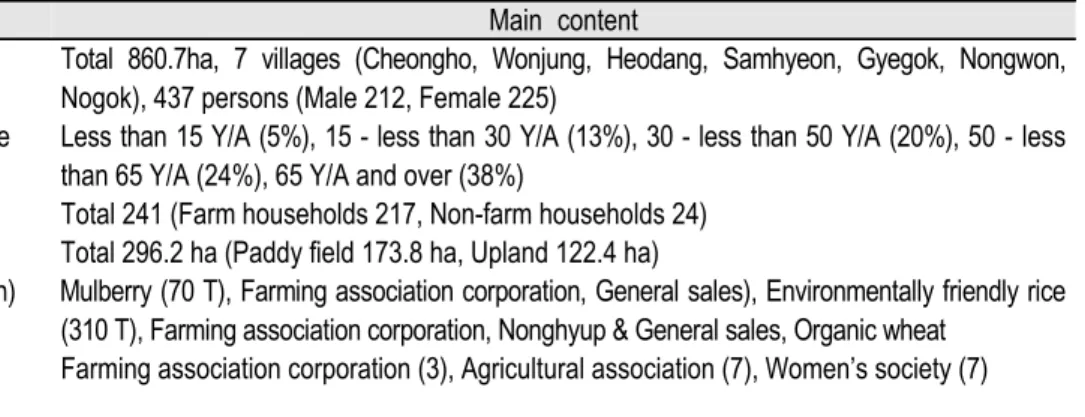
사례지역인 청호권역은 부안군 하서면 청호리에 위치하며(Fig. 1), 주요 권역현황은 Table 1과 같다. 권역면적은 860.7ha 이며, 7개의 행정리인 청호마을, 원중마을, 허당마을, 삼현마을, 계곡마을, 농원마을, 노곡마을로 구성되어
Fig. 1. Geographical location of Cheong-Ho region.
있다. 가구수는 총 241가구이며, 인구는 437명인데, 이중 남성이 212명, 여성이 225명이었다. 연령은 65세 이상이 38%, 50 - 64세가 24%, 30 - 49세가 20%, 15 - 29세가 13%, 14세 이하가 5%이었다. 특히 65세 이상이 38%인 점으로 볼 때 다른 농촌마을과 마찬가지로 고령화가 진행되고 있다.
농경지는 총 296.2 ha 중 논이 173.8 ha, 밭이 122.4 ha이며, 주요 작물로는 오디와 친환경 쌀, 유기농 밀이 있는데, 이중 오디는 연간 70톤, 친환경 쌀은 연간 310톤이 생산되고 있다. 이들 작물의 생산주체는 영농조합에서 담당하고 있다. 주민공동체는 영농조합법인 3개, 영농회 7개, 부녀회 7개가 존재하며, 특히 영농조합에서 운영하고 있는 오디 (뽕)의 방문 체험객은 연간 2,000여명에 이르고 있다.
2. 조사권역의 자원분포
사례지역인 청호권역의 자원현황은 Table 2와 같다. 자연자원은 석불산과 청호저수지이며, 등산객, 낚시, 경관관 람객 등이 지속적으로 방문하고 있다. 생활환경자원인 석불산 영상랜드는 과거 많은 방문객들이 찾았으나 현재는 Table 1. Summary of Cheong-Ho region area (As of December, 2015).
Category Main content
Region configuration Total 860.7ha, 7 villages (Cheongho, Wonjung, Heodang, Samhyeon, Gyegok, Nongwon, Nogok), 437 persons (Male 212, Female 225)
Percent population by age group (years of age; Y/A)
Less than 15 Y/A (5%), 15 - less than 30 Y/A (13%), 30 - less than 50 Y/A (20%), 50 - less than 65 Y/A (24%), 65 Y/A and over (38%)
Number of households Total 241 (Farm households 217, Non-farm households 24) Total cultivated area (ha) Total 296.2 ha (Paddy field 173.8 ha, Upland 122.4 ha)
Major crop production (ton) Mulberry (70 T), Farming association corporation, General sales), Environmentally friendly rice (310 T), Farming association corporation, Nonghyup & General sales, Organic wheat
Resident community Associations (number)
Farming association corporation (3), Agricultural association (7), Women’s society (7) Annual visitors, farming
experience center
Farming association corporation’s Mulberry farm experience (2,000 persons) Note: Buan-gun (2015).
Table 2. Major resources in Cheong-Ho region.
Category Resources name
Natural resources Forests Seokbulsan, Bambusoideaesan
Rivers Cheong-Ho reservoir, Seokbul creek, Creek Shade trees Nurse tree, Zelkova
Life environment
resources Traditional structures Traditional house, Stone wall
Resource for education Seokbulsan movie land, Mulberry experience center Agricultural
resources Farm-land resources Paddy/Upland fields Fishery resource Freshwater shrimp, Carp Mountain resources Bracken, Wild edible greens
Regional specialized agricultural product Environmentally friendly rice, Mulberry, Organic wheat Tourism resources Mountainous region tourism Seokbulsan trail, Cheong-Ho reservoir walk
Waterside tourism Cheong-Ho reservoir area
Leisure sports Fishing
Traditional Tourism Hyochungsa Historical culture
resources Historical resources Hyochungsa shrine Native land resource The new year festival
Cultural assets Ko Hui portrait & Family relic, Ko Heunggun memorial stone Traditional Structures Buddhist temple
Note: Ecobiz (2015).
방문객이 급격히 감소하였다. 농업자원은 친환경 쌀과 유기농 밀, 오디이며, 특히 오디는 권역의 대표적인 농산물인 데, 지역의 특화산업으로 지정된 오디(뽕)와 관련된 다양한 사업 및 마케팅이 진행되고 있어 지속적 발전이 전망되고 있다. 관광자원은 석불산과 청호저수지의 경관이 뛰어나 다수가 방문하고 있지만, 향후 청호권역으로 방문객을 유 인시킬 수 있는 노력이 필요할 것으로 판단된다. 끝으로 역사문화자원은 고희초상 및 문중유물이 보물 제739호, 고 흥건신도비는 전라북도 문화재 자료 제11호로 지정되어 있다.
Research design
1. 설문문항의 구성
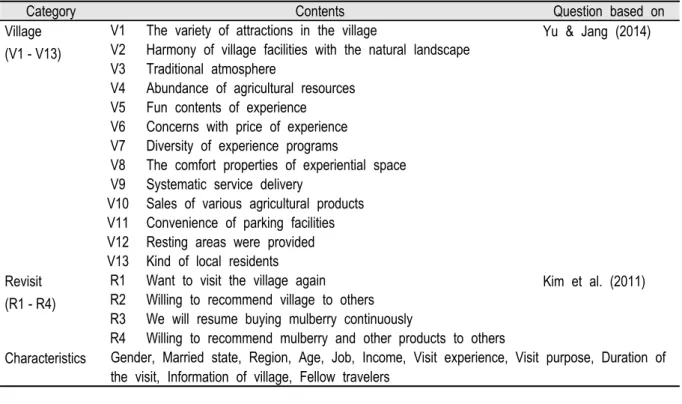
사례지역인 청호권역의 방문속성을 분석하기 위한 설문문항의 내용과 근거는 Table 3과 같다. 마을의 방문속성은 Yu and Jang (2014)을 기초로 마을내 볼거리의 다양성(V1) - 지역주민의 친절(V13)의 13개 설문문항을 이용하였다. 그 리고 마을의 재방문은 Kim et al. (2011)을 기초로 다시 마을을 방문하고 싶다(R1) - 타인에게 오디 제품 등을 추천할 의 사가 있다(R4)의 4개 설문문항을 이용하였다. 조사자의 특성은 성별, 결혼상태, 지역, 연령, 직업, 소득, 방문경험, 방문 목적, 방문기간, 마을정보, 동반자를 중심으로 문항을 구성하였다. 이와 같은 설문문항을 이용하여 마을의 방문속성이 재방문에 영향을 미치는지를 살펴보았고, 마을의 방문속성 중 어떠한 하위 요소가 영향을 미치는지를 분석하였다.
Table 3. Composition of survey questions.
Category Contents Question based on
Village (V1 - V13)
V1 The variety of attractions in the village Yu & Jang (2014) V2 Harmony of village facilities with the natural landscape
V3 Traditional atmosphere
V4 Abundance of agricultural resources V5 Fun contents of experience V6 Concerns with price of experience V7 Diversity of experience programs
V8 The comfort properties of experiential space V9 Systematic service delivery
V10 Sales of various agricultural products V11 Convenience of parking facilities V12 Resting areas were provided V13 Kind of local residents Revisit
(R1 - R4)
R1 Want to visit the village again Kim et al. (2011) R2 Willing to recommend village to others
R3 We will resume buying mulberry continuously
R4 Willing to recommend mulberry and other products to others
Characteristics Gender, Married state, Region, Age, Job, Income, Visit experience, Visit purpose, Duration of the visit, Information of village, Fellow travelers
2. 자료수집과 분석방법
자료수집과 분석방법은 Table 4와 같다. 자료수집은 청호권역의 방문객을 대상으로 설문조사를 하였고, 설문조사
기간은 2015년 6월 5일에서 6월 30일까지 이루어졌다. 설문방법은 방문객에게 설문목적을 설명하고, 방문객들이 자가
기입하는 방식으로 진행되었다. 조사된 설문부수는 총 229부이며, 이중 기입이 부실한 1부를 제외하고 총 228부를 분
석하였다. 설문문항 중 마을 방문속성은 13개 문항이며, 향후 재방문은 4문항이었다. 권역의 방문속성과 재방문은 전
혀 그렇지 않다(1점)에서 매우 그렇다(5점)로 5점 리커트 척도를 사용하였고, 조사자 특성은 명목척도를 사용하였다.
분석방법은 SPSS 22.0의 통계 패키지를 이용하여 청호권역 방문객의 특성을 파악하고자 인구통계와 방문객의 특 성에 대한 빈도분석을 하였다. 그리고 권역 방문속성과 재방문은 타당성과 신뢰도분석, 상관관계, 다중회귀분석, 단 계회귀분석을 실시하였다.
Results and Discussion
1. 조사자의 특성
조사자의 특성은 Table 5와 같다. 우선, 인구통계학적 특성은 성별은 남성이 54.8%, 여성이 45.2%이며, 결혼 상태 는 미혼이 20.2%, 기혼이 79.8%이었다. 거주지역은 서울이 36.4%, 경기와 충남이 각 18.9% 그리고 전북이 9.6%, 광 역시를 포함한 기타가 16.2%이었다. 연령은 40세 미만이 20.6%, 40 - 49세는 14.5%, 50 - 59세는 18.4%, 60 - 69세는 Table 4. Data collection and analysis methods.
Category Contents
Those questioned Consumers visiting Cheong-Ho village Investigation period 05/06/2015 - 30/06/2015
Collateral of the survey Total survey 229 (analysis 228)
Questionnaire and validation Village experience (13 questions), Revisit (4 question), Interval scale (5 = strongly agree to 1 = strongly disagree) and Nominal scale
Analysis method Frequency analysis, Factor analysis, Reliability analysis, correlations analysis, Multiple regression, Stepwise regression
Table 5. General characteristics of survey participants.
Classify N % Classify N %
Gender Male 125 54.8 Visit
experience Yes 99 43.4
Female 103 45.2 No 129 56.6
Married state Unmarried 46 20.2 Visit
purpose Event participation 85 37.3
Married 182 79.8 Tourism 45 19.6
Region Seoul 83 36.4 Buy agricultural products 46 20.2
Gyeonggi 43 18.9 Leisure and relaxation 17 7.5
Chungnam 43 18.9 Visit relatives 5 2.2
Jeonbuk 22 9.6 Nearby tourism 17 7.5
Megalopolis/other 37 16.2 Recommendation of the people around 12 5.3
Age Less than 40 47 20.6 Others 1 0.4
40 - 49 33 14.5 Duration of
the visit The day 207 90.8
50 - 59 42 18.4 1 night 2 days 16 7.0
60 - 69 67 29.4 2 night 3 days 5 2.2
More than 70 39 17.1 Information
of village Newspaper/broadcasting 17 7.5
Job Employee 45 19.7 Internet 27 11.8
Civil servant/Professional 87 38.2 Word of mouth 86 37.7
Self-employed 18 7.9 Travel agency 71 31.2
Part-time employment 19 8.3 Others 27 11.8
Housewife etc. 59 25.9 Fellow
travelers Alone 48 21.1
Income (thousand Won)
Less than 30,000 82 36.0 Couple 23 10.1
30,000 - 40,000 49 21.5 Family 78 34.2
40,000 - 50,000 38 16.7 Colleague 50 21.9
50,000 - 60,000 19 8.3 Others 29 12.7
More than 60,000 40 17.5 Total 228 100.0
29.4%, 70세 이상은 17.1%이었다. 직업은 회사원이 19.7%, 공무원/전문직이 38.2%, 자영업이 7.9%, 시간제근로자 가 8.3%, 주부/기타가 25.9%이었다. 년 평균 수입은 3천만원 미만이 36.0%, 3 - 4천만원이 21.5%, 4 - 5천만원이 16.7%, 5 - 6천만원이 8.3% 그리고 6천만원 이상이 17.5%이었다.
다음은 청호권역의 방문특성으로 방문경험이 있다가 43.4%, 없다가 56.6%이었다. 그리고 방문목적은 축제 등 이 벤트 참여가 37.3%, 관광이 19.6%, 농특산물의 구매가 20.2%, 여가/휴식이 7.5%, 친지방문이 2.2%, 주변관광이 7.5%, 지인의 권유가 5.3%, 기타가 0.4%이었다. 방문객의 체류기간은 당일이 90.8%로 가장 많았고, 1박 2일이 7.0%, 2박 3일이 2.2%이었다. 방문마을의 정보획득은 신문/방송이 7.5%, 인터넷이 11.8%, 주변사람 37.7%, 여행사 31.2%, 기타가 11.8%이었다. 방문의 동행형태는 혼자가 21.1%, 연인이 10.1%, 가족이 34.2%, 동료가 21.9%, 기타가 12.7%
이었다.
2. 타당성과 신뢰도 분석
청호권역의 방문속성과 재방문에 대한 타당성을 검정하기 위해서 탐색적 요인분석을 하였다. 측정변수는 구성요인 을 추출하기 위해서 주성분 분석을 이용하였고, 요인 적재치의 단순화를 위해서 직교회전방식(varimax)을 채택하였다 (Song, 2011; Noh, 2014). 그리고 문항선택은 고유값(eigen value) 1.0 이상, 요인 적재치는 0.4 이상을 기준으로 하였다.
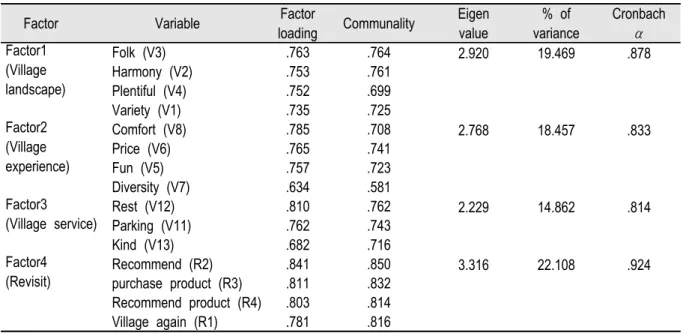
분석결과는 Table 6과 같다. 우선, KMO는 변수들간의 상관관계가 다른 변수에 의해 잘 설명되는 정도를 의미하 는데, 그 값이 0.914이며, Bartlett값은 모형의 적합성을 의미하는데 그 값이 2300.658 (p = .000)로 분석되었다. 결국, KMO > .5, Bartlett의 p < .05로 볼 때 요인분석은 적절하였다. 총 분산의 설명력은 74.896이며, 요인분석의 결과 4개 의 요인이 추출되었다. 추출된 요인에 대해서 요인1은 마을경관, 요인2는 마을체험, 요인3은 마을서비스, 요인4는 재 방문으로 명명하였다. 그리고 추출된 요인의 일관성을 검정하기 위한 신뢰도는 크론바흐 알파(Cronbach α)값을 이 용하였다. 크론바흐 알파값은 0.6 이상이면 신뢰도가 있다고 판단되는데(Song, 2011), 요인1(마을경관)은 .878, 요인 2(마을체험)는 .833, 요인3(마을서비스)은 .814, 요인4(재방문)는 .924로 나타나 신뢰도는 확보되었다.
Table 6. Result of Analysis of validity of visit to the village and reliability.
Factor Variable Factor
loading Communality Eigen value
% of variance
Cronbach α Factor1
(Village landscape)
Folk (V3) .763 .764 2.920 19.469 .878
Harmony (V2) .753 .761
Plentiful (V4) .752 .699
Variety (V1) .735 .725
Factor2 (Village experience)
Comfort (V8) .785 .708 2.768 18.457 .833
Price (V6) .765 .741
Fun (V5) .757 .723
Diversity (V7) .634 .581
Factor3 (Village service)
Rest (V12) .810 .762 2.229 14.862 .814
Parking (V11) .762 .743
Kind (V13) .682 .716
Factor4 (Revisit)
Recommend (R2) .841 .850 3.316 22.108 .924
purchase product (R3) .811 .832 Recommend product (R4) .803 .814 Village again (R1) .781 .816 Kaiser-Meyer-Olkin Measure of Sampling Adequacy = .914
Bartlett’s Test of Sphericity Approx. Chi-Square = 2300.658, df (p) = 105 (.000)
Note: V9 and V10 is low reliability were excluded from the analysis.
3. 상관관계의 분석
청호권역의 방문속성인 마을경관, 마을체험, 마을서비스와 재방문의 변수들간의 관계를 파악하기 위해서 상관관 계분석을 하였다. Table 7에서 마을경관, 마을체험, 마을서비스, 재방문의 모든 변수들간의 유의수준은 0.01하에서 상관관계가 있는 것으로 파악되었다. 그리고 변수들간의 상관관계의 방향은 정의 관계를 보였다. 구체적으로는 마 을경관은 마을체험과 0.579, 마을서비스와 0.655, 재방문과 0.630의 상관관계를 보였고, 마을체험은 마을서비스와 0.536, 재방문과 0.603 그리고 마을서비스는 재방문과 0.561의 상관관계를 갖고 있었다.
Table 7. Result of the correlations analysis.
Mean Std. deviation Inter-Construct correlations
z1 2 3 4
Village landscape 3.8015 .77675 1
Village experience 3.9605 .75864 .579 1
Village service 3.8216 .78055 .655 .536 1
Revisit 4.1864 .89222 .630 .603 .561 1
z
Correlation is significant at the 0.01 level (2-tailed).
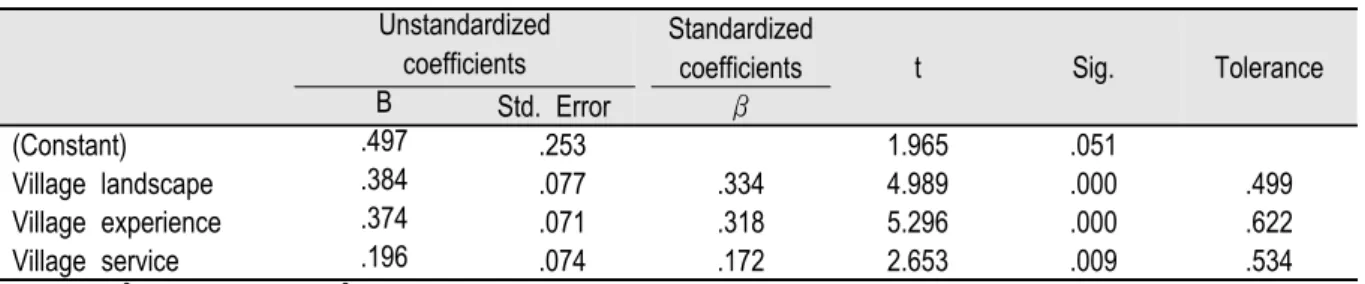
4. 회귀분석의 결과