Copyright ⓒ 2012, The Microbiological Society of Korea
주황해변해면(Hymeniacidon sinapium) 공생세균 군집의 계절적 차이
정종빈․박진숙*
한남대학교 생명공학과
Seasonal Differences of Bacterial Communities Associated with the Marine Sponge, Hymeniacidon sinapium
Jong-Bin Jeong and Jin-Sook Park*
Department of Biotechnology, Hannam University, Daejeon 305-811, Republic of Korea (Received December 14, 2012 / Accepted December 26, 2012)
Seasonal differences of the cultivable bacterial communities associated with the marine sponge, Hymeniacidon sinapium, between spring and summer were analyzed through the Amplified Ribosomal DNA Restriction Analysis (ARDRA). For the cultivation of the bacterial isolates, modified Zobell and MA media were used. The 16S rDNA of individual strains were amplified and fragmented by using two restriction enzymes, HaeIII and MspI. As a result, 23 ARDRA types from the spring sponge and 28 types from the summer sponge were obtained. The partial sequencing result of 1 to 3 selected strains from each types showed over 94% similarities with the known species from the public database. The bacterial communities from the sponge, captured on spring, contained 4 phyla: Actinobacteria, Alphaproteobacteria, Gammaproteobacteria, and Firmicutes. There were 5 phyla observed from the bacterial communities associated with the sponge, captured on summer: Alphaproteobacteria, Betaproteobacteria, Gammaproteobacteria, Firmicutes, and Bacteroidetes. Gammaproteobacteria was predominant group in both spring and summer, accounted for 33.8% of total in spring and 67.4% in summer, showed increase pattern on summer.
Because Firmicutes and Actinobacteria participated in 30.2% and 8.3% of the spring sponge while they represented only 6.9% and 0% of the summer sponge, both bacterial groups showed decrease drift on summer.
Betaproteobacteria (4.7%) and Bacteroidetes (4.7%) were only observed on the sponge captured on summer. On the sponge, Hymeniacidon sinapium, more diverse bacterial communities were shown on summer than on spring, and even from the same sponge, there were seasonal differences.
Keywords: 16S rDNA, Gammaproteobacteria, Hymeniacidon sinapium, ARDRA, sponge
*For correspondence. E-mail: [email protected]; Tel.: +82-42-629-8771; Fax:
+82-42-629-8769
해면(Porifera)은 진화적으로 가장 오래된 중생동물(metazoan) 로 50만 년전 캠브리아기로 부터 기원한 것으로 알려져 있으며 (White et al., 2012) 해양 및 담수에 서식하는 저서 무척추 동물 (sessile benthic invertebrate)로 여과섭식을 통하여 미생물을 먹 이원으로 하거나 혹은 미생물의 미소서식지(micro-habitat)로 기 능하면서 오랜 진화과정을 거쳐 미생물과 공생관계를 형성하고 있다. Bacteriosponges 혹은 high-microbial abundance (HMA) sponges라 불리는 해면은 공생 미생물이 해면 생체량의 40%에 이르기도 하며, 해면에 공생하는 세균, 고세균, 시안세균, 녹조 류, 홍조류, 규조류 등의 다양한 미생물 중 특히 세균은 해면에서 가장 많은 부분을 차지하며, 26문(plyum)에 이르는 매우 다양한
종들이 존재하는 것으로 알려져 있다(Cho and Park, 2009;
Jackson et al., 2012). 공생세균은 해면의 내부 혹은 외부에 영구 적 혹은 일시적 공생 관계를 유지하면서 해면의 면역 기작, 2차 대사산물의 형성 등에 관여하여 산업적으로 고부가가치를 갖는 다양한 종류의 천연물, 생리활성물질 등을 생산하는 것으로 보 고되고 있다(Selvin and Lipton, 2004; Kim and Dewapriya, 2012). 해면공생세균은 천연물 연구 분야를 비롯한 응용 분야뿐 만 아니라 미생물 생태학 분야에서도 동물과 미생물의 공생관계 에 대한 모델로써 관심이 집중되고 있다(Taylor et al., 2011).
자연계에서 배양 가능한 세균은 0.1–11% 정도에 국한되는 것 으로 추정되면서(Olson and McCarthy, 2005) 해면 공생미생물 군집 역시 16S rDNA에 기반한 DGGE, T-RFLP, pyrosequencing 등 분자적 방법을 이용하여 배양 불가능한 세균을 포함하는 군 집 구조의 규명이 활발히 이루어지고 있다(Jackson et al., 2012;
White et al., 2012). 한편으로는 해면 유래의 생리활성물질이 실 제 공생미생물에서 기원한다는 연구결과들이 보고되면서 배양 가능한 공생세균에 관한 관심도 꾸준히 증가하고 있다(Sipkema et al., 2011). 천연물 생산을 위한 물질 탐색, 대량생산, 혹은 2차 대사산물의 생산력을 분석하기 위해서(Selvin and Lipton, 2004), 또는 미생물의 생태적 기능을 이해하기 위해 배양 가능한 해면 공생미생물에 관한 연구가 필요하며(Tamaki et al., 2005), 완전한 유전체의 염기서열 결정 및 분석을 위해서도 미생물의 배양은 여전히 중요하다(Sipkema et al., 2011). 따라서 해면으 로부터 유용 방선균의 분리(Xi et al., 2012), 혹은 다양한 배지를 이용하여 배양 가능한 공생 세균의 군집 구조를 규명하는 등 (Kennedy et al., 2009; Sipkema et al., 2011), 배양법에 의거한 (culture-based) 연구도 활발히 수행되고 있다. 최근 20여 년간 해 면공생미생물 군집에 관한 수많은 연구들이 이루어졌으나 해면 공생 미생물의 개체 혹은 군집의 생태적 기능, 공생 관계의 형성 기작, 공생관계의 지속성 여부 등에 관하여는 아직 규명되지 못 하고 있다(White et al., 2012). 해면의 이차대사산물 생산과 관련 된 미생물 군집의 분석을 위해 최근 해면의 화학종(chemotype) 에 따른 온도 변화와 공생미생물 군집과의 상관관계를 분석하거 나(Anderson et al., 2010), 서식지의 환경 변화가 공생세균 군집 구조에 미치는 영향 등에 관한 연구가 시작되고 있다(Cao et al., 2012; Erwin et al., 2012; White et al., 2012). 본 연구에서는 조 간대에 서식하는 Hymeniacidon sinapium (주황해면해면)을 대 상으로 서식지의 환경 변화가 공생세균군집의 변화에 영향을 끼 치는지 파악하고자 하였다.
Hymeniacidon 해면은 Demosongiae 강(class)에 속하는 해면 으로 우리나라를 포함하여 북동 대서양, 북태평양 등 연안의 조 간대에 흔히 서식하며 서식지의 특성상 주기적인 대기와의 접 촉, 온도, 일조량 등에 있어 매우 심한 환경변화를 겪는다(Cao et al., 2012). Hymeniacidon 속(genus)의 해면은 spongiacidin, hymenialdisine (kinase inhibitor) 및 신경 염증성 반응 억제물질 등으로 개발 가능한 다양한 생리활성물질을 생산하는 것으로 알 려져 있으며(Inaba et al., 1998; Nguyen and Tepe, 2009; Mayer et al., 2012), 양식장의 총유기탄소(TOC) 및 병원성 세균을 제 거하기 위한 생물정화에의 이용 가능성(Fu et al., 2006, 2007;
Zhang et al., 2010) 혹은 양식 가능한 해면(Xue and Zhang, 2009)으로서 관심이 집중되고 있다. 그 중 H. sinapium (주황해 변해면)의 경우 서식지의 온도변화에 따른 공생세균의 군집 구 조의 변동에 관한 보고가 2012년 처음으로 이루어진 바 있으며 (Cao et al., 2012), 이 해면으로부터 유래한 sponjin은 항염증 효 과를 가지며 골형성(bone mineralization)을 촉진하는 물질로 알 려져 있어 H. sinapium은 생물의약적으로도 중요성을 갖는다 (Kim et al., 2009a). H. sinapium은 우리나라의 서해안과 제주 도 지역의 조간대에 흔히 분포하는 해면 종으로 사계절이 존재 하는 우리나라의 경우 좀 더 심한 계절적 변화에 노출되어 있다 고 할 수 있다. 따라서 공생세균 군집의 계절적 변화가 일어나는 지를 알아보기 위하여 우리나라 사계절 중 비교적 환경 변화의 폭이 작다고 생각되는 봄철과 여름철에 해면을 채집하여 공생세 균 다양성을 비교하였다.
본 연구에서는 공생 세균 군집에 있어 계절에 따른 변화를 파 악하고자 서해안의 충남 태안군 청포대로부터 봄철과 여름철에 각각 H. sinapium을 채집하여 배양 가능한(cultivable) 종속영양 세균의 공생세균 군집구조를 16S rDNA-ARDRA (Amplified Ribosomal DNA Restriction Analysis) 방법에 의해 분석하였다.
재료 및 방법
해면시료의 채집 및 환경조건
해양 해면 H. sinapium에 공생하는 세균 군집의 계절적 변화 를 조사하기 위하여 2011년 4월 9일(봄)과, 8월 2일(여름)에 각 각 충남 태안군 남면 원청리 청포대의 조간대에서 멸균된 끌을 이용하여 해면을 채집하였다. 채집한 해면은 멸균된 인공해수 (ASW)로 3회 세척 후 4℃에서 운반하여 12시간 이내에 실험에 사용하였다. 봄철과 여름철의 채집장소는 동일지역으로 각각의 GPS는 36° 38.091′N, 126° 17.822′E와 36° 38.0301′N, 126°
17.747′E이었으며, 봄철 해면 채집 일의 수온은 5.3℃, 염도 31.0 PSU이었으며, 여름철 채집 일의 수온은 20.8℃, 염도 28.8 PSU 이었다.
해면 공생세균의 분리 및 배양
해면 조각을 멸균된 인공해수로 3회 세척 후, 해면의 안쪽을 1 cm3 크기로 잘라 인공해수 3 ml 넣어 균질화시킨 다음 10분간 초음파 처리하였다. 각각 10-4까지 순차 희석한 후 변형된 ZoBell 배지(peptone 5 g, yeast extract 1 g, FePO44H2O 0.01g, NaCl 23.6 g, MgSO47H2O 5.94 g, MgCl26H2O 4.53 g, CaCl2
1.3 g, KCl 0.64 g, agar 15 g, DW 1 L, pH 7.2)와 MA 배지 (marine agar 2216, Difco, USA)에 100 μl씩 도말하여 26℃에서 7일간 배양하였다. 봄과 여름에 각각 채집된 해면으로부터 봄 해 면에서 160개, 여름 해면에서 121개의 세균 균주를 각각 분리하 고 분리된 균주들의 순수 분리를 위하여 동일한 배지에서 계대 배양하여 단일 콜로니를 얻었다.
DNA 추출 및 16S rDNA의 PCR 증폭
염색체 DNA는 분리된 세균 균주의 각 콜로니로부터 gDNA Isolation kit (Qiagen, Germany)를 사용하여 분리하였으며 분리 된 DNA는 PCR 반응의 주형으로 사용하였다. 16S rDNA의 증 폭에는 27f (AGA GTT TGA TCC TGG CTC AG)와 1492r (TAC GGY TAC CTT GTT ACG AC)의 primer 쌍을 사용하였 다. PCR 반응은 100 ng의 주형 DNA와 5U e-Taq polymerase (Solgent, Korea), 10 mM dNTP, 10× e-Taq buffer, 10 pmol primer를 최종 반응량이 50 μl가 되도록 혼합하여 수행하였다.
GeneAmp PCR system 2700 thermal cycler (Applied Biosystems, Version 2.0, USA)를 이용하여 94℃에서 5분간 초기 변성시킨 후, 94℃에서 40초간 변성, 55℃에서 40초간 냉각, 72℃에서 1 분간 신장, 이 과정을 30 cycle 반복 수행한 후 최종적으로 72℃
에서 10분간 신장시켰다. 증폭된 DNA의 확인을 위해서 PCR 반 응액 3 μl를 취하여 1% agarose gel (Bio-Rad, USA)을 이용하여 Mupid-ex (ADVANCE, Japan)로 100 V, 25분간 1×TAE buffer
ARDRA typea
Representative
strain Accession No. Closest speciesb Similarity (%) Number of
strains Phylum
1A spH-5 KC416072 Arthrobacter subterraneus 96.4 1 Actinobacteria
2B spH-58 KC416078 Bacillus aryabhattai 99.8 1 Firmicutes
2C spH-94 KC416086 Bacillus cereus 98.2 2 Firmicutes
3D spH-60 KC416079 Bacillus cibi 99.0 1 Firmicutes
4C spH-100 KC416087 Bacillus megaterium 99.6 1 Firmicutes
3D spH-56 KC416077 Bacillus oceanisediminis 99.9 1 Firmicutes
2B spH-58 KC416078 Bacillus thioparans 99.5 1 Firmicutes
5D spH-70 KC416081 Planomicrobium flavidum 98.3 1 Firmicutes
6E spH-35 KC416076 Paracoccus homiensis 99.5 1 α-proteobacteria
7F spH-115 KC416092 Pseudovibrio ascidiaceicola 99.0 1 α-proteobacteria
10I spH-63 KC416080 Ruegeria atlantica 99.8 5 α-proteobacteria
11L spH-2 KC416070 Ruegeria lacuscaerulensis 98.3 1 α-proteobacteria
9O spH-77 KC416083 Microbulbif erepialgicus 99.2 6 γ-proteobacteria
14D spH-112 KC416091 Psychrobacter frigidicola 98.6 1 γ-proteobacteria
16L spH-6 KC416073 Vibrio rumoiensis 98.4 2 γ-proteobacteria
a Arabian number and alphabetic abbreviation present ARDRA types with the restriction enzymes MspI and HaeIII, respectively.
b All strains used for comparison of sequence similarities, were type strains.
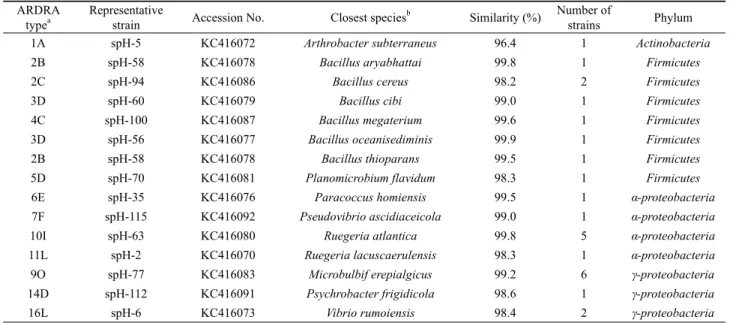
Table 1. Amplified Ribosomal DNA Restriction Analysis (ARDRA) fingerprinting types and sequence relationships of 16S rDNA from bacteria isolated from the marine sponge H. sinapium collected in spring
(40 mM Tris-acetate, 1 mM EDTA, pH 8.0)에서 전기영동 하였 다. 전기영동 후, EtBr (ethidium bromide, 50 ng/ml)에 10분간 염색하여 Gel Logic 200 (Kodak, USA)을 이용하여 UV하에서 약 1.5 kb 단편을 확인하였다.
ARDRA 분석
ARDRA 분석을 위해 2종의 제한효소 Fast Digest HaeIII (Thermo Scientific, Lithuania)와 Fast Digest MspI (Thermo Scientific, Lithuania)을 사용하였다. PCR 산물에 각각의 제한 효소를 첨가하여 37℃에서 5분간 반응시켰다. 반응물은 3%
agarose gel을 사용하여 1× TAE buffer로 100 V, 30분간 전기 영동한 후 EtBr로 염색하여 Gel Logic 200을 이용하여 UV하에 서 관찰하여 각 균주의 밴드유형을 확인하였다. ARDRA type의 패턴 분석을 위해 FPQuestTM (Bio-Rad, Belgium) software를 이 용하였다.
염기서열 분석 및 계통수 작성
16S rDNA-ARDRA fingerprinting type에 따라 각각의 type 별로 1–3개의 분리 균주들을 선택하여 봄 해면에서 26균주, 여 름 해면에서 43균주, 총 69균주의 부분 염기 서열(500 bp 이상) 을 분석하였다. 증폭된 PCR 산물은 Wizard SV Gel and PCR Clean-Up System (Promega, USA)을 이용하여 정제한 후 염기 서열 분석(Macrogen, Korea)을 의뢰하였다. 결정된 16S rRNA 유전자의 염기서열은 GenBank (http://ncbi.nlm.nih.gov)에 등록 하고(accession no.: KC416027–KC416095), 기 등록된 염기서 열을 대상으로 Blast search를 수행하였다. 각 염기서열의 alignment는 CLUSTAL W (Thomson et al., 1994)를 이용하여 정렬하였고 Molecular Evolutionary Genetics Analysis (MEGA)
software version 4.0 (Tamura et al., 2007)로 neighbor-joining 방법을 이용하여 각각의 계통수를 작성하였다. 1,000회 반복 bootstrap 분석에 의해 계통수의 견고성을 확인하였다.
결 과
해면 공생세균의 분리 및 ARDRA 분석
해면 H. sinapium의 계절에 따른 배양 가능한 공생세균 군집 구조의 변화를 관찰하기 위하여 각각 봄과 여름에 채집된 H.
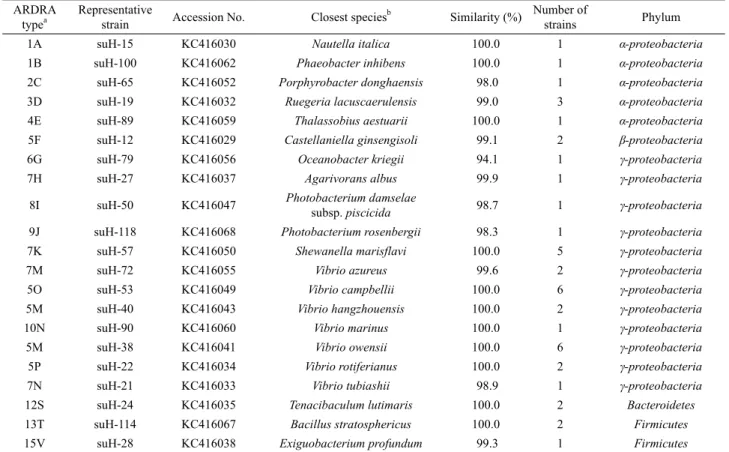
sinapium으로부터 배양 가능한 균주를 봄 해면과 여름 해면에서 총 281균주를 분리하여 16S rDNA의 ARDRA 분석을 수행하였 다. 두 종의 제한 효소를 사용하여 16S rDNA-ARDRA 분석을 수행한 결과, 봄 해면의 160개 분리 균주에서 23개의 ARDRA type이 구분되었으며(Table 1), 여름 해면의 121개 분리 균주에 서 28개의 서로 다른 ARDRA type이 구분되었다(Table 2).
Table 1과 2에서는 대표 균주들의 ARDRA type 만을 표시하였 다. 봄 해면의 경우 MspI에 의해 16개의 type (Table 1의 아라비 아 숫자), HaeIII에 의해 18 type (Table 1의 알파벳)을 얻었으며, 이를 근거로 분석한 결과(Fig. 1), 총 23개의 서로 다른 ARDRA type으로 구분되었다. 여름 해면의 경우 MspI (Table 2의 아라비 아 숫자)에 의해 15개의 type, HaeIII (Table 2의 알파벳)에 의해 22개의 type을 얻었으며, 이를 근거로 분석한 결과(Fig. 2), 총 28 개의 서로 다른 ARDRA type을 얻을 수 있었다.
염기서열 분석 및 계통학적 분석
ARDRA 분석에 의해 봄 해면의 23개의 type, 여름 해면의 28 개의 type으로 나뉜, H. sinapium 해면으로부터 분리된 세균들 에 대하여 각 ARDRA type 별로 1–3개의 분리 균주를 선별하여
Fig. 2. Dendrogram showing the relationship among bacterial isolates based on the 16S rDNA-ARDRA profiles from the marine sponge H. sinapium collected in summer.
ARDRA typea
Representative
strain Accession No. Closest speciesb Similarity (%) Number of
strains Phylum
1A suH-15 KC416030 Nautella italica 100.0 1 α-proteobacteria
1B suH-100 KC416062 Phaeobacter inhibens 100.0 1 α-proteobacteria
2C suH-65 KC416052 Porphyrobacter donghaensis 98.0 1 α-proteobacteria
3D suH-19 KC416032 Ruegeria lacuscaerulensis 99.0 3 α-proteobacteria
4E suH-89 KC416059 Thalassobius aestuarii 100.0 1 α-proteobacteria
5F suH-12 KC416029 Castellaniella ginsengisoli 99.1 2 β-proteobacteria
6G suH-79 KC416056 Oceanobacter kriegii 94.1 1 γ-proteobacteria
7H suH-27 KC416037 Agarivorans albus 99.9 1 γ-proteobacteria
8I suH-50 KC416047 Photobacterium damselae
subsp. piscicida 98.7 1 γ-proteobacteria
9J suH-118 KC416068 Photobacterium rosenbergii 98.3 1 γ-proteobacteria
7K suH-57 KC416050 Shewanella marisflavi 100.0 5 γ-proteobacteria
7M suH-72 KC416055 Vibrio azureus 99.6 2 γ-proteobacteria
5O suH-53 KC416049 Vibrio campbellii 100.0 6 γ-proteobacteria
5M suH-40 KC416043 Vibrio hangzhouensis 100.0 2 γ-proteobacteria
10N suH-90 KC416060 Vibrio marinus 100.0 1 γ-proteobacteria
5M suH-38 KC416041 Vibrio owensii 100.0 6 γ-proteobacteria
5P suH-22 KC416034 Vibrio rotiferianus 100.0 2 γ-proteobacteria
7N suH-21 KC416033 Vibrio tubiashii 98.9 1 γ-proteobacteria
12S suH-24 KC416035 Tenacibaculum lutimaris 100.0 2 Bacteroidetes
13T suH-114 KC416067 Bacillus stratosphericus 100.0 2 Firmicutes
15V suH-28 KC416038 Exiguobacterium profundum 99.3 1 Firmicutes
a Arabian number and alphabetic abbreviation present ARDRA types with the restriction enzymes MspI and HaeIII, respectively.
b All strains used for comparison of sequence similarities, were type strains.
Table 2. Amplified Ribosomal DNA Restriction Analysis (ARDRA) fingerprinting types and sequence relationships of 16S rDNA from bacteria isolated from the marine sponge H. sinapium collected in summer
Fig. 1. Dendrogram showing the relationship among bacterial isolates based on the 16S rDNA-ARDRA profiles from the marine sponge H. sinapium collected in spring.
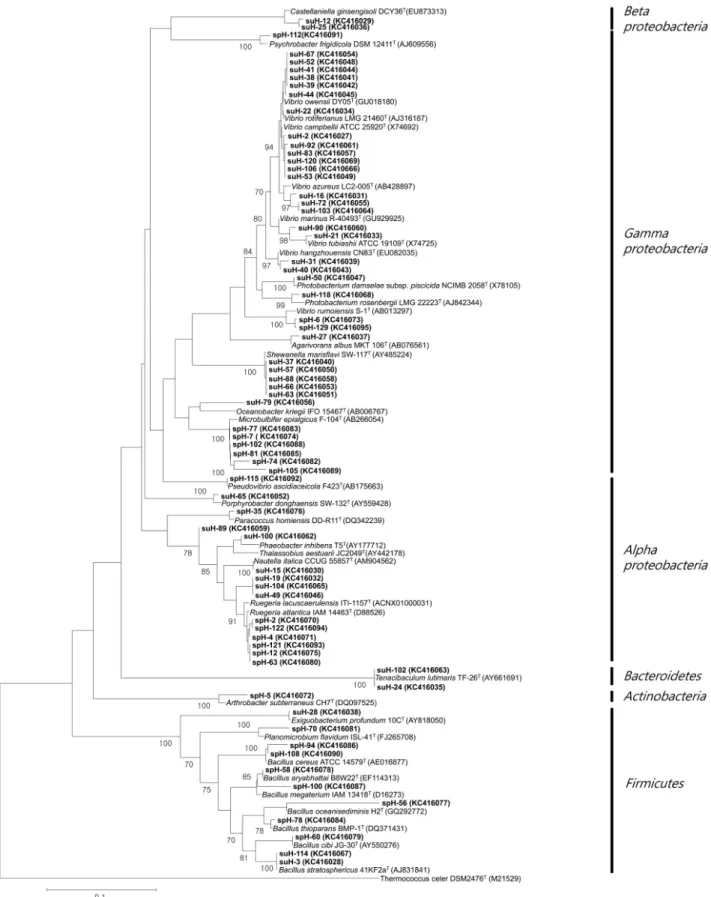
부분 염기서열을 분석하였다. 봄 해면의 경우 26균주, 여름 해면 의 경우 43개의 균주에 대하여 염기서열을 분석하였으며 염기서 열이 분석된 총 69개의 분리 균주는 모두 기존에 보고된 세균 종 과 94% 이상의 유사도를 나타내었다(Tables 1 and 2). 염기서열
이 분석된 균주들의 동정 결과와 이들의 ARDRA type을 근거로 하여 처음 ARDRA 분석에 쓰여 졌던 281개의 균주들을 분석하 고 이들의 분석 결과에 근거하여 군집의 차이를 분석하고 계통 수를 작성하였다(Fig. 3).
Season
Phylum Spring Summer
Alphaproteobacteria 27.7 a 16.3
Betaproteobacteria 4.7
Gammaproteobacteria 33.8 b 67.4
Firmicutes 30.2 6.9
Actinobacteria 8.3
Bacteroidetes 4.7
Number of species 15 21
a The number represents percentage (%) of each phylum in total bacterial community.
b Bold typed values represent increasing or newly appearing bacterial groups.
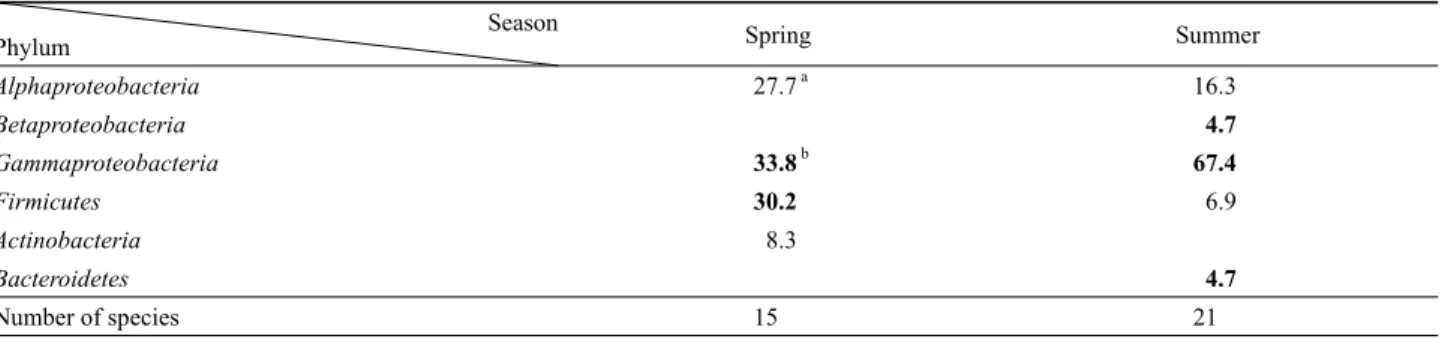
Table 3. Relative abundance of major bacterial groups of cultivable bacterial communities from the marine sponge, H. sinapium collected in spring and summer
두 계절의 해면으로부터 분리된, 배양 가능한 공생세균은 모두 Alphaproteobacteria, Betaproteobacteria, Gammaproteobacteria, Actinobacteria, Bacteroidetes, Firmicutes, 6개의 문(phylum)에 포함되었다. Gammaproteobacteria는 봄에 33.8%, 여름에 67.4%
가 관찰되어 H. sinapium 해면에 있어 두 계절에서 모두에서 우 점하는 세균군집이었다(Table 3). 특히, Gammaproteobacteria 에서 봄의 경우 Microbulbifer가 우점종인 반면 여름에는 Vibrio 종이 우점하였다(Tables 1 and 2). Alphaproteobacteria의 경우 봄에 27.7%, 여름에 16.3%를 나타내어 Gammaproteobacteria 에 이어 많은 수를 차지하였다. Alphaproteobacteria의 경우 봄 과 여름 모두 Ruegeria 종이 우점하였다. 종 수준에서 두 계절에 공통으로 발견된 종은 오직 Ruegeria lacuscaerulensis 뿐이었다.
Firmicutes의 경우, 봄에 30.2%, 여름에 6.9%를 나타내었다.
Actinobacteria (8.3%)는 봄 해면에서만 발견되었으며, Beta- proteobacteria와 Bacteroidetes는 여름 해면에서만 발견되었다.
고 찰
HaeIII와 MspI, 2종의 제한 효소에 의한 ARDRA type 별로 1 –3개씩 중복하여 16S rDNA의 부분 염기서열(500 bp 이상)을 분석한 결과, 봄 해면의 23개의 ARDRA type은 16S rDNA 염기 서열 상동성 96% 이상에서 15개 종으로 나타났으며(Tables 1 and 3), 여름 해면에서 나타난 28개의 ARDRA type은 16S rDNA 염기서열 상동성 94% 이상에서 21종의 공생세균으로 동 정되었다(Tables 2 and 3). H. sinapium의 공생세균의 군집구조 에 있어 봄에 비해 여름의 해면에서 좀 더 다양한 ARDRA type 과 세균 종을 나타냄을 알 수 있었다. 봄 해면의 공생세균은 Alphaproteobacteria, Gammaproteobacteria, Actinobacteria, Firmicutes 4개의 문에 속하였으며, 여름 해면의 공생세균은 Alphaproteobacteria, Betaproteobacteria, Gammaproteobacteria, Bacteroidetes, Firmicutes, 5개의 문(phylum)에 포함되어 문 (phylum) 수준에서 봄과 여름의 해면의 공생세균 군집 구성에 있 어 차이를 나타내었다(Table 3 and Fig. 4). Alphaproteobacteria 와 Gammaproteobacteria는 두 계절에 걸쳐 공통적으로 우점하 는 세균 그룹이었으며 이는 배양 가능한 공생세균 군집 중 일반
적으로 다양한 해면으로부터 높은 빈도로 발견되는 배양 가능한 공생세균 그룹이라는 이전의 보고들과 일치하는 결과이다(Li et al., 2008; Cho and Park, 2009). 특히 Gammaproteobacteria는 H. sinapium의 세균의 군집구조에 있어 봄의 경우 33.8%, 여름 의 경우 67.4%를 점유하는 것으로 나타나 두 계절에서 가장 우 점하는 세균그룹이었으며 이 세균 그룹은 여름철에 증가하는 경 향을 나타내었다. Gammaproteobacteria의 종(species) 구성은 봄에는 Microbulbifer 종이 우점하며 Vibrio 종이 소수를 차지하 는 반면 여름철에는 Vibrio 종이 매우 증가하는 경향을 나타내었 고 Vibrio에 이어 Shewanella와 Photobacterium이 우점종을 구 성하였다(Tables 1 and 2). Alphaproteobacteria의 종 구성에 있 어서는 봄과 여름 모두 Ruegeria 종이 우점하였으며 이 세균 종은 해양 환경에 흔히 분포하는 것으로 알려져 있다(Buchan et al., 2005). 두 계절에 공통으로 나타난 종은 Ruegeria lacuscaerulensis 뿐으로 매우 적은 수의 공통 세균 종의 분포를 나타내었다(Tables 1 and 2). 이는 배양법의 한계를 감안하더라도 종 수준에서 세균 종의 분포가 계절적인 변동을 나타내는 것으로 볼 수 있다.
Firmicutes의 경우 봄철에 30.2%가 관찰된 반면 여름철에는 6.9%로 관찰되어 감소하는 경향을 나타내었다. 또한 Actinobacteria 는 봄철에만 관찰되어(8.3%), 그람양성의 세균 문(phylum)인 Firmicutes와 Actinobacteria는 여름보다 봄철에 우세한 것으로 나타났다(Table 3 and Fig. 4). 이 세균 그룹들은 환경 변화에 비 교적 내성이 강한 것으로 알려진 포자 형성 세균을 포함하는 그 람양성 세균 문으로 겨울의 낮은 온도와 비교적 높아진 염도를 견뎌낸 봄철 해면에 있어, 환경 변화에 기인한 공생세균 군집 구 성의 변동을 반영한 것으로 생각된다. Firmicutes 문은 여름철에 비하여 봄철 해면에서 비율이 높고 종의 구성도 다양함을 알 수 있었다. 종 구성에 있어 봄철 해면인 경우 Bacillus 종의 비율이 매우 높은 반면, 여름철에는 Bacillus 종의 비율이 감소하는 경향을 나타내었으며 열수분출공으로 부터 처음 분리된 Exiguobacterium 도 확인되었다(Crapart et al., 2007).
Firmicutes와 Actinobacteria가 봄철 해면에 우세한 반면, Betaproteobacteria (4.7%)와 Bacteroidetes (4.7%)는 여름 해면 에서만 관찰되었다(Table 3 and Fig. 4). 이 두 세균그룹은 여름 철의 광합성 량의 증가와 하구로부터의 유기물의 유입에 의해
Fig. 3. Phylogenetic relationships were determined by the 16S rDNA sequences of the bacterial isolates from the marine sponge H. sinapium. Numbers above branches indicate bootstrap values of neighbor-joining analysis (50%) from 1,000 replicates. The scale bar represents 0.1 substitutions per nucleotide position. T. celer was used as an outgroup.
Fig. 4. Seasonal comparison among the major bacterial groups of the cultivable bacterial communities from the marine sponge, H. sinapium.
유기물의 농도가 높아지는 해양환경의 변화에 따라 유기물 분해 세균 종이 다수 포함되는 Bacteroidetes와 Betaproteobacteria 그룹이 검출된 것으로 생각된다. 실제 봄철 해면 채집일 당시의 수온은 5.3℃, 염도 31.0 PSU이었으나, 여름철 채집일의 수온은 20.8℃, 염도 28.8 PSU로, 수온은 상당히 증가한 반면, 염도는 다소 낮아진 것으로 관측되었다. 낮은 염도는 여름철의 잦은 강 수와 하구로부터의 민물 유입에 따른 것으로 생각된다. 여름철 H. sinapium 해면의 Bacteroidetes 문에 있어 주요 세균 종으로 나타난 Tenacibaculum lutimaris는 우리나라의 서해 조간대로 부터 분리되어 신종으로 보고되기도 하였다(Yoon et al., 2005).
Bacteroidetes 문의 주요 종으로 나타난 Tenacibaculum 속 세균은 이끼벌레, 말미잘, 해면과 같은 해양무척추 동물로부터 흔히 분리 되는 세균으로 분해세균 종인 Cytophaga-like bacteria로 알려져 있 다(Suzuki et al., 2001). 여름철 해면에서만 나타난 Betaproteobacteria 그룹의 종으로써 Castellaniella ginsengisolis는 Alcaligenaceae 과(family)에 속하며 β-glucosidase를 생성하는 세균으로 분리원 이 인삼토양으로 알려져 있으나(Kim et al., 2009b). 이번 연구 를 통해 처음으로 해면과 같은 해양환경에서도 발견됨을 알 수 있었다.
요약하여 본 연구 결과에서 H. sinapium 해면의 공생세균 군 집에 있어 계절에 따른 차이가 나타남을 알 수 있었다. 이는 중국의 황해(Yellow Sea)로부터 H. sinapium을 채집하여 DGGE 방법에 의해 온도 변화에 따른 공생세균의 군집 변화를 연구한 결과, 계절 에 따라 특징적인 band cluster를 형성하여 분명한 계절적 차이를 나타낸다는 보고(Cao et al., 2012)와 일치하는 결과이다. 또한 봄 과 가을의 Axinella corrugate 해면에서 pyrosequencing을 이용하 여 공생세균 군집 변화를 관찰한 결과, 계절적 변동이 나타난다는 연구 결과와도 일치하였다(White et al., 2012). 그러나 북서 지중 해의 Irchina 해면 종에 대하여 1년 6개월간에 걸쳐 T-RFLP및 clone library를 이용하여 온도와 일조량의 변화에 따른 공생세균 군집의 변동을 조사한 결과, 해면공생 군집구조는 숙주 특이적 군 집구조를 나타내며 이들은 매우 심한 환경변화에도 안정성을 유 지한다는 상반된 결과를 보고하였다. 또한 같은 연구에서 해면 공 생세균 군집과는 달리 주변의 해수의 해양 세균 군집은 환경조 건의 변화에 크게 영향을 받는 다는 것을 보고하였다(Erwin et al., 2012). 환경 조건의 변화에 따른 공생세균 군집의 변화에 관 한 연구는 아직 시작 단계로서, 위에서 기술한 바와 같이 공생세균 군집 구조의 환경변화에 따른 일반적인 추이를 파악하기는 어렵 다. 그러나 해면공생세균의 군집구조 연구에서 주변 해수에 존
재하는 세균 군집은 사실상 배제하기 어려우므로 주변 해수의 세균 군집구조의 변화가 반영되었을 가능성을 고려해야 할 것이다.
또한 배양법에 의한 경우, 배지의 조성에 따른 영향이 크며(Park et al., 2002) 다양성이 상당히 저평가된다는 점을 고려할 때(Jackson et al., 2012) 본 연구 결과에서 검출되지 않은 세균은 모든 경우 에 있어 존재하지 않는 것이 아니라 군집구조 내의 비율이 적거 나 배양조건에 제한되었을 가능성을 감안하여 평가해야 할 것이 다. 해면은 환경변화에 대항하여 모양이나 내부 구조를 변화시 키는 경우도 있어(Cao et al., 2012) 이에 따른 대사적 특징의 변 화가 예측되므로 해면의 대사와 밀접한 관계를 갖는 해면공생세 균의 군집구조는 변동될 것으로 예측할 수 있다. 그러나 환경 변화 에 따른 공생세균 군집의 변화에 관한 연구는 아직 몇몇 보고에 불과하여 지금까지는 일관된 결과를 얻을 수 없으며 연구들에 사용한 분자적 방법(DGGE, T-RFLP, culture-based ARDRA) 의 한계를 고려할 때 해면 특이적 혹은 비특이적 공생세균 군집 의 파악과 더불어 pyrosequencing 등 high-throughput method를 이용한 연구가 더욱 필요할 것으로 사료된다.
적 요
ARDRA (amplified ribosomal DNA restriction analysis) 방 법을 이용하여 주황해변해면(Hymeniacidon sinapium)의 배양 가능한 공생세균 군집에 대하여 봄과 여름의 계절에 따른 차이 를 분석하였다. 공생세균의 배양은 변형된 Zobell 배지와 MA 배지를 사용하였다. 분리된 균주의 16S rDNA를 증폭하고 제한 효소 HaeIII와 MspI을 이용하여 제한효소 type을 구별하였다.
그 결과 봄 해면인 경우 23개, 여름인 경우 28개의 ARDRA type을 구별할 수 있었다. 각 type 별로 1–3개의 분리균주를 선별하여 부 분 염기서열 분석 결과, 알려진 세균 종과 94% 이상의 유사도를 나 타내었다. 봄 해면으로부터 분리된 세균들은 Alphaproteobacteria, Gammaproteobacteria, Firmicutes, Actinobacteria, 4개의 문 (phylum)에 속하였으며 여름 해면의 공생세균은 Alphaproteobacteria, Betaproteobacteria, Gammaproteobacteria, Firmicutes, Bacteroidetes, 5개의 문에 포함되었다. Gammaproteobacteria는 봄 해면에서 33.8%, 여름 해면에서 67.4%가 각각 관찰되어 두 계절에서 우점 하는 세균그룹으로 나타났으며 여름철에 증가하는 경향을 나타 내었다. Firmicutes와 Actinobacteria의 경우 봄 해면에서 각각 30.2%, 8.3%로 관찰된 반면 여름해면에서는 6.9%, 0%로 관찰 되어 여름철에 감소하는 세균 그룹이었다. Betaproteobacteria (4.7%)와 Bacteroidetes (4.7%)는 여름 해면에서만 관찰되었다.
H. sinapium 해면에서 봄철에 비해 여름철에 더 다양한 세균그 룹을 발견할 수 있었으며 동일한 해면 종일지라도 계절에 따라 공생세균 군집에 차이를 나타냄을 알 수 있었다.
감사의 말
이 논문은 2012년 정부(교육과학기술부)의 재원으로 한국연구 재단의 지원을 받아 수행된 일반연구자지원사업(2010-0007045) 이며 이에 감사 드립니다.
참고문헌
Anderson, S.A., Northcote, P.T., and Page, M.J. 2010. Spatial and temporal variability of the bacterial community in different chemotypes of the New Zealand marine sponge Mycale hentscheli.
FEMS Microbiol. Ecol. 72, 328–342.
Buchan, A., González, J.M., and Moran, M.A. 2005. Overview of the marine Roseobacter lineage. Appl. Environ. Microbiol. 71, 5665–5677.
Cao, H., Cao, X., Guan, X., Xue, S., and Zhang, W. 2012. High temporal variability in bacterial community, silicatein and hsp70 expression during the annual life cycle of Hymeniacidon sinapium (Demospongiae) in China's Yellow Sea. Aquaculture 358–359, 262–273.
Cho, H.H. and Park, J.S. 2009. Comparative analysis of the community of culturable bacteria associated with sponges, Spirastrella abata and Spirastrella panis by 16S rDNA-RFLP. Kor. J. Microbiol. 45, 155–162.
Crapart, S., Fardeau, M.L., Cayol, J.L., Thomas, P., Sery, C., Ollivier, B., and Combet-Blanc, Y. 2007. Exiguobacterium profundum sp.
nov., a moderately thermophilic, lactic acid-producing bacterium isolated from a deep-sea hydrothermal vent. Int. J. Syst. Evol.
Microbiol. 57, 287–292.
Erwin, P.M., Pita, L., López-Legentil, S., and Turon, X. 2012. Stability of sponge-associated bacteria over large seasonal shifts in temperature and irradiance. Appl. Environ. Microbiol. 78, 7358–7368.
Fu, W., Sun, L., Zhang, X., and Zhang, W. 2006. Potential of the marine sponge Hymeniacidon perleve as a bioremediator of pathogenic bacteria in integrated aquaculture ecosystems. Biotechnol. Bioeng.
93, 1112–1122.
Fu, W., Wu, Y., Sun, L., and Zhang, W. 2007. Efficient bioremediation of total organic carbon (TOC) in integrated aquaculture system by marine sponge Hymeniacidon perleve. Biotechnol. Bioeng. 97, 1387–1397.
Inaba, K., Sato, H., Tsuda, M., and Kobayashi, J.I. 1998. Spongiacidins A−D, new bromopyrrole alkaloids from Hymeniacidon sponge. J.
Nat. Prod. 61, 693–695.
Jackson, S.A., Kennedy, J., Morrissey, J.P., O'Gara, F., and Dobson, A.D.
2012. Pyrosequencing reveals diverse and distinct sponge-specific microbial communities in sponges from a single geographical location in Irish waters. Microb. Ecol. 64, 105–116.
Kennedy, J., Baker, P., Piper, C., Cotter, P.D., Walsh, M., Mooij, M.J., Bourke, M.B., Rea, M.C., O’Connor, P.M., Ross, R.P., and et al. 2009.
Isolation and analysis of bacteria with antimicrobial activities from the marine sponge Haliclona simulans collected from Irish waters.
Mar. Biotechnol. 11, 384–396.
Kim, S.K. and Dewapriya, P. 2012. Bioactive compounds from marine sponges and their symbiotic microbes: a potential source of nutraceuticals. Adv. Food Nutr. Res. 65, 137–151.
Kim, M.M., Mendis, E., Rajapakse, N., Lee, S.H., and Kim, S.K. 2009a.
Effect of spongin derived from Hymeniacidon sinapium on bone mineralization. J. Biomed. Mater. Res. B Appl. Biomater. 90B, 540–546.
Kim, M.K., Srinivasan, S., Kim, Y.J., and Yang, D.C. 2009b.
Castellaniella ginsengisoli sp. nov., a beta-glucosidase-producing bacterium. Int. J. Syst. Evol. Microbiol. 59, 2191–2194.
Li, Z., He, L., and Miao, X. 2008. Cultivable bacterial community from South China Sea sponge as revealed by DGGE fingerprinting and 16S rDNA phylogenetic analysis. Curr. Microbiol. 55, 465–472.
Mayer, A.M., Avilés, E., and Rodríguez, A.D. 2012. Marine sponge
Hymeniacidon sp. amphilectane metabolites potently inhibit rat brain microglia thromboxane B2 generation. Bioorg. Med. Chem. 20, 279–282.
Nguyen, T.N. and Tepe, J.J. 2009. Preparation of hymenialdisine, analogues and their evaluation as kinase inhibitors. Curr. Med. Chem.
16, 3122–3143.
Olson, J.B. and McCarthy, P.J. 2005. Associated bacterial communities of two deep-water sponges. Aquat. Microb. Ecol. 39, 47–55.
Park, S.H., Kwon, K.K., Lee, D.S., and Lee, H.K. 2002. Morphological diversity of marine microorganisms on different media. J. Microbiol.
40, 161–165.
Selvin, J. and Lipton, A.P. 2004. Biopotentials of secondary metabolites isolated from marine sponges. Hydrobiologia. 513, 231–234.
Sipkema, D., Schippers, K., Maalcke, W.J., Yang, Y., Salim, S., and Blanch, H.W. 2011. Multiple approaches to enhance the cultivability of bacteria associated with the marine sponge Haliclona (gellius) sp.
Appl. Environ. Microbiol. 77, 2130–2140.
Suzuki, M., Nakagawa, Y., Harayama, S., and Yamamoto, S. 2001.
Phylogenetic analysis and taxonomic study of marine Cytophaga- like bacteria: proposal for Tenacibaculum gen. nov. with Tenacibaculum maritimum comb. nov. and Tenacibaculum ovolyticum comb. nov., and description of Tenacibaculum mesophilum sp. nov. and Tenacibaculum amylolyticum sp. nov. Int. J. Syst. Evol. Microbiol.
51, 1639–1652.
Tamaki, H., Sekiguchi, Y., Hanada, S., Nakamura, K., Nomura, N., Matsumura, M., and Kamagata, Y. 2005. Comparative analysis of bacterial diversity in freshwater sediment of a shallow eutrophiclake by molecular and improved cultivation-based techniques. Appl.
Environ. Microbiol. 71, 2162–2169.
Tamura, K., Dudley, J., Nei, M., and Kumar, S. 2007. MEGA 4:
Molecular Evolutionary Genetics Analysis (MEGA) software version 4.0. Mol. Biol. Evol. 24, 1596–1599.
Taylor, M.W., Hill, R., and Hentschel, U. 2011. Meeting report: 1st international symposium on sponge microbiology. Mar. Biotechnol.
13, 1057–1061.
Thompson, J.D., Higgins, D.G., and Gibson, T.J. 1994. CLUSTAL W:
improving the sensitivity of progressive multiple sequence alignment through sequence weighting, position-specific gap penalties and weight matrix choice. Nucleic Acids Res. 22, 4673–4680.
White, J.R., Patel, J., Ottesen, A., Arce, G., Blackwelder, P., and Lopez, J.V. 2012. Pyrosequencing of bacterial symbionts within Axinella corrugata sponges: diversity and seasonal variability. PLoS. 7, e38204. doi:10.1371/journal.pone.0038204.
Xi, L., Ruan, J., and Huang, Y. 2012. Diversity and biosynthetic potential of culturable Actinomycetes associated with marine sponges in the China Seas. Int. J. Mol. Sci. 13, 5917–5932.
Xue, L. and Zhang, W. 2009. Growth and survival of early juveniles of the marine sponge Hymeniacidon perlevis (Demospongiae) under controlled conditions. Mar. Biotechnol. 11, 640–649.
Yoon, J.H., Kang, S.J., and Oh, T.K. 2005. Tenacibaculum lutimaris sp.
nov., isolated from a tidal flat in the Yellow Sea, Korea. Int. J. Syst.
Evol. Microbiol. 55, 793–798.
Zhang, X., Zhang, W., Xue, L., Zhang, B., Jin, M., and Fu, W. 2010.
Bioremediation of bacteria pollution using the marine sponge Hymeniacidon perlevis in the intensive mariculture water system of turbot Scophthalmus maximus. Biotechnol. Bioeng. 105, 59–68.