Kor. J. Pharmacogn.
48(2) : 166∼ 171 (2017)
166
지유 분획의 Candida albicans에 대한 항균효과
이재혁1·최봉실2·박정숙2*·신태용3*
1
남부대학교 한방제약개발학과,2
남부대학교 간호학과,3
우석대학교 약학과Antifungal Effect of Sanguisorba officinalis L. fractions on Candida albicans
Jae-Hyeok Lee1, Bong-Sil Choi2, Jeong-Sook Park2* and Tae-Yong Shin3*
1
Department of Oriental Pharmaceutical Development, Nambu University, Gwangju, 506-706, Korea2
Department of Nursing, Nambu University, Gwangju, 506-706, Korea3
College of Pharmacy, Woosuk University, Jeonju 565-701, KoreaAbstract − We have studied the antifungal effect of 19 medicinal plants with paper disc diffusion method against candida albi- cans. As a result, Sanguisorba officinalis L., Cinnamomum cassia, Rheum coreanum, Perilla frutescens and Eugenia caryo- phyllata have been found to be effective against C. albicans. Among these, Sanguisorba officinalis L. was most effective at 24 hours and 48 hours. Its clear zone diameter was 17 mm for 24 hours and 16 mm for 48 hours. The antifungal activity of the solvent fraction of Sanguisorba officinalis L. by n-hexane, chloroform, ethyl acetate and n-butanol was the best for the chlo- roform fraction of 28 mm for 24 hours and 18 mm for 48 hours. The MIC concentration of the chloroform fraction was 80µg/
50µl at 24 hours and 240 µg/50 µl at 48 hours.
Keywords − Sanguisorba officinalis L., Candida albicans, Antifungal effect, Chloroform fraction
지유는 한국에서 자생하는 오이풀 및 그 동속식물(장미 과)의 뿌리와 뿌리줄기를 말린 것으로 화상이나 각종 피부 질환 및 지혈제로 사용되어 오고 있다.
1,2)
또한 지유 뿌리의 다당류는 항종양 및 면역 조절작용,3)
항알러지작용,4)
전립 선암세포주(pc3),5)
유방암세포주(MCF-7, MDA-MB-231)에 대한 항종양 효과도 보고되었다.6)
지유는 다양한 세균에 대 하여 항균효과를 가지고 있는 것으로 보고되고 있으나,6)
효 모균류인 Candida albicans(C. albicans)에 대한 연구는 그 리 많지 않다. 칸디다균은 인체와 공생하는 균으로 전인구 의 약 75%이상에서 구강에 존재하는 흔한 균이지만 병원 내 입원환자의 전신감염 및 패혈증을 유발하여 사망에 이 르게 하는 원인균으로 4위를 차지하는 치명적인 균이기도 하다.7)
칸디다증(candidiasis)은 피부, 구강, 식도, 위장관, 여 성의 질 및 혈관계에 흔히 발생하는 감염으로 대부분 면역 결핍 및 허약한 환자에게 발생 하며, 특히 HIV환자, 항암치 료환자 및 면역저하 환자에게는 치명적인 병원균이다. 특히 C. albicans는 단세포 효모 상태와 섬유 형태의 다중 성장형 태를 보이며 숙주에 대한 부착력이 뛰어나고 바이오필름을형성하여 병원 내 의료기구의 오염으로 인한 인체의 혈류 감염으로 이어지는 대표적인 병원균이다.
9,10)
더욱이 칸디다 증 치료에 유효한 Azol계 약물에 대한 내성도 빈번한 실정 으로 특히 가장 빈번하게 사용되는 약물인 amphotericin B, 및 fluconazol 역시 많은 내성이 보고되고 있으며 새로운 항 칸디다 약물의 개발이 절실한 상황이다.11)
본 연구에서는 19종의 약용식물에 대하여 C. albicans에 대한 항균력을 검토하였으며, 그 중 지유 추출물의 C.
albicans에 대한 억제력과 지유 추출물 용매분획의 항균활 성을 확인하여 이를 보고하고자 한다.
재료 및 방법
실험재료 − 실험에 사용된 지유 및 기타 한약재는 세화당 한약도매상(광주광역시)에서 규격품을 구입하였으며, 이재 혁교수가 정밀하게 감정 후 사용하였다.
추출 및 분획 − 각 재료 600 g을 정확히 칭량한 후 분쇄 하여 각 재료의 10배에 해당하는 100% 에탄올을 가한 후 40
o
C의 수조에서 48시간 진탕 후 여과하고 감압 농축하여 시료로 사용하였다.지유의 에탄올엑스 50 g을 증류수에 현탁 시키고 상법에
*교신저자(E-mail):[email protected], [email protected] (Tel): +82-62-970-0167, +82-63-290-1572
따라 동량의 용매를 n-hexan(0.6 g), chloroform(0.5 g), ethyl acetate(5.6 g), n-butanol(11.5 g) 순으로 가하여 용매 분획한 후 감압 농축하여 각각의 분획물의 엑스를 얻었다.
세균배양
12)
− C. albicans (ATCC 18804, KCCM 50235) 는 Korean Culture Center of Microorganisms (KCCM)에서 동결 건조된 균을 구입하여 yeast malt 배지(YM, containing Yeast extract, Malt extract, Peptone, Dextrose, Agar)에 접 종하여 24o
C에서 24 h 5회 계대 배양한 후 사용하였다.Paper Disc Diffusion법
13)
− 각 시료 추출물들의 항균활 성을 측정하기 위해 먼저 C. albicans를 5회 계대 배양한 후 24시간 배양하였다. 균 0.1 g을 정밀히 칭량하여 1 ml의 액 체배지에 희석(1×10⁻²
)한 후 희석액을 다시 10-3
~10-9
까지 희석하였다. 희석된 각각의 균액200μl씩을 YM 평판배지 에 균일하게 도말하여 24 h 시간 배양 후 Paper disc diffusion법에 적절한 균의 농도를 평가 하여 10-5
농도로 결 정하였다. 지름 8 mm paper disc에 시료를 100 μl(400 mg/ml, 40 mg)를 흡수시킨 후 평판배지위에 고정하고 24
o
C에 서 24 h, 48 h 배양하여 disc 주위에 나타난 억제환의 직경 의 크기로 항균성을 평가하였다.최소저해농도 측정(Minimal Inhibitory Concentration, MIC)
14)
− MIC는 Paper disc diffusion법을 이용하여 측정하 였다. 즉 0.45 μm membrane filter로 제균한 추출물들을 40μg부터 320 μg까지 단계별로 평판 배지위에 접종하여 24o
C에서 24 h, 48 h 배양한 후 육안으로 관찰했을 때 C.albicans 억제환이 나타나기 시작한 농도를 MIC 농도로 결 정하였다.
지유 CHCl
3
분획의 HPLC분석 − 실험에서 유의한 활성 을 나타낸 CHCl3
분획에서 활성화합물 추적을 위하여 분석 용 HPLC를 실시하였다. HPLC system은 Waters 2796 Bioseparations Module과 Phenomenex Gemini-nx (250×4.6 mm, 5u) C-18 column, Waters 2996 Photodiode Array Detector를 사용하였으며, 이동상으로는 3DW(A)과 Aceto- nitrile(B)의 농도구배법(0-5 min(80(A):20(B),5-30 min(50(A):
50(B))으로 1 mL/min의 유속으로 분석을 실시하였다. 검출 기는 190-500 nm(1.2 nm 해상도)로 분석하여 그 중 주요 화 합물의 peak검출이 용이한 254 nm에서 전체 chromatogram 을 추출하여 자료로 활용하였다.
결 과
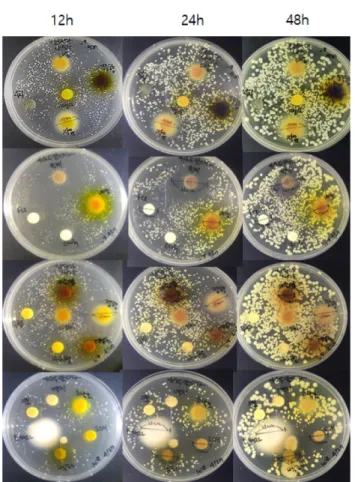
19종 약용식물의 C. albicans에 대한 항균효과 − 24시간 및 48시간 배양에서 Sanguisorba officinalis L.억제환의 지 름은 각각 17 mm, 16 mm를 나타냈으며, Cinnamomum cassia는 21 mm, 15 mm, Rheum coreanum NaKai는 24시 간에서는 12 mm를 나타냈으나, 48시간에서는 억제를 나타 내지 못했다. Perilla frutescens는 12 mm, 9 mm를 나타냈으
며, Eugenia caryophyllata 19 mm, 17 mm, Melaphis chinensissms 25 mm, 21 mm, Prunus mume, 13 mm, 13 mm, 양성대조군으로 사용한 fluconazol(50 mg/ml, 5 mg)은 14 mm, 10 mm를 나타내었으며 시료를 용해한 용매인 50% 에탄올 은 억제력이 없었다(Table I, Fig. 1).
지유 분획의 C. albicans에 대한 항균효과 − 지유 분획 의 C. albicans에 대한 항균력 실험 결과 n-hexan층의 24 h, 48 h 저해력은 25 mm, 14 mm를 나타냈으며, chloroform층 은 28 mm, 18 mm로 가장 우수한 저항력을 나타내었다.
Ethyl acetate, n-butanol층 및 용매로 사용한 50% 에탄올층 은 억제효과를 나타내지 않았다(Table II, Fig.2).
지유 Chloroform 분획의 C. albicans에 대한 최소저해 농도(MIC) − 지유의 chloroform 분획의 MIC 농도를 측정한 결과 24시간 배양시 40 μg/50 μl에서는 전혀 억제 작용이 없 었으며 80 μg/50 μl에서 억제작용이 나타나기 시작했다 Table I. Antifungal activity of 19 medicinal herb ethanol extracts as clear zone diameter (mm) against C. albicans by paper disk diffusion methods for 24 h, 48 h
Name Diameter (mm)
24h 48h
Lithospermum erythrorhizon S. et Z. 0 0 Orostachys japonicus A. Berger 0 0 Lysimachia foenum-graecum Hange 0 0 Torilis japonica (Houtt.) DC. 0 0 Sanguisorba officinalis L. 17 16
Cinnamomum cassia 21 15
Rheum coreanum NaKai 12 0
Perilla frutescens BRIT. var. crispa DECNE
12 9
Raphanus sativus L. (Leaves) 0 0 Eugenia caryophyllata Thunb.(Merr. et
Perry)
19 17
Melia azedarach L. Var.japonica Makino
0 0
Houttuynia cordata Thunb. 0 0
Portulaca oleracea L. 0 0
Anemarrhena asphodeloides Bunge 0 0 Angerica dahurica, Benth. et Hook. f. 0 0 Polygonum multiflorum Thunb. 0 0 Melaphis chinensis (Bell) Baker 25 21 Prunus mume Sieb. et Zucc. 13 13 Mentha arvensis var. piperascens
Makinv.
16 0
Fluconazol(FCZ) 14 10
Ethanol 0 0
(10.5 mm). 160μg/50 μl에서는 12.5 mm, 240 μg/50 μl에서 19 mm, 320μg/50 μl에서는 25 mm를 나타내었다. 48시간 배양 시 40 μg/50 μl, 80 μg/50 μl, 160 μg/50 μl에서는 전혀
억제 작용이 없었으며 240 μg/50 μl에서 억제작용이 나타나 기 시작했으며 320 μg/50 μl에서는 12.3 mm를 나타내었다.
즉 24시간 C. albicans 배양시 paper disk diffusion법에 의 한 지유의 chloroform 분획의 MIC 농도는 약 80 μg/50 μl으 로 나타났으며 48시간 배양시는 240 μg/50 μl으로 나타났다 (Table III, Fig. 3).
Fig. 1. Antifungal activity of 19 medicinal herb ethanol extracts as clear zone diameter (mm) against C. albicans by paper disk diffusion methods for 24 h, 48 h.
Table II. Antifungal activity as clear zone diameter (mm) of solvent fraction from Sanguisorba officinalis L. against C.
albicans by paper disk diffusion methods for 24 h, 48 h Solvent fraction layer Diameter (mm)
24 h 48 h
n-hexan 25 14
Chloroform 28 18
Ethyl acetate 0 0
n-butanol 0 0
Solvent 0 0
Table III. Minimal Inhibitory Concentration (MIC) of the chloroform fraction from Sanguisorba officinalis L. against C. albicans by paper disk diffusion methods for 24 h, 48 h
Concentration (μg) Diameter (mm)
24 h 48 h
40 0 0
80 10.5 0
160 12.5 0
240 19 9
320 25 12.3
Fig. 2. Antifungal activity as clear zone diameter(mm) of solvent fraction from Sanguisorba officinalis L. against C. albicans by paper disk diffusion methods for 24 h, 48 h.
지유 CHCl
3
분획의 HPLC분석 − CHCl3
분획에서 C.albicans 억제에 유효한 활성화합물 추적을 위하여 분석용 HPLC를 실시한 결과 peak A, peak B를 확인할 수 있었으
며 현재 column chromatography, Prep. HPLC 등을 활용하 여 분리를 하고 있으며 향후 NMR 분석 등을 통해 그 화학 구조를 동정할 계획이다(Fig. 4, 5).
Fig. 3. Minimal Inhibitory Concentration(MIC) of the chloroform fraction from Sanguisorba officinalis L. against C. albicans by paper disk diffusion methods for 24 h, 48 h.
Fig. 4. HPLC chromatogram of chloroform fraction from Sanguisorba officinalis L.
Fig. 5. UV spectral data of peak A and B in 254 nm.
고 찰
지유는 민간에서 상처의 치료나 대변출혈, 치질출혈, 및 외상 출혈 시 지혈제로 사용되고 있다. 지유의 ethyl acetate 분획은 위염이나 위궤양에 효과가 있는 것으로 보고되고 있 으며,
15)
물 추출물은 구강암세포에 대한 사멸효과가 보고되 어 있다.16)
지유의 Ziyuglycoside II 성분이 유방암세포에 대 해 미토콘드리아 의존성 경로를 통해 세포사멸을 유도할 수 있으며,17)
Bax/Bcl-2 발현을 조절하고 caspase-3 경로를 활 성화시킴으로써 위암세포의 사멸을 유도할 수 있다고 보고 되었다.18)
또 지유는 Rheum officinale, Agrimonia pilosa와 더불어 중국에서 항암보조제로 많이 사용하며 이 역시 물 추출물이 인간 폐선암종인 A549 세포와 인간 유방암 MCF- 7 세포에서 가장 높은 성장 억제 효과와 우수한 항산화효과 가 있는 것으로 보고되어 있다.19)
이러한 우수한 항산화효 과는 산화적 스트레스로 인한 심혈관계 질환을 예방하는 효 과가 있으며20)
항염작용도 매우 우수한 것으로 보고되고 있 다. 또한 지유추출물은 P. aeruginosa, S. Typhimurium, L.monocytogenes, B. cereus, S. aureus의 식품 위해성 세균에 항균작용이 있으며, ethyl acetate분획층의 항산화력과 항암
·항당뇨등 다양한 생리활성이 보고되고 있다.
21)
그러나 지유 의 C. albicans에 대한 억제작용은 지유 추출물의 억제력에 대한 보고에 그치고 있다.22-25)
이러한다양한 효능을 가지고 있는 지유(길림성지역, 중국)는 전분, 탄닌, 플라본 및 안토 시아닌 함량이 풍부하며 전분, 탄닌, 플라본 및 안토시아닌 의 함량은 각각 16.1%, 8.85%, 4.68% 및 0.559%로서 일반 식물과 같거나 높았다. 지유의 활성성분으로는 다양한 성분 들이 보고되고 있으나 ursolic acid가 IκBα Kinase 및 p65 인산화 억제를 통해 발암성 인자에 의해 유도된 nuclear factor-κB 활성화를 억제하는 기전이 보고되어 있으며, 다발 성 골수종 세포에서 투여량 및 시간 의존적으로 interleukin- 6–inducible STAT3 활성화를 억제하여 항암작용을 나타내 는 것으로 알려져 있다.26-28)
C. albicans 감염 환자 427명을 대상으로 한 연구에서 칸 디다혈증의 빈도는 1990년대에 비해 유의하게 증가 했으며 심각한 것은 칸디다혈증 환자의 13%는 이미 전신으로 항 균제를 투여 받고 있는 환자에게서 나타났다. 이는 칸디다 혈증 환자의 높은 합병증과 사망률을 고려할 때 매우 심각 한 상황이며 fluconazole, amphotericin B에 대한 내성이 증 가 할 것임을 예고하는 징조이다.
29)
이러한 우려는 현실로 나타나, HIV환자에 대한 fluconazole의 내성은 연구기간인 2년 동안 200배나 증가했다는 심각한 보고도 있다.30)
이러 한 상황에서 새로운 항칸디다 약물의 개발은 매우 절실한 상황에 이르렀다.금번 연구에서 지유의 n-hexan, chloroform 분획에서의 C.
albicans에 대한 억제력을 확인하였으며 그 억제력이 매우
우수하였다. 또한 지유의 chloroform 분획은 48시간 배양에 도 비교적 그 억제력이 저하되지 않음은 매우 의미 있게 관 찰되었다. C. albicans에 대한 억제력을 24시간, 48시간 지 속적으로 관찰하면서 C. albicans의 생장 속도에 따른 억제 력 및 최소저해농도(MIC)를 측정한 결과 항칸디다 천연소 재로의 가능성을 보였다. 지유 CHCl
3
분획의 HPLC분석에 서 peak A와 peak B를 확인할 수 있었으며 이들 물질의 분 리와 화학 구조 동정을 진행 중에 있으며, 차후 단일 물질 수준에서 C. albicans에 대한 심도 있는 연구진행이 필요할 것으로 사료된다.결 론
약용식물 19종의 C. albicans에 대한 항진균 효과를 연구 한 결과 Sanguisorba officinalis L., Cinnamomum cassia, Rheum coreanum, Perilla frutescens 및 Eugenia caryo- phyllata가 C. albicans 억제효과를 나타냈다. 이중에서 Sanguisorba officinalis L.의 항균활성이 우수했으며 48시간 배양까지 그 항균력이 지속되었다. 지유의 에탄올 추출물을 용매분획 하여 항균성을 검토한 결과 n-hexan, chloroform 분획의 항균작용이 우수했으며 48시간 배양시 chloroform 분획의 항균작용이 가장 우수하였다. 또한 chloroform 분획 의 MIC 농도는 24 시간에서 80 μg/50 μl 및 48 시간에서 240μg/50 μl이었다. 또한 chloroform 분획의 HPLC 분석 결 과 peak A, peak B를 확인할 수 있었다. 이는 C. albicans 를 억제하기 위한 소재가 전문의약품에 한정된 현실에서 향 후 건강식품 및 향장소재로서의 개발 가치가 충분하다고 사 료된다.
사 사
이 논문은 2017년도 남부대학교 학술연구비의 지원을 받 아 연구되었음.
인용문헌
1. Lee, M. O., Oh, H. G., Park, S. H., Lee, H. A., Song, J. and Kim, O. (2010) Antioxidant Activities of Sanguisorba offi- cinalis and Stichopus japonicus. Laboratory Animal Res., 26:
31-36.
2. An, R. B., Tian, Y. H., Oh, H. C., and Kim, Y. C. (2005) In vitro free radical scavenging and hepatoprotective compound from Sanguisorbae radix. Nat. Prod. Sci., 11: 119-122.
3. Cai, Z., Li, W., Wang, H., Yan, W., Zhou, Y., Wang, G. and Wang, F. (2012) Anti-tumor and immunomodulating activ- ities of a polysaccharide from the root of Sanguisorba offi- cinalis L. Int. J. Biol. Macromol., 51: 484-488.
4. Shin, T. Y., Lee, K. B. and Kim, S. H. (2002) Anti-allergic
effects of Sanguisorba officinalis on animal models of allergic reactions. Immunopharmacol. Immunotoxicol., 24: 455-468.
5. Choi, E. S., Kim, J. S., Kwon, K. H., Kim, H. S., Cho, N. P.
and Cho, S. D. (2012) Methanol extract of Sanguisorba offi- cinalis L. with cytotoxic activity against PC3 human prostate cancer cells. Mol. Med. Reports, 6: 670-674.
6. Kokoska, L., Polesny, Z., Rada, V., Nepovim, A. and Vanek, T. (2002) Screening of some Siberian medicinal plants for antimicrobial activity. M. Ethnopharmacol. 82: 51-53.
7. Wang, Z., Loo, W. T., Wang, N., Chow, L. W., Wang, D., Han, F. and Chen, J. P. (2012) Effect of Sanguisorba offi- cinalis L. on breast cancer growth and angiogenesis. Expert opinion on therapeutic targets, 16: S79-S89.
8. Mayer, F. L., Wilson, D. and Hube, B. (2013) Candida albi- cans pathogenicity mechanisms. Virulence, 4: 119-128.
9. Calderone, R. A. and Fonzi, W. A. (2001) Virulence factors of Candida albicans. Trends in Microbiol., 9: 327-335.
10. Nobile, C. J., Schneider, H. A., Nett, J. E., Sheppard, D. C., Filler, S. G., Andes, D. R. and Mitchell, A. P. (2008) Com- plementary adhesin function in C. albicans biofilm forma- tion. Current Biol., 18: 1017-1024.
11. Al-Fattani, M. A. and Douglas, L. J. (2006) Biofilm matrix of Candida albicans and Candida tropicalis: chemical compo- sition and role in drug resistance. J. Medical Microbiol., 55:
999-1008.
12. Blanco, M. T., Blanco, J., Sanchez-Benito, R., Perez-Giraldo, C., Moran, F. J., Hurtado, C. and Gomez-Garcia, A. C. (1997) Incubation temperatures affect adherence to plastic of Can- dida albicans by changing the cellular surface hydropho- bicity. Microbios, 89: 23-28.
13. Carson, C. F. and Riley, T. V. (1995) Antimicrobial activity of the major components of the essential oil of Melaleuca alternifolia. J. Applied Bacteriol., 78: 264-269.
14. Balouiri, M., Sadiki, M. and Ibnsouda, S. K. (2016) Methods for in vitro evaluating antimicrobial activity: A review. J.
Pharm. Analysis, 6: 71-79.
15. Lee, J. J., Choi, H. S., Lee, J. H., Jung, C. J. and Lee, M. Y.
(2005) The effects of ethylacetate fraction of Sanguisorba officinalis L. on experimentally-induced acute gastritis and peptic ulcers in rats. J. Kor. Society of Food Sci. Nutri., 34:
1545-1552.
16. Shin, J., Kim, J. S., Kwon, K. H., Nam, J. S., Jung, J. Y., Cho, N. P. and Cho, S. D. (2012) Apoptotic effect of hot water extract of Sanguisorba officinalis L. in human oral cancer cells. Oncology Letters, 4: 489-494.
17. Zhu, X., Wang, K., Zhang, K., Huang, B., Zhang, J., Zhang, Y. and Zhou, F. (2013) Ziyuglycoside II inhibits the growth of human breast carcinoma MDA-MB-435 cells via cell cycle arrest and induction of apoptosis through the mitochondria dependent pathway. Int. J. Molecular Sci., 14: 18041-18055.
18. Zhu, A. K., Zhou, H., Xia, J. Z., Jin, H. C., Wang, K., Yan, J. and Shan, T. (2013) Ziyuglycoside II-induced apoptosis in human gastric carcinoma BGC-823 cells by regulating Bax/
Bcl-2 expression and activating caspase-3 pathway. Brazilian
J. Med. Biol. Res., 46: 670-675.
19. Li, W. Y., Chan, S. W., Guo, D. J. and Yu, P. H. F. (2007) Correlation between antioxidative power and anticancer activity in herbs from traditional Chinese medicine formulae with anticancer therapeutic effect. Pharm. Biol., 45: 541-546.
20. Gan, R. Y., Xu, X. R., Song, F. L., Kuang, L. and Li, H. B.
(2010) Antioxidant activity and total phenolic content of medicinal plants associated with prevention and treatment of cardiovascular and cerebrovascular diseases. J. Medi. Plants Res., 4: 2438-2444.
21. Cho, J. Y., Yoo, E. S., Cha, B. C., Park, H. J., Rhee, M. H.
and Han, Y. N. (2006) The inhibitory effect of triterpenoid glycosides originating from Sanguisorba officinalis on tissue factor activity and the production of TNF-α. Planta Medica, 72: 1279-1284.
22. Kim, S. R., Won, J. H. and Kim, M. R. (2011) Antimicrobial Activity against Food Hazardous Microorganisms and Anti- mutagenicity against Salmonella serotype Typhimurium TA100 of an Ethanol Extract from Sanguisorba officinalis L.
Kor. J. Food Cookery Sci., 27: 17-26.
23. Janovska, D., Kubikova, K. and Kokoska, L. (2003) Screen- ing for antimicrobial activity of some medicinal plants spe- cies of traditional Chinese medicine. Czech J. Food Sci., 21:
107-110.
24. Chin, H. S., Pack, K. J., Pack, S. H. and Kim, J. K. (2009) The effects of herbal extract mixture on anti-obesity. J. Kor.
Soci. Food Sci. Nutri., 38: 32-38.
25. Cha, J. Y., Ha, S. E., Sim, S. M., Park, J. K., Chung, Y. O., Kim, H. J. and Park, N. B. (2008) Antimicrobial effects of ethanol extracts of Korea endemic herb plants. J. Life Sci., 18:
228-233.
26. Shishodia, S., Majumdar, S., Banerjee, S. and Aggarwal, B.
B. (2003). Ursolic acid inhibits nuclear factor-κB activation induced by carcinogenic agents through suppression of IκBα kinase and p65 phosphorylation. Cancer Res., 63: 4375-4383.
27. Yuan, C. L., Li, Z. X. and Yang, P. Y. (2002) Extraction of Ursolic Acid from Sanguisorba officinalis L. Chine. J.
Pharm., 33: 478-479.
28. Pathak, A. K., Bhutani, M., Nair, A. S., Ahn, K. S., Chakraborty, A., Kadara, H. and Aggarwal, B. B. (2007) Ursolic acid inhibits STAT3 activation pathway leading to suppression of proliferation and chemosensitization of human multiple myeloma cells. Mole. Cancer Res., 5: 943-955.
29. Nguyen, M. H., Peacock, J. E., Morris, A. J., Tanner, D. C., Nguyen, M. L., Snydman, D. R. and Victor, L. Y. (1996) The changing face of candidemia: emergence of non-Candida albicans species and antifungal resistance. American J. Medi., 100: 617-623.
30. White, T. C. (1997) Increased mRNA levels of ERG16, CDR, and MDR1 correlate with increases in azole resistance in Candida albicans isolates from a patient infected with human immunodeficiency virus. Antimicrobial. Agents Chem., 41: 1482-1487.
(2017. 6. 14 접수; 2017. 6. 16 심사; 2017. 6. 21 게재확정)