http://www.medicinalcrop.org http://dx.doi.org/10.7783/KJMCS.2013.21.4.268
봉화군 청옥산에 분포하는 대한민국약전 수재 약용식물의 분포 특성
송홍선*·김명혜**·이거룡**·김성민*
†*공주대학교 식물자원학과, **선문대학교 자연치유학과
Distribution of Medicinal Plants included in the Korean Pharmacopoeia at Cheongoksan Bonghwagun in Korea
Hong Seon Song *, Mung Hea Gim**, Geo Lyong Lee** and Seong Min Kim*
†*Department of Plant Resources, Kongju National University, Yesan 340-802, Korea
**Department of Naturopathic Medicine, Sunmoon University, Asan 336-708, Korea
ABSTRACT : This text was analyzed and investigated the distribution of medicinal plants in Cheongoksan Bonghwagun Korea, in order to search the medicinal resources that are used in modern medicine. Medicinal plants of the Korean Phar- macopoeia (10th edition) distributed in Cheongoksan Bonghwagun were consisted of 93 taxa ; 82 species, 10 varieties, 1 forma of 79 genus, 50 families. In medicinal plants of the Korean Pharmacopoeia, rate of native species and exotic species was 89.2% (83 taxa) and 10.8% (10 taxa) respectively. Family classification was the most of compositae of 8 taxa, and life form classification was most of herb of hemicryptophyte species. The classification by using parts were 34 taxa of root use and the classification of efficacy utilization was 24 taxa of Cheongyeolyak (heat-clearing drug) use.
Key Words : Medicinal Resource, Distribution and Classification, Native Species, Hemicryptophyte, Heat-Clearing
서 언
약용식물은 생약의 용도 이외에도 천연물신약, 기능성 화장 품 및 건강식품 등의 소재나 원료로 활용되면서 중요한 생명 산업의 유망자원으로 최근 그 중요성이 증대되고 있다. 약용 식물이 자원으로서의 가치가 높아짐에 따라 각국은 약용성분 을 함유한 식물자원의 확보 및 개발을 위한 경쟁을 치열하게 펼치고 있다. 특히 1992년의 생물다양성협약 (CBD)은 생물자 원의 지속가능한 이용과 보존을 인류의 공통과제 중 하나로 인식하였으며 (Kim et al., 2012), 그 이후 세계는 인류공동의 자산으로 인식되던 식물자원을 자국의 고유자원으로 선언하고 권리를 확보하는 방향으로 나아가고 있다.
이러한 때에 야생의 약용식물을 체계적으로 조사하고 분류 하는 일은 중요하고 필요하다. 한반도 분포의 약용식물 조사 연구는 전남 (Lee, 1988), 수도권 (Lee and Ahn, 1995), 강 원도 (Lee et al., 1997), 전북 (Kwak et al., 1997;Kil et
al., 2000)에서 이루어졌다. 특히 Song 등 (2011)은 충남 미호 천 약용식물 중 대한민국약전 (9개정판, 생약규격집 수재품목 포함)에 나타나는 종류를 85분류군이라 하였고, Ahn 등 (2012) 은 낙동강 하류에서 56분류군, Jung (2012)은 제주도에 서 217분류군의 대한민국약전 약용식물을 기록한 바 있다.
그러나 경북 봉화군은 약용식물의 분포가 다양한 곳이지만 정밀한 약용식물 조사 연구가 없었다. 봉화군 청옥산에 분포 하는 관속식물은 Lim과 Kim (2002), Song (2012)의 조사 연구에서 밝혀졌으나 이들 연구는 약용식물을 독립적으로 조 사 연구하거나 분석하고 분류한 것이 아니었다.
따라서 청옥산 약용식물의 조사 연구는 봉화군 일대와 경북 지역 약용식물 탐색의 의미가 있었다. 그리고 본 조사 연구는 자연훼손, 무분별한 남획 등으로 약용식물이 급감하기 전에 유 용한 약용식물의 조사와 종의 분류 필요성이 제기되어 경북 봉화군 청옥산에 분포한 약용식물을 대한민국약전의 수재 품 목과 비교하여 금후 봉화군 청옥산의 약용식물 이용을 위한
†
Corresponding author: (Phone) +82-41-330-1203 (E-mail) [email protected]
Received 2013 May 30 / 1st Revised 2013 June 28 / 2nd Revised 2013 July 16 / 3rd Revised 2013 July 21 / Accepted 2013 Revised July 22
This is an open access article distributed under the terms of the Creative Commons Attribution Non-Commercial License (http://creativecom-
mons.org/licenses/by-nc/3.0/) which permits unrestricted non-commercial use, distribution, and reproduction in any medium, provided the original
work is properly cited.
재료 및 조사 방법
약용식물 분포 조사지역은 경북 봉화군 소천면 고선리의 청 옥산이었다 (Fig. 1). 청옥산 (1,276 m)은 행정적으로 경북 봉 화군 지역이며, 백두대간에서 동남쪽으로 뻗어 나온 산자락에 위치하고, 북쪽으로는 강원도와 경계하는 태백산도립공원이 있 는 곳이다. 총 조사지역의 면적은 8,780 ha이었으며, 조사기간 은 2012년 5월부터 2012년 10월까지 6개월간이었다.
조사는 약용으로 이용하는 관속식물 중 ‘대한민국약전 (10 개정판, 생약규격집 수재품목 포함)’에 수재된 약용식물을 대 상으로 조사지역을 이동하면서 확인되는 관속식물 중의 약용 식물 출현을 동정하여 야장에 기록하고 분류한 후에 총목록을 작성하였다. 약용식물의 분류는 주로 Engler 분류체계 (Melchior and Werdermann, 1954, 1964) 의 과 (family) 분류에 따랐으며, 국명과 학명은 국가표준식물목록 (Korea National Arboretum, 2007) 을 기준으로 정리하였다.
분류는 이용부위의 경우 Im (1998), Ahn (2003), Bae (2000) 에 따랐고, 효능용도의 경우 Ahn (2003)에 기준하였다.
귀화식물은 Song (2008)의 정리를 참고하였다.
결과 및 고찰
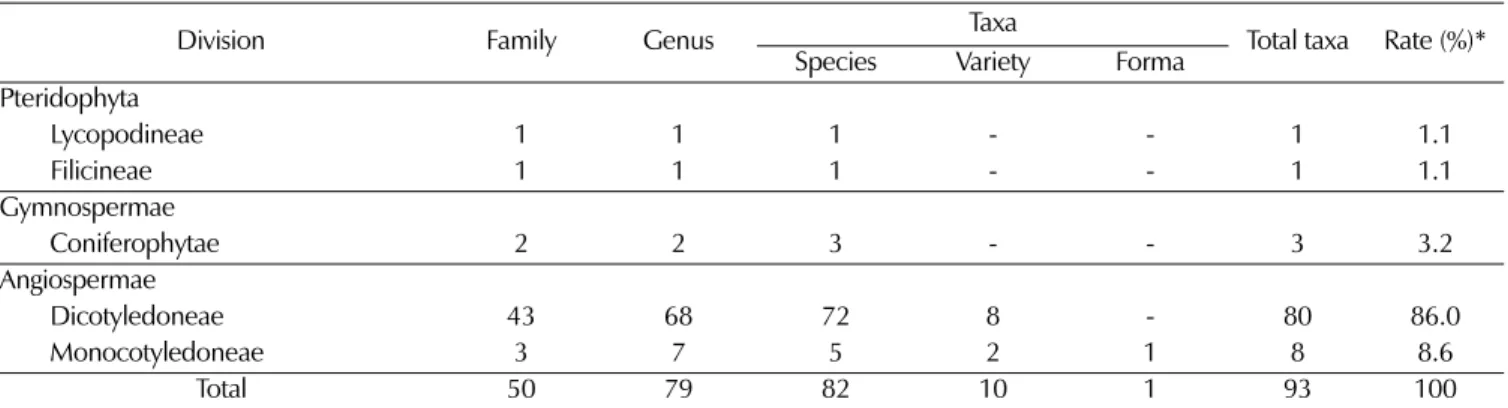
대한민국약전에 수재된 봉화군 청옥산에 분포한 약용식물은 50 과 79속의 82종 10변종 1품종으로 총 93분류군 (taxa)이었 다 (Table 1). 양치식물은 석송류와 고사리류가 각각 1과 1속 의 1종으로 총 1분류군 (1.1%)이었으며, 나자식물은 구과식물 류가 2과 2속의 3종으로 총 3분류군 (3.2%)이었다. 피자식물 은 쌍자엽식물류가 43과 68속의 72종 8변종으로 총 80분류군 (86.0%) 이었고, 단자엽식물류는 3과 7속의 5종 2변종 1품종으 로 총 8분류군 (8.6%)이었다 (Table 2).
대한민국약전 (대한약전 7 ~ 9개정판, 한약규격집 수재품목 포함)에 수재된 생약재는 514 ~ 517품목 (Shin et al., 2000;
Lee, 2008) 중 식물약재는 360여 종류 (430여 품목)로, 대한 민국약전에 수재된 청옥산 분포의 약용식물 93분류군은 대한 민국약전 수재품목 총 식물약재 360여 종류의 25.8%이었으며, 총 조사식물 612분류군 (Song, 2012)의 15.2% 수준이었다.
Song 등 (2011)은 대한민국약전에 수재된 충남 미호천 일대 의 약용식물을 85분류군이라 하여 미호천 총 조사식물의 18.4%
라고 하였는데, 대한민국약전에 수재된 청옥산의 약용식물 (93 분류군)은 미호천 일대의 것보다 조사종수 8분류군이 많았지만 총 조사식물에 대한 비율 (15.2%)이 3% 정도 낮았는데, 이는 봉화군 청옥산이 충남 미호천보다 약용식물 이외의 관속식물 종다양성이 상대적으로 매우 높았기 때문으로 판단되었다.
가장 많은 식물분류군으로 조사된 과 (family)는 8분류군 (8.6%) 의 국화과로 사철쑥, 더위지기, 쑥, 개미취, 삽주, 엉겅 퀴, 구절초, 민들레이었다 (Table 3).
Table 1. Number of plant taxa of medicinal plants at Cheongoksan located Bonghwagun in Korea.
Division Family Genus Taxa
Total taxa Rate (%)*
Species Variety Forma Pteridophyta
Lycopodineae 1 1 1 - - 1 1.1
Filicineae 1 1 1 - - 1 1.1
Gymnospermae
Coniferophytae 2 2 3 - - 3 3.2
Angiospermae
Dicotyledoneae 43 68 72 8 - 80 86.0
Monocotyledoneae 3 7 5 2 1 8 8.6
Total 50 79 82 10 1 93 100
*Rate as a percentage of the total 93 taxa.
Fig. 1. The map showing the investigation site of this study.
Tabe 2. Total medicinal plants included in Korean pharmacopoeia at Cheongoksan located Bonghwagun in Korea.
Scientific name (Korean name) Life form 4) Medicinal classification Use part 5) Efficacy 6) Pteridophyta ( 양치식물문), Lycopodineae (석송강), Selaginellaceae (부처손과)
Selaginella tamariscina (P.Beauv.) Spring ( 부처손) He Ⅰ 1),2),3) ⓓ Filicineae ( 고사리강), Aspidiaceae (면마과)
Dryopteris crassirhizoma Nakai ( 관중) He Ⅲ 1),2) ⓞ
Gimnospermae ( 나자식물문), Coniferophytae (구과식물강), Ginkgoaceae (은행나무과)
Ginkgo biloba L. ( 은행나무) Me ▲ Ⅱ 2) , Ⅷ 1),2) ⓔ
Pinaceae ( 소나무과)
Pinus densiflora Siebold & Zucc. ( 소나무) Me Ⅱ 1),2),3) , Ⅴ 1),2),3) , Ⅹ 1),2),3) ⓑ Pinus koraiensis Siebold & Zucc. ( 잣나무) Me Ⅷ 1),2),3) ⓝ Angiospermae ( 피자식물문), Dicotyledoneae (쌍자엽식물강), Fagaceae (참나무과)
Castanea crenata Siebold & Zucc. ( 밤나무) Me ▲ Ⅱ 1) , Ⅷ 1),2),3) ⓒ Ulmaceae ( 느릅나무과)
Ulmus davidiana var. japonica (Rehder) Nakai ( 느릅나무) Me Ⅱ 1) , Ⅳ 1),3) , Ⅵ 1) , Ⅶ 2) ⓐ Eucommiaceae ( 두충나무과)
Eucommia ulmoides Oliv. ( 두충나무) Me ▲ Ⅱ 1),3) , Ⅵ 1),2),3) ⓒ Moraceae (뽕나무과)
Morus alba L. ( 뽕나무) Me ▲ Ⅱ 1),2),3) , Ⅳ 1),2),3) , Ⅶ 2) ⓔ
Cannabaceae ( 삼과)
Humulus japonicus Sieboid & Zucc. ( 환삼덩굴) Th Ⅰ 1),3) ⓘ Loranthaceae ( 꼬리겨우살이과)
Viscum album var. coloratum (Kom.) Ohwi (겨우살이) Ep Ⅱ 1),2) , Ⅵ 1),2) ⓑ Polygonaceae ( 마디풀과)
Polygonum aviculare L. ( 마디풀) Th Ⅰ 1),2),3) ⓖ
Rumex crispus L. ( 소리쟁이) He ● Ⅳ 1),2) ⓐ
Portulacaceae ( 쇠비름과)
Portulaca oleracea L. ( 쇠비름) Th Ⅰ 1),2),3) ⓐ
Caryophyllaceae ( 석죽과)
Dianthus chinensis L. ( 패랭이꽃) He Ⅰ 2),3) ⓖ
Silene firma Siebold & Zucc. ( 장구채) He Ⅰ 1),2),3) ⓓ
Schisandraceae ( 오미자과)
Schisandra chinensis (Turcz.) Baill. ( 오미자) Ep Ⅱ 1) , Ⅶ 1),2),3) ⓙ Lauraceae (녹나무과)
Lindera obtusiloba Blume ( 생강나무) Me Ⅱ 1) , Ⅵ 1),2) ⓓ
Ranunculaceae ( 미나리아재비과)
Aconitum jaluense Kom. ( 투구꽃) He Ⅲ 1) ⓛ
Aconitum pseudolaeve Nakai ( 진범) He Ⅲ 1) , Ⅳ 2),3) ⓑ
Cimicifuga heracleifolia Kom. ( 승마) He Ⅲ 1),2),3) ⓕ
Clematis terniflora var. mandshurica (Rupr.) Ohwi ( 으아리) Ep Ⅳ 1),2),3) ⓑ Pulsatilla koreana (Yabe ex Nakai) Nakai ex Mori ( 할미꽃) He Ⅱ 1) , Ⅳ 1),2),3) , Ⅴ 1) ⓐ Menispermaceae ( 새모래덩굴과)
Cocculus trilobus (Thunb.) DC. ( 댕댕이덩굴) Ep Ⅳ 1),2) ⓑ
Aristolochiaceae ( 쥐방울덩굴과)
Asarum sieboldii Miq. ( 족도리풀) He Ⅳ 1),2),3) ⓛ
Actinidiaceae ( 다래과)
Actinidia arguta (Siebold & Zucc.) Planch. ex Miq. ( 다래) Mi Ⅱ 1) , Ⅳ 1),3) , Ⅶ 1),2),3) ⓐ Papaveraceae (양귀비과)
Chelidonium majus var. asiaticum (Hara) Ohwi ( 애기똥풀) He Ⅰ 1),2) ⓠ
Use part Efficacy Fumariaceae ( 현호색과)
Corydalis remota Fisch. ex Maxim. ( 현호색) He Ⅲ 1),2),3) ⓓ Brassicaceae ( 십자화과)
Capsella bursapastoris (L.) L.W.Medicus (냉이) Th Ⅰ 1),2),3) ⓖ
Draba nemorosa L. (꽃다지) Th Ⅷ 2),3) ⓔ
Crassulaceae (돌나물과)
Hylotelephium erythrostictum (Miq.) H.Ohba ( 꿩의비름) He Ⅰ 1) ⓣ Sedum kamtschaticum Fisch. & Mey. ( 기린초) He Ⅰ 1),2) ⓓ
Sedum sarmentosum Bunge (돌나물) Ch Ⅰ 1),2) ⓐ
Rosaceae ( 장미과)
Agrimonia coreana Nakai ( 산짚신나물) He Ⅰ 1) ⓗ
Rosa multiflora Thunb. ( 찔레나무) Mi Ⅶ 1),2),3) ⓒ
Sanguisorba officinalis L.(오이풀) He Ⅲ 1),2),3) ⓗ
Fabaceae ( 콩과)
Albizia julibrissin Durazz. ( 자귀나무) Me Ⅵ 1),2),3) ⓟ
Pueraria lobata (Willd.) Ohwi ( 칡) Ep Ⅰ 2) , Ⅳ 1) , Ⅴ 1) ⓕ Sophora flavescens Solander ex Aiton ( 고삼) He Ⅳ 1),2),3) ⓐ Geraniaceae ( 쥐손이풀과)
Geranium thunbergii Siebold & Zucc. ( 이질풀) He Ⅰ 1),2) ⓑ
Geranium wilfordii Maxim. ( 세잎쥐손이) He Ⅰ 2) ⓑ
Rutaceae (운향과)
Phellodendron amurense Rupr. (황벽나무) Me Ⅵ 1),2),3) ⓐ
Zanthoxylum schinifolium Siebold & Zucc. ( 산초나무) Mi Ⅶ 1),2),3) ⓛ Simaroubaceae ( 소태나무과)
Ailanthus altissima (Mill.) Swingle (가죽나무) Me ● Ⅳ 1),2) , Ⅵ 1) , Ⅶ 1) ⓐ Anacardiaceae (옻나무과)
Rhus javanica L. ( 붉나무) Mi Ⅱ 2) , Ⅳ 2) , Ⅶ 1) , Ⅹ 1),3) ⓐ Rhus verniciflua Stokes ( 옻나무) Me ▲ Ⅱ 1) , Ⅳ 1) , Ⅵ 1),2) , Ⅹ 2),3) ⓓ Celastraceae ( 노박덩굴과)
Euonymus alatus (Thunb.) Siebold ( 화살나무) Mi Ⅸ 1),2),3) ⓓ Violaceae ( 제비꽃과)
Viola mandshurica W.Becker ( 제비꽃) He Ⅰ 1),2) ⓐ
Viola yedoensis Makino (호제비꽃) He Ⅰ 1),2) ⓐ
Araliaceae (두릅나무과)
Aralia cordata Thunb. ( 땅두릅) He Ⅳ 1),2),3) ⓑ
Eleutherococcus sessiliflorus (Rupr. & Max.) S.Y.Hu ( 오갈피) Mi Ⅳ 1),2) , Ⅵ 2),3) ⓑ Kalopanax septemlobus (Thunb.) Koidz. ( 음나무) Me Ⅵ 1),2),3) ⓑ Apiaceae ( 산형과)
Angelica dahurica (Fisc. ex Hoff.) Benth. & Hook.f. ( 구릿대) He Ⅳ 1),2),3) ⓕ Angelica decursiva (Miq.) Franch. & Sav. ( 바디나물) He Ⅳ 1),2) ⓔ
Angelica gigas Nakai ( 참당귀) He Ⅳ 1),2),3) ⓒ
Ostericum praeteritum Kitag. ( 강활) He Ⅳ 1),2) ⓕ
Pyrolaceae ( 노루발과)
Pyrola japonica Klenze ex Alef. ( 노루발) He Ⅰ 1),2) ⓑ
Oleaceae (물푸레나무과)
Fraxinus rhynchophylla Hance ( 물푸레나무) Me Ⅵ 1),2),3) ⓐ
Ligustrum obtusifolium Siebold & Zucc. ( 쥐똥나무) Mi Ⅶ 1),2) ⓒ
(Continued).
Tabe 2. Total medicinal plants included in Korean pharmacopoeia at Cheongoksan located Bonghwagun in Korea.
Scientific name (Korean name) Life form 4) Medicinal classification Use part
5)Efficacy
6)Gentianaceae ( 용담과)
Gentiana scabra Bunge ( 용담) He Ⅳ 1),2),3) ⓐ
Rubiaceae ( 꼭두서니과)
Rubia akane Nakai (꼭두서니) He Ⅳ 1),2),3) ⓗ
Cuscuta australis R.Br. ( 실새삼) Ep Ⅷ 1),2) ⓒ
Cuscuta japonica Choisy (새삼) Ep Ⅷ 1),2),3) ⓒ
Labiatae ( 꿀풀과)
Agastache rugosa (Fisch. & Mey.) Kuntze ( 배초향) He Ⅰ 1),2) ⓘ
Elsholtzia ciliata (Thunb.) Hyl. (향유) Th Ⅰ 1),2) ⓕ
Leonurus japonicus Houtt. (익모초) He Ⅰ 1),2) , Ⅷ 3) ⓓ
Prunella vulgaris var. lilacina Nakai ( 꿀풀) He Ⅰ 1),2),3) ⓐ Soranaceae (가지과)
Solanum nigrum L.( 까마중) Th Ⅰ 1),2) ⓐ
Scrophulariaceae ( 현삼과)
Scrophularia kakudensis Franch. (큰개현삼) He Ⅳ 2) ⓐ
Bignoniaceae (능소화과)
Catalpa ovata G.Don ( 개오동) Me ▲ Ⅳ 1),2) , Ⅵ 1),2) , Ⅶ 1) ⓐ Plantaginaceae ( 질경이과)
Plantago asiatica L. (질경이) He Ⅰ 1),2),3) , Ⅷ 1),2),3) ⓖ Caprifoliaceae ( 인동덩굴과)
Lonicera japonica Thunb. (인동덩굴) Mi Ⅲ 1),3) , Ⅵ 1),2) , Ⅴ 1),2),3) ⓐ Valerianaceae ( 마타리과)
Patrinia scabiosaefolia Fisch. ex Trevir. ( 마타리) He Ⅰ 1) , Ⅳ 2) ⓐ Patrinia villosa (Thunb.) Juss. (뚝갈) He Ⅰ 1) , Ⅳ 2) ⓐ Campanulaceae ( 초롱꽃과)
Adenophora remotiflora (Siebold & Zucc.) Miq. ( 모시대) He Ⅳ 1),2),3) ⓔ Adenophora triphylla var. japonica (Regel) H.Hara (잔대) He Ⅳ 1),2),3) ⓒ Platycodon grandiflorum (Jacq.) A.DC. ( 도라지) He Ⅳ 1),2),3) ⓔ Asteraceae ( 국화과)
Artemisia capillaris Thunb. (사철쑥) He Ⅰ 1),2) ⓐ
Artemisia gmelini Weber ex Stechm. (더위지기) He Ⅰ 1),2),3) ⓐ
Artemisia princeps Pamp. ( 쑥) He Ⅰ 3) , Ⅱ 1),2) ⓗ
Aster tataricus L.f. (개미취) He Ⅲ 1) , Ⅳ 1),2) ⓔ
Atractylodes ovata (Thunb.) DC. (삽주) He Ⅲ 1),2),3) ⓘ
Cirsium japonicum var. maackii (Maxim.) Matsum. (엉겅퀴) He Ⅰ 1),2),3) , Ⅳ 1) ⓗ Dendranthema zawadskii var. latilobum (Max.) Kitam. (구절초) He Ⅰ 1),2) ⓛ Taraxacum platycarpum Dahlst. (민들레) He Ⅰ 1),2) , Ⅳ 1) ⓐ Angiospermae ( 피자식물문), Monocotyledoneae (단자엽식물강),
Liliaceae ( 백합과)
Hemerocallis fulva (L.) L. (원추리) He ▲ Ⅳ 1),2),3) ⓖ
Lilium lancifolium Thunb. ( 참나리) Ge ▲ Ⅲ 2),3) ⓒ
Polygonatum odoratum var. pluriflorum (Miq.) Ohwi (둥굴레) He Ⅲ 1),2),3) ⓒ Veratrum maackii var. japonicum (Baker) T.Schmizu ( 여로) He Ⅲ 1),2) , Ⅳ 1) ⓜ Dioscoreaceae ( 마과)
Dioscorea batatus Decne. ( 마) Ep Ⅲ 1),2) ⓒ
Dioscorea tokoro Makino ( 도꼬로마) He Ⅲ 2),3) ⓖ
국화과 다음으로는 미나리아재비과가 5분류군 (5.4%), 산형 과, 꿀풀과, 백합과가 각각 4분류군 (각각 4.3%), 콩과, 장미과, 초롱꽃과, 두릅나무과, 돌나물과가 각각 3분류군 (각각 3.2%) 순이었다.
생활형에 따른 약용식물은 초본 62분류군 (66.7%), 목본 31 분류군 (33.3%)이었으며, 초본식물 중에는 반지중식물 (hemicryptophyte) 이 53분류군 (57.0%)으로 가장 많았는데, 그 식물들은 관중, 둥굴레, 기린초, 사철쑥, 도꼬로마, 이질풀, 세 잎쥐손이, 엉겅퀴, 오이풀, 꿩의비름, 애기똥풀, 족도리풀, 할미 꽃, 승마, 진범, 삽주, 현호색, 투구꽃, 호제비꽃, 장구채, 땅두 릅, 개미취, 패랭이꽃, 소리쟁이, 구릿대, 바디나물, 참당귀, 강 활, 천남성, 노루발, 반하, 구절초, 쑥, 민들레, 용담, 원추리, 꼭 두서니, 산짚신나물, 제비꽃, 고삼, 도라지, 배초향, 더위지기,
익모초, 꿀풀, 모시대, 여로, 질경이, 큰개현삼, 뚝갈, 잔대, 마 타리, 부처손이었다.
반지중식물 다음으로는 일년생식물 7분류군 (7.5%), 지표식 물과 심토식물 각각 1분류군 (각각 1.1%) 순이었다. 목본식물 은 대형지상식물이 15분류군 (16.1%)이었고, 소형지상식물과 착생식물이 각각 8분류군 (8.6%) 순이었다 (Table 4).
본 조사지역에서 본토식물은 83분류군 (89.2%)이었고, 귀화 및 식재된 식물 (외래식물)은 10분류군으로 10.8%를 차지하였 다 (Table 5). 그 중 귀화식물은 가죽나무, 소리쟁이 등 2분류 군 (2.2%)이었으며, 식재식물은 개오동, 두충나무, 밤나무, 뽕 나무, 옻나무, 원추리, 은행나무, 참나리 등 8분류군 (8.6%)이 었다.
외국의 귀화식물이 대한민국약전에 수재된 것이 특이하였는 데, 이는 대한민국약전에 수재되기 이전에 도입된 것으로 중 국 원산의 가죽나무는 조선시대 중후반, 유럽 원산의 소리쟁 이는 삼국시대 말에 도입되었기 때문이다 (Song, 2008).
청옥산에 분포하는 약용식물을 이용부위에 따라 분류할 경우 가장 많은 34분류군 (36.5%)이 뿌리 (뿌리껍질)로 그 식물들은 여로, 민들레, 칡, 엉겅퀴, 옻나무, 개미취, 바디나물, 강활, 댕댕 이덩굴, 소리쟁이, 가죽나무, 오갈피나무, 개오동, 잔대, 땅두릅, 원추리, 구릿대, 모시대, 참당귀, 으아리, 족도리풀, 용담, 도라 지, 고삼, 꼭두서니, 할미꽃, 뽕나무, 느릅나무, 다래나무, 큰개 현삼, 마타리, 뚝갈, 붉나무, 진범이었다.
Use part
5)Efficacy
6)Araceae ( 천남성과)
Arisaema amurense for. serratum (Nakai) Kitag. ( 천남성) He Ⅲ 1),2),3) ⓔ Pinellia ternata (Thunb.) Breitenb. ( 반하) He Ⅲ 1),2),3) ⓔ
1)