ISSN 0367-6315 (Print) / ISSN 2288-2162 (Online) Korean J. Soil Sci. Fert. 47(6), 506-509 (2014) http://dx.doi.org/10.7745/KJSSF.2014.47.6.506
Mercury Contents of Medicinal Plants and the Cultivated Soils in Korea
Won-Il Kim, Woo-Ri Go, Chang-Oh Hong1, and Kwon-Rae Kim2*
Chemical Safety Division, National Academy of Agricultural Science, RDA, Wanju 565-851, Korea
1Department of Life Science and Environmental Biochemistry, Pusan National University, Miryang 627-706, Korea
2Department of Agronomy and Medicinal Plant Resources, GNTECH, Jinju 660-758, Korea
(Received: November 12 2014, Revised: November 19 2014, Accepted: November 20 2014)
This study was conducted to identify transition characteristics of mercury in several selected medicinal plants and to find the appropriate management for production of safety food. Cultivated soils and medicinal plants were collected at 29 sites for Angelica gigas (Korean angelica root), 68 sites for Platycodon grandiflorum (Balloon flower), 35 sites for codonopsis lanceolata (Deoduck), 36 sites for Dioscorea batatas (Chinese yam), 32 sites for Rehmannia glutinosa (Foxglove), 16 sites for Cnidium officinale makino (cnidium), and 26 sites for Astragalus membranaceus (milk vetch root) during the harvest season of 2013. Mercury in the soils and medicinal roots were analyzed with a Direct Mercury Analyzer. Average content of mercury in soils cultivated medicinal plants was 0.023 mg kg-1 (range: from 0.003 to 0.074 mg kg-1) and average content of mercury in medicinal plants was 0.003 mg kg-1 (range: from 0.001 to 0.011 mg kg-1), indicating that mercury in the surveyed soils and medicinal plants were not exceeded the Korean regulation.
Key words: Mercury, Medicinal plant, Upland soil, Regulation
Correlation between Hg contents in medicinal plants (A: milky vetch root, B: balloon flower) and cultivated soils Short Communication
1)
*Corresponding author : Phone: +821071209188, E-mail: [email protected]
§Acknowledgement: This study was financially supported by “Research Program for Agricultural Science & Technology Development (Project No. PJ 009219)” National Academy of Agricultural Science, Rural Development Administration, Korea.
Won-Il Kim, Woo-Ri Go, Chang-Oh Hong, and Kwon-Rae Kim 507
Table 1. The mercury contents of the soil cultivated for medicinal plants in Korea Medicinal plants Balloon
flower Chinese yam Cridium Deodeok Foxglove Korean angelica root
Milk vetch root --- mg kg-1 ---
ave 0.025 0.012 0.036 0.025 0.014 0.030 0.031
min 0.004 0.004 0.017 0.006 0.003 0.003 0.003
max 0.054 0.031 0.072 0.071 0.067 0.075 0.074
SD 0.012 0.006 0.016 0.015 0.016 0.017 0.019
Concern level for soil
contamination1 4.0
1: This value is designated by "Soil Environmental Conservation Law" (MOE, 2010a)
Introduction
최근 세계적으로 약용작물은 특정 질병의 치료, 예방 및 관리에 광범위하게 이용되고 있다. 세계보건기구 (WHO, World Health Organization)에 의하면 65 ~ 80%의 인류가 건강관 리의 초기형태로 전통적 (대체) 의학에 의존하고 있다. 그러 나 이러한 약용작물의 이용은 이들이 함유한 화학물질이나 미량원소 등의 장기적인 독성 영향 때문에 면밀한 검토가 선행되어야한다 (WHO, 1998; Lekouch et al., 2001; Annan et al., 2013).
타 식물과 마찬가지로 약용작물도 미량원소를 함유하고 있으며 특정 원소의 축적은 약용작물의 약리적인 효과를 높 이는 면에서 중요한 의미를 가진다. 그러나 식물에 직접적 으로 이용되지 않는 카드뮴 (Cd), 코발트 (Co), 납 (Pb) 등 일 부 성분은 인체 건강에 해로운 영향을 미친다. 수은 (Hg)과 비소 (As)도 소량의 농도에서 일부 약리적인 효과를 보이고 있으나, 과량의 존재에서 미나마타병 (Minamata disease) 및 오각병 (Black foot disease) 등 인체에 치명적인 영향을 미친다 (Baker and Brooks, 1989).
그동안 국내의 약용작물에 관한 연구는 재배적지 선정, 비배관리 및 작물체의 유효성분과 무기성분과의 관계 등에 대한 연구가 수행되었고 (Park et al., 1989; Jung et al., 1996a), 약용작물 재배토양의 토성별 중금속 함량분포와 흡 수이행에 대하여 논의된 바 있으나 대상원소가 카드뮴, 납, 크롬 등에 국한되었고 수은에 대한 연구는 미미한 실정이다 (Jung et al., 1996b). 따라서 본 연구에서는 약용작물 재배 토양과 식물체를 수집하여 수은의 함량을 분석하여 수은의 토양-식물체로의 흡수이행 특성을 파악하고, 이를 통해서 안전한 농산물 생산을 위한 적절한 관리방안을 제시하고자 수행하였다.
Materials and Methods
본 연구에서는 우리나라 주요 7대 약용작물을 대상으로
주산단지에서 재배토양 및 약용작물을 동일지점에서 수확 기에 채취하였다. 분석에 사용한 토양과 약용작물은 당귀 29지점, 도라지 68지점, 더덕 35지점, 마 36지점, 지황 32 지점, 천궁 16지점, 황기 26지점의 시료를 채취하여 수은 함 량을 조사하였다. 토양은 음건 후 고무망치를 이용해 뭉쳐 진 부분을 분리시켜 2 mm로 체질한 후 소량을 채취하여 막 자사발로 곱게 마쇄한 다음, 0.074 mm로 체질한 후 수은 분석시료로 사용하였다. 식물체 시료는 수확한 약용작물의 뿌리부위를 깨끗한 물로 세척한 후 60℃에서 건조한 후 분 쇄하여 분말로 만들어 분석시료로 사용하였다.
토양 및 약용작물의 수은함량 분석은 미국 환경보호청 (US EPA)이 개발한 EPA method 7473을 만족시키는 자동 수은분석기 (Direct Mercury Analyzer, DMA 80, Milestone, Italy)에 직접 토양 및 식물체 시료를 주입하여 수은함량을 분석하였다. 또한, 생물농축계수 (Bioconcentration factor, Eq. 1)는 토양 중 오염물질에 대한 농산물의 흡수와 이동성 을 고려하여 식물체내 중금속 함량을 토양 중 중금속 함량 으로 나눈 값으로 토양으로부터 작물로 이동하는 중금속의 상대적인 흡수비를 의미한다 (Kim et al., 2012). 즉 생물농 축계수가 높을수록 토양 중의 수은이 작물로의 이동이 높다 는 것을 의미한다. 본 연구에서는 토양 중 수은함량을 약용 작물의 수은함량과 계산하여 생물농축계수를 산출하였다.
Bioconcentration factor (BCF)=
(1)
Results and Discussion
약용작물 재배지 토양의 수은 평균함량은 0.023 mg/kg, 범위는 0.003 ~ 0.074 mg kg-1으로 조사되어 평균함량은 토양환경보전법에서 제시하는 수은의 토양오염 우려기준인 4 mg kg-1의 1/200 수준이며, 최대함량도 기준치의 1/50로 서 안전한 수준이었다 (Table 1). 이는 2005 ~ 2006년 조사 된 우리나라 논토양의 평균 수은 함량인 0.031 mg kg-1
Mercury Contents of Medicinal Plants and the Cultivated Soils in Korea
508
Table 2. The mercury contents in the medicinal plants grown in Korea
Medicinal plants Balloon flower Chinese yam Cridium Deodeok Foxglove Korean angelica root
Milk vetch root --- mg kg-1 DW ---
ave 0.004 0.002 0.005 0.005 0.002 0.004 0.001
min 0.002 0.001 0.003 0.002 0.001 0.002 0.001
max 0.008 0.005 0.007 0.009 0.005 0.011 0.003
SD 0.001 0.001 0.001 0.002 0.001 0.002 0.001
Permittable level1 0.2
1: This value is designated by "Regulation and analytical methods of residual contaminants in a herb medicine" (KFDA, 2010)
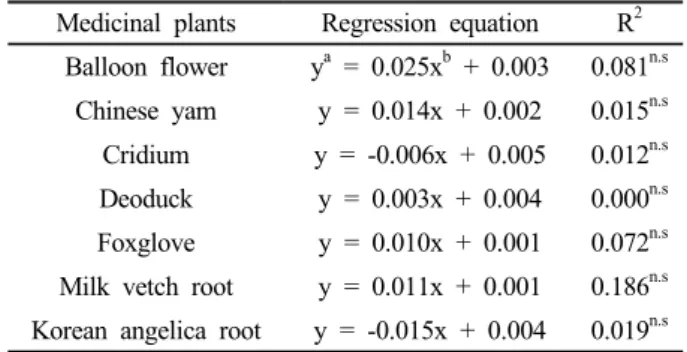
Table 3. Regression equation between mercury contents of the soils cultivated for medicinal plants and those of medicinal plants.
Medicinal plants Regression equation R2 Balloon flower ya = 0.025xb + 0.003 0.081n.s
Chinese yam y = 0.014x + 0.002 0.015n.s Cridium y = -0.006x + 0.005 0.012n.s Deoduck y = 0.003x + 0.004 0.000n.s Foxglove y = 0.010x + 0.001 0.072n.s Milk vetch root y = 0.011x + 0.001 0.186n.s Korean angelica root y = -0.015x + 0.004 0.019n.s
a: y = Hg in medicinal plants, b: x = Hg in soil (0.005 ~ 0.144 mg kg-1)과 비교하여 다소 낮은 수준이었다
(Park et al., 2008). 2006 ~ 2012년 조사된 환경부의 토양 측정망에서 조사된 논토양 및 밭토양의 평균 수은함량도 각 각 0.019 ~ 0.040과 0.018 ~ 0.041 mg kg-1을 보여 유사한 수준임을 확인하였다 (MOE, 2012).
2013년 각 약용작물 주산단지의 수확기에 영농현장을 방 문하여 채취한 약용작물의 수은 함량은 Table 2와 같다. 약 용작물의 수은 평균함량은 0.003 mg kg-1, 범위는 0.001 ~ 0.011 mg kg-1으로 조사되어 평균함량은 ‘식물성 생약 등의 중금속 허용기준’인 0.2 mg kg-1의 1/50수준을 보였고, 최 고 농도를 보인 시료에서도 기준의 약 1/20로 매우 안전한 수준을 보였다. 작물별로는 천궁 > 더덕 > 도락지 > 당귀 >
산약 > 지황 > 황기 순으로 수은함량이 조사되었다.
Lee 등 (2012)이 조사한 유통 환제의 유해 중금속 함량에 서 뿌리류 약용작물 8종의 평균 수은 함량은 작물별로 0.01
~ 0.10 mg kg-1로 보였고, 동일 작목인 도라지환, 황기환 및 당귀환에서도 이번 조사보다 높은 수준의 수은 함량을 보였다. 이와 같이 유통 중인 약용작물에 다소 높은 농도를 보이는 이유는 원산지 및 토양의 물리화학성 등 재배환경 조건에 따른 차이, 혹은 가공과정 중 오염될 가능성 등으로 유추할 수 있다. 외국의 조사결과도 유사한 경향을 보였는 데 Caldas와 Machado (2004)는 브라질 산 약용작물 중 뿌리 의 수은 함량이 평균 0.005 mg kg-1으로 보고하였다. 수은 의 토양-식물체로의 흡수이행 특성을 고려한 약용작물의 생물농축계수는 더덕이 0.185로 가장 높았으며 마 0.183, 도라지 0.159, 천궁 0.135, 지황 0.127, 당귀 0.119이었으며, 황기는 0.045로 대상 작물 중 가장 낮은 수치를 보였다. 이 는 국외 환경위해성평가에서 제시한 근채류에 대한 수은의 생물농축계수 0.014 (USEPA, 1996), 0.05 (CLEA, 1998), 0.015 (Otte et al., 2001)보다 다소 높은 수준으로 작물의 종류, 재배환경의 차이, 기후적 여건, 토양의 물리화학성 등 의 차이에서 기인하는 것으로 추정된다.
일반적으로 토양의 수은 함량이 높아짐에 따라 약용작물 의 수은 함량이 증가하는 경향을 보인다. Table 3은 조사된 약용작물 재배 토양의 수은함량과 약용작물의 수은 함량의
관계를 나타내는 관계식이다. 대부분의 작물별 관계식에서 정의 상관으로 증가함을 확인할 수 있으나 높은 상관관계을 보이지는 않았다. 이는 같은 종류의 식물이라도 지역, 토양 특성 등이 다양할 경우 토양과 식물사이에서 중금속의 축적 에 관한 명확한 상관관계를 입증하기 어렵다고 보고한 Barthwal 등 (2008)의 보고로 해석할 수 있다.
Conclusion
본 연구는 수은의 토양-식물체 (약용작물)로의 흡수이행 특성을 파악하고 이에 따라 안전한 약용작물 생산을 위한 적절한 관리방안을 도출하기 위하여 수행되었다. 약용작물 주요 주산단지를 중심으로 당귀 29지점, 도라지 68지점, 더 덕 35지점, 마 36지점, 지황 32지점, 천궁 16지점, 황기 26 지점의 시료를 채취하여 수은 함량을 조사하였다. 약용작물 재배지 토양의 수은 평균함량은 0.023 mg kg-1, 범위는 0.003 ~ 0.074 mg kg-1으로 조사되어 평균함량은 토양환경 보전법에서 제시하는 수은의 토양오염 우려기준인 4 mg kg-1의 1/200 수준이며, 최대함량도 기준치의 1/50로서 안 전한 수준이다. 약용작물의 수은 평균함량은 0.003 mg kg-1, 범위는 0.001 ~ 0.011 mg kg-1으로 조사되어 평균함량은
‘식물성 생약 등의 중금속 허용기준’인 0.2 mg kg-1의 1/50
Won-Il Kim, Woo-Ri Go, Chang-Oh Hong, and Kwon-Rae Kim 509
수준을 보였고, 작물별로는 천궁 > 더덕 > 도라지 > 당귀 >
산약 > 지황 > 황기 순으로 수은함량이 조사되었다. 수은의 토양-식물체로의 흡수이행 특성을 고려한 약용작물의 생물 농축계수는 더덕 > 산약 > 도라지 > 천궁 > 지황 > 당귀 >
황기 순으로 확인되었다. 결론적으로 우리나라에서 재배되 는 조사 약용작물의 토양 및 생산 농산물은 수은에 오염되 지 않았으며 매우 안전한 수준으로 판단되었다.
References
Annan, K., A.I. Kojo, A. Cindy, A.N. Samual, B.M. Tun- kumgnen. 2013. Profile of heavy metals in some medicinal plants from Ghana commonly used as components of herbal formulations. Pharmacognosy Res. 2:41-44.
Baker, A.J.M., R.R. Brooks. 1989. Terrestrial higher plants, which hyperaccumulate metallic elements-A review of their distribution, ecology and phytochemistry. Biorecovery. 1:
81-126.
Barthwal, J., S. Nair., P. Kakkar. 2008. Heavy metal accumula- tion in medicinal plants collected from environmentally different sites. Biomed. Environ. Sci. 21:319-324.
Caldas, E.D., L.L. Machado. 2004. Cadmium, mercury and lead in medicinal herbs in Brazil. Food and Chemical Toxicology.
42:599-603.
CLEA. 1998. The Contaminated Land Exposure Assessment Model (CLEA); Technical basis and algorithms. Report prepared for the Department of Environment, Transport, and the Region and the Environment Agency.
Jung, G.B., B.Y. Kim, K.S. Kim, J.S. Lee, I.S. Ryu. 1996a.
Chemical properties of medicinal plant cultivated soils.
Korean J. Soil Sci. Fert. 29(1):20-25.
Jung, G.B., B.Y. Kim, K.S. Kim, J.S. Lee, I.S. Ryu. 1996b.
Distribution of heavy metal contents in medicinal plants and soils with soil texture. Korean J. Soil Sci. Fert. 29(2): 158-164.
KFDA. 2010. Regulation and analytical methods of residual contaminants in a herb medicine. KFDA Notification 2010-75.
Kim, J.Y., J.H. Lee, A. Kunhikrishnan, D.W. Kang, M.J. Kim, J.H. Yoo, D.H. Kim, Y.J. Lee, and W.I. Kim. 2012. Transfer factor of heavy metals from agricultural soil to agricultural products. Korean J. Environ. Agric. 31(4):300-307.
Lee, S.D., Y.K. Lee, M.S. Kim, S.K. Park, Y.S. Kim, Y.Z. Chae.
2012. The content and risk assessment of heavy metals in herbal pills. J. Fd Hyg. Safety. 27(4):375-387.
Lekouch, N., A. Sedki, A. Nejmeddine, S. Gamon. 2001. Lead and traditional Moroccan pharmacopoeia. Sci. Total Environ.
280:39-43.
MOE, 2012. Annual report on the monitoring of soil con- tamination at the designated sites in Korea. Ministry of Environment.
MOE, 2010a. Soil environment conservation act. Minister of Environment.
MOE, 2010b. Standard test method for soil pollution. Ministry of Environment.
Otte, P.F., J.P.A. Lijzen, J.G. Otte, F.A. Swartjes and C.W.
Versluijs. 2001. Evaluation and revision of the CSOIL parameter set; Proposed parameter set for human exposure modelling and deriving Intervention Values for the first series of compounds. RIVM report 711701021.
Park, B.Y., S.M. Chang, S.J. Park, J. Choi. 1989. Effects of the soil properties and N,P,K application on the contents of inorganic constituents in the rhizoma and leaf of Rehmannia glutinosa. J. Soil Sci. Fert. 22(1):45-52.
Park, S.W., J.S. Yang, J.K. Kim, B.J. Park, W.I. Kim, J.H. Choi, O.K. Kwon, G.H. Ryu. 2008. Mercury contents of paddy soil in Korea and its uptake to rice plant. J. Fd Hyg. Safety 23(1):6-14.
USEPA. 1996. Soil Screening Guidance: Technical Background Document Table Content.
WHO. 1998. Quality control methods for medicinal plant materials.
WHO Geneva Switzerland.