SSR 마커를 이용한 고려인삼 품종 판별기술 개발
방경환*†·정종욱**·김영창*·이제완***·조익현*·서아연*·김옥태*·현동윤*·김동휘*·차선우*
*농촌진흥청 국립원예특작과학원 인삼특작부, **농촌진흥청 국립농업과학원 농업유전자원센터,
***산림청 국립산림과학원 대외협력과
Development of SSR Markers for Identification of Korean Ginseng (Panax ginseng C. A. Meyer) Cultivars
Kyong Hwan Bang
*†, Jong Wook Chung
**, Young Chang Kim
*, Jei Wan Lee
***, Ick Hyun Jo
*, A Yeon Seo
*, Ok Tae Kim
*, Dong Yun Hyun
*, Dong Hwi Kim
*and Seon Woo Cha
**
Department of Herbal Crop Research, NIHHS, RDA, Eumseong 369-873, Korea.
**
National Agrobiodiversity Center, NAAS, RDA, Suwon 441-707, Korea.
***
Korea Forest Research Institute, Seoul 130-712, Korea.
ABSTRACT: The principal objective of this study was to develop a discrimination method using SSR markers in Korean ginseng cultivars. Five cultivars--Chunpoong, Yunpoong, Gopoong, Sunpoong, and Kumpoong--were evaluated by nine markers out of 22 SSR markers. A total of 23 alleles were detected, ranging from 1 to 4, with an average of 2.6 alleles per locus, and an averages of gene diversity (GD) of 0.480. Nine markers were tested in order to distinguish among five Korean ginseng cultivars. Two markers out of nine SSR markers, GB-PG-065 and GB-PG-142, were selected as key markers for dis- crimination among Korean ginseng cultivars. Two genotypes were detected in GB-PG-065. Chunpoong and Kumpoong shared the same allele type, and Yunpoong, Gopoong, and Sunpoong shared another identical allele type. In the case of GB- PG-142, a specific allele type differentiated from those of other four cultivars was observed only in Sunpoong cultivar. Con- sequently, the SSR markers developed in this study may prove useful for the identification of Korean ginseng cultivars and the development of ginseng seed management systems, as well as tests to guarantee the purity of ginseng seeds.
Key Words : Korean Ginseng, Cultivar, Discrimination, Simple Sequence Repeats
서 언
식물 유전자원으로부터 개발된 품종의 구별성과 균일성 확 보를 위한 과학적인 지표 마련은 , 중국 등 인삼 산업 경쟁국 을 상대로 우리 품종에 대한 대내·외 지적재산권을 확보하 고 품종을 보호하는 측면에서 매우 중요한 일이다 . 최근 선진
국에서는 세계 무역기구의 지적재산권협정 (WTO/TRIPS) 에
따라 개발된 신품종에 대한 육종가의 상업적 권리를 독점할 수 있는 식물품종보호제도 (PVPS; Plant Variety Protection System) 의 시행을 의무화하고 있으며 , 국제적으로도 국제식물 신품종보호연맹 (UPOV; International Union for the Protection of New Varieties of Plants) 을 설치하여 개발된 신품종에 대한 법규 및 제도 등에 대한 사항을 주관하고 있다 . 우리나라에서
는 국립종자원 (KOREA SEED & VARIETY SERVICE) 을
중심으로 주로 품종의 형태적 특성에 근거한 구별성
(Distinctness), 균일성 (Uniformity) 및 안정성 (Stability) 을 검 정함으로써 식물 품종에 대한 분류 기준을 확립하고 , 더 나아 가 품종보호 및 종자 관리체계를 확립하기 위한 노력이 이루 어지고 있다 (Moon et al ., 2003; Kwon et al ., 2005).
개발된 품종에 대한 구별성을 확보하기 위한 수단으로는 주 로 품종이 지닌 형태적 형질을 비교 평가한 후 , 품종 고유의
특정 형질을 선발하여 품종을 구분하여왔다 . 그러나 형태적 형
질은 그 수가 제한적이고 , 대부분의 형질이 다수의 유전자가 관여하는 양적 또는 연속적 형질이며 , 이들 형질의 발현이 외 부 환경 조건에 의해 영향을 받기 때문에 외부 형태적 형질을 이용한 품종 구분은 제한적으로 활용될 수밖에 없다 . 이러한 문제점을 보완하기 위하여 , 일부 유럽국가를 중심으로 주요 작 물에 대한 품종 구별 , 안정성 검정 및 자국 품종 보호의 목적
으로 안정적이고 환경에 영향을 받지 않는 DNA 에 근거한 분
자표지자가 이용되고 있으며 , 오이 (Bernet et al ., 2003), 대
†
Corresponding author: (Phone) +82-43-871-5534 (E-mail) [email protected]
Received 2011 May 20 / 1st Revised 2011 June 16 / 2nd Revised 2011 June 20 / Accepted 2011 June 22
청 (Choi et al ., 2009), 유채 (Tommasini et al ., 2003), 고 추 (Kwon et al ., 2005), 밀 (Noil et al ., 2008) 을 대상으로
RAPD, SSR, AFLP 등의 DNA 분석기법들이 적용되어왔다 .
인삼은 한 세대가 3~4 년으로 하나의 품종을 만드는데 소요
되는 기간이 약 30~40 년이 소요될 정도로 많은 시간과 노력
이 필요한 약용작물이다 . 이러한 이유로 국내의 인삼 재배는
주로 지역 재래종인 자경종과 황숙종이 재배되어 왔다 . 최근 에는 인삼 유전자원으로부터 순계분리 육종방법을 이용하여 천풍 , 연풍 , 고풍 , 금풍 , 선풍 등의 우수한 형질을 보유한 품종 들이 개발되어 , 이들 품종에 대한 농가의 수요가 증가함에 따
라 재배면적 또한 점차 증가하고 있는 추세이다 (Kwon et
al ., 1991, 1998, 2000, 2003).
현재 인삼 품종 개발 연구 분야의 경쟁력은 우리나라가 중 국 , 미국 , 캐나다 등 인삼 산업경쟁국에 비해 앞서있는 실정이 지만 , 우수 품종에 대한 과학적인 인증 기술 개발과 체계적인 종자관리가 이루어지지 않을 경우 , ① 우리 품종이 외국에 불 법으로 유출 , 재배되어 우리나라로 다시 역수입되어서 국내산 으로 둔갑 판매되는 사례 , ② 국내 종자시장에서 재래종이 신 품종으로 둔갑되어 비싸게 거래되는 사례 , ③ 품종 재배 시 종자 관리 소홀로 인한 종자의 순도 저하 등의 문제를 일으켜 서 인삼산업 발전에 커다란 저해요소로 작용할 수 있다 .
따라서 본 연구는 대내·외적으로 우리 국산 품종에 대한 지적재산권을 보호하고 , 더 나아가 품종을 재배하는 생산자에
게 안정적인 소득을 보장하기 위하여 , SSR 마커를 이용한 고
려인삼 품종을 판별할 수 있는 기술을 개발하여 과학적인 종 자관리 체계의 기반을 구축하고자 수행하였다 .
재료 및 방법
1. 시험재료 및 DNA 추출
본 연구에 사용된 재료는 농촌진흥청 국립원예특작과학원 인삼특작부 인삼과 시험포장에서 재배중인 천풍 , 연풍 , 고풍 ,
금풍 , 선풍 등 5 품종을 대상으로 하였으며 , 그 외 국내·외 수
집종들은 다형성을 나타내는 프라이머들을 선발하기 위하여 참고적으로 활용하였다 . 실험에 사용된 재료는 인삼특작부 육 종전문가의 도움을 받아 지상부의 형태적 특징을 1 차적으로 파악하여 품종 당 5 개체씩의 샘플을 채취하였으며 , 증거자료
확보를 위해 석엽표본을 제작하여 인삼특작부 Korea Medicinal Herbarium 에 보관하였다 (Table 1). 인삼의 genomic DNA 를 확보하기 위해서 3 년생 잎을 채취하여 세척한 후 액체질소로 급냉시켜 막자사발을 이용하여 분말상태가 되도록 마쇄한 후 , DNeasy Plant Mini Kit (QIAGEN, Germany) 을 이용하여
제작사가 제공한 Protocol 에 따라 DNA 를 추출하였다 . 추출된 DNA 는 1% agarose gel 에 λ DNA 와 함께 전기 영동한 후 , EtBr (Ethidium Bromide) 로 염색하여 UV light 에서 DNA band 의 밝기를 상대 비교하여 농도를 측정하였다 . 농도 측정
이 완료된 각각의 DNA 샘플들은 멸균된 증류수를 이용하여
최종 DNA 농도를 10 ng/ ㎕ 로 조정하여 SSR 분석 시 사용하 였다 .
2. SSR 분석
Ma 등 (2007) 이 발표한 논문에서 polymorphic information content (PIC) 값이 높고 allele 수가 많은 22 개 SSR 마커를 선발하여 분석에 사용하였다 . PCR 반응을 위해서 Schuelke (2000) 의 방법을 변형하여 수행하였다 . 주형 DNA 20 ng, M13-tailed forward primer 0.2 µM, reverse primer 0.6 µM,
형광 M13 primer 0.5 µM, dATP, dGTP, dCTP, dTTP 를 각
각 200 µM, 50 mM KCl, 10 mM Tris-HCl, 1.5 mM MgCl
2, 0.25 unit Taq DNA polymerase 를 사용하였다 . 형광물질로는
6-FAM, HEX, NED 를 사용하였으며 , PCR 반응은 PTC-200 thermocycler (MJ Research, USA) 를 이용하여 95 ℃에서 2 분 간 초기변성 후 , 95 ℃ 20 초 변성 , 60 ℃ 10 초 결합 및 72 ℃
1 분 신장의 조건으로 35 cycles 을 수행하였고 , 마지막으로 72
℃에서 10 분간 최종 신장 반응을 수행하였다 .
유전자형을 분석하기 위하여 PCR 산물 1.2 ㎕ , internal size standard 500 ROX (ABI, Foster city, CA) 0.3 ㎕ , Hi- di formamid (ABI, Foster City, CA) 9 ㎕ 를 첨가 후 ABI 3130xl Genetic Analyzer (ABI, Foster City, CA) 를 이용하 여 분석하였다 . 자료 분석을 위하여 Genemapper 4.0 (ABI PRIZM Applied Biosystems) 을 이용하였다 .
마커에 대한 number of allele (N
A), major allele fre- quency (M
AF), gene diversity (GD) 및 polymorphic infor- mation content (PIC) 에 대한 분석은 PowerMarker (ver 3.25) 를 이용하였다 .
Table 1.
Information of five Korean ginseng cultivars used in this study.
No. Code Collection region Voucher No.
1
P. ginsengcv. Chunpoong Eumsung, Chungbuk, Korea MPS002375
2
P. ginsengcv. Yunpoong Eumsung, Chungbuk, Korea MPS002380
3
P. ginsengcv. Gopoong Eumsung, Chungbuk, Korea MPS002385
4
P. ginsengcv. Kumpoong Eumsung, Chungbuk, Korea MPS002390
5
P. ginsengcv. Sunpoong Eumsung, Chungbuk, Korea MPS002395
3. 유전자형 분석
GB-PG-065 와 GB-PG-142 의 두 종의 마커는 한쪽 프라이머 에 6-FAM 으로 형광 표지한 후 , 위와 같은 방법으로 PCR 을 수행하였다 . PCR 산물은 자동염기서열 분석기인 ABI 3730 Genetic Analyzer (Applied Biosystems) 를 이용하여 분리한
후 , 유전자형 분석은 Genemapper 4.0 (ABI PRIZM Applied Biosystems) 을 이용하였다 .
결과 및 고찰
Ma 등 (2007) 은 고려인삼 품종 및 수집종을 대상으로 이들
간에 다형성을 나타내는 22 종의 SSR 마커를 선발하여 유전적
특성을 분석하였다 . 그 결과 총 111 개의 대립유전자가 관찰되 었으며 평균 대립유전자수는 4.5 개 이었다고 보고하였다 .
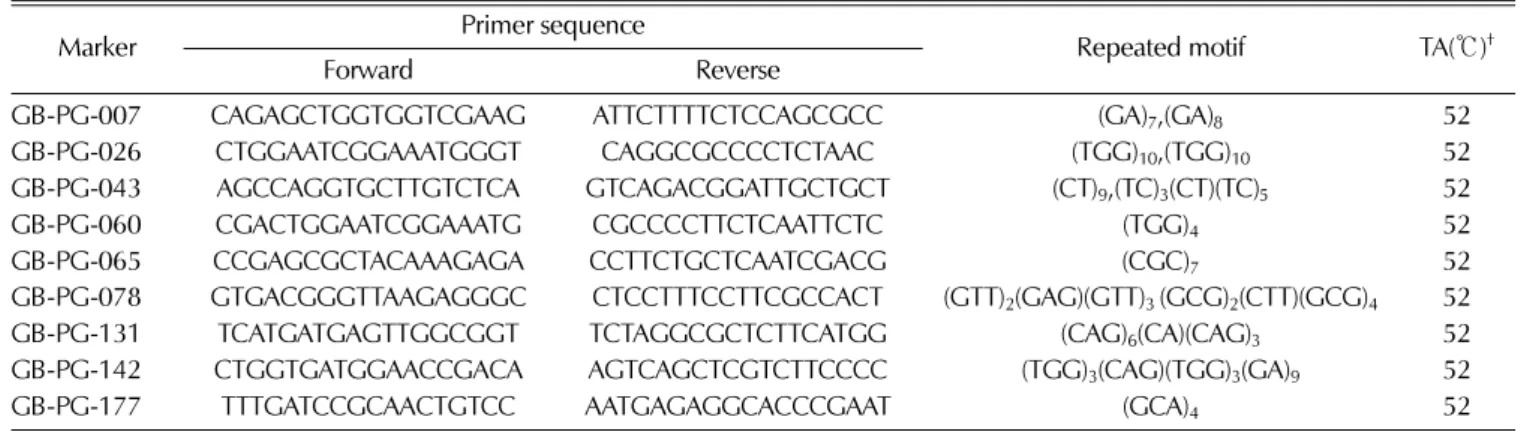
본 실험에서는 위에서 보고된 22 개의 마커 중 다형성과 재 현성이 좋은 9 개의 마커 (GB-PGM-007, GB-PGM-026, GB- PGM-043, GB-PGM-060, GB-PGM-065, GB-PGM-078, GB-
PGM-131, GB-PGM-142, GB-PGM-177) 를 선발하여 천풍 ,
연풍 , 고풍 , 선풍 및 금풍의 고려인삼 5 품종을 대상으로 유전 자형을 분석하였다 (Table 2). 그 결과 총 23 개의 대립유전자 가 관찰되었는데 , 대립유전자수의 범위는 1 개 (GB-PGM-078)
에서 4 개 (GB-PGM-065) 로 나타났으며 평균 대립유전자수는 2.6 개 이었고 , 평균 Gene diversity 는 0.480 이었다 (Table 3).
한편 Park 등 (2009) 은 5 개의 다형성 SSR 마커를 선발하여 국내 재배종에 대한 유전적 다양성을 분석 하였는데 , 그 결과 평균 대립유전자 수는 3.45 개였으며 , 평균 Gene diversity 는
0.367 로 보고하여 본 연구에 활용한 SSR 마커가 조금 더 높 은 다양성을 보이는 것으로 나타났다 . 식물 자원의 변이를 탐
색하기 위하여 SSR 마커가 RAPD 등 다른 DNA 표지기술에
비하여 보다 효율적으로 유전적 다양성을 탐색하기에 적합하 였다는 보고와 같이 (Olufowote et al ., 1997; Ji et al ., 1998;
Kwon et al ., 2000; Chung et al ., 2009), 인삼 품종 , 재배종
등 에 대한 변이 분석에 SSR 마커가 더 효율적으로 활용 될
수 있을 것으로 생각된다 .
Table 2.
Information of nine SSR markers used in this study.
Marker Forward Primer sequence Reverse Repeated motif TA(
℃)
†GB-PG-007 CAGAGCTGGTGGTCGAAG ATTCTTTTCTCCAGCGCC (GA)
7,(GA)
852
GB-PG-026 CTGGAATCGGAAATGGGT CAGGCGCCCCTCTAAC (TGG)
10,(TGG)
1052
GB-PG-043 AGCCAGGTGCTTGTCTCA GTCAGACGGATTGCTGCT (CT)
9,(TC)
3(CT)(TC)
552
GB-PG-060 CGACTGGAATCGGAAATG CGCCCCTTCTCAATTCTC (TGG)
452
GB-PG-065 CCGAGCGCTACAAAGAGA CCTTCTGCTCAATCGACG (CGC)
752
GB-PG-078 GTGACGGGTTAAGAGGGC CTCCTTTCCTTCGCCACT (GTT)
2(GAG)(GTT)
3(GCG)
2(CTT)(GCG)
452
GB-PG-131 TCATGATGAGTTGGCGGT TCTAGGCGCTCTTCATGG (CAG)
6(CA)(CAG)
352
GB-PG-142 CTGGTGATGGAACCGACA AGTCAGCTCGTCTTCCCC (TGG)
3(CAG)(TGG)
3(GA)
952
GB-PG-177 TTTGATCCGCAACTGTCC AATGAGAGGCACCCGAAT (GCA)
452
†
: Annealing temperature
Table 3.
Characterization of nine SSR markers in Korean ginseng cultivars.
Marker Number of alleles M
AF†H
O‡Gene diversity PIC
§GB-PG-007 2 0.50 1.00 0.50 0.38
GB-PG-026 4 0.70 0.60 0.48 0.45
GB-PG-043 3 0.60 0.80 0.54 0.47
GB-PG-060 2 0.50 1.00 0.50 0.38
GB-PG-065 4 0.30 1.00 0.74 0.69
GB-PG-078 1 1.00 0.00 0.00 0.00
GB-PG-131 2 0.50 1.00 0.50 0.38
GB-PG-142 3 0.50 1.00 0.58 0.49
GB-PG-177 2 0.60 0.80 0.48 0.36
Mean 2.6 0.578 0.800 0.480 0.399
†
: Major allele frequency
‡
: Observed heterozygosity
§
: Polymorphic information content
SSR 마커를 이용하여 천풍 등 5 품종을 판별하기 위하여 9
종의 형광표지 마커 (GB-PGM-007, GB-PGM-009, GB-PGM- 026, GB-PGM-043, GB-PGM-060, GB-PGM-065, GB-PGM- 078, GB-PGM-114, GB-PGM-177) 를 이용하여 자동 염기서열 분석기 (ABI-3730) 로 분석한 결과 , 이 중 GB-PGM-065 와
GB-PGM-142 의 두 종의 마커 조합에서 품종 특이적인 allele
이 관찰되었다 (Table 4).
두 종의 마커 조합 중 GB-PGM-065 마커를 이용한 유전양
상은 천풍과 금풍의 allele 이 동일했으며 (Fig. 1A), 연풍 , 고 풍 및 선풍이 동일한 allele 을 나타내어 5 품종을 두 그룹으로 구분할 수 있었다 (Fig. 1B). GB-PGM-142 마커를 이용한 유전자형은 선풍에서만 다른 4 품종들과 구분되는 특이적인
allele 이 관찰되어 향후 선풍을 구분하는 DNA 마커로 활용 될 수 있을 것으로 판단된다 (Fig. 1C and 1D).
Table 4.
Genotype information of five Korean ginseng cultivars by nine SSR markers.
Primers
Cultivars GB-
PG-007 GB-
PG-026 GB-
PG-043 GB-
PG-060 GB-
PG-065 GB-
PG-078 GB-
PG-131 GB-
PG-142 GB-
PG-177 Chunpoong
117
†, 232 127, 133, 137, 188, 191 185 179
150, 184
267 204,
207
162, 174
283, 287
Yunpoong 184 162, 174
Gopoong 184 162, 174
Sunpoong 184 166, 174
Kumpoong 150, 184 162, 174
†:
Allele size of Korean ginseng cultivars which were detected by nine SSR markers
Fig. 1.