179
FOREST SOCIETY
Effect of the Application of an Organophosphate Pesticide (Fenitrothion) on Foraging Behavior of Ants
Tae-Sung Kwon*
Division of Forest Ecology, Korea Forest Research Institute, 57, Hoegiro, Dongdaemun-gu, Seoul 130-712 Korea
Abstract :Organophosphate pesticides inhibit cholinesterase. It is likely that application of organophosphate pesticides affect behavior of arthropods. This study aimed to find changes in foraging behavior of ants due to application of fenitrothion, one of the widely used organophosphate pesticides. Foraging activity (FA) of ants was observed using bait cards in a pesticide sprayed pine stand and in an unsprayed stand before and after aerial application of fenitrothion in 2003 and 2004. Ant abundance and species richness of ants were also monitored using pitfall traps during the activity season in 2003 and 2004. There was not a significant decrease in abundance and species richness after the application of fenitrothion. However, FA of an ant, Paratrechina flavipes (Smith), which was abundant enough to be statistically compared, was depressed from 2 hours to 10 days after application of the pesticide. FA was fully recovered at day 14 in 2003, and was partially recovered at day 18 and fully at day 31 in 2004. FA of other ant species also decreased significantly during the FA depression period of P. flavipes. On the bait cards, workers of the species responded dully to baits during the FA depression period. Despite the decline in activity, alertness of P.
flavipes to other species did not decrease even during the FA depression period.
Key words :insecticide, competition, foraging behavior, aerial spray, Paratrechina flavipes
Introduction
Development of the first organic pesticides (DDT) in 1874 contributed to an increase in food production and to a decline in epidemics of human diseases vectored by insects (Freedman 1989). Despite the astonishing achieve- ments on pest control, DDT has long persistence time in ecosystem and caused environmental contamination. To overcome these problems, various organic pesticides such as lindane, cyclodienes, organophosphates, and carbamates had been developed. Organophosphate pesticides are used as insecticides, acaricides, and nematicides. They have a high toxicity to arthropods but a short persistence time in the environment (Freedman 1989, Fukuto 1961). These pesticides are also highly toxic to nontarget arthropods (EXTOXNET 2004), and a variety of studies on their impacts on nontarget arthropods have been carried out.
However, most of these studies focused changes of arthropod abundance and richness caused by pesticides.
The toxicity of organophosphate pesticide is due to the inhibition of cholinesterase (Fukuto 1961, Nath and Kumar 1999, Villatte and Bachmann 2002), which kills
animals at higher dosage and which likely changes var- ious behaviors at lower dosage. However, changes of behaviors of surviving arthropods are unexplored except for a few studies (Perfecto 1990, Murphy and Croft 1990) which document changes of ant foraging activity after pesticide application.
Ants are a good model to study the change of behav- iors because of their abundance, diversity, ease in obser- vation, and wide season of activity (Hölldobler and Wilson 1990, Agosti et al., 2000). The baiting method was widely used to study foraging patterns, territorial behavior, and competition among ants (Halley and Burd 2004, Morri- son 2002, Feller 1987). This tool may also be effectively used for detecting changes in foraging, feeding and com- petition behaviors after pesticide application. Ants were used to study nontarget impacts of pesticides in a few studies, but these were aimed to determine changes in abundance and richness of ant communities caused by pesticide application. The results of these studies do not agree (Chong et al., 2007); some showed significant impacts of pesticide but most did not (Matlock and Cruz 2003).
In my previous work, I did not find any significant non-target impacts on ants in fenitrothion-sprayed pine stands (Kwon et al., 2005, Kwon 2008). The aim of the present study is to determine whether foraging behavior
*Corresponding author E-mail: [email protected]
of ants is changed by pesticide application. I predicted that, because the nerve system of ants is disturbed by the inhibitory action of fenitrothion on cholinesterase, ants attracted to baits would decrease because smell and/or communication between workers are affected, and that they would dully respond to baits. In addition, ants may be less alert to ants of other species, which may lead to a decrease of interspecies competition in feeding behav- ior. Changes of abundance and species richness of ant communities were monitored using pitfall traps during activity seasons of the study years.
Materials and Methods 1. Study sites and treatment
The study was conducted in Haman, Gyeongsangnam- do (35o 15' N, 128o 30' E), in southern Korea. The two study sites, pesticide-sprayed and unsprayed, were selected from the secondary pine forests of approximately 30 years of age. The sprayed and unsprayed sites were 1.6 km apart. Japanese red pine, Pinus densiflora, was most abundant, followed by Pinus thunbergii. Shrubs and herbs were well developed. More details on the sites are shown in Kwon (2008). The insecticide aerial sprays were conducted three times in 2003 (6, 16 and 28 June), and one in 2004 (6 June). The dose of the insecticide (fenitrothion 50% EC) was 0.5 kg a.i.. The aerial spray was done early in the morning (05:30-08:00 a.m.) from a Korea Forest Service helicopter (Bell-206L3). Flying speed was 30-35 knot/h and height above the canopy was 5-10 m (KFRI, 1996). During the study period, the average of temperature in the study area was 14.8oC in 2003 and 15.7oC in 2004 (KMA 2008). Annual precip- itation was 2,036 mm in 2003, and 1,827 mm in 2004.
2. Ant survey
Foraging activities (FA) of ants were surveyed using 25 bait cards, which were set on the ground in a line at an interval of 5 m. Strawboard (11.5×16 cm2) was used as bait cards and small pieces of tuna (10-20 g) were put on the center of the card as bait. Ants on the cards were counted 10, 20, and 30 minutes later after the cards were set up. Behaviors of ants on cards were classified as for- aging or feeding. Attacks and killed ants were also recorded. Each card was observed for about 10 seconds.
The FA surveys were performed on sunny days.
Surveys were conducted on six study days in 2003; 5 June 2003 (-1 day; one day before the first pesticide spray), 6 June (3 h, 6 h after the first pesticide spray), 10 June (4 days after the first pesticide spray), 26 June (10 d after the second spray day), and 14 July (14 days after the third spray day). Surveys were conducted on eight days in 2004; 6 June (-4 days; 4 days before the spray),
10 June (2 h after the spray), 11 June (1 days after the spray), 12 June (2days after the spray), 13 June (3 days after the spray), 16 June (6 days after the spray), 28 June (18 days after the spray), and 11 July (31 days after the spray). The surveys were usually conducted for 2 hours from 14:00 to 16:00 except the survey at the 2 and 3 h surveys on 5 June 2003 and 10 June 2004 respectively, which were conducted from 10:00 to 12:00. The survey at the unsprayed site was conducted 1 hour after the sur- vey at the sprayed site, but was not conducted on 5 and 10 June 2003. During the surveys, temperature was recorded using a maximum-minimum thermometer. Mean of tem- perature during the surveys was 28.8±1.4oC (SD) in 2003, and 29.3±1.3oC in 2004.
To monitor changes in abundance and species richness during the activity season, pitfall traps made of plastic bottles of 292 cm3 volume (depth 6.5 cm, mouth diam- eter 8.5 cm, bottom diameter 6.5 cm) were used from May to October in the study years. Ten pitfall traps were filled one third with polyethylene glycol and were set up in a line with 5 m between them. The pitfall traps were changed monthly on most season except in June they were changed biweekly.
3. Ant identification
During the FA survey, all ants were identified to spe- cies except the genus of Crematogaster, which were identi- fied as Crematogaster osakensis or C. spp.; C. matsumurai, C. vagula, and C. teranishi, were identified as C. spp because they were difficult to identify in the field. Ants specimens collected in pitfall traps were identified to species. The specimens were deposited at the Forest Ecology Laboratory of Korea Forest Research Institute.
4. Data analysis
The number of individuals and species of ants col- lected in ten pitfall traps was represented as abundance and species richness, respectively, on each sampling day.
Descriptive analysis was applied on abundance and spe- cies richness, because there was no replication of data.
Among the 12 ant species observed on bait cards, Paratrechina flavipes was the only one abundant enough to be tested statistically. Therefore, only FA of P. flavi- pes was examined in this study. The number of P. fla- vipes individuals observed on bait cards was log- transformed [ln (N+1)] to reduce variance and was com- pared using one-way ANOVA of three observations (i.e.
10, 20, 30 minutes) followed by multiple comparison of Neuman Keuls. In addition, the data of the sprayed site were compared with data of the unsprayed site using one- tailed t-test because the number of ants was expected to decrease because of the pesticide spray. When the null hypothesis was rejected, the impact of pesticide was
assumed to affect FA of ants. On the basis of this deci- sion, all study times at the sprayed site were grouped as the ‘Depressed’ time with significant impact of pesticide on behavior change and ‘Normal’ time with non-signif- icant impact. All study times at the unsprayed site were grouped as ‘Normal’ time. Frequencies (i.e., number of observed surveys) of other ant species except P. flavipes
were compared between the ‘Depressed’ and ‘Nomal’
times to find the impact of pesticides on FA of the spe- cies. To find the effect of pesticides and interspecific com- petition on FA of P. flavipes, the proportion of ants of P.
flavipes participating in feeding behavior with the absence of other ant species were compared with those in the pres- ence of other species between ‘Depressed’ and ‘Normal’
times. The proportions were arcsine-transformed for nor- malization, and were analyzed using two-way ANOVA with two factors, pesticide (‘Depressed’ or ‘Normal’) and other species (presence or absence), followed by a poste- riori Keuls-Newman multiple comparison. All analyses were conducted using Statistica (ver. 6.1).
Results
Twenty three ant species were collected in pitfall traps at the sprayed and unsprayed sites, and about half that number of species was observed on the bait cards (Table 1). Attractiveness to bait was significantly different among ant species. Ten-fold or more ants of P. flavipes were observed on bait cards than collected in pitfall traps.
However, although Pachycondyla javana was one of most abundant species in pitfall traps, only one ant was
Table 1. The number of ants observed on bait cards or collected in pitfall traps in the sprayed and unsprayed pine stands.
Species Sprayed Unsprayed
Bait Pitfall Bait Pitfall
Aphaenogaster japonica 24 1
Camponotus japonicus 148 132 302 541
Crematogaster osakensis 5 7
Crematogaster spp. 2 27 18 13
Dolichoderus itoi 1
Formica japonica 1 1 13
Lasius japonicus 25
Messor aciculatus 1
Monomorium chinense 91 39 155 234
Myrmecina nipponica 1
Pachycondyla chinensis 1 2
Pachycondyla javana 150 1 196
Paratrechina flavipes 10,486 1,163 14,252 1,081
Pheidole fervida 6 35 9
Ponera japonica 3 1
Pristomyrmex pungens 58 158 414
Proceratium itoi 1 1
Solenopsis japonica 39 9
Strumigenys lewisi 18 11
Tapinoma melanocephalum 1
Technomyrmex gibbosus 4
Tetramorium tsuhimae 19 32
Vollenhovia emeryi 13 1 12
No. of Species 7 18 9 19
No. of Individuals 10,796 1,837 14,750 2,576
Figure 1. Ants collected in pitfall traps; number of species (A), number of total ants (B), and number of Paratrechina flavipes
ants (C). Arrows indicate dates of pesticide application.
attracted to bait (Table 1). Figure 1 shows seasonal changes in abundance and species richness at the sprayed and unsprayed sites from May 2003 to Septem- ber 2004. Compared to the pre-spray periods, no differ- ence was found in species richness and abundance of ants at the sprayed site. Furthermore, the change of abundance of P. flavipes at the sprayed site was syn- chronous with that of the unsprayed site before and after the pesticide spray in 2003 and 2004. These results strongly suggest that fenitrothion did not significantly change abundance or species richness of ants.
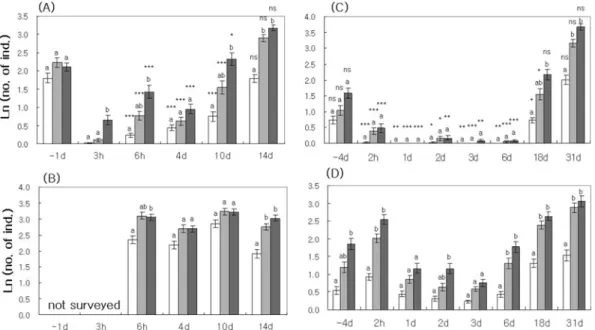
However, the pesticide spray significantly affected FA of P. flavipes ants (Figure 2). Compared to the mean of number (log-transformed) of P. flavipes on the day before the first pesticide spray in 2003, the figure abruptly decreased 3 h after the spray. When compared with that of the unsprayed site, the figures of the sprayed site were significantly lower from 6 h to 10 d after the spray.
At 14 d, however, the mean number of P. flavipes at the sprayed site did not differ from the mean number at the unsprayed site, representing the recovery of FA. A sim- ilar ephemeral depression and recovery of FA of P. fla-
vipes was also recognized in 2004. When mean numbers were compared between the sprayed and unsprayed sites at 4 d before the pesticide spray in 2004, there was no difference. However, the mean number of ants at the sprayed site was consistently lower from 2 h to 6 d, showing a depression of FA during this period.
The mean number of ants at the sprayed site increased greatly at 18 d in 2004. The mean number of ants at the
third observations (30 minutes) was not lower than that of the unsprayed site. However, the mean number of ants at the first (10 minutes) and second (20 minutes) observations were significantly lower than that of the unsprayed site. It is likely that ants at the sprayed site respond more slowly to baits even at 18 d after the pes- ticide spray. Hence, ants at 18 d in 2004 did not seem to be fully recovered at the sprayed site, implying a remaining inhibition of cholinesterase. In addition, the dull response to bait was ascertained by a decrease of ants which were participating in feeding behavior on the
‘Depressed’ times (0.463±0.297 (SD), n=874 in ‘Nor- mal’ times, 0.298±0.315, n=168 in ‘Depressed’ times;
Figure 2. Number (ln N+1) of Paratrechina flavipes ants observed at the bait cards at the sprayed site in 2003 (A), unsprayed site in 2003 (B), sprayed site in 2004 (C), unsprayed site in 2004 (D). Error bars indicate one SE. Different captions above bars mean significant difference of means among three observations (i.e. 10 minutes, 20 minutes, and 30 minutes). Asterisks and ns in the sprayed stand represent significant and insignificant difference between the sprayed and unsprayed stands, respectively. *: p < 0.05, **: p < 0.01, ***: p < 0.001.
Figure 3. Proportion (arcsine-transformed) of Paratrechina flavipes ants feeding on baits among total P. flavipes ants on bait cards. The open and dark bars show the means in the presence and the absence of other ant species, respectively.
Error bars indicate one SE. The categories ‘Normal’ and
‘Depressed’ are explained in text. Different captions above bars mean significant differences of means among the groups.
Mann Whitney test, U=50548, p<0.001). When ants of other species were present on bait cards, the proportions of P. flavipes ants showing feeding behavior also signif- icantly decreased (0.447±0.309, n=905 in absence of other species, 0.367±0.277, n=137 in presence of other species; Mann Whitney test, U=52342, p<0.01). The interspecies inhibitions on feeding behavior were shown in both ‘Normal’ and ‘Depressed’ times (Figure 3), showing no significant interactive effects of pesticide and com- petition (two-way ANOVA, F=0.095, df=1, p=0.758).
This illustrates that pesticide did not decrease the alert- ness of ants to other species.
Depression of FA in the ‘Depressed’ times of P. flavipes also occurred in other ant species (Figure 4). In Cam- ponotus japonicus, which were dominant in abundance and behavior, only 11 of 148 ants observed on bait cards at the sprayed site were counted in the ‘Depressed’ times in 2 h, 10d in 2003, and 18 d in 2004 (Table 1). Similarly, in Monomorium chinense, only 18 of 97 ants attracted to baits at the sprayed site were found during ‘Depressed’
times in 4 d, 10 d in 2003 and 18 d in 2004. Other species such as Crematogaster osakensis, C. spp., Formica japon- ica, Pachycondyla javana, Pheidole fervida, Tetramorium tushimae, and Vollenhovia emeryi, were only attracted to baits in the ‘Normal’ times at the sprayed site and at the unsprayed site. Compared with other species, more Pris- tomyrmex pungens ants were attracted to baits in
‘Depressed’ times. At the sprayed site, 14 ants of this spe- cies were observed in ‘Depressed’ times (4d, 10d in 2003), while 44 ants were observed during ‘Normal’
times (16 d in 2003, 31 d in 2004).
Discussion
Despite non-significant impacts of fenitrothion sprayed on abundance and species richness of ant communities,
the surviving ants showed depressed behavior as expected.
Although a similar recovery process of FA of P. flavipes was observed in both 2003 and 2004, the recovery rate and the strength of depression were different between two years. P. flavipes was fully recovered at 14 d after pesticide spray in 2003, but only partially recovered at 18 d in 2004. Rainfalls differed between two years.
Rainfall in 2003 was 372 mm during the 14 d, while that in 2004 was 289 mm during the 18 d. Rainy days were 13 d in 2003 and 9 d in 2004 during the periods. For- aging activity of ants decrease in rainy days, so contacts of ants with pesticide would decrease. Furthermore, rain removed pesticide sprayed on foliage and litter in the sprayed pine stand (Kim et al., 2005).
P. flavipes, the main species in present study, is abun- dant in forests in most regions of South Korea, espe- cially in southern part (Kwon, unpublished). This small ant species is monogynous species and is endemic to north-eastern Asia. They live in forest and grassland in small colonies (JAID 2008, Ichnose 1986). Although P.
flavipes was most abundant in pitfall traps and on bait cards in present study, the species was not dominant over other species in competition for foods. On a bait card, P. flavipes monopolized bait during the first obser- vation, but they were replaced by workers of Pristo- myrmex pungense. The two species attacked each other around baits. When workers of P. flavipes contacted with workers of Componotus japonicus, they were sometimes killed by the big ants. However, P. flavipes frequently attacked C. japonicus, so C. japonicus also avoided the bait occupied by many workers of P. flavipes. Workers of P. flavipes were alert even to the presence of smallest ants, Monomorium chinense. Workers of P. flavipes feed- ing on baits significantly decreased in the presence of the small ants. Thus, all ant species avoided contact with other ant species on bait cards. The well-known hierar- chical system of ant communities (Feller 1987, Cerdá et al. 1998, Basu 1997, LeBrun 2005) was not apparent among ant species at the study sites, since dominant and subordinate ant species were not clearly divided. Con- specific attacks were also observed among workers of P.
flavipes. The strong tension among ants due to compe- tition for foods may lead to persistence of alertness to other ants under the dullness caused by pesticide.
Other studies using baiting methods also indicated sig- nificant impacts of pesticide application on ant fauna. In the study using the baiting technique, ant foraging activ- ity decreased significantly after application of chlorpy- rifos, another organophosphate pesticide (Perfecto 1990).
The decrease led to depressed predation on pests by ants and the resurgence of pests. However, it is possible that some portion of the depressed predation was caused by the decreased foraging activity of surviving ants rather Figure 4. Frequency (number of observed surveys) of ant
species except Paratrechina flavipes occurring on bait cards. The numbers indicate the following ant species; 1:
Camponotus japonicus, 2: Monomorium chinense, 3:
Pristomyrmex pungens, 4: Pheidole fervida, 5: Crematogaster spp., 6: Tetramorium tsushimae, 7: Pachycondyla javana, 8: Aphaenogaster japonica, 9: Formica japonica, 10:
Vollenhovia emeryi, and 11: Crematogaster osakensis. The categories ‘Normal’ and ‘Depressed’ are explained in text.
than decreased foragers, as indicated by the author. Mur- phy and Croft (1990) showed that ants attracted to bait boards decreased more after carbaryl application, com- pared with ants collected at drop traps. They attributed the great decrease to a change in behavior rather than to killed ants. Most of other studies using pitfall traps did not report the significant impacts of pesticides. Chong et al. (2007) showed that ants in vineyards were not influ- enced by application of chlorpyrifos. They documented that ants should not be considered indicators for assess- ment of pesticide impacts because worker abundance may be a poor indicator of chemical pressures. The non- significant impacts of pesticides on ants were also reported in other studies using pitfall traps (Catangui et
al., 1996, Kwon et al., 2005, Matlock and DE RA Cruz 2003, Wang et al., 2000). Thus, conclusions for impacts of pesticides on ants may be dependent on survey meth- ods.The results of present study uncovered a neglected phenomena, the decreased activity of surviving ants caused by cholinesterase inhibition of pesticides. In the few studies using baiting methods, the number of ants attracted to baits was assumed to represent the number of ants (e.g. Murphy and Croft 1990, Perfecto 1990) but the number of ants attracted to bait does not have a strong relationship to the number of existing ants, as shown in present study. The decrease in behavior activ- ity leads secondarily to a change of arthropod commu- nities in pesticide sprayed forests. It is likely that colony- related behaviors, such as nursing and cleaning nests, would be inhibited during the short term pesticide-inhib- itory period, which temporarily decreases production of ants. The decreased activity of ants would also lower ant pressure on other arthropods. Activity of other arthro- pods may also temporarily decrease. The effect of pes- ticides on activity of surviving arthropods also changes the influences of arthropods on plants, fungi and bacte- ria. Rapid recovery from the dullness caused by pesti- cides may be important for the continuous survival of arthropods in pesticide sprayed ecosystems. Hence, the behavior change due to pesticide should be regarded as nontarget impacts of pesticides.
Acknowledgments
I thank Dr. Seong-Joon Park and Prof. Dong-Pyeo Lyu for identifying ants. This study was funded by the Korea Forest Service.
Literature Cited
1. Agosti, D., Majer, J.D., Alonso, L.E. and Schultz, T.R.
2000. Ants, Standard Methods for Measuring and Mon-
itoring Biodiversity. Smithsonian Institution Press, Wash- ington.
2. Basu, P. 1997. Competition hierarchy in the ground for- aging ant community in a wet evergreen forest (West- ern Ghats, India): Role of interference behavior. Current Science 73: 173-179.
3. Cantangui, M.A., Fuller, B.W., Walz, A.W., Boetel, M.A. and Brinkman, M.A. 1996. Abundance, diversity, and spatial distribution of ants (Hymenoptera: Formi- cidae) on mixed-grass rangelands treated with difluben- zuron. Environ. Entomol. 25: 757-766.
4. Cerdá, X., Retana, J. and Manzaneda, A. 1998. The role of competition by dominants and temperature in the for- aging of subordinate species in Mediterranean ant com- munities. Oecologia 117: 404-412.
5. Chong, C.S., Hoffmann, A.A. and Thomson, L.J. 2007.
Commercial agrochemical applications in vineyards do not influence ant communities. Environ. Entomol. 36:
1374-1383.
6. EXTOXNET (Extension Toxicology Network). 2004.
http://extonet.orst.edu/pips. (assessed on 25 August 2004) 7. Feller, J.H. 1987. Interference and expoitation in a guild
of woodland ants. Ecology 68: 1466-1478.
8. Freedman, B. 1989. Environmental ecology, the impacts of pollution and other stresses on ecosystem structure and function. Academic Press, Inc. Toronto.
9. Fukuto, T.R. 1961. The chemistry of organic insecti- cides. Ann. Rev. Entomol. 6: 313-332.
10. JAID (Japanese Ant Image Database). 2008. http://
ant.edb.miyakyo-u.ac.jp/. (assessed on 10 July 2009) 11. Halley, J.D. and Burd, M. 2004. Nonequilibrium dynamics
of social groups: insights from foraging Argentine ants.
Insect. Soc. 51: 226-231.
12. Hölldobler, B., and Wilson, E.O. 1990. The Ants. Har- vard University Press, Cambridge, 732pp.
13. Ichnose, K. 1986. Occurrence of polydomy in a monog- ynous ant, Paratrechina flavipes (Hymenoptera, Formi- cidae). Kontyû 54: 208-217.
14. KFRI (Korea Forest Research Institute). 1996. Tech- nique Development for Increasing of Effect with Aerial Control on Chestnut Tree Insect Pests. Ministry of Agriculture and Forestry, Seoul, 57p (in Korean with English summary).
15. Kim, C.S., Lee, Y.D., Choi, J.H. and Lyu, G.H. 2005.
Remains of insecticide. In: Choi GS, Kwon TS, Chung YJ, Shin SC (eds) Effects of aerial pesticide application for control of pine wilt disease on ecosystem of pine forest. Research Report of Korea Forest Research Insti- tute. Seoul, pp 157-175. (in Korean)
16. KMA (Korea Meteorological Administration). 2008. Annual and monthly reports on meteorological observations.
http://www.kma.go.kr/gw.jsp?to=/sfc/sfc_03_01.jsp 17. Kwon, T.S. 2008. Change of abundance of arthropods
in pine forests caused by aerial insecticide spray. Arch.
Environ, Contam, Toxicol. 54: 92-106.
18. Kwon, T.S., Song, M.Y., Shin, S.C. and Park, Y.S. 2005.
Effects of aerial insecticide sprays on ant communities to control pine wilt disease in Korean pine forests.
Appl. Entomol. Zool. 40: 563-574.
19. LeBrun, E.G. 2005. Who is the top dog in ant commu- nities? Resources, parasitoids, and multiple competitive hierarchis. Oecologia 142: 643-652.
20. Matlock, R.B. and R. DE RA Cruz. 2003. Ants as Indi- cators of pesticide impacts in banana. Environ. Ento- mol. 32: 816-829.
21. Morrison, L.W. 2002. Interspecific competition and coexistence between ants and land hermit crabs on small Bahamian islands. Acta Oecologica 23: 223-239.
22. Murphy, C.F. and Croft, B.A. 1990. Forest ant compo- sition and foraging following aerial spraying of car- baryl to suppress Western Spruce Budworm. Can.
Entomol. 122: 595-606.
23. Nath, B.S. and Kumar, R.P.S. 1999. Toxic impact of organophosphorus insecticides on acetylcholinesterase activity in the silkworm, Bombyx mori L. Ecotoxicol.
Environ. Saf. 42: 157-162.
24. Perfecto, I. 1990. Indirect and direct effects in a tropical agroecosystem: the maize-pest-ant system in Nicara- gua. Ecology 71(6): 2125-2134.
25. Villatte, F. and Bachmann, T.T. 2002. How many genes encode cholinesterase in arthropods. Pesticide 73: 122- 26. Wang, C., Starzanac, J. and Butler, L. 2000. Abundance,129.
diversity, and activity of ants (Hymenoptera: Formi- cidae) in oak-dominated mixed Appalachian forests treated with microbial pesticides. Environ. Entomol.
29: 579-586.
(Received December 15, 2009; Accepted March 22, 2010)