• 검색 결과가 없습니다.

Synthesis and Biological Evaluation of Some New2-propyl- 4(3H)-Quinazolinone Derivatives as Anti-bacteria

N/A
N/A
Protected

Academic year: 2021

Share "Synthesis and Biological Evaluation of Some New2-propyl- 4(3H)-Quinazolinone Derivatives as Anti-bacteria"

Copied!
10
0
0

로드 중.... (전체 텍스트 보기)

전체 글

(1)

2008, Vol. 52, No. 3

Printed in the Republic of Korea

항균성을 가진 새로운 2-propyl-4(3H)-Quinaz inone 유도체의 생물학적 평가와 합성

A. M. F. Eissa * , A. M. El-metwally ' , M. A. El-hashash * , and A. M. F. El-goharyFaculty of Science, Banha University, Egypt

^National Organization for Drug Control And Research, Egypt

* Faculty of science, Ain Shams University, Egypt (2008. 2. 8 접수 )

Synthesis and Biological Evaluation of Some New2-propyl-4(3H)- Quinazolinone Derivatives as Anti-bacteria

A. M. F. Eissa * , A. M. El-metwally, M. A. El-hashash * , and A. M. F. El-goharyFaculty of Science, Banha University, Egypt

^National Organization for Drug Control And Research, Egypt

* Faculty of science, Ain Shams University, Egypt (Received February 8, 2008)

주제어 : Benzoxazin-4(3H)one, Quinazolin-4(3H)one, Anthranil Keywords: Benzoxazin-4(3H)one, Quinazolin-4(3H)one, Anthranil

INTRODUCTION

Quinazolin-4-one is a frequently encountered unit in nature products such as L-vasicinone(l), 1 Chry- songine(2), 2 and drugs 3 such as methaqualone(3), 4 Nolatrexed(4), 5 Chloroqualone(5), 5 Diproqualone 5 (6).

This molecules which based on the quinazolin-4- one ring were reported as interesting pharmaco­

logical activities, 6 including anticonvulsant, antibacterial, anti tumor, 7 analgesic, 8 anti- inflammatory, 9 and anti-diabetic activity. 10,11 The most common synthetic method to quinazo- lin-4-one is based on acylation of anthranilic acid and ring closure with acetic anhydride to afford corresponding benzoxazinone 12 which was treated with hydrazine hydrate to give a new 3-aminoquinazolin-4-one derivatives. The current study also involves in vitro antimicro­

bial screening (neutriet agar) of synthesized quinazolinone derivatives by filter paper disc method. 13

RESULT AND DISCUSSION

The key starting material 2-propyl-4H- 3,l-ben-

zoxazin-4-one (2) has been synthesized via the

interaction of butyroyl chloride with anthranilic

acid in the presence of pyridine which yielded the

corresponding anthranil l. Treatment of anthranil l

with acetic anhydride afforded the benzoxazinone

2. The structure of anthranil l was proved from its

microanalytical data and its IR spectra (cm -1 ) which

showed strong absorption bands at 1672, 1693,

(2)

3286 and 3422 attributable to 七密 of two carbonyl groups, uNH and uOH respectively. IR spectrum of the benzoxazinone 2 exhibits strong absorption bands at 1614, 1764 (cm -1 ) due to Ugx.of C=N and C=O and lack of any band for NH and / or OH such IR data agreed well with the proposed structure.

The 3-amino-2- propylquinazolin-4(3H)-one (3) resulted via treatment of the Benzoxazinone 2 with hydrazine hydrate in boiling ethanol. The structure of compound 3 was confirmed based on its elemen­

tal and spectral analyses, thus IR spectrum of com­

pound 3 reveals strong absorption band at 1596, 1673, 3309 and 3212 attributable to for C=N, C=O and NH. EIMS of compound 3 exhibits an ion peak at m/z (M + ,203). 1 HNMR spectrum of compound 3 exhibits 3(ppm) in CDC, 1 (t,3H,CH), 1.8(m, 2H,CHMe), 2.8(t, 2H, CHQ), 7.2-8 (m, 4H, aromatic), 9.3(s, 2H, NH).

Stirring of 3-amino-2- propylquinazolin-4(3H)- one (3) with aromalic aldehydes namely, 3,4- dimethoxy benzaldehyde, 4-N,N-dimethylami- nobenzaldehyde and 3,4-methylenedioxy benzalde­

hyde in ethanol at room temperature afforded 3- (arylidenamino)-2-propylquinazolin-4(3H)-ones (4a-c).

The structure of compound 4 were confirmed on the basis of their elemental analyses. Thus IR spec­

tra of compounds (4a-c) revealed strong absorption bands at 1600-1612, 1669-1676; attributable to uC=N and uC=O respectively, and lacked of any band due to NH?. On treatment of compounds 4a-c with aromatic aldehyde namely, 3,4-dimethoxy benzaldehyde, 4-N,N-dimethylaminobenzaldehyde and 3,4-methylenedioxy benzaldehyde in refluxing glacial acetic acid the 3-(arylideneamino)-2-(1-phe- nylbut-1-en-2-yl)quinazolin-4(3H)-ones (5a-d) were obtained. The structure of compounds 5 were inferred from their IR spectra which exhibit strong absorption bands at the region 1600-1605 and 1670 -1676 attributable to 七熙 C=N and C=O respec­

tively. EIMS of compound 5b exhibited an ion peak at m/z (465; M + ).

when compound 3 was allowed to react with car­

bon disulfide and dimethylsulfate in the presence of sodium hydroxide it yielded methyl-4-oxo-2-propy- lquinazolin-3(4H)-ylcarbamodithioate (6), The struc­

ture of compounds 6 was inferred from elemental analyses, its IR spectrum revealed strong absorp­

tion bands at 1450 and 1673 attributable to umax C=S and C=O respectively and devoid the band of NH 》 The refluxing of compound 6 with secondary amine namely, piperidine, morpholine and pipra- zine in methanol yielded the corresponding car­

bothioamide 7a-c. IR spectra of compounds 7a-c exhibit absorption bands in the regions 1450-1470 and 1658-1670 cm -1 attributable to 七熙 of C=S and C=O respectively, EIMS of compound 7c gave molecular ion peak at M + (332).

Bromination of compound 3 by treatment with bromine in glacial acetic acid in the presence of sodium acetate yielded 1-(3-amino-4-oxo-3,4-dihy- droquinazolin-2yl)propyl acetate (8). Formation of compound 8 takes place via bromination of methyl­

ene group at position 2 followed by nucleophilic substitution by acetate ion. The structure of com­

pound (8) was proved from its IR spectrum (cm -1 ) which showed a strong absorption bands at 1612, 1645, 1725, 3214 and 3324 due to of C=N, C=O (amide), C=O (ester) and NH? respectively.

EIMS of 8 exhibited a molecular ion peak at (M + , 260). The reaction of ester 8 with phenylhydrazine involves nucleophilic substitution, with a subse­

quent oxidation process analogous to the formation of osazones 14 to afford 2-( 1 -phenylhydrazonopro- pyl)-3-amino-4(3H)-quinazolinone (9). IR Spec­

trum of compound (9) exhibits strong absorption bands at 1610, 1673 and 3200, 3300 and 3360 attributable to u^ for C=N, C=O, NH and NH2 respectively. On treatment of compound 9 with phosphoric acid under fisher indol synthesis condi­

tion yielded 3-amino-2-(-3-methylindolin-2-yl)quinazo- lin-4(3H)-one (10). IR spectrum of compound 10 revealed absorption bands at 1612, 1676, abroad band 3240-3400 due to 七熙 for C=N, C=O, and NH, NH respectively. When compound 10 was allowed to react with aromatic aldehydes namely, 3,4-dimethoxy benzaldehyde, 4-N,N-dimethylami- nobenzaldehyde and 3,4-methylenedioxy benzalde­

hyde afforded schiffs bases 3-(arylideneamino)-2- (3-methylinolin-2-yl)quinazolin-4(H)-one (11a-c).

the structure of compounds 11 were proved from

(3)

their IR spectra which showed absorption at regions 1600-1612, 1665-1675 attributable to n x for C=N and C=O and lack the band of NH^ EIMS of 11b exhibited a molecular ion peak (M + , 438).

Compound (3) was converted to 3-(cyclopentyli- dine/hexylidineamino)-2-propylquinazolino-4(3H)- one(12a,b) by the reaction with cyclopentanone and cyclohexanone in ethanol, the structure of com- pound(12a,b)were proved from their IR spectra (cm -1 ) which showed absorption bands at vmax 1675,

1610 attributable to C=O and C=N and devoid any band for NH^ EI.MS of 12a and 12b showed molecular ion peak at m/z (M + 269) and m/z (M +

283) respectively. When Compounds (12a,b) were submitted to react with thioglycolic acid gave spiro- componds (13a,b). IR spectra of compounds (13a,b) revealed strong absorption bands at Umax 16141687.

1675 and attributable to C=N and two carbonyl group respectively. EI. MS of 13b exhibited a molecular ion peak m/z (M + 357).

COOH pyridine

o

stirring

Acetic acid

a Ar= 3,4 C6H3(OCH3)2 b Ar = 4C6H4N(CH3)2 C Ar = 3,4C6H3O2CH2

aAr=3,4 C6H3(OCH3)2 b Ar = 4C사

1iN(CH3)2

Schem 1

a Ar= 3,4 C6H3(OCH3)2 b Ar = 4C사%N(CH3)2

= 3,4C6H3O2CH2

(4)

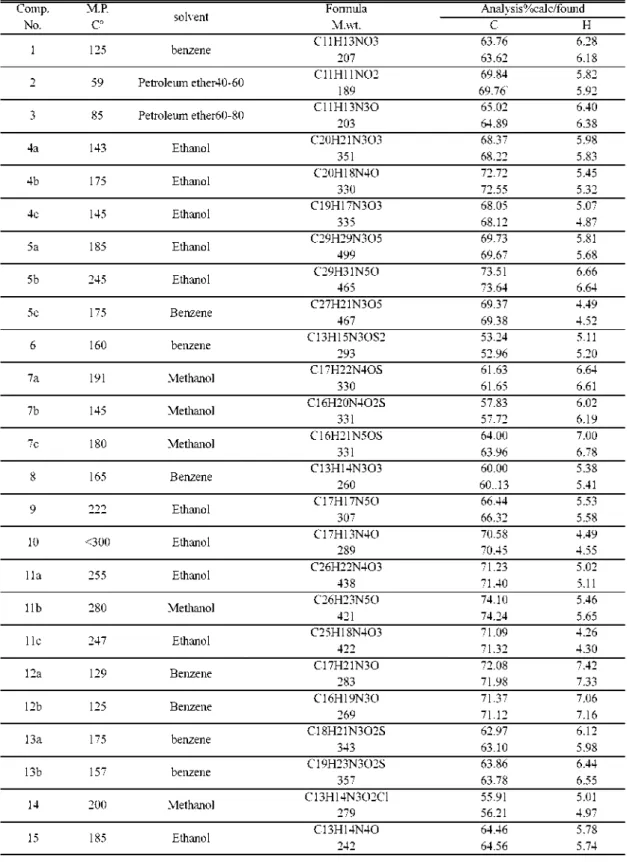
Table 1. Characterization and physical data of synthesized compounds Comp.

No.

M.P.

C solvent Formula

M.wt.

Analysis%calc/found

C H

1 125 benzene C11H13NO3 63.76 6.28

207 63.62 6.18

C11H11NO2 69.84 5.82

2 59 Petroleum ether40-60

189 69.76' 5.92

C11H13N3O 65.02 6.40

3 85 Petroleum ether60-80

203 64.89 6.38

4a 143 Ethanol C20H21N3O3 68.37 5.98

351 68.22 5.83

4b 175 Ethanol C20H18N4O 72.72 5.45

330 72.55 5.32

4c 145 Ethanol C19H17N3O3 68.05 5.07

335 68.12 4.87

5a 185 Ethanol C29H29N3O5 69.73 5.81

499 69.67 5.68

5b 245 Ethanol C29H31N5O 73.51 6.66

465 73.64 6.64

5c 175 Benzene C27H21N3O5 69.37 4.49

467 69.38 4.52

6 160 benzene C13H15N3OS2 53.24 5.11

293 52.96 5.20

7a 191 Methanol C17H22N4OS 61.63

61.65

6.64 6.61 330

7b 145 Methanol C16H20N4O2S 57.83 6.02

331 57.72 6.19

7c 180 Methanol C16H21N5OS

331

64.00 63.96

7.00 6.78

8 165 Benzene C13H14N3O3 60.00 5.38

260 60..13 5.41

9 222 Ethanol C17H17N5O 66.44 5.53

307 66.32 5.58

10 <300 Ethanol C17H13N4O 70.58 4.49

289 70.45 4.55

11a 255 Ethanol C26H22N4O3 71.23 5.02

438 71.40 5.11

11b 280 Methanol C26H23N5O

421

74.10 5.46

5.65 74.24

11c 247 Ethanol C25H18N4O3 71.09 4.26

422 71.32 4.30

12a 129 Benzene C17H21N3O 72.08 7.42

283 71.98 7.33

12b 125 Benzene C16H19N3O 71.37 7.06

269 71.12 7.16

13a 175 benzene C18H21N3O2S 62.97 6.12

343 63.10 5.98

13b 157 benzene C19H23N3O2S 63.86 6.44

357 63.78 6.55

14 200 Methanol C13H14N3O2Cl 55.91 5.01

279 56.21 4.97

15 185 Ethanol C13H14N4O 64.46 5.78

242 64.56 5.74

(5)

Table (2) : 13C-NMR of some synthesized compounds

Structure formula and compound No. 5 (ppm) carbon atom number

143.3 (C-1), 115.15(C-2), 129.7 (C-3), 122.4(C-4), 132.98(C-5), 121.52 (C-6), 168.8 (C-7), 173.0 (C-8), 38.1 (C-9), 19.0 (C-10), 13.2 (C-11)

155.2 (C-1), 161 (C-2), 120 (C-3), 128 (C-4), 127.4 (C-5), 133.5 (C-6), 122 (C-7), 147 (C-8), 25.1 (C-9), 14.6 (C-10), 13.9 (C-11)

164 (C-1), 160 (C-2), 120.9 (C-3), 128.8 (C-4), 127.4 (C-5), 133.5 (C-6), 122.4(C-7), 147.1(C-8), 25.6(C-9), 14.6(C-10), 13.9 (C-11), 143(C-12), 127 (C-13), 122(C-14), 115 (C-15), 151(C-16), 148 (C-17), 114(C-18), 101(C-19)

164 (C-1), 160 (C-2), 120.9 (C-3), 128.8 (C-4), 127.4 (C-5), 133.5 (C-6), 122.4(C-7), 147.1(C-8), 143(C-9), 127 (C-10), 122(C-11), 115 (C-12), 151(C-13), 148 (C-14), 114(C-15), 101(C-16), 56.1(C-17) ,32(C-18), 137(C-19),127(C-20), 116(C-21), 1 26(C-22),113(C-23), 1 49(C-24),15.9(C-25).

155.2 (C-1), 161 (C-2), 120 (C-3), 128 (C-4), 127.4 (C-5), 133.5 (C-6), 122 (C-7), 147 (C-8), 25.1 (C-9), 14.6 (C-10), 13.9 (C-11), 179.3 (C-12), 52.5 (C-13), 66.5(C-14)

155.2 (C-1), 164 (C-2), 123 (C-3), 130.5 (C-4), 127.4 (C-5), 133.5 (C-6), 122 (C-7), 148.8 (C-8), 25.4 (C-9), 14.6 (C-10), 13.7 (C-11),165.7(C-12), 49.7(C-13)

Interaction of 3-amino-2-propylquinazolin-4(3H)- one (3) with chloroacetyl chloride in pyridine yielded 2- chloro-N-(4-oxo-2-propylquinazolin-3(4H)-yl)ace- tamide (14), IR spectrum of compound 14 was revealed strong absorption bands at 1614, 1672, 1710 and 3120 attributable to ^max C=N , tow carbo­

nyl groups and NH. Treatment of compound 14

with ammonium acetate in oil bath yielded 6-pro-

pyl-2H-[ 1,2,4]triazin 이 2,3-c]quinazolin-3(4H)-one

(15). IR spectrum of 15 revealed strong absorption

bands at ^max 1615, 1680 and 3200 attributable to

1

猝 C=N,C=O, and NH respectively.

(6)

BIOLOGICAL PART

All the synthesized compound were screened for anti-bacteria activity using the following method.

The neutrient agar was used as media and filter paper disc (0.7 mm diameter). The qunazolinone derivatives were prepared in ethanol at 3 X concen­

trations (200

g/ml,100

g/ml and 50

g/ml) Two bacteria isolates (E.coli and Staph. Aureus) were used as a test organisms The compounds 3, 4a, 4b, 5a, 5b, 14 and 15 were highly active against (E.

Coli and B.Sublet), whereas 1, 4c, 5c, 7b, 7c, 8, 9, 12a, 12b, 13a and 13b showed moderate activity this microorganism. No significant inhibitory activ­

ity of other synthesized derivatives was seen by any against (E. Coli and B.Sublet).

EXPERMINTAL PART

All melting point are uncorrected and deter­

mined by the open capillary method using Gallen

Kamp melting point apparatus. Microanalysis were carried out by the Micro Analytical Unit at Cairo University. IR spectra (KBr disk) were recorded on FT/IR-300E Jasco spectrophotometer. HNMR spec­

tra were recorded in CDC^ or DMSO-d solution on a Varian EM 390-90 MHz. 15,16 Mass spectrome­

try were recorded were recorded Shomadzu, GC- MS (QP-1000EX).

2-

butyramidobenzoic acid (1)

A stirred solution of 2-aminobenzoic acid 13.7 g (0.1 mol) in dry pyridine (150 ml) was treated drop wise with n-butyroyl chloride 10.5 g (0.11 mol) during 10 min. the mixture was stirred at room tem­

perature (3 hours) and poured into a mixture of ice and hydrochloric acid gave crude 2-butyramidoben- zoic acid crystallize from the proper solvent. IR(KBr) cm -1 : 3422 (OH), 3286(NH), 3055 (CH aromatic), 2957, 2927, 2869 (CH aliphatic), 1693 (C=O, Acid),

1672 (C=O, amide) 2-

propyl-4H- 3,1-benzoxazin-4-one(2)

A suspension of 2-butyramidobenzoic acid 2.07 g Table 3. Inhibition zones in mm for the synthesized compound at deferent concentration

Comp. No. - E. Coli B. Sublet

50

g/ml 100

gml 200

g/ml 50

g/ml 100

g/ml 200

g/ml

1 9 12 13 10 11 11

2 12 15 20 15 16 18

3 25 29 33 22 26 29

4a 28 29 30 14 25 30

4b 26 30 33 23 28 29

4c 10 15 16 13 14 14

5a 28 19 32 22 25 29

5b 27 28 28 29 29 33

5c 8 15 16 11 13 15

7a

- -

-

- _ _ _

- -

7b 10 16 19 9 11 14

7c 8 11 12 6 12 13

8 5 11 13 14 15 17

9 11 15 19 15 18 20

10 - - _ _ _ -

11a - - _ _ _ -

11b - - _ _ _ -

11c - - _ _ _ -

12a 5 11 16 8 12 16

12b 9 11 13 8 13 19

13a 17 19 19 15 16 18

13b 9 15 19 10 12 16

14 25 27 30 28 29 33

15 26 28 29 28 29 34

(-) Represent no inhibition of growth

(7)

(0.01 mol) in 50 ml acetic anhydride was heated under reflux (3hours) and then concentrated. The solid was obtained crystallized from petroleum ether 40-60 o C, giving 2-propyl-4H-3,1-benzoxazin-4- one as a colorless crystals melting point(59 o C).

IR(KBr) cm -1 : 3055 (CH aromatic), 2965, 2935, 2875 (CH aliphatic),1764(C=O), 1614(C=N),1161 (C-O).

3-

amino-2 - propylquinazin-4(3H)-one (3) Compound (2) (1.89 g- 10 mmol) and 5 ml hydrazine hydrate were heated on water bath for 1/

2 hour and then added 50 ml ethanol the mixture was refluxed 3hours, then concentrated and poured on cooled water, the precipitate formed was col­

lected by filtration, dried and crystallization from petroleum ether 60- 80 o C to give (1.5g) 3-amino-2- propylquinazolin-4(3H)-one IR(KBr) cm -1 : 3309, 3212 (NH)3055 (CH aromatic), 2965, 2935, 2875 (CH aliphatic),1673(C=O), 1596(C=N); MS: m/z 203[M + ], 188, 174, 158, 145, 132, 104, 77; 1 HNMR (CDCL) : 57.2-8 (m, 4H, aromatic),12 (s, 2H, NH).

1(t, 3H, CH), 1.8 (sextet,2H,CHMe), 2.8 (t,2H, CHQ).

3-

(3,4-dimethoxybenzylideneamino)-2-propy- lquinazolin4(3H)-one (4a), 3-(4-(dimethylamino)- benzylideneamino)-2-propylquinazolin^(3H)-one (4b) and 3-(benzo[d][1,3]dioxol-5-ylmethylene- amino)-2-propylquinazin-4(3H)-one (4c)

a mixture of vetraldehyde (1.66 g., 10 mmol) or 4-

N,N-dimethylaminobenz aldehyde (1.49 g., 10 mmol) or piperonal (1.5 g., 10 mmol) and com­

pound 3 (2.03 g., 10 mmol) in 50 ml ethanol was stirred for 3 hr. the obtained solid was filtered off and recrystalization from the proper solvent to give 4a, 4b or 4c.

3-(3,4-dimethoxybenzylideneamino)-2-propy- lquinazolin-4(3H)-one (4a).

IR(KBr) cm -1 : 3076 (CH aromatic), 2962, 2919, 2870 (CH aliphatic), 1673(C=O), 1605(C=N); MS:

m/z 351[M + ], 320, 289, 192, 179, 97; 1 HNMR (CDC,): 57.7-8.4 (m, 7H, aromatic), 6 (s, H, N=CH), 3.4 (s, 6H, 2OCH), 1(t, 3H, CH), 1.5 (sextet,2H, C^.Me ), 1.3 (t,2H, 殂 Q).

3-(4-(dimethylamino)benzylideneamino)-2- propylquinazolin-4(3H)-one (4b).

IR(KBr) cm -1 : 3059 (CH aromatic), 2975, 2925, 2875 (CH aliphatic), 1675(C=O), 1600(C=N); MS:

m/z 330[M + ], 315, 300, 286, 273, 259, 244, 216, 188, 174; 1 HNMR (CDC,): 57.7-8.3 (m, 8H, aro­

matic), 6 (s, H, N=CH), 3.3 (s, 6H, N(CH)>), 1(t, 3H, CH), 1.9 (sextet, 2H, 殂 Me ), 2.9 (t, 2H, 殂 Q).

3- (benzo[d][1,3]dioxol-5-ylmethyleneamino)- 2-propylquinazolin-4(3H)-one (4c).

IR(KBr) cm -1 : 3076 (CH aromatic), 2962, 2919, 2870 (CH aliphatic), 1671(C=O), 1601(C=N), 1255 (C-O-C); MS: m/z 235[M + ], 320, 289, 274, 259, 254, 145; 1 HNMR (CDCl) : 57.2-8.1 (m, 7H, aro­

matic), 6.1 (s, 2H, O-CH2-O), 6 (s, H, N=CH) 1(t, 3H, CH), 1.8 (sextet, 2H, CHMe ), 2.8 (t, 2H, CHQ).

3,4-dimethoxybenzylideneamino)-2-(3,4-dime- thoxyphenyl)but-1-en-2-yl) quinazolin^(3H)-one(5a)

4- (dimethylamino)benzylideneamino)-2-(4-dime- thylamino)phenyl)but-1-en-2-yl) quinazolinM(3H)- one (5b)

1-

(benzd][1,3]dioxol-5-yl)but-1-en-2-yl)-3- (benzo[d] [1dioxol-5-ylmethylene amino)quinazo- m(3H)-one (5c).

A solution of compound 4a (3.51 g 10mmol) or 4b (3.3 g., 10 mmol) or 4c (3.35 g., 10 mmol) and vetral- dehyde (1.66 g., 10 mmol) or 4-N,N-dimethylami- nobenz aldehyde (1.49 g., 10 mmol) or piperonal (1.5 g., 10 mmol) respectively in 10 ml glacial ace­

tic acid and the mixtures were refluxed for 12 hours and then allowed to cool and the obtained solids were filtered and recrystallization from proper sol­

vent yielded (5a-c).

3,4-dimethoxybenzylideneamino)-2-(3,4-dime- thoxyphenyl)but-1-en-2-yl)quinazolin-4(3H)-one(5a).

IR(KBr) cm -1 : 3076 (CH aromatic), 2962, 2919, 2870 (CH aliphatic), 1673(C=O), 1605(C=N); MS:

m/z 499[M + ], 468, 437, 406, 375, 300, 225; 1 HNMR (DMSO-d) : 57.7-8.4 (m, 7H, aromatic), 6 (s, H, N=CH), 5.5 (s, 1H, C=CH) 3.4 (s, 12H, 2OCH),

1(t, 3H, CH), 2.2 (q,2H,CHMe).

4-(dimethylamino)benzylideneamino)-2-(4-dime- thylamino)phenyl)but-1-en-2-yl) quinazolinM(3H)- one (5b).

IR(KBr) cm -1 : 3059 (CH aromatic), 2975, 2925,

(8)

2875 (CH aliphatic), 1675(C=O), 1600(C=N); MS:

m/z 465[M + ], 421, 377, 315, 303, 228; 1 HNMR (DMSO-d) : 67.7-8.3 (m, 8H, aromatic), 6 (s, H, N=CH), 5.8 (s, 1H, C=CH), 3.3 (s, 12H, N(CHX),

1(t, 3H, CH), 2.2 (q, 2H, CHMe).

1-(benzd][1,3]diox 이- 5-yl)but-1-en-2-yl)-3- (benzo[d][1,3]dioxol-5-ylmethylene amino)quinazo- lin-4(3H)-one (5c).

IR(KBr) cm -1 : 3076 (CH aromatic), 2962, 2919, 2870 (CH aliphatic), 1671(C=O), 1601(C=N), 1255 (C-O-C); MS: m/z 467[M + ], 421, 375, 300, 225,210, 196; 1 HNMR (DMSO-d) : 57.2 -8.1 (m, 7H, aromatic), 6 (s, H, N=CH), 5.8 (s, 1H, C=CH),4 (s, 4H, 2O-CH-O), 1(t, 3H, CH), 2.2 (q, 2H, CHMe).

methyl 4-oxo-2-propylquinazin-3(4H)-ylcar- bamodithioate (6)

A solution of 3 -aminoquinazolinone 3 (4.06 g., 0.02 mol) in dimethyl sulphoxide (10 ml) was stirred vigorously. then added carbon disulphide (1.6 ml) and aqueous sodium hydroxide 1.2 ml (20 mol solution) dropwise during 30 min with stirring . Dimethyl sulphate (0.02 mol) was added gradually keeping the reaction mixture stirring in freezing mixture for 2 hr. The solid obtained was filtered, washed with water, dried and recrystallized from proper solvent gave (6). IR(KBr) cm -1 : 3250 (NH), 3066 (CH aromatic), 2979, 2906, 2867 (CH ali­

phatic), 1673(C=O), 1600(C=N), 1450 (C=S); MS:

m/z 293[M + ], 278, 246, 214, 202, 187, 172, 152, 142; 1 HNMR (CDCl) : 5 11 (s, 1H, NH), 7.4-8 (m, 4H, aromatic), 2.6 (s, 3H, SCH), 1(t, 3H, CH), 1.9 (sextet, 2H, CHMe), 2.8 (t, 2H, CHQ).

N-(4-oxo-2-propylquinazolin-3(4H)-yl)piperi- dine-4-carbothioamide (7a)

N-(4-oxo-2-propylquinazolin-3(4H)-yl)mor- phine-4-carbothioamide (7b)

N-(4-oxo-2-propylquinazolin-3(4H)-yl)pipera- zine-4-carbothioamide (7c)

A mixture of (2.93 g, 0.01 mol) and of piperidine or morpholine or piperazine (10 ml) was refluxed for 3 hr. the produced mixture was cooled triturated with methanol and the solid obtained was filtered off and re crystallization from proper solvent yielded (7a-c).

N-(4-oxo-2-propylquinazolin-3(4H)-yl)piperi- dine-4-carbothioamide (7a)

IR(KBr) cm -1 : 3225 (NH), 3045 (CH aromatic), 2963, 2900, 2862 (CH aliphatic), 2270 (C=S), 1645(C=O), 1600(C=N); MS: m/z 331 [M + ], 330, 252, 220, 208, 193, 162, 120; 1 HNMR (DMSO-d):

5 10.8 (s, 1H, NH), 7.2-87.7 (m, 4H, aromatic), 3.2 (s, 4H, NKHLpiperidine), 1.8 (pentet, 6H, piperi­

dine), 1(t, 3H, CH), 1.8 (sextet, 2H, CHMe), 2.8 (t, 2H, CHQ).

N-(4-oxo-2-propylquinazolin-3(4H)-yl)mor- pholine-4-carbothioamide (7b)

IR(KBr) cm -1 : 3225 (NH), 3045 (CH aromatic), 2963, 2900, 2862 (CH aliphatic), 2270 (C=S), 1645(C=O), 1600(C=N), 1110 (c-o-c); MS: m/z 331 [M + ], 330, 303, 205, 186, 162, 145, 120, 90. 77; 1 HNMR (DMSO-d) : 5 11 (s, 1H, NH), 7.2-7.7 (m, 4H, aro­

matic), 3.8 (t,4H,O(CH\ morphiline), 3.2 (t, 4H, N(CH\ morpholine), 1(t, 3H, CH), 1.9(sextet, 2H, CHMe), 2.8 (t, 2H, CHQ).

N-(4-oxo-2-propylquinazolin-3(4H)-yl)pipera- zine-4-carbothioamide (7c)

IR(KBr) cm -1 : 3225 (NH), 3045 (CH aromatic), 2963, 2900, 2862 (CH aliphatic), 2270 (C=S), 1645(C=O), 1600(C=N); MS: m/z 331 [M + ], 330, 303, 205, 186, 162, 145, 120, 90. 77.

1- (3-amino-4-oxo-3,4-dihydroquinazolin-2-yl)- propyl acetate (8)

A mixture of 3 (2.03 g, 10 mmol) and sodium acetate (10 mmol) in glacial acetic acid (20 ml) was added bromine (10 mmol) in glacial acetic acid (10 ml) drop wise at 40-50 o C the reaction mixture was stirred for 3 hr, and it was then left to stand in refrigerator overnight the crystals were filtered off, washed with water and recrystallization from proper solvent to give (8). IR(KBr) cm -1 : 3324, 3249 (NH) 3025 (CH aromatic), 2963, 2923, 2849 (CH ali­

phatic), 1725 (C=O ester), 1645(C=O quinazolinone), 1612(C=N), 1265 (C-O); MS: m/z 260 [M + ], 259, 244, 200, 184, 169, 155, 141; 1 HNMR (DMSO-d) : 5 12 (s, 2H, NH), 7.9 (s, 3H, COCH), 7.2-7.7 (m, 4H, aromatic), 5.5 (t, 1H, CHOCOMe), 1.2(t, 3H, CH), 2.2 (p, 2H, 殂 Me).

2- (1-phenylhydrazonopropyl)-3-amino-4(3H)-

quinazolinone (9)

(9)

To a solution of 8 (2.6 g, 0.01 mol) in ethanol (5 ml) was added phenyl hydrazine 1.81 ml, 2 g, 0.02 mol) the reaction mixture was refluxed for 4 hr. after cooling of mixture, the crystallized prod­

uct was filtered off, washed with cooled ethanol, dried and recrystallization from proper solvent pro­

duced (9). IR(KBr) cm -1 : 3360, 3300 (NH) 3200 (NH) 3025 (CH aromatic), 2963, 2923, 2849 (CH aliphatic), 1673 (C=O), 1610 (C=N); MS: m/z 307 [M + ], 306, 292, 278, 201, 187, 170, 77; 1 HNMR (DMSO-d) : 5 11.3 (s, 2H, NH), 7.2-7.7 (m, 9H, aromatic), 4.5 (s, 1H, NH), 2.1(q, 2H, CHJMe), 1.2 (t, 2H, CH).

3-amino-2-(3-methylindin-2-yl)quinazin-4 (3H)-one (10)

Compound 9 (3.07 g 0.1 mol)was added to 85%

phosphoric acid (25 ml) at 180 o C. the reaction mix­

ture was heated for 30 min then cooled and diluted with water 100 ml the solid was filtered and recrys­

tallization from the proper solvent gave (10).

IR(KBr) cm -1 : 3400-3324 (abroad NH and NH), 3060 (CH aromatic), 2940 (CH aliphatic), 1676 (C=O), 1612(C=N); MS: m/z 289 [M + ], 288, 274, 258, 144, 114; 1 HNMR (DMSO-d) : 5 11.2 (s, 2H, NH), 7.2-7.7 (m, 9H, aromaticand indole NH), 2.8 (s,3H, CH).

3-

(3,4-dimethoxybenzylideneamino)-2-(3-methy- lindin-2-yl)quinazin-4(3H)-one (11a), 3-(4- (dimethylamino)benzylideneamino)-2-(3-meth- ylindolin-2-yl)quinazolin^(3H)-one (11b), 3-(benzo- [d][1,3]diox 이- 5-ylmethyleneamino)-2-(3-meth- ylindolin-2-yl)quinazolin-4(3H)-one (11c).

To asolution of 10 (2.89 g, 0.01 mol) in DMF (20 ml) and vetraldehyde (1.66 g., 10 mmol) or 4- N,N-dimethylaminobenzaldehyde (1.49 g, 10 mmol) or piperonal (1.5 g., 10 mmol) the mixture was stirred at 50 o C for 3 hr following pouring the reac­

tion mixture in cooled water and recrystallization the solid produced from the proper solvent yielded (11a-c).

3-(3,4-dimethoxybenzylideneamino)-2-(3-methy- lindin-2-yl)quinazin-4(3H)-one (11a).

IR(KBr) cm -1 : 3180 (NH), 3055 (CH aromatic), 2967 (CH aliphatic), 1675 (C=O), 1610(C=N); MS:

m/z438 [M + ], 437, 407, 376, 361, 284, 271, 257,

144, 113; 1 HNMR (DMSO-d) : 5 7.2-7.9 (m, 12H, aromaticand indole NH), 6 (s, H, N=CH), 3.8(s, 6H, 2OCH), 2.8 (s, 3H, CH).

3-(4-(dimethylamino)benzylideneamino)-2-(3- methylindolin-2-yl)quinazolin-4(3H)-one (11b).

IR(KBr) cm -1 : 3195 (NH), 3065 (CH aromatic), 2957 (CH aliphatic), 1675 (C=O), 1607(C=N); MS:

m/z 421 [M + ], 377, 362, 349, 335, 191, 144, 77;

1 HNMR (DMSO-d) : 57.2-7.9 (m, 13H, aromatic and indole NH), 6 (s, H, N

H), 3.2(s, 6H, N(Cft^), 2.8 (s, 3H, CH).

3-(benzo[d] [1,3]dioxol-5-ylmethyleneamino)-2- (3-methylindin-2-yl)quinazin-4(3H)-one (11c).

IR(KBr) cm -1 : 3193 (NH), 3045 (CH aromatic), 2957 (CH aliphatic), 1675 (C=O), 1603(C=N); MS:

m/z 422 [M + ], 407, 377, 361, 286, 273, 259, 144, 115; 1 HNMR (DMSO-d) : 58.8 (s, H, N=CH), 7.2- 7.7 (m, 12H, aromaticand indole NH), 6 (s, 2H, OCHO), 2.8 (s, 3H, CH).

3-(cyohexylideneamino)-2-propylquinazolin- 4(3H)-one (12a), 3-( cyclopenty lidene amino)-2- propylquinazolin-4(3H)-one (12b).

Cyclohexanone (0.01 mol) or cyclopentanone (0.01 mol) was added to solution of 3 (0.01 mol ) in 50 ml ethanol. The reaction mixture was heated under reflux for 3 hr and then poured in cooled water and stirring the mixture for 5 min. the solid that separated was filtered and washed with water and recrystallized from the proper solvent giving (12a,b).

3-(cyclopenty lidene amino)-2-propylquinazo- lin-4(3H)-one (12a).

IR(KBr) cm -1 : 3035 (CH aromatic), 2967, 2906, 2876, 2789 (CH aliphatic), 1675 (C=O), 1609(C=N); MS: m/z 283 [M + ], 363, 239, 180, 146, 120, 92, 65.

3-(cyohexylideneamino)-2-propylquinazin- 4(3H)-one (12b).

3035 (CH aromatic), 2967, 2906, 2876, 2789 (CH aliphatic), 1675 (C=O), 1609(C=N) ; MS: m/z 269 [M + ], 254, 240, 226, 158, 144, 120, 77.

2-(1-(4-oxo-2-propylquinazin-3(4H)-ylamino)-

cyclohexylthio)acetic acid (13a) or 2-(1-(4-oxo-2-

propylquinazolin-3(4H)-ylamino)cyclopentylthio)-

acetic acid (13b).

(10)

A mixture of compound 12a (2.83 g,. 0.01 mol) or 12 b (2.69 g, 0.01 mol) and thioglycolic acid (0.01 mol) in benzene (50 ml) were refluxed for 3 hr and the solvent was evaporated under reduced pressure. The residue was crystallization from the proper solvent gave (13a,b).

2-(1-(4-oxo-2-propylquinazin-3(4H)-ylamino)- cyclopentylthio)acetic acid (13a).

IR(KBr) cm -1 : 3035 (CH aromatic), 2967, 2906, 2876, 2789 (CH aliphatic), 1685 (C=O thiazole), 1675 (C=O Quinazolinone), 1609(C=N); MS: m/z 357 [M + ], 358, 343, 269, 254, 240, 226,144, 120;

1 HNMR (DMSO-d) : 67.2-7.7 (m, 9H, aromatic), 5.8 (s, 2H, CH thiazole ring), 2.1 (t, 4H, cyclopen­

tane), 1.8 (pentet, 6H, cyclopentane) 1.8 (sextet, 2H, CHMe ), 2.7 (t, 2H, CHQ), 1(t, 3H, CH)

2-(1-(4-oxo-2-propylquinazin-3(4H)-ylamino)- cyclohexylthio)acetic acid (13b).

IR(KBr) cm -1 : 3035 (CH aromatic), 2967, 2906, 2876, 2789 (CH aliphatic), 1687 (C=O thiazole), 1675 (C=O Quinazolinone), 1609(C=N); MS: m/z 343 [M + ], 328, 314, 300, 269, 254, 240, 226, 144, 120; 1 HNMR (DMSO-d) : 67.2-7.7 (m, 9H, aro­

matic), 5.8 (2H, CH thiazole ring), 2.1 (t, 4H, cyclopentane), 1.8 (pentet, 4H, cyclopentane) 1.5 (sextet, 2H, CHMe), 2.8 (t, 2H, CHQ), 1(t, 3H, CH).

2-chloro-N-(4-oxo-2-propylquinazin-3(4H)- yl)acetamide (14).

Compound 3 (2.03 g, 0.01 mol)was dissolved in dry pyridine (25 ml) was stirred at room tempera­

ture, chloroacetyl chloride was added drop by drop during 20 min the stirring was continued for 3 hr the produced mixture was poured on ice and HCl, the resulting precipitate was collected and washed with water and recrystallization from the proper sol­

vent gave (14). IR(KBr) cm -1 : 3120 (NH), 3068 (CH aromatic), 2967, 2906, 2876, 2789 (CH ali­

phatic), 1710 (C=O ), 1672 (C=O Quinazolinone), 1610(C=N); MS: m/z 279 [M + ], 244, 230, 202, 187, 158; 1 HNMR (DMSO-d) : 610.9 (s, 1H, NH), 7.2­

7.7 (m, 4H, aromatic), 6.6 (s,2H, COCHCl), 1(t, 3H, CH), 1.8 (sextet, 2H, CHJMe), 2.8 (t, 2H, C^2Q).

6-propyl-2H-[1,2,4]triazin2,3 -이 quinazin-3- (4H)-one (15)

Compound (14) (2.79, 0.01 mol) and ammonium acetate (5 g) was heated in oil bath for 3 hr. The reaction mixture was allowed to cool and treated with water the obtained solid was filtered off and recrystallized from the proper solvent gave (15).

IR(KBr) cm -1 : 3200 (NH), 3068 (CH aromatic), 2967, 2906, 2876, 2789 (CH aliphatic), 1680 (C=O), 1615(C=N); MS: m/z 242 [M + ], 227, 213, 199, 171, 157, 142; 1 HNMR (DMSO-d) : 6 11.5 (s, 1H, NH), 7.2-7.7 (m, 4H, aromatic), 5.1 (s, 2H, COCH), 1(t, 3H, CH), 1.8 (sextet, 2H, CHMe), 2.8 (t, 2H, CHQ).

REFERENCE

1. Jonhe, S. Prog. Chem. Org. Nat.Prod. 1984, 46, 159-229.

2. Eguchi, S.; Suzuki, T.; Okawa, T.; Matsushita, Y; Yash- ima, E.; Okamoto, Y J. Org. Chem. 1996, 61, 7316.

3. Hohne, S. In: supplements to the 2泅 ed of the roddS Chemistry of carbon compounds. M.F.; Ansell, (Ed.), Elsevier Amsterdam, 1995 vol. IV, 223.

4. Kacker, I. K.; Zaieer, S. H. J. Indian Chem. Soc., 1951 , 28, 344.

5. Sweetman, S., (Ed), Martindale: the complete drug ref­

erence. London: Pharmaceutical press. Electronic ver ­ sion, 2005.

6. Armarego, W. L. E. Adv. Heterocycl. Chem., 1979, 24, 1.

7. Raffa, D.; Diadone G.; Maggio B.; Schillaci D.; Plescia F. Arch. Pharm. Pharm. Med. Chem. 1999, 332, 317-320.

8. Srivastava, B. M.; Bhalla, V. K.; Shankar, T. N. Arz- neim. Forsch, 1993, 43, 595-600.

9. Alagarsamy, V; Thangathirupathy, A.; Mandal. S. C.

Indian Pharm. Sci. 2006, 68, 108-111.

10. Mayer, J. P; Lewis, GS.; Curtis, M. J.; Zhang, J. Tet­

rahedron Lett. 1997, 389, 8445.

11. Jiang, J. B.; Hessan, D. P; Dusak.; Dexter, D. L.; Kag, G J.; Hamel, E. J. Med. Chem. 1990, 33, 1721.

12. Eienne F.; Van Zyl. Forensic Sci. Int. 2001, 122 , 142­

149.

13. Bauer, A. W.; Sherris, W. W. M.; Turck, J. C. Am. J.

Clin.Pathol., 1966, 45, 493.

14. Kiss, A.; Kokosi, J.; Rotter, R.; Hermecz, I. Tetrahe ­ dron, 2000, 56 , 7987-7994.

15. Kasi, P. S. Spectroscopy of organic compounds. 2nd Edn; New age. International Limited Publisher: New Delhi, 1995.

16. Pretsch, E.; Clerc, Th.; Seibl, J.; Simon, W. Tables of

Spectral Data For structure Determination of organic

Compounds 2nd Edn; Springer-Verlag, 1983.

수치

Table  1. Characterization and  physical  data of  synthesized  compounds Comp. No. M.P.C solvent Formula M.wt
Table  (2) : 13C-NMR of some synthesized compounds

참조

관련 문서

Filtration: Water, nutrients, 1 and wastes are filtered from the glomerular capillaries into the Bowman’s capsule of the nephron. blood leaving

The index is calculated with the latest 5-year auction data of 400 selected Classic, Modern, and Contemporary Chinese painting artists from major auction houses..

The “Asset Allocation” portfolio assumes the following weights: 25% in the S&amp;P 500, 10% in the Russell 2000, 15% in the MSCI EAFE, 5% in the MSCI EME, 25% in the

1 John Owen, Justification by Faith Alone, in The Works of John Owen, ed. John Bolt, trans. Scott Clark, &#34;Do This and Live: Christ's Active Obedience as the

reaction mixture, e.g., hydrogenation of ethene to ethane, a gas phase reaction, in the presence of a solid catalyst such as palladium, platinum... The

- 각종 지능정보기술은 그 자체로 의미가 있는 것이 아니라, 교육에 대한 방향성과 기술에 대한 이해를 바탕으로 학습자 요구와 수업 맥락 등 학습 환경에 맞게

The solidification process of metal alloy was expressed by the change of solid fraction, and the solid fraction was controlled by varying size and

Objective: The purpose of this study was to investigate the relationship between the awareness of death and the ethical attitude to Do-Not-Resuscitate (DNR) among some