• 검색 결과가 없습니다.

Global Value Chains and Creating Shared Value in Vietnamese Coffee Frontier

N/A
N/A
Protected

Academic year: 2021

Share "Global Value Chains and Creating Shared Value in Vietnamese Coffee Frontier"

Copied!
18
0
0

로드 중.... (전체 텍스트 보기)

전체 글

(1)

This work was supported by the National Research Foundation of Korea Grant funded by the Korean Government (NRF-2012S1A5 A2A03034237)

* Professor, Department of Geography Education, Dongguk University-Seoul campus(동국대학교 사범대학 지리교육과 교수, leesc

@dongguk.edu)

** Associate Professor, Department of Geography, Sangmyung University(상명대학교 지리학과 부교수, [email protected])

*** Professor, Department of Regional Development, Hyupsung University(협성대학교 지역개발학과 교수, [email protected])

Global Value Chains and Creating Shared Value in Vietnamese Coffee Frontier

Sung-Cheol Lee* · Su-Yuel Chung** · Young-Kug Joh***

베트남 커피변경지역의 글로벌 가치사슬과 공유가치 창출

이승철*·정수열**·조영국***

Abstract : The main aim of the research attempts to identify value relations appropriated and realized in the coffee frontier of Vietnam by investigating the ways in which it is integrated into coffee global value chains driven by multinational companies, and to provide some implications of the integration of the frontier into sustainable coffee global value chains for creating shared value in Dak Lak, Vietnam. Recently Dak Lak has gone through the transition of value relations from exploitative value chains based upon conventional coffee production into shared value chains relied upon the production of sustainable or certified coffee in Dak Lak. The transition has been expected to result in sustainability in the creation of value by enhancing regional competitive advantages and regional bargaining power in global value chains driven by multina- tional companies. However, the reality has shown the intensification of hierarchical profits allocation among stakeholders such as farmer, middlemen, and multinational companies in the region. The main reasons for this could be found in two perspectives. Firstly, the formation of exclusive relations among farmers, middle- men, and processors has led to stakeholders to secure market, but resulted in the intensification of hierarchy among them in global value chain, because multinational companies could control indirectly over the farm- ing system through exclusive middlemen. Secondly, social and ecological costs imputed by multinational companies to coffee farmers in the name of creating shared value has deteriorated the economic profits of stakeholders such as farmers and middlemen. As a result, it has led to the configuration of systematically hierarchical and subordinated global value chain in Dak Lak.

Key Words : coffee frontier, creating shared value, Dak Lak, global value chain, multinational companies, sustainable coffee, stakeholder, Vietnam

요약 : 본 연구의 목적은 베트남 커피변경지역이 글로벌 가치사슬에 통합되는 과정에서 나타나는 가치의 전유 및 실현

관계를 고찰하고, 공유가치창출에 대한 지속가능한 커피 글로벌 가치사슬의 의미를 분석하고자 한다. 최근 베트남의

대표적 커피 변경지역인 닥락성은 일반 커피생산의 착취적 가치사슬에서 인증 커피 생산에 따른 공유가치사슬로의 전

(2)

1. Introduction

Vietnam has become the second largest coffee sup- plier after Brazil in the world and the single largest exporter of the Robusta variety since the late 1990s.

This extraordinary growth has been mainly based on the formation of coffee frontier in the four provinces - Dak Lak, Dak Nong, Lam Dong and Gia Lai - of Central Highlands (Agergaard et al 2009; de Kon- ninck 2000), particularly in Dak Lak which alone produced 40% of total Vietnamese coffee in 2012.

The formation of coffee frontier is resulted not only from strategies of the government or domestic coffee producers for the integration into coffee global value chains (GVCs), but from the transition of the socio- economic system in frontiers into de-collectivization, the de-establishment of state-owned enterprises (SOEs) and privatization since the start of doi moi in 1986 in Vietnam.

Along with these transitions, coffee production in frontiers has increased significantly with the rapid expansion of coffee areas since the early 1990s, so that it has achieved a significant economic growth in frontiers. It seems that the integration of a frontier into GVCs has a critical role for enhancing regional

economic capabilities. However, in reality, the value performance of those regions appears to be differenti- ated by economic actors, and even coffee farmers as one of main economic actors have been exploited by middlemen and foreign processors and traders who are other economic actors in coffee frontiers (Lee 2013). Also, impacts led by GVCs on technology, management and environment in frontiers have been limited. It shows that economic and social values cre- ated by the integration of frontiers into GVCs might not be shared by stakeholders in local economies. In other words, obviously no economic actors of frontier could be winner in this system.

According to Porter and Krammer (2011), firms are able to maximize their profits through shared value among stakeholders participated in GVCs with the integration of societal improvement into economic value creation itself, which is called ‘creating shared value’ (CSV). What is more, as space involved in CSV might enhance regional competitive advantages, it is able to integrate into profit-offensive GVCs, so that the effectiveness and efficiency of GVCs should be en- hanced. In other words, enhancing the shared value of stakeholders in local economies leads firms to maxi- mize their sustainable profits.

The main purpose of this paper is, therefore, to 환을 경험하였다. 이와 같은 전환은 글로벌 가치사슬에서 지역의 교섭력과 경쟁우위를 강화시킴으로써 지속적인 가치 창출을 수반할 수 있을 것으로 기대되었다. 그러나 실질적으로 농가, 중개인, 외국 가공업체와 같은 지역 이해관계자 간 이윤 분배의 위계성이 더욱 심화되는 현상이 나타났다. 이와 같은 현상의 원인은 크게 두 가지 측면에서 나타났다.

첫째, 다국적기업, 중개인, 농가 간 전속관계의 형성은 이해관계자에게 안정적인 시장을 확보해 주었지만, 다국적 기업 이 전속 커피 중개인을 통해 농가를 간접적으로 통제함으로써 이해관계자 간 위계가 더욱 심화되었다. 둘째, 공유가치 창출의 명목으로 농가로 전가된 사회적 및 생태적 비용이 농가의 경제적 이윤 획득을 악화시킨 반면에 다국적기업으 로의 비대칭적이고 위계적인 이윤 분배를 가져왔다. 그 결과, 닥락성에 보다 위계적이고 종속적인 글로벌 가치사슬이 형성되었다.

주요어 : 커피변경지역, 공유가치창출, 닥락성, 글로벌 가치사슬, 다국적기업, 지속가능한 커피, 이해관계자, 베트남

(3)

grasp the characteristics of value relations appropri- ated and realized in the coffee frontier of Vietnam by investigating the ways in which it is integrated into coffee GVCs driven by multinational companies (MNCs), and to identify some implications of the integration of the frontier into GVCs for CSV in Dak Lak, Vietnam. It is essential to understand the alloca- tion of regional economies by analyzing commodity value chains and networks (Smith et al 2002). In particular, it should focus on value relations involved in macro-regional economies. Also, it is important to investigate production organization, the appropria- tion and realization of value flows and various forces (ex: governance, corporate practice etc.) that structure these processes.

To this end, the paper is divided into three sec- tions. Firstly, it has explored the ways in which shared value is created in GVCs, and attempted to propose a research framework for constructing space of CSV in the frontier of Vietnam. Secondly, it has deal with the emergence of Dak Lak as a coffee frontier in Vietnam.

This section has identified the process of the forma- tion of coffee frontier resulted not only from strategies of the government or domestic coffee producers for the integration into coffee GVCs, but from the transi- tion of the socio-economic system in frontiers. Fi- nally, it has attempted to identify the characteristics of value networks in coffee frontier to evaluate Dak Lak as a space in which value is created with sustainability by investigating the appropriation and realization of value flows and various that structure these processes, centering on the process of value creation, enhance- ment and capture in Dak Lak.

The research carried out 5 times field trips for local data capture, interviews and semi in-depth question- naire survey between 2013 and 2014. We have in- depth interviewed with 12 local coffee processing

firms, 3 foreign investment firms, 6 middlemen, 2 members of coffee association in the commune level, and a certified coffee institute. Also, 35 questionnaire surveys were carried out with face-to-face interviews with coffee processors and exporters, and middlemen by local researchers.

2. Creating shared value in global value chains

Global value chain could be regarded as an analyti- cal framework for providing an insight into the spatial system of firms’ business activities in global econo- mies, while creating shared value could be regarded as a practical framework for enabling to build the system of regional (sub-national) development. Therefore, the research uses GVC framework as a lens to identify the position of Dak Lak in the global coffee industry by investigating the roles and relations of local stake- holders involved in coffee GVCs. At the same time, it also uses the CSV framework to establish and suggest a system enabled to allocate profits resulted from the exploited space into local stakeholders, rather than shareholders, by integrating social gains into econom- ic gains.

The concept of shared value has emerged from a series of Harvard Business Review articles written by Porter and Kramer since 2011. CSV can be defined as “corporate polices and operating practices that enhance competitiveness of the company while simul- taneously advancing social and economic conditions in the communities in which it sells and operates.”

(Porter and Krammer 2011: 6) In other words, the

maximization of corporate profits would be realized

through the share of value among stakeholders, and

(4)

the integration of societal improvement into econom- ic value creation itself. More specifically, it success- fully appeals to practitioners and scholars elevating social goals to a firm’s strategic level. It also adds rigor to ideas of ‘conscious capitalism’ and provides an um- brella construct for loosely connected concepts.

Notwithstanding this kind of strengths, there are a number of criticisms on this CSV reviews on the contrary (Crane et al 2014). The main criticism lay down that CSV is nothing new. The framing of the shared value concept appears to ignore a well-devel- oped stream of work around creating value within the stakeholder management literature. For example, instrumental stakeholder theory which contends that

“adherence to stakeholder principles and practices achieves conventional corporate performance objec- tives as well or better than rival approaches” is largely synonymous with the characterization of CSV as

“creating economic value in a way that also creates value for society by addressing its needs and chal- lenges” (Crane et al 2014: 135). In addition, it might be criticized in a comparison between corporate social responsibility (CSR) and CSV approaches. Accord- ing to Beschorner (2013: 109), the argument of Porter and Krammer (2011: 76) that “CSR is characterized as essentially philanthropic, or as disconnected from a company’s core business” is a very particular and limited understanding of CSR, one that neither re- flects the academic debates of the past few decades nor captures most of recent CSR practices adequately. He also pointed out CSR is not an end-of-pipe practice, but an integral part of business practice, including the supply-chain and the market side. We agree partially with this kind of criticism on CSV, but would not participate in the debate centering on the originality and misunderstanding of CSV in this paper. Rather we attempts to identify some implications of changes

in Vietnamese coffee GVCs from conventional to sustainable coffee GVCs for CSV which emphasize social and ecological values in the regional level.

Although the analysis of GVCs has paid little at- tention on regional development as its main research interests laid on the national level (Coe et al 2004), it is likely that approach to CSV provides some insights into linkages of GVCs to regional development.

CSV in a (sub-national) region integrated into GVCs would enhance regional bargaining power which enables the region to have specific advantages in its integration into GVC operated by MNCs. It might lead to the profit-offensive integration of the region into GVCs, so that it would form more efficient and effective GVCs. It would again enhance shared value among stakeholders, and eventually could maximize the profits of MNCs. In other words, shared value might result in sustainability in the creation of value by enhancing regional competitive advantages and regional bargaining power in their GVCs.

MNCs might obtain the rents of differentiated form through control over GVCs, so that a specific region could be relegated to a space exploited by them who is non-local actors. However, as this kind of space is not able to keep up regional competitive advantages, it is difficult for them to create sustainable profits or values. Therefore, strategies for value cap- ture should be based on upgrading regional capability through building institutional settings, which is able to couple with GVCs, by creating value of stakehold- ers in the regional economies. In other words, regional development as well as the maximization of their profits should be resulted from the creation of shared value among local stakeholders, rather than tradi- tional value chain based on the allocation of value to shareholders.

What is more, as activities involved in value chain

(5)

depend mainly on the inter-relationships of economic actors based on geographical proximity, they are em- bedded in the specific local economy. Therefore, non- local actors who dominate GVCs might prefer net- works based on territoriality, to complement potential risks and weakness which could be appeared in the networks of economic actors to create value (Dicken et al 2001). These networks for CSV and upgrading regional capability could be considered in the process of value creation, enhancement and capture with respect to the construction of regional institutional structure (Coe et al 2004).

However, what is the most important issue raised here is the relationship between CSV and the alloca- tion of value among stakeholders in an underdevel- oped region. Social and ecological values resulted from CSV should be involved with the capture of economic value in GVCs, but there are number of possibility which economic value capture could be allocated mainly into shareholder by imputing social and ecological costs to local stakeholders. It is likely to configure GVCs which local stakeholders are exploit- ed and subordinated by MNCs, although it attempts to integrate societal improvement into economic value creation in GVCs towards CSV. In this perspec- tive, the research try to identify relationships between GVCs and CSV in Dak Lak, Vietnam.

3. Emergence of Dak Lak as a coffee frontier in Vietnam

Most of coffee beans have been produced in Latin America since 1840 (Roldan Perz et al 2009), and four countries - Brazil, Colombia, Indonesia and Ethiopia - shared over the half of world coffee production up to

1990 (Lee 2013). However Vietnam has been second only to Brazil in world coffee exports since 2002, dis- placing Colombia and Indonesia into 3

rd

and 4

th

place respectively (calculated from ICO). Vietnam held 1.5% of the world coffee market in 1991 and 17.7%

20 years later, and experienced 18 times growth in coffee production in the period (figure 1). It is clearly related to the formation of coffee frontiers in Viet- nam. Therefore, this section attempts to identify the nature of the emergence of Dak Lak as a coffee fron- tier by investigating the history of coffee development and the formation of coffee frontier.

The history of growth in the coffee industry in Vietnam could be divided into three periods: (1) the formation of potential coffee frontiers with the establishment of new economic zones (NEZs) based on collective policies (1975~1985), (2) rapid growth involved in the transition in the coffee farming system from the collective-based to the household- based system characterized by de-collectivization and the opening-up of market relations (Doi Moi), (1986~1998), and (3) maturity based on the liberaliza- tion of the coffee industry with the introduction of FIEs (1998 onward). The nature of these three periods and their implications for the formation of the cof- fee frontier in the Central Highlands will be detailed here.

Although coffee was introduced in the 1850s in

the first time in Vietnam by the French colonial

administration with the establishment of coffee

plantations, the significance of coffee in Vietnamese

economies had been not long until the 1980s. For

example, the amount of Vietnamese coffee exports

in 1984 was only less than 10,000 ton (Chung 2013

cited from Doutriaux et al., 2008), and the area of

coffee production was 66,476 ha in 1989, accounting

for only 10.8% of coffee area cultivated in 2012(cal-

(6)

culated from USDA 2013). After the reunification of Vietnam in 1975, however, the first 10 years had been a critical period for the Central Highlands to be a coffee frontier. During this period the govern- ment attempted to extend NEZs policies in the whole country, aiming at the reduction of population pres- sure in urban regions and population redistribution after the Vietnam War (Desbarats, 1987). The NEZ project had played an important role in shaping the coff ee frontier in the Central Highlands, particularly in Dak Lak province. After the reunification of Viet- nam the government designated Dak lak as a NEZ area

1)

following the Fixed Cultivation and Resettle- ment Program (FCRP), and established hundreds of state farms and cooperatives based on collective and planned policies to draw large-scale immigrants alike the ethnic Kinhs, Vietnam’s majority, from the heavily populated lowlands as well as other minorities from the north on purpose (Müller 2003). It encour- aged planned or organized migrants and indigenous population group such as the Ede to participate in cooperative, state farms and forestry enterprises in

Dak Lak (Agergaard, Fold and Gough 2009: 135).

Therefore, all coffee in this period was produced by the collective farming system governed by the state- owned enterprises (SOEs) thanks to the socialist col- lective production system in Vietnam.

For the post-war decade 270 thousand people had migrated from the lowlands and the north; 129 thousand people (47.8% of them) were resettled between 1976 and 1980, and another 141 thousand (52.2%) were resettled between 1981 and 1985, while population changed in this period was 275 thousand people (table 1). In particular, Due to the planned or organized migration policy, almost 80% of total migration in Dak Lak was planned migration. It is likely to show that the population increase in Dak Lak province in the first 10 years after the reunifica- tion of Vietnam in 1975 was mainly dependent upon planned migrants during this period.

Th e second period of growth in the coff ee industry in Vietnam is involved in the transition in the cof- fee farming system from the collective-based into the household-based system characterized by the de- Figure 1. Trends in market share and production of Vietnam’s coffee

Source: ICO

Note: * One bag includes 60kg of coff ee green bean.

(7)

establishment of SOEs and the opening-up market re- lations. According to Joh (2013), there are three ways - cultivation, allocation and transaction - in which farmers were able to obtain their own coffee lands in Dak Lak after Doi Moi. Firstly, there were the plenty of coffee areas privatized with illegal land cultivations in public open space owned by SOEs up to the early 1990s. By convention the number of farmers, in par- ticular indigenous group alike Ede, cultivated public open space without the certification of land use, which is called ‘red book’ after the amendment of the land law in 1993. They never ever regarded it as a kind of temporary land use, even though it is clearly illegal for SOEs. However, as SOEs have de-established since the early 1990s, the government provided the right of land use with the issue of red book for them who have vested rights for the lands, where any land conflict was not allowed (Joh 2013).

Secondly, since the de-establishment of SOEs in the early 1990s lands owned by the SOEs had been collected by the central government under decree 200 (200/2004/NDCP)

2)

, and it was allocated to farm- ers (Joh 2013 cited in Uy Ban Nhan Dan Tinh Dak Lak, 2005 and 64/2005/QD-UBND, 10-11). What is notable here is that lands collected from SOEs used to allocate to farmers who have vested rights for the land.

Finally, while the benefits relied mainly on indig- enous ethnics, migrants mainly Kinh ethnic were able

to obtain lands through transactions with SOEs or personal contracts in Dak Lak. According to a case study carried by Joh (2013) in Dak Lak, the acquisi- tion of land through allocations and cultivations accounted only 20.3%, while the other accounted 79.7% in a commune composed by the Kinh in Dak Lak. In particular, most transactions were contracted in the 1990s, accounting for 77.3% of total trans- action in the commune. New settlers were able to acquire the lands from the minority with a little com- pensation, as the minority was not aware of the right of land ownership, and open space not cultivated has not been regarded as important lands traditionally.

Also, their land transactions were contracted with SOEs by taking over the rights of land use from SOEs in the form of the khan and the lienket system. As it is possible for them to harvest coffee for long time in the lands acquired by this kind of transaction with long term contracts, it increased significantly in the 1990s. In addition, the amendment of the land law in 1993

3)

made farmers possible financing from banks, so that they could obtain more lands. It had led to rapid increases in the number of spontaneous or free migrants in Dak Lak in this period. As shown table 1, since 1986 trends in migration to Dak Lak had gone through significant transformation from planned- oriented to spontaneous-oriented migration. For example, the ratio of spontaneous migration to Dak

Table 1. Changes in migration and population in Dak Lak province, 1976-1996

1976~1985 1986~1996 1976~1996

Migration 1,000 people (%)

Planned 214( 79.3) 98( 25.4) 312( 47.6)

Spontaneous 56( 20.7) 288( 74.6) 344( 52.4)

Total 270(100.0) 386(100.0) 656(100.0)

Source: elaborated from Chung 2013 and Dak Lak Statistical Department 2002

Note: *The number of migration should be taken as estimates, as the Department for the FCRP could not tract down all

migrants who came with the NEZ policies.

(8)

Lak accounted for 74.6% between 1986 and1996.

What is more, due to the drought in Brazil in the early 1990s there was a significant decline in global coffee production, so that coffee price increased dramati- cally during this period. It led Dak Lak to participate in the global coffee value chain, and to obtain sig- nificant benefits from coffee production. As a result, growth in the coffee industry in Vietnam is involved in the transition in the coffee farming system from the collective-based into the household-based system.

The final stage is the period of maturity based on the liberalization of the coffee industry. Since the late 1990s, although an increase in the number of migra- tion to Dak Lak has flatted off, the introduction of FIEs has encouraged the coffee industry once again in Dak Lak. According to the Dak Lak provincial Peo- ple’s Committee, in the 2010-2011 crop, FIEs pur- chased 180,000 tons of coffee materials, or 50 percent of the total coffee output in the province. Especially, the volume of coffee purchased by FIEs has been in- creasing very rapidly year after year with the purchase volume of the next year two or three times higher than that of the previous year. However, According to the Dak Lak provincial Department for Planning and Investment, the province encourages FIEs to process coffee materials to create valuable products for export. However, most of the processing factories of FIEs in the local economy just simply collect, classify and then polish coffee beans for export. As such, the money does not go to the state budget.

To sum up, the formation of coffee frontier in Viet- nam has resulted from the historical contingency for national even development with the establishment of NEZ in Central Highlands after the reunification of Vietnam, the transition of the socio-economic system in frontiers as well as its integration into GVCs after doi moi, and the introduction of FIEs resulted from

institutional liberalization since the late 1990s.

4. Integration of a coffee frontier into global value chains: From exploitative

to shared value chains in Dak Lak

This section aims to identify the characteristics of value networks in Dak Lak province by investigat- ing ways in which a coffee frontier has integrated into GVCs. More specifically, it concerns with the transition of value relations from exploitative value chains based upon conventional coffee production into shared value chains relied on the production of sustainable coffee in Dak Lak. Therefore, it attempts to consider value relations involved in the appropria- tion and realization of value flows that structure these processes in Dak Lak.

1) Formation of exploitative value chains until the mid-2000s

Coffee production in Dak Lak has increased sig- nificantly with the rapid expansion of coffee areas since the early 1990s, so that it has contributed to a significant economic growth in frontiers (see Ji and Lee 2015). As shown in table 2, per capita GDP in Dak Lak province increased significantly from US$

209 in 1991 to approximately US$ 1,400 in 2013.

In particular, coffee production accounted for over 40% of GDP of the province, and its planting area has increased significantly from around 70 thousand ha in 1991 to 203 thousand ha in 2012. It seems that the integration of a frontier into GVCs has a critical role for enhancing regional economic capabilities.

Notwithstanding the impacts of the coffee industry

(9)

for the regional economy, in reality, the value per- formance of the region appears to be differentiated by economic actors, and even coffee farmers as had been exploited by middlemen and foreign processors and traders who are other economic actors in coffee frontiers. In other words, a hierarchical allocation of value among local stakeholders, which implicates the inequality of value allocation, in the province was shown in the conventional coffee value chain in Dak Lak. According to Lee (2013: 378~379), there had been an apparent ‘cartel’ among assemblers licensed by SOEs

4)

, state processors and exporters, which enabled high profits going to them up to the end of 1998. In particular, monopsony position was given to middlemen, because exporters provided export prices daily for them and farmers was completely iso- lated from coffee price information. It made possible keeping the farm-gate price as a relatively low rate of export prices. For example, the farm-gate price was only about 65% of export prices (Nguyen 1999; de Fontenay and Leung 2002), so that a bulk of profits was captured by middlemen.

However, the gravity of profit allocation had moved from middlemen licensed by SOEs to private

middlemen unlicensed by SOEs and FIEs consider- ably with the liberalization of coffee exports and the introduction of FIEs since 1999. The liberalization of coffee exports has undermined the cartel among middlemen, state owned processors and exporters, so that the rate of passing the risk of price fluctuations onto small farmers has decreased, the farm-gate coffee prices have increased up to 96.0% of export price, and the profit margins of middlemen was only 533 VND (about US 2.5 cent) per kg in 2012 (table 3). It is likely to show that middlemen is not able to possess monop- sony power any more in coffee value chain. Instead, there has been the significant allocation of profits to private middlemen and FIEs by establishing subordi- nate relationships among farmers, private middlemen and FIEs has emerged since the late 1990s in Dak Lak.

The evidence could be found in the problem of global market mechanism and the response of fam- ers to a rapid drop in producer coffee prices led by the Coffee Crisis between 1999 and 2003 (figure 2). As Vietnam has increased significantly coffee produc- tion since the first coffee boom, Vietnam was often accused of causing the Coffee Crisis occurred in the

Table 2. GRDP and coffee production in Dak Lak, Vietnam, 1991~2013

Year GRDP

(billion VND) GRDP per capita (1,000 VND)

Amount of coffee production (1,000 tons)

Coffee planting area

(1,000 ha)

Proportion of coffee production to GRDP

(%)

1991 861 787.0 n.a. 73.0 n.a.

1996 4,215 2,806.3 212.1 126.9 70.3

2000 4,030 2,141.1 370.6 259.0 75.1

2005 8,293 5,000.3 266.3 167.0 40.0

2010 27,695 15,786.1 403.6 183.9 36.8

2013 52,006 28,453.0 462.4 203.6 36.8

Source: Dak Lak Statistical Yearbook

Note: As Dak Lak province was divided into Dak Lak and Dak Nong province in 2003, statistics for Dak Nong have been

excluded after 2003.

(10)

early 2000s by oversupplying coffee to the world market. It has led to terrible coffee price fall down to a historically-low level of price. What is notable here is that the amount of coffee production increased until the early 2000s, while the price of coffee decreased rapidly from 1995 to 2002. The reason for this is farmer’s response to global market signal inspired from coffee boom in the early 1990s. Coffee farmers concentrated on producing as much as possible ignor- ing the quality of coffee and environment destruction to achieve price competitiveness

5)

, while consumers (MNCs) were interested in finding cheap products.

To this end, coffee farmers had attempted to use huge amounts of chemical fertilizers and pesticides, be- cause coffee is considered one of the most profitable crops

6)

(figure 3). It had led to high household loans from banks and middlemen. For example, about 66%

of coffee farmers in Vietnam had loans from banks or middlemen in those time (Oxfam International 2002). Along with this situation, high increases in interest rates and input prices in the coffee bust de- teriorated value captured by farmers significantly, so that it is difficult for farmers who have very little spare income to repay their original loans plus inter- est. In particular, farmers used to borrow money from middlemen at interest rates higher than banks, from 1.5% per month to as high as 5% per month to buy fertilizer, oil and rice (based on interview with

middleman Mr. Tien in April 23, 2013). It seems that profits allocated to farmers were determined by private middlemen in the extremely low level, due to kinds of exploitative transactions involved in increases in interest rates and input prices between farmers and middlemen. What is notable here is that the high portion of the loan provided by private middlemen stemmed from FIEs, because they prepaid coffee pric- es to private middle to secure low coffee supply chains.

This deteriorated farmer’s bargaining power against middlemen and FIEs, and isolated farmers from value networks by intensifying the dependency of farmers on private middlemen and FIEs, so that led to the se- rious inequality of value creation among them. There- fore, conventional coffee value chain driven by FIEs between the late 1990s and the mid-2000s could be defined as a measure which resulted in the formation of exploitative space in Dak Lak.

2) Transition to sustainable coffee value chain since the mid-2000s In the mid-2000s the export turnover of Vietnam- ese coffee ranked secondly in the world only to Brazil, but Vietnam faced some serious problems with export resulted from the failure of quality control against coffee quality standard classified by the International Coffee Organization (ICO). According to Vietnam Table 3. Coffee prices in Dak Lak

Year Average coffee prices (VND per kg) A/B

Farm gate prices purchased by middlemen (A) Prices sold by middlemen Exporting prices (B) (%)

2010 38,692 39,142 40,200 96.0

2011 45,200 46,113 47,500 95.0

2012 42,893 43,426 44,600 96.0

Source: Authors’ survey 2013

Note: *Farm gate price purchased by middlemen and price sold by middlemen are an average prices of 29 middlemen

interviewed in Dak Lak

(11)

Figure 2. Prices of Robusta coffee beans and coffee production in Vientnam

Source: Prices for green Robusta beans from ICO; amount of coffee production from Dak Lak Statistical Yearbook

Figure 3. Value chains of conventional coffee in Dak Lak in the early 2000s

Source: based on authors’ survey, 2013

(12)

Chamber of Commerce and Industry (2007), in the 2005-2006 coffee crop, the ICO carried out coffee classification in 10 different ports in Europe, and over 72% of the 1,485,750 rejected coffee bags, from 17 exporting countries and regions, was from Viet- nam. It has led the Vietnamese government to scale up the production of certified or sustainable coffee to increase productivity and quality for exports. As a result, the production of certified sustainable coffee in Dak Lak increased about 1% in 2001 to 24% in 2011, and is targeting to rise sustainable coffee area up to 90% by 2020 (USDA 2015).

In addition, the government has created a kind of institute such as a Coffee Coordination Board (CCB), which offers the potential for improved coordination of sus tainability initiatives and improved sector gov- ernance overall. The Board is a public-private partner- ship whose mandate includes advising the Minister of Agriculture and Rural Development (MARD) on matters of strategy, policy, planning, and program- ming implementation. Initial efforts have included measures to improve the coordination and quality of extension ser vices, with greater emphasis to be placed on promoting more ecological practices, and to promote farm-level diversification (Scherr, Mankad, Jaffee and Negra 2015).

In accordance with trends, Dak Lak has gone through the transition of value relations from exploit- ative value chains based upon conventional coffee production into shared value chains relied upon the production of sustainable or certified coffee in Dak Lak since the mid-2000s. The transition has been expected to result in sustainability in the creation of value by enhancing regional competitive advantages and regional bargaining power in global value chains driven by multinational companies. However, the reality has shown the intensification of hierarchical

profits allocation among stakeholders such as farmer, middlemen, and multinational companies in the re- gion. The main reasons for this could be found in two perspectives.

The first evidence could be found in relationships

between middlemen and FIEs, which is based on ex-

clusive transactions. Along with the liberalization of

coffee exports since the late 1990s, private assembler

has been allowed without permission from SOEs, and

FIEs has been introduced in Dak Lak. However, ac-

cording to the Circular No. 08 which has been issued

by the ministry, FIEs licensed to export products can

only buy materials from Vietnamese businessmen,

who have business certificates or the right to import

products and distribute goods, for export, while they

are not able to develop the collection networks of their

own. Although it seems that FIEs should be isolated

from the supply chain networks of coffee beans in the

local economy, the reality has been opposite in Dak

Lak. Rather FIEs have secured coffee supply chains

via the establishment of exclusive relations with pri-

vate middlemen, and even controlled indirectly over

the farming system by providing middlemen with

the prepayment for the purchase of coffee beans from

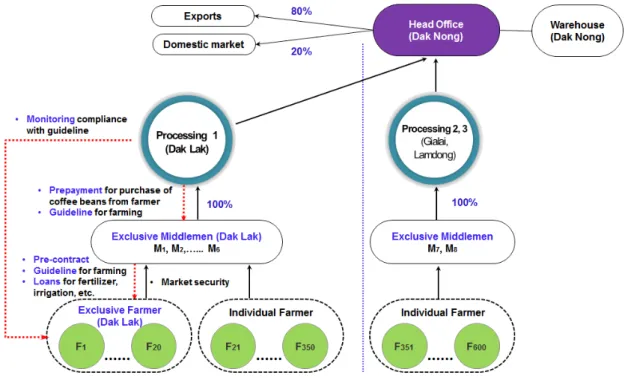
farmers. For example, Olam, which is an integrated

supply chain manager of agricultural products such

as coffee, cocoa, cashew, rice and sesame, is head-

quartered in Singapore, and is invested in Dak Lak

in 1997, has exclusive contracts with 6 local coffee

collectors (see figure 4). The exclusive middlemen (lo-

cal partner collectors) supplied 100% of coffee beans,

and Olam provided prepayment for the purchase of

coffee beans from 350 local farmers before harvesting

season. It made possible for the middlemen to use its

money profitably by providing loans for farmers with

high interest rates. Among those farmers 20 farmers

have exclusive contracts with the exclusive middlemen

(13)

contracted with Olam. The exclusive farmers should be controlled by a work guideline provided by Olam in substitute for loans from the middlemen and secur- ing market from the pre-contract with the middle- men. It is likely to show a subordinated value chain through the formation of exclusive relations among FIEs, middlemen and farmers.

Secondly, social and ecological costs imputed by multinational companies to coffee farmers in the name of creating shared value has deteriorated the economic profits of stakeholders such as farmers and middlemen. It has led to the configuration of system- atically hierarchical and subordinated global value chain, rather than constructing the space of CSV in Dak Lak. Table 4 and 5 shows some positive effects and limits in accordance with sustainable coffee pro- duction perceived by farmers, who are participated in

a certified coffee value chain, in economic, social and ecological perspectives. The degree of importance in economic, social, and ecological effects accounts for 4.2, 3.8, and 4.3 respectively, whereas in economic, social, and ecological limits is 2.4, 2.8, and 2.8 respec- tively. Also, transition into the eco-friendly mind of farmers, technology learning from FIEs, monitoring compliance with coffee production standard from cer- tification institutes such as Utz, 4C (Common Code for Coffee Community) and Rainforest has led a good deal of achievements in terms of productivity, qual- ity, environment matters, and volume. It seems that participation in certified coffee production has made value capture and enforcement possible by providing better environment and social profits (figure 5).

However, there is a need to reconsider its effects and limits in economic perspectives. According to

Figure 4. Value chain of Olam in Dak Lak

Source: based on authors’ survey, 2013

(14)

interviews with Olam, Ned Caffee and Dak Man involved in sustainable coffee project scheme, the costs of meeting the requirements of this certification scheme were estimated at US$ 40~50 per ton of green

coffee bean for 4C Association, US$ 60~70 per ton for Utz Kapeh, and US$ 100 per ton for Rainforest Alliance. Those FIEs, mainly involved in 4C and Utz Kapeh scheme since 2006, has attempted to change Table 4. Positive effects of sustainable coffee production.

Effects Degree of importance*

SOE farmer Private farmer Total

Economic effects

Decrease in household debts 3.5 4.2 3.8

Profit increase 4.1 4.5 4.2

Increase in amounts of coffee sales 4.5 4.1 4.3

Financial support (loan) 4.5 3.9 4.2

Coffee farming technique development 4.4 4.7 4.5

Social effects Children’s education 4.7 4.2 4.5

Village facilities development 3.8 2.1 3.1

Ecological effects

Decrease in chemical fertilizer usage 4.1 4.4 4.2

Decrease in pesticide usage 4.4 4.6 4.5

Decrease in amounts of waste water 4.7 4.4 4.6

Number of respondents** 30 20 50

Note: * Numbers calculated in the table are the degree of importance, where ‘5’ is the most important effects, while ‘1’ is the least effects

** Only farmers, who are participated in sustainable coffee production, are considered as respondents in this table.

Source: Authors’ survey, 2014

Table 5. Limits in accordance with sustainable coffee production.

Limits Degree of importance *

SOE farmer Private farmer Total

Economic limits

Low premium level 2.5 3.2 2.8

Difficulty in application of new farming techniques 2.8 1.2 2.2

Requirement of additional input costs 2.7 2.9 2.7

Limits to increase in the amount of coffee production 2.1 1.6 1.9 Social limits Lack of training & education opportunity for sustain-

able production 2.5 3.1 2.8

Ecological limits Compliance with environmental standard 2.7 2.9 2.8

Number of respondents 30 20 50

Note: * Numbers calculated in the table are the degree of importance, where ‘5’ is the most important limits, while ‘1’ is the least limits

** Only farmers, who are participated in sustainable coffee production, are considered as respondents in this table.

Source: Authors’ survey, 2014

(15)

farm practice and introduce social projects such as schools for worker’s children. Also, they provide high- er prices for the coffee produced as a result of those certifications, but it has not been sufficient to offset input costs added by sustainable coffee production.

For example, premium resulted from Utz scheme is about US$ 130 per hectare, whereas costs of inputs added by the certification scheme is around 4.3 mil- lion VND (around US$210) (table 6). Therefore, so far, there has been little apparent financial incentive to producers to opt for certified coffee production.

This result could be also found in the recent empirical study of export sustainable coffee production firms in Vietnam (Nguyen 2015). Nguyen (2015) pointed out ecological and social benefits from the export sustain- able coffee value chain were relatively high, while eco- nomic benefits had some limits as there was a decrease

in both productivity and value in Dak Lak (see also figure 5).

5. Conclusion

Since the late 1990s Vietnam has become the sec- ond largest coffee supplier after Brazil in the world and the single largest exporter of the Robusta variety.

This extraordinary growth has been mainly based on the formation of coffee frontier in Vietnam. The formation of coffee frontier in Vietnam has resulted from the historical contingency for national even de- velopment with the establishment of NEZ in Central Highlands after the reunification of Vietnam, the transition of the socio-economic system in frontiers Figure 5. Value chain of sustainable coffee in Dak Lak

Source: based on authors’ survey. 2013

(16)

as well as its integration into GVCs after doi moi, and the introduction of FIEs resulted from institutional liberalization since the late 1990s. What is more, cof- fee frontier has gone through significant transition from conventional to sustainable or certified coffee value chains since the mid-2000s. Therefore, the research has attempted to analyze changes in value relations appropriated and realized in the coffee fron- tier of Vietnam by investigating the ways in which it is integrated into coffee GVCs driven by MNCs, and to identify some implications of the integration of the frontier into GVCs for CSV in Dak Lak, Vietnam.

Until the mid-2000s Dak Lak witnessed the for- mation of a serious hierarchical allocation of value among local stakeholders due to the problem of global market mechanism and the response of famers to a rapid drop in producer coffee prices led by the coffee crisis in the early 2000s. The expectation of farm- ers for the rise of coffee prices led by coffee boom in the mid-1990s resulted in the high debts of farmers from private middlemen by increasing the use of fertilizers and pesticides to produce coffee as much as possible ignoring coffee quality and environment destruction. Moreover, high increases in interest rates and input prices in the coffee bust deteriorated value

captured by farmers significantly, so that it is difficult for farmers who have very little spare income to repay their original loans plus interest. It led to the serious inequality of value creation and capture among local stakeholders by intensifying the dependency of farm- ers on private middlemen and FIEs in Dak Lak.

Since the mid-2000s Dak Lak has gone through the transition of value relations from exploitative value chains based upon conventional coffee produc- tion into shared value chains relied upon the produc- tion of sustainable or certified coffee in Dak Lak.

The transition has been expected to result in sustain- ability in the creation of value by enhancing regional competitive advantages and regional bargaining power in global value chains driven by multinational companies. However, the reality has shown the in- tensification of hierarchical profits allocation among stakeholders such as farmer, middlemen, and multi- national companies in the region. The main reasons for this could be found in two perspectives. Firstly, the formation of exclusive relations among farmers, middlemen, and processors has led to stakeholders to secure market, but resulted in the intensification of hierarchy among them in global value chain, because multinational companies could control indirectly Table 6. Input costs per household added by sustainable coffee production

Inputs million VND

SOE farmer Private farmer Total

Fertilizer 2.9 2.4 2.8

Pesticide 0.2 -0.3 0.0

Irrigation 1.6 0.1 1.1

Others 0.2 0.8 0.4

Total 4.9 3.0 4.3

Number of respondents 30 16 46

Note: * Added costs are estimated by farmers.

** Only farmers, who are participated in sustainable coffee production, are considered as respondents in this table.

Source: Authors’ survey, 2014

(17)

over the farming system through exclusive middle- men. Secondly, social and ecological costs imputed by multinational companies to coffee farmers in the name of creating shared value has deteriorated the economic profits of stakeholders such as farmers and middlemen in Dak Lak.

In this context, we would like to suggest the partnership-based supporting system which promote relations among the local government, research insti- tutes, and network brokerages which are able to coor- dinate technology and vocational training programs for sustainable coffee production by promoting the entrepreneurship of farmers, to create shared value networks among local stakeholders in Dak Lak. The establishment of this kind of institutional structure coupled with coffee GVCs should make possible the allocation of value centering on local-based stakehold- ers, rather than conventional value networks based on shareholder-centered value allocation. Eventually, it would lead to regional development and the maximi- zation of firm’s profits at the same time.

Notes

1) The Vietnamese government established 25 NEZs in Dak Lak province by 1985 (Doutriaux et al 2008 cited in Fortunnel 2000).

2) According to the decree, land never used before, land used differently in initial purpose, and land allocated or rented to staffs of SOEs should be returned to the government.

3) The amended provisions in the land law defined some rights for the exchange of agricultural lands, mortgage, rent, inheri- tance, and so on to enforce the right of personal land owner- ship. Therefore, the amendment of the land law in 1993 which resulted in transition in the ownership rights from national to household unit (Dortriaux et al 2008).

4) Up to the end of 1998 most of the green coffee beans were delivered by small farmers to middlemen who are licensed by SOEs (Lee 2013).

5) As most coffee produced in Vietnam is Robusta used for main- ly producing instant coffee, the names of Vietnam seldom appear in the country-of-origin label of the products. There- fore, Vietnamese coffee producers are much less interested in improving quality (Matusi and Ikemoto 2015: 88~89) 6) According to Ha and Shively (2008), the most common re-

sponse to plummeting coffee prices in the early 2000s was the reduction of fertilization inputs applied to coffee as a measure to cut expenditures. According to survey carried out between 2012 and 2013 in Dak Lak, the average proportion of input costs for the output of coffee production per hectare is about 59.2% (where farm gate price is 42,300 VND per kg and productivity is 2.3 ton per hectare). Inputs are composed of fertilizer (20.4% of total output), pesticide (5.1%), irrigation (5.1%), water pump (10.2%) and workforce (18.4%). There- fore, value added per hectare for coffee farmer is about US$

2,000, which is about US$ 0.87 per kg.

Reference

Agergaard, J., Fold, N. and Gough, K., 2009, Global-local interactions: socioeconomic and spatial dynamics in Vietnam’s coffee frontier, 175(2), 133-145.

Beschorner, T., 2013, Creating shared value: The one-trick pony approach, 1(17), 106-112.

Chung, S-Y., 2013, The linkage between planned and spon- taneous migration: The roles of migration on coffee production in Dak Lak, Vietnam, 16(3), 344-358.

(in Korean)

Coe, N., Hess, M., Yeung, H., Dicken, P. and Henderson, J., 2004, Globalizing regional development: a global production networks perspective, 29, 468-484.

Crane, A., Palazzo, G., Spence, L. and Matten, D., 2014, Contesting the value of “creating shared value”, 56(2), 130-153.

Dak Lak Statistical Department, 2002, Statistical Yearbook 2001. Buon Ma Thuot, Vietnam.

De Fontenay, P. and Leung, S., 2002, APSEG Economics and Development Working Papers at the ANU.

Desbarats, J., 1987, Population Redistribution in Vietnam”,

(18)

Population and Development Review 13, 43-76.

Doutriaux, S., Geisler, C. and Shively, G., 2008, Competing for coffee space: Development-induced displacement in the central Highlands of Vietnam, Rural Sociology, 73(4), 2008, pp. 528-554.

Dicken, P., Kelly, P., Olds, K. and Yeung, H., 2001, Chains and networks, territories and scales: towards a rela- tional framework for analyzing the global economy, Global Networks 1(2), 89-112.

Ha, T.H., and Shively, G., 2008, Coffee boom, coffee bust and smallholder response in Vietnam’s Central Highlands, Review of Development Economics, 12(2), 312-326.

Hardy, A., 2000, Strategies of Migration to Upland Areas in Contemporary Vietnam, Asia Pacific Viewpoint, 41(1), 23-34.

Ji, H. and Lee, S-C., 2015, Changes in corporate governance and competitiveness in Vietnam: Strategies for the equitization of Vinacafe, Journal of the Economic Geographical Society of Korea, 18(4), 415-430. (in Ko- rean)

Joh, Y-K., 2013, Frontier, transitional process and coffee pro- duction’s geography in Dak Lak province, Vietnam, Journal of the Economic Geographical Society of Korea, 16(3), 323-343. (in Korean)

Lee, S-C., 2013, Coffee middlemen in Dak Lak, Vietnam: A key stakeholder of coffee value chain as an intermedi- ary of changes in local economies, Journal of the Eco- nomic Geographical Society of Korea, 16(3), 372-388.

Matsui, N. and Ikemoto (eds.), 2015, Solidarity economy and social business: New models for a new society, Springer.

Müller, D., 2003, Land-use change in the central Highlands of Vietnam: A spatial econometric model combining satel- lite imagery and village survey data, unpublished PhD.

Dissertation, Institute of Rural Development Georg- August University of Göttingen.

Nguyen, A.T., 1999, The export of agricultural commodities in developing countries: The case of Vietnam’s coffee indus- try in period 1986-1998, unpublished Master thesis, National Economics University.

Nguyen, H., 2015, Empirical study of sustainable export cof-

fee supply chain in Vietnam, International Journal of Business and Management, 10(7), 230-235.

Oxfam International, 2002, Mugged: Poverty in Your Coffee Cup, http://www.oxfamamerica.org/static/media/

files/mugged-full-report.pdf, (final access in March 18, 2016).

Porter, M. and Kramer, M., 2011, Creating shared value, 89(1-2), 62-77.

Scherr, S., Mankad, K., Jaffee, S. and Negra, C., 2015, The World Bank.

Smith, A., Rainnie, A., Dunford, M., Hardy, J., Hudson, R.

and Sadler, D., 2002, Networks of value, commodi- ties and regions: reworking divisions of labour in macro-regional economies, 26(1), 41-63.

USDA (United States Department of Agriculture), 2013, GAIN (Global Agricultural Information Network) Reports: Vietnam Coffee Annual May 2013, GAIN Report No.:VM5030, USDA Foreign Agricultural Service.

USDA (United States Department of Agriculture), 2015, GAIN (Global Agricultural Information Network) Reports: Vietnam Coffee Annual May 2015, GAIN Report No.:VM3026, USDA Foreign Agricultural Service.

Vietnam Chamber of Commerce and Industry, 2007, Im- proving coffee export product quality, Vietnam Business Forum, posted in April 11, 2007, http://

vccinews.com/news_detail.asp?news_id=949 (final access in 7

th

June, 2016).

Correspondence: Young Kug Joh, Department of Regional Development, Hyupsung University, 72 Choe- rubaeck-ro, Bongdam, Hwasung, Kyonggido, Korea, Tel: 82-31-299-0830, E-mail: [email protected]

교신: 조영국, 445-745, 경기도 화성시 봉담읍 최루백로

72, 협성대학교 지역개발학과(전화: 031-299- 0830, 이메일: [email protected])

최초투고일 2016년 5월 9일

수 정 일 2016년 5월 23일

최종접수일 2016년 5월 26일

수치

Table 1. Changes in migration and population in Dak Lak province, 1976-1996
Table 2. GRDP and coffee production in Dak Lak, Vietnam, 1991~2013
Figure 2. Prices of Robusta coffee beans and coffee production in Vientnam
Figure 4. Value chain of Olam in Dak Lak Source: based on authors’ survey, 2013
+2

참조

관련 문서

Also, in order to estimate the consequentially colliding relations of the benefits and cost of using location based services, perceived value, security

– Budgeted (not actual) cost of work performed to-date on project.. – BCWP =

The average tensile strength value before heat treatment of PLA output was 9.67 N/㎟, and the average tensile strength value after heat treatment was 24.17 N/㎟, which

Appearance and prevalence of women hero novels at the time when existing sense of value collided with a new sense of value have significant meaning

 store value (read from the Register File during decode) written to the Data Memory.  load value, read from the Data Memory, written to

1. Free radical initiator abstract a hydrogen from polymer chains 2. Through chain transfer of propagating chain with polymer chain 3. Polymer mixtures are mechanically

- The best value of a parameter of a probability distribution should be that value which maximizes the likelihood or joint probability of occurrence of

일반적인 국제무역이론은 최종재화의 교환(trade in final goods)이라는 전제하 에 성립되나, 최근에는 글로벌 가치사슬(Global Value Chains: GVCs) 구조에서