467
서 론플랑크톤은바다
,
강,
호수등수생태계의표영계상부에서식 하는생물의총칭이다.
이들은일반적으로광합성을하는식물 플랑크톤과식물플랑크톤이나다른생물을포식하는동물플랑 크톤,
박테리아등이속하는미소플랑크톤으로나눌수있으며,
저서환경에서식하는조개류,
굴,
해조류와같은생물은생활사 중일부인유생시기를플랑크톤생활형으로보내는종도포함 한다.
이러한플랑크톤중식물플랑크톤은수생태계에서일차 생산자로서먹이사슬의바탕을이루며,
동물플랑크톤은일차 소비자로영양염순환과정에기여하는동시에어류나다른생 물의먹이로써생태계먹이망안에서중요한연결고리역할을 한다.
따라서이들의플랑크톤군집구조연구는수생태계연구 의근간이다.
또한수생태계플랑크톤의종조성과활성에따라 영양염을포함한물질의성분과함량이변하므로이들은수질 의상태를보여주는지시자역할뿐만아니라수환경의건강도 를평가할수있는지표로사용되기도한다(Suthers and Rissik,
2008).
따라서플랑크톤군집동태의장기적이고체계적으로모니터링이필요하다
.
낙동강은우리나라에서두번째긴강으로유역의식수원
,
농 공업용수원으로중요수자원으로쓰이고있다.
염해방지와원활한 용수확보를위해
1987
년 완공된하구둑공사과정에서ISWACO(1987)
은1983
년하구둑공사착공전과1984
년부터1987
년까지식물플랑크톤의종조성및규조류현존량변화를 조사하여하구언건설전후의플랑크톤현존량의변화를보고 하였다.
이후낙동강유역은산업화와도시화로점차수질이악 화되면서심각한문제로대두되고있다(Moon et al., 2001).
또 한낙동강하구역입구인을숙도수역의경우,
하구둑관리에의 존하여해수와담수가점진적인혼합이아닌간헐적인방류에 의해혼합이이루어지면서,
하구둑수문의개폐에따라수괴의 변화는물론이고하구생태계의식물플랑크톤군집구조가현 저히다른양상을보여주고있다(Chung et al., 2000).
또한초 여름에발생하는남조류Microcystis
녹조현상(Ha et al., 1999;
Choi et al., 2002)
과겨울철갈수기의규조Stephanodiscus
대 발생(Ha et al., 2003; Seo et al., 2010)
등의현상도하구둑건 설이후에매년나타나는현상으로체계적인대책마련이시급Article history;
Received 8 August 2013; Revised 14 August 2013; Accepted 16 August 2013
*Corresponding author: Tel: +82. 51. 510. 2279 Fax: +82. 51. 581. 2963 E-mail address: [email protected]
Kor J Fish Aquat Sci 46(4) 467-487, August 2013 http://dx.doi.org/10.5657/KFAS.2013.0467 pISSN:0374-8111, eISSN:2287-8815
ⓒ The Korean Society of Fishereis and Aquatic Science. All rights reserved
낙동강 하구역 식물플랑크톤 생물상 변동과 출현종 고찰
부산대학교 해양학과1, 부산대학교 해양연구소2
정익교
1,2*ㆍ김남림
1ㆍ송은혜
1ㆍ이지은
2ㆍ이상래
2Literature Survey on the Phytoplankton Flora in the Nakdong River Estuary, Korea
Long-term and systematic monitoring of phytoplankton is important, as phytoplankton serve as indicators of water quality status in aquatic environments. In the present study, the plankton community structure of the Nakdong River estuary over the past 30 years was investigated by literature survey to provide references for the occurrence of plank- tonic species. A total of 876 species from 18 taxonomic lineages were reported and, among them, 569 species were identified to occur seasonally at the Mulgeum, Seonam and Eulsukdo sites. Diatoms and chlorophytes were dominant in the microscopic studies. The 54 species at the Mulgeum and the 96 species at the Eulsukdo sites have not been reported since the river barrage construction in 1987. The majority of reports speculate that there has been a change in the aquatic environment, particularly the plankton community structure, due to operation of a river barrage since 1987.
Key Words: Phytoplankton community structure, Nakdong River estuary, Light microscopy, River barrage
Ik Kyo Chung1,2*, Nam Lim Kim1 Eun Hye Song1, Jee Eun Lee2 and Sang-Rae Lee2
1
Department of Oceanography, Pusan National University, Busan 609-735, Korea
2
Marine Research Institute, Pusan National University, Busan 609-735, Korea
하다
(Cho and Shin, 1997; Cho, 2001; Kim et al., 1998; Jeong et al., 2006).
이러한플랑크톤군집구조의변화를관찰하기위해지속적 인플랑크톤생물상조사가필요하며
,
이에는종동정에관한 정확성이요구된다.
최근30
여년동안낙동강수역의식물플랑 크톤에관한연구는낙동강하구둑건설공사와함께대부분이하구역에편중되어이루어져왔다
(Table 1).
그리고기존연구들의종동정은대부분광학현미경관찰을통해서수행되고있 다
.
현미경관찰을통한종동정은종의실제모습을시각적인 자료로증명할수있으므로보편적으로종동정방법으로활용 되고있다.
그러나생물의크기,
광학기기의해상력,
생물의형 태적유사성과가소성에의한동정의한계가있으며,
동정과정 에서관찰자의주관성이개입할가능성을배제할수없다.
이미 신종기재에서유전정보의언급이필수적인점을감안하면,
출 현종형태및유전정보의일관성유지를위해메타게노믹스(metagenomics)
가도입되어야한다(Lee et al., 2010). DNA
염 기서열을통한종동정은종의유전정보를기반으로실행하기 때문에보다객관적인자료를얻을수있으며,
확인된염기서열 의일관성을유지할수있다.
그러나종의실존을시각적자료로는제시할수없다
.
따라서정확한종동정과자료의축적을위해서는현미경관찰과
DNA
염기서열을통한분석을병행하는것이바람직하다
.
최근18S ribosomal RNA gene (18S rDNA)
를이용하여낙동강수역의서낙동강,
물금과을숙도수역에서 다양한분류군에속하는부유생물종다양성이보고된바있다(Kim et al., 2010; Lee et al., 2012).
본연구는최근30
여년동 안낙동강하구역에서보고된플랑크톤다양성에대한자료를 종합적으로정리하여출현종을파악하여,
추후인위적인유역 과연안역환경변화및기후변화등연구에바탕이되는수생태 계플랑크톤연구자료로활용하고자수행되었다.
연구 방법
최근
20
여년동안낙동강수역에서대표적으로다루어진조 사정점을대상으로수행된연구를대상으로조사된플랑크톤 자료검토하였다(Fig. 1).
낙동강하구역수생태계의특성과인 간활동의영향을고려하여세정점을선택하여분석하였다.
하구역상부물금
(Mulgeum, MG)
수역은담수지역이며부산주민의식수채수시설이설치된중요한정점이다
.
하구역입구에서
1983
년물막이공사를시작하여1987
년건설된하구둑이있는을숙도
(Eulsukdo, ES)
수역은하구둑의관리와수문개폐에따른수환경변화가급격히진행되고있는정점이다
.
그리 고대동수문과녹산수문으로흐름이단절된서낙동강의선암 교(Seonam Bridge, SA)
인근수역은김해하수등낙동강유 역에서인위적인요소에의해수생태계교란이높은지역이다.
이들중담수역인물금수역에해당하는논문17
편,
선암교수역 논문4
편,
기수수역인을숙도수역논문12
편을포함하여조사 하였다.
조사대상자료는출현종분석이가능한문헌을우선적 으로선택하였으며,
보고된출현종목록을종합적으로분석하 였다(Table 1).
출현종조성분석
:
조사연구별로대상수역과연구방법에차 이가있는점을고려하여,
하구둑건설과정초기의조성으로ISWACO (1987)
을기준으로Seo and Chung (1994), Chung et al. (2000)
의조사와Lee et al. (2002), Kim (2004), Choi et al. (2007)
연구에서보고된20
여년동안보고된종자료를기반 으로분석하였다. Lee et al. (2012)
연구는메타게노믹스방법 으로보고된자료로서같은기준으로분석하지않고클론라이 버러리차원에서비교하였다.
종명에대한정확한분류학적처 리및확인은플랑크톤에대한국제데이터베이스인Algaebase
를근간으로정리하였다(http://www.algaebase.org/).
식물플랑 크톤연구규모와횟수에비해상대적으로적은동물플랑크톤 연구에서다룬동물플랑크톤생물상도일부제시하였다(Lim et al., 1997; Kim et al., 2000; Kim et al., 2005).
결 과
낙동강 하구 수역의 플랑크톤 분류군 현황
낙동강 하구 수역인 물금
(MG),
선암교(SA)
와 을숙도수역Fig. 1. Map of Nakdong river estuary showing the study area referred: Mulgeum (MG), Seonam Bridge (SA), Eulsukdo (ES).
(ES)
을모두통합하여현미경관찰에의한종수준동정자료와 속수준동정자료를나누어서분류군별로정리하였으며,
수역 별로담수수역,
기수수역,
선암교수역으로나누어서분류군별 로출현한종수를정리하였다(Table 2).
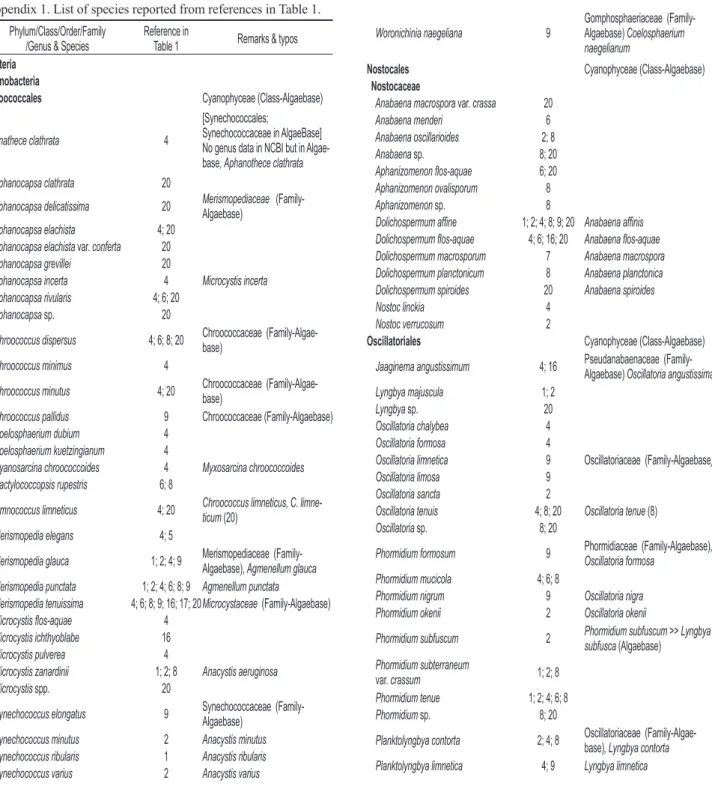
출현한종의목록과제 시된문헌은부록으로첨부하였다(Appendix 1).
광학현미경형태관찰로수행된낙동강하류수역연구에서 물금
,
을숙도와선암교3
정점을검토한결과9
개의상위분류 군에서18
개의분류군이보고되었으며,
총876
종의출현이확 인되었다.
속수준까지동정된종은79
종이었으며속이하수 준까지동정이되지않아목록에서제외하였다.
출현종중에서 규조식물문(Bacillariophyta)
의출현종수는482
종으로낙동강 하류수역에서가장많은종이차지하였으며,
동물플랑크톤에 속하는절지동물문(Athropoda)
와 윤형동물문(Rotifera)
분류 군도각각11
종과5
종이출현하였다.
담수수역인물금수역에 서는15
개의분류군에서총383
종이출현하였다.
을숙도수역 에서는17
개의분류군에서총569
종이출현하였다.
선암교수 역에서는9
개의분류군에서총157
종이출현하였다.
동물플랑 크톤을다룬연구는일반적으로식물플랑크톤연구에비해많 지않았다(ISWACO, 1987; Lim et al., 1997; Kim et al., 2000;
Kim et al., 2005).
물금수역에서는규조식물문의출현종수가
159
종,
을숙도수 역에서는287
종,
선암교수역에서는82
종으로각각의수역에 서규조식물문이종조성의 대부분을차지하였다.
규질편모조 강(Dictyochophyceae), Cercozoa,
미포자충목(Microsporidia)
은물금과선암교수역에서는출현하지않았으나기수수역인 을숙도수역에서출현하였다.
선암교수역에서는물금과을숙도수역에서출현한황갈조강
(Chrysophyceae),
황록조강(Xan- thophyceae),
진안점조강(Eustigmatophyceae)
과 후생동물(Metazoa)
의 절지동물문(Arthropoda),
윤형동물문(Rotifera)
이나타나지않았다.
각수역별하구둑건설전보고되었던식물플랑크톤종에서 물금에서는
54
종그리고을숙도수역에서는96
종이하구둑건 설이후연구에서는보고되지않았다.
이들은정점별총출현종 수중물금은14%,
을숙도는17%
정도이었다.
이들종의목록 을정리하여부록으로첨부하였다(Appendix 2).
계절별 종 출현 현황
낙동강하구역수생태계의특성과인간활동의영향을고려하 여물금
,
을숙도,
선암교세정점을선택하여분석하였다.
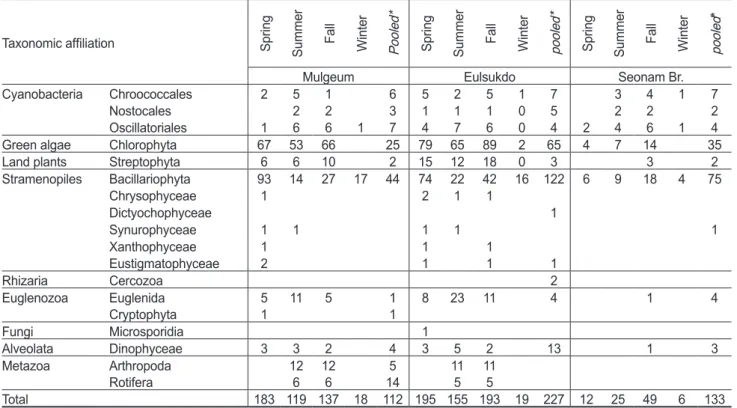
문헌 에서제시된종조성을종합하여계절별그리고주요정점별로 출현한종수를분류군별로재정리하였다(Table 3). 3
월에서5
월까지를봄, 6
월에서8
월까지를여름, 9
월에서11
월까지가을, 12
월에서2
월까지를겨울로고려하였다. Table 3
에서‘Pooled’
열은출현수역은확인가능하나
,
출현계절이명시되지않은종 수를따로묶어서정리하였다.
물금수역에는사계절중봄에출 현종수183
종으로가장많은종이출현하였다.
봄에물금수역 에서는12
개의분류군에서규조식물문의출현종수가93
종으 로가장많이출현하였다.
겨울로갈수록출현종수는감소하였 다.
을숙도수역에는사계절중봄에출현종수195
종으로가장 많은종이출현하였다.
봄에을숙도수역에서는13
개의분류군 에서녹조식물문(Chlorophyta)
의출현종수가79
종으로가장 많이출현하였다.
겨울로갈수록출현종수는감소하였다.
선암 Table 1. List of reports referred in this studyNo. References Year (study period) Site information & remarks
1 Chung et al. 1987 (1983-1987) Fresh Water (FW), Brackish Water (BW)
2 ISWACO 1987 (1983-1987) FW, BW
3 Cho 1989 (1986-1987) FW, BW; benthic diatom
4 Kim and Lee 1991 (1988-1989) FW, BW:
5 Moon and Choi 1991 (1989) FW, BW
6 Cho et al. 1993 (1991-1992) FW, BW Seonam Br.
7 Noh et al. 1994 (1993) FW
8 Seo and Chung 1994 (1992-1993) FW, BW Seonam Br.
9 Chung et al. 1994 (1993) FW, BW
10 Kim et al. 1994 (1993) FW, BW
11 Lee et al. 1995 (1994) FW
12 Lim et al. 1997 (1994) FW, BW; zooplankton
13 Chung et al. 2000 (1998-1999) BW
14 Kim et al. 2000 (1998-1999) FW; zooplankton
15 Moon et al. 2001 (1999) FW
16 Bahk et al. 2001 (1999) FW; Bacterioplankton
17 Lee et al. 2002 (2000-2001) FW
18 Kim 2004 (1995-1996) FW
19 Kim et al. 2005 (1998-2002) FW; zoopalnkton
20 Choi et al. 2007 (2004) FW, BW
교수역에서는사계절중가을에출현종수
49
종으로가장많 은종이출현하였다.
겨울에는사계절중출현종수6
종으로가 장적은종이출현하였다.
여름의출현종수는봄보다많았다. 토의
본연구는낙동강하류수역의종다양성을변동을문헌들을 통하여확인하였다
.
지난30
여년간문헌에보고된플랑크톤출 현종은검토결과18
개의분류군이보고되었고,
총876
종이확 인되었다.
각정점별,
계절별로출현이확인된종은물금수역 에서는383
종,
을숙도수역에서는569
종,
그리고선암교수역 에서는157
종이보고되어총종수에비해적은수의종이보고 되었다.
속수준까지동정된종은79
종이었으며이에대한분류 학적재고가필요하다(Table 2).
전반적으로부영양화수역의대표적인지표종인규조식물문 의
Leptocylindrus danicus,
다음으로Aulacoseira granulata
가 우점종으로출현하는것으로보고되었다(Kim, 2004).
낙동강하구둑건설과정의영향평가
(ISWACO, 1987),
그리고하구둑축조후에도계속된다른사업
(
예:
신항만사업)
으로낙동강 하구역의수환경은계속인위적인환경변화를겪어왔다.
따라 서둑건설에따른생물상변화(Moon and Choi, 1991),
하국둑 건설후호소화및부영양화(Choi et al., 2007)
등의연구가단 편적으로수행되었으나,
지속적으로같은방법으로모니터링 이된적이없는바지난30
여년간의일반적인경향성을파악 할수없었다.
다만,
보편적인계절변화양상으로하계에는남조류가우점하며
,
나머지계절에는규조류가우점을이루는양 상을파악하였다.
전체출현종에서물금
14%,
을숙도대교에서는17%
가하구둑건설이후연구에서는보고되지않았다
.
하구둑건설이전의출현종목록은
ISWACO(1987)
의환경영향평가보고와저서규조상
(Cho, 1989)
를다룬조사로서1987
년이후조사에서출현이보고되지않은종류는주로녹조류의
Cosmarium
속,
규조류의
Navicula, Chaetoceros, Coscinodiscus, Rhizosolenia
속,
와편모조류의Neoceratium
속에속하는종들이었다.
부착성규조류를다룬
Cho(1989)
의연구로인해규조류의출현종변동양상에서하국둑건설이전부착성규조류들이건설후에는다 루어지지않아미출현종수가다소과장되어제시되었다
.
하구둑건설이후매년초여름에발생하는남조류
Microcys-
tis
속의대발생과겨울철갈수기의규조류Stephanodiscus
대발 생현상에대한고찰은출현종확인에초점을둔본조사의목 적과차이가있어다루지않았다.
이들대번식현상에대하여최 근많은연구가수행되었으나발생시기와수역별로각기다른 양상을보여주고있어체계적으로지속적인모니터링이필요하 다.
또한,
남조류에대한분류학적종동정은광학현미경만으로 는한계가있고(Lee et al., 1997),
아직종분류체제가확립되어 있지않아,
보다근본적인원인종규명도시급하다.
유전정보로분석한자료에서진핵생물에해당하는식물플랑 크톤중분류군규조식물문에서가장많은출현종이확인되었 으며이는대부분의식물플랑크톤문헌조사의경향성과일치 하였다
(Kim et al., 2010; Lee et al., 2012).
은편모조식물문은 Table 2 List of planktonic taxa in the Nakdong River estuaryTaxonomic affiliation species sp.1 spp.2 Mulgeum Eulsukdo Seonam Br.
Cyanobacteria Chroococcales 30 1 1 11 12 9
Nostocales 12 2 0 7 5 5
Oscillatoriales 19 3 0 12 14 6
Green algae Chlorophyta 168 11 102 132 41
Land plants Streptophyta 58 3 25 43 5
Stramenopiles Bacillariophyta 482 28 4 159 287 82
Chrysophyceae 3 1 2
Dictyochophyceae 2 1
Synurophyceae 2 1 1 1 1
Xanthophyceae 1 1 1
Eustigmatophyceae 2 2 2
Rhizaria Cercozoa 1 1
Euglenozoa Euglenida 30 3 11 25 4
Cryptophyta 2 2 2
Fungi Microsporidia 1 1
Alveolata Dinophyceae 29 6 19 26 4
Metazoa Arthropoda 18 1 1 14 11
Rotifera 16 5 7 16 5
Total 876 66 13 383 569 157
1Scientific name of species in the list was presented by genus name only without s specific epithet.
2A specific epithet of species in references was expressed in ‘spp.’ As an epithet of ‘spp’ means the plural, we separated them with a differ- ent column.
을숙도수역에서분석되었으며
,
물금수역에서종수준의자료 가존재하였다.
그러나,
은편모조식물문은낙동강하구역(Yang et al., 2001)
뿐만아니라해수수역인마산만과진해만(Hyun
et al., 2011)
에서출현이보고된바가있으므로기수역인을숙도수역에서관찰가능하다고생각된다
. Odontella sinensis
는 문헌조사에서을숙도수역에서만나타난종이다(Chung et al., 1987; ISWACO, 1987; Chung et al., 1994; Choi et al., 2007;
Kim et al., 2010; Lee et al., 2012). Chaetoceros
속은문헌조사 지역에서선암교를제외한모든수역에다양한종들이출현하 였으며(Chung et al., 1987; Moon and Choi, 1991; Cho et al., 1993; Seo and Chung, 1994; Lee et al., 1995; Chung et al., 2000; Choi et al., 2007),
해수뿐만아니라담수역에서도광범 위하게분포한다는것을알수있었다. DNA
염기서열분석을 통한연구에서도Chaetoceros
속의근연종이출현된보고가있 다(Yoon et al., 2012).
일부보고에서는종명기재에대한재확인이필요하였다
.
최 근계통분류논문에서공식적으로통용되고있는분류학적정보를다루고있는
Algaebase
를바탕으로출현한종조성을재확인하였고
,
종기재가차이가있거나,
이명처리된종의재검토 를통하여가능한경우일부수정하였다(Appendix 1).
보다정 확한종정보를제공하기위해서는출현한생물종의학명에대 한지속적인점검도필요하다.
현재일반적으로광학현미경관찰에의한종동정은관찰자
의경험에따른주관성개입을배제할수없고
,
기기의해상력 에따른한계성과관찰자의숙련도에의존할수밖에없다.
최근 종기재에서유전정보의제시가필수적인항목으로요구되고 있는점을감안한다면,
환경시료에서유전정보검증을바탕으 로분석하는메타게노믹스가도입되어야만한다.
기존의광학현미경조사를보완하고
,
보다객관적인방법론인DNA
염기서열분석을도입하여
,
진핵부유생물을위한18S rDNA
클론분 석은물론남조류를포함한박테리아플랑크톤분석을위한16S
rDNA
조사도같이수행하는것이바람직하다.
사 사
이논문은부산대학교자유과제학술연구비
(2
년)
에의하여연 구되었음참고문헌
Bahk JR, Ha K, Son YJ and Joo GJ. 2001. Seasonal variation in the phytoplankton and bacterial fauna in the mid to lower reaches of the Nakdong River. J Korean Environ Sci Soc 10, 259-267.
Cho KJ. 1989. The community structure of benthic diatoms along environmental gradient of sediment from the Naktong river estuary, Korea. Ph. D. Dissertation. Seoul National University, Seoul, Korea, 91, 28 Plates.
Table 3. List of planktonic taxa in the Nakdong River estuary reported in seasons
Taxonomic affiliation
Spring Summer Fall Winter Pooled* Spring Summer Fall Winter pooled* Spring Summer Fall Winter pooled *
Mulgeum Eulsukdo Seonam Br.
Cyanobacteria Chroococcales 2 5 1 6 5 2 5 1 7 3 4 1 7
Nostocales 2 2 3 1 1 1 0 5 2 2 2
Oscillatoriales 1 6 6 1 7 4 7 6 0 4 2 4 6 1 4
Green algae Chlorophyta 67 53 66 25 79 65 89 2 65 4 7 14 35
Land plants Streptophyta 6 6 10 2 15 12 18 0 3 3 2
Stramenopiles Bacillariophyta 93 14 27 17 44 74 22 42 16 122 6 9 18 4 75
Chrysophyceae 1 2 1 1
Dictyochophyceae 1
Synurophyceae 1 1 1 1 1
Xanthophyceae 1 1 1
Eustigmatophyceae 2 1 1 1
Rhizaria Cercozoa 2
Euglenozoa Euglenida 5 11 5 1 8 23 11 4 1 4
Cryptophyta 1 1
Fungi Microsporidia 1
Alveolata Dinophyceae 3 3 2 4 3 5 2 13 1 3
Metazoa Arthropoda 12 12 5 11 11
Rotifera 6 6 14 5 5
Total 183 119 137 18 112 195 155 193 19 227 12 25 49 6 133
(Pooled*: Reported but not specified for seasons)
Cho KJ. 2001. Phytoplankton and eutrophication of the lower Nakdong River. In: Ecology and application of algae in Ko- rea. Lee IK, ed. Academy Publ Co, 75-94.
Cho KJ and Shin JK. 1997. Dynamics of inorganic N P nutrient and planktonic algae during summer and winter in down- stream of the Naktona River. Korean J Limnol 31, 67-75.
Cho KJ, Chung IK and Lee JA. 1993. Seasonal dynamics of phytoplankton community in the Naktong River estuary, Korea. Korean J Phycol 8, 15-28.
Choi AR, Oh HM and Lee JA. 2002. Ecological study on the toxic Microcystis in the lower Nakdong River. Algae 17, 171-186.
Choi CM, Kim JH, Kim WI, Lee JS, Jung GB, Lee JT and Moon SG. 2007. Phytoplankton flora and community structure in the lower Nakdong River. Korean J Environ Agriculture 26, 159-170.
Chung IK, Kang YJ, Kwon OS and Seo JK. 2000. The ecology of phytoplankton in the Naktong estuary. Algae 15, 99-110.
Chung J, Kim HS and Kim YJ 1994. Structure of phytoplank- ton community in the Nakdong river estuary dam. Korean J Limnol 27, 33-46.
Chung YH, Noh KH and Lee OM. 1987. As s standpoint of phy- toplankton, the guideline of water quality management in Nakdong estuary. Korean J Environ Biol 5, 51-60.
Ha K, Cho EA, Kim HW and Joo GJ 1999. Microcystis bloom formation in the lower Nakdong River, South Korea: impor- tance of hydrodynamics and nutrient loading. Marine Fresh- water Res 50, 89-94.
Ha K, Jang MH and Joo GJ. 2003. Winter Stephanodiscus bloom development in the Nakdong River regulated by an estuary dam and tributaries. Hydrobiologia 506, 221-227.
Hyun BG, Shin KS, Kim, DS, Kim YO, Joo HM and Baek S-H.
2011. Understanding of phytoplankton community dyna- mics through algae bioassay experiment during winter sea- son of Jinhae Bay, Korea. J Ocean Soc Korea: The Sea 16, 27-38.
Industrial Sites & Water Resources Development Corporation (ISWACO) 1987. The ecological baseline studies in the es- tuary of Nakdong river (1986-87). 409.
Jeong KS, Recknagel F, and Joo GJ. 2006. Prediction and elu- cidation of population dynamics of the blue-green algae
Microcystis aeruginosa and the diatom Stephanodiscus hantzschii in the Nakdong River-Reservoir System (South
Korea) by a recurrent artificial neural network. In: Ecologi- cal Informatics. Springer Berlin Heidelberg. 255-273.Kim BK, Lee SR, Lee JA and Chung IK. 2010. Molecular moni- toring of plankton diversity in the Seonakdong River and along the coast of Namhae. J Ocean Soc Korea: The Sea 15, 25-35.
Kim HS, Kim YJ, Park CW and Chung J. 1994. Unreported fresh-water algae in Korea. J Plant Biol 37, 131-139.
Kim HW, Chang KH and Joo GJ. 2005. Characteristics and in-
ter-annual variability of zooplankton dynamics in the middle part of the river (Nakdong River). Korean J Limnol 38, 412- Kim HW, Ha K and Joo GJ. 1998. Eutrophication of the lower 419.
Nakdong River after the construction of an estuarine dam in 1987. Int Rev Hydrobiol 83, 65-72.
Kim HW, Hwang SJ and Joo GJ. 2000. Zooplankton grazing on bacteria and phytoplankton in a regulated large river (Nak- dong River, Korea). J Plankton Res 22, 1559-1577.
Kim JW and Lee HY. 1991. Study on phytoplankton commu- nities in the reservoir of Nakdong river estuary. Korean J Limnol 24, 143-151.
Kim YJ. 2004. Monthly variations of phytoplankton communi- ties in themed and lower parts of the Nakdong River. Algae 19, 329-337.
Lee JA, Choi AR and Watanabe M. 1997. Taxonomic implica- tions of the Genus Microcystis (Cyanophyceae) from the Naktong river. Algae 12, 167-176.
Lee JE, Lee SR, Youn SH, Chung SO, Lee JA and Chung IK.
2012. Molecular Monitoring of Eukaryotic Plankton Diver- sity at Mulgeum and Eulsukdo in the Lower Reaches of the Nakdong River. J Ocean Soc Korea: The Sea 17, 160-180.
Lee JH, Choi JS, Kim YJ and Chung J. 1995. Flora of plank- tonic diatoms in the Naktong River estuary, Korea. Korean J Limnol 28, 35-47.
Lee JH, Kwon JN and Yang SY. 2002. Seasonal variation of phytoplankton community in the Nakdong river. Algae 17, 267-273.
Lee SR, Oak JH, Chung IK and Lee JA. 2010. Effective mo- lecular examination of eukaryotic plankton species diversity in environmental seawater using environmental PCR, PCR- RFLP, and sequencing. J Appl Phycol 22, 699-707.
Lim BJ, Kim BC, Yoo KI and Ryu JK. 1997. Changes in zoo- plankton community during the Blue - green algal bloom in the Nakdong River. Korean J Limnol 30, 337-346.
Moon CH and Choi HJ. 1991. Studies on the environmental characteristics and phytoploankton community in the Nak- dong river estuary. J Ocean Soc Korea 26, 144-154.
Moon SG, Chung JM and Choi CM. 2001. The structure of phytoplankton community in the middle-lower part of the Nakdong River. J Korean Environ Sci Soc 10, 41-45.
Noh JS, Kim SG, Ryu JI. 1994. A research on algae dynamics in downstream of Nakdong River. J Korean Soc Water Waste Water Treatment Technol 2, 11-23.
Seo JK and Chung IK. 1994. The phytoplankton community structure in the Nakdong River mouth. Korean J Limnol 27, 227-250.
Seo JK, Lee HJ and Chung IK. 2010. The community dynamics of microbial food web during algal bloom by Stephanodis-
cus spp. in downstream of Nakdong River. Korean J Envir-
ron Biol 28, 172-178.Suthers IM and Rissik D. 2008. Plankton: a guide to their ecol-
ogy and monitoring for water quality. CSIRO Publishing, Collingwood. Australia. 256.
Yang SR, Song HS, Moon CH, Kwon KW and Han-Seob Yang HW. 2001. Changes in Marine Environment and Primary Production due to Freshwater Input in the Nakdong Estuary.
Algae 16, 165-177.
Yoon J, Lee JE, Lee SR, Rho T, Lee JA, Chung IK and Lee T. 2012. Metagenomic approach on the eukaryotic plankton biodiversity in coastal water of Busan (Korea). J Ocean Soc Korea: The Sea 17, 59-75.
Appendix 1. List of species reported from references in Table 1.
Phylum/Class/Order/Family
/Genus & Species Reference in
Table 1 Remarks & typos
Bacteria
Cyanobacteria
Chroococcales
Cyanophyceae (Class-Algaebase)Anathece clathrata
4[Synechococcales;
Synechococcaceae in AlgaeBase]
No genus data in NCBI but in Algae- base, Aphanothece clathrata
Aphanocapsa clathrata
20Aphanocapsa delicatissima
20Merismopediaceae (Family-
Algaebase)Aphanocapsa elachista
4; 20Aphanocapsa elachista var. conferta
20Aphanocapsa grevillei
20Aphanocapsa incerta
4Microcystis incerta
Aphanocapsa rivularis
4; 6; 20Aphanocapsa sp.
20Chroococcus dispersus
4; 6; 8; 20 Chroococcaceae (Family-Algae- base)Chroococcus minimus
4Chroococcus minutus
4; 20 Chroococcaceae (Family-Algae- base)Chroococcus pallidus
9 Chroococcaceae (Family-Algaebase)Coelosphaerium dubium
4Coelosphaerium kuetzingianum
4Cyanosarcina chroococcoides
4Myxosarcina chroococcoides
Dactylococcopsis rupestris
6; 8Limnococcus limneticus
4; 20Chroococcus limneticus, C. limne- ticum (20)
Merismopedia elegans
4; 5Merismopedia glauca
1; 2; 4; 9 Merismopediaceae (Family- Algaebase), Agmenellum glaucaMerismopedia punctata
1; 2; 4; 6; 8; 9 Agmenellum punctataMerismopedia tenuissima
4; 6; 8; 9; 16; 17; 20Microcystaceae (Family-Algaebase)Microcystis flos-aquae
4Microcystis ichthyoblabe
16Microcystis pulverea
4Microcystis zanardinii
1; 2; 8Anacystis aeruginosa
Microcystis spp.
20Synechococcus elongatus
9 Synechococcaceae (Family-Algaebase)
Synechococcus minutus
2Anacystis minutus
Synechococcus ribularis
1Anacystis ribularis
Synechococcus varius
2Anacystis varius
Woronichinia naegeliana
9 Gomphosphaeriaceae (Family-Algaebase) Coelosphaerium