Vol. 25, No. 6 (2015)
288
Enhanced Piezoelectric Properties of Lead-Free La and Nb Co-Modified Bi
0.5(Na
0.84K
0.16)
0.5TiO
3-SrTiO
3Ceramics
Rizwan Ahmed Malik
1, Ali Hussain
1, Adnan Maqbool
1, Arif Zaman
2, Tae Kwon Song
1, Won Jeong Kim
3and Myong Ho Kim
1†1School of Advanced Material Engineering, Changwon National University, Gyeongnam 641-773, Korea
2Department of Physics, Abdul Wali Khan University, Mardan, KPK, Pakistan
3Department of Physics, Changwon National University, Gyeongnam 641-773, Korea
(Received April 24, 2015 : Revised May 26, 2015 : Accepted May 28, 2015)
Abstract
New lead-free piezoelectric ceramics 0.96[{Bi0.5 (Na0.84 K0.16)0.5}1-xLax(Ti1-y Nby)O3]-0.04SrTiO3 (BNKT-ST-LN, where x = y = 0.00 ≤ (x = y) ≤ 0.015) were synthesized using the conventional solid-state reaction method. Their crystal structure, microstructure, and electrical properties were investigated as a function of the La and Nb (LN) content. The X-ray diffraction patterns revealed the formation of a single-phase perovskite structure for all the LN-modified BNKT-ST ceramics in this study. The temperature dependence of the dielectric curves showed that the maximum dielectric constant temperature (Tm) shifted towards lower temperatures and the curves became more diffuse with an increasing LN content. At the optimum composition (LN 0.005), a maximum value of remnant polarization (33 C/cm2) with a relatively low coercive field (22 kV/cm) and high piezoelectric constant (215 pC/N) was observed. These results indicate that the LN co-modified BNKT-ST ceramic system is a promising candidate for lead-free piezoelectric materials.Key words
lead-free ceramics, bismuth sodium titanate, electric-field induced strain.1. Introduction
Lead zirconate titanate (PZT) ceramics are widely used in sensors and micro-electromechanical devices due to their excellent piezoelectric properties. However, due to growing environmental issues, their use is restricted for many commercial applications.
1-4)Hence, to discover environmentally benign replacements for commercial Pb- based piezoceramics, extensive efforts have been made to find new lead-free materials with properties comparable to those of lead-based systems. Recently, research has been focused on lead-free systems with a perovskite structure, especially, compositions based on bismuth sodium titanate, Bi
0.5Na
0.5TiO
3(BNT).
BNT (a well-known perovskite material) with rhomb- ohedral symmetry, is one of the most promising lead-free piezoelectric ceramic because of its strong ferroelectric behavior at room temperature.
4)However, poling of pure BNT is difficult due to its high conductivity. To improve
its piezoelectric properties, it has been modified with other ABO
3-type perovskite materials, such as BaTiO
3(BT),
5)SrTiO
3(ST),
6)(Bi
0.5K
0.5)TiO
3(BKT),
7)and Bi
0.5- Na
0.5TiO
3-BaTiO
3-K
0.5Na
0.5NbO
3(BNT-BT-KNN).
8)Among these modified ceramics, the binary BNT-BKT system is most appealing because of its high electromechanical properties and morphotrophic phase boundary (MPB) similar to that of the PZT system. However, the piezo- electric properties of BNT-based are not suitable for practical applications. Many researchers have endeavored to modify BNT-BKT ceramic by single A-site or B-site ion replacement.
4,9-14)However, a few studies have been found on simultaneous A-site and B-site ion replacement in BNT-BKT ceramics.
15,16)Moverover, Strontium titanate (SrTiO
3) is a well-known centrosymmetric paraelectric perovskite material and has been reported to improve piezoelectric properties of BNT-based ceramics.
12,13,17)Therefore, the effects of A- and B-site concurrent doping in BNT-BKT-ST ceramics will be interesting for tailoring
†Corresponding author
E-Mail : [email protected] (M. H. Kim, Changwon Nat'l Univ.)
©Materials Research Society of Korea, All rights reserved.
This is an Open-Access article distributed under the terms of the Creative Commons Attribution Non-Commercial License (http://creative- commons.org/licenses/by-nc/3.0) which permits unrestricted non-commercial use, distribution, and reproduction in any medium, provided the original work is properly cited.
the electromechanical properties.
In this study, a new lead-free solid solution 0.96[{Bi
0.5(Na
0.84K
0.16)
0.5}
1-xLa
x(Ti
1-yNb
y)O
3]-0.04SrTiO
3(BNKT- ST-LN, where x = y = 0.00-0.015) was developed by partially substituting La
3+in the A-site and Nb
5+in the B- site of BNKT-ST ceramics through conventional solid state reaction method. The crystal structure, microstructure, ferroelectric, dielectric, and piezoelectric properties were systemically investigated.
2. Experimental Method
0.96[{Bi
0.5(Na
0.84K
0.16)
0.5}
1-xLa
x(Ti
1-yNb
y)O
3]-0.04SrTiO
3(BNKT-ST-LN, where x = y = 0.00-0.015) ceramics were fabricated using the conventional ceramic fabrication technique. Commercially available reagent-grade Bi
2O
3, Na
2CO
3, TiO
2, K
2CO
3, SrCO
3, La
2O
3and Nb
2O
5(99.9 % Sigma Aldrich Co. St. Louis, MO) were used as the starting raw materials. The powders were first dried in an oven at 100
oC for 24 h. The dried powders were then weighed according to the stoichiometric formula and ball-milled with zirconia media for 24 h in ethanol. The dried slurries were calcined at 850
oC for 2 h and ball- milled again to dissociate the agglomerates. After further drying, the powders were pulverized, passed through a sieve with a 150 mesh, and mixed with an aqueous polyvinyl alcohol (PVA) solution as a binder for granu- lation. The granulated powders were subsequently pressed into green disks of diameter 10 mm at 98 MPa. The green bodies were embedded in a powder of the same composition to minimize the evaporation of the volatile elements (Bi, Na); all the compositions were then sintered at 1160
oC for 2 h in air.
The crystal structure of the sintered samples was characterized using an X-ray diffractometer ((XRD:
Miniflex II Rigaku). The microstructures of as-sintered samples were examined using a scanning electron micro- scope (SEM: JP/JSM5200, Japan). To measure the electrical properties, silver paste was coated on both polished faces of the sintered samples and fired at 650
oC for 0.5 h to form electrodes. The specimens for measuring the piezo- electric properties were poled in a silicone oil bath under a dc field of 5 kV/mm for 20 min. The piezoelectric properties were measured after aging for 24 h. The piezoelectric constant was measured using a Berlincourt d
33meter (IACAS, ZJ-6B). The dielectric constant and loss of the poled sample were measured using an automatic acquisition system with an impedance analyzer (Agilent HP4292A, USA) in the temperature range of 25- 500
oC. The ferroelectric hysteresis loops were measured using a Precision Premier II device (Radiant Technology, Inc.).
3. Results and Discussion
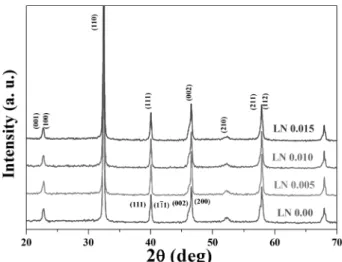
Fig. 1 shows X-ray diffraction patterns of the BNKT- ST-LN ceramics in the 2 θ range of 20
o-70
o. All samples exhibit a single-phase perovskite structure without any traces of secondary phases. This indicates that La and Nb (LN) ions were successfully incorporated into the lattice of the BNKT-ST matrix. Pure BNKT-ST sample (LN 0.00) exhibits coexistence of rhombohedral and tetragonal symmetry evident from visible peaks splitting (111)/(1 1) and (002)/(200) at 40
oand 46
o, respectively. However, it is noted that the (111)/(1 1) split peaks of the rhom- bohedral phase transformed into a single (111) peak and (002)/(200) split peaks of the tetragonal phase trans- formed into a single (200) peak with the increase in LN contents, which indicates that the crystal structure of LN modified BNKT-ST ceramics transformed from the co- existence of rhombohedral and tetragonal into a pseudo cubic phase. Similar structural characteristics were also observed in previously studied BNKT-based ceramics.
13,16)Fig. 2 shows the surface grain morphologies of as- sintered LN-modified BNKT-ST ceramics. The grains of the BNKT ceramics had a dense structure, similar to that of typical BNKT ceramics. The co-substitution of LN seemed little influence on the morphology of BNKT-ST ceramics; however, the average grain size slightly in- creased with increasing LN content. The results are consistent with previous work on Nb-doped BNKT-BST and La-doped BNKT ceramics.
11,14)The temperature-dependent dielectric constant ( ε
r) and loss (tan δ) of poled samples LN modified BNKT-ST ceramics at a measurement frequency of 100 kHz are presented in Fig. 3. As can be seen from Fig. 3, two dielectric anomalies, the maximum dielectric constant temperature (T
m) peak observed around 280
oC and the
1 1
Fig. 1. X-ray diffraction patterns of LN-doped BNKT-ST ceramics.
depolarization temperature (T
d) curve appeared around 100
oC. The dielectric peaks at T
mgradually broadened and ε
mdecreased with increasing LN concentration. The loss curves showed a sharp T
dpeak for pure BNKT-ST ceramic, however the peaks were diffused for LN-sub- stituted BNKT-ST ceramics. The sharp peak in the loss curves of the pure BNKT-ST ceramic may be ascribe to
formation of macrodomains in its poled sample.
4)How- ever, the diffused character in the LN co-modified BNKT-ST ceramics is due to simultaneous substitutions of La and Nb ions on A- and B-site respectively, which are the sources of random fields that break the long-range order of BNKT-ST and stabilize the polar nanoregions at low temperature and zero field in a way similar to that proposed for other BNT-based ceramics.
4,5,17-19)Therefore, the observed diffuse and/or relaxor behavior could be attributed to the disordering of the A-site and B-site cations and the compositional fluctuation in the present work.
The ferroelectric properties of LN-doped BNKT-ST ceramics are described by the P-E hysteresis loops, as shown in Fig. 4(a). The P-E hysteresis loops demonstrate that ceramics with LN 0.00 and LN 0.005 exhibit a well- saturated ferroelectric behavior, which is in good agree- ment with previous work.
9-17)However, with further increase in the LN content, LN > 0.005, the P-E loops of the ceramics become constricted, and the ceramics exhibit some characteristics of a relaxor state.
9,10,13,15-18)This result indicates that excessive LN content considerably weakens the ferroelectricity of the ceramics. The charac- teristic values of the remnant polarization (P
r), maximum polarization (P
max), and coercive field E
care presented in Fig. 4(b). P
rslightly increased from 26 μC/cm
2to 33 μC/
cm
2for LN 0.00 and LN 0.005, respectively, and then decreased with further increase in the LN contents. The
Fig. 2. SEM micrographs of BNKT-ST ceramics with different LN content.Fig. 3. Temperature dependence of the dielectric constant and loss of poled LN-doped BNKT- ST ceramics.
effective E
cdecreased steeply from 30 kV/cm to 4 kV/cm as LN increased from 0.00 to 0.015. The significant reduction in the polarization response and the distinct changes in the P-E loop with increasing LN contents suggest that LN induces a phase transition in BNKT-ST ceramics from normal ferroelectric to diffuse and/or relaxor phase. Similar phenomenon has been observed in previous reports on BNT-based ceramics.
17-22)Fig. 5 shows the piezoelectric constant (d
33) of the LN- doped BNKT-ST ceramics. The d
33parameter increases up to LN 0.005 with a maximum value of d
33= 215 pC/
N. The obtained value of d
33for La and Nb co-doped BNKT-ST system is significantly higher than La-doped BNKT (d
33= 172 pC/N) and Nb-doped BNKT (d
33= 152 pC/N) ceramics.
14,23)This enhancement might be related to the increased random fields with the conversion of nano-domains to FE domains and the increase in intrinsic piezoelectric strain at unit cell level for this composition (LN 0.005). Further increase in LN concentration resulted in a significant reduction in d
33values, which can be attributed to the weakened ferroelectric properties of the sample. The observed trends of d
33is in good agreement with the polarization hysteresis loops in Fig. 4(a), similar behavior is also reported in other BNKT-based ce- ramics.
4,14)The substantial increase in d
33at LN 0.005 is attributed to a large P
rand a lower E
c. This is because a lower E
cenables the ceramics to be more easily poled, while a large P
rand P
mfavors piezoelectricity. Therefore, such improvement in piezoelectricity can be attributed to the enhancement of remnant polarization and reduction in coercive field.
4. Conclusion
The influence of La and Nb co-substitution on crystal structure, microstructure, dielectric, ferroelectric, and piezo- electric properties of BNKT-ST ceramics was investigated.
The crystal structure of LN-doped BNKT-ST shows a phase transformation from the coexistence of rhomb- ohedral and tetragonal to pseudocubic symmetry. The
Fig. 4. Room temperature ferroelectric properties (a) P-E loops of LN-doped BNKT-ST ceramics (b) Characteristics values of LN-doped BNKT-ST ceramics.Fig. 5. Piezoelectric constant (d33) of LN-doped BNKT-ST ceramics.
Table 1. Physical and electrical properties of LN-doped BNKT-ST ceramics sintered at 1160oC.
BNKT-ST-LN (x) Density (g/cm3) Ec (kV/cm) Pr (μC/cm2) Pm (μC/cm2) εr tan δ (%) d33 (pC/N)
0.00 5.78 30 26 34 703 4.5 165
0.005 5.80 22 33 38 1455 7.0 215
0.010 5.81 6 7 29 1462 7.1 24
0.015 5.79 4 3 21 1464 7.2 10
temperature dependence of dielectric properties showed that the depolarization temperature (T
d) shifted towards lower temperatures and that the degree of diffuseness of the phase transition around T
dand T
mbecame more obvious with the addition of LN. Deformed P-E hysteresis loop at LN 0.010 concentration was observed, suggesting the coexistence of ferroelectric and relaxor phases for modified BNKT-ST ceramic. A maximum value of remnant polarization (33 μC/cm
2) and high piezoelectric constant (215 pC/N) were observed at LN 0.005 com- position, which is significantly higher than individually La-doped BNKT and Nb-doped BNKT ceramics.
Acknowledgements
This work was supported by the Basic Science Re- search Program through the National Research Foun- dation of Korea (NRF), as funded by the Ministry of Education, Science and Technology (MEST) (2011- 0030058) and Ministry of Education (MOE) and Na- tional Research Foundation of Korea (NRF) through Human Resource Training Project for Regional Innovation (No. 2013H1B8A2032206).
References
1. G. H. Haertling, J. Am. Ceram. Soc., 82(4), 797 (1999).
2. J. Rödel, K. G. Webber, R. Dittmer, W. Jo, M. Kimura and D. Damjanovic, J. Eur. Ceram. Soc., 35(6), 1659 (2015).
3. A. Maqbool, A. Hussain, J. U. Rahman, T. K. Song, W.
J. Kim, J. Lee and M. H. Kim, Ceram. Int., 40, 11905 (2014).
4. A. Zaman, Y. Iqbal, A. Hussain, M. H. Kim and R. A.
Malik, J. Mater. Sci., 49(8), 3205 (2014).
5. S. T. Zhang, A. B. Kounga, E. Aulbach and Y. Deng, J.
Am. Ceram. Soc., 91(12), 3950 (2008).
6. Y. Hiruma, Y. Imai, Y. Watanabe and T. Takenaka, Appl.
Phys. Lett., 92, 262904 (2008).
7. A. Sasaki, T. Chiba, Y. Mamiya and E. Otsuki, Jpn. J.
Appl. Phys., 38, 5564 (1999).
8. S. T. Zhang, A. B. Kounga, E. Aulbach and J. Rödel, Appl. Phys. Lett., 91, 112906 (2007).
9. H. S Han, W. Jo, J. Rödel, I. K. Hong, W. P. Tai and J.
S Lee, J. Phys.: Condens. Matter., 24, 36590 (2012).
10. M. Acosta, N. Liu, M. Deluca, S. Heidt, I. Ring, C. Dietz, R. W. Stark and W. Jo, J. Appl. Phys., 117, 134106 (2015).
11. A. Ullah, R. A. Malik, A. Ullah, D. S. Lee, S. J. Jeong, J. S. Lee, I. W. Kim and C. W. Ahn, J. Eur. Ceram. Soc., 34(1), 29 (2014).
12. Y. Hiruma, Y. Imai, Y. Watanabe, H. Nagata and T.
Takenaka, Appl. Phys. Lett., 92, 262904 (2008).
13. R. A. Malik, J. K. Kang, A. Hussain, C. W. Ahn, H. S.
Han and J. S. Lee, Appl. Phys. Exp., 7, 061502 (2014).
14. T. H. Dinh, H. Y Lee, C. H Yoon, R. A Malik, Y. M Kong, J. S Lee and V. D. N. Tran, J. Korean Phys. Soc., 62, 1004 (2013).
15. V. Q. Nguyen, H. S. Han, K. J. Kim, D. D. Dang, K. K.
Ahn and J. S. Lee, J. Alloys Compd., 511, 237 (2012).
16. R. A. Malik, A. Hussain, J. U. Rahman, A. Maqbool, T.
K. Song, W. J. Kim, S. Y. Ryou and M. H. Kim, Mater.
Lett., 143, 148 (2015).
17. K. Wang, A. Hussain, W. Jo and J. Rodel, J. Am. Ceram.
Soc., 95(7), 2241 (2012).
18. J. Hao, B. Shen, J. Zhai and H. Chen, J. Appl. Phys., 115, 034101 (2014).
19. A. Ullah, C. W. Ahn, R. A. Malik, J. S. Lee and I. W.
Kim, J. Electroceram., 33(3-4), 187 (2014).
20. H. B. Lee, D. J. Heo, R. A. Malik, C. H. Yoon, H. S.
Han and J. S. Lee, Ceram. Int., 39, S705 (2013).
21. A. Hussain, J. U. Rahman, A. Zaman, R. A. Malik, J.
S. Kim, T. K. Song, W. J. Kim and M. H. Kim, Mater.
Chem. Phys., 143(3), 1282 (2014).
22. A. Maqbool, A. Hussain, R. A. Malik, J. U. Rahman, A.
Zaman, T. K. Song, W. J. Kim and M. H. Kim, Mater.
Sci. Eng. B, (2015) doi.org/10.1016/j.mseb.2015. 05.009.
23. K. N. Pham, A. Hussain, C. W. Ahn, I. W. Kim, S. J.
Jeong and J. S. Lee, Mater. Lett., 64(20), 2219 (2010).