Optimization for Scenedesmus obliquus Cultivation:
the Effects of Temperature, Light Intensity and pH on Growth and Biochemical Composition
Yonggang Zhang1, Li Ren2, Huaqiang Chu2, Xuefei Zhou2, Tianming Yao1*, and Yalei Zhang2*
1School of Chemical Science and Engineering, 2State Key Laboratory of Pollution Control and Resource Reuse, Tongji University, Shanghai 200092, P.R. China
Received: June 12, 2019 / Revised: July 23, 2019 / Accepted: July 25, 2019
Introduction
Due to the overconsumption of fossil fuel, the increas- ing demand for energy and environment pollution are major challenges facing modern society [1]. In recent years, biodiesel produced from algae biomass is receiv- ing widespread attention owing to the potential as a non-toxic, renewable and biodegradable fuel because of the high photosynthetic efficiency and growth of algae.
Moreover, microalgae have several functions for remov- ing pollutants, contributing to the development of the
coupling of bioenergy and wastewater treatment [2].
Despite these advantages, several problems remain to be addressed to make this technology competitive for commercial production of biodiesel [3−5]. Improved strains based on volumetric productivity, appropriate metabolic profile and optimal cultivation conditions are required to make feasible for large-scale production [6].
Cultivation for microalgae requires consideration of different environmental conditions. Among the several factors affecting the growth of microalgae, environmen- tal factors such as temperature, light intensity, and pH, may significantly affect the algal growth and cellar com- positions [7−9]. Temperature plays a crucial role in algae growth and photosynthetic activity of microalgae. In the cultivation process, algae growth and lipid accumulation with different temperatures are influenced by the activ- ity of enzyme, material exchange and cell division [10].
Due to photosynthetic characteristics, light condition is Microalgae have been explored as potential host species for biofuel production. Environmental factors affect algal growth and cellular composition. The effects of several key environmental factors, such as tem- perature, light, and pH of the medium on the growth and biochemical composition of Scenedesmus obliquus were investigated in this study. The highest growth rate of microalgae was observed at an optimal tem- perature of 25℃, 150 µmol/(m2·s) light intensity, and pH 10.0. The biochemical composition analysis revealed that the carbohydrate content decreased at lower (20℃) or higher temperature (35℃), whereas the protein and lipid contents increase at these temperatures. The fluctuation of light intensity significantly affected the contents of protein, carbohydrate, and lipid. The protein levels varied greatly when the pH of the medium was below 7.0. The carbohydrate and lipid contents significantly increased at pH above 7.0.
Keywords: Scenedesmus obliquus, temperature, light, medium pH, growth rate, lipid content
*Corresponding authors T. Yao
Tel: +86-21-65983292, Fax: +86-21-65985811 E-mail: [email protected]
Y. Zhang
Tel: +86-21-65983292, Fax: +86-21-65985811 E-mail: [email protected]
© 2019, The Korean Society for Microbiology and Biotechnology
one of the most important factors for microalgae growth, which affects the growth rate and appreciation rate mainly through regulating intensity and time [11].
Under certain light conditions, the appropriate inten- sity can promote growth and accumulation of lipid in algae. The growth can be inhibited with too low or high light intensity. pH is believed to be one of the basic parameters affect enzyme activity and material flow and utilization in microalgae [10]. Most algal strains are known to flourish at neutral pH about 7.0 to 7.6, and all strains seem to have a limited optimal range of pH.
Scenedesmus obliquus (S. obliquus) is one of the most potential species as feedstock for biodiesel production and wastewater treatment [12]. The optimization of its cultivation conditions is the key premise for bioenergy and pollutant removal researches. Microalgae at optimal temperature results in a high growth rate [13]. It was found that S. obliquus is mesophilic and can grow at a temperature between 15 and 40℃. Martínez et al. have demonstrated that the highest specific growth of S.
obliquus was obtained at 30℃ [14]. Moreover, light intensity affects the growth of algae through its impact on photosynthesis. Previous research has reported that photosynthetic pigment was affected. It was found that protein, carbohydrate, and lipid contents remained sta- ble with light intensity from 50−1000 µmol/(m2· s) and the highest growth was detected at 150 µmol/(m2· s) in S.
obliquus [15, 16]. A fluctuated medium pH may limit the growth of algae via metabolic inhibition. The optimal pH for growth of S. obliquus was observed under neutral and alkaline conditions, while resulting in an increase of triglyceride accumulation. The maximum growth was observed at a pH of 8.0 [17].
Whether in laboratory experiments or open ponds researches, cultivation for algae requires consideration of optimizing numerous environmental conditions.
However, the optimal environmental conditions are mostly deliberated separately in different culture medium; there are few studies available which focus on the main environmental factors in the same medium synchronously. Furthermore, environmental factors not only affect photosynthesis and growth rate but also influence the activity and composition of cellular metab- olites [8]. However, plenty of previous researches with environmental factors have exclusively concentrated on
effects on lipid accumulation and do not examine the alteration of biochemical compositions (i.e. protein, car- bohydrate, and lipid) [18−20].
In this paper, the effects of major environmental fac- tors, including temperature, light intensity, and pH, on S. obliquus growth and biochemical compositions were investigated. S. obliquus showed the highest growth rate with optimal conditions of temperature 25℃, light inten- sity 150 µmol/(m2· s) and pH value 10.0. Temperature and light intensity contributed to the increase in protein and lipid. The content of protein was influenced obviously when the medium pH value was below 7.0, while a higher pH above 7.0 significantly affecting the carbohydrate and lipid contents. This study expounded the influence of both algae growth and broader biochemical process with consolidated environmental factors. These results may guide optimal system establishment and efficient scale-up of production for biodiesels and bioproducts.
Materials and Methods
Microalgae strain and culturing conditions
The microalgae strain was prepared from Freshwater Algae Culture Colletion at the Institute of Hydrobiology, in Wuhan, China. The culture medium was modified BG11 [18, 19], consisting of NaNO3 (1500 mg/l), K2HPO4· 3H2O (40 mg/l), MgSO4·7H2O (75 mg/l), ammonium ferric citrate (6 mg/l), CaCl2· 2H2O (36 mg/l), Na2CO3 (20 mg/l), citric acid (6 mg/l), EDTA (1 mg/l), H3BO3 (2.86 mg/l), MnCl2·4H2O (1.81 mg/l), ZnSO4·7H2O (0.22 mg/l), CuSO4· 5H2O (0.079 mg/l), (NH4) 6Mo7O24· 4H2O (0.39 mg/l) and Co(NO3)2· 6H2O (0.049 mg/l). The strain was culti- vated in 500 ml flask containing 400 ml BG11 medium.
The initial algal concentration was about 0.15 g/l (dried weight) with shaking three times a day for 22 days. The cultivation temperatures were controlled at 20, 25, 30 and 35℃ respectively with a light intensity of 100 µmol/
(m2· s) and a medium pH value of 8.0. The light intensi- ties of cultivation conditions were maintained at 50, 100, 150 and 200 µmol/(m2· s), respectively. The temperature was controlled at 25± 1℃ with an initial pH value of 8.0.
The medium of initial pH values was set at 5, 6, 7, 8, 9, 10 and 11 respectively. Illumination was provided on a 12 h light, 12 h dark cycle. All experiments were carried out in triplicate.
Estimation of biomass concentration
The cell concentration of the culture was determined by measuring the OD680 (the optical density of algae culture at 680) using a UV spectrophotometer [11]. The dry weight of the microalgae biomass with a known volume was estimated by centrifuging at 5000 rpm for 10 min. The harvested biomass was dried at 105℃ until the weight was invariant. The microalgae dry weight was obtained by subtracting the blank biomass. The OD680 value was converted to biomass concentration via appropriate calibration between OD680 and dry cell weight and the conversion factor was determined. The relationship of microalgae biomass concentration was shown in Eq. (1) (determined with the experiment result).
(1)
Determination of protein content
The estimation of protein content was analyzed using the Kjeldahl nitrogen determination method, the same
as the national standard of the People’s Republic of China (GB/T5009.5-2003). The calibration between pro- tein content and nitrogen content was confirmed as PC (protein content) = NC (nitrogen content) × 6.25.
Determination of carbohydrate content
The carbohydrate content in microalgae was analyzed mainly by a modified method from Chaplin M. The car- bohydrate was determined by the phenol-sulfuric acid reaction with the standard of glucose [20]. A 15-ml medium containing algae cell was centrifuged at 5000 rpm for 5 min and removed the supernatant. The buffer solution was then added into the biomass and the cells were broken with ultrasonic. The supernatant collected after centrifugation added a 6 ml phenol-sulfuric acid solution and heated at 90℃ after 15 min. The result was determined by measuring the OD485.
Determination of lipid content
The content of lipids was done following the method of Bligh and Dyer [21]. 0.5 g dried algae powder was BC 0.3625 OD= × 680–0.0319, R2=0.99587
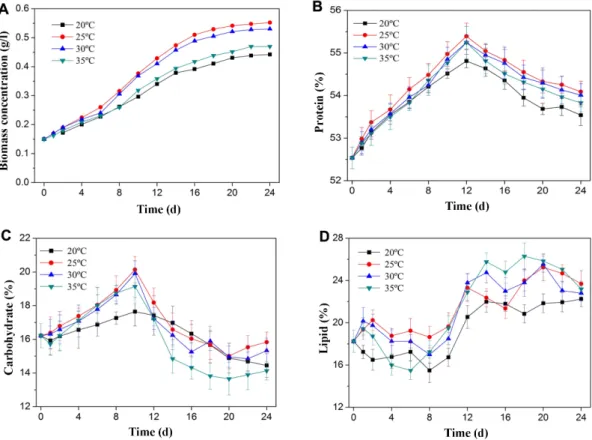
Fig. 1. The effects of temperature on growth and biochemical compositions in S. obliquus. Biomass concentration (A), protein content (B), carbohydrate content (C), lipid content (D) under different temperature. Error bars represent standard error.
extracted with a mixture of chloroform and methanol (2:1 v/v) and kept for 24 h at 25℃. The supernatant was separated by centrifugation for 10 min at 5000 rpm and the solvent was removed using a rotary evaporator at 104℃ for 30 min.
Results and Discussion
Effect of temperature on biomass production and bio- chemical composition of S. obliquus
The growth curves of S. obliquus in a medium for cul- tivation with different temperature were shown in Fig.
1A. Cultivation of S. obliquus for 22 days grew into the stable phase. The groups of 20℃ and 35℃ had consistent growth, which indicated lower or higher temperature was unfavorable to biomass accumulation of microalgae with photoinhibition [8]. The microalgae in every group grew very slowly at the beginning of the culture period.
After 4 days of adaptation the growth rate S. obliquus increased, and cells achieved the maximum biomass con- centration (0.57 g/l) at 25℃. The microalgae at 20℃ and
35℃ had almost the same algae density. This result fur- ther demonstrated that higher temperature increased the growth of algae up to an optimal value, and then decreased with any further increase in temperature [13].
The decrease in growth is caused by heat stress and it leads to the inactivation of enzymes and denaturation of proteins that participate in the photosynthesis process [22]. Biochemical compositions in terms of protein, car- bohydrate and lipid, were illustrated in Fig. 1B−1D. The content of protein, carbohydrate, and lipid changed slightly at different temperatures. The temperature from 20℃ to 35℃, the protein and carbohydrate content of S. obiquus rose firstly and then deceased, and the maximum protein and carbohydrate content was shown at 25℃. At the temperature above 25℃, the content of protein and carbohydrate decreased. With the increas- ing temperatures beyond optimum, the efficiency of pro- tein synthesis and starch production was reduced resulting in the decrease of protein and carbohydrate content [23, 24]. When the temperatures ranged from 25℃ to 35℃, the lipid content rose slowly in the
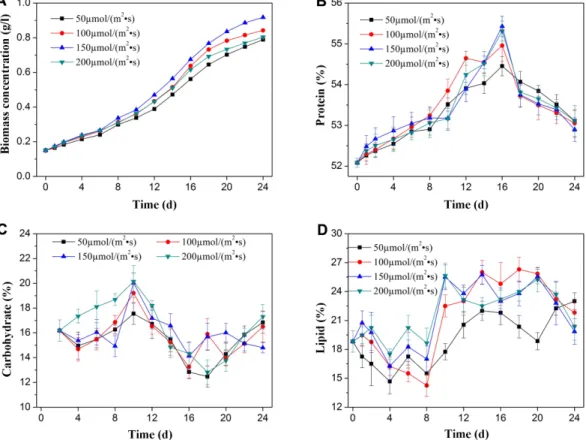
Fig. 2. The effects of light intensity on growth and biochemical compositions in S. obliquus. Biomass concentration (A), protein content (B), carbohydrate content (C), lipid content (D) under different light intensity. Error bars represent standard error.
4 days and then declined gradually. During the exponen- tial phase of the cultivation process, the content of lipid increased and the highest lipid content was 24% at 35℃ which increased by 33.3%. Similar influences were observed in Nannochloropsis oculata with doubled the lipid content with the growth temperature [25].
Effect of light intensity on growth and biochemical com- position of S. obliquus
The growth of S.obliquus under different light intensi- ties was shown in Fig. 2A. It was found that the growth
rate increased with rising light intensity during expo- nential phase. However, the algal growth dropped down when the light intensity rose above 200 µmol/(m2· s). The biomass productivity trended to increase with a rising light intensity until it reached the maximum. The maxi- mum biomass productivity of 35.10 mg/(L· d) was obtained at a light intensity of 150 µmol/(m2· s). Further rise of light intensity to 200 µmol/(m2· s), led to a marked drop in biomass concentration. Three light conditions, namely light limitation, light saturation and light inhibi- tion impacts the growth of microalgae. When the condi-
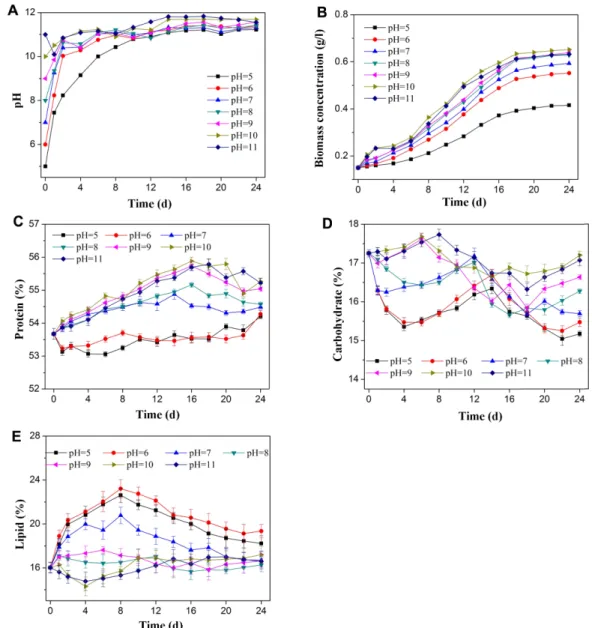
Fig. 3. Changes of pH and the effects of pH on growth and biochemical compositions in S. obliquus. Change of pH (A), Biomass concentration (B), protein content (C), carbohydrate content (D), lipid content (E) under different pH value. Error bars represent stan- dard error.
tion is light limiting, the growth of algae increases with rising light intensity. At light saturation, the process of photosynthesis is inhibited as the photon absorption exceeds the amount of electron turnover. When the light intensity is further increased, excessive illumination limits the growth of microalgae, which was recognized as the effect of photoinhibition resulting from the disrup- tion of chloroplast lamellae [26−28].
Light intensity not only takes advantage of fast algal growth but influences the metabolism of cellular compo- sition. As showed in Fig. 2B−2D, the change of cellular protein content showed a tendency of rising from initial to an exponential phrase, and during the stationary phase, the content of protein decreased. With an increase of light intensity, S. obliquus exhibited a reduc- tion in protein content. A similar result was reported in Phaeodactylum tricornutum, in which the protein syn- thesis was promoted with lower light intensity of 18 µE/
(m2· s) [29]. When light intensity was in ranges of 50− 150 µmol/(m2· s), the same fluctuation of carbohydrate content was observed. The light intensity had little effect on carbohydrate content the initial and stationary pro- cess, except for a slight decrease at 150 µmol/(m2· s). At the light intensity of 200 µmol/(m2· s), the carbohydrate content reached the highest level. The lipid content appeared to rise fluctuations ranging from 50 to 200 µmol/(m2· s) rising about 5%, which increased signifi- cantly at 100−200 µmol/(m2· s). In general, high light resulted in an increase in cellular lipid content [16].
Change of pH value and the effect on growth and bio- chemical composition of S. obliquus
Fig. 3A showed that the pH value of the culture solu- tion turned neutral or alkaline on the first day when the condition of the cultivation for S. obliquus was acidic pH, and then gradually increased and stabilized between 10 and 11. At initial pH 7 to 9, pH value increased and kept consistent after a slight decrease.
The pH value fluctuates around 11. When the initial pH was 10 to 11, the pH of the culture solution was approxi- mately 11−12. Due to the uptake of inorganic carbon by algae, pH can rise significantly in algal cultures [30]. It indicates that S. obliquus is suitable to grow under alkaline conditions. Under the treatment of different initial pH values, the biomass concentration was observed for the cultivation of S. obliquus (Fig. 3B). At pH 5 the
algae grew slowly, and the growth rate of S. obliquus increased with increasing pH values up to 11. Acidic con- ditions induce the inhibition of the enzyme in photosyn- thetic and this results in the alteration of nutrient uptake and thus affects algal growth [10]. With the increase of the initial pH value, the biomass concentra- tion increased. The maximum biomass concentration was 0.65 g/l at pH 10.
The effect of pH on biochemical composition was illus- trated in Fig. 3C−3E. When the pH was 5 and 6, the pro- tein content fluctuated around 54%. The protein content gradually increased at the exponential process and decreased during the stationary phase under neutral and alkaline environments. At pH 10, the protein con- tent reached a maximum of 55.26%. The carbohydrate content significantly decreased and gradually increased at pH 5−6. During the exponential phase, the carbohy- drate content decreased by about 2%. With the increase of pH, the reduction of carbohydrate content decreased.
When the pH was 5−7, the lipid content first increased dramatically, then slowly decreased. The content of lipid changed slightly in alkaline pH and varied from 15 to 17%. When the pH was 6, the lipid content gained the highest. Researches have demonstrated that several algae such as Chlorella zofingiensis can accumulate stor- age lipid under acidic condition, which was same as this study [31].
Summing up the above, the effect of several key envi- ronmental factors including temperature, light intensity and pH on S. obliquus for cultivation in aim to establish optimal system was investigated. S. obliquus showed a maximum growth rate with the condition of tempera- ture 25℃, light intensity 150 µmol/(m2· s) and pH value 10. Above or below the optimal value, the growth rate was inhibited. S. obliquus could quickly grow under the optimal condition, and the changes in biochemical com- position differed from different conditions. Temperature and light intensity contributed to the synthesis of pro- tein and lipid. Acidic conditions influenced the content of protein and alkaline condition mainly affected the carbo- hydrate and lipid content. This study of consolidated cul- tivation with optimal environmental factors offered essential parameters for supporting further researches with algae technology, such as an algae-wastewater sys- tem with the aim of biodiesel production and pollutant removal in photobioreactors or open ponds.
Acknowledgments
This research was financially supported by the National Natural Sci- ence Foundation of China (No.51625804).
Conflict of Interest
The authors have no financial conflicts of interest to declare.
References
1. Abomohra AE, Eladel H, El-Esawi M, Wang S, Wang Q, He Z, et al.
2017. Effect of lipid-free microalgal biomass and waste glycerol on growth and lipid production of Scenedesmus obliquus:
Innovative waste recycling for extraordinary lipid production.
Bioresour. Technol. 249: 992-999.
2. Xin L, Hong-Ying H, Jia Y. 2010. Lipid accumulation and nutrient removal properties of a newly isolated freshwater microalga, Scenedesmus sp. LX1, growing in secondary effluent. N. Biotechnol.
27: 59-63.
3. Scott SA, Davey MP, Dennis JS, Horst I, Howe CJ, Lea-Smith DJ, et al. 2010. Biodiesel from algae: challenges and prospects. Curr.
Opin. Biotechnol. 21: 277-286.
4. Demirbas A. 2011. Competitive liquid biofuels from biomass.
Appl. Energy 88: 17-28.
5. Koller M, Salerno A, Tuffner P, Koinigg M, Böchzelt H, Schober S, et al. 2012. Characteristics and potential of micro algal cultivation strategies: a review. J. Clean Prod. 37: 377-388.
6. Malcata FX. 2011. Microalgae and biofuels: a promising partner- ship? Trends Biotechnol. 29: 542-549.
7. Behrens PW, Kyle DJ. 2010. Microalgae as a source of fatty acids.
J. Food Lipids 3: 259-272.
8. Juneja A, Ceballos RM, Murthy GS. 2013. Effects of environmental factors and nutrient availability on the biochemical composition of algae for biofuels production: a review. Energies 6: 4607-4638.
9. Cabello J, Toledo-Cervantes A, Sánchez L, Revah S, Morales M.
2015. Effect of the temperature, pH and irradiance on the photo- synthetic activity by Scenedesmus obtusiusculus under nitrogen replete and deplete conditions. Bioresour. Technol. 181: 128-135.
10. Gatamaneni BL, Orsat V, Lefsrud M. 2018. Factors affecting growth of various microalgal species. Environ. Eng. Sci. 35: https://
doi.org/10.1089/ees.2017.0521.
11. Ho SH, Chen CY, Chang JS. 20012. Chang Effect of light intensity and nitrogen starvation on CO2 fixation and lipid/carbohydrate production of an indigenous microalga Scenedesmus obliquus CNW-N. Bioresour. Technol. 113: 244-252.
12. Gris B, Morosinotto T, Giacometti GM, Bertucco A, Sforza E. 2014.
Cultivation of Scenedesmus obliquus in photobioreactors: effects of light intensities and light-dark cycles on growth, productivity, and biochemical composition. Appl. Biochem. Biotechnol. 172:
2377-2389.
13. Theses and Dissertations--Biosystems and Agricultural Engineering.
Available from https://uknowledge.uky.edu/bae_etds/3. Accessed April 5, 2012.
14. Martínez ME, Jiménez JM, Yousfi FE. 1999. Influence of phospho-
rus concentration and temperature on growth and phosphorus uptake by the microalga Scenedesmus obliquus. Bioresour. Technol.
67: 233-240.
15. Sforza E, Gris B, de Farias Silva CE, Morosinotto T, Bertucco A. 2014.
Effects of light on cultivation of Scenedesmus obliquus in batch and continuous flat plate photobioreactor. Chem. Eng. Trans. 38: 211-216.
16. Liu J, Yuan C, Hu G, Li F. 2012. Effects of light intensity on the growth and lipid accumulation of microalga Scenedesmus sp. 11-1 under nitrogen limitation. Appl. Biochem. Biotechnol. 166: 2127-2137.
17. Yang J, Li B, Zhang C, Hongxuan L, Zhou Y. 2016. pH-associated changes in induced colony formation and growth of Scenedesmus obliquus. Fundam. Appl. Limnol. 187: 241-246.
18. Allen MM. 1968. Simple conditions for growth of inicellular blue- green algae on plates (1, 2). J. Phycol. 4: 1-4.
19. Tang D, Han W, Li P, Miao X, Zhong J. 2011. CO2 biofixation and fatty acid composition of Scenedesmus obliquus and Chlorella pyrenoidosa in response to different CO2 levels. Bioresour. Technol.
102: 3071-3076.
20. Chaplin MF, Kennedy JF. 1994. Carbohydrate analysis: a practical approach, 2nd Ed. pp. 1-41. IRL Press, New York.
21. Bligh EG, Dyer WJ. 1959. A rapid method of total lipid extraction and purification. Can. J. Biochem. Physiol. 57: 911-917.
22. Ras M, Steyer JP, Bernard O. 2013. Temperature effect on microalgae:
a crucial factor for outdoor production. Rev. Environ. Sci. Biotechnol.
12: 153-164.
23. Nakamura Y, Miyach S. 1982. Effect of temperature on starch degradation in Chlorella vulgaris 11h cells. Plant Cell Physiol. 23:
333-341.
24. Williams PJLB, Laurens LML. 2010. Microalgae as biodiesel & bio- mass feedstocks: Review & analysis of the biochemistry, energet- ics & economics. Energy Environ. Sci. 3: 554-590.
25. Converti A, Casazza AA, Ortiz EY, Perego P, Borghi MD. 2009.
Effect of temperature and nitrogen concentration on the growth and lipid content of Nannochloropsis oculata and Chlorella vulgaris for biodiesel production. Chem. Eng. Process 48: 1146-1151.
26. Chang JS, Show PL, Ling TC, et al. 2016. Photobioreactors, pp. 313-352. In LarrIRL Pressoche C, Sanroman M, Du GC, Pandey A, Curr. Dev. Biotechnol. Bioeng, 1st Ed. Elsevier, Amsterdam.
27. Pandey SS, Kumar D, Tiwari BS. 2016. Chloroplast Metabolic Engi- neering for Sustainable Agriculture, pp. 149-162. In Dubey S, Pan- dey A, Sangwan R, Curr. Dev. Biotechnol. Bioeng, 1st Ed. Elsevier, Amsterdam.
28. Fan J, Huang J, Li Y, Han F, Wang J, Li X, et al. 2012. Sequential heterotrophy-dilution-photoinduction cultivation for efficient microalgal biomass and lipid production. Bioresour. Technol. 112:
206-211.
29. Qian KX, Borowitzka MA. 1993. Light and nitrogen deficiency effects on the growth and composition of Phaeodactylum tricor- nutum. Appl. Biochem. Biotechnol. 38: 93-103.
30. Hansen PJ. 2002. Effect of high pH on the growth and survival of marine phytoplankton : implications for species succession.
Aquat. Microb. Ecol. 28: 279-288.
31. Zhu L, Hiltunen, E, Shu Q, Zhou W, Li Z, Wang Z. 2014. Biodiesel production from algae cultivated in winter with artificial wastewater through pH regulation by acetic acid. Appl. Energy 218: 103-110.