Effect of Light Emitting Diodes Treatment on Growth and Quality of Lettuce ( Lactuca sativa L. 'Oak Leaf')
Yong-Seub Shin
1*, Mun-Jung Lee
1, Eun-Sook Lee
1, Joon-Hyung Ahn
1, Min-Ki Kim
1, Ji-Eun Lee
1, Han-Woo Do
1, Joung-Do Cheung
1, Jong-Uk Park
1, Young-Ghul Um
2, So-Deuk Park
1and Jang-Heui Chae
11
Gyeongsangbukdo Agricultural Research & Extension Services, Daegu 702-708, Korea
2
National Institute of Horticultural and Herbal Science, RDA, Suwon 440-706, Korea
Received August 31, 2013 /Revised December 31, 2013 /Accepted January 6, 2014The objective of this study was to elucidate the effect of light-emitting diode treatment on early growth and inorganic elements in leaf lettuce (Lactuca sativa L. 'Oak Leaf'). In changes to leaf mor- phology, shoot elongation and hypocotyl length showed poor growth under red light irradiation, while red+blue light irradiation induced shorter plant height and more leaves, resulting in increased fresh weight. With respect to Hunter's color and SPAD values, lettuce seedlings grown under red+
blue and fluorescent light irradiation had a higher a* value but showed no other changes to SPAD values. Interestingly, redness in relative chlorophyll content was 1.4 times higher under red+blue light irradiation. Inorganic element (N, Ca, Mg, and Fe) and ascorbic acid concentrations increased in let- tuce plants grown under LED light irradiation compared to those of lettuce grown under fluorescent light, which showed a higher P content. In conclusion, red+blue light irradiation, which stimulates growth and higher nutrient uptake in leaf lettuce, could be employed in containers equipped with LEDs.
Key words : Growth, Light emitting diodes (LEDs) lettuce, minerals
*Corresponding author
*Tel : +82-54-931-6789, Fax : +82-54-931-1753
*E-mail : [email protected]
This is an Open-Access article distributed under the terms of the Creative Commons Attribution Non-Commercial License (http://creativecommons.org/licenses/by-nc/3.0) which permits unrestricted non-commercial use, distribution, and reproduction in any medium, provided the original work is properly cited.
Journal of Life Science 2014 Vol. 24. No. 2. 148~153 DOI : http://dx.doi.org/10.5352/JLS.2014.24.2.148
Introduction
Lettuce (Lactuca sativa L.) belongs to a member of the compositae, which is one of the major vegetable in the world. Lettuce is representative rice wrapped vegetable in Korea [5]. In Korea, leaf lettuce is commonly used as ''wrap-up vegetable'' with perilla (Perilla frutescens), kale (Brassica oleracea L. var. acephala), and pak-choi (B. rapa L.
var. chinensis) [9] and is widely grown commercially in greenhouses using hydroponic culture [6].
Light emitting diodes (LEDs) have been proposed as a photosynthetic radiation source for space flight growing systems and as a more efficient source for terrestrial con- trolled-environment agriculture facilities [2]. It showed that lettuce and other dicotyledon plants developed excessive hypocotyl elongation when grown under high-intensity red-emitting LEDs as the sole source of irradiance. LEDs
are a promising electric light source for space-based plant growth chambers because of their small mass and volume, solid-state construction, superior safety, and longevity [1, 2]. The electrical efficiency (μmol·J
-1) of gallium aluminum arsenide (GaAlAs) red LEDs is reportedly greater than that of fluorescent lamps and comparable to high-pressure so- dium lamps [1].
Commonly available red LEDs emit a narrow-spectrum of light (660 nm with 25 nm bandwidth at half peak height), which closely matches a peak absorbance of chlorophyll [7].
Although red LEDs have great potential for use as a light source to drive photosynthesis, plants are adapted to utilize a wide-spectrum of light to control photomorphogenesis.
Previous reports indicate that a minimum amount (20-30
μ mol·m
-2·s
-1) of blue light in broad-spectrum lamps is neces-
sary to achieve normal growth and morphology. This blue
light requirement appears to be a species-specific response
[12]. Tests with the addition of blue fluorescent (BF) light
to narrow-band red LEDs (660 nm) support the findings
with broad-spectrum lamps. Despite the increasing popular-
ity of red LEDs as a radiation source for growing plants,
information is available for only a few plant species that
directly compares growth and yield under red LEDs (with
and without supplemental blue light) with those under the
Table 1. ICP-OES operating conditions
Parameter Operation conditions
RF power, W
Sample uptake rate, ml/min Nebulization gas flow rate, L/min Plasma flow rate, L/min
Sample flow rate, L/min Observation height Nebulizer
Spray chamber
Elements, wavelengths (nm)
1350 1.50.85 151l5
15 mm above load coil Cross flow
Scott
Ca (422.673), Fe (259.940), K (766.491), Mg (280.270), Mn (257.610), P (213.618)
broad spectrum light. Hence, the purpose of this study is
to evaluate the effects of different LEDs on early seedling growth, leaf color, inorganic elements, ascorbic acid and SPAD value in lettuce.
Materials and Methods Lettuce growing
Lettuce (Lactuca sativa L., cv. 'Oak Leaf') seeds were in- cubated at 4°C on moistened germination paper for 2 days and germinated seeds were grown in peat substrate with a with a 6 h/18 h (day/night) photoperiod and an average ambient temperature of 20/16°C (day/night) . Each plastic
.culture tray (10 cm W × 35 cm L) contained three plants spaced 12 cm apart which is an effective planting density of 75 plants per m
2). Evapotranspiration losses of water were replenished daily by adding deionized water to the nutrient solution reservoir. Air temperature, relative humid- ity, and CO
2levels were maintained in growth chambers at 20°C, 60%, and 500 mg·l
-1respectively. The referred am- bient parameters of the room were maintained throughout the experiment duration. Each treatment comprises a 60 ×60cm illuminated growth area.
×LED treatment
Lettuce seedlings were grown for 30 day with photo- synthetic photon flux (PPF) maintained at near 300 μ mol·m
-2·s
-1. Levels of PPF were measured with a quantum sensor (Model LI-180, LI-COR, Lincoln) calibrated with a spectro-radiometer (Model LI-1800, LI-COR) to enable accu- rate readings for LEDs. The photosynthetic photon flux (PPF) in Red, Blue, Red+Blue, Fluorescent, Ultra violet, Far red was 172, 192, 169, 163 μmol․m
-2․s
-1, 5.1
-3, 497.7 w․
m
-2. The maximum peak of each LED radiation showed red (450-660 nm), far-red (730 nm), blue (450 nm), blue-red
(450+660 nm), Ultra violet (350 nm), Fluorescent as control light.
Leaf surface were measured with a Minolta CR-200b col- orimeter (Minolta, Ramsey, NJ) Three matured leaves per plant, in the upper third of the canopy, were measured on half of the plants of each plant under grown different LED radiation treatments. Leaf L*a*b* values were measured at the midpoint between the distal and basal ends of leaf.
Chlorophyll meter readings (SPAD values) were repeatedly taken ten times at the centre of the leaves throughout the experiments.
For determining inorganic elements, about 2 g lettuce powder was directly weighed in a porcelain crucible. The sample was preheated on a Bunsen burner until smoke was no longer observed. The crucible was placed in a cold muf- fle furnace. The temperature of the muffle was raised from 50℃/30 min to 450℃, and kept at this temperature for 4 hr. Mineralization was considered completion when ash was white or slightly colored, with no charred particles.
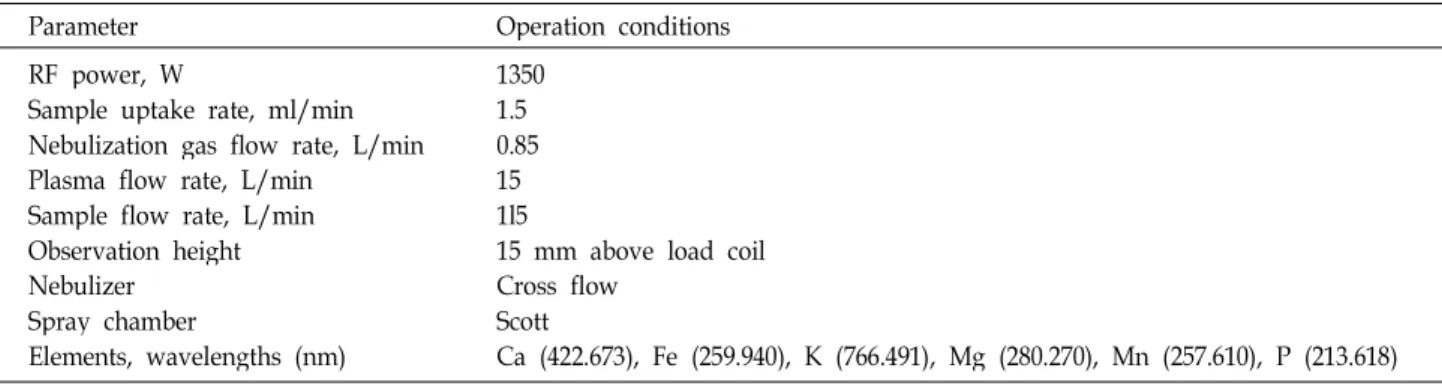
The ash was dissolved in 1 ml HCl and transferred with deionized water into 10.0 ml volumetric flask. For ICP-OES spectrometric measurements (Optima 3000 DV; Perkin Elmer Corp., Norwalk, CT). Details on ICP-OES in- strumental operating conditions and measuring parameters used are given in Table 1.
Analysis
The working multi-elemental standard solutions were
made with 10% HCl. All working standard solutions were
stored in Nalgene polypropylene bottles. The calibration
curve was made from 5 points and the blank. The multi-ele-
mental standard solutions ranged from 2.5 to 100.0 mg/l
for Ca, K, and P; 0.25-10.0 mg/l for Fe, 0.625-25.0 mg/l
for Mg; and 0.0125-0.5 mg/l for Mn. The collected data were
analyzed by using SAS package (version 8.0, SAS Institute
Fig. 1. Absolute PPF spectral distribution balance of LEDs and fluorescent light at the centre of growth areas(The wavelength of each LED used in this study was 450 and 660 nm in red, 450 nm in blue, 450 and 660 nm in red+blue, 350 nm in ultraviolet, and 730 nm in far-red light).
Table 2. Effects of light emitting diode on growth of 'Oak Leaf' lettuce at 30 days after treatment Radiation
light Plant height
(cm) Hypocotyl
length (cm) No. of leaf Leaf length
(cm) Leaf dia.
(cm) Fresh weight (g/plant) RedBlue
Red+blue Ultraviolet Far-red Fluorescent
13.3 az 8.8 c 9.1 c 10.8 b
6.2 d 14.2 a
1.9 a 0.0 b 0.0 b 0.0 b 0.0 b 0.0 b
4.4 b 4.3 b 5.7 a 3.8 b 2.0 c 5.3 a
13.3 a 8.9 c 9.0 c 10.8 b
0.9 d 14.2 a
3.7 a 3.4 a 4.1 a 2.7 b 0.4 c 4.1 a
2.6 a 1.5 b 3.3 a 0.7 b 0.0 c 3.0 a
zMeans separation within columns by Duncan,s multiple range test at 5% level.
Inc., Cary, NC) for Duncan's multiple range tests.
Results and Discussion Effect of growth
The wavelength of each LED used in this study was 450 and 660 nm in red, 450 nm in blue, 450 and 660 nm in red+blue, 350 nm in ultraviolet, and 730nm in far-red light (Fig. 1).
The PPF irradiance in red, blue, red+blue, fluorescent, ultraviolet, and far-red was 172, 192, 169, 163 μmol․m
-2․ s
-1, and 5.1
-3, 497.7 w․m
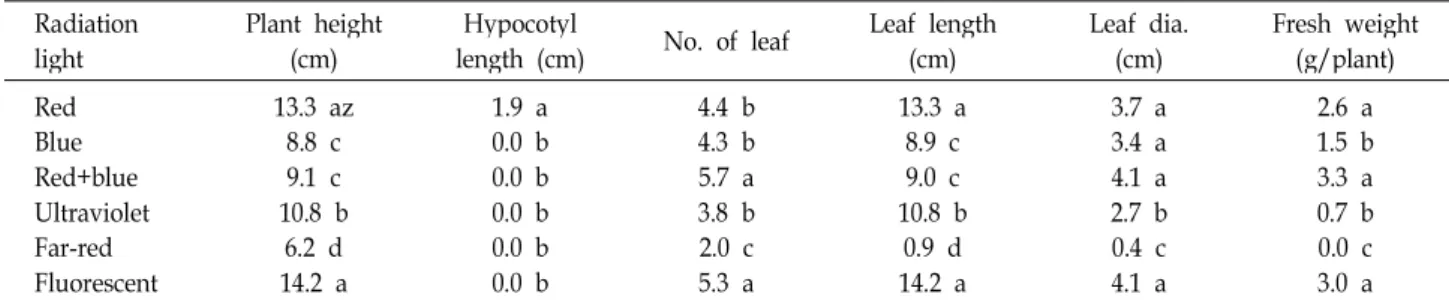
-2respectively. The plant height, hypocotyl length, leaf characteristics, and fresh weight culti- vated by various LEDs light radiation are shown in Table 2. Plant height of lettuce grown under red, blue, red-blue, ultraviolet, far-red and fluorescent light radiation were 13.3, 8.8, 9.1, 10.8, 6.2 and 14.2 cm, respectively.
Plant height of length cultivated by red and fluorescent showed the highest score compared with other samples.
Hypocotyl length was measured following 30 days of growth. Elongation of the hypocotyl was significantly af- fected by only red light irradiation. There was no meas- urable change in five light irradiation except for red light.
No elongation of hypocotyl was observed in blue, red+blue, ultraviolet, far-red and fluorescent light irradiations.
A large number of leaves were founded when the seed- lings were grown under red+blue and fluorescent. Very small number of leaf was produced by far-red light irradiation. Leaf length of lettuce seedlings were decreased by far-red light irradiation and meanwhile it was sig- nificantly increased by red and fluorescent.
Lee et al. (2010) reported that plant growth like a leaf
length and fresh weight is more stimulated in red+blue light
than that of fluorescent light under same photon flux, al-
though the photosynthetic photon flux of fluorescent light
irradiation (163 μmol․m
-2․s
-1) was similar to red+blue
light (169 μmol․m
-2․s
-1). Similarly to the leaf length, the
longer leaf diameter of lettuce plants grown under red,
Fig. 2. Effects of LED radiation light on Hunter's values of 'Oak Leaf' lettuce. Changes in the Hunter color value of leaf lettuce cultivated by various LED irrigations are shown.
Fig. 3. Effects of LED radiation light on SPAD values of 'Oak Leaf' lettuce. The SPAD values of lettuce grown under red, blue, red+blue, u ltraviolet, and fluorescent light irradiation.
Table 3. Effect of light emitting diodes on mineral absorption in lettuce seedlings
Radiation light N P K Ca Mg Mn Fe
mg․kg-1 Red
BlueRed+blue Ultraviolet Fluorescent
990 az 895 a 357 c 761 b 756 b
78.1 ab 70.2 bc 62.8 c 79.7 ab 85.4 a
0.34 a 0.39 a 0.36 a 0.40 a 0.34 a
41.6 b 35.1 c 51.8 a 40.8 b 41.3 b
149.8 c 183.1 a 196.7 a 157.2 c 171.5 b
7.5 c 21.5 a 15.2 b 6.9 c 23.7 a
3.3 d 5.1 b 6.7 a 4.2 c 3.2 d
zMeans separation within columns by Duncan,s multiple range test at 5% level.
red+blue, and fluorescent light irradiation has resulted in more compact foliage and improved morphology in com- parison with plants grown in ultraviolet and far-red light irradiation.
Pinho et al. (2007) showed that red+blue light irradiation causes an increased leaf diameter and number in lettuce plants [11]. The higher increment of fresh weight grown in LEDs light irradiation was observed in red+blue, red, and fluorescent light irradiation, in turn.
Effect of quality
Changes in the Hunter color value of leaf lettuce culti- vated by various LED irrigations are shown in Fig. 2. The LED irradiation during the cultivation induced the color change of the samples. Redness (a*) of lettuce leaf in the treatments of red+blue light was higher than that of red, blue, ultraviolet and fluorescent light irradiation. Zhou and Singh (2004) reported that amount of each individual antho- cyanin of cranberry increased differently under natural light, red, and far-red light, suggesting that expressions of enzymes that catalyze the anthocyanin biosynthesis are
regulated differently by environments [13]. The results were agreement with the results of Lee et al. (2010) that the red+blue light irradiation increased significantly anthocya- nin content in leaf lettuce [4].
Fig. 3 shows the SPAD values of lettuce grown under red, blue, red+blue, u ltraviolet, and fluorescent light irradiation. Highest SPAD values were recorded in red+blue light irradiation. The SPAD values were higher in red, blue, red+blue light irradiation as compared with the fluorescent light except for ultraviolet light. The effect of irradiance on SPAD values are used for the estimation of the nitrogen status of crops. Most crops are sun adapted plants in which leaf transmittance is less affected by irradiance than in shade plants [3, 10] and SPAD values are therefore probably not affected by irradiance in rice plant. However, in lettuce plant grown in various LEDs irradiation, the SPAD values are significantly affected by LEDs light irradiation.
Changes in seven kinds of inorganic elements in lettuce
seedlings grown under different LEDs light irradiation were
shown in Table 3. The red, blue and ultraviolet light irradi-
ation caused an increased N content in lettuce seedlings.
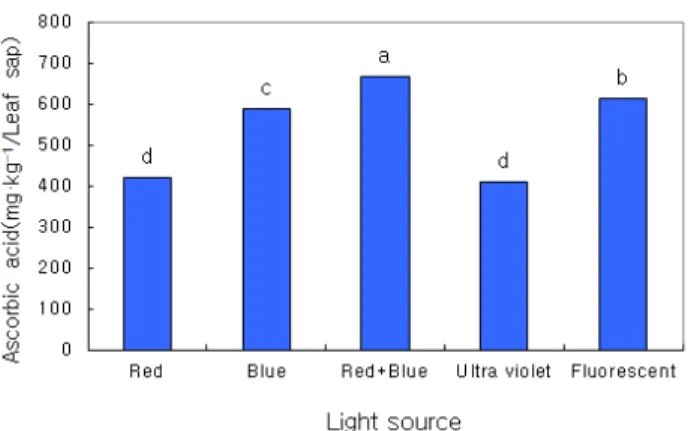
Fig. 4. Ascorbic acid content of 'Oak Leaf' lettuce under differ- ent radiation lights. As one of the functional nutrients, ascorbic acid content was measured in leaf of lettuce plants grown under different LEDs light irradiation.
Otherwise the red+blue light irradiation showed 2.5~2.8 times lower than that of red and blue light irradiation, respectively. In the changes of P content, LEDs light irradi- ation showed low P level compared with that of fluorescent light irradiation. The Ca and Mg content was only increased by red+blue light irradiation. The Mn content was increased in the treatment of blue and fluorescent light irradiation and decreased red and ulraviolet light irradiation. The Fe content in lettuce seedlings ranged from 3.2 to 6.7 mg․kg
-1. As one of the functional nutrients, ascorbic acid content was measured in leaf of lettuce plants grown under differ- ent LEDs light irradiation (Fig. 4). Red+blue and fluorescent light irradiation showed highest ascorbic acid contents, meanwhile red, blue and ultraviolet light irradiation caused lower ascorbic acid content compared with red+blue and fluorescent light irradiation. Nam et al. (2004) reported that far-red radiation significantly increased the antioxidant ac- tivity of rice hull extracts [8].
Detailed studies are required regarding the application of LED light for seedling growth, inorganic elements, anti- oxidative compounds including ascorbic acid in terms of economic utility, nutrition enhancement, and the correlation between light quality and growth of colored lettuce seedling.
Acknowledgment
The study was supported by the Cooperative Research Project (PJ 907022122012), Rural Development Administra- tion, Republic of Korea.
References
1. Barta, D. J., Tibbitts, T. W., Bula, R. J. and Morrow, R.
C. 1992. Evaluation of light emitting diode characteristics for a space-based plant irradiation source.
Adv Space Res
12, 141-149.2. Bula, R. J., Morrow, R. C., Tibbitts, T.W., Bula, R. J., Barta, D. J., Ignatius, R. W. and Martin, T. S. 1991. Light-emitting diodes as a radiation source for plants.
HortScience
26, 203-205.3. Inoue, Y. and Shibata, K. 1974. Comparative examination of terrestrial plant leaves in terms of light-induced absorp- tion changes due to chloroplast rearrangements.
Plant Cell Physiol
15, 717-721.4. Lee, J. G., Oh, S. S., Cha, S. H., Jang, Y. A., Kim, S. Y., Um, Y. C. and Cheong, S. Y. 2010. Effects of red/blue light ratio and short-term light quality conversion on growth and anthocyanin contents of baby leaf lettuce.
J Bio-Env Con
19, 351-359.5. Lee, G. J., Shin, H. M., Kim, K. S., Lee, C. H. and Kim, J. H. 1999. Effects of added chlorides and their concen- trations on growth and nitrate content in leaf lettuce(
Lactuca sativa
L.) in hydroponics.Plant Res
2, 26-30.6. Lee, J. G., Lee, B. Y. and Lee, H. J. 2006. Accumulation of phytotoxic organic acids in reused nutrient solution dur- ing hydroponic cultivation of lettuce (
Lactuca sativa
L.).SciHort
110, 119-128.7. Mc Cree, K. J. 1972. The action spectrum, absorbance and quantum yield of photosynthesis in crop plants.
Agric Meteorol
9, 191-216.8. Nam, K. C., Kim, J. H., Ahn, D. U. and Lee, S. C. 2004.
Far-infrared radiation increases the antioxidant properties of rice hull extract in cooked turkey meat.
J Agric Food Chem
52, 374-379.9. Park, K. W. and Lee, J. M. 2006. Wrap-ups: A unique meth- od of vegetable usage and consumption in Korea.
Chronica Hort
46, 13-15.10. Park, Y. I., Chow, W. S. and Anderson, J. M. 1996.
Chloroplast movement in the shade plant
Tradescantia albi- flora
helps protect photosystem II against light stress.Plant Physiol
111, 867-875.11. Pinho, P., Lukkala, R., Sarkka, L., Tetri, E., Tahvonen, R.
and Halonen, L. 2007. Evaluation of lettuce growth under multi-spectral-component supplemental solid state lighting in greenhouse environment.
IREE
2, 22-29.12. Yorio, N. C., Goins, G. D., Kagie, H. R., Wheeler, R. M.
and Sager, J. C. 2001. Improving spinach, radish, and lettuce growth under red light-emitting diodes (LEDs) with blue light supplementation.
HortScience
36, 380-383.13. Zhou, Y. and Singh, B. R. 2004. Effect of light on anthocya- nin levels in submerged, harvested Cranberry fruit.