Location Responsive Vehicle Digital Signage System for Visual Mobile Advertisement
Byoungduk Lee*, Seungyoun Yang**, Jaekwon Shin**, Jintae Kim**, Seonhee Lee***ⓒ Regular Members
ABSTRACT
In this paper we present the combination of location based mobile advertisement services and dynamic digital signage markets has been developing recent days to provide consumer admired visual mobile advertisement on all kind transportation vehicles. In spite of that, the digital signage advertisement content management is still not that easy to manage the content dynamically as well operation is most time consuming to handle the contents dynamically in digital signage business. As location based services is most impactful service in shopping, the location responsive advertisement on vehicle signage will be most desirable mobile advertisement to help people migrate from one place to another place for travel or stay. This paper propose a mobile location responsive digital signage system for vehicles using the GPS and wireless infrastructure integrated with digital signage system. This proposed research use the centralized digital signage system architecture for the mobile advertisement application and this system can be expanded to different vehicles for digital advertisement including buses, trucks, train, air vehicle and any other form of mobile advertising vehicles. Also, this present an effective advertisement recommendation algorithm, by which the advertisement can be selected broadcasted for the right advertisement ventures more effectively as the service requested from advertiser. This paper present the emulated experimental result to evidence the proposed dynamic vehicle signage system performed better than compared with traditional signage random advertising. The emulated result proves that the advertisement recommendation algorithm can effectively works out the targeted key audiences in location responsive region the algorithm evaluated
Key Words : Digital Signage, Location Responsive System, Interactive Device, Media Content Server, GPS, Vehicle Signage System, Mobile Advertisement Service
※ This research was supported by a grant from the Fundamental R&D program for Technology of Material & Components funded by the Ministry of Trade, Industry and Energy, Republic of Korea.
*서울과학기술대학교 IT정책대학원 방송통신정책전공, **(주)파이브텍, ***서울과학기술대학교 전자IT미디어공학과
ⓒ교신저자 : ([email protected])
접수일자: 2017년 01월 15일, 최종게재확정일자: 2017년 03월 22일
I. Introduction
The convergence of information and communication technology (ICT) and recent trends in display technology sets new research in key aspect of digital signage technology content delivery. This signage technology changeover sets the key aspect in the recent development of digital-signage systems is the increasing amount of personalized and location aware real-time content being delivered to viewers. The properties of the advertising markets will impact not only the advertising results, but the differences of consumers’ behaviors among different geographical regions.
There are digital signage system defines the real-time, dynamically changing, digitized multimedia distribution, one store in multiple zones or multiple locations, setting
up diverse display devices at the same time [1]. This proposed signage design to be served as the sending system interface of contents, entertainments, referring to information, and advertisements to draw the attention of targeted people on targeted segmentation, based on the internet equipment and function to be controlled by main center remotely.
There are location-aware and personalization digital advertising systems methods and architectures have been proposed and developed [2, 3, 4, 5] to deliver efficient location aware personalized advertising services. Al these cases, the mobile phone is the device which is used most interestingly and beneficially for vehicles of advertisement.
This paper proposed the location responsive vehicle digital signage system design based on the GPS and wireless communication infrastructure to provide
location-aware content delivery on transportation vehicle and advertisement vehicles signage system. In addition to the vehicle signage model, this paper also delivers the advertisement recommendation algorithm to enhance the personalized location based content delivery on digital signage system. This proposed digital signage system development taken into account few important features to design, they are: mobile vehicles’ advertisement, market segmentation identification, adaptive communication channels, scheduling of dynamic advertising, easy to attract consumer’s attention, improve the effectiveness of advertisement, etc.
Ⅱ. Related Work
To provided location-aware advertisement, there are two different implication of the mobile advertisement used in the advertisement industry [6]. One is on the mass transit advertisement using transport system and another one is on rendering advertisement to mobile device.
When web technologies was developed, there was web-based geographical image data digitizer [7] used regions planning accordance with actual distribution of the city and those regions are classified as Education, Commerce, Medical, Residential and Tourism. In digital vehicles routes advertisement, the web-based geographical image data digitizer method was used, and then sequentially depicted the straight line and recorded the coordinates as a turning point.
The traveler needs a suitable information while traveling one place to another place by the transport system to ease the traveling. Nowadays, there are many Location-Base services (LBS) designated [2, 3, 4, 5] for the mobile users and the basic advertisement system requirement of a LBS [8] is ability to provide the exact location information of the mobile device exactly and having the ability to identify the any mobile device has entered into one specific location in short interval of time.
Meanwhile Mobile digital signage concept is developed in signage advertisement for limited to individuals to sending advertising information to a smartphone [9]. For example, when particular user enters into specific area, the area specific advertisement delivered to smartphone of the particular persons located on that region.
Recently in the transport system, the front and rear side installed electric signboards on the surface to display the
route number, route information, etc. and this kind of electronic board’s installed vehicle is increasing day by day [10]. This display only about the route details and does not display the particular areas special location, shopping malls and location of the shopping mall, etc.
This paper proposed a digital and ultra-new high end technology based digital signage system which provides all location aware visual mobile advertisement information and display the advertisement about the market segments and special events etc. To identify the location the device built with GPS module and load the advertisement content dynamically the device have the content server connectivity through WiFi / LTE network.
Ⅲ. On-Vehicle Digital Signage
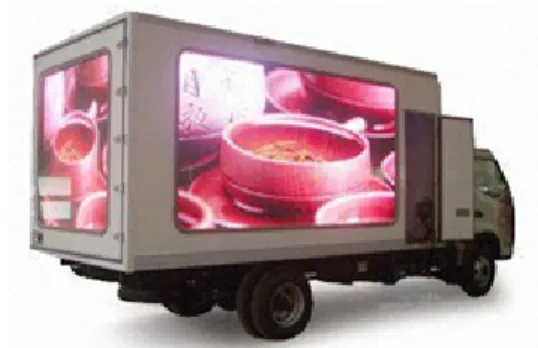
The present day’s transport systems like taxis, public transit buses, trains, shuttles and delivery vehicles are in the ultimate out-of-home environment and are poised for the expanding area of vehicle-mounted digital signage and LED messaging. The vehicles have been used for long as a way for advertisers to get their messages across its travel as shown in Figure 1.
Figure 1. On-Vehicle Digital Signage
The most used vehicle based advertisement uses from the lowly bumper sticker promoting things such as politicians and tourist attractions to billboard-sized signs on the sides of buses, the concept of advertising on vehicles has been around nearly as long as motorized vehicles have been on the road. Technological developments are paving the way for digital signage to become a feature of the street.
All these use the static content and this frontier for digital signage is opening in high viewership urban areas, where a transportation authority or a network operator, as their agent, can leverage moving assets as well as
existing ad sales and management capabilities. This idea is driven by the hunger for display revenues, improved technology and advertiser demand.
This paper proposed a digital and ultra-new high end digital signage technology for vehicles to provide location responsive advertisement while in moves so that it fill the digital advertisement demand to the operator and provides the customer admired advertisement techniques to improve the business development.
Ⅳ. Location Responsive Digital Signage System
The proposed location-responsive vehicle digital signage system designed to built-in with the GPS and wireless infrastructure, used a centralized system architecture and webpage interface design as shown in Figure 2.
Figure 2. Location Responsive Digital Signage Syste Model
The proposed system uses the GPS to get mobile vehicle location information to access the location responsive content to display and wireless network infrastructure used to access the content server to get location specific content to the mobile vehicle to render.
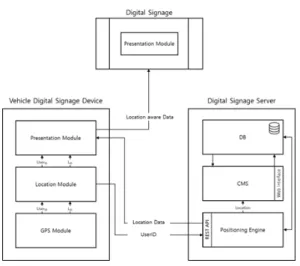
The proposed location responsive vehicle digital signage includes two components, namely digital signage server system and vehicle digital signage system. The vehicle digital signage system architecture is shown in Figure 3 and illustrates the modules of each component of the proposed system.
Figure 3. System Architecture
The digital signage server system composed, database, content management system (CMS) with web user interface, and vehicle or user position information subsystems. The advertisement management subsystem designed to provides two paths of uploading advertisements, one is a customized advertisement scheduling via the schedule management module to set advertising periods and positions and the other is the advertisement recommend subsystem. The system user only need is to configure the types of advertisements, and then the dynamic schedule subsystem based on advertisement recommend algorithm will work exactly.
The advertisement recommendation system, works according to the advertisement types configured by the customers, which are going to recommend the highly relative broadcasting regions based on the prior recommendation results.
The vehicle digital signage system can be used in vehicle or fixed digital signage through different modules to communicate with digital signage server, including transfer location specific content from server and download playlist and advertisement information from database.
In this paper, the advertisement recommendation algorithm is one of the main goal is to compute the location specific advertisement more effectively on vehicles with neighboring region informations. In advertisement recommendation approach, the fuzzy logic based controller is used to construct a relevance module of advertisement and regions, by which the vehicle digital signage system can work in the effective markets and right times in particular geographical region as planned.
object. The object recognition applies the chosen object
recognition method to the image in order to determine the presence of a sign and returns the results to the core module
V. Real-Time Emulation Results
To evaluate the proposed location-responsive digital signage controller system, designed by Raspberry Pi 3 which built-in with WiFi connectivity interface and the GPS is interface through Arduino UNO. The signage display connected with designed signage controller through HDMI port. The Raspberry Pi open HW based proposed signage system controller implementation is shown Figure 4.
Figure 4. Raspberry Pi 3 Based Signage Controller System
The signage server emulated on Host PC with SQL server and implemented using Java framework to define the web interface. The server to end signage system interface through WiFi and `content access from the server and display on signage display implemented using HTML5. The proposed design, whether the advertising was favored by audiences or not found out by questionnaires. The questionnaire rating to find out the preferred advertising involvement in different regions, and the regions specific advertisements helps the viewers. The proposed approach reduce the time and labor cost of the advertiser and customers for discussing the content of advertisement to the operator. The proposed vehicle advertisement system with advertisement recommendation algorithm gives more than 90% user preference and comfortableness to the travelers when travel to specific locations.
VI. Conclusion
In this paper, the proposed location responsive vehicle location responsive structure presented using GPS and wireless infrastructure like Wi-Fi, LTE, etc. and makes the digital signage can be applied in vehicles like advertisement broadcast cars and buses etc. The proposed signage system design, includes the design of centralizing system structure, integrated the digital signage management and the upload advertisement function by adviser. The defined state-of-art of vehicle digital signage system architecture makes the service providers and the advertisers can contact to content server through the internet for digital signage management, uploading and scheduling the advertisement. In addition through advertisement recommendation algorithm, the advertisers only need to setup the advertisement types to designating the higher benefit advertisement to broadcast. Through the real-time experimental analysis, this proposed system proves that advertisement recommendation algorithm is the only method can control the key audiences of different times.
References
[1] Chang F. Y., “Structural Analysis and Competence Dynamics of Digital Signage Industry”, Graduate Paper of Department of International Business, National Taiwan University, 2005.
[2] Kim Y. S., Lee J. W., et al., “Mobile advertisement system using data push scheduling based on user preference” in WTS'09. Wireless Telecommunications Symposium, pp. 1-5, 2009.
[3] Kölmel B., and Alexakis S., “Location Based Advertising” in Proceedings of the First International Conference on Mobile Business, Athens, Greece, July 2002.
[4] Lee J. W., Lee C. S., Park Y. S., “Research on the Advertisement Effect of Push Type Mobile Advertisement”, 2009 4th International Conference on Cooperation and Promotion of Information Resources in Science and Technology, pp. 137-142, 2009.
[5] Pessemier T., Deryckere T., et al., “Proposed architecture and algorithm for personalized advertising on iDTV and mobile devices”, IEEE Transactions on Consumer Electronics, vol. 54, Issue: 2, pp. 707-713, 2008.
[6] Chang Y. C., “Web-based Geographical Image Data Digitizer on Google Map”, TANET2008, pp. 647-650.
[7] Ting S. L., “A Distributed Location-Aware Advertisement System with the Mobile Peer-to-Peer Network”, Graduate
Paper of Department of Electrical Engineering, National Taiwan University, 2007.
[8] Tsao W. H., “Location-Based SMS Information Push System – Its Architecture, Design, and Applications”, Graduate Paper of Department of Information Management, Tatung University, 2007.
저자
이 병 덕(Byoungduk Lee) 정회원
․현재: 서울과학기술대학교 IT정책대학 원 방송통신정책전공 박사수료
․MBC(문화방송) 편성국 TV편성부
<관심분야> : 방송통신기술, 유무선 통신기술, 방송통신 법규
양 승 연(Seungyoun Yang) 정회원
․1999년 2월:순천향대학교 제어계측 공학과 졸업
․현재:파이브텍 R&D 센터 차장
<관심분야> : 유무선 통신, 모니터링시스템, USN
신 재 권(Jaekwon Shin) 정회원
․1993년 2월:단국대학교 전기공학과 학사 졸업
․현재:파이브텍 R&D 센터 소장
<관심분야> : 원방원격 제어, 영상 모니터링 시스템, 스마트 워터그리드 구축/제어, 통신 응용
김 진 태(Jintae Kim) 정회원
․1991년:건국대학교 전자공학과
․1991년 ~ 1993년:건국대학교 전자공 학과 석사
․1993년 ~ 1999년:건국대학교 전자공 학과 박사
․현재:(주)파이브텍 대표이사
<관심분야> : 원방원격 제어, 모니터링 시스템, 스마트 워터 그리드 구축/제어, 통신 응용
이 선 희(Seonhee Lee) 정회원
․1982년:동국대학교 대학원 전자공학 과(공학석사)
․1990년:동국대학교 대학원 전자공학 과(공학박사)
․1982년 ~ 1990년:유한대학교 전자과 교수
․1990년 ~ 현재 : 서울과학기술대학교 전자IT미디어공학과 교수
<관심분야> : 오디오기술, 3D음향, 전자공학