Received August 11, 2017, Revised September 11, 2017, Accepted for publication September 13, 2017
Corresponding author: Seong Jin Jo, Department of Dermatology, Seoul National University Hospital, 101 Daehak-ro, Jongno-gu, Seoul 03080, Korea. Tel: 82-2-2072-4916, Fax: 82-2-742-7344, E-mail: [email protected] This is an Open Access article distributed under the terms of the Creative Commons Attribution Non-Commercial License (http://creativecommons.
org/licenses/by-nc/4.0) which permits unrestricted non-commercial use, distribution, and reproduction in any medium, provided the original work is properly cited.
Copyright © The Korean Dermatological Association and The Korean Society for Investigative Dermatology
Ann Dermatol Vol. 29, No. 6, 2017 https://doi.org/10.5021/ad.2017.29.6.761
ORIGINAL ARTICLE
Prevalence of Psoriasis in Korea: A Population-Based Epidemiological Study Using the Korean National Health Insurance Database
Jin Yong Lee1,2, Sungchan Kang3, Jong Seo Park4, Seong Jin Jo4,5
1Public Health Medical Service, Boramae Medical Center, Seoul National University College of Medicine, 2Institute of Health Policy and Management, Medical Research Center, Seoul National University, 3Department of Health Policy and Management, Graduate School of Public Health, Seoul National University College of Medicine, 4Department of Dermatology, Seoul National University Hospital, 5Institute of Human-Environment Interface Biology, Seoul National University, Seoul, Korea
Background: Although psoriasis is universal in its occurrence worldwide, its prevalence varies by geographic location and race. A few hospital-based surveys have reported on the dem- ographic characteristics in Korean patients with psoriasis.
However, a nation-wide study on the prevalence of psoriasis in Korea remains uncompleted. Objective: The purpose of this study was to determine the prevalence of psoriasis in Korea and to describe the demographic and social character- istics of afflicted individuals. Methods: We identified pa- tients with psoriasis using a relevant diagnostic code from the sixth revision of the Korean Standard Classification of Disease in the 2011∼2015 claims database of the Health Insurance Review and Assessment Service of Korea. We esti- mated the annual prevalence of psoriasis and described the age and sex distribution of the patients, type and severity of psoriasis, comorbidities, type of health insurance, type of health-care institution and residence area. Patients with moderate-to-severe psoriasis were defined as those who had been treated with phototherapy, classical systemic agents, and/or biologic agents. Results: The standardized prevalence of psoriasis was 453 per 100,000 individuals of the database
population in 2015. We found male preponderance with a 1.3:1 male-to-female ratio, and that the largest number of pa- tients belonged to the age group of 50s. Of the patients diag- nosed with psoriasis in 2015, 83.8% had plaque psoriasis and 22.6% had moderate-to-severe psoriasis. Conclusion:
The annual standardized prevalence of psoriasis in Korea was 453 per 100,000 of the population in 2015. (Ann Dermatol 29(6) 761∼767, 2017)
-Keywords-
Demography, National health programs, Prevalence, Psoriasis
INTRODUCTION
Psoriasis is a skin disease with a chronic relapsing course that is clinically characterized by erythematous scaly plaque. Although it is globally universal in occurrence, its prevalence varies by geographic location and race1. Ge- nerally, psoriasis is more common in Caucasians than in those of African or Asian descent. In northern Europe, about 2%∼3% of the population is known to be psoriasis patients. In the United States, the prevalence was reported to be 2.5% in Caucasian Americans and only 1.3% in African-Americans2. The prevalence in Asians is also esti- mated to be low, it ranges from 0.29% to 1.18% in Japan and from 0.2% to 1.5% in Chinese population1. However, to date, large-scale epidemiological studies of psoriatic pa- tients have predominantly been conducted in Western countries, with few large-scale epidemiological studies on Asians in existence.
In Korea, most of the available previous studies on the clinical characteristics of psoriasis have been performed by tertiary referral hospitals at a single or multiple sites, and contain the possibility of selection bias and therefore cannot provide a clear idea on the prevalence of the disease. The lack of nation-wide research is an obstacle to estimating the exact prevalence and other epidemiological characteristics of psoriasis, including the male-to-female ratio and the age distribution of the patients. However, ob- taining precise and detailed epidemiological data is essen- tial to understand the nature of disease and develop ap- propriate health policies.
The purpose of this study was to investigate the preva- lence of psoriasis and describe demographic and social characteristics of psoriasis patients in Korea using Health Insurance Review and Assessment Service (HIRA) data from 2011 to 2015. Since all people in Korea are obli- gated to join the National Health Insurance (NHI) Program and information on their visits to health institutions and in- surance claims are stored in this system, HIRA data is ap- propriate as means to obtain a national level of epidemio- logical information on psoriasis.
MATERIALS AND METHODS
Data source
We used insurance claims data from 2011 to 2015 pro- vided by the HIRA in Korea. The HIRA is Korea’s NHI sys- tem’s data repository, in which all residents of the country must be enrolled. Thus, the HIRA database contains the details of patient demographics, diagnoses, medications and medical services as noted in insurance claims made following patients’ reception of medical services in all types of medical institutions.
Study population
In this study, the study population included all individuals who had an outpatient visit or admission history with a primary diagnostic code of psoriasis in accordance with the 6th revision of the Korean Standard Classification of Disease (KCD-6), which is modified from the 10th revision of the International Classification of Diseases (ICD-10).
The primary diagnostic code is made for the disease for which the resources are consumed majorly. The study population was further classified into those with plaque psoriasis (L40.0, L40.8, and L40.9), guttate psoriasis (L40.4), palmoplantar pustulosis (L40.2 and L40.3), generalized pustular psoriasis (L40.1), and psoriatic arthritis (L40.5, M07.0∼M07.3, and M09.0) according to the KCD-6. In addition, patients with mild-to-moderate psoriasis were defined as those who had been treated with phototherapy,
acitretin, cyclosporine, methotrexate and/or biologic agents such as tumor necrosis factor-alpha inhibitors and interleukin-12/23 inhibitors, while the others were defined as those with mild psoriasis. In addition, we collected on patients who had at least one claim with a diagnosis of diabetes mellitus (E11 and E11.0∼E11.9), dyslipidemia (E78 and E78.0∼E78.9), hypertension (I10), cardiovascular (CV) diseases (I20∼I25), cerebral infarction (I63), non-al- coholic fatty liver (K76.0), Crohn’s disease (K50, K50.0 and K50.9), and/or malignancy including in situ neoplasm (C00∼C97 and D00∼D09).
Prevalence of psoriasis
Adopting the concept of period prevalence, we calculated the annual prevalence because it is not only more easily applicable to the HIRA database, but also more suitable for the interpretation of changes in time series, as com- pared with point prevalence or lifetime prevalence. The standardized prevalence was obtained by adjusting to the standard population data from the Korean Statistical Information Service in Korea National Statistical Office.
For the comparison with world population, it was also standardized to the standard population data of Organiza- tion for Economic Co-operation and Development (OECD) and World Health Organization (WHO) countries.
Prevalence rates were presented as the annual number per 100,000 members of the population.
Demographic and social characteristics of the patients with psoriasis
Frequency analyses were performed to describe patient sex and age group, type and severity of psoriasis, co- morbidities, type of health insurance (NHI or Medical Aid), type of health-care institution (office-based physician practice, hospital, general hospital or tertiary teaching hos- pital) and residence area (metropolitan city, city and coun- ty, or rural place). In addition, we compared the patients with moderate-to-severe psoriasis with those with mild psoriasis.
Statistical analysis
To compare clinical and socioeconomic factors between patients with moderate-to-severe and with mild psoriasis, we conducted multiple logistic regression with moder- ate-to-severe psoriasis as the dependent variable. The rela- tive risks of moderate-to-severe psoriasis as compared with mild psoriasis were presented as an adjusted odds ratio (aOR) with 95% confidence interval. All analyses were performed with SAS Enterprise Guide (SAS Institute, Inc., Cary, NC, USA). All statistical tests were two-sided, and a p-value<0.05 was considered statistically significant.
Table 1. Prevalence of psoriasis in Korea between 2011 and 2015 (per 100,000 persons)
Year Crude
prevalence
Standardized prevalence (Korea)
Standardized prevalence (OECD)
Standardized prevalence (WHO)
2011 438 444 437 389
2012 440 444 435 386
2013 453 453 445 394
2014 457 454 445 394
2015 459 453 443 391
OECD: Organization for Economic Co-operation and Development, WHO: World Health Organization.
RESULTS
Prevalence of psoriasis
The crude and standardized prevalence of psoriasis, re- spectively, in Korea are summarized in Table 1. Notably, over the past five years, the crude prevalence for psoriasis stabilized, but with a slight increase. As of 2015, there were 233,909 Korean patients with psoriasis, which in- cluded, for crude prevalence, 459 per 100,000. After ad- justing for age and sex, the standardized prevalence of psoriasis was 453 per 100,000 of the population. For the comparison with worldwide population, the standardized prevalence to OECD and WHO populations were calcu- lated to be 443 and 391 per 100,000 in 2015, respectively.
Demographic and social characteristics of the patients with psoriasis
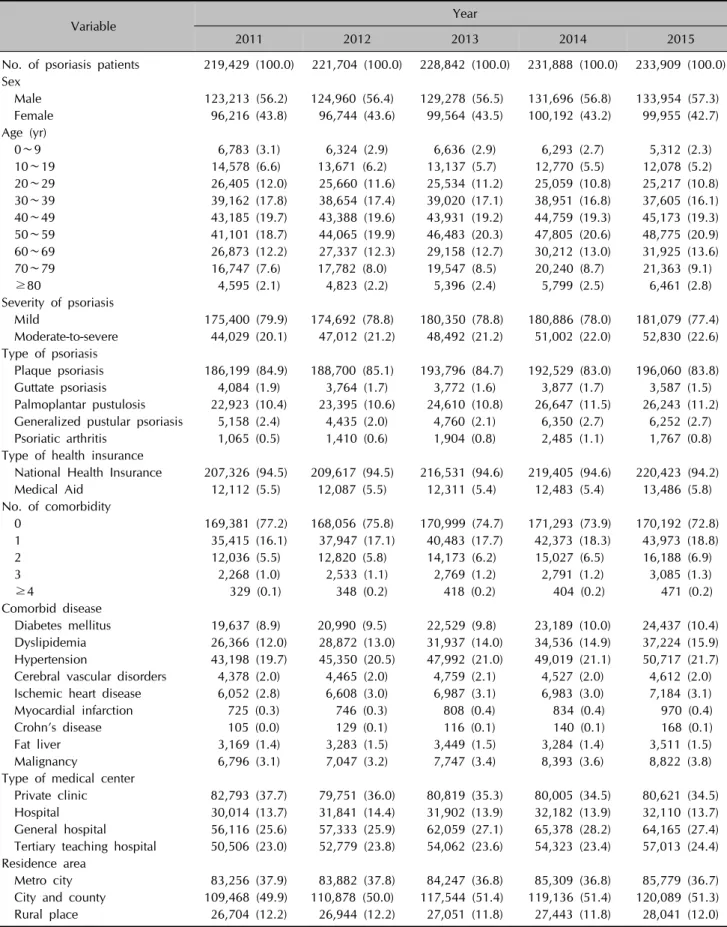
The annual population of psoriasis patients presented sim- ilar patterns of demographic and social characteristics over the past five years (Table 2). As of 2015, the male-to-female ratio was approximately 1.3:1 among patients with psoriasis.
The largest subgroup by age was patients in their 50s, fol- lowed by those in the 40s and 30s. Of the patients with psoriasis, 77.4% were classified into the mild group, while 22.6% were placed in the moderate-to-severe group.
Regarding the type of psoriasis, plaque psoriasis and pal- moplantar pustulosis were seen in 83.8% and 11.2% of the patients, respectively. In addition, 27.2% of psoriasis patients had one or more comorbid diseases including dia- betes mellitus, dyslipidemia, hypertension, cerebral vascular disorders, ischemic heart disease, Crohn’s disease, fatty liver, and malignancies. It was also found that 24.4% of patients were treated in tertiary teaching hospital, 27.4%
in general hospital, 13.7% in hospital, and 34.5% in pri- vate clinics, respectively.
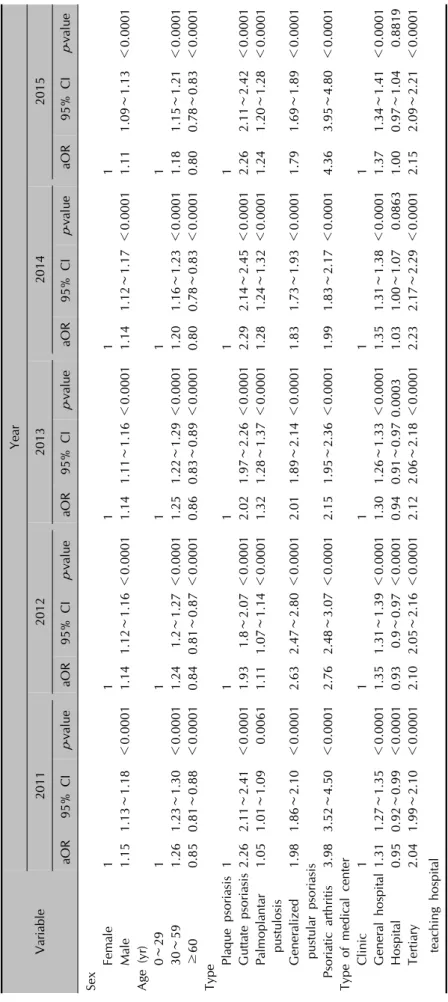
Factors associated with moderate-to-severe psoriasis To find out the clinical and social factors associated with the severity of psoriasis, we calculated the aOR for moder- ate-to-severe psoriasis as compared with mild psoriasis
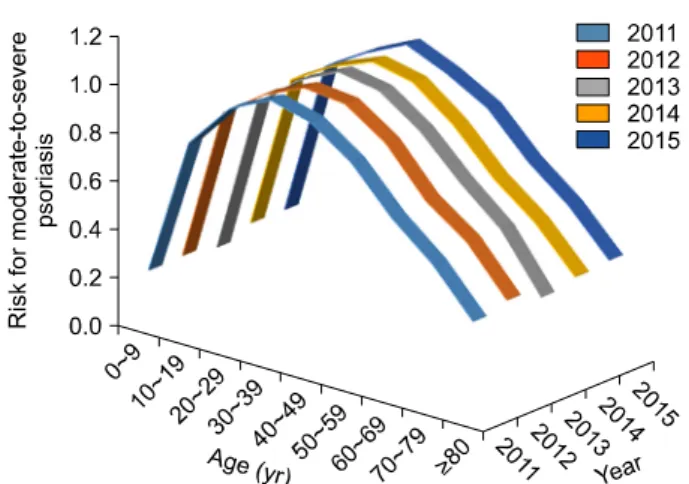
(Table 3). The aOR of male sex for moderate-to-severe psoria- sis was about 1.11∼1.16 with significance. Children younger than 10 (aOR, 0.22∼0.26) and elders older than 60 (aOR, 0.40∼0.77) years of age had significantly lower aORs than young and mid-aged adult patients (aOR, 0.91∼
1.08) (Fig. 1). In comparison with plaque psoriasis, gener- alized pustular psoriasis (aOR, 1.87∼2.75), guttate psor- iasis (aOR, 1.90∼2.25), and psoriatic arthritis (aOR, 1.97
∼4.31) was significantly associated with moderate-to-severe psoriasis. In addition, our data showed that the level of health institution visited was associated with the severity of psoriasis. However, the type of insurance used did not have a significant association with the severity of psoriasis.
We also did not observe consistent differences in the risks of comorbid diseases between patients with mild and those with moderate-to-severe psoriasis, either.
DISCUSSION
Psoriasis is a worldwide disease. Population-based studies in many countries have reported a prevalence of psoriasis ranging from 0.2% to 4.8%3. Studies in Europe and the United States have yielded prevalences around 1% to 2%4-8. However, the prevalence of psoriasis in Asians has been reported to be lower, specifically, the prevalence of psoriasis was only 0.19% in Taiwan9, 0.34% in Japan10, and 0.3% in China, respectively11. In our study, the stand- ardized prevalence in the Korean population ranged from 0.44% to 0.45%, confirming the results of previous stud- ies involving Korean populations12,13.
The racial differences in the prevalence of psoriasis can be explained by the difference in genetic backgrounds be- tween races. An association of psoriasis with several hu- man leukocyte antigen (HLA) loci such as A1, B13, B17, and Cw6 have been reported1. In particular, HLA-Cw6 is strongly associated with psoriasis. It is believed that the lower prevalence of psoriasis in Asian populations might result from the lower frequency of HLA-Cw6 in this pop- ulation1. In the Korean population, HLA-Cw0602 was found in 69.6% of the patients with psoriasis, but only in
Table 2. Characteristics of Korean patients with psoriasis between 2011 and 2015
Variable Year
2011 2012 2013 2014 2015
No. of psoriasis patients 219,429 (100.0) 221,704 (100.0) 228,842 (100.0) 231,888 (100.0) 233,909 (100.0) Sex
Male 123,213 (56.2) 124,960 (56.4) 129,278 (56.5) 131,696 (56.8) 133,954 (57.3) Female 96,216 (43.8) 96,744 (43.6) 99,564 (43.5) 100,192 (43.2) 99,955 (42.7) Age (yr)
0∼9 6,783 (3.1) 6,324 (2.9) 6,636 (2.9) 6,293 (2.7) 5,312 (2.3)
10∼19 14,578 (6.6) 13,671 (6.2) 13,137 (5.7) 12,770 (5.5) 12,078 (5.2)
20∼29 26,405 (12.0) 25,660 (11.6) 25,534 (11.2) 25,059 (10.8) 25,217 (10.8)
30∼39 39,162 (17.8) 38,654 (17.4) 39,020 (17.1) 38,951 (16.8) 37,605 (16.1)
40∼49 43,185 (19.7) 43,388 (19.6) 43,931 (19.2) 44,759 (19.3) 45,173 (19.3)
50∼59 41,101 (18.7) 44,065 (19.9) 46,483 (20.3) 47,805 (20.6) 48,775 (20.9)
60∼69 26,873 (12.2) 27,337 (12.3) 29,158 (12.7) 30,212 (13.0) 31,925 (13.6)
70∼79 16,747 (7.6) 17,782 (8.0) 19,547 (8.5) 20,240 (8.7) 21,363 (9.1)
≥80 4,595 (2.1) 4,823 (2.2) 5,396 (2.4) 5,799 (2.5) 6,461 (2.8)
Severity of psoriasis
Mild 175,400 (79.9) 174,692 (78.8) 180,350 (78.8) 180,886 (78.0) 181,079 (77.4) Moderate-to-severe 44,029 (20.1) 47,012 (21.2) 48,492 (21.2) 51,002 (22.0) 52,830 (22.6) Type of psoriasis
Plaque psoriasis 186,199 (84.9) 188,700 (85.1) 193,796 (84.7) 192,529 (83.0) 196,060 (83.8) Guttate psoriasis 4,084 (1.9) 3,764 (1.7) 3,772 (1.6) 3,877 (1.7) 3,587 (1.5) Palmoplantar pustulosis 22,923 (10.4) 23,395 (10.6) 24,610 (10.8) 26,647 (11.5) 26,243 (11.2) Generalized pustular psoriasis 5,158 (2.4) 4,435 (2.0) 4,760 (2.1) 6,350 (2.7) 6,252 (2.7) Psoriatic arthritis 1,065 (0.5) 1,410 (0.6) 1,904 (0.8) 2,485 (1.1) 1,767 (0.8) Type of health insurance
National Health Insurance 207,326 (94.5) 209,617 (94.5) 216,531 (94.6) 219,405 (94.6) 220,423 (94.2) Medical Aid 12,112 (5.5) 12,087 (5.5) 12,311 (5.4) 12,483 (5.4) 13,486 (5.8) No. of comorbidity
0 169,381 (77.2) 168,056 (75.8) 170,999 (74.7) 171,293 (73.9) 170,192 (72.8)
1 35,415 (16.1) 37,947 (17.1) 40,483 (17.7) 42,373 (18.3) 43,973 (18.8)
2 12,036 (5.5) 12,820 (5.8) 14,173 (6.2) 15,027 (6.5) 16,188 (6.9)
3 2,268 (1.0) 2,533 (1.1) 2,769 (1.2) 2,791 (1.2) 3,085 (1.3)
≥4 329 (0.1) 348 (0.2) 418 (0.2) 404 (0.2) 471 (0.2)
Comorbid disease
Diabetes mellitus 19,637 (8.9) 20,990 (9.5) 22,529 (9.8) 23,189 (10.0) 24,437 (10.4) Dyslipidemia 26,366 (12.0) 28,872 (13.0) 31,937 (14.0) 34,536 (14.9) 37,224 (15.9) Hypertension 43,198 (19.7) 45,350 (20.5) 47,992 (21.0) 49,019 (21.1) 50,717 (21.7) Cerebral vascular disorders 4,378 (2.0) 4,465 (2.0) 4,759 (2.1) 4,527 (2.0) 4,612 (2.0) Ischemic heart disease 6,052 (2.8) 6,608 (3.0) 6,987 (3.1) 6,983 (3.0) 7,184 (3.1) Myocardial infarction 725 (0.3) 746 (0.3) 808 (0.4) 834 (0.4) 970 (0.4)
Crohn’s disease 105 (0.0) 129 (0.1) 116 (0.1) 140 (0.1) 168 (0.1)
Fat liver 3,169 (1.4) 3,283 (1.5) 3,449 (1.5) 3,284 (1.4) 3,511 (1.5)
Malignancy 6,796 (3.1) 7,047 (3.2) 7,747 (3.4) 8,393 (3.6) 8,822 (3.8)
Type of medical center
Private clinic 82,793 (37.7) 79,751 (36.0) 80,819 (35.3) 80,005 (34.5) 80,621 (34.5) Hospital 30,014 (13.7) 31,841 (14.4) 31,902 (13.9) 32,182 (13.9) 32,110 (13.7) General hospital 56,116 (25.6) 57,333 (25.9) 62,059 (27.1) 65,378 (28.2) 64,165 (27.4) Tertiary teaching hospital 50,506 (23.0) 52,779 (23.8) 54,062 (23.6) 54,323 (23.4) 57,013 (24.4)
Residence area
Metro city 83,256 (37.9) 83,882 (37.8) 84,247 (36.8) 85,309 (36.8) 85,779 (36.7) City and county 109,468 (49.9) 110,878 (50.0) 117,544 (51.4) 119,136 (51.4) 120,089 (51.3) Rural place 26,704 (12.2) 26,944 (12.2) 27,051 (11.8) 27,443 (11.8) 28,041 (12.0) Values are presented as number (%).
Table 3. Factors Associated with Moderate-to-Severe Psoriasis Variable
Year 20112012201320142015 aOR95% CIp-valueaOR95% CIp-valueaOR95% CIp-valueaOR95% CIp-valueaOR95% CIp-value Sex Female11111 Male1.151.13∼1.18<0.00011.141.12∼1.16<0.00011.141.11∼1.16<0.00011.141.12∼1.17<0.00011.111.09∼1.13<0.0001 Age (yr) 0∼2911111 30∼591.261.23∼1.30<0.00011.24 1.2∼1.27<0.00011.251.22∼1.29<0.00011.201.16∼1.23<0.00011.181.15∼1.21<0.0001 ≥600.850.81∼0.88<0.00010.840.81∼0.87<0.00010.860.83∼0.89<0.00010.800.78∼0.83<0.00010.800.78∼0.83<0.0001 Type Plaque psoriasis11111 Guttate psoriasis2.262.11∼2.41<0.00011.93 1.8∼2.07<0.00012.021.97∼2.26<0.00012.292.14∼2.45<0.00012.262.11∼2.42<0.0001 Palmoplantar pustulosis1.051.01∼1.09 0.00611.111.07∼1.14<0.00011.321.28∼1.37<0.00011.281.24∼1.32<0.00011.241.20∼1.28<0.0001 Generalized1.981.86∼2.10<0.00012.632.47∼2.80<0.00012.011.89∼2.14<0.00011.831.73∼1.93<0.00011.791.69∼1.89<0.0001 pustular psoriasis Psoriatic arthritis3.983.52∼4.50<0.00012.762.48∼3.07<0.00012.151.95∼2.36<0.00011.991.83∼2.17<0.00014.363.95∼4.80<0.0001 Type of medical center Clinic1 1 1 1 1 General hospital1.311.27∼1.35<0.00011.351.31∼1.39<0.00011.301.26∼1.33<0.00011.351.31∼1.38<0.00011.371.34∼1.41<0.0001 Hospital0.950.92∼0.99<0.00010.93 0.9∼0.97<0.00010.940.91∼0.970.00031.031.00∼1.07 0.08631.000.97∼1.04 0.8819 Tertiary2.041.99∼2.10<0.00012.102.05∼2.16<0.00012.122.06∼2.18<0.00012.232.17∼2.29<0.00012.152.09∼2.21<0.0001 teaching hospital aOR: adjusted odd ratio, 95% CI: 95% confidence interval.
Fig. 1. Risk for moderate-to-severe psoriasis by age group between 2011 and 2015 in Korea.
9.0% of the healthy controls14.
It is known that psoriasis is equally common in men and women3,15. However, several studies on Asian populations have reported a male preponderance11-13,16-18. In Japan, the incidence in men was twice that in women18. Mild male preponderance in the Korean population was also found in this study, as well as in previous studies12,13. However, it is unclear whether Korean men are indeed more vulner- able to psoriasis, or if this finding comes from the differ- ence in health-related behaviors between the sexes. To confirm this, further community-based study is necessary.
The distribution of psoriasis patients by age group was re- ported differ in accordance with the study population. The highest prevalence was observed among 20 to 50-year-old subjects in Spain19, while it was noted in those patients in their 50s and 60s in the United Kingdom4. In Taiwan, the prevalence inclines with age, and peaks in people aged 70 years and older9. In our study, the highest prevalence was observed among people in their 40s and 50s, which was younger than in the Taiwan population.
Consistent with previous studies13,18,20,21, the plaque type was the most common, found in 85% of psoriasis patients in this study. The second most common type of psoriasis in this study was palmoplantar pustulosis, which was seen in more than 10% of the patients studied. However, Na et al. previously reported that palmoplantar pustulosis was found in only 3.5% of psoriasis patients who visited a ter- tiary teaching hospital. This difference may come from the differences in the study population between these two studies, or the potential misclassification of patients due to incorrect diagnostic codes in the HIRA database.
We found that 20% of psoriasis patients were treated with phototherapy, conventional systemic agents, and/or bio- logic agents. In this study, we regarded those individuals as patients with moderate-to-severe psoriasis because it is
widely accepted as basic therapeutic strategy for psor- iasis22. Consistent with the previous study13, male sex was significantly associated with more severe psoriasis than fe- male sex. Interestingly, the risk of moderate-to-severe psoriasis was found to decline in patients 40 years of age and older. Considering this, together with the previous study reporting that the elderly-onset psoriasis was gen- erally milder than early-onset psoriasis21,23-25, this finding supports the association between age and the severity of psoriasis. However, the correlation might be due to se- lection bias, because the elders more frequently have medical conditions that prohibit the use of systemic and biologic agents.
It has been reported that CV morbidity increases in psor- iasis patients26,27. In particular, patients with severe psor- iasis have an increased risk of CV mortality, as compared to people without psoriasis28. A case-control study con- ducted in Korea showed a higher prevalence of metabolic syndrome, CV disease, hypertension, and hyperlipidemia in psoriasis patients than in controls29. A study using a Korean nation-wide database reported that only the risk of dyslipidemia was significantly higher in Korean patients with psoriatic arthritis than in those with psoriasis vulga- ris12. In this study, we did not observe the difference in the risks of comorbid diseases according to the severity of psoriasis. Further analyses by age, sex, and type of psor- iasis are necessary to elucidate the association between psoriasis and CV morbidity in the Korean population.
This study has several limitations. First, the presence of psoriasis and comorbid diseases was defined by diagnostic codes from an insurance claims database and thus, bias might occur owing to the misclassification and omission of patients. Second, data of disease severity were not available in the HIRA. Instead, we used an assumption that patients treated with phototherapy or systemic agents would most like have moderate-to-severe psoriasis, as op- posed to mild psoriasis. Third, the prevalence of psoriasis may be underestimated because we used the NHI claim database; if psoriasis patients did not visit clinics or hospi- tals, their cases were not included in calculating prevalence.
Nevertheless, to yield more accurate prevalence, we used the entire Korean population database rather than sampled database and performed analyses based on period pre- valence. Therefore, the current results of this study might provide the best representation for the prevalence of psor- iasis in Korea.
In conclusion, we found that the standardized prevalence of psoriasis was around 450 per 100,000 of the Korean population. The prevalence peaked in the age of 50s and there was a male preponderance. This nation-wide study provides highly reliable epidemiologic information on
Korean patients with psoriasis.
CONFLICTS OF INTEREST
The authors have nothing to disclose.
REFERENCES
1. Raychaudhuri SP, Farber EM. The prevalence of psoriasis in the world. J Eur Acad Dermatol Venereol 2001;15:16-17.
2. Gelfand JM, Stern RS, Nijsten T, Feldman SR, Thomas J, Kist J, et al. The prevalence of psoriasis in African Americans:
results from a population-based study. J Am Acad Dermatol 2005;52:23-26.
3. Gudjonsson JE, Elder JT. Psoriasis: epidemiology. Clin Dermatol 2007;25:535-546.
4. Gelfand JM, Weinstein R, Porter SB, Neimann AL, Berlin JA, Margolis DJ. Prevalence and treatment of psoriasis in the United Kingdom: a population-based study. Arch Dermatol 2005;141:1537-1541.
5. Nevitt GJ, Hutchinson PE. Psoriasis in the community:
prevalence, severity and patients' beliefs and attitudes towards the disease. Br J Dermatol 1996;135:533-537.
6. Braathen LR, Botten G, Bjerkedal T. Prevalence of psoriasis in Norway. Acta Derm Venereol Suppl (Stockh) 1989;
142:5-8.
7. Egeberg A, Skov L, Gislason GH, Thyssen JP, Mallbris L.
Incidence and prevalence of psoriasis in denmark. Acta Derm Venereol 2017;97:808-812.
8. Barisić-Drusko V, Paljan D, Kansky A, Vujasinović S.
Prevalence of psoriasis in Croatia. Acta Derm Venereol Suppl (Stockh) 1989;146:178-179.
9. Chang YT, Chen TJ, Liu PC, Chen YC, Chen YJ, Huang YL, et al. Epidemiological study of psoriasis in the national health insurance database in Taiwan. Acta Derm Venereol 2009;89:262-266.
10. Kubota K, Kamijima Y, Sato T, Ooba N, Koide D, Iizuka H, et al. Epidemiology of psoriasis and palmoplantar pustulosis:
a nationwide study using the Japanese national claims database. BMJ Open 2015;5:e006450.
11. Yip SY. The prevalence of psoriasis in the Mongoloid race. J Am Acad Dermatol 1984;10:965-958.
12. Oh EH, Ro YS, Kim JE. Epidemiology and cardiovascular comorbidities in patients with psoriasis: A Korean nationwide population-based cohort study. J Dermatol 2017;44:
621-629.
13. Na SJ, Jo SJ, Youn JI. Clinical study on psoriasis patients for past 30 years (1982-2012) in Seoul National University Hospital Psoriasis Clinic. J Dermatol 2013;40:731-735.
14. Nam SH, Kim CW, Kim SS, Kim KH, Lee KW, Kim KJ.
Correlations between HLA-Cw*0602 and clinical picture in Korean psoriatic patients. Korean J Dermatol 2001;39:
183-189.
15. Christophers E. Psoriasis--epidemiology and clinical spec- trum. Clin Exp Dermatol 2001;26:314-320.
16. Tsai TF, Wang TS, Hung ST, Tsai PI, Schenkel B, Zhang M, et al. Epidemiology and comorbidities of psoriasis patients in a national database in Taiwan. J Dermatol Sci 2011;
63:40-46.
17. Kaur I, Handa S, Kumar B. Natural history of psoriasis: a study from the Indian subcontinent. J Dermatol 1997;
24:230-234.
18. Takahashi H, Nakamura K, Kaneko F, Nakagawa H, Iizuka H; Japanese Society For Psoriasis Research. Analysis of psoriasis patients registered with the Japanese Society for Psoriasis Research from 2002-2008. J Dermatol 2011;
38:1125-1129.
19. Ferrándiz C, Bordas X, García-Patos V, Puig S, Pujol R, Smandía A. Prevalence of psoriasis in Spain (Epiderma Project: phase I). J Eur Acad Dermatol Venereol 2001;15:
20-23.
20. Fan X, Yang S, Sun LD, Liang YH, Gao M, Zhang KY, et al.
Comparison of clinical features of HLA-Cw*0602-positive and -negative psoriasis patients in a Han Chinese popu- lation. Acta Derm Venereol 2007;87:335-340.
21. Ferrándiz C, Pujol RM, García-Patos V, Bordas X, Smandía JA. Psoriasis of early and late onset: a clinical and epidemiologic study from Spain. J Am Acad Dermatol 2002;46:867-873.
22. Ashcroft DM, Li Wan Po A, Griffiths CE. Therapeutic strategies for psoriasis. J Clin Pharm Ther 2000;25:1-10.
23. Kwon HH, Kwon IH, Youn JI. Clinical study of psoriasis occurring over the age of 60 years: is elderly-onset psoriasis a distinct subtype? Int J Dermatol 2012;51:53-58.
24. Henseler T, Christophers E. Psoriasis of early and late onset:
characterization of two types of psoriasis vulgaris. J Am Acad Dermatol 1985;13:450-456.
25. Bernhard JD. Clinical differences in juvenile vs adult-onset psoriasis. Br J Dermatol 1996;135:501-502.
26. Edson-Heredia E, Zhu B, Lefevre C, Wang M, Barrett A, Bushe CJ, et al. Prevalence and incidence rates of cardiovascular, autoimmune, and other diseases in patients with psoriatic or psoriatic arthritis: a retrospective study using Clinical Practice Research Datalink. J Eur Acad Dermatol Venereol 2015;29:955-963.
27. Reich K. The concept of psoriasis as a systemic inflam- mation: implications for disease management. J Eur Acad Dermatol Venereol 2012;26 Suppl 2:3-11.
28. Mehta NN, Azfar RS, Shin DB, Neimann AL, Troxel AB, Gelfand JM. Patients with severe psoriasis are at increased risk of cardiovascular mortality: cohort study using the General Practice Research Database. Eur Heart J 2010;
31:1000-1006.
29. Choi WJ, Park EJ, Kwon IH, Kim KH, Kim KJ. Association between psoriasis and cardiovascular risk factors in Korean patients. Ann Dermatol 2010;22:300-306.