• 검색 결과가 없습니다.

Development of Single-layer Glucose Sensor Using GDH-FAD (Glucose Dehydrogenase Flavin Adenine Dinucleotide)

N/A
N/A
Protected

Academic year: 2021

Share "Development of Single-layer Glucose Sensor Using GDH-FAD (Glucose Dehydrogenase Flavin Adenine Dinucleotide)"

Copied!
4
0
0

로드 중.... (전체 텍스트 보기)

전체 글

(1)

156 J. Sens. Sci. Technol. Vol. 27, No. 3, 2018 Journal of Sensor Science and Technology

Vol. 27, No. 3 (2018) pp. 156-159 http://dx.doi.org/10.5369/JSST.2018.27.3.156 pISSN 1225-5475/eISSN 2093-7563

Development of Single-layer Glucose Sensor Using GDH-FAD (Glucose Dehydrogenase Flavin Adenine Dinucleotide)

Ji-Won Kye

1

and Young-Tae Lee

2+

Abstract

We developed a glucose sensor using glucose dehydrogenase flavin adenine dinucleotide (GDH-FAD). The structure of the three- layer glucose sensor was simplified, in which a single-layer design was used to lower the unit cost, and GDH-FAD was used to increase the measurement reliability. GDH-FAD has less impact on the 20 interfering substances that affect blood glucose measurement, such as galactose and maltose compared to glucose oxidase (GOD), and is not affected by the oxygen saturation; therefore, it is possible to measure both arterial or venous blood and thus less susceptibility to hematocrit. In this study, we developed a single-layer glucose sensor strip with low hematocrit effect using the GDH-FAD enzyme, and measured and evaluated the performance.

Keywords: Glucose sensor, Electrochemical, GDH-FAD, Single-layer structure

1. INTRODUCTION

Recently, the occurrence of diabetes mellitus has reached 13.7%

[1]. Moreover, the prevalence in elderly people aged 65 or older is 30%, and the prevalence of diabetes in the total population is 25% [1], suggesting that diabetes can cause serious social problems. According to the National Health Insurance Corporation of Korea, medical expenses have been incurred owing to the expenditure of diabetes medical expenses of 8.51 trillion won for five years, from 2012 to 2016. According to the International Diabetes Federation (IDF), the number of diabetic patients is projected to surge to approximately 600 million by 2035, with more than 80% expected in low- and middle-income countries. In Korea, the prevalence of diabetes is higher in the low-income group (14.7%) compared to that in the high-income group (10.8%) [2]. To solve the rapidly growing diabetes problem, it is important to reduce the diagnosis cost of diabetes significantly and to create a social environment in which everyone can be diagnosed regardless of income level.

In this study, we used glucose dehydrogenase flavin adenine dinucleotide (GDH-FAD) to improve the performance by minimizing the influence of interfering substances, which is a problem of the single-layer glucose sensor using glucose oxidase (GOD) [3,4]. Previous studies have developed a simple process that prints electrodes and protective layers on a single-layer plastic film and dispenses the enzyme layer [3]. In this study, we used GDH-FAD [5], an enzyme that minimizes the influence of interfering substances. GDH-FAD is less impacted by blood oxygen saturation and minimizes the effects of hematocrit, as well as minimizing the effects of more than 20 interfering substances that affect blood glucose measurement. Therefore, the performance of the glucose sensor strip can be improved compared to the glucose oxidase (GOD) typically used in glucose sensor strips. In this study, a carbon/silver and hydrophobic protection layer is screen printed on a polyethylene terephthalate (PET) film and the GDH-FAD solution is dispensed. The properties of the fabricated glucose sensor were evaluated.

2. SENSOR STRUCTURE AND SENSING PRINCIPLES

2.1 Sensor Structure

The structure of the single-layer glucose sensor using GDH- FAD is shown in Fig. 1. The sensor consists of a carbon/silver electrode formed on a PET film. A hydrophobic film is formed on the enzyme layer and the electrode is excluded; further, an enzyme

1

REDICARE CO., LTD,

4F, 1, Ilsanbong-ro, Yeongdo-gu, Busan, Korea

2

Dept. of Bio-ICT Engineering, Graduate School, Andong National Unversity, 1375 Gyeongdong-ro, Andong, Gyeongsangbuk-do 36729, Korea

+
Corresponding author:

(Received: May. 19, 2018, Revised: May. 29, 2018, Accepted: May. 30, 2018)

This is an Open Access article distributed under the terms of the Creative Commons Attribution Non-Commercial License(http://creativecommons.org/

licenses/bync/3.0) which permits unrestricted non-commercial use, distribution,

and reproduction in any medium, provided the original work is properly cited.

(2)

Development of Single-layer Glucose Sensor Using GDH-FAD (Glucose Dehydrogenase Flavin Adenine Dinucleotide)

157 J. Sens. Sci. Technol. Vol. 27, No. 3, 2018 layer is formed by fixing GDH-FAD. Therefore, as the glucose

sensor is a single layer, the blood is introduced from the upper part of the sensor.

2.2 Sensing Principle

The single-layer glucose sensor is an electrochemical-type glucose sensor[6,7]. The enzyme layer formed on the electrode is composed of GDH-FAD, ruthenium ([Ru (NH3) 6] Cl3), 1- methoxy PMS (5-methylphenazinium methyl sulfate), PVP10, stabilizer, and surfactant. Ruthenium and 1-methoxy PMS are mediators that accept electrons in the process of glucose oxidation by GDH-FAD and transfer them to the electrode to form a current. The glucose concentration is measured by measuring this current.

To improve the low oxidation current, which is a disadvantage of GDH-FAD, the double-mediator method is used as shown in Fig. 2.

3. FABRICATION

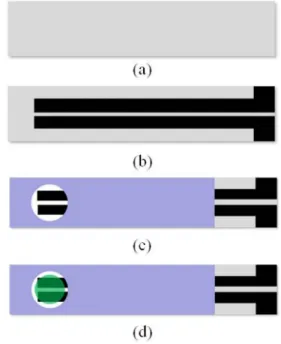
Fig. 3 shows the fabrication process of a single-layer glucose sensor using GDH-FAD. To fabricate a single-layer glucose sensor, a carbon/silver electrode is formed on a PET film using screen printing technology, a hydrophobic film is formed, and a dispensing technique is used to dispense the GDH-FAD enzyme

solution [3]. The fabricated glucose sensor is 30 mm in length, 4.5 mm in width, and 0.2 mm in thickness. Fig. 4 shows photographs of the glucose sensor.

4. RESULTS AND DISCUSSIONS

To evaluate the characteristics of the prepared single-layer glucose sensor using GDH-FAD, blood was used and the YSI2300 STAT PLUS and WPG potentiostat/galvanostat, which are standard equipment for blood glucose measurement, were used. Cyclic voltammetry (C–V) measurements were performed Fig. 1. Single-layer glucose sensor strip using GDH-FAD

Fig. 2. Sensing principle.

Fig. 3. Fabrication process, (a) PET film, (b) carbon/silver screen printing, (c) hydrophobic film screen printing, (d) GDH-FAD dispensing.

Fig. 4. Photograph of single-layer glucose sensor strip using GDH-

FAD.

(3)

Ji-Won Kye and Young-Tae Lee

J. Sens. Sci. Technol. Vol. 27, No. 3, 2018 158 to obtain the optimal supply voltage through the oxidation–

reduction of the fabricated single-layer glucose sensor. The measurement results are shown in Fig. 5.

For the C–V measurement, blood with glucose concentrations from 40.3 mg/dL to 556 mg/dL was used and the measurement voltage range was -0.7 V to 0.7 V with scan-rate 50mV/S. From the measurement results, we confirmed that oxidation and reduction peaks appeared at approximately 50 mV. As shown in Fig. 5, each concentration shows a definite resolution.

For the amperometry measurement, the blood used ranged from 40.3 mg/dL to 556 mg/dL, the applied voltage was set to 50 mV, and the measurement time was set to 10 s. Because a relatively large amount of polymer is used for the enzyme preparation of GDH-FAD, the incubation time was set to approximately 1 s. Fig.

6 shows the results of the amperometry measurement. Fig. 6 shows that the output value is sufficiently stable for 2–3 s after the start of the measurement. Therefore, we confirmed that the stable measurement value can be obtained in approximately 34 s including the incubation time.

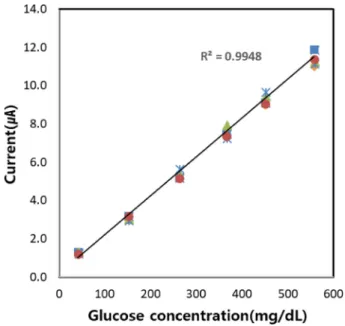
Fig. 7 shows the blood glucose concentration–current characteristics. Five measurements were obtained for each glucose concentration. The linearity of the measured results was outstanding, with R

2

= 0.9948, and the average CV value was 3.1, which is excellent. These results suggest that the single-layer glucose sensor using GDH-FAD can be used as a self-diagnostic blood glucose sensor capable of measuring in approximately 3 to

4 seconds.

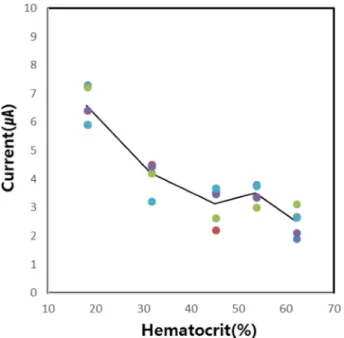
Hematocrit is the percentage red blood cell volume in the blood, which is different for different people, especially in people with diseases. The hematocrit–current characteristics of the prepared single-layer glucose sensor using GDH-FAD are shown in Fig. 8 To analyze the hematocrit characteristics, hematocrit was measured five times with a hemoglobin concentration of 200 mg/

dL, adjusted to 18%, 31.5%, 45%, 53.5%, and 62%, respectively.

Other than 18%, the hematocrit showed similar current characteristics. The glucose sensor using GDH-FAD was shown to be superior to the glucose sensor using the GOD enzyme[8].

Fig. 5. Cyclic voltammetry waveform

Fig. 6. Amperometry waveform.

Fig. 7. Glucose concentration-current characteristics of single-layer

glucose sensor.

(4)

Development of Single-layer Glucose Sensor Using GDH-FAD (Glucose Dehydrogenase Flavin Adenine Dinucleotide)

159 J. Sens. Sci. Technol. Vol. 27, No. 3, 2018 Generally, the blood glucose sensor is fabricated in a three-layer

structure for precisely controlling the amount of blood and accurately measuring the blood glucose level. However, even if the amount of blood is not accurately controlled, the results of the single-layer glucose sensor can confirm that the blood glucose measurement can be performed relatively accurately. Generally, a three-layer glucose sensor is fabricated as a single layer, which not only simplifies the manufacturing process but also reduces the amount of input material, thus enabling the development of a low- cost glucose sensor. In the case of the single-layer glucose sensor, because blood is injected at the upper part of the sensor, it is considered more convenient for patients to use than the conventional glucose sensor.

In this study, we developed and evaluated a single-layer glucose sensor using the GDH-FAD enzyme to improve the hematocrit dependence due to the oxygen effect of the previously developed single-layer glucose sensor using GOD. The results of the measurement range, linearity, and resolution characteristics of the fabricated sensor shows that it can be used as a self-diagnostic blood glucose sensor.

5. CONCLUSIONS

We developed a single-layer glucose sensor using GDH-FAD.

The C–V method was used to analyze the characteristics of the fabricated glucose sensor. The optimal oxidation–reduction voltage was approximately 50 mV. In addition, the resolution and linearity of the single-layer sensor using GDH-FAD were analyzed through C–A and glucose concentration–current characteristics measurement.

In this study, the hematocrit dependence was minimized using the GDH-FAD enzyme. It is believed that the existing three-layer glucose sensor can be developed as a single layer; therefore, it is expected to secure price competitiveness in the current glucose sensor market.

REFERENCES

[1] Diabetes Fact Sheet in Korea 2016, Korean Diabetes Asso- ciation, 2016.

[2] Diabetes Fact Sheet in Korea 2018, Korean Diabetes Asso- ciation, 2018.

[3] Y. T. Lee, and M. S. Kwon, “Development of single-layer- structured glucose sensor”, Journal of the Korea Sensors Society, Vol. 24(2), pp.83-87, 2015.

[4] Y. T. Lee, and S. R. Lee, “Development of the disposable glucose sensor using Cu/Ni/Au electrode”, Journal of the Korea Sensors Society, Vol. 15(5), pp.352-356, 2006.

[5] H. Bilen, A. Kilicaslan, G. Akcay, and F. Albayrak, “Per- formance of glucose dehydrogenase(GDH) based and glu- cose oxidase(GOX) based blood glucose meter systems”, Journal of Medical Engineering and Technology, Vol. 31(2), pp.152-156, 2007.

[6] Joseph Wang, “Electrochemical glucose biosensors”, Chem- ical Reviews, Vol.108(2), pp814-825, 2008.

[7] J. R. Mor, and R. Guarnaccia, “Assay of glucose using an electrochemical enzymatic sensor”, Analytical Biochemis- try, Vol. 79, pp.319-328, 1977.

[8] Z. Tang, J. H. Lee, R. F. Louie, “Effects of different hema- tocrit levels on glucose measurements with handheld meters for point-of care testing”, Arch Pathol Lab Med, Vol.124, pp.1135-1140, 2000.

Fig. 8. Hematocrit–current characteristics

수치

Fig. 3 shows the fabrication process of a single-layer glucose sensor using GDH-FAD. To fabricate a single-layer glucose sensor, a carbon/silver electrode is formed on a PET film using screen printing technology, a hydrophobic film is formed, and a dispens
Fig. 7. Glucose concentration-current characteristics of single-layer glucose sensor.
Fig. 8. Hematocrit–current characteristics

참조

관련 문서