http://dx.doi.org/10.5369/JSST.2015.24.2.83 pISSN 1225-5475/eISSN 2093-7563
Development of Single-layer-structured Glucose Biosensor
Young-Tae Lee
1,+and Min Su Kwon
2Abstract
In this paper, we fabricated a low-cost glucose sensor with a simpler structure and fabrication process than the existing glucose sensor.
The currently used glucose sensor has a three-layer structure with upper, middle, and bottom plates; here, we fabricated a single-layer glucose sensor using only a printing and dispensing process. We successfully fabricated the glucose sensor using a simple method involving the formation of an electrode and insulator layer through a 2- or 3-step printing process on plastic or paper film, followed by the dispensing of glucose oxidase solution on the electrode. Cyclic voltammetry (CV) and cyclic amperometry (CA) measurements were used to evaluate the characteristics of the fabricated single-layer glucose sensor. Also, its sensitivity was analyzed through glucose-con- trolled blood measurements. Hence, a low-cost single-layer glucose sensor was fabricated with evaluation of its characteristics dem- onstrating that it has useful application in medicine.
Keywords: Glucose, Single-layer, Electrochemical, Biosensor, Screen printing
1. INTRODUCTION
Recently, due to the rapidly aging global population and other lifestyle- and environment-related factors, the prevalence of diabetes has increased. According to the International Diabetes Federation (IDF) [1], the number of diabetics in Korea in 2013 came to 3.32 million, ranking Korea 20
thin the world as regards sufferer numbers. It is anticipated that, in 2035, the global number of diabetics will increase to 592 million, i.e., 1 in 10 people, the majority of whom (over 80%) will be from low or middle-income countries and aged under sixty. In south-east Asia, as it is not possible for half of diabetics to be diagnosed correctly, concerns have been raised regarding increasing death rates due to complications, along with the cost of treatment. In 2013, $548 billion was spent on diabetes treatment and the scale is predicted to grow rapidly every year. Thus, each country is actively framing
policies to reduce the cost of diabetes-related treatment. To monitor the blood glucose values of the majority of a nation’s population, including those in the low-income bracket, personal glucose measurement devices can be distributed; however, the device price must first be reduced significantly. This would also contribute to the exportation of glucose sensors and decrease the global social cost of health care, by making it possible to monitor glucose levels in south-east Asia and Africa.
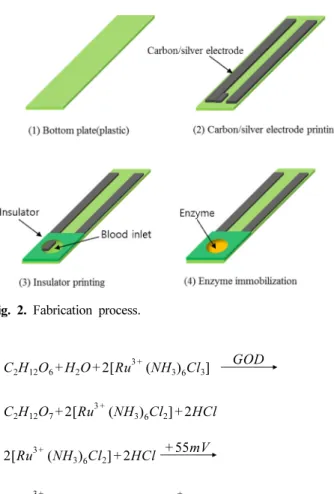
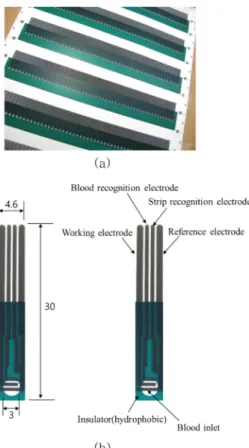
In this paper, we have fabricated a glucose sensor with a single- layer structure. At present, this device is fabricated using three- layer plastic film and electrochemical methods, so the cost of the glucose sensor is reduced [2-5]. The currently used glucose sensor has a three-layer structure comprised of upper, middle, and bottom plates, but the single-layer glucose sensor suggested in this paper is fabricated using a 3-step printing process (silver/carbon/
insulator) only, using screen printing technology [6] on plastic [7]
or paper film [8]. Thus, the device price can be decreased significantly by simplifying the sensor structure and fabrication process. For the existing three-layer glucose sensor, the upper, middle, and bottom plates are each fabricated individually and film is then bonded on each layer through double lamination [7].
However, in the case of the single-layer glucose sensor, the equipment is simple and the material cost is reduced, because only 2- or 3-step screen printing is required. So, we estimate that the price of the sensor can be decreased significantly.
1
Department of Electronic Engineering Education, College of Education, Andong National University
1375 Gyeongdong-ro, Andong, Gyeongsangbuk-do 760-749, Korea
2
Center for Integrated Smart Sensors
309 ITC Building(N1), Kaist, 290 Daehak-ro, Yuseong-gu, Daejeon 305-701, Korea
+